brake Citroen JUMPY 2010 2.G User Guide
[x] Cancel search | Manufacturer: CITROEN, Model Year: 2010, Model line: JUMPY, Model: Citroen JUMPY 2010 2.GPages: 225, PDF Size: 10.84 MB
Page 103 of 225
97
Under the bonnet
CHECKS
6
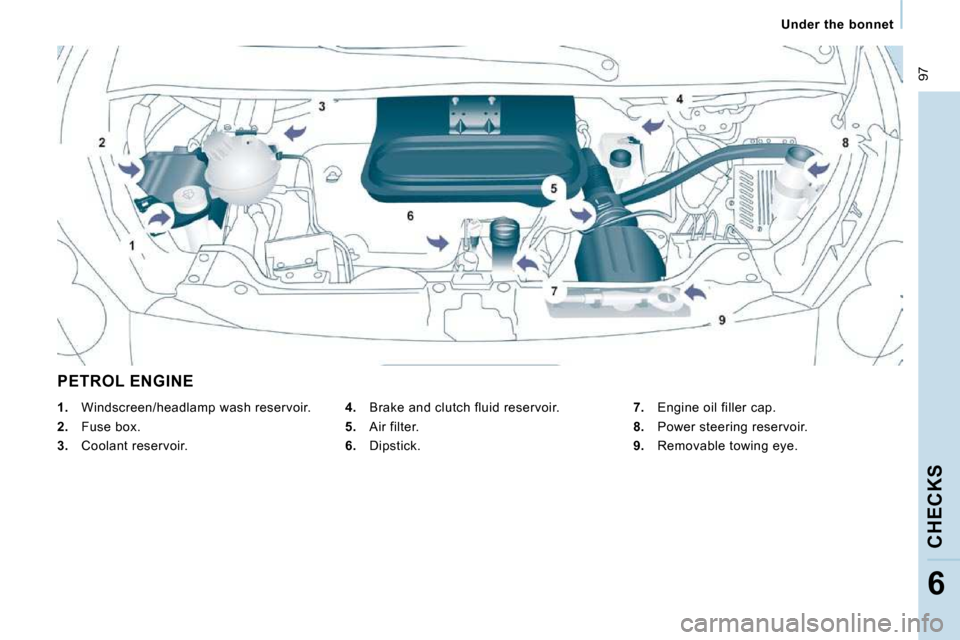
PETROL ENGINE
4. Brake and clutch fluid reservoir.
5. Air filter.
6. Dipstick.
7. Engine oil filler cap.
8. Power steering reservoir.
9. Removable towing eye.
1. Windscreen/headlamp wash reservoir.
2. Fuse box.
3. Coolant reservoir.
Page 104 of 225
98
Levels
LEVELS
the use of additives in engine oil is
prohibited. Changing the brake fluid
The brake fluid must be changed at
the intervals stated, according to the
manufacturer's servicing schedule.
Use fluids recommended by the
manufacturer, which fulfil DOT4 standards.
The level must be between the MIN and
MAX marks on the reservoir.
If fluid has to be added frequently, this
indicates a failure which must be checked by
a CITROËN dealer as soon as possible.
Warning lights
These regular maintenance operations
will keep your vehicle in good running
order. Consult the instructions at CITROËN
dealerships or in the servicing booklet
enclosed in the handbook pack.
If you have to remove/refit the engine
style cover, handle it with care to avoid
damaging the fixing clips.
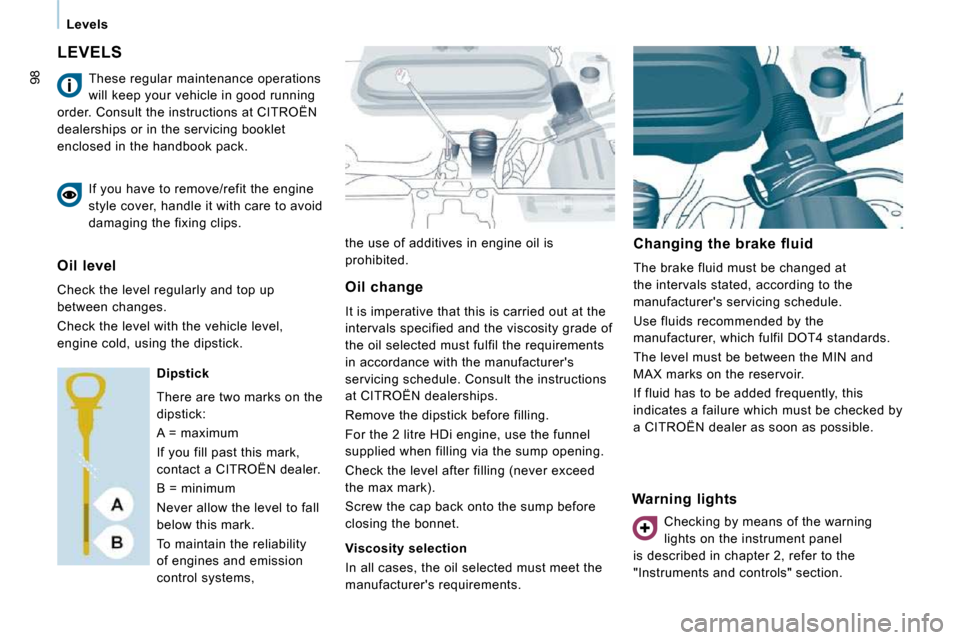
Oil level
Check the level regularly and top up
between changes.
Check the level with the vehicle level,
engine cold, using the dipstick. Dipstick
There are two marks on the
dipstick:
A = maximum
If you fill past this mark,
contact a CITROËN dealer.
B = minimum
Never allow the level to fall
below this mark.
To maintain the reliability
of engines and emission
control systems, Oil change
It is imperative that this is carried out at the
intervals specified and the viscosity grade of
the oil selected must fulfil the requirements
in accordance with the manufacturer's
servicing schedule. Consult the instructions
at CITROËN dealerships.
Remove the dipstick before filling.
For the 2 litre HDi engine, use the funnel
supplied when filling via the sump opening.
Check the level after filling (never exceed
the max mark).
Screw the cap back onto the sump before
closing the bonnet.
Viscosity selection
In all cases, the oil selected must meet the
manufacturer's requirements.
Checking by means of the warning
lights on the instrument panel
is described in chapter 2, refer to the
"Instruments and controls" section.
Page 106 of 225
100
Checks
CHECKS
Battery
At the start of winter, have your battery
checked by a CITROËN dealer.
Brake pads
Brake pad wear depends on the style of
driving, in particular for vehicles which are
used in town, over short distances. It may
be necessary to check the thickness of the
pads, even between services.
Unless there is a leak on the circuit, a drop
in the brake fluid level indicates that the
brake pads are worn.
Brake disc/drum wear status
For any information relating to checking
the brake disc/drum wear status, contact a
CITROËN dealer.
Handbrake
Where the handbrake travel is too great
or there is a reduction in the performance
of the system, the handbrake should be
adjusted, even between services.
Have the system checked by a
CITROËN dealer. Oil filter
Change the filter regularly, in accordance
with the servicing schedule.
Carbon filter and passenger
compartment filter
The carbon filter permits continuous and
effective filtering of dust.
If the passenger compartment filter becomes
clogged, this may reduce the performance
of the air conditioning system and generate
unpleasant odours.
We recommend the use of a combined
passenger compartment fi lter. By means of
its second special active fi lter, it contributes
to the purifi cation of the air breathed by the
occupants and the cleanness of the passenger
compartment (reduction of allergic symptoms,
unpleasant odours and greasy deposits).
Refer to the servicing booklet to find out the
replacement interval for these components.
Depending on the environment (dusty
atmosphere...) and the use of the vehicle
(urban driving...), change them twice as
often if necessary.
Particle emission filter (Diesel)
It is imperative that particle
emission filter maintenance is
carried out by a CITROËN dealer.
On acceleration after the vehicle
has been running for a prolonged period
at very low speed or at idle, you may, in
exceptional circumstances, notice the
emission of water vapour at the exhaust.
This water vapour does not have any
adverse effect on vehicle handling or the
environment.
Refer to the "Under the bonnet" section
of chapter 6.
Page 114 of 225
108
Changing a wheel
CHANGING A WHEEL
If your vehicle is equipped with a spare
wheel located underneath the vehicle, follow
these instructions. 1. PARKING THE VEHICLE
- It is imperative that you ensure that the
occupants get out of the vehicle and
wait in a safe location.
- If possible, park the vehicle on level, stable and non-slippery ground.
- Apply the handbrake, switch off the ignition and engage first or reverse gear.
- If available, place a chock under the wheel diagonally opposite the one to be
changed.
On certain types of ground and/or if
considerable loads are being transported,
the vehicle must be raised in order to
disengage the spare wheel from the carrier.
Call a CITROËN dealer. If your vehicle is fitted with suspension
with pneumatic compensation, please
deactivate the system. Refer to the "Rear
suspension" section of chapter 3. 2. TOOLS
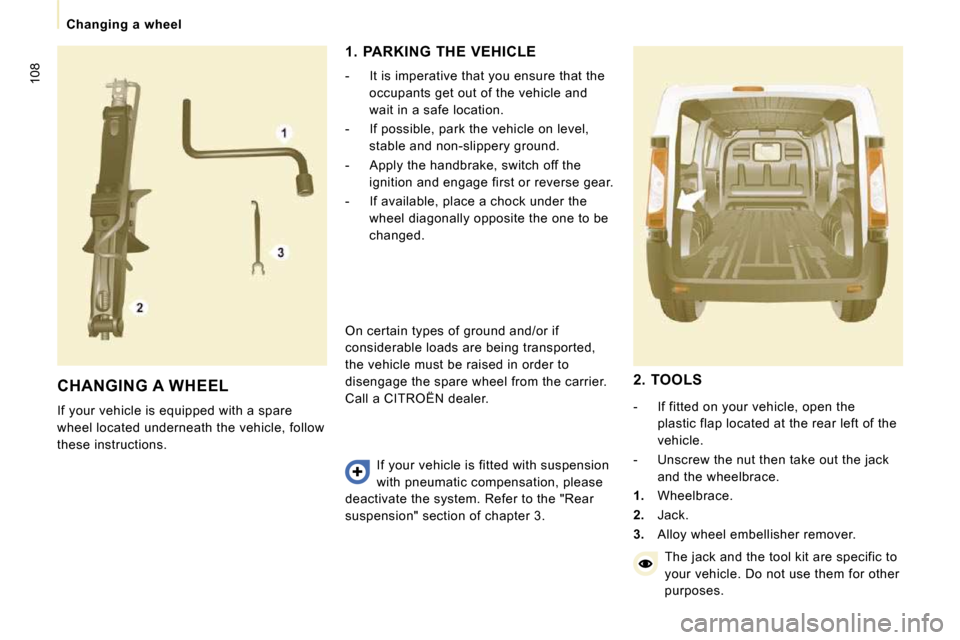
- If fitted on your vehicle, open the
plastic flap located at the rear left of the
vehicle.
- Unscrew the nut then take out the jack and the wheelbrace.
1. Wheelbrace.
2. Jack.
3. Alloy wheel embellisher remover.
The jack and the tool kit are specific to
your vehicle. Do not use them for other
purposes.
Page 123 of 225
116
Changing a bulb
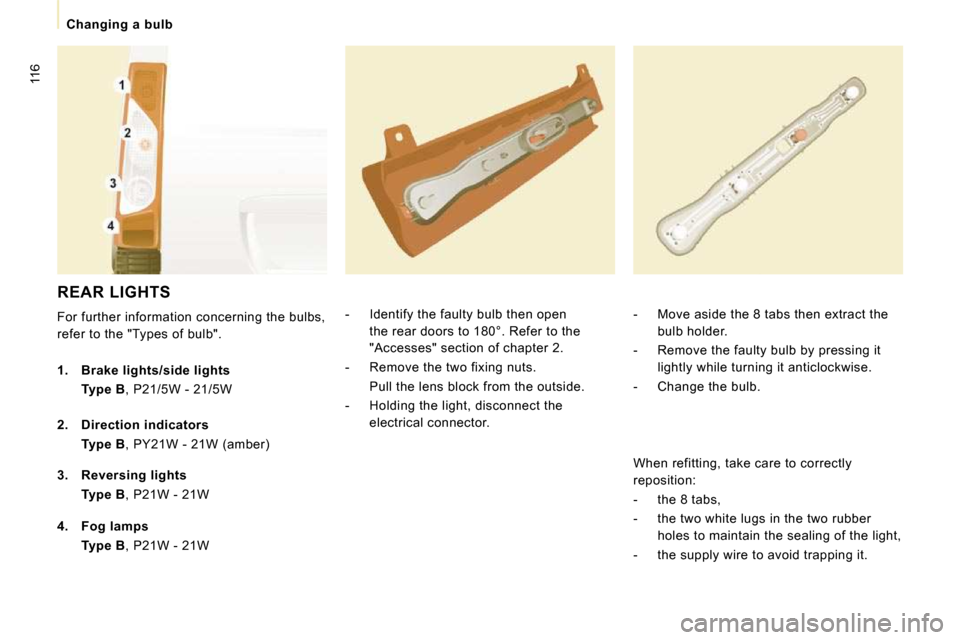
REAR LIGHTS
For further information concerning the bulbs,
refer to the "Types of bulb". - Identify the faulty bulb then open
the rear doors to 180°. Refer to the
"Accesses" section of chapter 2.
- Remove the two fixing nuts.
Pull the lens block from the outside.
- Holding the light, disconnect the electrical connector. - Move aside the 8 tabs then extract the
bulb holder.
- Remove the faulty bulb by pressing it lightly while turning it anticlockwise.
- Change the bulb.
1. Brake lights/side lights
Type B , P21/5W - 21/5W
2. Direction indicators
Type B , PY21W - 21W (amber)
3. Reversing lights
Type B , P21W - 21W
4. Fog lamps
Type B , P21W - 21W When refitting, take care to correctly
reposition:
- the 8 tabs,
- the two white lugs in the two rubber
holes to maintain the sealing of the light,
- the supply wire to avoid trapping it.
Page 124 of 225
117
Changing a bulb
QUICK HELP
7
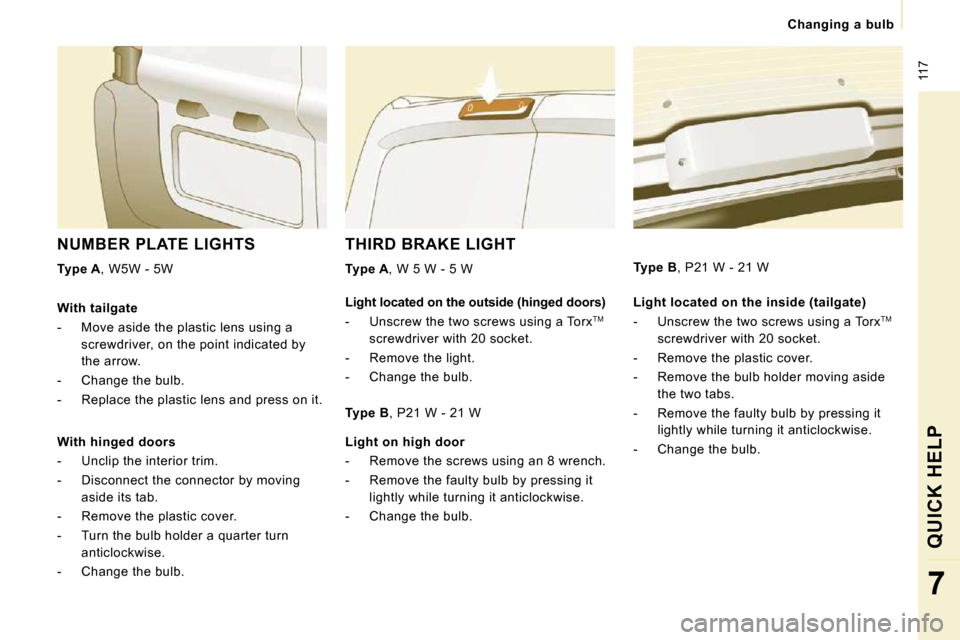
THIRD BRAKE LIGHT
Type A , W 5 W - 5 W
NUMBER PLATE LIGHTS
Type A , W5W - 5W
Light located on the inside (tailgate)
- Unscrew the two screws using a Torx TM
screwdriver with 20 socket.
- Remove the plastic cover.
- Remove the bulb holder moving aside the two tabs.
- Remove the faulty bulb by pressing it lightly while turning it anticlockwise.
- Change the bulb.
Type B , P21 W - 21 W
With tailgate
- Move aside the plastic lens using a
screwdriver, on the point indicated by
the arrow.
- Change the bulb.
- Replace the plastic lens and press on it.
With hinged doors
- Unclip the interior trim.
- Disconnect the connector by moving aside its tab.
- Remove the plastic cover.
- Turn the bulb holder a quarter turn anticlockwise.
- Change the bulb. Light located on the outside (hinged doors)
- Unscrew the two screws using a Torx
TM
screwdriver with 20 socket.
- Remove the light.
- Change the bulb.
Type B , P21 W - 21 W
Light on high door
- Remove the screws using an 8 wrench.
- Remove the faulty bulb by pressing it lightly while turning it anticlockwise.
- Change the bulb.
Page 128 of 225
121
Changing a fuse
QUICK HELP
7
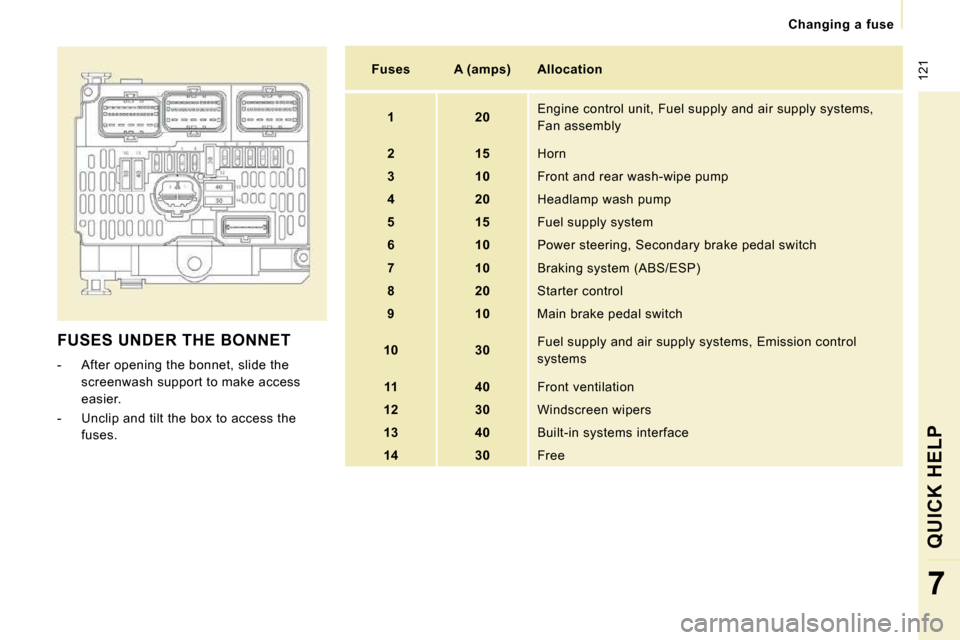
FUSES UNDER THE BONNET
- After opening the bonnet, slide the screenwash support to make access
easier.
- Unclip and tilt the box to access the fuses.
Fuses A (amps) Allocation
1 20 Engine control unit, Fuel supply and air supply sy
stems,
Fan assembly
2 15 Horn
3 10 Front and rear wash-wipe pump
4 20 Headlamp wash pump
5 15 Fuel supply system
6 10 Power steering, Secondary brake pedal switch
7 10 Braking system (ABS/ESP)
8 20 Starter control
9 10 Main brake pedal switch
10 30 Fuel supply and air supply systems, Emission contr
ol
systems
11 40 Front ventilation
12 30 Windscreen wipers
13 40 Built-in systems interface
14 30 Free
Page 138 of 225

Weights
WEIGHTS AND TOWED LOADS (KG)
For further information, refer to your registration certificate.
In each country, it is imperative that the towed l oads permitted by local legislation are complied wi th. To find out your vehicle's towing
capabilities and its gross train weight, contact a CITROËN dealer.
Load transfer
If the towing vehicle has not reached the GVW, it is possible to transfer this weight to the trailer.
In all cases, do not exceed the weight of the trai ler and the GTW, indicated on your registration cer tificate.
Comply with the towing capacities of your vehicle.
Engine Body type
Number of
seats
Kerb weight
Maximum
weight (1)
Maximum
payload
Payload
without driver
Braked towed
weight (2)
1.6 HDi 90 Short (L1-H1)
227 2 1 661 2 661 1 000 925 1 672
3 1 673 2 661 988 913 1 672
Short (L1-H1) 229 2 1 661 2 861 1 200 1 125 1 472
3 1 673 2 861 1 188 1 113 1 472
Long (L2-H1) 229 2 1 680 2 880 1 200 1 125 1 453
3 1 692 2 880 1 188 1 113 1 453
Raised
(L2-H2) 229 2 1 700 2 900 1 200 1 125 1 433
3 1 712 2 900 1 188 1 113 1 433
Page 139 of 225

133
Weights
TECHNICAL DATA
8
(1) Gross vehicle weight (GVW).
(2) Braked towed weight with load transfer: this can be increased on condition that the equivalent o f this load is removed from the vehicle so
that the GTW is not exceeded.
High exterior temperatures may result in a reducti on in the performance of the vehicle to protect the engine. When the exterior temperature
is higher than 37 °C, limit the towed weight to 700 kg, without load transfer.
The speed of a towing vehicle must not exceed 60 m ph (100 km/h) (comply with the legislation in force in your country).
Engine Body type
Number of
seats
Kerb weight
Maximum
weight (1)
Maximum
payload
Payload
without driver
Braked towed
weight (2)
2.0 HDi 120 and
2.0 HDi 120 PEF Short (L1-H1)
227 2 1 702 2 702 1 000 925 2 000
3 1 714 2 702 988 913 2 000
Short (L1-H1) 229 2 1 702 2 902 1 200 1 125 1 998
3 1 714 2 902 1 188 1 113 1 998
Long (L2-H1) 229 2 1 732 2 932 1 200 1 125 1 968
3 1 744 2 932 1 188 1 113 1 968
Raised
(L2-H2)
229 2 1 763 2 963 1 200 1 125 1 937
3 1 775 2 963 1 188 1 113 1 937
Page 140 of 225

134
Weights
(1) Gross vehicle weight (GVW).
(2) Braked towed weight with load transfer: this can be increased on condition that the equivalent o f this load is removed from the vehicle so
that the GTW is not exceeded.
High exterior temperatures may result in a reducti on in the performance of the vehicle to protect the engine. When the exterior temperature
is higher than 37 °C, limit the towed weight to 700 kg, without load transfer.
The speed of a towing vehicle must not exceed 60 m ph (100 km/h) (comply with the legislation in force in your country).
Engine Body type
Number of
seats
Kerb weight
Maximum
weight (1)
Maximum
payload
Payload
without driver
Braked towed
weight (2)
2.0 HDi 136 PEF Short (L1-H1)
227 2 1 717 2 717 1 000 925 2 000
3 1 729 2 717 988 913 2 000
Short (L1-H1) 229 2 1 717 2 917 1 200 1 125 2 000
3 1 729 2 917 1 188 1 113 2 000
Long (L2-H1) 229 2 1 746 2 946 1 200 1 125 2 000
3 1 758 2 946 1 188 1 113 2 000
2.0 PETROL 140 Short (L1-H1)
227 2 1 661 2 661 1 000 925 1 389
3 1 673 2 661 988 913 1 389
Short (L1-H1) 229 2 1 661 2 861 1 200 1 125 1 189
3 1 673 2 861 1 188 1 113 1 189
Long (L2-H1) 229 2 1 680 2 880 1 200 1 125 1 170
3 1 692 2 880 1 188 1 113 1 170
Raised
(L2-H2)
229 2 1 700 2 900 1 200 1 125 1 150
3 1 712 2 900 1 188 1 113 1 150