lock Citroen JUMPY 2016 2.G Workshop Manual
[x] Cancel search | Manufacturer: CITROEN, Model Year: 2016, Model line: JUMPY, Model: Citroen JUMPY 2016 2.GPages: 595, PDF Size: 12.47 MB
Page 95 of 595

93
Jumpy _en_Chap02_ouvertures_ed01-2016
If the child lock is on (activated), the
handle is inoperative.
For more information on the Child lock,
refer to the corresponding section.
From inside
Opening
Cab and loading area selectivity
deactivated and the vehicle
locked. Cab
and loading area selectivity
activated and the vehicle locked.
Door or vehicle unlocked.
F
T
wist this handle down to totally unlock the
vehicle and open the right-hand door. F
T
wist this handle down to unlock the
loading area and open the right-hand
d o o r.
F
T
wist this handle down to open the right-
hand door.
Closing
F First close the right-hand door, then the left-hand door.
Vehicle locked and child lock off (deactivated).
F
T
wist this handle down to totally
unlock the
vehicle and open the right-hand door.
Vehicle locked.
F
T
wist this handle down to totally
unlock the
vehicle and open the right-hand door
Vehicle unlocked.
F
T
wist this handle down to open the right-
hand door. Vehicle unlocked and child lock off
(deactivated).
F
T
wist this handle down to open the right-
hand door.
2
Access
Page 96 of 595
94
Jumpy _en_Chap02_ouvertures_ed01-2016
For more information on the Key,
Remote control or Keyless Entr y and
Starting and in particular unlocking
the vehicle, refer to the corresponding
section. For more information on the Key,
Remote control or Keyless Entr y and
Starting and in particular on locking
the vehicle, refer to the corresponding
section.
Tailgate
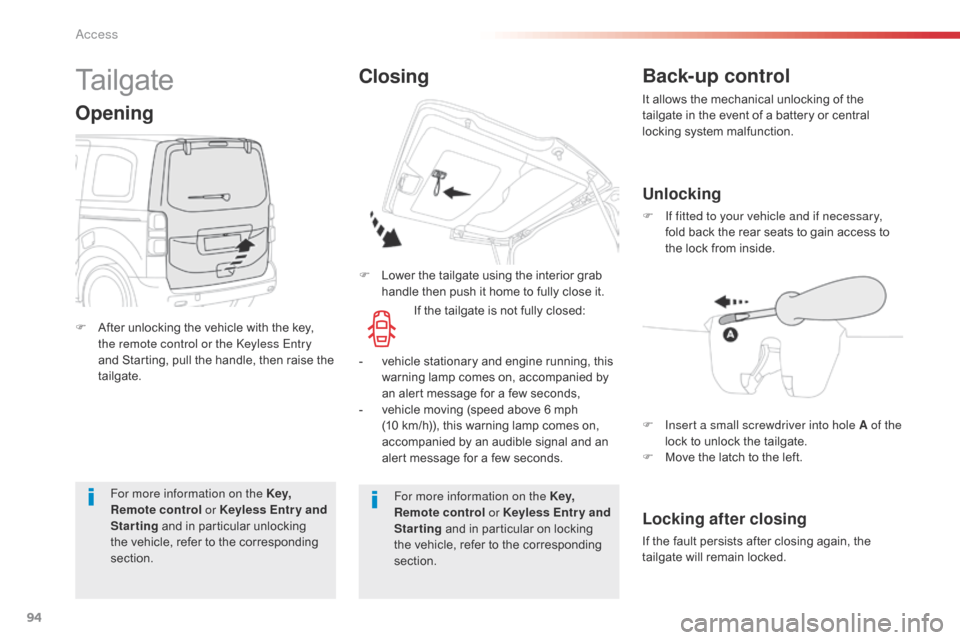
F After unlocking the vehicle with the key, the remote control or the Keyless Entry
and Starting, pull the handle, then raise the
tailgate.
Opening
F Lower the tailgate using the interior grab handle then push it home to fully close it.
Closing Back-up control
It allows the mechanical unlocking of the
tailgate in the event of a battery or central
locking system malfunction.
Unlocking
F If fitted to your vehicle and if necessary,
fold back the rear seats to gain access to
the lock from inside.
Locking after closing
If the fault persists after closing again, the
tailgate will remain locked.
If the tailgate is not fully closed:
-
v
ehicle stationary and engine running, this
warning lamp comes on, accompanied by
an alert message for a few seconds,
-
v
ehicle moving (speed above 6 mph
(10
km/h)), this warning lamp comes on,
accompanied by an audible signal and an
alert message for a few seconds. F
I
nsert a small screwdriver into hole A of the
lock to unlock the tailgate.
F
M
ove the latch to the left.
Access
Page 97 of 595
95
Jumpy _en_Chap02_ouvertures_ed01-2016
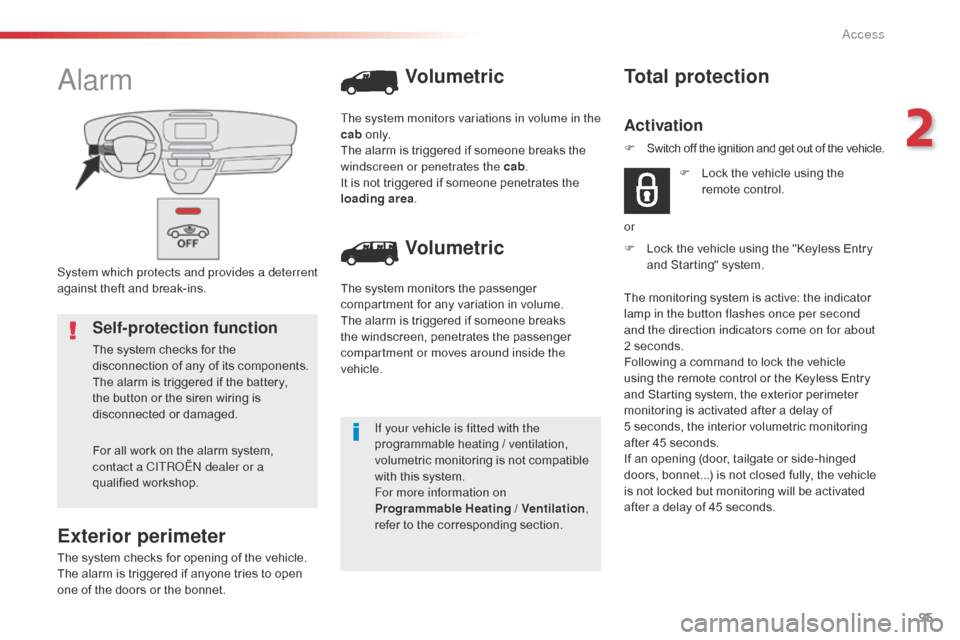
System which protects and provides a deterrent
against theft and break-ins.
Alarm
Exterior perimeter
The system checks for opening of the vehicle.
The alarm is triggered if anyone tries to open
one of the doors or the bonnet.
Self-protection function
The system checks for the
disconnection of any of its components.
The alarm is triggered if the battery,
the button or the siren wiring is
disconnected or damaged.For all work on the alarm system,
contact a CITROËN dealer or a
qualified workshop.
VolumetricVolumetric
The system monitors the passenger
compartment for any variation in volume.
The alarm is triggered if someone breaks
the windscreen, penetrates the passenger
compartment or moves around inside the
vehicle. The system monitors variations in volume in the
cab
o n l y.
The alarm is triggered if someone breaks the
windscreen or penetrates the cab .
It is not triggered if someone penetrates the
loading area .
If your vehicle is fitted with the
programmable heating / ventilation,
volumetric monitoring is not compatible
with this system.
For more information on
Programmable Heating / Ventilation ,
refer to the corresponding section. F
L
ock the vehicle using the "Keyless Entry
and Starting" system.
Total protection
Activation
F Lock the vehicle using the remote control.
or
The monitoring system is active: the indicator
lamp in the button flashes once per second
and the direction indicators come on for about
2 seconds.
Following a command to lock the vehicle
using the remote control or the Keyless Entry
and Starting system, the exterior perimeter
monitoring is activated after a delay of
5
seconds, the interior volumetric monitoring
after 45 seconds.
If an opening (door, tailgate or side-hinged
doors, bonnet...) is not closed fully, the vehicle
is not locked but monitoring will be activated
after a delay of 45 seconds. F
Switch off the ignition and get out of the vehicle.
2
Access
Page 98 of 595
96
Jumpy _en_Chap02_ouvertures_ed01-2016
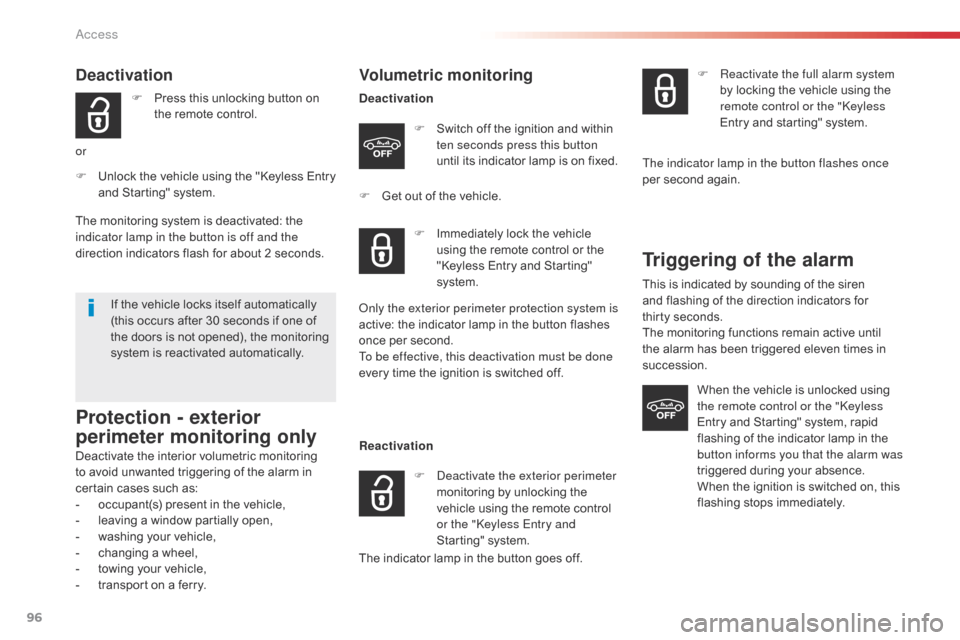
Deactivation
F Press this unlocking button on the remote control.
or
F
U
nlock the vehicle using the "Keyless Entry
and Starting" system.
If the vehicle locks itself automatically
(this occurs after 30 seconds if one of
the doors is not opened), the monitoring
system is reactivated automatically.
The monitoring system is deactivated: the
indicator lamp in the button is off and the
direction indicators flash for about 2 seconds.
Protection - exterior
perimeter monitoring only
Deactivate the interior volumetric monitoring
to avoid unwanted triggering of the alarm in
certain cases such as:
-
o
ccupant(s) present in the vehicle,
-
l
eaving a window partially open,
-
w
ashing your vehicle,
-
c
hanging a wheel,
-
t
owing your vehicle,
-
t
ransport on a ferry.
Volumetric monitoring
Deactivation F
S
witch off the ignition and within
ten seconds press this button
until its indicator lamp is on fixed.
F
G
et out of the vehicle.
Reactivation
The indicator lamp in the button goes off. F
I
mmediately lock the vehicle
using the remote control or the
"Keyless Entry and Starting"
system.
Only the exterior perimeter protection system is
active: the indicator lamp in the button flashes
once per second.
To be effective, this deactivation must be done
every time the ignition is switched off.
F
D
eactivate the exterior perimeter
monitoring by unlocking the
vehicle using the remote control
or the "Keyless Entry and
Starting" system. F
R
eactivate the full alarm system
by locking the vehicle using the
remote control or the "Keyless
Entry and starting" system.
The indicator lamp in the button flashes once
per second again.
Triggering of the alarm
This is indicated by sounding of the siren
and flashing of the direction indicators for
thirty seconds.
The monitoring functions remain active until
the alarm has been triggered eleven times in
succession.
When the vehicle is unlocked using
the remote control or the "Keyless
Entry and Starting" system, rapid
flashing of the indicator lamp in the
button informs you that the alarm was
triggered during your absence.
When the ignition is switched on, this
flashing stops immediately.
Access
Page 99 of 595
97
Jumpy _en_Chap02_ouvertures_ed01-2016
Failure of the remote control
To deactivate the monitoring functions:
F U nlock the vehicle using the key (integral
with the remote control with Keyless Entry
and Starting) in the driver's door lock.
F
O
pen the door; the alarm is triggered.
F
S
witch on the ignition; the alarm stops. The
indicator lamp in the button goes off.
Locking the vehicle without
activating the alarm
F Lock or deadlock the vehicle using the key (integral with the remote control with
Keyless Entry and Starting) in the driver's
door lock.
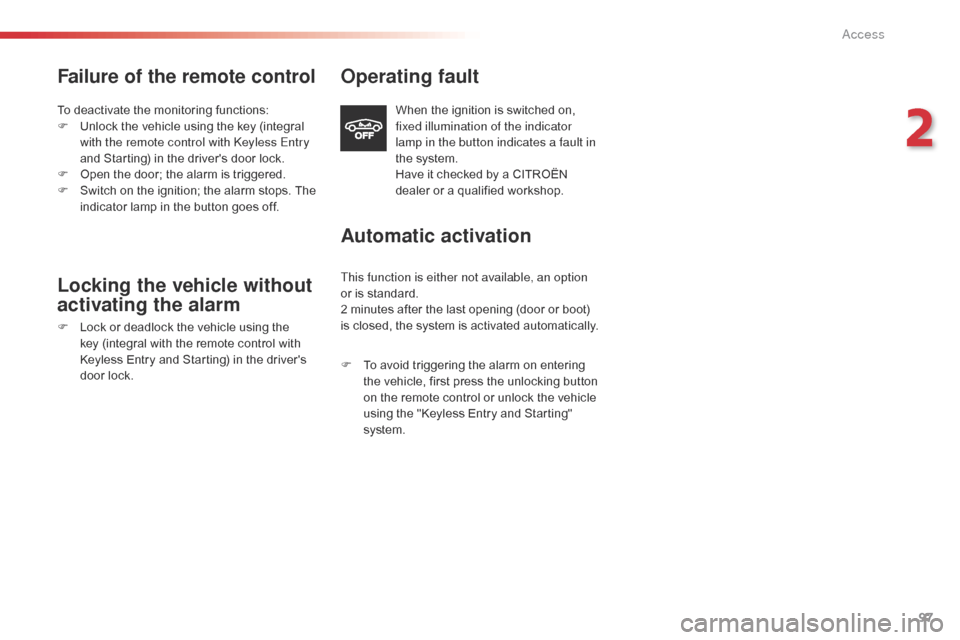
Operating fault
When the ignition is switched on,
fixed illumination of the indicator
lamp in the button indicates a fault in
the system.
Have it checked by a CITROËN
dealer or a qualified workshop.
Automatic activation
This function is either not available, an option
or is standard.
2 minutes after the last opening (door or boot)
is closed, the system is activated automatically.
F
T
o avoid triggering the alarm on entering
the vehicle, first press the unlocking button
on the remote control or unlock the vehicle
using the "Keyless Entry and Starting"
system.
2
Access
Page 101 of 595
99
Jumpy _en_Chap03_ergonomie-et-confort_ed01-2016
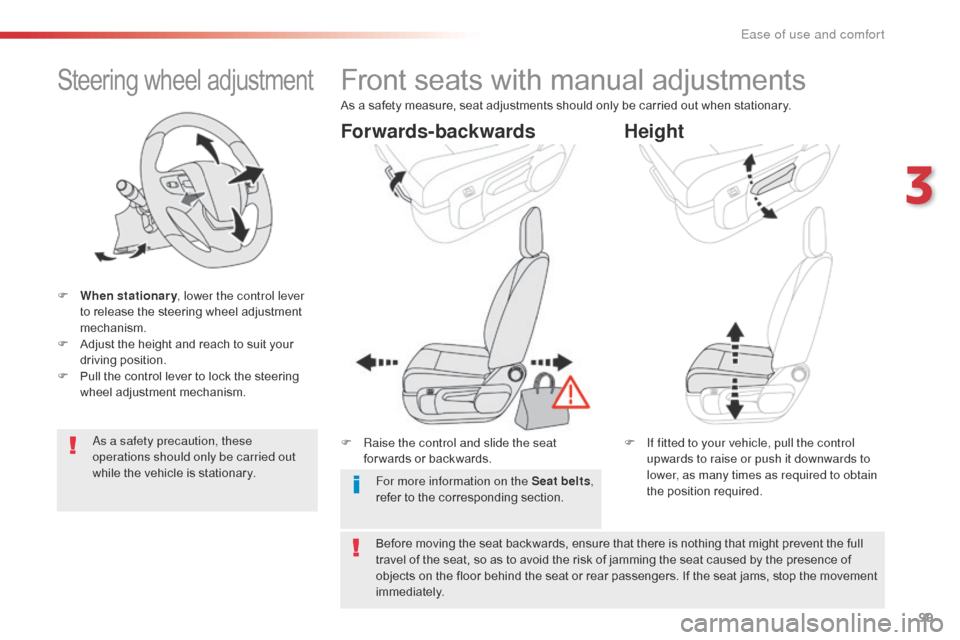
Steering wheel adjustment
F When stationary, lower the control lever
to release the steering wheel adjustment
mechanism.
F
A
djust the height and reach to suit your
driving position.
F
P
ull the control lever to lock the steering
wheel adjustment mechanism.
As a safety precaution, these
operations should only be carried out
while the vehicle is stationary.
Front seats with manual adjustments
F Raise the control and slide the seat for wards or backwards. F
I f fitted to your vehicle, pull the control
upwards to raise or push it downwards to
lower, as many times as required to obtain
the position required.
Forwards-backwards Height
As a safety measure, seat adjustments should only be carried out when stationary.
Before moving the seat backwards, ensure that there is nothing that might prevent the full
travel of the seat, so as to avoid the risk of jamming the seat caused by the presence of
objects on the floor behind the seat or rear passengers. If the seat jams, stop the movement
immediately. For more information on the Seat belts ,
refer to the corresponding section.
3
Ease of use and comfort
Page 110 of 595
108
Jumpy _en_Chap03_ergonomie-et-confort_ed01-2016
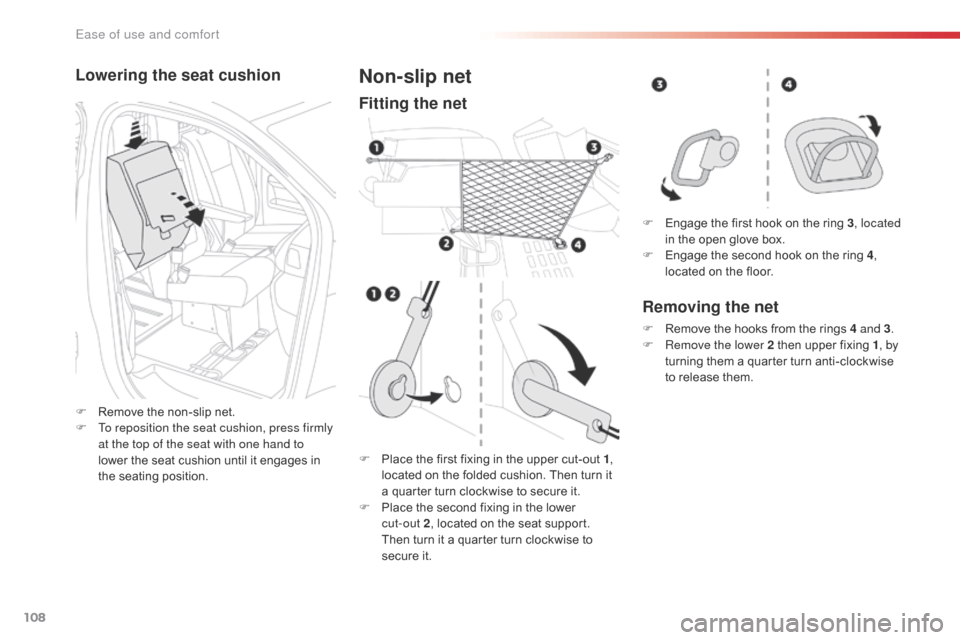
Lowering the seat cushion
F Remove the non-slip net.
F T o reposition the seat cushion, press firmly
at the top of the seat with one hand to
lower the seat cushion until it engages in
the seating position.
Non-slip net
Fitting the net
F Place the first fixing in the upper cut-out 1 ,
located on the folded cushion. Then turn it
a quarter turn clockwise to secure it.
F
P
lace the second fixing in the lower
cut-out
2, located on the seat support.
Then turn it a quarter turn clockwise to
secure it. F
E
ngage the first hook on the ring 3
, located
in the open glove box.
F
E
ngage the second hook on the ring 4
,
located on the floor.
Removing the net
F Remove the hooks from the rings 4 and 3 .
F R emove the lower 2 then upper fixing 1 , by
turning them a quarter turn anti-clockwise
to release them.
Ease of use and comfort
Page 113 of 595
111
Jumpy _en_Chap03_ergonomie-et-confort_ed01-2016
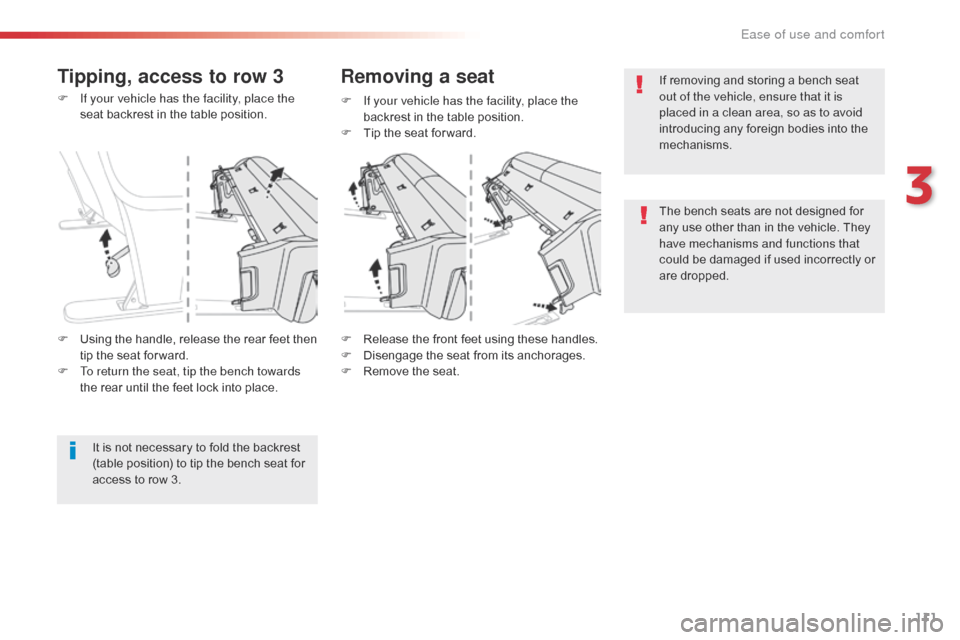
F If your vehicle has the facility, place the seat backrest in the table position.
F
R
elease the front feet using these handles.
F
D
isengage the seat from its anchorages.
F
R
emove the seat.
F
I f your vehicle has the facility, place the
backrest in the table position.
F
T
ip the seat for ward.
Tipping, access to row 3 Removing a seat
It is not necessary to fold the backrest
(table position) to tip the bench seat for
access to row 3.
F
U
sing the handle, release the rear feet then
tip the seat for ward.
F
T
o return the seat, tip the bench towards
the rear until the feet lock into place. If removing and storing a bench seat
out of the vehicle, ensure that it is
placed in a clean area, so as to avoid
introducing any foreign bodies into the
mechanisms.
The bench seats are not designed for
any use other than in the vehicle. They
have mechanisms and functions that
could be damaged if used incorrectly or
are dropped.
3
Ease of use and comfort
Page 114 of 595

112
Jumpy _en_Chap03_ergonomie-et-confort_ed01-2016
F If your vehicle has the facility, pull the control and raise the backrest (from the
rear, lower the lever).
Check that the seat has correctly
engaged in its anchorages on the floor
when returned to the seating position. Ensure that no object, or the feet of a
passenger seated at the rear, could
obstruct the anchorage points or prevent
the correct latching of the assembly.
F
C
heck that there is nothing obstructing the
anchorages or which would prevent the
correct engagement of the feet.
Refitting a seat
F Lock the front feet using the handles.
F T ip the seat toward the rear until the rear
feet lock into place.
Be aware of the feet of any passengers
while tipping the seat.
F
E
ngage the front feet in the anchorages in
the floor (as shown above).
Ease of use and comfort
Page 117 of 595
115
Jumpy _en_Chap03_ergonomie-et-confort_ed01-2016
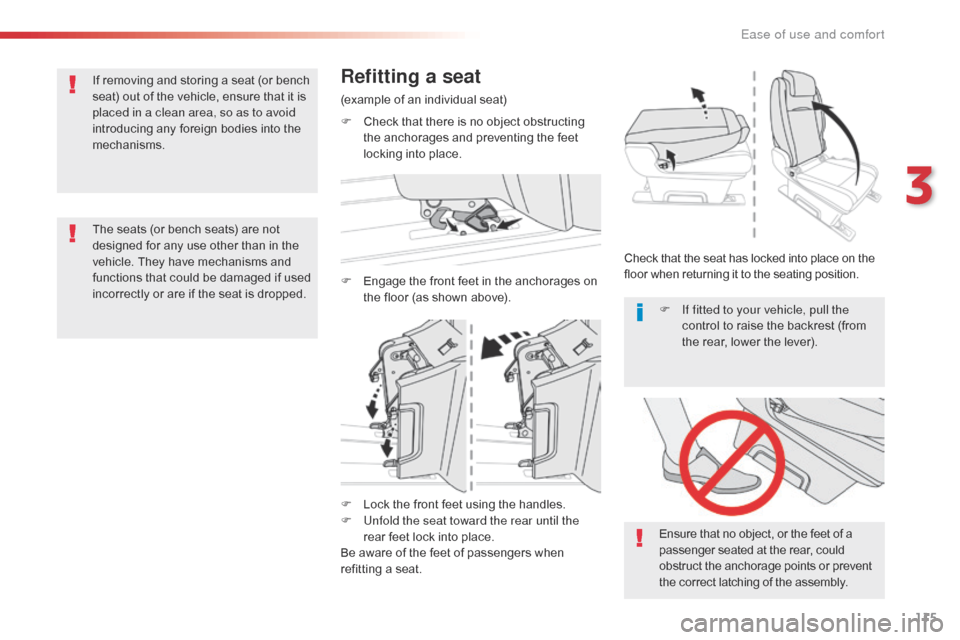
F Lock the front feet using the handles.
F U nfold the seat toward the rear until the
rear feet lock into place.
Be aware of the feet of passengers when
refitting a seat. Ensure that no object, or the feet of a
passenger seated at the rear, could
obstruct the anchorage points or prevent
the correct latching of the assembly. F
I
f fitted to your vehicle, pull the
control to raise the backrest (from
the rear, lower the lever).
The seats (or bench seats) are not
designed for any use other than in the
vehicle. They have mechanisms and
functions that could be damaged if used
incorrectly or are if the seat is dropped. If removing and storing a seat (or bench
seat) out of the vehicle, ensure that it is
placed in a clean area, so as to avoid
introducing any foreign bodies into the
mechanisms.
Refitting a seat
(example of an individual seat)
F
C
heck that there is no object obstructing
the anchorages and preventing the feet
locking into place.
F
E
ngage the front feet in the anchorages on
the floor (as shown above). Check that the seat has locked into place on the
floor when returning it to the seating position.
3
Ease of use and comfort