seats Citroen JUMPY RHD 2012 2.G Owner's Manual
[x] Cancel search | Manufacturer: CITROEN, Model Year: 2012, Model line: JUMPY RHD, Model: Citroen JUMPY RHD 2012 2.GPages: 270, PDF Size: 9.6 MB
Page 4 of 270
2
Contents
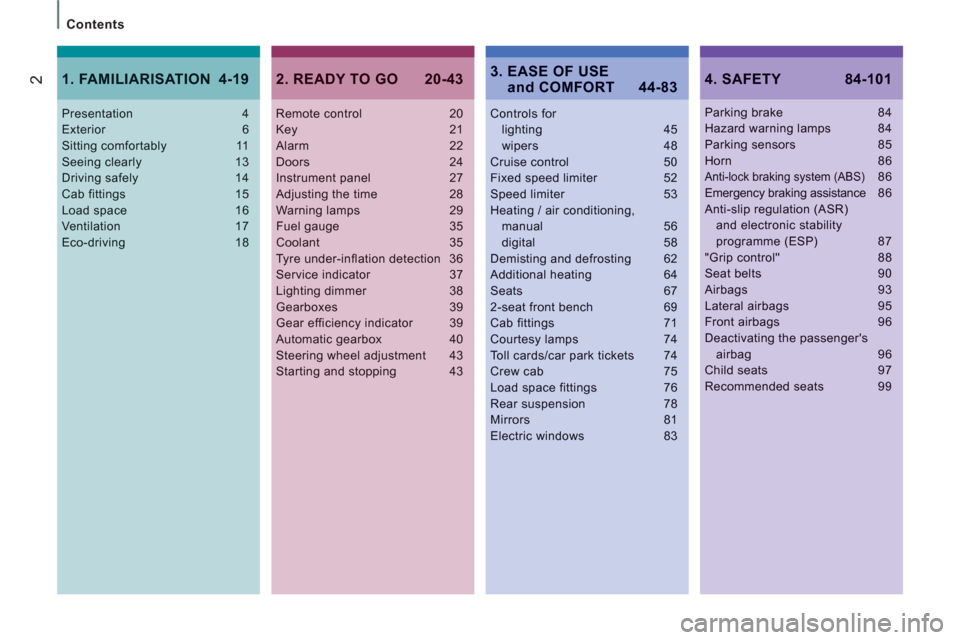
Remote control 20Key 21Alarm 22Doors 24Instrument panel 27Adjusting the time 28Warning lamps 29Fuel gauge 35Coolant 35Tyre under-inflation detection 36Service indicator 37Lighting dimmer 38Gearboxes 39Gear efficiency indicator 39Automatic gearbox 40Steering wheel adjustment 43Starting and stopping 43
Controls forlighting 45wipers 48Cruise control 50Fixed speed limiter 52Speed limiter 53Heating / air conditioning,manual 56digital 58Demisting and defrosting 62Additional heating 64Seats 672-seat front bench 69Cab fittings 71Courtesy lamps 74Toll cards/car park tickets 74Crew cab 75Load space fittings 76Rear suspension 78Mirrors 81
Electric windows 83
2. READY TO GO 20-434. SAFETY 84-101
Presentation 4Exterior 6Sitting comfortably 11Seeing clearly 13Driving safely 14Cab fittings 15Load space 16Ventilation 17Eco-driving 18
1. FAMILIARISATION 4-19
Parking brake 84Hazard warning lamps 84Parking sensors 85Horn 86Anti-lock braking system (ABS)86Emergency braking assistance 86Anti-slip regulation (ASR) and electronic stability programme (ESP) 87"Grip control" 88Seat belts 90Airbags 93Lateral airbags 95Front airbags 96Deactivating the passenger'sairbag 96Child seats 97Recommended seats 99
3. EASE OF USE and COMFORT 44-83
Page 21 of 270
19
Interior
FAMILIARISATIO
N
1
Limit the causes of
excess consumption
Spread loads throughout the vehicle;
place the heaviest items in the bottom of
the boot, as close as possible to the rear
seats.
Limit the loads carried in the vehicle and
reduce wind resistance (roof bars, roof
rack, bicycle carrier, trailer...). Use a roof
box in preference.
Remove roof bars and roof racks after
use.
At the end of winter, remove snow tyres
and refit your summer tyres.
Observe the recommendations
on maintenance
Check the tyre pressures regularly, when
cold, referring to the label in the door
aperture, driver's side.
Carry out this check in particular:
- before a long journey,
- at each change of season,
- after a long period out of use.
Don't forget the spare wheel and the tyres
on any trailer or caravan.
Have your vehicle serviced regularly
(engine oil, oil filter, air filter...) and observe
the schedule of operations recommended
by the manufacturer.
When refuelling, do not continue after
the 3 rd cut-off of the nozzle to avoid any
overflow.
At the wheel of your new vehicle,
it is only after the first 1 800 miles
(3 000 kilometres) that you will see
the fuel consumption settle down to a
consistent average.
Page 28 of 270
26
Access
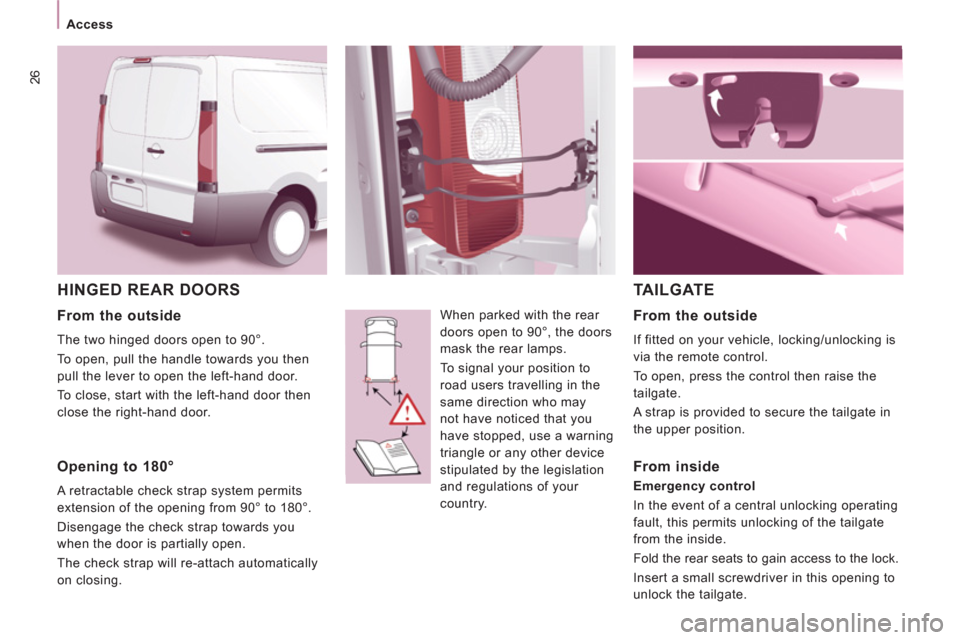
HINGED REAR DOORS
When parked with the rear
doors open to 90°, the doors
mask the rear lamps.
To signal your position to
road users travelling in the
same direction who may
not have noticed that you
have stopped, use a warning
triangle or any other device
stipulated by the legislation
and regulations of your
country.
TAILGATE
From the outside
The two hinged doors open to 90°.
To open, pull the handle towards you then
pull the lever to open the left-hand door.
To close, start with the left-hand door then
close the right-hand door.
Opening to 180°
A retractable check strap system permits
extension of the opening from 90° to 180°.
Disengage the check strap towards you
when the door is partially open.
The check strap will re-attach automatically
on closing.
From the outside
If fitted on your vehicle, locking/unlocking is
via the remote control.
To open, press the control then raise the
tailgate.
A strap is provided to secure the tailgate in
the upper position.
From inside
Emergency control
In the event of a central unlocking operating
fault, this permits unlocking of the tailgate
from the inside.
Fold the rear seats to gain access to the lock.
Insert a small screwdriver in this opening to
unlock the tailgate.
Page 29 of 270
27
Instruments and controls
READY TO GO
2
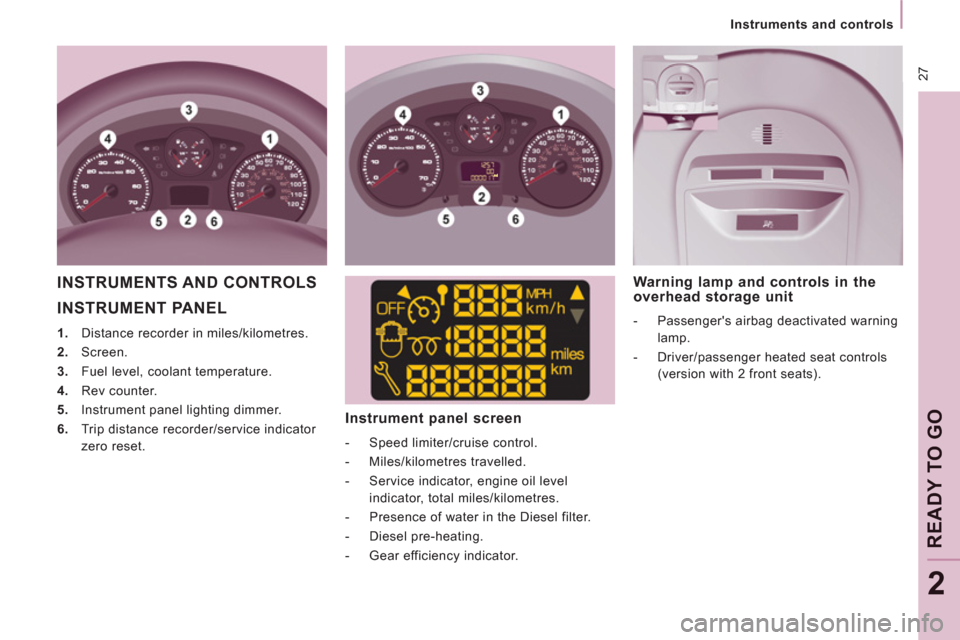
INSTRUMENT PANEL
1.
Distance recorder in miles/kilometres.
2.
Screen.
3.
Fuel level, coolant temperature.
4.
Rev counter.
5.
Instrument panel lighting dimmer.
6.
Trip distance recorder/service indicator
zero reset.
Instrument panel screen
- Speed limiter/cruise control.
- Miles/kilometres travelled.
- Service indicator, engine oil level
indicator, total miles/kilometres.
- Presence of water in the Diesel filter.
- Diesel pre-heating.
- Gear efficiency indicator.
Warning lamp and controls in the
overhead storage unit
- Passenger's airbag deactivated warning
lamp.
- Driver/passenger heated seat controls
(version with 2 front seats).
INSTRUMENTS AND CONTROLS
Page 69 of 270

67
Seats
EASE OF USE AND COMFOR
T
3
FRONT SEATS
Depending on the version and configuration
of your vehicle, different front seats are
fitted, either:
- a driver's seat and a passenger seat,
- an individual driver's seat and
a two-seat passenger bench.
Depending on the models, the following
adjustments are available:
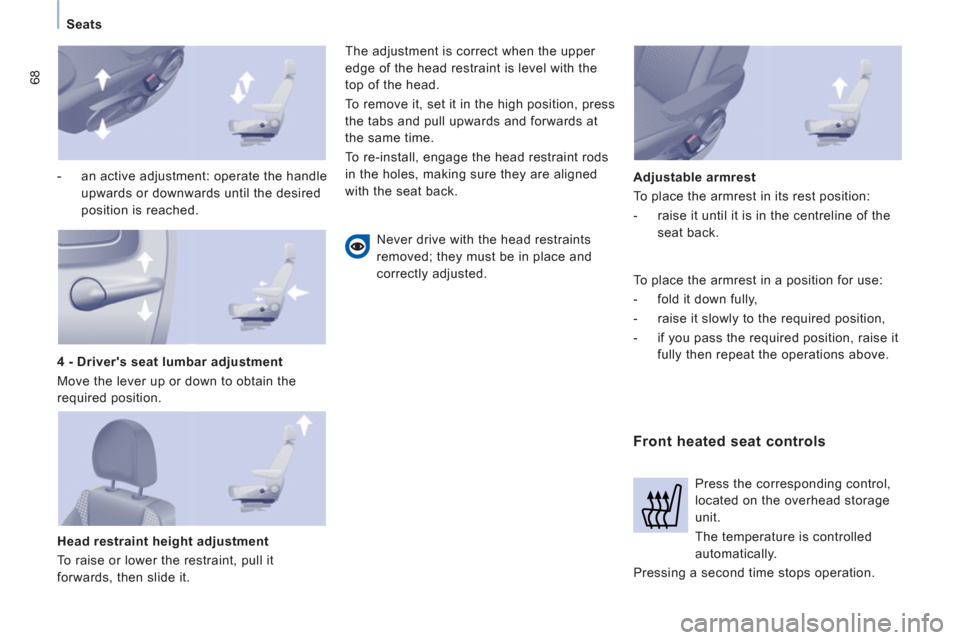
3 - Driver's seat height adjustment
Depending on the version and configuration
of your vehicle, you have either:
- a passive adjustment: pull the handle
upwards then take your weight off the
seat to raise, or push on the seat to
lower,
2 - Seat back angle adjustment
Pull the lever upwards and set the required
angle.
1 - Forwards/backwards adjustment
Lift the bar and slide the seat forwards or
backwards.
Page 70 of 270
68
Seats
- an active adjustment: operate the handle
upwards or downwards until the desired
position is reached.
Head restraint height adjustment
To raise or lower the restraint, pull it
forwards, then slide it. The adjustment is correct when the upper
edge of the head restraint is level with the
top of the head.
To remove it, set it in the high position, press
the tabs and pull upwards and forwards at
the same time.
To re-install, engage the head restraint rods
in the holes, making sure they are aligned
with the seat back.
Never drive with the head restraints
removed; they must be in place and
correctly adjusted.
Front heated seat controls
Adjustable armrest
To place the armrest in its rest position:
- raise it until it is in the centreline of the
seat back.
4 - Driver's seat lumbar adjustment
Move the lever up or down to obtain the
required position.
Press the corresponding control,
located on the overhead storage
unit.
The temperature is controlled
automatically.
Pressing a second time stops operation. To place the armrest in a position for use:
- fold it down fully,
- raise it slowly to the required position,
- if you pass the required position, raise it
fully then repeat the operations above.
Page 71 of 270
69
Seats
EASE OF USE AND COMFOR
T
3
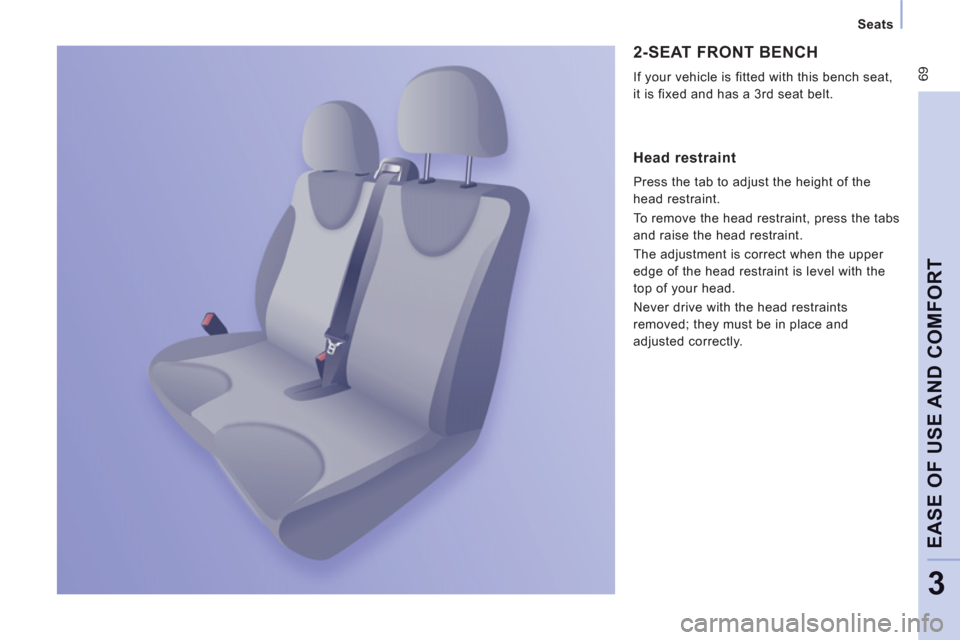
2-SEAT FRONT BENCH
If your vehicle is fitted with this bench seat,
it is fixed and has a 3rd seat belt.
Head restraint
Press the tab to adjust the height of the
head restraint.
To remove the head restraint, press the tabs
and raise the head restraint.
The adjustment is correct when the upper
edge of the head restraint is level with the
top of your head.
Never drive with the head restraints
removed; they must be in place and
adjusted correctly.
Page 77 of 270

75
Practical information
EASE OF USE AND COMFOR
T
3
CREW CAB
Bench seat
The crew cab consists of a 3-seat bench,
located in row 2, the one-piece back of
which is fixed to the "load retainer" glazed
partition.
Access to the rear seats is via the sliding
side door.
Head rests and seat belts
Each seat has a head rest adjustable for
height and angle.
The three seats are equipped with inertia
reel seat belts. The seat belts are integral
with the backrest of the bench seat.
Ensure that the seat belt is attached to the
correct buckle.
For more information on the use of this
equipment, refer to "Seat belts" in section 4.
Good practice
The rear seat belt stalks are not designed for securing the load transported. Use the lashing rings on the floor only.
The bench seat of the crew cab is not suitable for the installation of a child seat.
Rear side glasses
If fitted to your vehicle, the side glasses can
be opened.
Squeeze the two controls together then slide
the window. There are 4 position notches.
When driving, the glass should be closed or
secured at one of the 4 notches.
Page 79 of 270
77
Practical information
EASE OF USE AND COMFOR
T
3
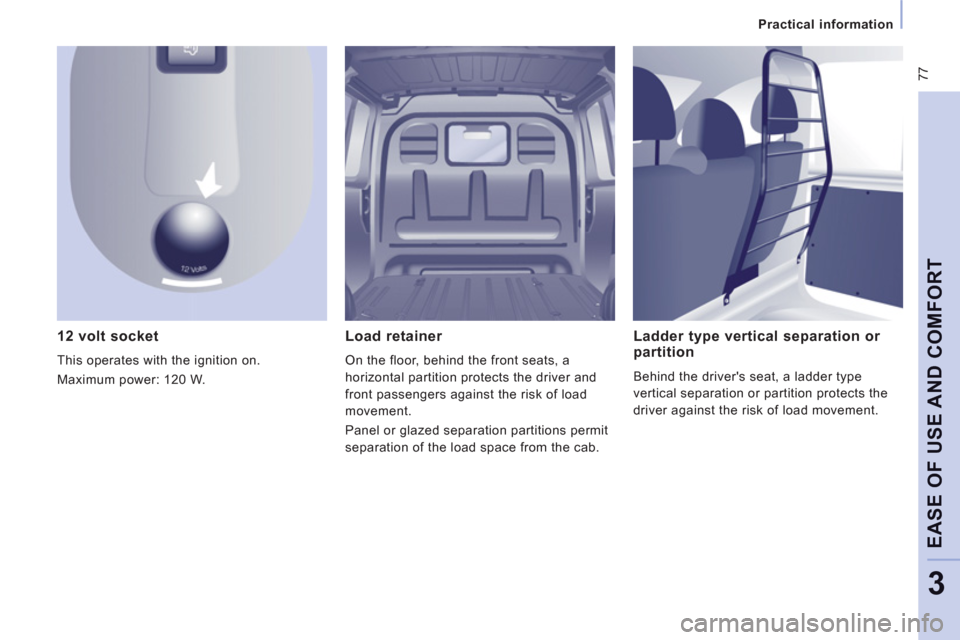
12 volt socket
This operates with the ignition on.
Maximum power: 120 W.
Ladder type vertical separation or
partition
Behind the driver's seat, a ladder type
vertical separation or partition protects the
driver against the risk of load movement.
Load retainer
On the floor, behind the front seats, a
horizontal partition protects the driver and
front passengers against the risk of load
movement.
Panel or glazed separation partitions permit
separation of the load space from the cab.
Page 93 of 270
91
Seat belts
SAFETY
4
Deployment of the pretensioners is
accompanied by a slight discharge of
harmless smoke and a noise, due to the
activation of the pyrotechnic cartridge
incorporated in the system.
The force limiter reduces the pressure of the
seat belt against the body of the occupants.
The pretensioning seat belts are active when
the ignition is switched on.
The inertia reels are fitted with a device
which automatically locks the strap in the
event of a collision or emergency braking or
if the vehicle rolls over.
You can unfasten the seat belt by pressing
the red button on the buckle. Guide the seat
belt after unfastening.
The airbag warning lamp comes on if the
pretensioners are deployed. Contact a
CITROËN dealer or a qualified workshop.
In order to be effective, a seat belt must:
- restrain one person only,
- must not be twisted, check by pulling in
front of you with an even movement,
- be tightened as close to the body as
possible.
The upper part of the seat belt should be
positioned in the hollow of the shoulder.
The lap part should be placed as low as
possible on the pelvis.
Recommendations for children:
- use a suitable child seat if the
passenger is less than 12 years old or
shorter than one metre fifty,
- never allow a child to travel on your lap,
even with the seat belt fastened.
FRONT SEAT BELTS
For more information on child seats,
refer to the "Children on board" section
of chapter 4.
In accordance with current safety
regulations, your CITROËN dealer can
guarantee all work or any checks, from
testing to maintenance, on your seat belt
equipment.
Have the seat belts checked regularly (even
after a minor impact) by a CITROËN dealer
or a qualified workshop: they must not show
any signs of wear, cutting or fraying and they
must not be converted or modified.
Clean the seat belt straps with soapy
water or a textile cleaning product,
sold by CITROËN dealers.
With front airbags
The front seats are fitted with pretensioners
and force limiters.
Without front airbag
If your vehicle is fitted with a front bench
without front airbag, the centre passenger's
seat belt does not have a pretensioner.
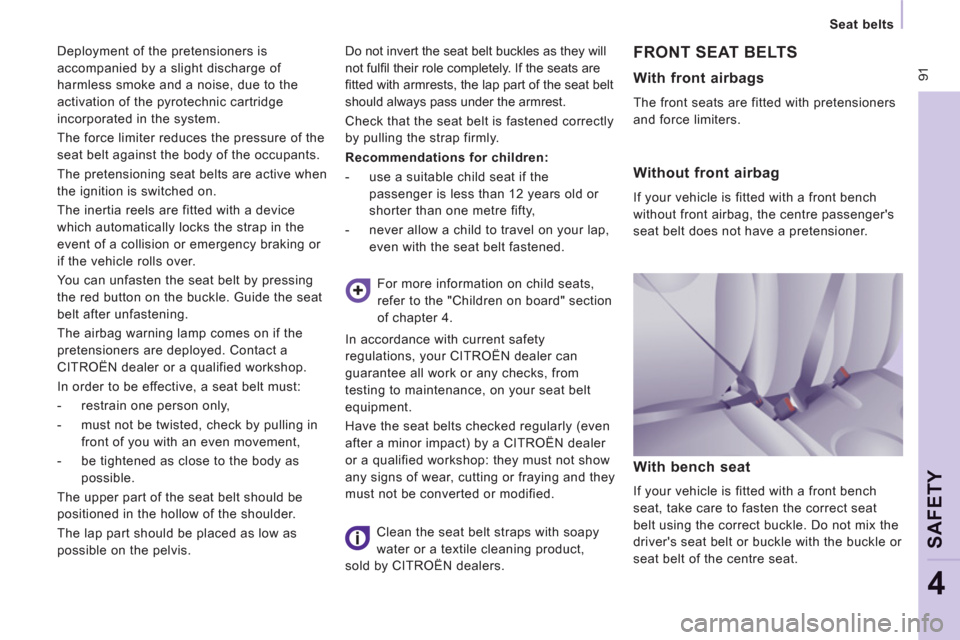
With bench seat
If your vehicle is fitted with a front bench
seat, take care to fasten the correct seat
belt using the correct buckle. Do not mix the
driver's seat belt or buckle with the buckle or
seat belt of the centre seat. Do not invert the seat belt buckles as they will
not fulfi l their role completely. If the seats are
fi tted with armrests, the lap part of the seat belt
should always pass under the armrest.
Check that the seat belt is fastened correctly
by pulling the strap firmly.