towing Citroen NEMO 2015 1.G User Guide
[x] Cancel search | Manufacturer: CITROEN, Model Year: 2015, Model line: NEMO, Model: Citroen NEMO 2015 1.GPages: 192, PDF Size: 7.84 MB
Page 80 of 192
78
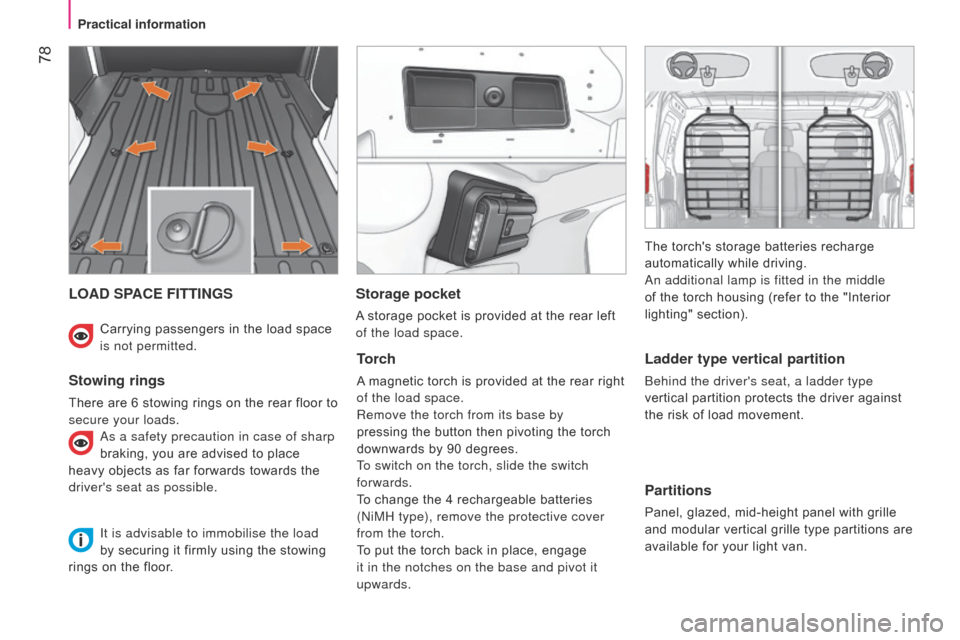
LOAD SPACE FITTINGS
Stowing rings
There are 6 stowing rings on the rear floor to
secure your loads.
a
s a safety precaution in case of sharp
braking, you are advised to place
heavy objects as far forwards towards the
driver's seat as possible.
Storage pocket
A storage pocket is provided at the rear left
of the load space.
Torch
A magnetic torch is provided at the rear right
of the load space.
Remove the torch from its base by
pressing the button then pivoting the torch
downwards by 90 degrees.
To switch on the torch, slide the switch
forwards.
To change the 4 rechargeable batteries
(
n iMH type), remove the protective cover
from the torch.
To put the torch back in place, engage
it in the notches on the base and pivot it
upwards.
Ladder type vertical partition
behind the driver's seat, a ladder type
vertical partition protects the driver against
the risk of load movement.
Partitions
Panel, glazed, mid-height panel with grille
and modular vertical grille type partitions are
available for your light van.
Carrying passengers in the load space
is not permitted.
It is advisable to immobilise the load
by securing it firmly using the stowing
rings on the floor. The torch's storage batteries recharge
automatically while driving.
a
n additional lamp is fitted in the middle
of the torch housing (refer to the "Interior
lighting" section).
Practical information
Page 82 of 192
80
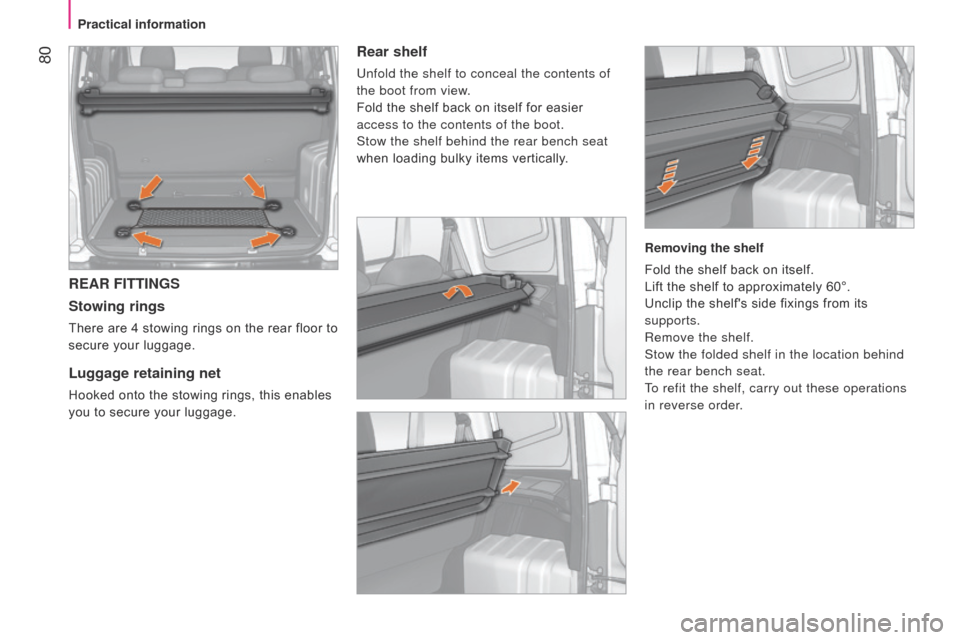
REAR FITTINGS
Stowing rings
There are 4 stowing rings on the rear floor to
secure your luggage.
Luggage retaining net
Hooked onto the stowing rings, this enables
you to secure your luggage.
Rear shelf
Unfold the shelf to conceal the contents of
the boot from view.
Fold the shelf back on itself for easier
access to the contents of the boot.
Stow the shelf behind the rear bench seat
when loading bulky items vertically.Removing the shelf
Fold the shelf back on itself.
Lift the shelf to approximately 60°.
Unclip the shelf's side fixings from its
supports.
Remove the shelf.
Stow the folded shelf in the location behind
the rear bench seat.
To refit the shelf, carry out these operations
in reverse order.
Practical information
Page 139 of 192

137
TOWING A TRAILER, CARAVAN, ETC...
Driving advice
as the fan is electrically controlled, its
cooling capacity is not dependent on the
engine speed.
On the contrary, use a high gear to lower the
engine speed and reduce your speed. In all cases, pay attention to the coolant
temperature.
A towed vehicle must free wheel: gearbox in
neutral.
Cooling: towing a trailer on a slope
increases the coolant temperature.
7
ACCESSORIES
Towing a trailer
Page 140 of 192
138
In certain cases of particularly arduous
use (towing the maximum load up a steep
slope in high temperatures), the engine
automatically limits its power. In this case,
automatic cutting off of the air conditioning
allows the engine power to be saved.If the coolant temperature
warning lamp comes on, stop the
vehicle and switch off the engine
as soon as possible.
ChecksSee the "Levels" section of
chapter 7.
Tyres: check the tyre pressures on the
towing vehicle and the trailer, observing the
recommended pressures.
Brakes: towing increases the braking
distance.
d rive at a moderate speed,
change down early and brake gradually. Side wind: sensitivity to side wind is
increased.
d rive smoothly and at a
moderate speed.
ABS: the system only controls the vehicle,
not the trailer.
Distribution of loads
distribute the load in the trailer so that the
heaviest objects are as close as possible
to the axle and the nose weight is close to
the maximum authorised without, however,
exceeding it. The air density decreases with
altitude, so reducing the performance of the
engine. The maximum towed load must be
reduced by 10 % for each 1 000 metres of
altitude.
Refer to the "Technical data -
Identification markings" section. Rear parking sensors: the sensors will be
deactivated automatically when an genuine
CITR
o Ë n towbar is used.
Towbar
We recommend the use of genuine
CITR
o Ë n towbars and their harnesses,
which have been tested and approved from
the design stage of your vehicle, and that
the fitting of this equipment is entrusted to a
CITROËN dealer or a qualified workshop.
If this equipment is not fitted by a CITR
o Ë n
dealer
, it is essential that it is fitted using
the electrical pre-equipment located at
the rear of the vehicle and following the
manufacturer's instructions.
The operation of the rear parking sensors is
deactivated automatically when the trailer
cable connector is inserted in the towbar
socket.
When the trailer cable is removed, the rear
parking sensors are re-activated.
Refer to the "Technology on board -
Parking sensors" section.
For information on the maximum
weights and towed loads applicable to
your vehicle, refer to the "Technical data -
Weights" section.
Towing a trailer
Page 157 of 192
155
CHANGING A WHEEL
Parking the vehicle
As far as possible, park the vehicle on level,
stable and non-slippery ground.
Apply the parking brake, switch off the
ignition and engage first gear (on a hill).
It is imperative that you ensure that the
occupants get out of the vehicle and wait in
a safe location.
If possible, place a chock under the
wheel diagonally opposite the wheel to be
changed.
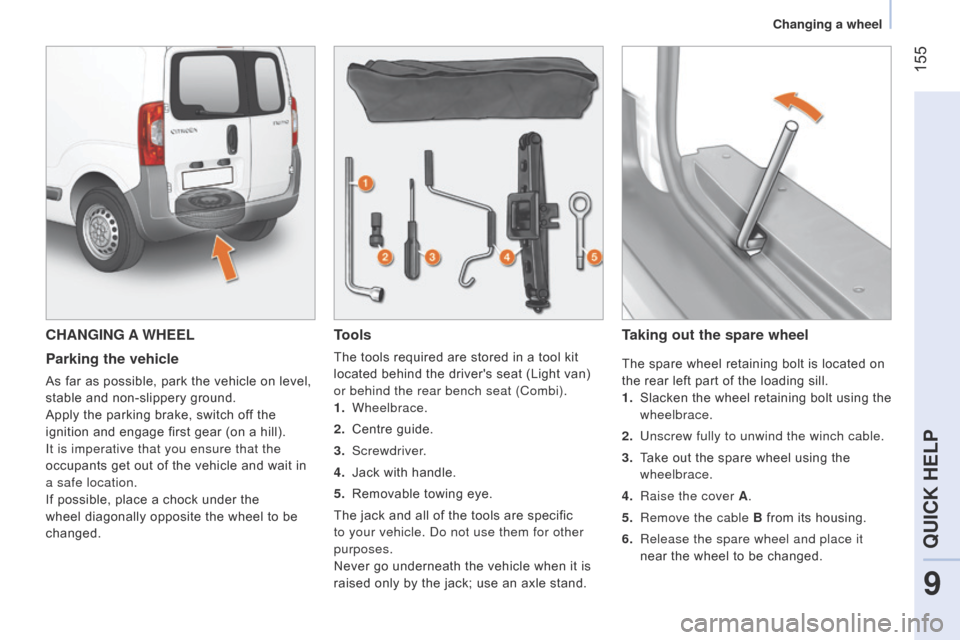
Tools
The tools required are stored in a tool kit
located behind the driver's seat (Light van)
or behind the rear bench seat (Combi).
1. Wheelbrace.
2.
Centre guide.
3.
Screwdriver.
4.
Jack with handle.
5.
Removable towing eye.
The jack and all of the tools are specific
to your vehicle.
d o not use them for other
purposes.
Never go underneath the vehicle when it is
raised only by the jack; use an axle stand.
Taking out the spare wheel
The spare wheel retaining bolt is located on
the rear left part of the loading sill.
1.
Slacken the wheel retaining bolt using the
wheelbrace.
2.
Unscrew fully to unwind the winch cable.
3.
T
ake out the spare wheel using the
wheelbrace.
4.
Raise the cover
A.
5.
Remove the cable
B from its housing.
6.
Release the spare wheel and place it
near the wheel to be changed.
9
QUICK HELP
Changing a wheel
Page 174 of 192
172 172
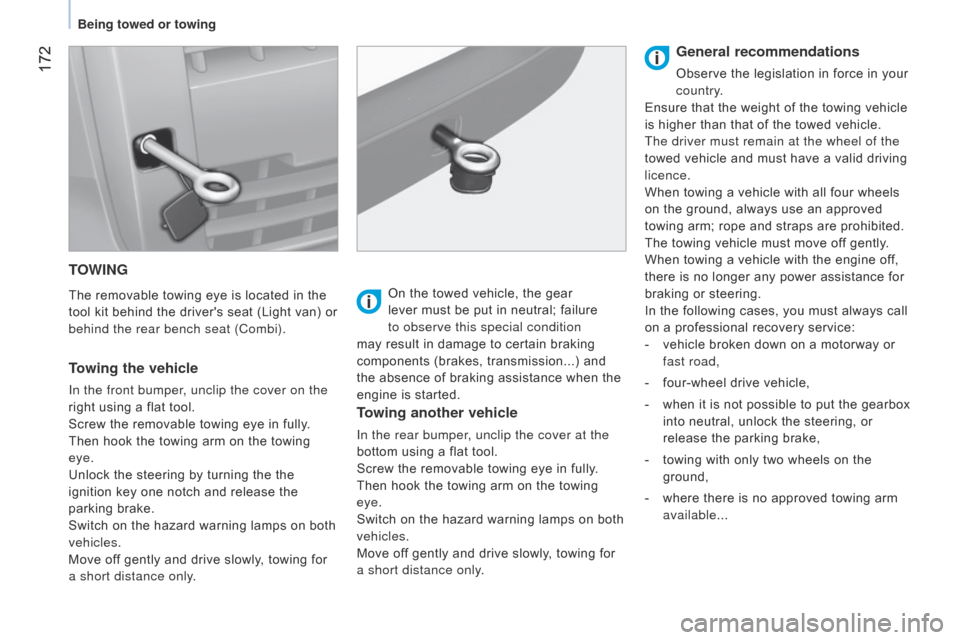
TOWING
The removable towing eye is located in the
tool kit behind the driver's seat (Light van) or
behind the rear bench seat (Combi).
Towing the vehicle
In the front bumper, unclip the cover on the
right using a flat tool.
Screw the removable towing eye in fully.
Then hook the towing arm on the towing
eye.
Unlock the steering by turning the the
ignition key one notch and release the
parking brake.
Switch on the hazard warning lamps on both
vehicles.
Move off gently and drive slowly, towing for
a short distance only.On the towed vehicle, the gear
lever must be put in neutral; failure
to observe this special condition
may result in damage to certain braking
components (brakes, transmission...) and
the absence of braking assistance when the
engine is started.
Towing another vehicle
In the rear bumper, unclip the cover at the
bottom using a flat tool.
Screw the removable towing eye in fully.
Then hook the towing arm on the towing
eye.
Switch on the hazard warning lamps on both
vehicles.
Move off gently and drive slowly, towing for
a short distance only.
General recommendations
Observe the legislation in force in your
country.
Ensure that the weight of the towing vehicle
is higher than that of the towed vehicle.
The driver must remain at the wheel of the
towed vehicle and must have a valid driving
licence.
When towing a vehicle with all four wheels
on the ground, always use an approved
towing arm; rope and straps are prohibited.
The towing vehicle must move off gently.
When towing a vehicle with the engine off,
there is no longer any power assistance for
braking or steering.
In the following cases, you must always call
on a professional recovery service:
-
vehicle broken down on a motorway or
fast road,
-
four-wheel drive vehicle,
-
when it is not possible to put the gearbox
into neutral, unlock the steering, or
release the parking brake,
-
towing with only two wheels on the
ground,
-
where there is no approved towing arm
available...
Being towed or towing
Page 184 of 192

182
WEIGHTS AND TOWED LOADS
The maximum weights and towed loads
for your vehicle are given are given in the
registration document, as well as in sales
brochures.
These values are also present on the
manufacturer's plate or label (see the
"Technical data - Identification markings"
section). The kerb weight is equal to the unladen
weight
+ driver (75 kg).
The gross train weight and towed load values
indicated apply up to a maximum altitude
of 1
000 metres; the towed load mentioned
must be reduced by 10 % for every additional
1
000 metres.High ambient temperatures may result
in a reduction in the performance of
the vehicle to protect the engine; when the
ambient temperature is higher than 37 °C, limit
the towed weight.
Towing with a lightly loaded vehicle can
adversely affect roadholding.
Braking distances are increased when towing
a trailer.
When towing, the maximum speed allowed is
reduced (comply with the legislation in force in
your country).
For information on the maximum trailer weight
for your vehicle, contact a CITR
o Ë n dealer or
a qualified workshop. The weight of the braked trailer can be
increased, within the GTW limit, on condition
that the GVW of the towing vehicle is reduced
by the same amount.
The recommended nose weight is the vertical
load on the towbar ball (removable with or
without tools).
GVW: gross vehicle weight, the maximum
authorised vehicle weight.
GTW: gross train weight, the maximum
authorised weight of vehicle plus trailer.
In all countries, it is essential to comply with
the local legislation on towed loads.
Weights