warning lights DACIA DUSTER 2012 1.G Owner's Manual
[x] Cancel search | Manufacturer: DACIA, Model Year: 2012, Model line: DUSTER, Model: DACIA DUSTER 2012 1.GPages: 200, PDF Size: 2.4 MB
Page 80 of 200
2.12
ENG_UD20643_3
Transmission : 4 roues motrices (4WD) (H79 - Dacia)
ENG_NU_898-5_H79_Dacia_2
Jaune NoirNoir texte
TRANSMISSION: 4-wheel drive (4WD) (2/4)
This problem may be resolved by
changing the tyres. Always use four
identical tyres (same brand, profile,
etc.) and with similar wear.
In the event of excessive wheelspin,
the mechanical components may be
overheating.
If this happens:
–
a
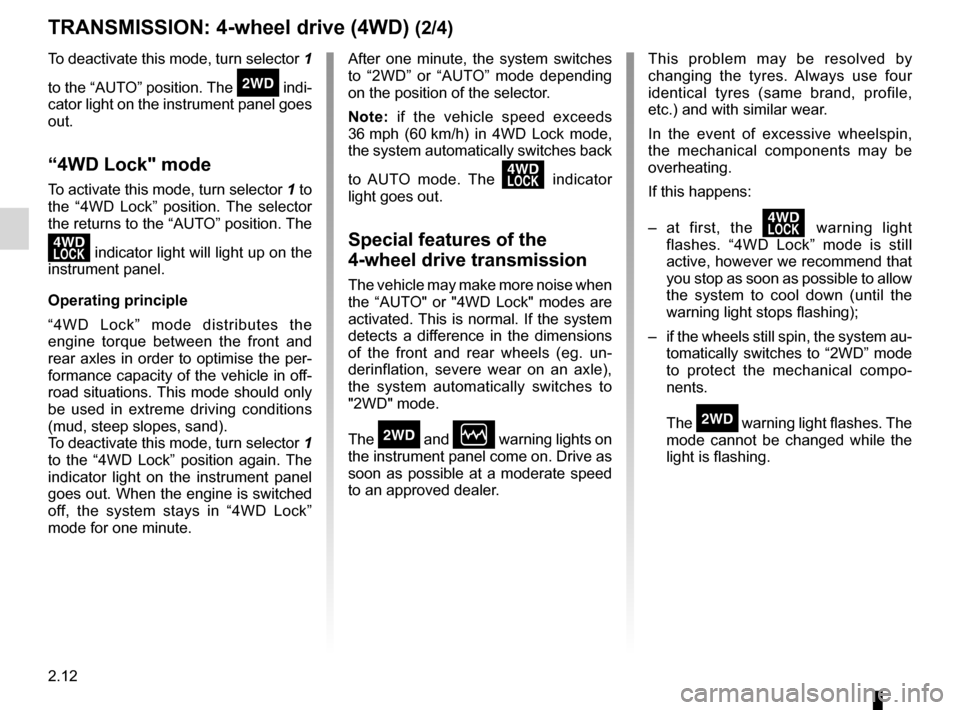
t first, the
’ warning light
flashes. “4WD Lock” mode is still
active, however we recommend that
you stop as soon as possible to allow
the system to cool down (until the
warning light stops flashing);
–
if
the wheels still spin, the system au-
tomatically switches to “2WD” mode
to protect the mechanical compo-
nents.
The
‘ warning light flashes. The
mode cannot be changed while the
light is flashing.
After one minute, the system switches
to “2WD” or “AUTO” mode depending
on the position of the selector.
Note:
if the vehicle speed exceeds
36
m
ph (60
k
m/h) in 4WD Lock mode,
the system automatically switches back
to AUTO mode. The
’ indicator
light goes out.
Special features of the
4-wheel drive transmission
The vehicle may make more noise when
the “AUTO" or "4WD Lock" modes are
activated. This is normal. If the system
detects a difference in the dimensions
of the front and rear wheels (eg. un-
derinflation, severe wear on an axle),
the system automatically switches to
"2WD" mode.
The
‘ and Ò warning lights on
the instrument panel come on. Drive as
soon as possible at a moderate speed
to an approved dealer.
To deactivate this mode, turn selector
1
to the “AUTO” position. The
‘ indi-
cator light on the instrument panel goes
out.
“4WD Lock" mode
To activate this mode, turn selector 1 to
t he “4WD Lock” position. The selector
the returns to the “AUTO” position. The
’ indicator light will light up on the
instrument panel.
Operating principle
“4WD Lock” mode distributes the
engine torque between the front and
rear axles in order to optimise the per-
formance capacity of the vehicle in off-
road situations. This mode should only
be used in extreme driving conditions
(mud, steep slopes, sand).
To deactivate this mode, turn selector
1
to the “4WD Lock” position again. The
indicator light on the instrument panel
goes out. When the engine is switched
off, the system stays in “4WD Lock”
mode for one minute.
Page 81 of 200
JauneNoirNoir texte
2.13
ENG_UD20643_3
Transmission : 4 roues motrices (4WD) (H79 - Dacia)
ENG_NU_898-5_H79_Dacia_2
TRANSMISSION: 4-wheel drive (4WD) (3/4)
Electronic stability program and
traction control when driving off-
road
(vehicles equipped with ESP)
When driving on soft ground (sand,
mud, deep snow), we recommend that
you deactivate the ESP function by
pressing the “ESP” switch.
In this case, only individual wheel brak-
ing remains active. This function ap-
plies the brake to any wheel that is slip-
ping, allowing the engine torque to be
transferred to the wheels with the most
grip. This is particularly useful when
crossing a bridge.
All the ESP functions will be reactivated
when the vehicle speed reaches ap-
proximately 30 mph (50 km/h), (36 mph
(60 km/h) in “4WD Lock” mode), or
when the engine is restarted, or when
the “ESP” button is pressed again.Operating faults
If the system detects an operating
fault, it automatically switches to “2WD”
mode, and the
‘ and Ò warn-
ing lights come on.
Drive as soon as possible at a moder-
ate speed to an approved dealer.
For certain operating faults, the system
may not be able to switch to “2WD" or
"4WD Lock" mode. "AUTO" mode re-
mains active.
Contact an approved dealer as soon as
possible.
In this case, we recommend that you
stop as soon as possible to allow the
system to cool down (until the warning
light stops flashing).
Cooling may take up to five minutes.
If the system detects excessive wheel-
spin on the front wheels, it adapts the
engine to run in a way that reduces
wheelspin.
Anti-lock braking in “
LOCK” mode
(vehicles equipped with ABS)
When “4WD Lock" mode is active, the
ABS switches to off-road mode. In this
case, the wheels may lock intermit-
tently to achieve better grip, thus reduc-
ing braking distances on soft ground.
When this mode is active:
–
t
he vehicle’s manoeuvrability is lim-
ited during braking. This operating
mode is therefore not recommended
in very low-grip conditions (eg. ice).
–
t
here may be some noise. This is
normal, and does not indicate an op-
erating fault.
Page 84 of 200

2.16
ENG_UD22494_3
Dispositifs de correction et d’assistance à la conduite (H79 - Da\
cia)
ENG_NU_898-5_H79_Dacia_2
Jaune No")
emergency brake assist........................ (up to the end of the DU)
2.16
ENG_UD22494_3
Dispositifs de correction et d’assistance à la conduite (H79 - Da\
cia)
ENG_NU_898-5_H79_Dacia_2
Jaune NoirNoir texte
DRIVER CORRECTION DEVICES/AIDS (2/4)
Emergency brake assist with
electronic brake distribution
(depending on the vehicle)
This system supplements the ABS
and helps reduce vehicle stopping dis-
tances.
Operating principle
The system is for detecting an emer-
gency braking situation. In this case,
the braking assistance immediately de-
velops maximum power and may trig-
ger ABS regulation.
ABS braking is maintained as long as
the brake pedal is applied.
Operating faults –
If
the x warning light on the in-
strument panel comes on while you
are driving, the brakes will still
work normally without ABS;
–
I
f the
x and D warning
lights on the instrument panel come
on while you are driving, there is a
fault in the braking system.
In both cases, consult an approved
Dealer.
Yo u r b r a k i n g s y s t e m s
are partially operational.
However, it is dangerous
to brake suddenly and
it is essential to stop immediately,
as soon as traffic conditions allow.
Contact an approved dealer.
Page 86 of 200

ENG_NU_898-5_H79_Dacia_2
DRIVER CORRECTION DEVICES/AIDS (4/4)
Operating faults
When the system detects")
2.18
ENG_UD22494_3
Dispositifs de correction et d’assistance à la conduite (H79 - Da\
cia)
ENG_NU_898-5_H79_Dacia_2
DRIVER CORRECTION DEVICES/AIDS (4/4)
Operating faults
When the system detects an operating
fault, warning lights
Ò and ù
light up on the instrument panel. In this
case, the ESP and ASR are deacti-
vated.
Please consult an authorised dealer if
these warning lights remain displayed
on the instrument panel after the igni-
tion is switched off and on again.
Note:
the function is automatically re-
activated when the ignition is switched
on, or when the speed exceeds 30 mph
(50 km/h) in AUTO and 2WD modes,
and approximately 36 mph (60 km/h) in
4WD Lock mode.
Operating principle
A sensor in the steering wheel detects
the direction selected by the driver.
Other sensors throughout the vehicle
measure the actual direction.
The system compares driver input to
the actual trajectory of the vehicle and
corrects the trajectory if necessary by
controlling the braking of certain wheels
and/or engine power. In the event that
the system is engaged, indicator light
ù flashes on the instrument panel.
Page 138 of 200
5.6
ENG_UD22629_3
Kit de gonflage des pneumatiques (H79 - Dacia)
ENG_NU_898-5_H79_Dacia_5
Jaune NoirNoir texte
TYRE INFLATION KIT (2/3)
Depending on the vehicle, in the event
of a puncture, use the kit located on the
left side of the luggage compartment on
4x2 versions or in the in the emergency
spare wheel tray under the luggage
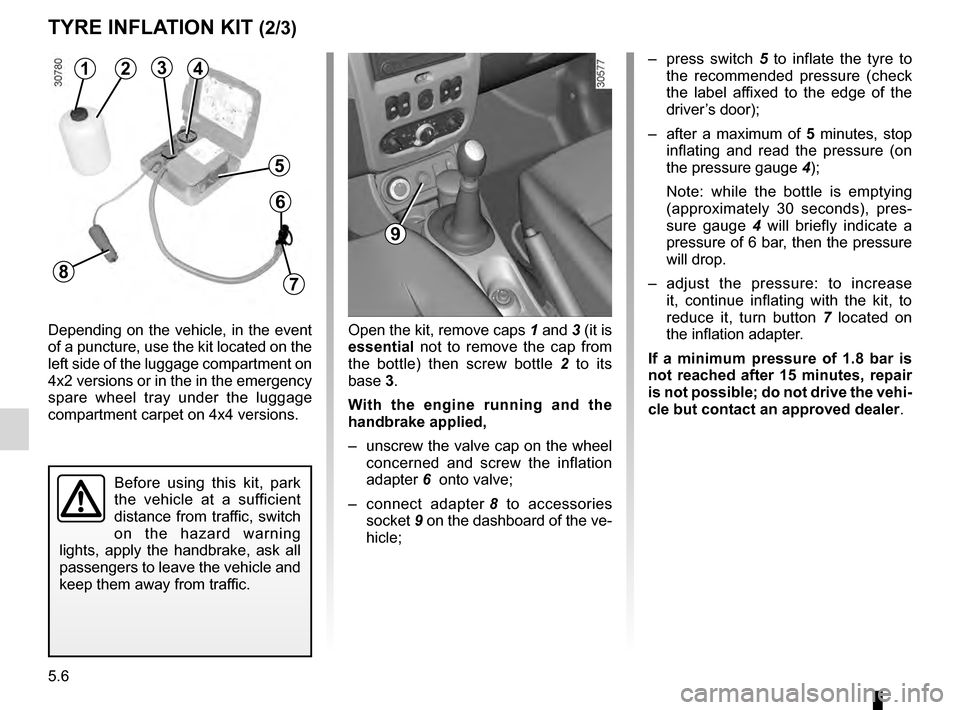
compartment carpet on 4x4 versions. –
p
ress switch
5
to inflate the tyre to
the recommended pressure (check
the label affixed to the edge of the
driver’s door);
–
after
a maximum of
5 minutes, stop
inflating and read the pressure (on
the pressure gauge
4
);
Note: while the bottle is emptying
(approximately 30 seconds), pres-
sure gauge
4
will briefly indicate a
pressure of 6 bar, then the pressure
will drop.
–
a
djust the pressure: to increase
it, continue inflating with the kit, to
reduce it, turn button 7 located on
the inflation adapter.
If a minimum pressure of 1.8 bar is
not reached after 15 minutes, repair
is not possible; do not drive the vehi-
cle but contact an approved dealer .
Before using this kit, park
the vehicle at a sufficient
distance from traffic, switch
on the hazard warning
lights, apply the handbrake, ask all
passengers to leave the vehicle and
keep them away from traffic.
Open the kit, remove caps 1 and 3 (it is
essential not to remove the cap from
the bottle) then screw bottle
2
to its
base 3.
With the engine running and the
handbrake applied,
–
unscrew
the valve cap on the wheel
concerned and screw the inflation
adapter
6 onto valve;
–
c
onnect adapter
8
to accessories
socket
9
on the dashboard of the ve-
hicle;
9
1234
5
6
78
Page 141 of 200
changing a wheel.................................. (up to the end of the DU)
practical advice ..................................... (up to the end of the DU)
jack ....................................................... (up to the end of the DU)
puncture................................................ (up to the end of the DU)
lifting the vehicle changing a wheel ............................ (up to the end of the DU)
5.9
ENG_UD20699_3
Changement de roue (H79 - Dacia)
ENG_NU_898-5_H79_Dacia_5
Changing a wheel
CHANGING A WHEEL (1/2)
Switch on the hazard warn-
ing lights.
Park the vehicle away from
traffic on firm, flat, non-slip-
pery ground (if necessary, place a
solid support under the jack base).
Apply the handbrake and engage a
gear (first or reverse gear).
Ask the passengers to leave the ve-
hicle and to keep away from traffic.
If you have a puncture, re-
place the wheel as soon as
possible.
A tyre which has been punc-
tured should always be inspected
(and repaired, where possible) by a
specialist.
Vehicles equipped with a jack
and wheelbrace
If necessary, remove the wheel trim,
refer to the information on “Wheel trims
- Wheels” in this Section. Undo the
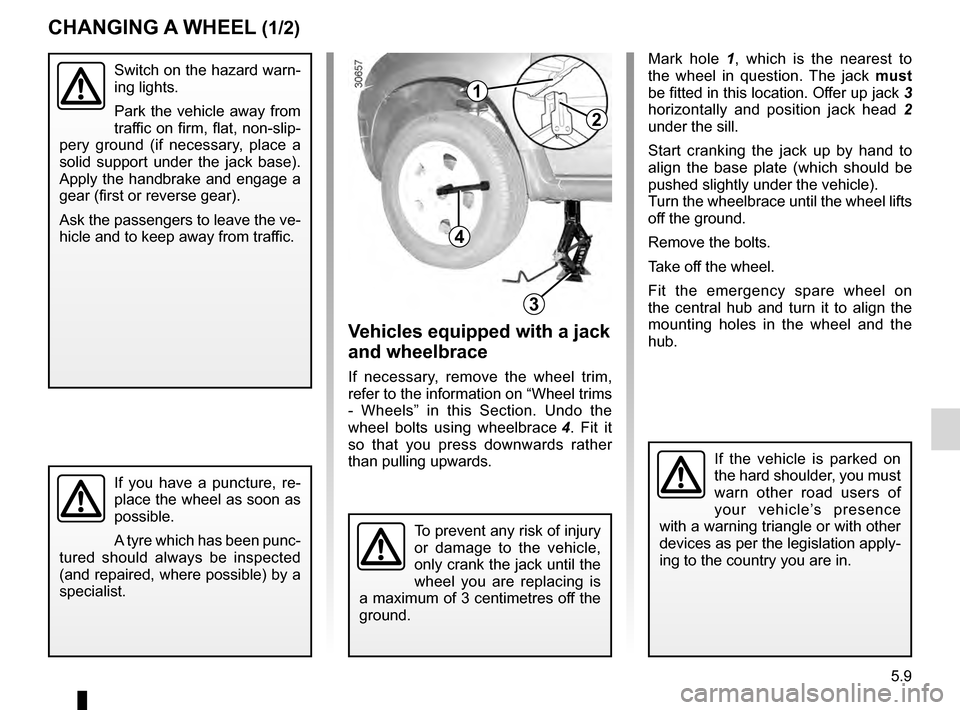
wheel bolts using wheelbrace
4 .
Fit it
so that you press downwards rather
than pulling upwards. Mark hole
1
,
which is the nearest to
the wheel in question. The jack must
be fitted in this location. Offer up jack
3
horizontally and position jack head
2
under the sill.
Start cranking the jack up by hand to
align the base plate (which should be
pushed slightly under the vehicle).
Turn the wheelbrace until the wheel lifts
off the ground.
Remove the bolts.
Take off the wheel.
Fit the emergency spare wheel on
the central hub and turn it to align the
mounting holes in the wheel and the
hub.
To prevent any risk of injury
or damage to the vehicle,
only crank the jack until the
wheel you are replacing is
a maximum of 3 centimetres off the
ground.
If the vehicle is parked on
the hard shoulder, you must
warn other road users of
your vehicle’s presence
with a warning triangle or with other
devices as per the legislation apply-
ing to the country you are in.
1
2
3
4
Page 164 of 200
towing hitch........................................... (up to the end of the DU)
practical advice ..................................... (up to the end of the DU)
towing breakdown ...................................... (up to the end of the DU)
5.32
ENG_UD22437_4
Remorquage : dépannage (H79 - Dacia)
ENG_NU_898-5_H79_Dacia_5
Jaune NoirNoir texte
Towing: troubleshooting
TOWING: breakdown (1/3)
Towing procedure
The steering wheel must be un-
locked and the ignition key must be
in position M (ignition on) to pro-
vide stop lights and hazard warning
lights on the towed vehicle. At night
the vehicle must have its lights on.
Unhitch the trailer, etc., if one is being
towed.
You must observe the towing regu-
lations which apply in the country in
which you are driving: do not exceed
the towing weight for your vehicle.
Contact an approved Dealer.
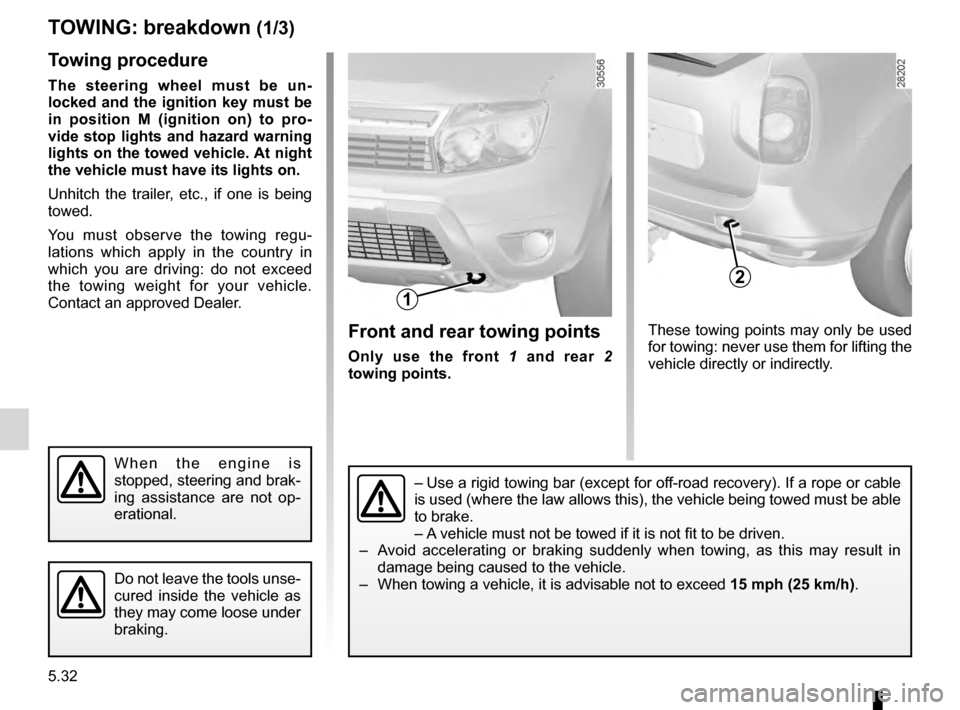
Front and rear towing points
Only use the front 1 and rear 2
towing points.
W h e n t h e e n g i n e i s
stopped, steering and brak-
ing assistance are not op-
erational.
Do not leave the tools unse-
cured inside the vehicle as
they may come loose under
braking.
– Use a rigid towing bar (except for off-road recovery). If a rope or cable
is used (where the law allows this), the vehicle being towed must be able
to brake.
–
A
vehicle must not be towed if it is not fit to be driven.
–
A
void accelerating or braking suddenly when towing, as this may result in
damage being caused to the vehicle.
–
When towing a vehicle, it is advisable not to exceed 15 mph (25
km/h).
These towing points may only be used
for towing: never use them for lifting the
vehicle directly or indirectly.
1
2
Page 171 of 200
operating faults ..................................... (up to the end of the DU)
practical advice ..................................... (up to the end of the DU)
faults operating faults ............................... (up to the end of the DU)
5.39
ENG_UD20968_2
Anomalies de fonctionnement (H79 - Dacia)
ENG_NU_898-5_H79_Dacia_5
Operating faults
OPERATING FAULTS (1/5)
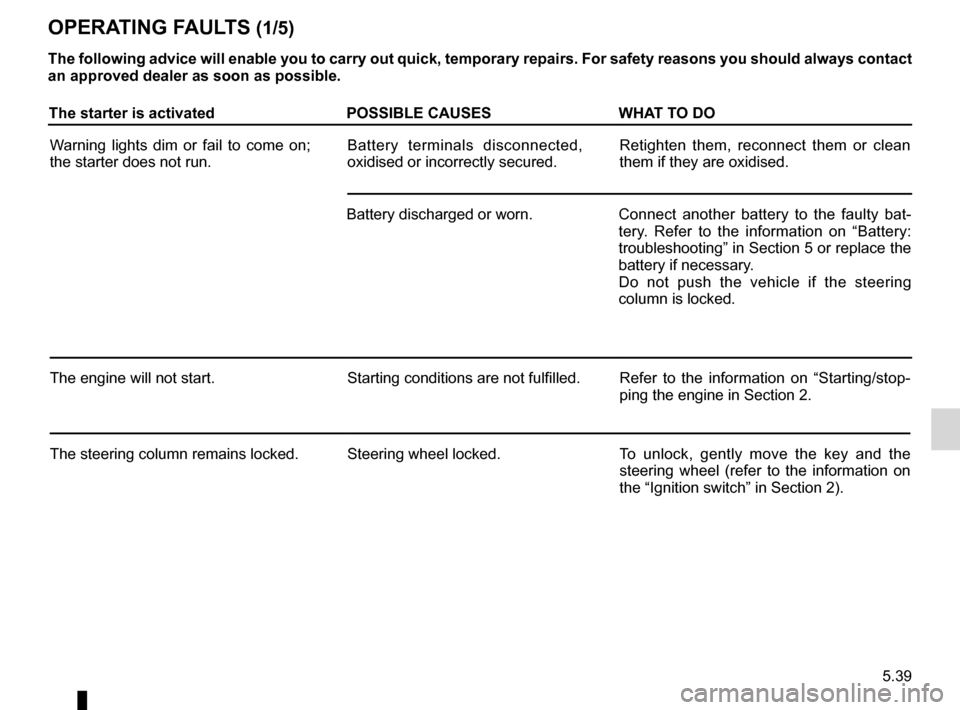
The following advice will enable you to carry out quick, temporary repairs. For safety reasons you should always contact
an approved dealer as soon as possible.
The starter is activated POSSIBLE CAUSESWHAT TO DO
Warning lights dim or fail to come on;
the starter does not run. Battery terminals disconnected,
oxidised or incorrectly secured.Retighten them, reconnect them or clean
them if they are oxidised.
Battery discharged or worn. Connect another battery to the faulty bat-
tery. Refer to the information on “Battery:
troubleshooting” in Section 5 or replace the
battery if necessary.
Do not push the vehicle if the steering
column is locked.
The engine will not start. Starting conditions are not fulfilled. Refer to the information on “Starting/stop-
ping the engine in Section 2.
The steering column remains locked. Steering wheel locked. To unlock, gently move the key and the
steering wheel (refer to the information on
the “Ignition switch” in Section 2).
Page 173 of 200
JauneNoirNoir texte
5.41
ENG_UD20968_2
Anomalies de fonctionnement (H79 - Dacia)
ENG_NU_898-5_H79_Dacia_5
OPERATING FAULTS (3/5)
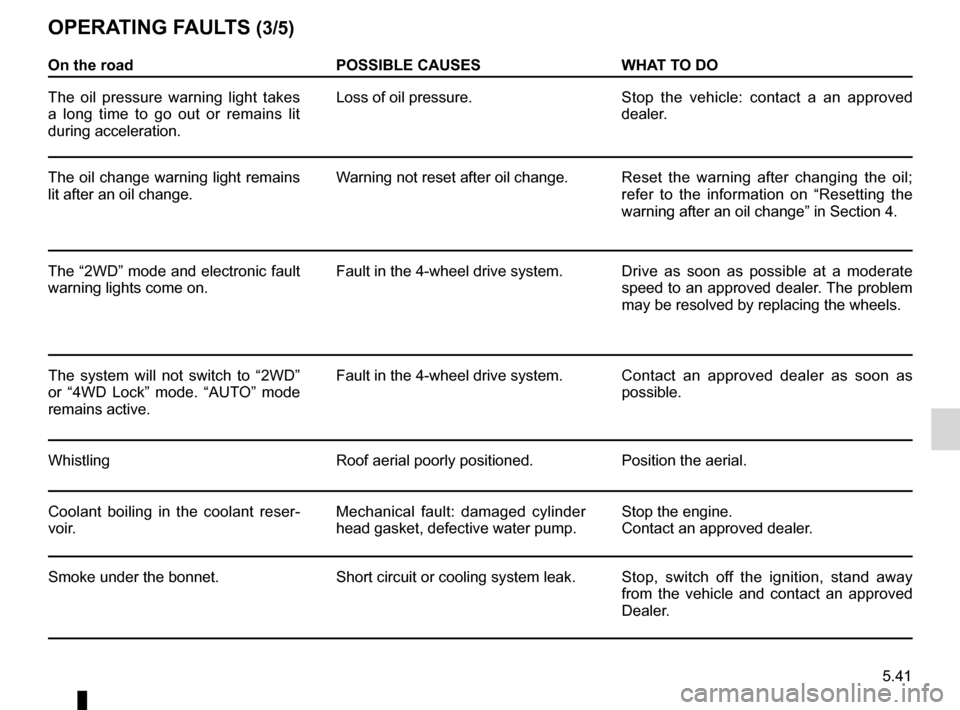
On the road POSSIBLE CAUSESWHAT TO DO
The oil pressure warning light takes
a long time to go out or remains lit
during acceleration. Loss of oil pressure.
Stop the vehicle: contact a an approved
dealer.
The oil change warning light remains
lit after an oil change. Warning not reset after oil change. Reset the warning after changing the oil;
refer to the information on “Resetting the
warning after an oil change” in Section 4.
The “2WD” mode and electronic fault
warning lights come on. Fault in the 4-wheel drive system. Drive as soon as possible at a moderate
speed to an approved dealer. The problem
may be resolved by replacing the wheels.
The system will not switch to “2WD”
or “4WD Lock” mode. “AUTO” mode
remains active. Fault in the 4-wheel drive system. Contact an approved dealer as soon as
possible.
Whistling Roof aerial poorly positioned.Position the aerial.
Coolant boiling in the coolant reser-
voir. Mechanical fault: damaged cylinder
head gasket, defective water pump.Stop the engine.
Contact an approved dealer.
Smoke under the bonnet. Short circuit or cooling system leak. Stop, switch off the ignition, stand away
from the vehicle and contact an approved
Dealer.
Page 196 of 200
7.2
FRA_UD25066_7
Index (H79 - Dacia)
ENG_NU_898-5_H79_Dacia_7
Jaune NoirNoir texte
AlphAbeticAl index (2/4)
F
4 wheel drive (4WD) .............................................. 2.1
1 → 2.14
faults operating faults
......
.......................................... 5.39 → 5.43
filter
........................................................................\
............ 4.10
air filter
......
................................................................... 4.10
diesel filter
.......
............................................................. 4.10
passenger compartment filter
......
................................ 4.10
fitting a radio
........................................................... 5.36
– 5.37
fittings
.................................................................... 3.15 → 3.18
fog lights
........................................................................\
.... 1.55
front passenger air bag deactivation ................................. 1.32
front seat adjustment
......................................................... 1.1
1
front seats adjustment
......
............................................................. 1.11
fuel advice on fuel economy
......
.................................2.6 → 2.8
filling
.......
...................................................................... 1.61
grade
.......
.............................................................. 1.60, 6.5
fuel economy
............................................................. 2.6 → 2.8
fuel filler cap ...................................................................... 1.60
fuel grade........................................................................\
... 1.60
fuel level
........................................................................\
.... 1.45
fuel tank
................................................................. 1.60 → 1.62
fuel tank capacity ............................................................... 1.60
fuses
...................................................................... 5.25 → 5.27
G
gear lever........................................................................\
... 2.10
glove box
........................................................................\
... 3.15
grab handle........................................................................\
3.13
hhandbrake........................................................................\
.. 2.10
hazard warning lights signal ................................... 1.52
– 1.53
headlight beam adjustment
............................................... 1.56 headlight flashers
................................................... 1.52
– 1.53
headrest.................................................................... 1.9 – 1.10
heating and air conditioning system
.......................... 3.2 → 3.8
heating system .......................................................... 3.2 → 3.8
horn
........................................................................\
1.52
– 1.53
hubcap tool
........................................................................\
.. 5.2
iignition switch ...................................................................... 2.2
indicator lights.................................................................... 5.21
indicators
....................................................... 1.52
– 1.53, 5.14
indicators: direction indicators
.......
..................................... 1.52 – 1.53
instrument panel
.................................................... 1.40 → 1.45
interior trim maintenance
......
............................................... 4.16 – 4.17
J
jack
.................................................................... 5.2, 5.9
– 5.10
K
keys
........................................................................\
.... 1.2
– 1.3
replacing the battery
......
.............................................. 5.30
llevels ..................................................................4.4,
4.7 → 4.9
levels: coolant
......
..................................................................... 4.8
windscreen washer reservoir
......
................................... 4.9
lifting the vehicle changing a wheel
.......
........................5.2 – 5.4,
5.8 → 5.10
lighting: exterior
.......
..................................1.54 – 1.55,
5.14 → 5.21
interior
.......
..............................................3.12,
5.22 → 5.24
lights
......................................................................1.54 → 1.56
additional ......
............................................................... 5.17