Fuel tank DACIA DUSTER 2016 1.G User Guide
[x] Cancel search | Manufacturer: DACIA, Model Year: 2016, Model line: DUSTER, Model: DACIA DUSTER 2016 1.GPages: 254, PDF Size: 18.85 MB
Page 89 of 254
JauneNoir Noir texte
2.13
ENG_UD39326_3
Particularités des versions GPL (H79 Ph2 - Dacia) ENG_NU_1079-6_H79Ph2_Dacia_2
SPECIAL FEATURES OF LPG VERSIONS (2/3)
Changing fuel while driving
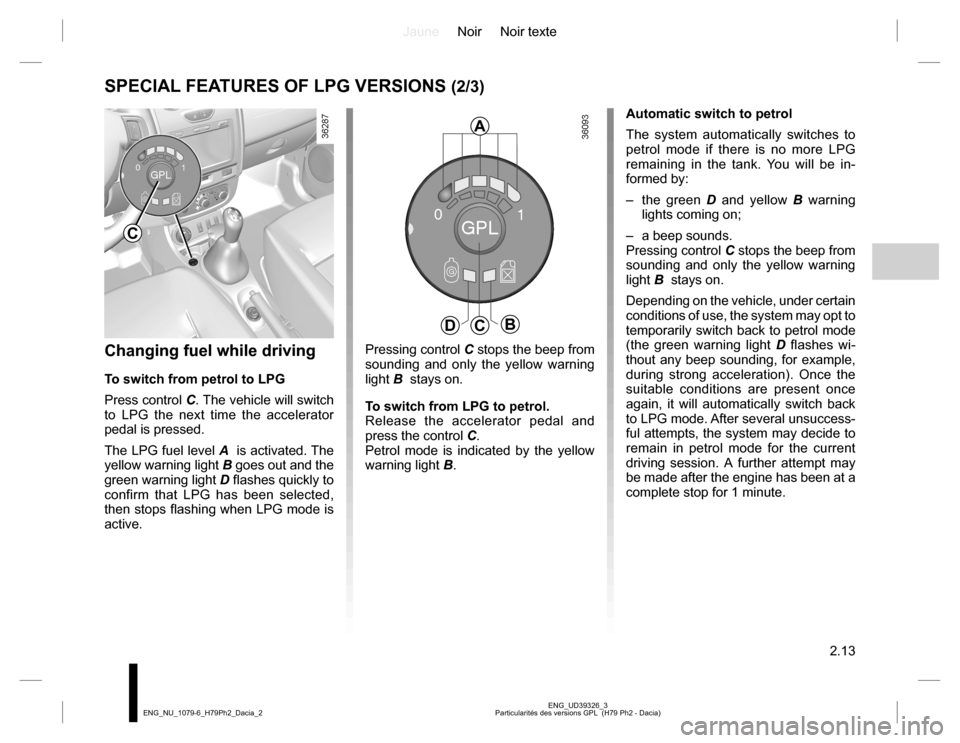
To switch from petrol to LPG
Press control C. The vehicle will switch
to LPG the next time the accelerator
pedal is pressed.
The LPG fuel level A is activated. The
yellow warning light B goes out and the
green warning light D flashes quickly to
confirm that LPG has been selected,
then stops flashing when LPG mode is
active.
Pressing control C stops the beep from
sounding and only the yellow warning
light B stays on.
To switch from LPG to petrol.
Release the accelerator pedal and
press the control C.
Petrol mode is indicated by the yellow
warning light B.Automatic switch to petrol
The system automatically switches to
petrol mode if there is no more LPG
remaining in the tank. You will be in-
formed by:
– the green D and yellow B warning
lights coming on;
– a beep sounds.
Pressing control C stops the beep from
sounding and only the yellow warning
light B stays on.
Depending on the vehicle, under certain
conditions of use, the system may opt to
temporarily switch back to petrol mode
(the green warning light D flashes wi-
thout any beep sounding, for example,
during strong acceleration). Once the
suitable conditions are present once
again, it will automatically switch back
to LPG mode. After several unsuccess-
ful attempts, the system may decide to
remain in petrol mode for the current
driving session. A further attempt may
be made after the engine has been at a
complete stop for 1 minute.
DCB
A
C
Page 95 of 254
JauneNoir Noir texte
2.19
ENG_UD35353_1
Conseils de conduite, eco conduite (H79 Ph2 - Dacia) ENG_NU_1079-6_H79Ph2_Dacia_2
DRIVING ADVICE, ECO-DRIVING (5/5)
– In vehicles fitted with air condi-
tioning, it is normal to observe an
increase in fuel consumption (es-
pecially in urban conditions) when
it is used. For vehicles fitted with
manual air conditioning, switch off
the system when it is not required.
Advice for reducing consumption
and therefore helping to preserve
the environment:
If the vehicle has been parked in the
sun, open the doors for a few mo-
ments to let the hot air escape before
starting the engine.
– Do not leave an empty roof rack
fitted to the vehicle.
– It is better to fit a trailer for bulky ob-
jects.
– When towing a caravan, fit a wind
deflector and adjust it carefully.
– Avoid using the car for door-to-door
calls (short journeys with long waits
in between) because the engine
never reaches its normal operating
temperature. Advice on use
– Favour ECO mode.
– Electricity is fuel; switch off all the
electrical components which are
not really needed. However (safety
first), keep your lights on when the
visibility is bad (“see and be seen”).
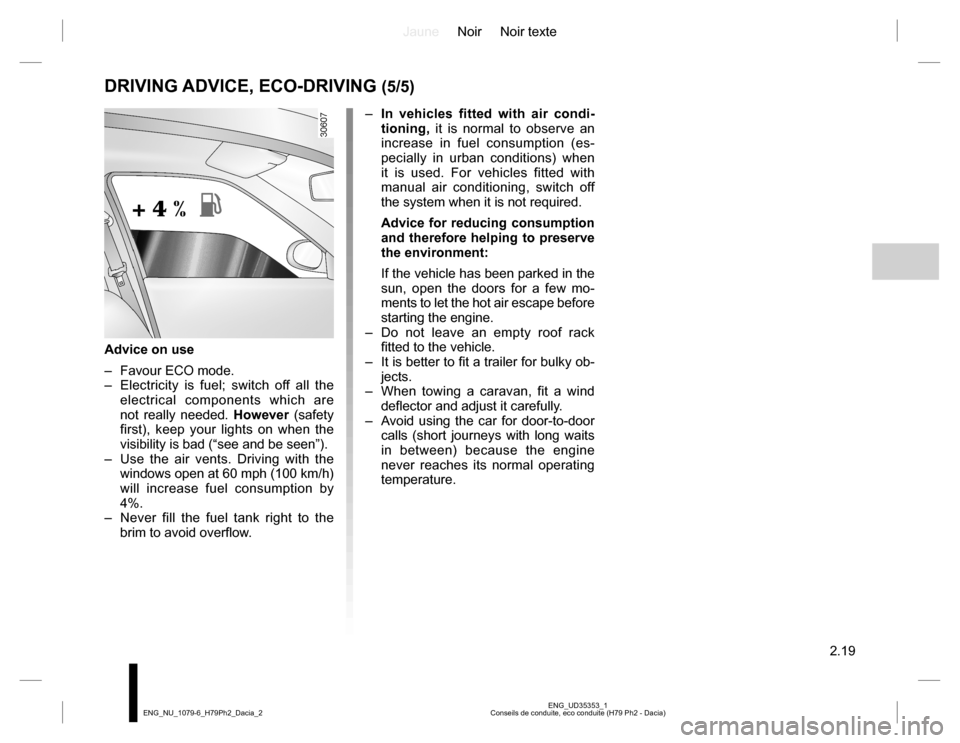
– Use the air vents. Driving with the
windows open at 60 mph (100 km/h)
will increase fuel consumption by
4%.
– Never fill the fuel tank right to the
brim to avoid overflow.
Page 97 of 254

JauneNoir Noir texte
2.21
ENG_UD34481_2
Environnement (sans marque) (X35 - X44 - X45 - X77 - X81 - X85 - X90 - X91 - X83 - X61 - TEST - X95 - L90 Ph2 - F90 Ph2 - R90 Ph2 - X33 - X47 - X43 - X38 - H79 - ENG_NU_1079-6_H79Ph2_Dacia_2
ENVIRONMENT
Emissions
Your vehicle has been designed to
emit fewer greenhouse gases (CO2)
while in use, and therefore to consume
less fuel (eg. 140 g/km, equivalent to
5.3 l/100 km for a diesel vehicle).
Our vehicles are also equipped with a
particle filter system including a cata-
lytic converter, an oxygen sensor and
an active carbon filter (the latter pre-
vents vapour from the fuel tank being
released into the open air).
For certain diesel vehicles, this system
also has a particle filter to reduce the
volume of soot particles emitted.
Please make your own
contribution towards
protecting the environment
too
– Worn parts replaced in the course of
routine vehicle maintenance (vehi-
cle battery, oil filter, air filter, batter-
ies, etc.) and oil containers (empty or
filled with used oil) must be disposed
of through specialist organisations.– At the end of the vehicle’s service
life, it should be sent to approved
centres to ensure that it is recycled.
– In all cases, comply with local legis-
lation.
Recycling
Your vehicle is 85% recyclable and
95% recoverable.
To achieve these objectives, many of
the vehicle components have been de-
signed to enable them to be recycled.
The materials and structures have
been carefully designed to allow these
components to be easily removed and
reprocessed by specialist companies.
In order to preserve raw material re-
sources, this vehicle incorporates nu-
merous parts made from recycled plas-
tics or renewable materials (vegetable
or animal-derived materials such as
cotton or wool). Your vehicle has been designed with
respect for the environment in mind for
its entire service life: during production,
use and at the end of its life.
This commitment is illustrated by the of
the manufacturer eco² signature.Manufacture
Your vehicle has been manufactured at
a factory which complies with a policy
to reduce the environmental impact
on the surrounding areas (reduction of
water and energy consumption, visual
and noise pollution, atmospheric emis-
sions and waste water; sorting and re-
using waste).
Page 250 of 254

JauneNoir Noir texte
7.2
FRA_UD39333_8
Index (H79 Ph2 - Dacia) ENG_NU_1079-6_H79Ph2_Dacia_7
ALPHABETICAL INDEX (2/5)
engine
technical specifications .................................................. 6.6
engine coolant ..................................................................... 4.9
engine immobiliser (switch) ................................................. 2.2
engine oil ............................................................................. 4.4
engine oil grade .........................................................4.5 → 4.7
engine oil level ...........................................................4.5 → 4.7
engine specifications ........................................................... 6.6
engine standby ..........................................................2.7 → 2.9
environment ....................................................................... 2.21
ESC: electronic stability control .............................2.34 → 2.37
F
4 wheel drive (4WD) ..............................................2.30 → 2.33
faults
operating faults ................................................5.45 → 5.49
filter .................................................................................... 4.11
air filter ......................................................................... 4.11
diesel filter ........................................................... 1.72, 4.11
passenger compartment filter ...................................... 4.11
fitting a radio ...................................................................... 5.43
fittings ....................................................................3.16 → 3.19
fog lights ............................................................................ 1.62
front passenger air bag deactivation ................................. 1.34
front seat adjustment .............................................. 1.12 – 1.13
front seats
adjustment ....................................................... 1.11 → 1.13
fuel
advice on fuel economy ...................................2.15 → 2.19
filling ............................................................................. 1.68
grade ..................................................................... 1.67, 6.6
fuel economy .........................................................2.15 → 2.19
fuel filler cap ...................................................................... 1.67
fuel grade........................................................................... 1.67
fuel priming bulb ................................................................ 1.72
fuel tank .................................................................1.67 → 1.72fuel tank capacity ............................................................... 1.67
fuses ......................................................................5.28 → 5.35
G
gear lever........................................................................... 2.29
glove box ........................................................................... 3.18
grab handle........................................................................ 3.13
H
handbrake.......................................................................... 2.29
hands-free telephone integrated control ............................ 3.29
hazard warning lights signal ................................... 1.59 – 1.60
headlight beam adjustment .................................... 1.63 – 1.64
headlight flashers ................................................... 1.59 – 1.60
headrest.................................................................... 1.11, 3.15
heating and air conditioning system ..........................3.2 → 3.7
heating system ..........................................................3.2 → 3.7
Hill Start Assist.......................................................2.34 → 2.37
horn ........................................................................ 1.59 – 1.60
hubcap tool .......................................................................... 5.2
I
ignition switch ...................................................................... 2.2
indicator lights.................................................................... 5.23
indicators ....................................................... 1.59 – 1.60, 5.16
indicators:
direction indicators ............................................ 1.59 – 1.60
instrument panel ...........................................1.42 → 1.50, 1.50
interior trim
maintenance ..................................................... 4.18 – 4.19
J
jack .................................................................. 5.2, 5.10 – 5.11
K
keys ............................................................................ 1.2 – 1.3