Eco DACIA DUSTER 2016 1.G Workshop Manual
[x] Cancel search | Manufacturer: DACIA, Model Year: 2016, Model line: DUSTER, Model: DACIA DUSTER 2016 1.GPages: 254, PDF Size: 18.85 MB
Page 135 of 254
JauneNoir Noir texte
3.7
ENG_UD18246_14
Air conditionné : informations et conseils utilisation (B90 - U90 - L90 Ph2 - F90 Ph2 - R90 Ph2 - H79 - Dacia) ENG_NU_1079-6_H79Ph2_Dacia_3
AIR CONDITIONING: information and advice on use
Fuel consumption
You will normally notice an increase
in fuel consumption (especially
when driving in town) when the air
conditioning is operating.
For vehicles fitted with air condition-
ing with no automatic mode, switch
off the system when it is not re-
quired.
Advice for reducing consumption
and helping to preserve the envi-
ronment
Drive with the air vents open and
the windows closed.
If the vehicle has been parked in
the sun, open the doors for a few
moments to let the hot air escape
before starting the engine. Operating faults
As a general rule, contact your ap-
proved dealer in the event of an op-
erating fault.
– Reduction in de-icing, demist-
ing or air conditioning per-
formance.
This may be caused by the pas-
senger compartment filter car-
tridge becoming clogged.
– No cold air is being produced.
Check that the controls are set
correctly and that the fuses are
sound. Otherwise, switch off the
system.
Do not open the refriger-
ant fluid circuit. The fluid
may damage eyes or skin.Presence of water under the ve-
hicle. After prolonged use of the air
conditioning system, it is normal for
water to be present under the vehi-
cle. This is caused by condensation.Maintenance
Refer to the Maintenance Document
for your vehicle for the inspection
frequency.
Page 137 of 254
JauneNoir Noir texte
3.9
ENG_UD32154_1
Lève-vitres (H79 - Dacia) ENG_NU_1079-6_H79Ph2_Dacia_3
ELECTRIC WINDOWS (2/3)
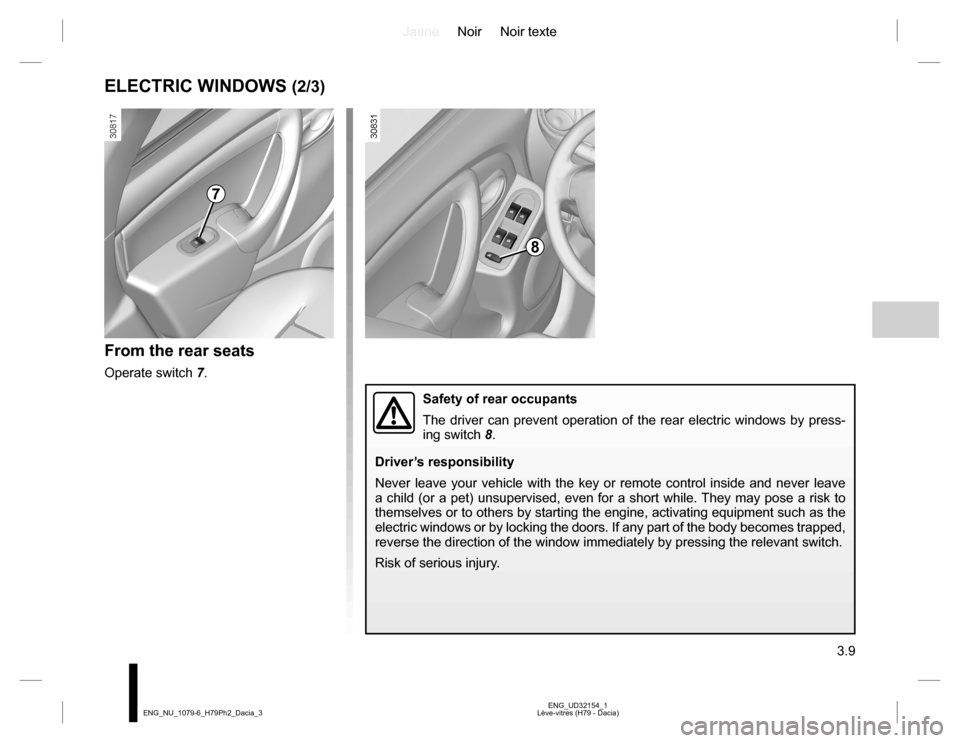
From the rear seats
Operate switch 7.
7
8
Safety of rear occupants
The driver can prevent operation of the rear electric windows by press-
ing switch 8.
Driver’s responsibility
Never leave your vehicle with the key or remote control inside and never leave
a child (or a pet) unsupervised, even for a short while. They may pose a risk to
themselves or to others by starting the engine, activating equipment such as the
electric windows or by locking the doors. If any part of the body becomes trapped,
reverse the direction of the window immediately by pressing the relevant switch.
Risk of serious injury.
Page 138 of 254
JauneNoir Noir texte
3.10
ENG_UD32154_1
Lève-vitres (H79 - Dacia) ENG_NU_1079-6_H79Ph2_Dacia_3
ELECTRIC WINDOWS (3/3)
One-touch windows
When the vehicle is equipped with this
function, the one-touch mode works in
addition to the operation of the electric
windows described previously.
It is only fitted to the driver’s window.
– Fully and briefly press down on the
relevant switch down: the window
will open completely.
– Fully and briefly lift the relevant
switch: the window will close com-
pletely.
Pressing the switch again while the
window is moving will stop its move-
ment.
Special features
If the window detects resistance when
closing (e.g.: fingers, branch of a tree,
etc.) it stops and then lowers again by a
few centimetres.
If you use the switch while the window
is moving, it stops working.
Operating faults
In case of a fault when closing a window,
the system reverts to normal mode: pull
the switch concerned up to fully close
the window, then hold the switch (still
on the closure side) for three seconds
then lower and raise the window fully to
reinitialise the system.
If necessary, contact an approved
Dealer.
Closing windows can cause
serious injury.
Avoid resting any objects against
a half-open window: there is a risk
that the electric window could be
damaged.
Page 140 of 254
JauneNoir Noir texte
3.12
ENG_UD39255_3
Eclairage intérieur (H79 - Dacia) ENG_NU_1079-6_H79Ph2_Dacia_3
INTERIOR LIGHTING (2/2)
Automatic operation of interior
lighting
(depending on the vehicle)
– if the doors are unlocked using
the remote control, the lighting
is switched on for approximately
30 seconds.
– If a door is open (or not properly
closed), the lighting is switched
on for approximately 3 to 30 mi-
nutes.
– if all the doors are closed, the
lighting start to dim when the ig-
nition is switched on.
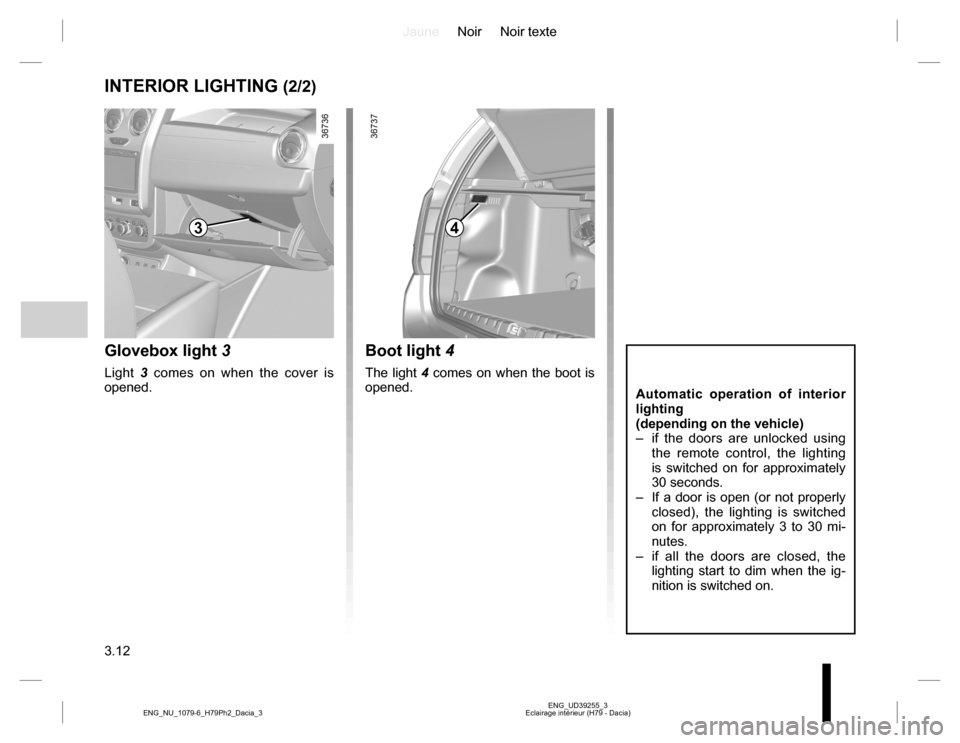
43
Boot light 4
The light 4 comes on when the boot is
opened.
Glovebox light 3
Light 3 comes on when the cover is
opened.
Page 162 of 254
JauneNoir Noir texte
4.4
ENG_UD37388_5
Niveau huile moteur : généralités (X52 - H79 Ph2 - Dacia) ENG_NU_1079-6_H79Ph2_Dacia_4
ENGINE OIL LEVEL: general information
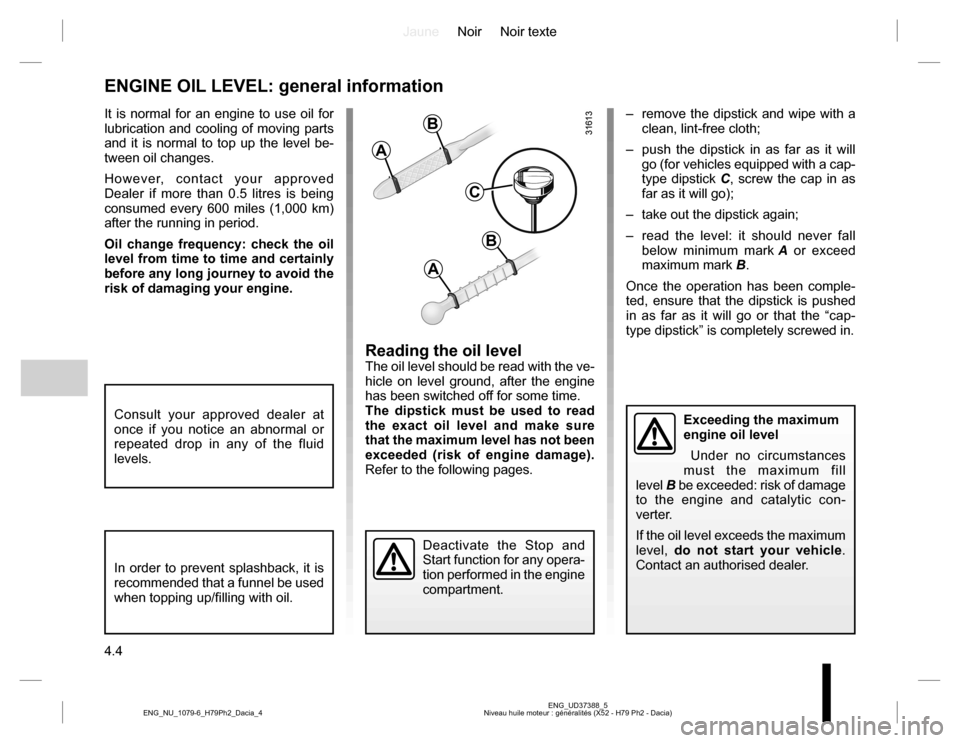
Reading the oil levelThe oil level should be read with the ve-
hicle on level ground, after the engine
has been switched off for some time.
The dipstick must be used to read
the exact oil level and make sure
that the maximum level has not been
exceeded (risk of engine damage).
Refer to the following pages.
C
A
B
A
B
Exceeding the maximum
engine oil level
Under no circumstances
must the maximum fill
level B be exceeded: risk of damage
to the engine and catalytic con-
verter.
If the oil level exceeds the maximum
level, do not start your vehicle.
Contact an authorised dealer.
It is normal for an engine to use oil for
lubrication and cooling of moving parts
and it is normal to top up the level be-
tween oil changes.
However, contact your approved
Dealer if more than 0.5 litres is being
consumed every 600 miles (1,000 km)
after the running in period.
Oil change frequency: check the oil
level from time to time and certainly
before any long journey to avoid the
risk of damaging your engine.
Consult your approved dealer at
once if you notice an abnormal or
repeated drop in any of the fluid
levels.
In order to prevent splashback, it is
recommended that a funnel be used
when topping up/filling with oil.
– remove the dipstick and wipe with a
clean, lint-free cloth;
– push the dipstick in as far as it will
go (for vehicles equipped with a cap-
type dipstick C, screw the cap in as
far as it will go);
– take out the dipstick again;
– read the level: it should never fall
below minimum mark A or exceed
maximum mark B.
Once the operation has been comple-
ted, ensure that the dipstick is pushed
in as far as it will go or that the “cap-
type dipstick” is completely screwed in.
Deactivate the Stop and
Start function for any opera-
tion performed in the engine
compartment.
Page 164 of 254
JauneNoir Noir texte
4.6
ENG_UD37389_3
Niveau huile moteur : appoint / remplissage (H79 Ph2 - Dacia) ENG_NU_1079-6_H79Ph2_Dacia_4
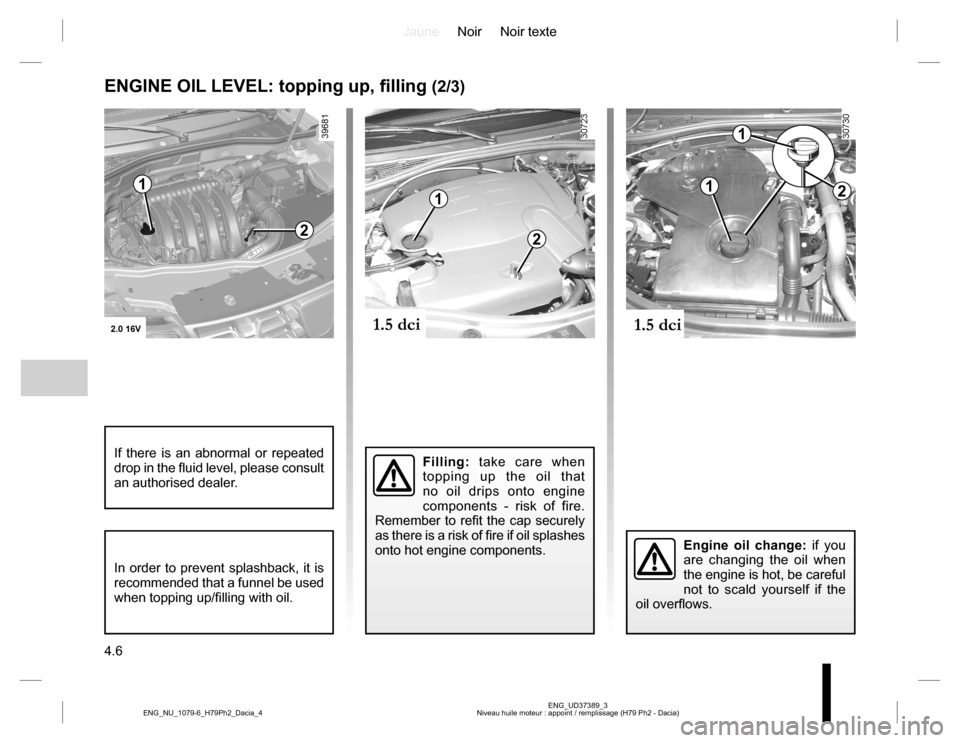
ENGINE OIL LEVEL: topping up, filling (2/3)
Filling: take care when
topping up the oil that
no oil drips onto engine
components - risk of fire.
Remember to refit the cap securely
as there is a risk of fire if oil splashes
onto hot engine components.If there is an abnormal or repeated
drop in the fluid level, please consult
an authorised dealer.
Engine oil change: if you
are changing the oil when
the engine is hot, be careful
not to scald yourself if the
oil overflows.
1
2
1
1
2
In order to prevent splashback, it is
recommended that a funnel be used
when topping up/filling with oil.
1
2
Page 165 of 254
JauneNoir Noir texte
4.7
ENG_UD37389_3
Niveau huile moteur : appoint / remplissage (H79 Ph2 - Dacia) ENG_NU_1079-6_H79Ph2_Dacia_4
ENGINE OIL LEVEL: topping up, filling (3/3)
Never run the engine in an
enclosed space as exhaust
gases are poisonous.
Resetting the alert after an oil
change
(depending on the vehicle)
If you change the oil yourself, you will
need to reset the oil change warning.
To do this, after switching on the igni-
tion, for ten seconds you must:
– Depress the accelerator pedal fully,
– with your foot on the accelerator, de-
press the brake pedal three times in
succession.
Reinitialisation is complete when the
# indicator light goes out. If this is
not the case, repeat the operation.
Special case: if you change the oil
before the oil change interval exceeded
warning is displayed, it will also be nec-
essary to reset the display. In this case,
the
# warning light comes on for
approximately 5 seconds to confirm the
reset.
The engine may be hot
during operations in close
proximity. In addition, the
engine cooling fan may
come on at any moment.
Risk of injury.
Exceeding the maximum
engine oil level
Under no circumstances
must the maximum fill level
be exceeded: risk of damage to the
engine and catalytic converter.
If the oil level exceeds the maximum
level, do not start your vehicle.
Contact an authorised dealer.
Deactivate the Stop and
Start function for any opera-
tion performed in the engine
compartment.
Oil change
Service interval: refer to the
Maintenance Document for your vehi-
cle.
Oil change capacity
Please refer to the maintenance docu-
ment for your vehicle, or contact an au-
thorised dealer.
Always check the engine oil level using
the dipstick, as explained previously (it
should never fall below the minimum
level, or be over the maximum level on
the dipstick).
Engine oil grade
Refer to the Maintenance Document for
your vehicle.
Page 166 of 254
JauneNoir Noir texte
4.8
ENG_UD37390_3
Niveaux (H79 - H79 Ph2 - Dacia) ENG_NU_1079-6_H79Ph2_Dacia_4
LEVELS (1/3)
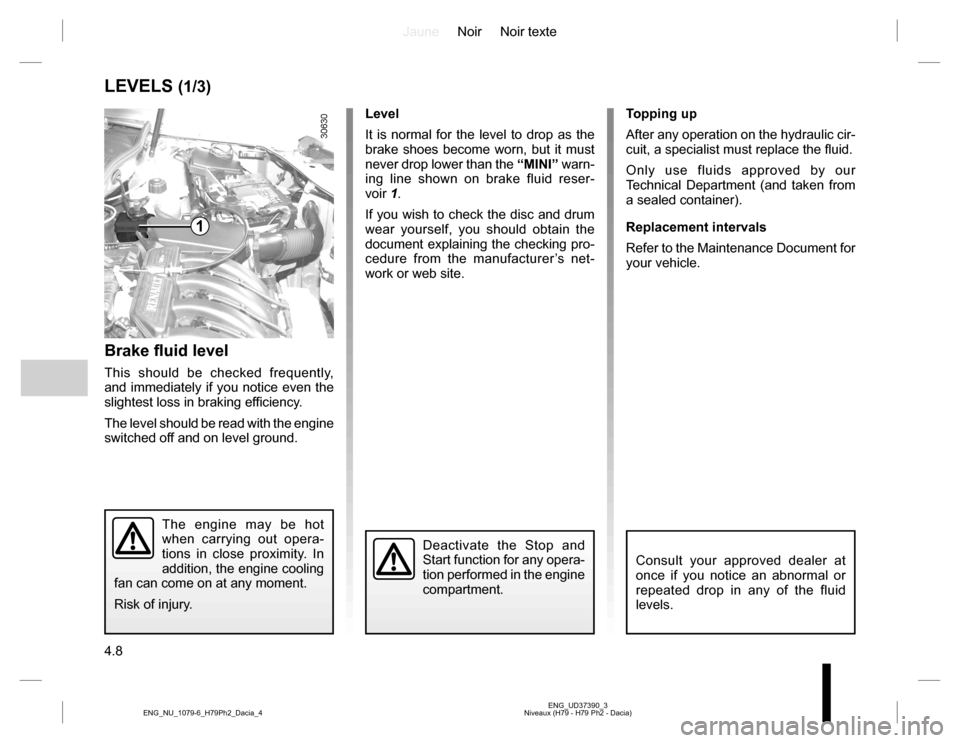
Brake fluid level
This should be checked frequently,
and immediately if you notice even the
slightest loss in braking efficiency.
The level should be read with the engine
switched off and on level ground. Level
It is normal for the level to drop as the
brake shoes become worn, but it must
never drop lower than the “MINI” warn-
ing line shown on brake fluid reser-
voir 1.
If you wish to check the disc and drum
wear yourself, you should obtain the
document explaining the checking pro-
cedure from the manufacturer’s net-
work or web site.Topping up
After any operation on the hydraulic cir-
cuit, a specialist must replace the fluid.
Only use fluids approved by our
Technical Department (and taken from
a sealed container).
Replacement intervals
Refer to the Maintenance Document for
your vehicle.
The engine may be hot
when carrying out opera-
tions in close proximity. In
addition, the engine cooling
fan can come on at any moment.
Risk of injury.
Consult your approved dealer at
once if you notice an abnormal or
repeated drop in any of the fluid
levels.
1
Deactivate the Stop and
Start function for any opera-
tion performed in the engine
compartment.
Page 170 of 254
JauneNoir Noir texte
4.12
ENG_UD38371_4
Pressions de gonflage des pneumatiques à froid (H79 - H79 Ph2 - Dacia) ENG_NU_1079-6_H79Ph2_Dacia_4
TYRE PRESSURE (1/2)
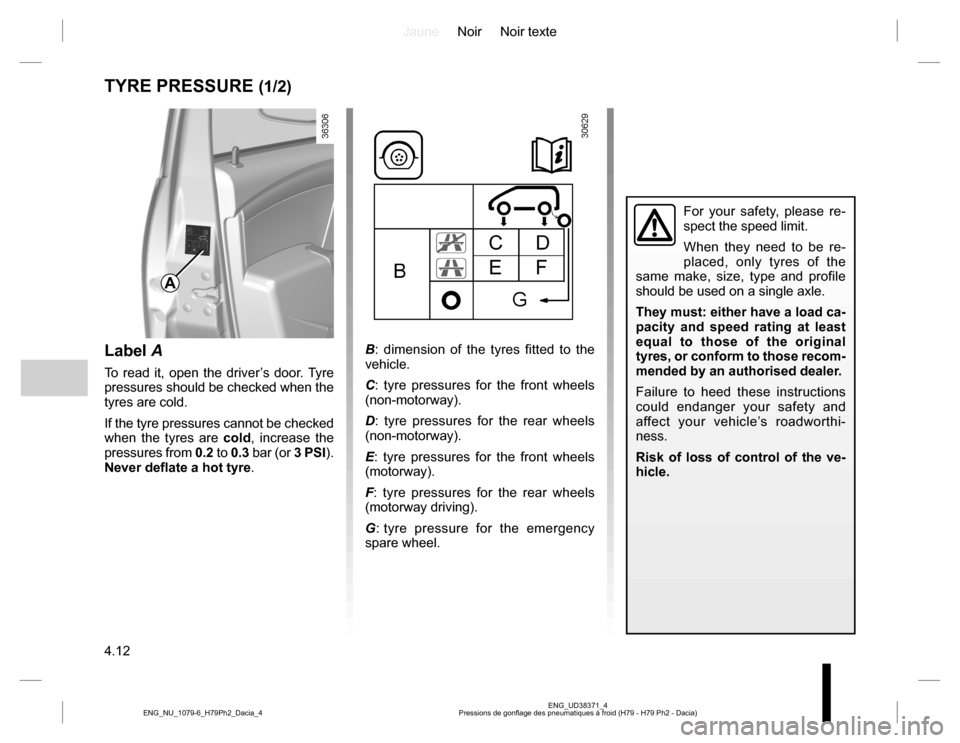
B: dimension of the tyres fitted to the
vehicle.
C: tyre pressures for the front wheels
(non-motorway).
D: tyre pressures for the rear wheels
(non-motorway).
E: tyre pressures for the front wheels
(motorway).
F: tyre pressures for the rear wheels
(motorway driving).
G: tyre pressure for the emergency
spare wheel.
For your safety, please re-
spect the speed limit.
When they need to be re-
placed, only tyres of the
same make, size, type and profile
should be used on a single axle.
They must: either have a load ca-
pacity and speed rating at least
equal to those of the original
tyres, or conform to those recom-
mended by an authorised dealer.
Failure to heed these instructions
could endanger your safety and
affect your vehicle’s roadworthi-
ness.
Risk of loss of control of the ve-
hicle.
A
Label A
To read it, open the driver’s door. Tyre
pressures should be checked when the
tyres are cold.
If the tyre pressures cannot be checked
when the tyres are cold, increase the
pressures from 0.2 to 0.3 bar (or 3 PSI).
Never deflate a hot tyre.
Page 174 of 254

JauneNoir Noir texte
4.16
ENG_UD26811_2
Entretien de la carrosserie (peinture mate) (X44 - X77 - J77 - X85 - B90 - X61 - TEST - X77 ph2 - X95 - B95 - D95 - K95 - J95 - R95 - L90 Ph2 - F90 Ph2 - R90 Ph2 - X62 ENG_NU_1079-6_H79Ph2_Dacia_4
BODYWORK MAINTENANCE (1/2)
You should
Wash your car frequently, with the
engine off, with cleaning products rec-
ommended by the manufacturer (never
use abrasive products). Rinse thor-
oughly beforehand with a jet:
– spots of tree resin and industrial
grime;
– mud in the wheel arches and under-
neath the body which forms damp
patches;
– bird droppings, which cause a
chemical reaction with the paint that
rapidly discolours paintwork and
may even cause the paint to peel
off;
wash the vehicle immediately to
remove these marks since it is im-
possible to remove them by polish-
ing;
– salt, particularly in the wheel arches
and underneath the body after driv-
ing in areas where the roads have
been gritted.
Remove any plant matter (resin, leaves,
etc.) from the vehicle regularly.
What you should not doDo not degrease or clean mechani-
cal components (e.g. the engine com-
partment), underneath the body, parts
with hinges (e.g. inside the doors) and
painted plastic external fittings (e.g.
bumpers) using high-pressure clean-
ing equipment or by spraying on prod-
ucts not approved by our Technical
Department. Doing this could give rise
to corrosion or operational faults.
Wash the vehicle in bright sunlight or
freezing temperatures.
Do not scrape off mud or dirt without
pre-wetting.
Allow dirt to accumulate on the exterior.
Allow rust to form following minor im-
pacts.
Do not use solvents not approved by
our Technical Department to remove
stains as this could damage the paint-
work.
Do not drive in snow or muddy condi-
tions without washing the vehicle, par-
ticularly under the wheel arches and
body. A well-maintained vehicle will last
longer. It is therefore recommended to
maintain the exterior of the vehicle reg-
ularly.
Your vehicle has been treated with very
effective anti-corrosion products. It is
nevertheless subject to various outside
influences.
Corrosive agents in the atmosphere
– atmospheric pollution (built-up and
industrial areas),
– saline atmospheres (near the sea,
particularly in hot weather),
– seasonal and damp weather condi-
tions (e.g. road salt in winter, water
from road cleaners, etc.).
Minor impacts
Abrasive action
Dust and sand in the air, mud, road grit
thrown up by other vehicles, etc.
You should take a number of minor pre-
cautions in order to safeguard your ve-
hicle against such risks.