Air bag DACIA DUSTER 2016 1.G Owners Manual
[x] Cancel search | Manufacturer: DACIA, Model Year: 2016, Model line: DUSTER, Model: DACIA DUSTER 2016 1.GPages: 254, PDF Size: 18.85 MB
Page 5 of 254
JauneNoir Noir texte
1.1
ENG_UD39327_8
Sommaire 1 (H79 Ph2 - Dacia) ENG_NU_1079-6_H79Ph2_Dacia_1
Section 1: Getting to know your vehicle
Keys, radio frequency remote control: general information . . . . . . . . . . . . . . . . . . . . . . . . . . . . . . . . 1.2
Locking/unlocking the doors . . . . . . . . . . . . . . . . . . . . . . . . . . . . . . . . . . . . . . . . . . . . . . . . . . . . . . . 1.5
Automatic locking when driving . . . . . . . . . . . . . . . . . . . . . . . . . . . . . . . . . . . . . . . . . . . . . . . . . . . . . 1.8
Opening and closing the doors . . . . . . . . . . . . . . . . . . . . . . . . . . . . . . . . . . . . . . . . . . . . . . . . . . . . . 1.9
Front headrests . . . . . . . . . . . . . . . . . . . . . . . . . . . . . . . . . . . . . . . . . . . . . . . . . . . . . . . . . . . . . . . . . 1.11
Front seats. . . . . . . . . . . . . . . . . . . . . . . . . . . . . . . . . . . . . . . . . . . . . . . . . . . . . . . . . . . . . . . . . . . . . 1.12
Seat belts. . . . . . . . . . . . . . . . . . . . . . . . . . . . . . . . . . . . . . . . . . . . . . . . . . . . . . . . . . . . . . . . . . . . . . 1.14
Methods of restraint in addition to the front seat belts . . . . . . . . . . . . . . . . . . . . . . . . . . . . . . . . . . . . 1.18
Side protection devices . . . . . . . . . . . . . . . . . . . . . . . . . . . . . . . . . . . . . . . . . . . . . . . . . . . . . . . . . . . 1.21
Additional methods of restraint . . . . . . . . . . . . . . . . . . . . . . . . . . . . . . . . . . . . . . . . . . . . . . . . . . . . . 1.22
Child safety: General information . . . . . . . . . . . . . . . . . . . . . . . . . . . . . . . . . . . . . . . . . . . . . . . . . . . 1.23
child seat mounting . . . . . . . . . . . . . . . . . . . . . . . . . . . . . . . . . . . . . . . . . . . . . . . . . . . . . . . . 1.26
fitting a child seat . . . . . . . . . . . . . . . . . . . . . . . . . . . . . . . . . . . . . . . . . . . . . . . . . . . . . . . . . . 1.28
Deactivating/activating the front passenger air bag . . . . . . . . . . . . . . . . . . . . . . . . . . . . . . . . 1.34
Rear view mirrors . . . . . . . . . . . . . . . . . . . . . . . . . . . . . . . . . . . . . . . . . . . . . . . . . . . . . . . . . . . . . . . 1.37
Driving position . . . . . . . . . . . . . . . . . . . . . . . . . . . . . . . . . . . . . . . . . . . . . . . . . . . . . . . . . . . . . . . . . 1.38
Instrument panel: warning lights . . . . . . . . . . . . . . . . . . . . . . . . . . . . . . . . . . . . . . . . . . . . . . . . . . . . 1.42
Display and indicators . . . . . . . . . . . . . . . . . . . . . . . . . . . . . . . . . . . . . . . . . . . . . . . . . . . . . . . . . . . . 1.49
Trip computer and warning system . . . . . . . . . . . . . . . . . . . . . . . . . . . . . . . . . . . . . . . . . . . . . . . . . . 1.51
Steering wheel, Power-assisted steering . . . . . . . . . . . . . . . . . . . . . . . . . . . . . . . . . . . . . . . . . . . . . 1.57
Clock . . . . . . . . . . . . . . . . . . . . . . . . . . . . . . . . . . . . . . . . . . . . . . . . . . . . . . . . . . . . . . . . . . . . . . . . . 1.58
Audible and visual signals . . . . . . . . . . . . . . . . . . . . . . . . . . . . . . . . . . . . . . . . . . . . . . . . . . . . . . . . . 1.59
Exterior lighting and signals. . . . . . . . . . . . . . . . . . . . . . . . . . . . . . . . . . . . . . . . . . . . . . . . . . . . . . . . 1.61
Adjusting the headlight beam height . . . . . . . . . . . . . . . . . . . . . . . . . . . . . . . . . . . . . . . . . . . . . . . . . 1.63
Screen washer/wiper . . . . . . . . . . . . . . . . . . . . . . . . . . . . . . . . . . . . . . . . . . . . . . . . . . . . . . . . . . . . . 1.65
Fuel tank (filling with fuel) . . . . . . . . . . . . . . . . . . . . . . . . . . . . . . . . . . . . . . . . . . . . . . . . . . . . . . . . . 1.67
Page 22 of 254
JauneNoir Noir texte
1.18
ENG_UD32115_1
Dispositifs complémentaires aux ceintures avant (H79 - Dacia) ENG_NU_1079-6_H79Ph2_Dacia_1
METHODS OF RESTRAINT IN ADDITION TO THE FRONT SEAT BELTS (1/3)
– Have the entire restraint
system checked following
an accident.
– No operation whatsoever
is permitted on any part of the
system (air bags, electronic con-
trol units, wiring) and the system
components must not be reused
on any other vehicle, even if iden-
tical.
– To avoid premature triggering
of the system which may cause
injury, only qualified Network per-
sonnel are authorisedto work on
the methods of restraint in addi-
tion to the front seat belt.
– The electric trigger system may
only be tested by a specially
trained technician using special
equipment.
– When the vehicle is scrapped,
contact an approved dealer for
disposal of the pretensioner and
airbag gas generators.
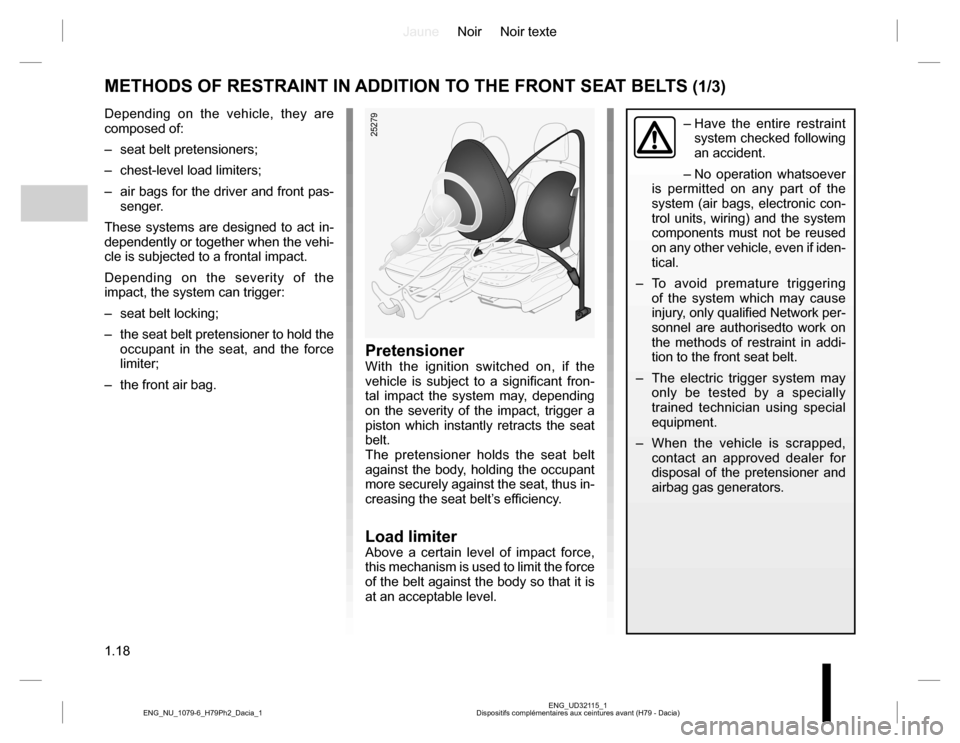
PretensionerWith the ignition switched on, if the
vehicle is subject to a significant fron-
tal impact the system may, depending
on the severity of the impact, trigger a
piston which instantly retracts the seat
belt.
The pretensioner holds the seat belt
against the body, holding the occupant
more securely against the seat, thus in-
creasing the seat belt’s efficiency.
Load limiterAbove a certain level of impact force,
this mechanism is used to limit the force
of the belt against the body so that it is
at an acceptable level. Depending on the vehicle, they are
composed of:
– seat belt pretensioners;
– chest-level load limiters;
– air bags for the driver and front pas-
senger.
These systems are designed to act in-
dependently or together when the vehi-
cle is subjected to a frontal impact.
Depending on the severity of the
impact, the system can trigger:
– seat belt locking;
– the seat belt pretensioner to hold the
occupant in the seat, and the force
limiter;
– the front air bag.
Page 23 of 254
JauneNoir Noir texte
1.19
ENG_UD32115_1
Dispositifs complémentaires aux ceintures avant (H79 - Dacia) ENG_NU_1079-6_H79Ph2_Dacia_1
METHODS OF RESTRAINT IN ADDITION TO THE FRONT SEAT BELTS (2/3)
Driver’s and passenger air
bags
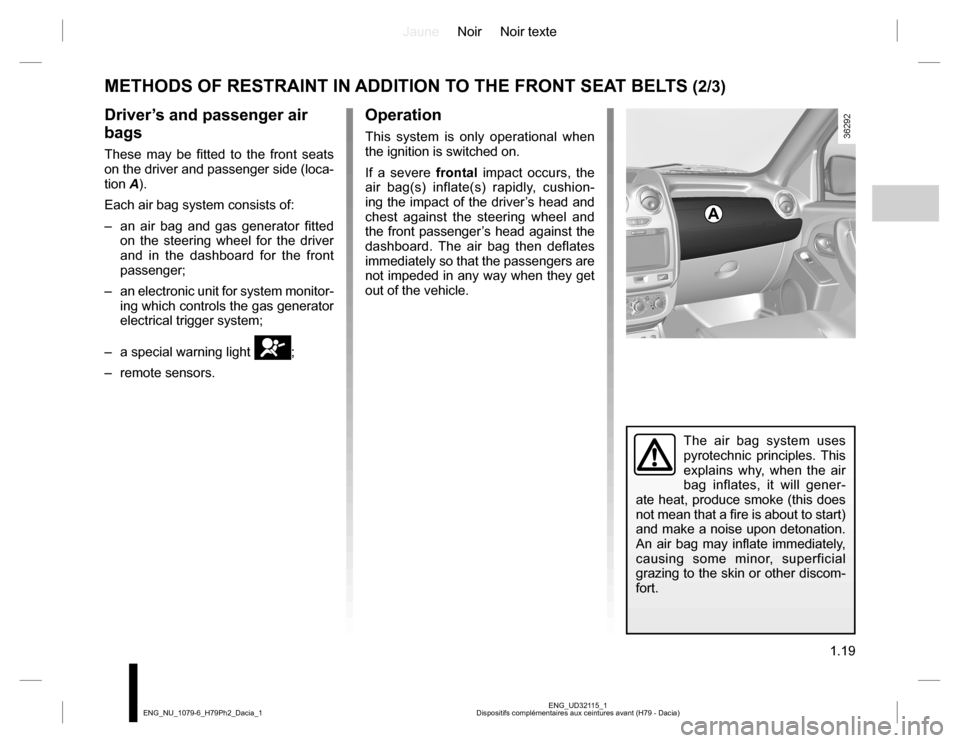
These may be fitted to the front seats
on the driver and passenger side (loca-
tion A).
Each air bag system consists of:
– an air bag and gas generator fitted
on the steering wheel for the driver
and in the dashboard for the front
passenger;
– an electronic unit for system monitor-
ing which controls the gas generator
electrical trigger system;
– a special warning light
å;
– remote sensors.
The air bag system uses
pyrotechnic principles. This
explains why, when the air
bag inflates, it will gener-
ate heat, produce smoke (this does
not mean that a fire is about to start)
and make a noise upon detonation.
An air bag may inflate immediately,
causing some minor, superficial
grazing to the skin or other discom-
fort.
Operation
This system is only operational when
the ignition is switched on.
If a severe frontal impact occurs, the
air bag(s) inflate(s) rapidly, cushion-
ing the impact of the driver’s head and
chest against the steering wheel and
the front passenger’s head against the
dashboard. The air bag then deflates
immediately so that the passengers are
not impeded in any way when they get
out of the vehicle.
A
Page 24 of 254
JauneNoir Noir texte
1.20
ENG_UD32115_1
Dispositifs complémentaires aux ceintures avant (H79 - Dacia) ENG_NU_1079-6_H79Ph2_Dacia_1
METHODS OF RESTRAINT IN ADDITION TO THE FRONT SEAT BELTS (3/3)
Warnings concerning the driver’s air bag
– Do not modify the steering wheel or the steering wheel boss.
– Do not cover the steering wheel boss under any circumstances.
– Do not attach any objects (badge, logo, clock, telephone holder, etc.) to the steering wheel boss.
– You must not remove the steering wheel (such work must only be performed by trained personnel from our Network).
– When driving, do not sit too close to the steering wheel. Sit with your arms slightly bent (see the information on “Adjusting
your driving position” in Section 1). This will allow sufficient space for the air bag to inflate properly and be fully effective.
Warnings concerning the passenger air bag
– Do not attach or glue any objects (badge, logo, clock, telephone holder, etc.) to the dashboard in the proximity of the air bag
housing.
– Do not place anything between the dashboard and the passenger (pet, umbrella, walking stick, parcels, etc.).
– The passenger must not put his or her feet on the dashboard or seat as there is a risk that serious injuries may occur. In
general, all parts of the body should be kept away from the dashboard (knees, hands, head etc.).
– You should reactivate the passenger air bag as soon as you remove the child seat to ensure the protection of the front pas-
senger in the event of an impact.
A REAR-FACING CHILD SEAT MUST NOT BE FITTED TO THE FRONT PASSENGER SEAT UNLESS
THE RESTRAINT SYSTEMS IN ADDITION TO THE SEAT BELT, I.E. AIR BAG, ARE DEACTIVATED.
(refer to the information on “Child safety: deactivating/activating the front passenger air bag” in Section 1)
All of the warnings below are given so that the air bag is not obstructed in any way when it is deployed and also to pre-
vent the risk of serious injuries caused by items which may be dislodged when the air bag deploys.
Page 25 of 254
JauneNoir Noir texte
1.21
ENG_UD18027_3
Dispositifs de protection latérale (B90 - L90 Ph2 - H79 - Dacia) ENG_NU_1079-6_H79Ph2_Dacia_1
SIDE PROTECTION DEVICES
Side air bags
These air bags may be fitted to the front
seats and are deployed at the sides of
the seats (door side) to protect the oc-
cupants in the event of a severe side
impact.
Warnings concerning the side air bag
– Fitting seat covers: seats equipped with an air bag require covers
specifically designed for your vehicle. Contact an approved dealer to find
out if such covers are available from our Network. The use of any covers
other than those designed for your vehicle (including those designed for an-
other vehicle) may affect the operation of the air bags and reduce your protec-
tion.
– Do not place any accessories, objects, or even pets, between the seatback,
the door and the internal fittings. Do not cover the seatback with objects such
as clothes or accessories. This may prevent the air bag from operating cor-
rectly or cause injury when the air bag is deployed.
– No work or modification whatsoever may be carried out on the seat or internal
fittings, except by qualified personnel from our Network.
Page 26 of 254
JauneNoir Noir texte
1.22
ENG_UD32117_1
Dispositifs de retenue complémentaires (H79 - Dacia) ENG_NU_1079-6_H79Ph2_Dacia_1
The airbag is designed to complement the action of the seat belt. Both the
airbags and seat belts are integral parts of the same protection system.
It is therefore essential to wear the seat belt at all times. If seat belts are
not worn, the occupants are exposed to the risk of serious injury in the
event of an accident. It may also increase the risk of minor superficial injuries
occurring when the airbag is deployed, although such minor injuries are always
possible with airbags.
If the vehicle should overturn or suffer a rear impact, however severe, the pre-
tensioners and air bags are not always triggered. Impacts to the underside of the
vehicle, e.g. from pavements, potholes or stones, can all trigger these systems.
– No work or modification whatsoever may be carried out on any part of the
driver or passenger air bag system (air bag, electronic unit, wiring, etc.), except
by qualified personnel from our Network.
– To ensure that the system is in good working order and to avoid accidental trig-
gering of the system which could cause injury, only qualified personnel from
our Network may work on the air bag system.
– As a safety precaution, have the air bag system checked if your vehicle has
been involved in an accident, or is stolen or broken into.
– When selling or lending the vehicle, inform the user of these points and hand
over this driver’s handbook with the vehicle.
– When scrapping your vehicle, contact your approved Dealer for disposal of the
gas generator(s).
All of the warnings below are given so that the air bag is not obstructed in any way when it is inflated and also to prevent
the risk of serious injuries caused by items which may be dislodged when the air bag inflates.
ADDITIONAL METHODS OF RESTRAINT
Operating faults
This warning light å will light up on
the instrument panel when the ignition
is switched on and then go out after a
few seconds.
If it does not light up when the ignition
is switched on, or if it lights up when the
engine is running, it indicates a fault in
the system. In this case, fitting a child
seat in the front passenger seat is
PROHIBITED.
Contact an approved dealer as soon
as possible. Your protection will be re-
duced until this fault is rectified.
Page 32 of 254
JauneNoir Noir texte
1.28
ENG_UD34961_5
Sécurité enfants : installation du siège enfant (H79 - H79 Ph2 - H79 Nissan - Dacia) ENG_NU_1079-6_H79Ph2_Dacia_1
CHILD SAFETY: fitting a child seat (1/6)
In the front seat
The laws concerning children travel-
ling in the front passenger seat differ in
every country. Consult the legislation in
force and follow the indications on the
diagram on the following page.
Before fitting a child seat in this seat (if
authorised):
– deactivate the front passenger air
bag;
– lower the seat belt as far as possible;
– move the seat as far back as pos-
sible;
– gently tilt the seatback away from
vertical (approximately 25°).
Do not change these settings after the
child seat is installed.
RISK OF DEATH OR
SERIOUS INJURY: before
fitting a child seat in this
seat, check that the air bag
has been deactivated (refer to the in-
formation on “Deactivating the front
passenger air bag” in Section 1).
Some seats are not suitable for fitting
child seats. The diagram on the fol-
lowing page shows you how to attach
a child seat.
The types of child seats indicated may
not be available. Before using a diffe-
rent child seat, check with the manufac-
turer that it can be fitted.
Fit the child seat in a rear
seat wherever possible.
Check that when installing
the child seat in the vehicle
it is not at risk of coming loose from
its base.
If you have to remove the headrest,
check that it is correctly stored so
that it does not come loose under
harsh braking or impact.
Always attach the child seat to the
vehicle even if it is not in use so that
it does not come loose under harsh
braking or impact.
Page 34 of 254
JauneNoir Noir texte
1.30
ENG_UD34961_5
Sécurité enfants : installation du siège enfant (H79 - H79 Ph2 - H79 Nissan - Dacia) ENG_NU_1079-6_H79Ph2_Dacia_1
CHILD SAFETY: fitting a child seat (3/6)
Using a child safety system
which is not approved for
this vehicle will not correctly
protect the baby or child.
They risk serious or even fatal injury.
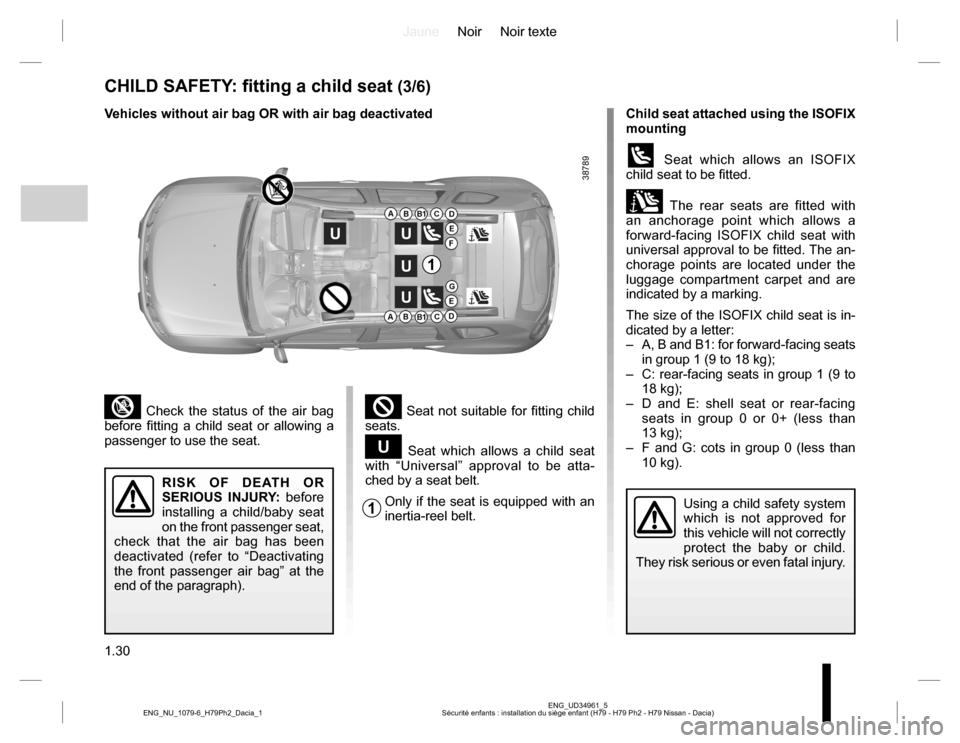
³ Check the status of the air bag
before fitting a child seat or allowing a
passenger to use the seat. Vehicles without air bag OR with air bag deactivated
RISK OF DEATH OR
SERIOUS INJURY: before
installing a child/baby seat
on the front passenger seat,
check that the air bag has been
deactivated (refer to “Deactivating
the front passenger air bag” at the
end of the paragraph).
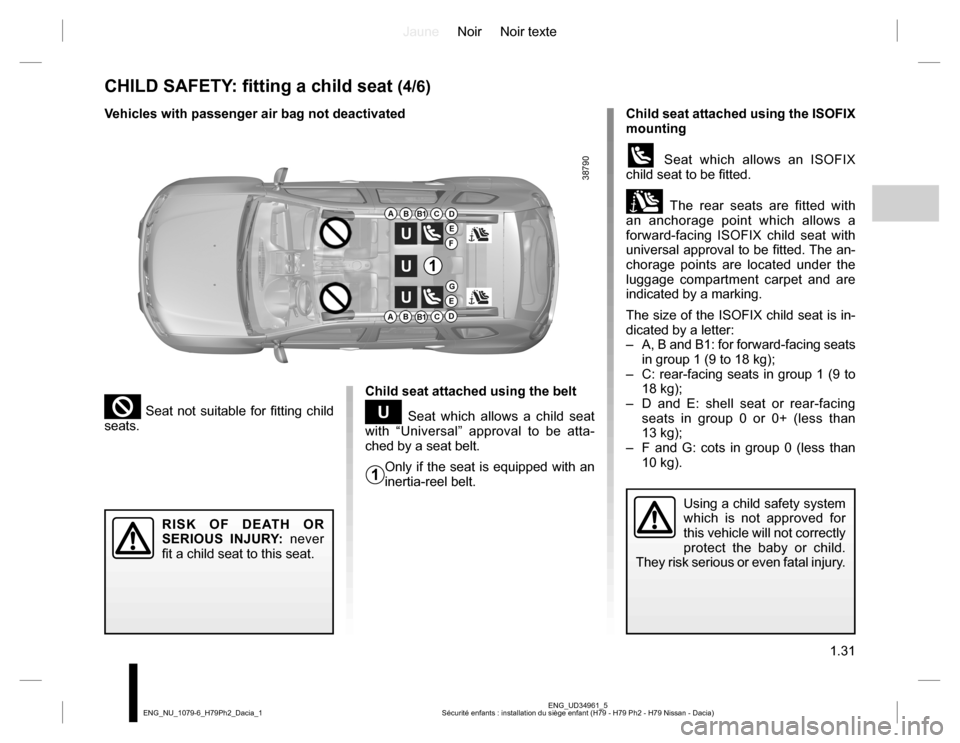
Child seat attached using the ISOFIX
mounting
ü Seat which allows an ISOFIX
child seat to be fitted.
± The rear seats are fitted with
an anchorage point which allows a
forward-facing ISOFIX child seat with
universal approval to be fitted. The an-
chorage points are located under the
luggage compartment carpet and are
indicated by a marking.
The size of the ISOFIX child seat is in-
dicated by a letter:
– A, B and B1: for forward-facing seats
in group 1 (9 to 18 kg);
– C: rear-facing seats in group 1 (9 to
18 kg);
– D and E: shell seat or rear-facing
seats in group 0 or 0+ (less than
13 kg);
– F and G: cots in group 0 (less than
10 kg).
² Seat not suitable for fitting child
seats.
¬ Seat which allows a child seat
with “Universal” approval to be atta-
ched by a seat belt.
Only if the seat is equipped with an
inertia-reel belt.
1
1
Page 35 of 254
JauneNoir Noir texte
1.31
ENG_UD34961_5
Sécurité enfants : installation du siège enfant (H79 - H79 Ph2 - H79 Nissan - Dacia) ENG_NU_1079-6_H79Ph2_Dacia_1
CHILD SAFETY: fitting a child seat (4/6)
Child seat attached using the belt
¬ Seat which allows a child seat
with “Universal” approval to be atta-
ched by a seat belt.
Only if the seat is equipped with an
inertia-reel belt.
Using a child safety system
which is not approved for
this vehicle will not correctly
protect the baby or child.
They risk serious or even fatal injury.
² Seat not suitable for fitting child
seats. Vehicles with passenger air bag not deactivated
RISK OF DEATH OR
SERIOUS INJURY: never
fit a child seat to this seat.
Child seat attached using the ISOFIX
mounting
ü Seat which allows an ISOFIX
child seat to be fitted.
± The rear seats are fitted with
an anchorage point which allows a
forward-facing ISOFIX child seat with
universal approval to be fitted. The an-
chorage points are located under the
luggage compartment carpet and are
indicated by a marking.
The size of the ISOFIX child seat is in-
dicated by a letter:
– A, B and B1: for forward-facing seats
in group 1 (9 to 18 kg);
– C: rear-facing seats in group 1 (9 to
18 kg);
– D and E: shell seat or rear-facing
seats in group 0 or 0+ (less than
13 kg);
– F and G: cots in group 0 (less than
10 kg).
1
1
Page 36 of 254
JauneNoir Noir texte
1.32
ENG_UD34961_5
Sécurité enfants : installation du siège enfant (H79 - H79 Ph2 - H79 Nissan - Dacia) ENG_NU_1079-6_H79Ph2_Dacia_1
CHILD SAFETY: fitting a child seat (5/6)
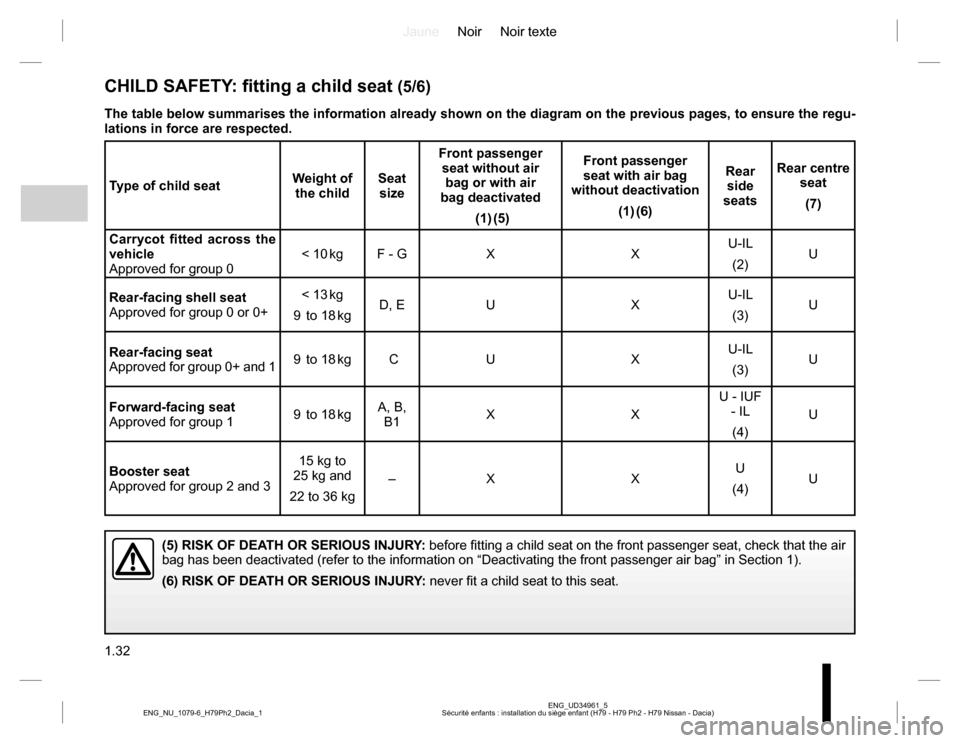
(5) RISK OF DEATH OR SERIOUS INJURY: before fitting a child seat on the front passenger seat, check that the air
bag has been deactivated (refer to the information on “Deactivating the front passenger air bag” in Section 1).
(6) RISK OF DEATH OR SERIOUS INJURY: never fit a child seat to this seat.
The table below summarises the information already shown on the diagram on the previous pages, to ensure the regu-
lations in force are respected.
Type of child seatWeight of
the childSeat
sizeFront passenger
seat without air
bag or with air
bag deactivated
(1) (5)Front passenger
seat with air bag
without deactivation
(1) (6)Rear
side
seatsRear centre
seat
(7)
Carrycot fitted across the
vehicle
Approved for group 0< 10 kg F - G X XU-IL
(2)U
Rear-facing shell seat
Approved for group 0 or 0+ < 13 kg
9 to 18 kgD, E U XU-IL
(3)U
Rear-facing seat
Approved for group 0+ and 19 to 18 kg C U XU-IL
(3)U
Forward-facing seat
Approved for group 19 to 18 kgA, B,
B1XXU - IUF
- IL
(4)U
Booster seat
Approved for group 2 and 315 kg to
25 kg and
22 to 36 kg–X XU
(4)U