Pump DACIA DUSTER 2017 Owners Manual
[x] Cancel search | Manufacturer: DACIA, Model Year: 2017, Model line: DUSTER, Model: DACIA DUSTER 2017Pages: 244, PDF Size: 3.57 MB
Page 66 of 244
Downloaded from www.Manualslib.com manuals search engine JauneNoir Noir texte
1.60
ENG_UD32128_1
Volant de direction/Direction assistée (H79 Ph2 - Dacia)
ENG_NU_1079-3_H79Ph2_Dacia_1
STEERING WHEEL, POWER-ASSISTED STEERING
Power Assisted Steering
With the engine running, do not leave
the steering wheel at full lock while sta-
tionary as this may damage the power-
assisted steering pump.
With the engine switched off, or if there
is a system fault, it is still possible to
turn the steering wheel. The force re-
quired will be greater.
Adjusting the steering wheel
Depending on the vehicle, the steering
wheel position is adjustable.
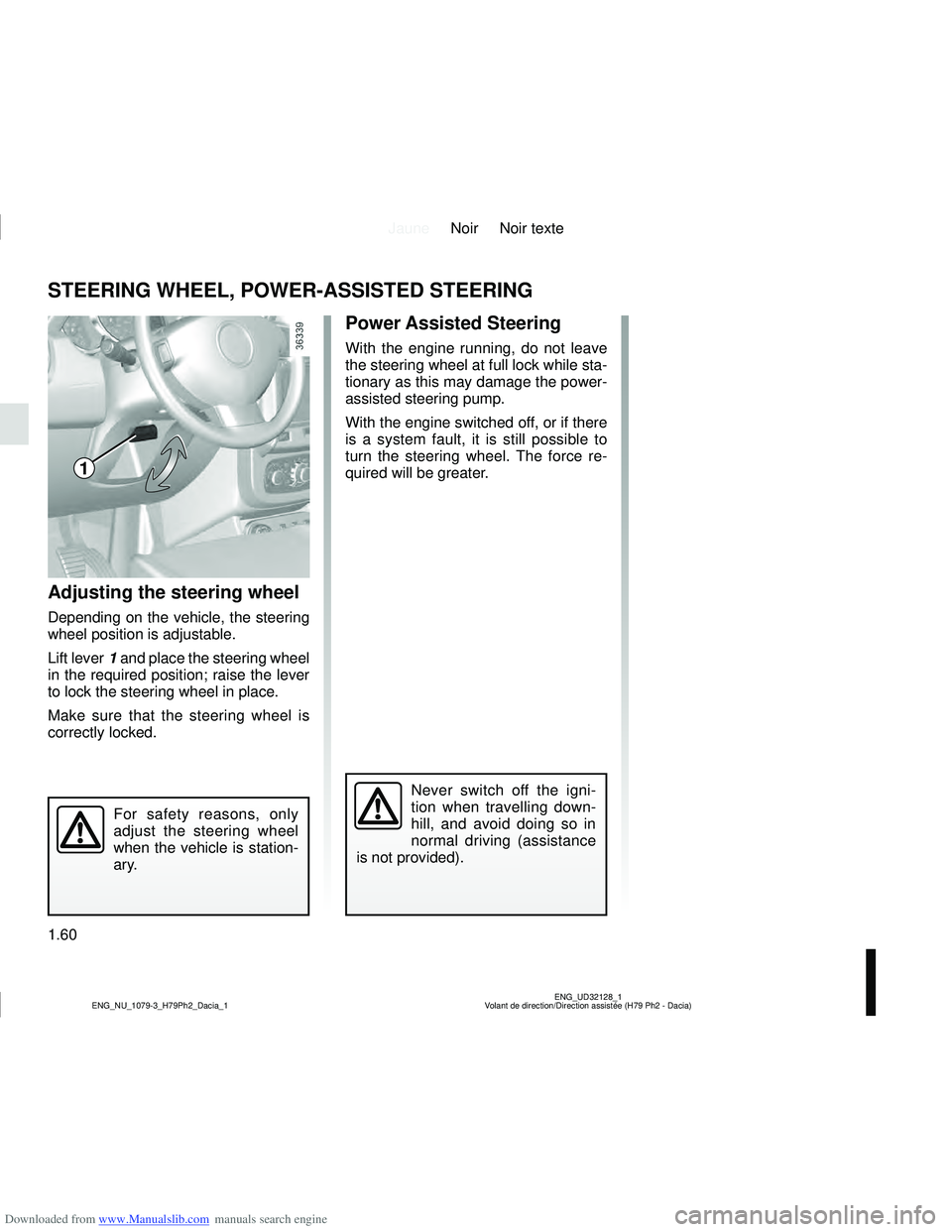
Lift lever 1 and place the steering wheel
in the required position; raise the lever
to lock the steering wheel in place.
Make sure that the steering wheel is
correctly locked.
For safety reasons, only
adjust the steering wheel
when the vehicle is station-
ary.
Never switch off the igni-
tion when travelling down-
hill, and avoid doing so in
normal driving (assistance
is not provided).
1
Page 78 of 244
Downloaded from www.Manualslib.com manuals search engine JauneNoir Noir texte
1.72
ENG_UD32134_1
Réservoir carburant (H79 - Dacia)
ENG_NU_1079-3_H79Ph2_Dacia_1
FUEL TANK (3/6)
Filling with fuel
Insert the nozzle to open the valve and
insert it fully before turning it on to fill
the fuel tank (risk of splashing).
Keep the nozzle in this position
throughout the entire filling operation.
When the pump cuts out automatically
at the end of the filling procedure, a
maximum of two further filling attempts
may be made, as there must be suffi-
cient space in the fuel tank to allow for
expansion.
Make sure that no water enters the fuel
tank during filling. The valve and its sur-
round must remain clean.
Persistent fuel odour
If you notice a persistent
smell of fuel you should:
– stop the vehicle when traffic conditions allow it and switch off
the ignition;
– switch on the hazard warning lights and ask your passengers to
leave the vehicle and stay clear
of the traffic;
– contact an authorised dealer.
Petrol versions
Using leaded petrol will damage the
antipollution system and may lead to a
loss of warranty.
To ensure that the fuel tank is not filled
with leaded petrol, the fuel tank filler
neck contains a restrictor fitted with a
foolproof system which only allows
the nozzle for unleaded petrol to be
used (at the pump).
Page 79 of 244
Downloaded from www.Manualslib.com manuals search engine JauneNoir Noir texte
1.73
ENG_UD32134_1
Réservoir carburant (H79 - Dacia)
ENG_NU_1079-3_H79Ph2_Dacia_1
LPG versions
Useful capacity of fuel tank: approx.
32 litres.
Filling up with LPG
Engage the handbrake, stop the engine,
switch off the ignition and switch off the
lights.
Always respect the safety instructions
given at filling stations.
When filling the tank, add the desired
quantity of LPG.
When the pump stops delivering LPG,
or when the pump flow reduces signi-
ficantly, the maximum LPG level has
been reached.
At this point, do not attempt to carry on
filling.
If you exceed the LPG tank capacity when filling completely, please go
to an accredited garage or your authorised dealer to check the automatic\
filler device.
FUEL TANK (4/6)
Filling stations without self-service
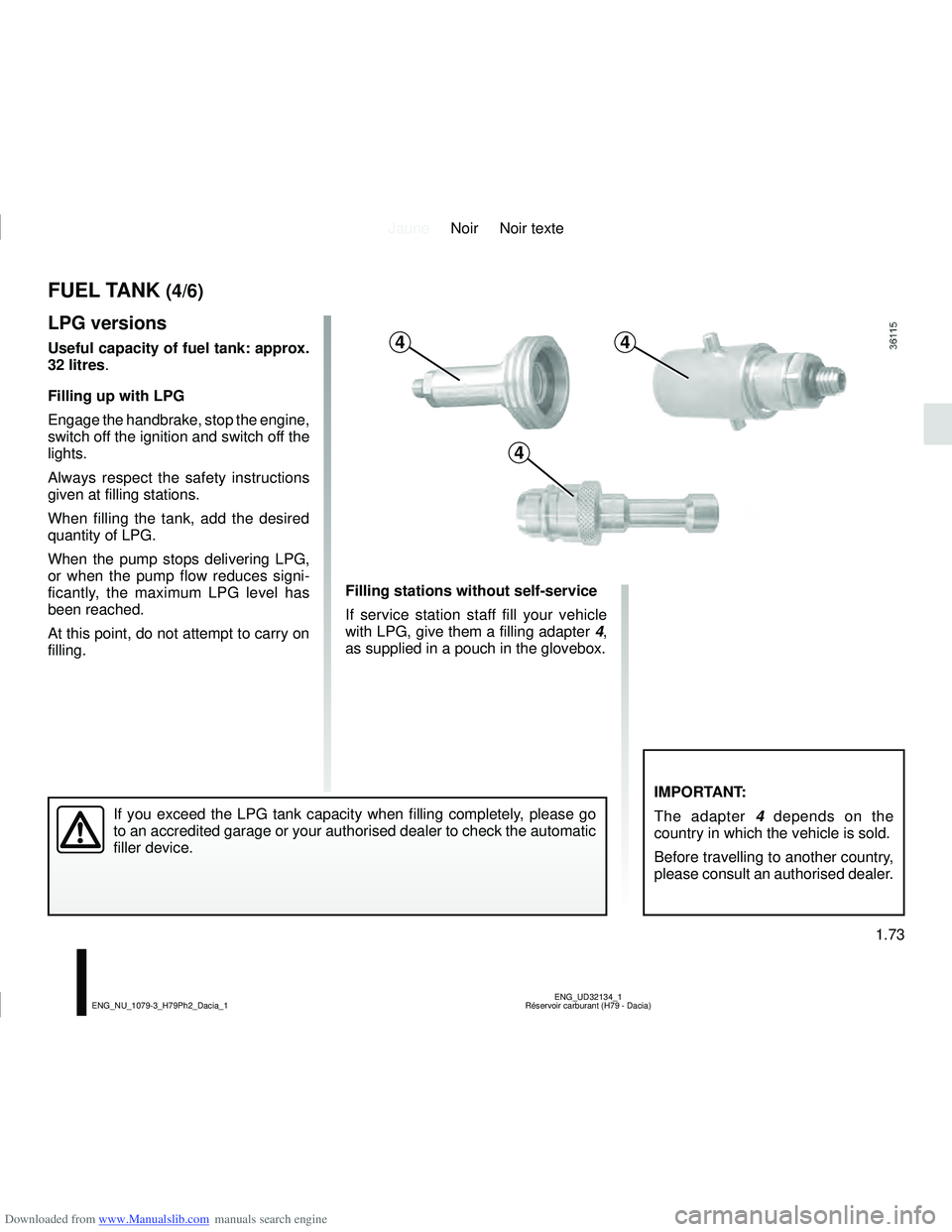
If service station staff fill your vehicle
with LPG, give them a filling adapter 4,
as supplied in a pouch in the glovebox.
IMPORTANT:
The adapter 4 depends on the
country in which the vehicle is sold.
Before travelling to another country,
please consult an authorised dealer.
44
4
Page 80 of 244
Downloaded from www.Manualslib.com manuals search engine JauneNoir Noir texte
1.74
ENG_UD32134_1
Réservoir carburant (H79 - Dacia)
ENG_NU_1079-3_H79Ph2_Dacia_1
FUEL TANK (5/6)
Filling stations with self-service
We recommend that you wear gloves
when handling the LPG pistol.
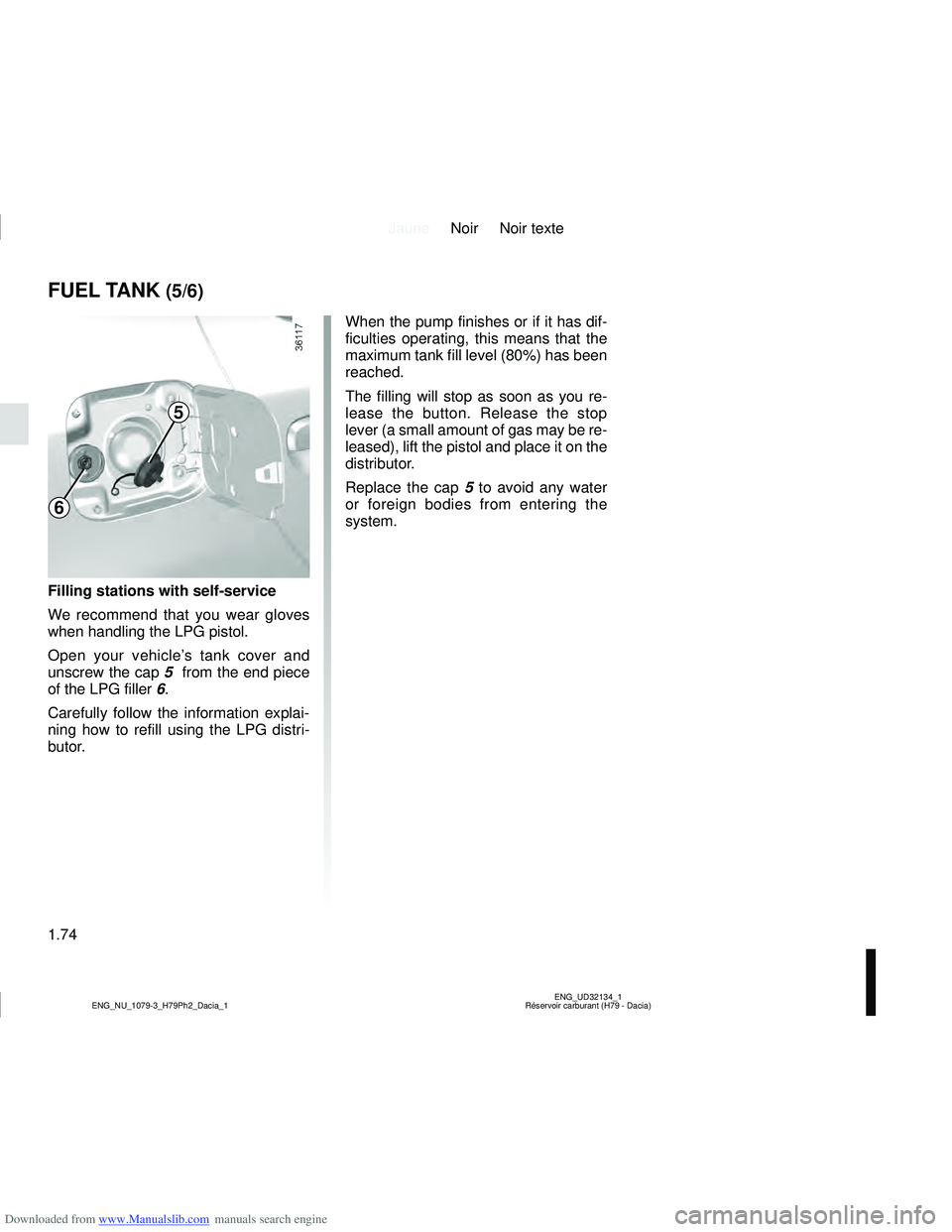
Open your vehicle’s tank cover and
unscrew the cap 5 from the end piece
of the LPG filler 6.
Carefully follow the information explai-
ning how to refill using the LPG distri-
butor. When the pump finishes or if it has dif-
ficulties operating, this means that the
maximum tank fill level (80%) has been
reached.
The filling will stop as soon as you re-
lease the button. Release the stop
lever (a small amount of gas may be re-
leased), lift the pistol and place it on the
distributor.
Replace the cap 5
to avoid any water
or foreign bodies from entering the
system.
5
6
Page 85 of 244
Downloaded from www.Manualslib.com manuals search engine JauneNoir Noir texte
2.3
ENG_UD34520_2
Mise en route / Arrêt du moteur (H79 Ph2 - Dacia)
ENG_NU_1079-3_H79Ph2_Dacia_2
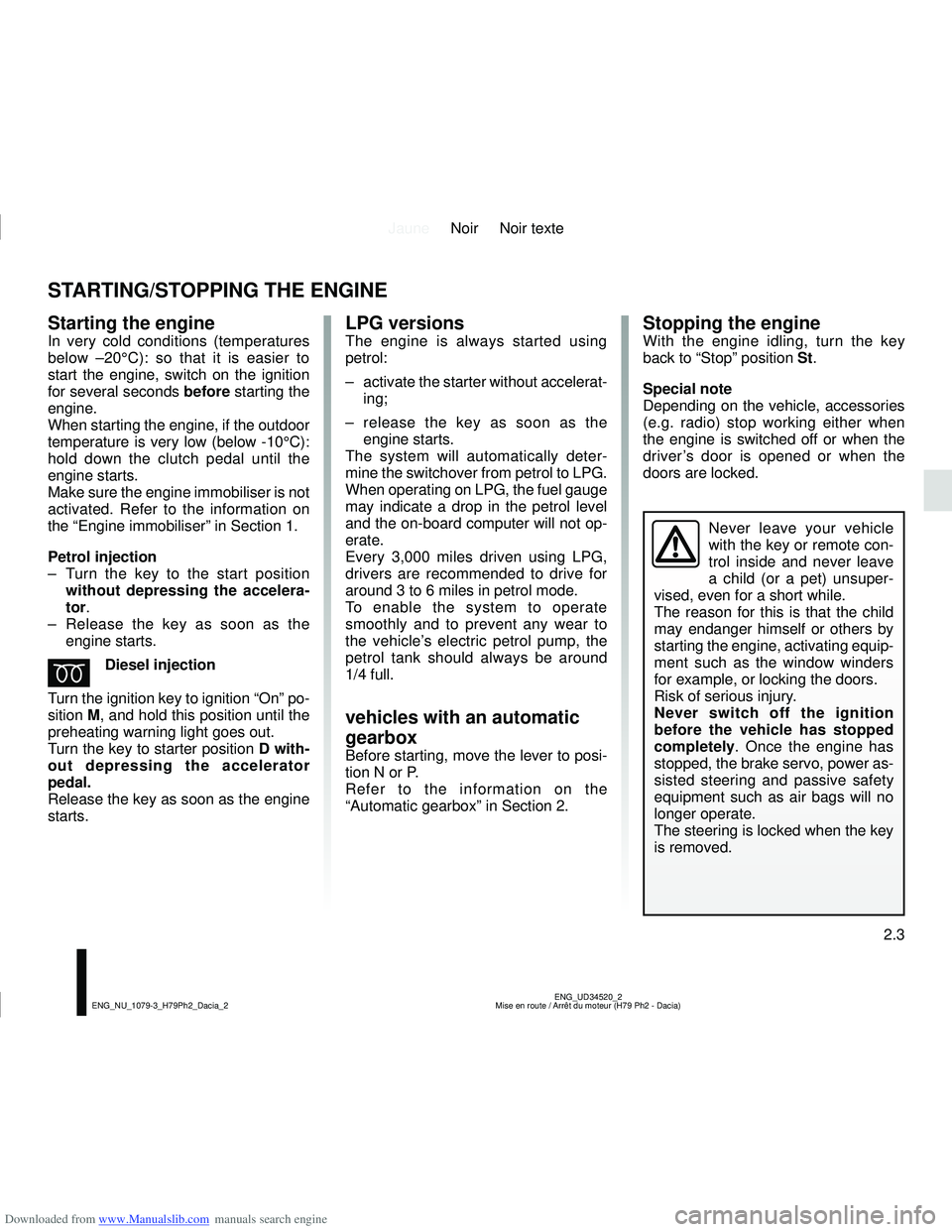
Stopping the engineWith the engine idling, turn the key
back to “Stop” position St.
Special note
Depending on the vehicle, accessories
(e.g. radio) stop working either when
the engine is switched off or when the
driver’s door is opened or when the
doors are locked.LPG versionsThe engine is always started using
petrol:
– activate the starter without accelerat- ing;
– release the key as soon as the engine starts.
The system will automatically deter-
mine the switchover from petrol to LPG.
When operating on LPG, the fuel gauge
may indicate a drop in the petrol level
and the on-board computer will not op-
erate.
Every 3,000 miles driven using LPG,
drivers are recommended to drive for
around 3 to 6 miles in petrol mode.
To enable the system to operate
smoothly and to prevent any wear to
the vehicle’s electric petrol pump, the
petrol tank should always be around
1/4 full.
vehicles with an automatic
gearbox
Before starting, move the lever to posi-
tion N or P.
Refer to the information on the
“Automatic gearbox” in Section 2.
Starting the engineIn very cold conditions (temperatures
below –20°C): so that it is easier to
start the engine, switch on the ignition
for several seconds before starting the
engine.
When starting the engine, if the outdoor
temperature is very low (below -10°C):
hold down the clutch pedal until the
engine starts.
Make sure the engine immobiliser is not
activated. Refer to the information on
the “Engine immobiliser” in Section 1.
Petrol injection
– Turn the key to the start position without depressing the accelera-
tor.
– Release the key as soon as the engine starts.
ÉDiesel injection
Turn the ignition key to ignition “On” po-
sition M, and hold this position until the
preheating warning light goes out.
Turn the key to starter position D with-
out depressing the accelerator
pedal.
Release the key as soon as the engine
starts.
STARTING/STOPPING THE ENGINE
Never leave your vehicle
with the key or remote con-
trol inside and never leave
a child (or a pet) unsuper-
vised, even for a short while.
The reason for this is that the child
may endanger himself or others by
starting the engine, activating equip-
ment such as the window winders
for example, or locking the doors.
Risk of serious injury.
Never switch off the ignition
before the vehicle has stopped
completely . Once the engine has
stopped, the brake servo, power as-
sisted steering and passive safety
equipment such as air bags will no
longer operate.
The steering is locked when the key
is removed.
Page 87 of 244
Downloaded from www.Manualslib.com manuals search engine JauneNoir Noir texte
2.5
ENG_UD14105_1
Particularités des versions diesel (H79 - Dacia)
ENG_NU_1079-3_H79Ph2_Dacia_2
SPECIAL FEATURES OF DIESEL VERSIONS
Diesel engine speed
Diesel engines are fitted with an injec-
tion pump which prevents the engine
speed being exceeded irrespective of
the gear selected.
If the
Ä and Ò warning lights
come on, consult an approved dealer
as soon as possible.
When driving, depending on the fuel
grade used, it is possible that white
smoke may be emitted.
This is due to the exhaust particle filter
being cleaned automatically, and does
not affect the way the vehicle runs.
Running out of fuel
If the tank has been completely
drained, the system must be reprimed
after the tank is refilled: see information
on the “Fuel tank” in Section 1 before
restarting the engine.
Precautions to be taken in
winter
To avoid any faults in icy weather:
– ensure that the battery is always fully charged;
– always keep the diesel tank rela- tively full to avoid water vapour con-
densing in it and accumulating at the
bottom of the tank.
Do not park the vehicle or
run the engine in locations
where combustible sub-
stances or materials such
as grass or leaves can come into
contact with a hot exhaust system.
Page 106 of 244

ENG_NU_1079-3_H79Ph2_Dac")
Downloaded from www.Manualslib.com manuals search engine JauneNoir Noir texte
2.24
ENG_UD35069_2
Dispositifs de correction et d’assistance à la conduite (H79 Ph2 \
- Dacia)
ENG_NU_1079-3_H79Ph2_Dacia_2
ABS (anti-lock braking
system)
Under heavy braking, the ABS prevents
the wheels from locking, allowing the
stopping distance to be managed and
keeping control of the vehicle. Under
these circumstances, the vehicle can
be steered to avoid an obstacle whilst
braking. In addition, this system can
increase stopping distances, particu-
larly on roads with low surface grip (wet
ground etc.).
You will feel a pulsation through the
brake pedal each time the system is
activated. The ABS does not in any way
improve the vehicle's physical perfor-
mance relating to the road surface and
roadholding. It is still essential to follow
the rules of good driving practice (such
as driving at a safe distance from the
vehicle in front etc.).
DRIVER CORRECTION DEVICES/AIDS (1/4)
Depending on the vehicle, this is com-
posed of:
– the ABS (anti-lock braking
system);
– the emergency brake assist;
– electronic stability control (ESC)
with understeer control and trac-
tion control.
– hill start assistance.
These functions are an ad-
ditional aid in the event of
critical driving conditions,
enabling the vehicle beha-
viour to be adapted to suit the dri-
ving conditions.
However, the functions do not take
the place of the driver. They do
not increase the vehicle’s limits
and should not encourage you
to drive more quickly. Therefore,
they can under no circumstances
replace the vigilance or responsibi-
lity of the driver when manoeuvring
the vehicle (the driver must always
be ready for sudden incidents which
may occur when driving).
In an emergency, apply firm and
continuous pressure to the brake
pedal. There is no need to pump
it repeatedly. The ABS will modu-
late the force applied in the braking
system.
Special feature of 4-wheel drive vehi-
cles
In 4WD Lock mode, the system may
lock the wheels briefly to optimise the
braking distance on very wet ground
(snow, mud, sand, etc.).
Page 153 of 244
Downloaded from www.Manualslib.com manuals search engine JauneNoir Noir texte
4.1
ENG_UD35446_5
Sommaire 4 (H79 - Dacia)
ENG_NU_1079-3_H79Ph2_Dacia_4
Section 4: Maintenance
Bonnet . . . . . . . . . . . . . . . . . . . . . . . . . . . . . . . . . . . . \
. . . . . . . . . . . . . . . . . . . . . . . . . . . . . . . . . . . . 4.2
Engine oil level: general information . . . . . . . . . . . . . . . . . . . . . . . . . . . . . . . . . . . .\
. . . . . . . . . . . . . 4.3
Engine oil level: topping up, filling . . . . . . . . . . . . . . . . . . . . . . . . . . . . . . . . . . . . \
. . . . . . . . . . . . . . . 4.4
Levels: . . . . . . . . . . . . . . . . . . . . . . . . . . . . . . . . . . . .\
. . . . . . . . . . . . . . . . . . . . . . . . . . . . . . . . . . . 4.7
Brake fluid . . . . . . . . . . . . . . . . . . . . . . . . . . . . . . . . . . . .\
. . . . . . . . . . . . . . . . . . . . . . . . . . . 4.7
Engine coolant . . . . . . . . . . . . . . . . . . . . . . . . . . . . . . . . . . . . \
. . . . . . . . . . . . . . . . . . . . . . . . 4.8
Power-assisted steering pump . . . . . . . . . . . . . . . . . . . . . . . . . . . . . . . . . . . . \
. . . . . . . . . . . . 4.9
Windscreen washer reservoir . . . . . . . . . . . . . . . . . . . . . . . . . . . . . . . . . . . . \
. . . . . . . . . . . . . 4.9
Filters . . . . . . . . . . . . . . . . . . . . . . . . . . . . . . . . . . . . \
. . . . . . . . . . . . . . . . . . . . . . . . . . . . . . . . . . . . . 4.10
Tyre pressures . . . . . . . . . . . . . . . . . . . . . . . . . . . . . . . . . . . . \
. . . . . . . . . . . . . . . . . . . . . . . . . . . . . . 4.11
Battery . . . . . . . . . . . . . . . . . . . . . . . . . . . . . . . . . . . . \
. . . . . . . . . . . . . . . . . . . . . . . . . . . . . . . . . . . . 4.12
Bodywork maintenance . . . . . . . . . . . . . . . . . . . . . . . . . . . . . . . . . . . . \
. . . . . . . . . . . . . . . . . . . . . . . 4.13
Interior trim maintenance . . . . . . . . . . . . . . . . . . . . . . . . . . . . . . . . . . . . \
. . . . . . . . . . . . . . . . . . . . . . 4.15
Page 213 of 244
Downloaded from www.Manualslib.com manuals search engine JauneNoir Noir texte
5.45
ENG_UD32196_1
Anomalies de fonctionnement (H79 Ph2 - Dacia)
ENG_NU_1079-3_H79Ph2_Dacia_5
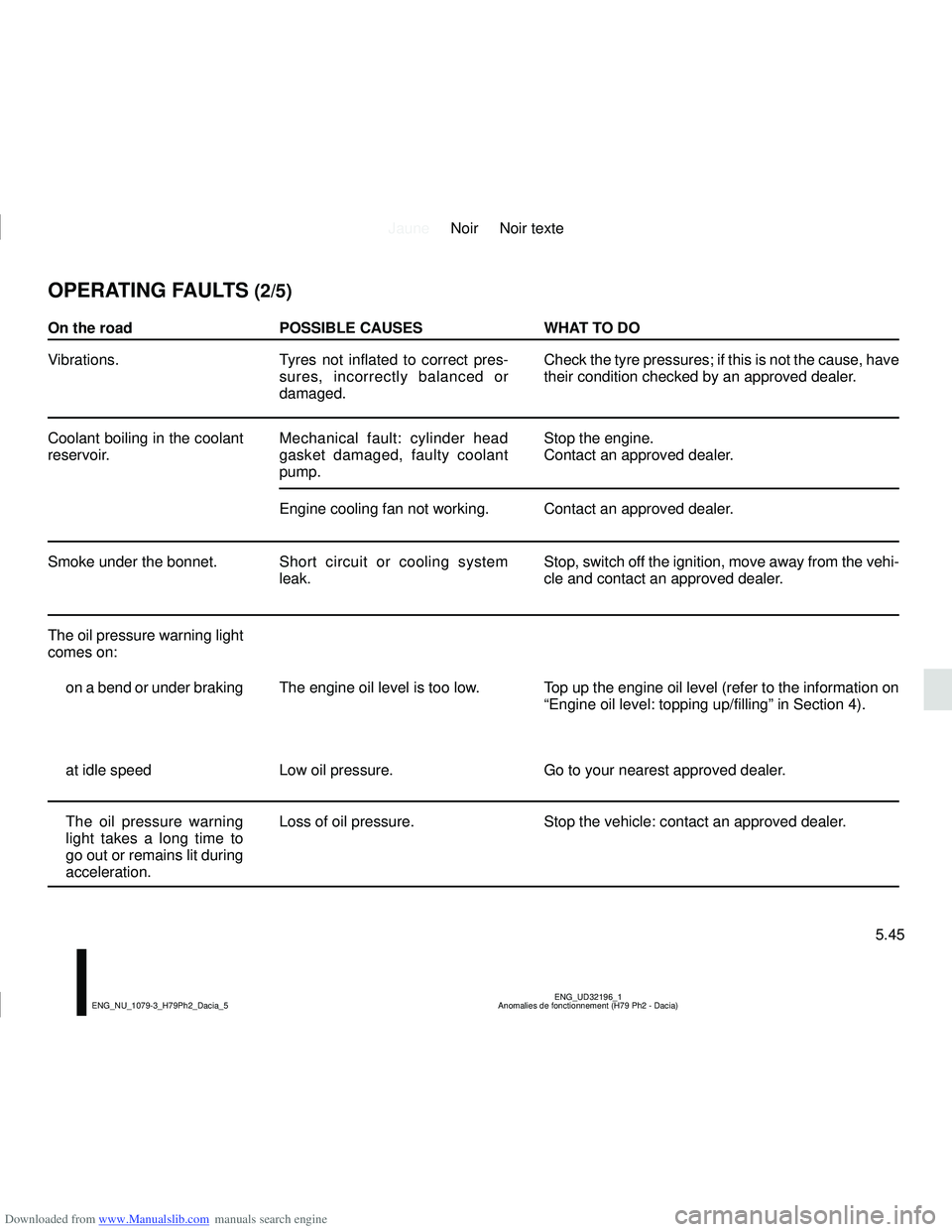
OPERATING FAULTS (2/5)
On the road POSSIBLE CAUSES WHAT TO DO
Vibrations. Tyres not inflated to correct pres-
sures, incorrectly balanced or
damaged. Check the tyre pressures; if this is not the cause, have
their condition checked by an approved dealer.
Coolant boiling in the coolant
reservoir. Mechanical fault: cylinder head
gasket damaged, faulty coolant
pump. Stop the engine.
Contact an approved dealer.
Engine cooling fan not working. Contact an approved dealer.
Smoke under the bonnet. Short circuit or cooling system
leak. Stop, switch off the ignition, move away from the vehi-
cle and contact an approved dealer.
The oil pressure warning light
comes on: on a bend or under braking The engine oil level is too low. Top up the engine oil level (refer to the information on “Engine oil level: topping up/filling” in Section 4).
at idle speed Low oil pressure. Go to your nearest approved dealer.
The oil pressure warning
light takes a long time to
go out or remains lit during
acceleration. Loss of oil pressure.
Stop the vehicle: contact an approved dealer.
Page 239 of 244
Downloaded from www.Manualslib.com manuals search engine JauneNoir Noir texte
7.3
FRA_UD35449_5
Index (H79 - Dacia)
ENG_NU_1079-3_H79Ph2_Dacia_7
ALPHABETICAL INDEX (3/5)
K
keys ........................................................................\
.... 1.2 – 1.3
L
levels .................................................................\
.4.3, 4.7 → 4.9
levels: coolant ................................................................\
........... 4.8
windscreen washer reservoir ......................................... 4.9
lifting the vehicle changing a wheel ............................... 5.2 – 5.4, 5.9 → 5.11
lighting: exterior .........................................1.64 – 1.65, 5.15 → 5.24
interior ..........................................3.12 – 3.13, 5.25 → 5.28
lights .................................................................\
.....1.64 → 1.67
additional ..................................................................... 5.19
adjustment ........................................................ 1.66 – 1.67
lights: adjusting ........................................................... 1.66 – 1.67
brake lights ......................................................... 5.20, 5.22
daytime running lights .................................................. 5.18
dipped beam headlights ..........................1.64, 5.15 → 5.18
direction indicators .......................1.62 – 1.63, 5.15 → 5.18
fog lights ............................................................. 1.65, 5.19
hazard warning ................................................. 1.62 – 1.63
main beam headlights .............................1.64, 5.15 → 5.18
reversing lights .................................................... 5.20, 5.22
side lights ................................................1.64, 5.15 → 5.18
locking the doors ................................................................. 1.4
LPG ................. 1.73 – 1.74, 2.3, 2.6 → 2.8, 3.27, 5.29 → 5.34
M
maintenance ............................................................\
.......... 2.14
maintenance: bodywork .......................................................... 4.13 – 4.14
interior trim ........................................................ 4.15 – 4.16
mechanical ..................................4.3, 4.7, 4.12, 6.9 → 6.14map reading lights .................................................. 3.12 – 3.13
methods of restraint in addition to the front seat belts ..............
1.20 → 1.22, 1.24
mirrors ................................................................\
............... 3.14
multimedia equipment ....................................................... 3.30
N
navigation .............................................................\
............. 3.30
navigation system .............................................................. 3.30
O
oil change .................................................................\
.4.4
→ 4.6
opening the doors ..................................................... 1.9 – 1.10
operating faults ......................................................5.44 → 5.48
overspeed buzzer ................................................... 1.51 – 1.52
P
paintwork maintenance ..................................................... 4.13 – 4.14
reference ..............................................................\
.......... 6.2
parking distance control.......................................... 2.38 – 2.39
power-assisted steering.............................................. 1.60, 4.9
power-assisted steering pump............................................\
. 4.9
practical advice .....................1.75, 3.27, 5.2 – 5.4, 5.9 → 5.36,
5.38 → 5.42, 5.44 → 5.48
puncture.................................................. 5.3 – 5.4, 5.10 – 5.11
R
radio...................................................................\
................ 3.30 fitting a radio ................................................................ 5.42
radio frequency remote control/key use ....................................................................\
............. 1.2
rear bench seat......................................................3.2\
1 → 3.23
rear parcel shelf ................................................................. 3.28
rear screen de-icing/demisting ..................................3.4 → 3.6