Charge battery DACIA DUSTER 2019 Owners Manual
[x] Cancel search | Manufacturer: DACIA, Model Year: 2019, Model line: DUSTER, Model: DACIA DUSTER 2019Pages: 244, PDF Size: 3.57 MB
Page 13 of 244
Downloaded from www.Manualslib.com manuals search engine JauneNoir Noir texte
1.7
ENG_UD32108_1
Verrouillage et déverrouillage des portes (H79 - Dacia)
ENG_NU_1079-3_H79Ph2_Dacia_1
Door and tailgate status
indicator
(depending on vehicle)
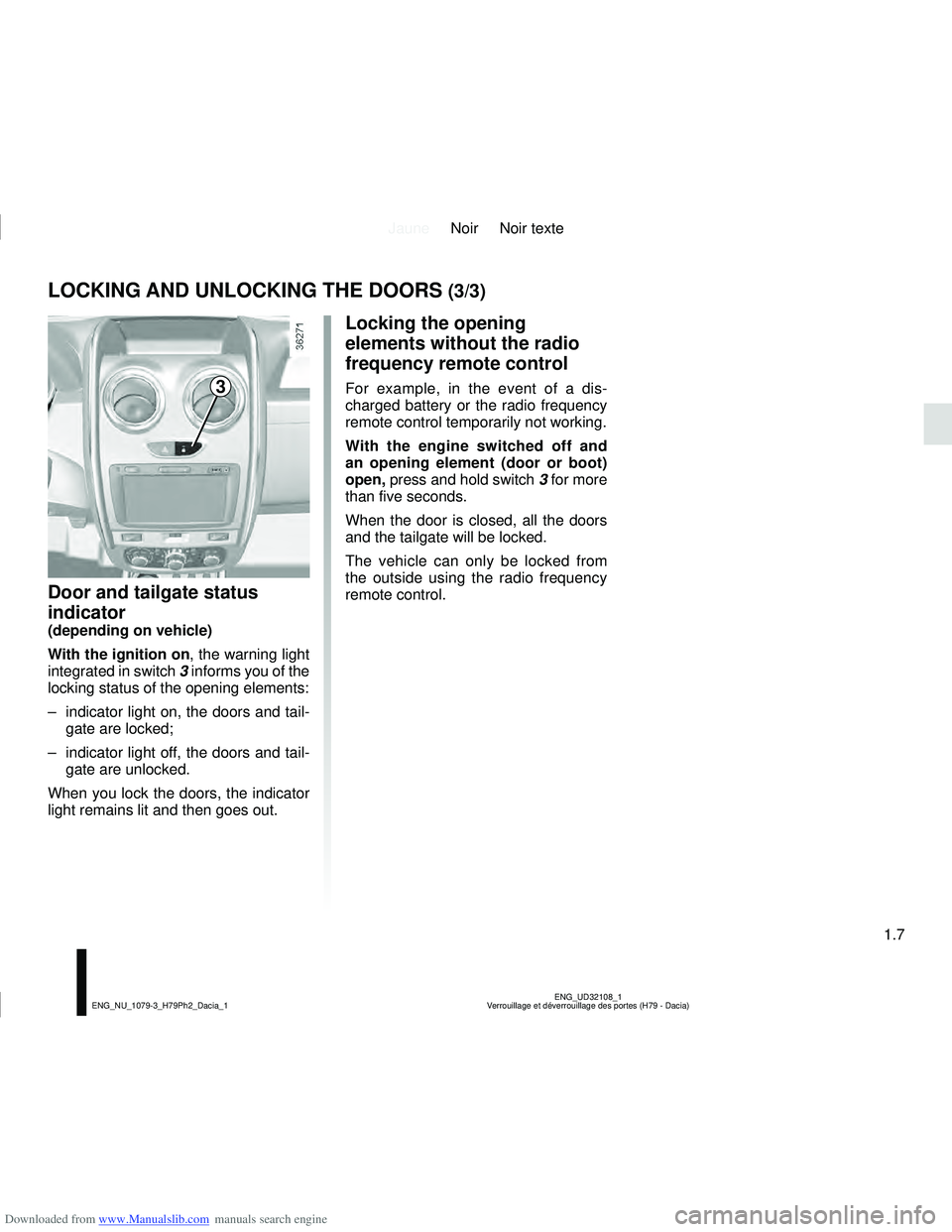
With the ignition on , the warning light
integrated in switch 3 informs you of the
locking status of the opening elements:
– indicator light on, the doors and tail- gate are locked;
– indicator light off, the doors and tail- gate are unlocked.
When you lock the doors, the indicator
light remains lit and then goes out.
Locking the opening
elements without the radio
frequency remote control
For example, in the event of a dis-
charged battery or the radio frequency
remote control temporarily not working.
With the engine switched off and
an opening element (door or boot)
open, press and hold switch 3 for more
than five seconds.
When the door is closed, all the doors
and the tailgate will be locked.
The vehicle can only be locked from
the outside using the radio frequency
remote control.3
LOCKING AND UNLOCKING THE DOORS (3/3)
Page 52 of 244
Downloaded from www.Manualslib.com manuals search engine JauneNoir Noir texte
1.46
ENG_UD34962_2
Témoins lumineux (H79 Ph2 - Dacia)
ENG_NU_1079-3_H79Ph2_Dacia_1
WARNING LIGHTS (3/7)
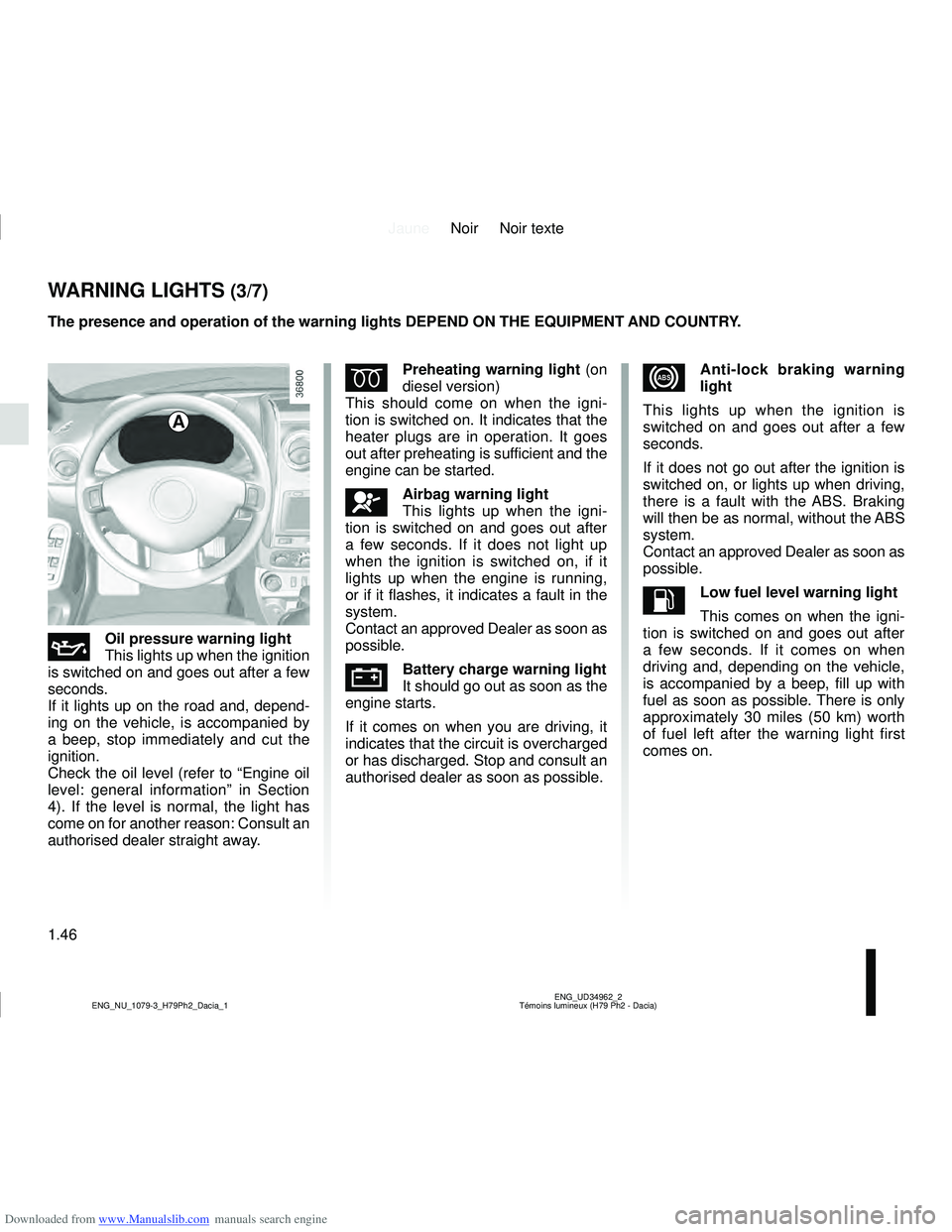
A
ÀOil pressure warning light
This lights up when the ignition
is switched on and goes out after a few
seconds.
If it lights up on the road and, depend-
ing on the vehicle, is accompanied by
a beep, stop immediately and cut the
ignition.
Check the oil level (refer to “Engine oil
level: general information” in Section
4). If the level is normal, the light has
come on for another reason: Consult an
authorised dealer straight away.
ÉPreheating warning light (on
diesel version)
This should come on when the igni-
tion is switched on. It indicates that the
heater plugs are in operation. It goes
out after preheating is sufficient and the
engine can be started.
åAirbag warning light
This lights up when the igni-
tion is switched on and goes out after
a few seconds. If it does not light up
when the ignition is switched on, if it
lights up when the engine is running,
or if it flashes, it indicates a fault in the
system.
Contact an approved Dealer as soon as
possible.
ÚBattery charge warning light
It should go out as soon as the
engine starts.
If it comes on when you are driving, it
indicates that the circuit is overcharged
or has discharged. Stop and consult an
authorised dealer as soon as possible.
xAnti-lock braking warning
light
This lights up when the ignition is
switched on and goes out after a few
seconds.
If it does not go out after the ignition is
switched on, or lights up when driving,
there is a fault with the ABS. Braking
will then be as normal, without the ABS
system.
Contact an approved Dealer as soon as
possible.
LLow fuel level warning light
This comes on when the igni-
tion is switched on and goes out after
a few seconds. If it comes on when
driving and, depending on the vehicle,
is accompanied by a beep, fill up with
fuel as soon as possible. There is only
approximately 30 miles (50 km) worth
of fuel left after the warning light first
comes on.
The presence and operation of the warning lights DEPEND ON THE EQUIPMENT\
AND COUNTRY.
Page 87 of 244
Downloaded from www.Manualslib.com manuals search engine JauneNoir Noir texte
2.5
ENG_UD14105_1
Particularités des versions diesel (H79 - Dacia)
ENG_NU_1079-3_H79Ph2_Dacia_2
SPECIAL FEATURES OF DIESEL VERSIONS
Diesel engine speed
Diesel engines are fitted with an injec-
tion pump which prevents the engine
speed being exceeded irrespective of
the gear selected.
If the
Ä and Ò warning lights
come on, consult an approved dealer
as soon as possible.
When driving, depending on the fuel
grade used, it is possible that white
smoke may be emitted.
This is due to the exhaust particle filter
being cleaned automatically, and does
not affect the way the vehicle runs.
Running out of fuel
If the tank has been completely
drained, the system must be reprimed
after the tank is refilled: see information
on the “Fuel tank” in Section 1 before
restarting the engine.
Precautions to be taken in
winter
To avoid any faults in icy weather:
– ensure that the battery is always fully charged;
– always keep the diesel tank rela- tively full to avoid water vapour con-
densing in it and accumulating at the
bottom of the tank.
Do not park the vehicle or
run the engine in locations
where combustible sub-
stances or materials such
as grass or leaves can come into
contact with a hot exhaust system.
Page 164 of 244
Downloaded from www.Manualslib.com manuals search engine JauneNoir Noir texte
4.12
ENG_UD32174_1
Batterie (H79 - Dacia)
ENG_NU_1079-3_H79Ph2_Dacia_4
BATTERY
Battery 1 does not require any mainte-
nance.
Handle the battery with care
as it contains sulphuric acid,
which must not come into
contact with eyes or skin. If
it does, wash the affected area with
plenty of cold water and consult a
doctor, if necessary.
Ensure that naked flames, red hot
objects and sparks do not come into
contact with the battery as there is a
risk of explosion.
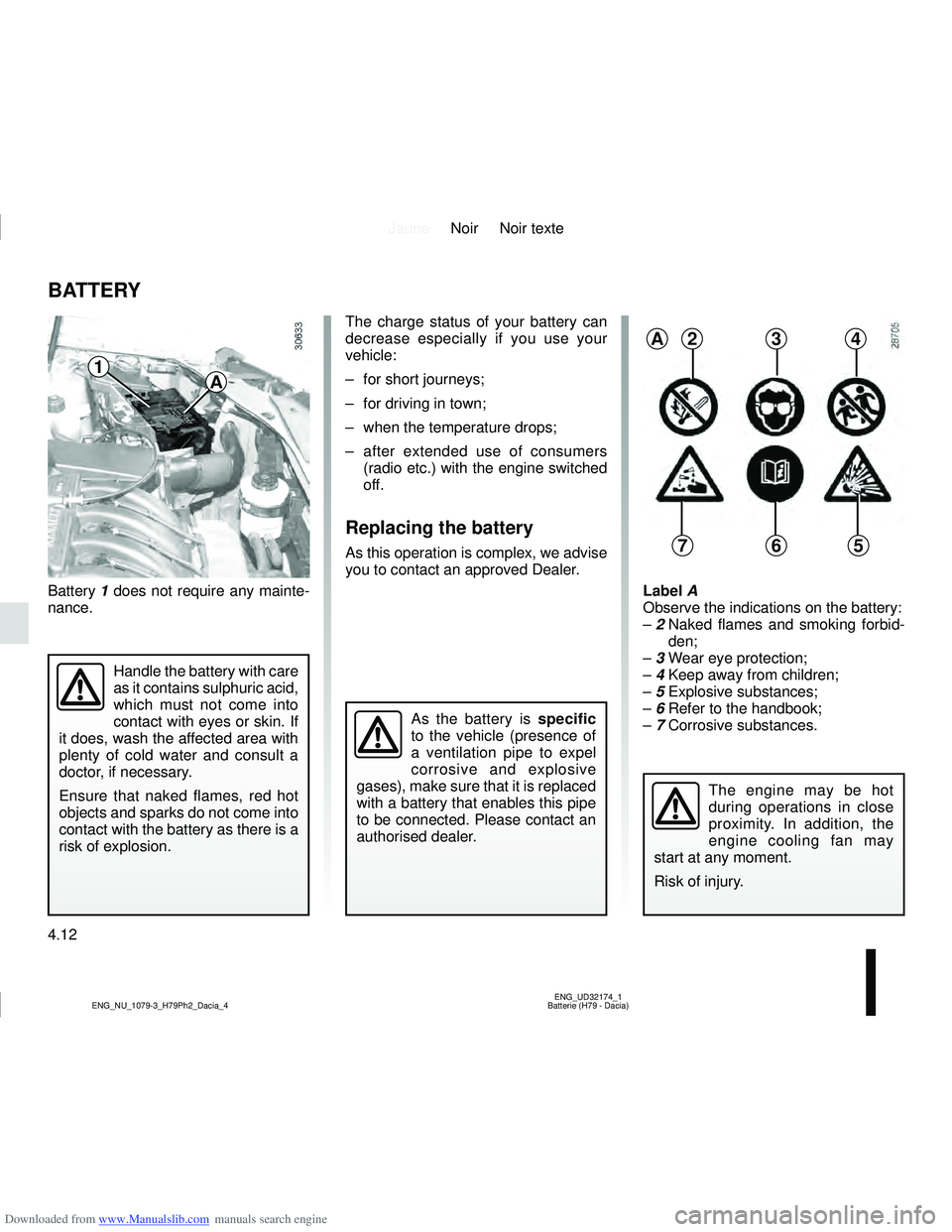
Label A
Observe the indications on the battery:
– 2 Naked flames and smoking forbid-
den;
– 3 Wear eye protection;
– 4 Keep away from children;
– 5 Explosive substances;
– 6 Refer to the handbook;
– 7 Corrosive substances.
The engine may be hot
during operations in close
proximity. In addition, the
engine cooling fan may
start at any moment.
Risk of injury.
A234
567
1A
The charge status of your battery can
decrease especially if you use your
vehicle:
– for short journeys;
– for driving in town;
– when the temperature drops;
– after extended use of consumers (radio etc.) with the engine switched
off.
Replacing the battery
As this operation is complex, we advise
you to contact an approved Dealer.
As the battery is specific
to the vehicle (presence of
a ventilation pipe to expel
corrosive and explosive
gases), make sure that it is replaced
with a battery that enables this pipe
to be connected. Please contact an
authorised dealer.
Page 203 of 244
Downloaded from www.Manualslib.com manuals search engine JauneNoir Noir texte
5.35
ENG_UD32190_1
Batterie : dépannage (H79 - Dacia)
ENG_NU_1079-3_H79Ph2_Dacia_5
BATTERY: troubleshooting (1/2)
To avoid all risk of sparks:
– Ensure that any consumers (cour- tesy lights, etc.) are switched off
before disconnecting or reconnect-
ing the battery;
– when charging, stop the charger before connecting or disconnecting
the battery;
– to avoid creating a short circuit be- tween the terminals, do not place
metal objects on the battery;
– always wait at least one minute after the engine has been switched off
before disconnecting a battery;
– make sure that you reconnect the battery terminals after refitting.
Handle the battery with care
as it contains sulphuric acid,
which must not come into
contact with eyes or skin. If
it does, wash the affected area with
plenty of cold water and consult a
doctor, if necessary.
Ensure that naked flames, red hot
objects and sparks do not come into
contact with the battery as there is a
risk of explosion.
The engine may be hot during oper-
ations in close proximity. In addition,
the engine cooling fan may start to
operate at any moment. Risk of se-
rious injury.
Certain batteries may have
specific recharging require-
ments; consult your au-
thorised dealer. Avoid any
risk of sparks, as this could cause
a sudden explosion, and always
charge the battery in a well-venti-
lated area. Risk of serious injury.
Connecting a battery charger
The battery charger must be com-
patible with a battery with nominal
voltage of 12 volts.
Do not disconnect the battery when the
engine is running. Follow the instruc-
tions given by the manufacturer of
the battery charger you are using.
When many accessories are fitted to
the vehicle, have them connected to
the + after ignition feed.
Page 204 of 244
Downloaded from www.Manualslib.com manuals search engine JauneNoir Noir texte
5.36
ENG_UD32190_1
Batterie : dépannage (H79 - Dacia)
ENG_NU_1079-3_H79Ph2_Dacia_5
BATTERY: troubleshooting (2/2)
Starting the vehicle using the
battery from another vehicle
If you have to use the battery from an-
other vehicle to start, obtain suitable
jump leads (with a large cross section)
from an approved dealer or, if you al-
ready have jump leads, ensure that
they are in perfect condition.
The two batteries must have an iden-
tical nominal voltage of 12 volts. The
battery supplying the current should
have a capacity (amp-hours, Ah) which
is at least the same as that of the dis-
charged battery.
Ensure that there is no risk of contact
between the two vehicles (risk of short
circuiting when the positive terminals
are connected) and that the discharged
battery is properly connected. Switch
off your vehicle ignition.
Start the engine of the vehicle supply-
ing the current and run it at an interme-
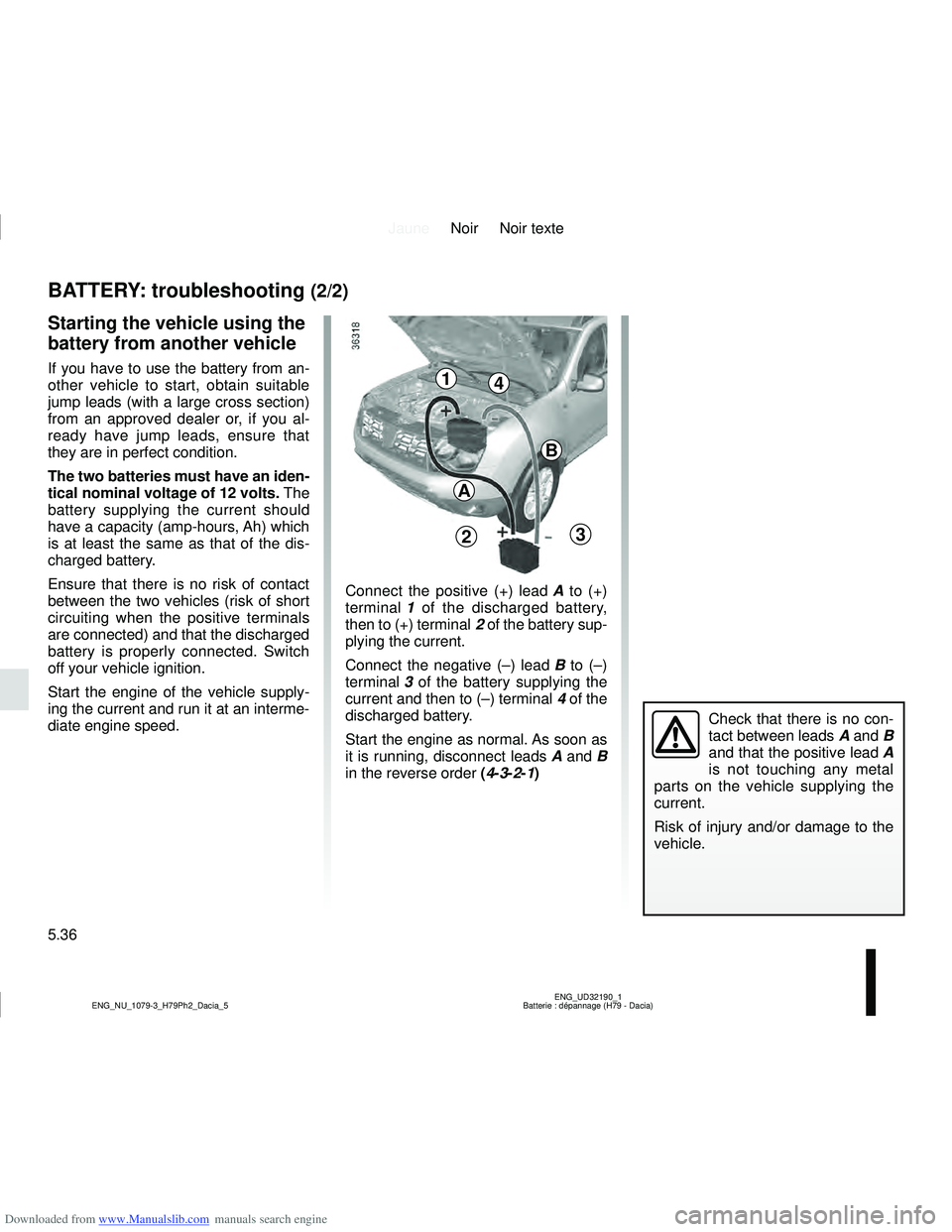
diate engine speed. Connect the positive (+) lead
A to (+)
terminal 1 of the discharged battery,
then to (+) terminal 2 of the battery sup-
plying the current.
Connect the negative (–) lead B to (–)
terminal 3 of the battery supplying the
current and then to (–) terminal 4 of the
discharged battery.
Start the engine as normal. As soon as
it is running, disconnect leads A and B
in the reverse order (4-3-2-1)
Check that there is no con-
tact between leads A and B
and that the positive lead A
is not touching any metal
parts on the vehicle supplying the
current.
Risk of injury and/or damage to the
vehicle.
A
B
14
23
Page 212 of 244
Downloaded from www.Manualslib.com manuals search engine JauneNoir Noir texte
5.44
ENG_UD32196_1
Anomalies de fonctionnement (H79 Ph2 - Dacia)
ENG_NU_1079-3_H79Ph2_Dacia_5
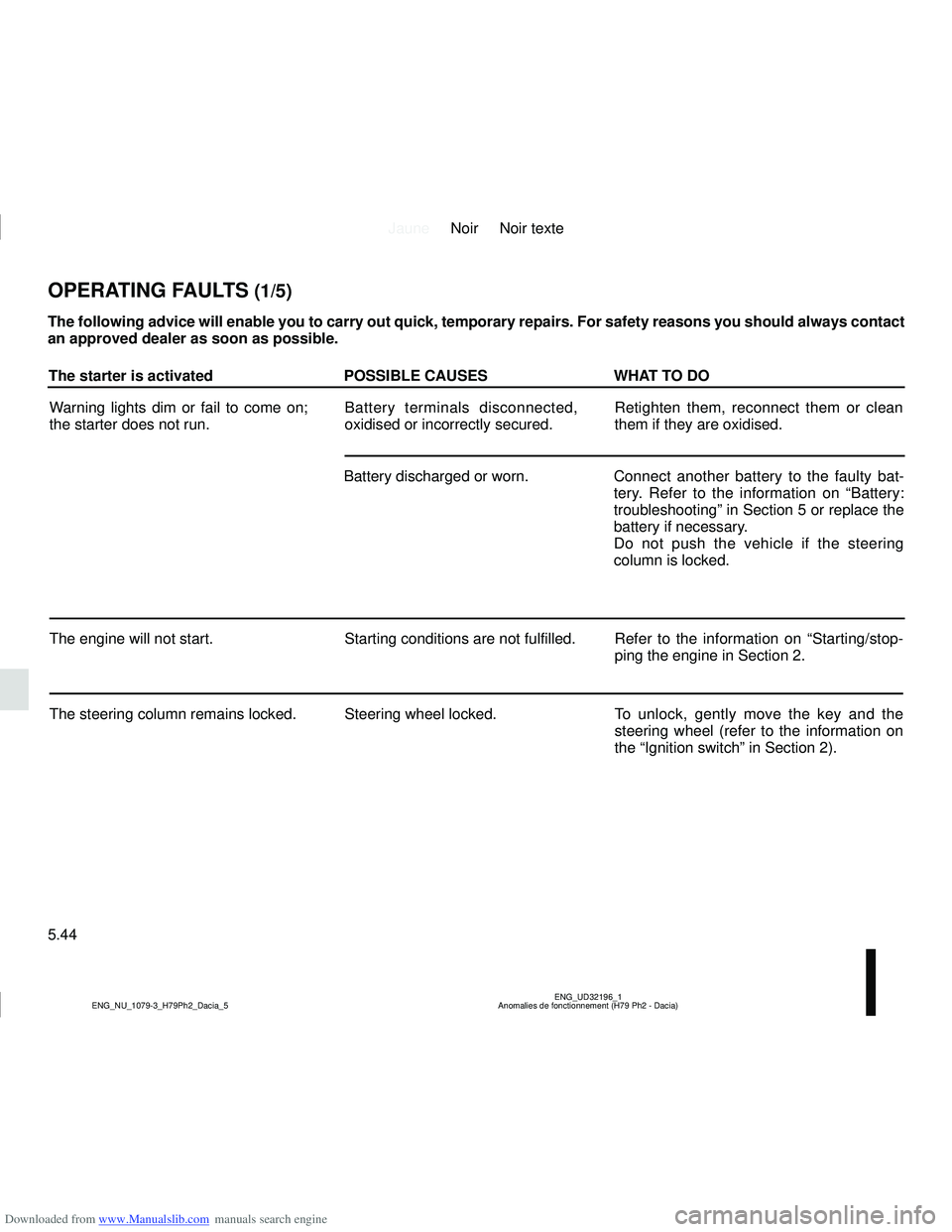
OPERATING FAULTS (1/5)
The following advice will enable you to carry out quick, temporary repairs. For safety reasons you should always contact
an approved dealer as soon as possible.
The starter is activated POSSIBLE CAUSESWHAT TO DO
Warning lights dim or fail to come on;
the starter does not run. Battery terminals disconnected,
oxidised or incorrectly secured.Retighten them, reconnect them or clean
them if they are oxidised.
Battery discharged or worn. Connect another battery to the faulty bat-
tery. Refer to the information on “Battery:
troubleshooting” in Section 5 or replace the
battery if necessary.
Do not push the vehicle if the steering
column is locked.
The engine will not start. Starting conditions are not fulfilled.Refer to the information on “Starting/stop-
ping the engine in Section 2.
The steering column remains locked. Steering wheel locked. To unlock, gently move the key and the
steering wheel (refer to the information on
the “Ignition switch” in Section 2).