lock DACIA LODGY 2013 1.G Owner's Guide
[x] Cancel search | Manufacturer: DACIA, Model Year: 2013, Model line: LODGY, Model: DACIA LODGY 2013 1.GPages: 258, PDF Size: 16.44 MB
Page 93 of 258
Downloaded from www.Manualslib.com manuals search engine JauneNoir Noir texte
2.23
ENG_UD33448_2
Frein à main / Direction assistée (X67 - X92 - Renault) ENG_NU_975-8_X92_Dacia_2
Handbrake
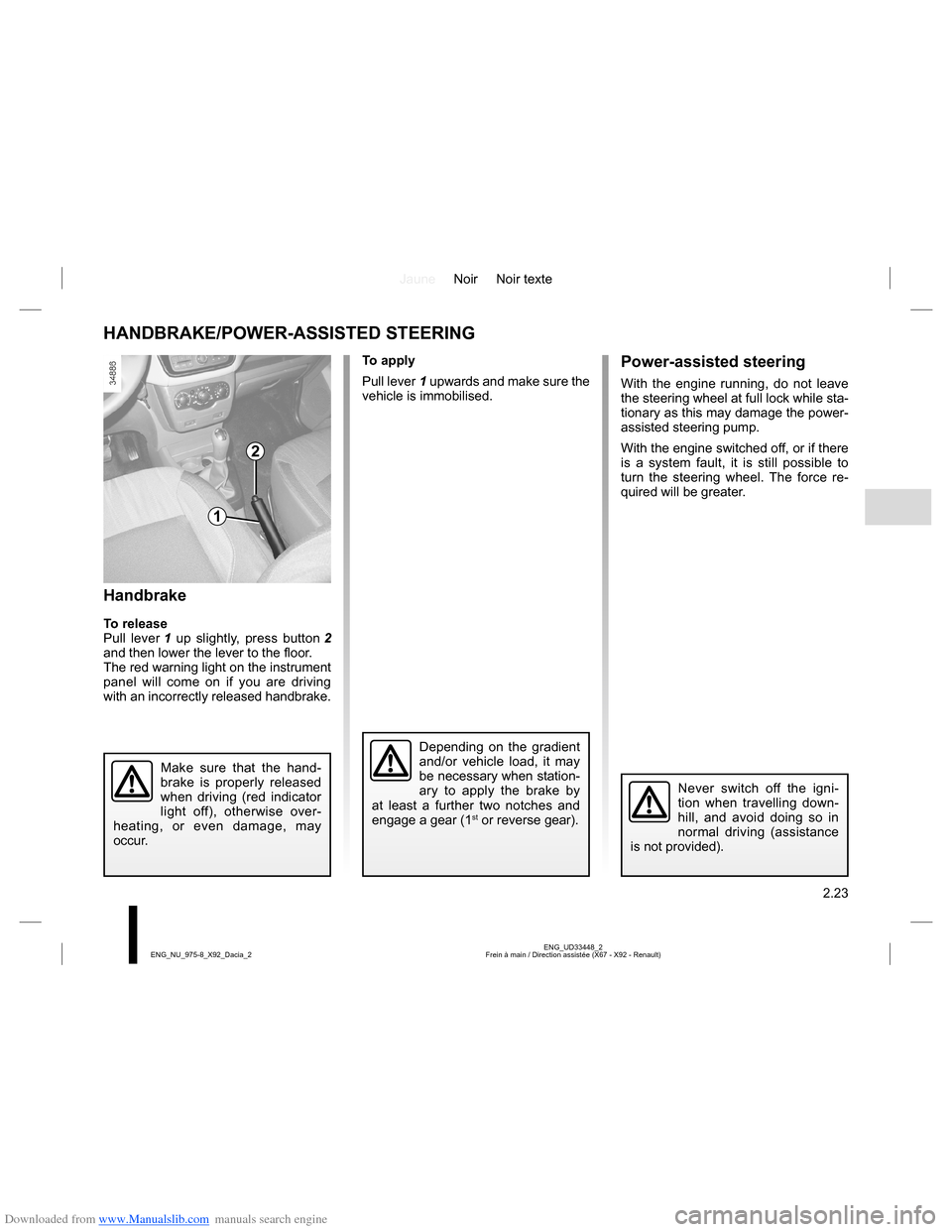
To release
Pull lever 1 up slightly, press button 2
and then lower the lever to the floor.
The red warning light on the instrument
panel will come on if you are driving
with an incorrectly released handbrake.
HANDBRAKE/POWER-ASSISTED STEERING
To apply
Pull lever 1 upwards and make sure the
vehicle is immobilised.
Depending on the gradient
and/or vehicle load, it may
be necessary when station-
ary to apply the brake by
at least a further two notches and
engage a gear (1
st or reverse gear).
Never switch off the igni-
tion when travelling down-
hill, and avoid doing so in
normal driving (assistance
is not provided).
Make sure that the hand-
brake is properly released
when driving (red indicator
light off), otherwise over-
heating, or even damage, may
occur.
1
2
Power-assisted steering
With the engine running, do not leave
the steering wheel at full lock while sta-
tionary as this may damage the power-
assisted steering pump.
With the engine switched off, or if there
is a system fault, it is still possible to
turn the steering wheel. The force re-
quired will be greater.
Page 94 of 258
Downloaded from www.Manualslib.com manuals search engine JauneNoir Noir texte
2.24
ENG_UD36361_3
Dispositifs de correction et d’assistance à la conduite (X92 - Renault) ENG_NU_975-8_X92_Dacia_2
DRIVER CORRECTION DEVICES/AIDS (1/3)
ABS (anti-lock braking
system)
Under heavy braking, the ABS prevents
the wheels from locking, allowing the
stopping distance to be managed and
keeping control of the vehicle.
Under these circumstances, the vehi-
cle can be steered to avoid an obstacle
whilst braking. In addition, this system
can increase stopping distances, par-
ticularly on roads with low surface grip
(wet ground etc.).
You will feel a pulsation through the
brake pedal each time the system is
activated. The ABS does not in any
way improve the vehicle’s physical per-
formance relating to the road surface
and road-holding. It is still essential to
follow the rules of good driving practice
(such as driving at a safe distance from
the vehicle in front, etc.).Operating faults:
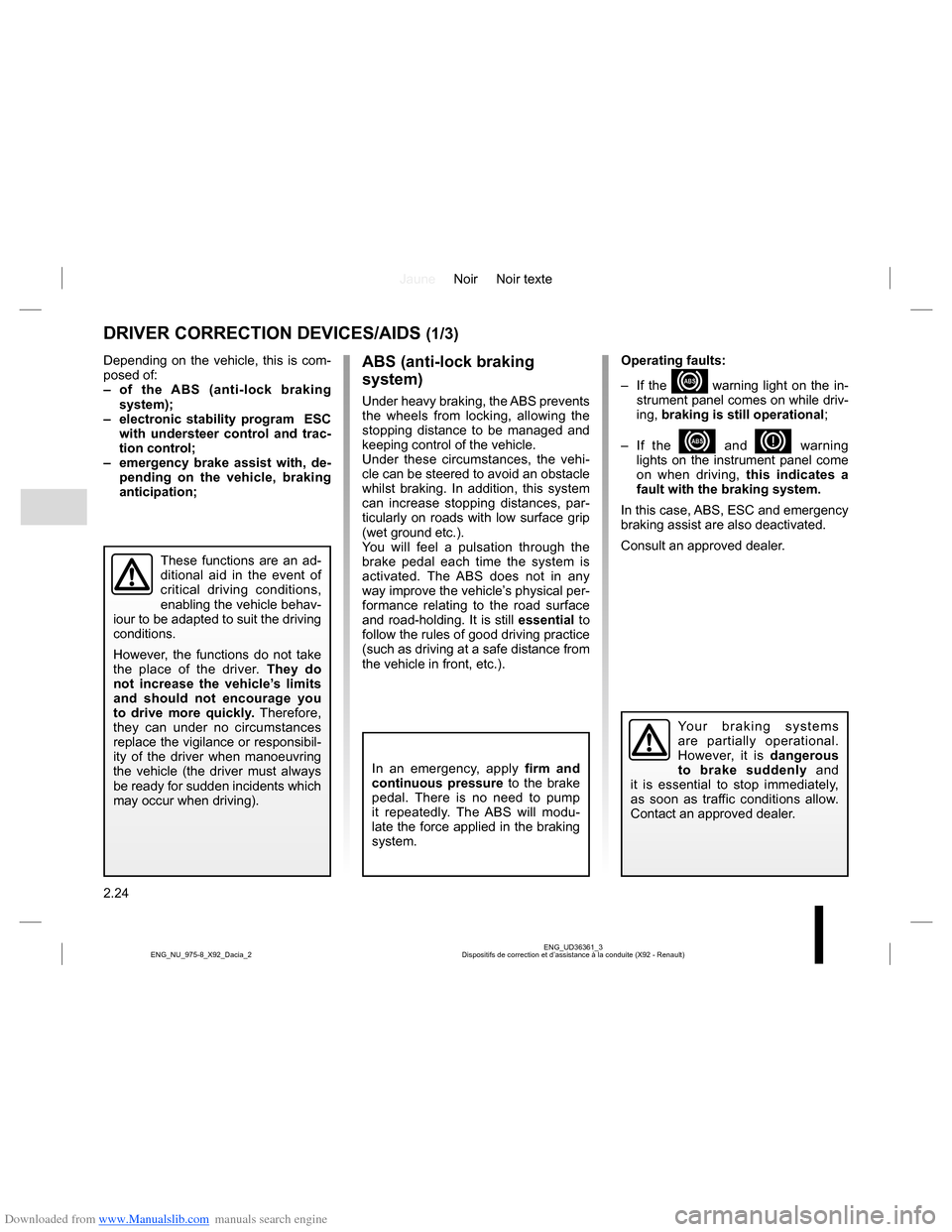
– If the
x warning light on the in-
strument panel comes on while driv-
ing, braking is still operational;
– If the
x and D warning
lights on the instrument panel come
on when driving, this indicates a
fault with the braking system.
In this case, ABS, ESC and emergency
braking assist are also deactivated.
Consult an approved dealer.
Depending on the vehicle, this is com-
posed of:
– of the ABS (anti-lock braking
system);
– electronic stability program ESC
with understeer control and trac-
tion control;
– emergency brake assist with, de-
pending on the vehicle, braking
anticipation;
In an emergency, apply firm and
continuous pressure to the brake
pedal. There is no need to pump
it repeatedly. The ABS will modu-
late the force applied in the braking
system.
These functions are an ad-
ditional aid in the event of
critical driving conditions,
enabling the vehicle behav-
iour to be adapted to suit the driving
conditions.
However, the functions do not take
the place of the driver. They do
not increase the vehicle’s limits
and should not encourage you
to drive more quickly. Therefore,
they can under no circumstances
replace the vigilance or responsibil-
ity of the driver when manoeuvring
the vehicle (the driver must always
be ready for sudden incidents which
may occur when driving).
Your braking systems
are partially operational.
However, it is dangerous
to brake suddenly and
it is essential to stop immediately,
as soon as traffic conditions allow.
Contact an approved dealer.
Page 108 of 258
Downloaded from www.Manualslib.com manuals search engine JauneNoir Noir texte
2.38
ENG_UD24437_1
Boîte de vitesses automatique (X92 - Renault) ENG_NU_975-8_X92_Dacia_2
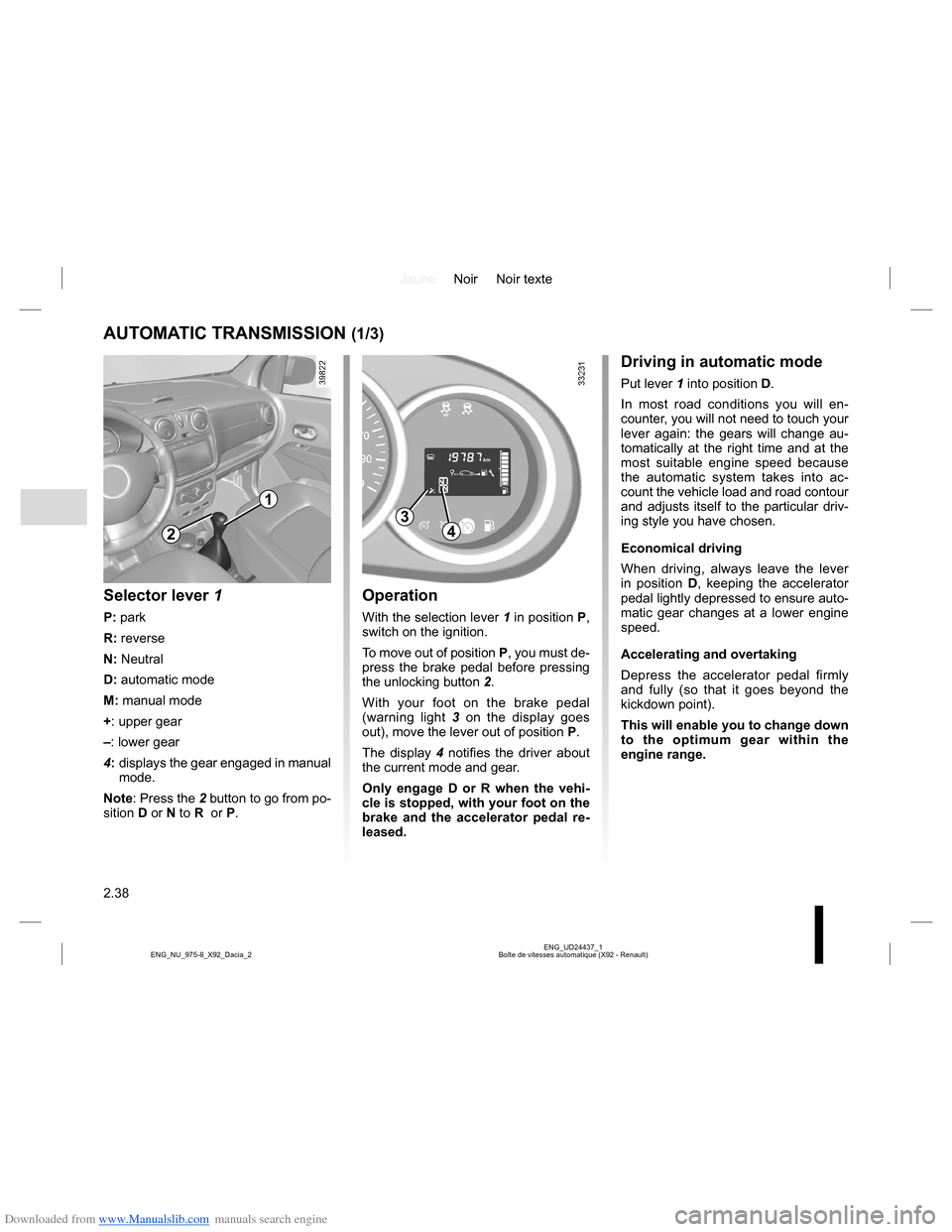
Selector lever 1
P: park
R: reverse
N: Neutral
D: automatic mode
M: manual mode
+: upper gear
–: lower gear
4: displays the gear engaged in manual
mode.
Note: Press the 2 button to go from po-
sition D or N to R or P.
Operation
With the selection lever 1 in position P,
switch on the ignition.
To move out of position P, you must de-
press the brake pedal before pressing
the unlocking button 2.
With your foot on the brake pedal
(warning light 3 on the display goes
out), move the lever out of position P.
The display 4 notifies the driver about
the current mode and gear.
Only engage D or R when the vehi-
cle is stopped, with your foot on the
brake and the accelerator pedal re-
leased.
AUTOMATIC TRANSMISSION (1/3)
Driving in automatic mode
Put lever 1 into position D.
In most road conditions you will en-
counter, you will not need to touch your
lever again: the gears will change au-
tomatically at the right time and at the
most suitable engine speed because
the automatic system takes into ac-
count the vehicle load and road contour
and adjusts itself to the particular driv-
ing style you have chosen.
Economical driving
When driving, always leave the lever
in position D, keeping the accelerator
pedal lightly depressed to ensure auto-
matic gear changes at a lower engine
speed.
Accelerating and overtaking
Depress the accelerator pedal firmly
and fully (so that it goes beyond the
kickdown point).
This will enable you to change down
to the optimum gear within the
engine range.
1
2
34
Page 110 of 258
Downloaded from www.Manualslib.com manuals search engine JauneNoir Noir texte
2.40
ENG_UD24437_1
Boîte de vitesses automatique (X92 - Renault) ENG_NU_975-8_X92_Dacia_2
– In cold weather (temperatures
under -20°C), wait a few seconds
before moving the selector lever
from position P and engaging it in D
or R, then avoid strong acceleration
for the first few minutes to prevent
the engine stalling.
Parking the vehicle
When the vehicle is stopped, move the
lever to position P while keeping your
foot on the brake pedal: the gearbox is
in neutral and the drive wheels are me-
chanically locked by the driveshaft.
Apply the handbrake.
AUTOMATIC TRANSMISSION (3/3)
Operating faults
If a vehicle with an automatic gear-
box breaks down, please refer to
the information on “Towing” in Section
5. When setting off, if the lever is
locked in position P even though you
are pressing the brake pedal, the lever
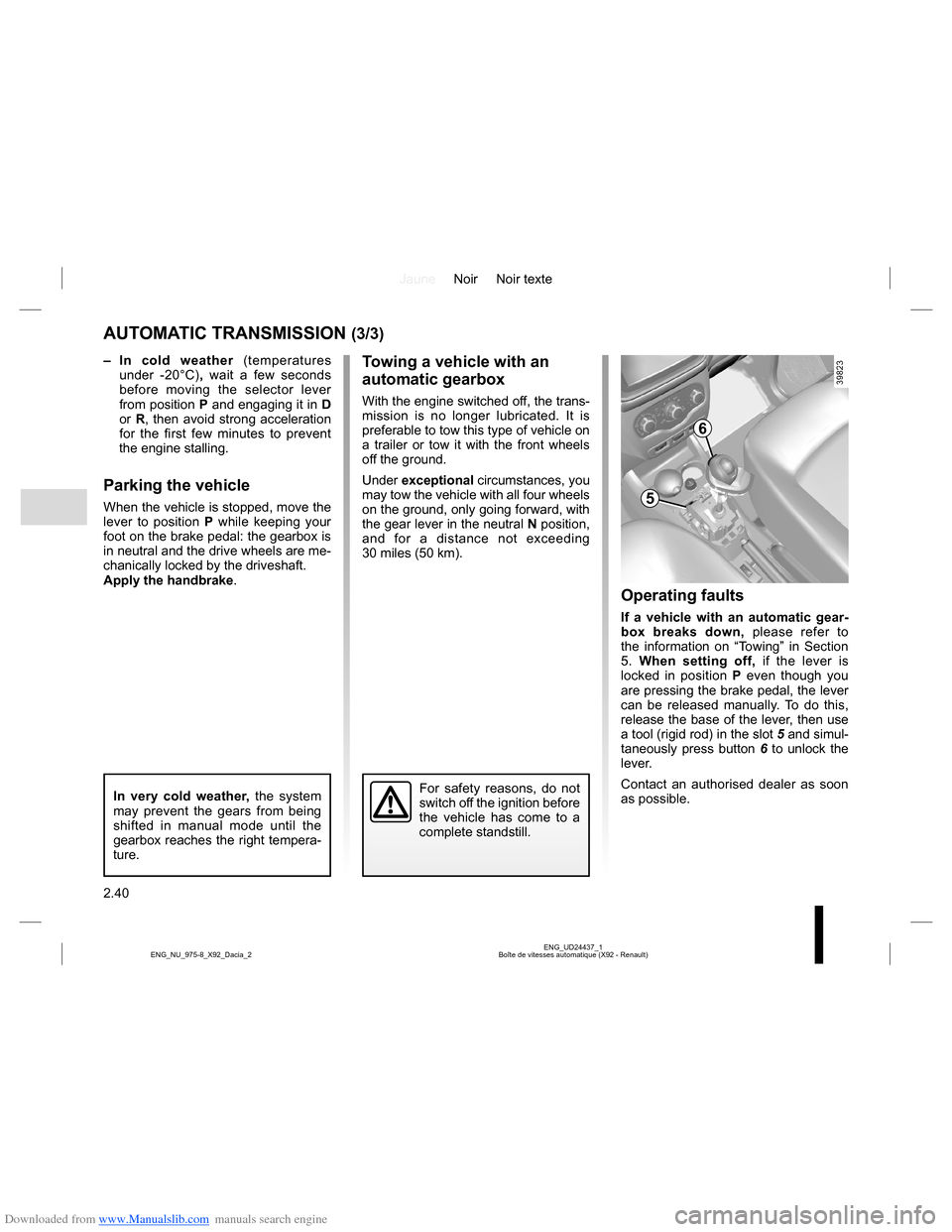
can be released manually. To do this,
release the base of the lever, then use
a tool (rigid rod) in the slot 5 and simul-
taneously press button 6 to unlock the
lever.
Contact an authorised dealer as soon
as possible.
In very cold weather, the system
may prevent the gears from being
shifted in manual mode until the
gearbox reaches the right tempera-
ture.
Towing a vehicle with an
automatic gearbox
With the engine switched off, the trans-
mission is no longer lubricated. It is
preferable to tow this type of vehicle on
a trailer or tow it with the front wheels
off the ground.
Under exceptional circumstances, you
may tow the vehicle with all four wheels
on the ground, only going forward, with
the gear lever in the neutral N position,
and for a distance not exceeding
30 miles (50 km).
For safety reasons, do not
switch off the ignition before
the vehicle has come to a
complete standstill.
5
6
Page 118 of 258
Downloaded from www.Manualslib.com manuals search engine JauneNoir Noir texte
3.8
ENG_UD36370_2
Vitres (X92 - Renault) ENG_NU_975-8_X92_Dacia_3
ELECTRIC WINDOWS (1/3)
Safety of rear occupants
The driver can prevent op-
eration of the rear elec-
tric windows by pressing
switch 4.
Driver’s responsibility
Never leave your vehicle with the
key inside and never leave a child
(or a pet) unsupervised, even for a
short while. They may pose a risk
to themselves or to others by start-
ing the engine, activating equipment
such as the electric windows or by
locking the doors. If a body part
gets trapped, reverse the direction
of travel of the window as soon as
possible by pressing the relevant
switch.
Risk of serious injury.1
2
4
5
3
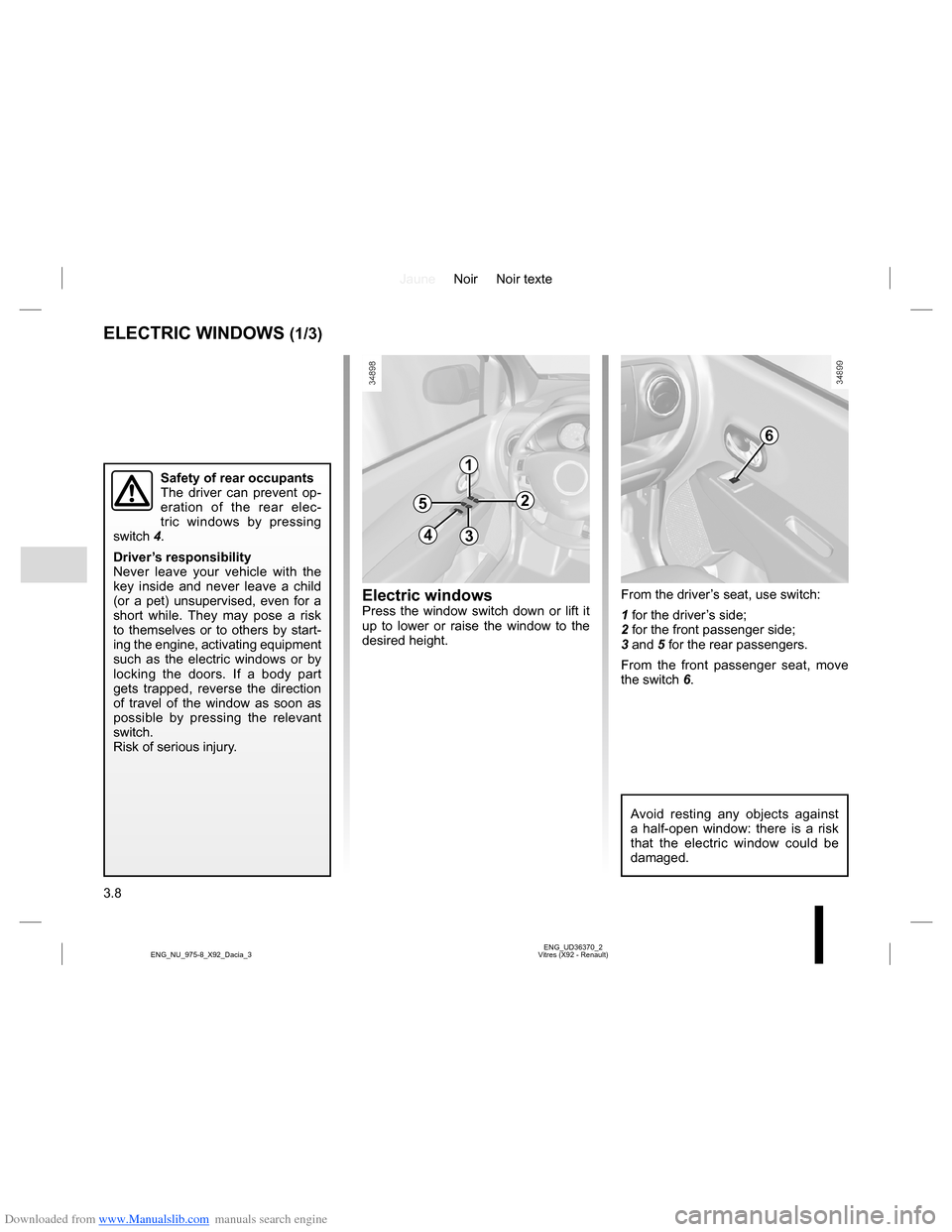
Electric windowsPress the window switch down or lift it
up to lower or raise the window to the
desired height.From the driver’s seat, use switch:
1 for the driver’s side;
2 for the front passenger side;
3 and 5 for the rear passengers.
From the front passenger seat, move
the switch 6.
6
Avoid resting any objects against
a half-open window: there is a risk
that the electric window could be
damaged.
Page 119 of 258
Downloaded from www.Manualslib.com manuals search engine JauneNoir Noir texte
3.9
ENG_UD36370_2
Vitres (X92 - Renault) ENG_NU_975-8_X92_Dacia_3
ELECTRIC WINDOWS (2/3)
8
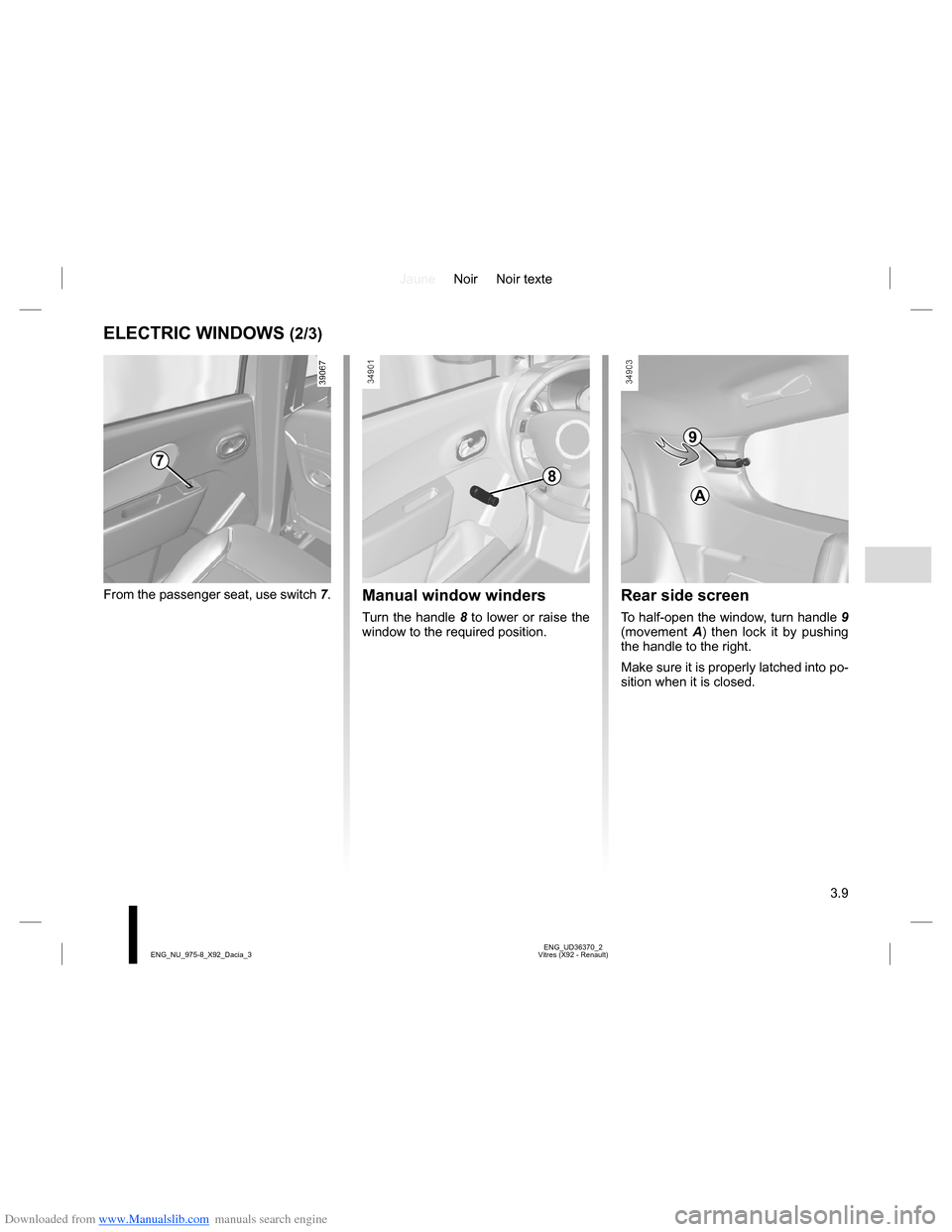
Manual window winders
Turn the handle 8 to lower or raise the
window to the required position.
Rear side screen
To half-open the window, turn handle 9
(movement A) then lock it by pushing
the handle to the right.
Make sure it is properly latched into po-
sition when it is closed.
9
A
From the passenger seat, use switch 7.
7
Page 121 of 258
Downloaded from www.Manualslib.com manuals search engine JauneNoir Noir texte
3.11
ENG_UD38061_4
Eclairage intérieur (X92 - Renault) ENG_NU_975-8_X92_Dacia_3
INTERIOR LIGHTING
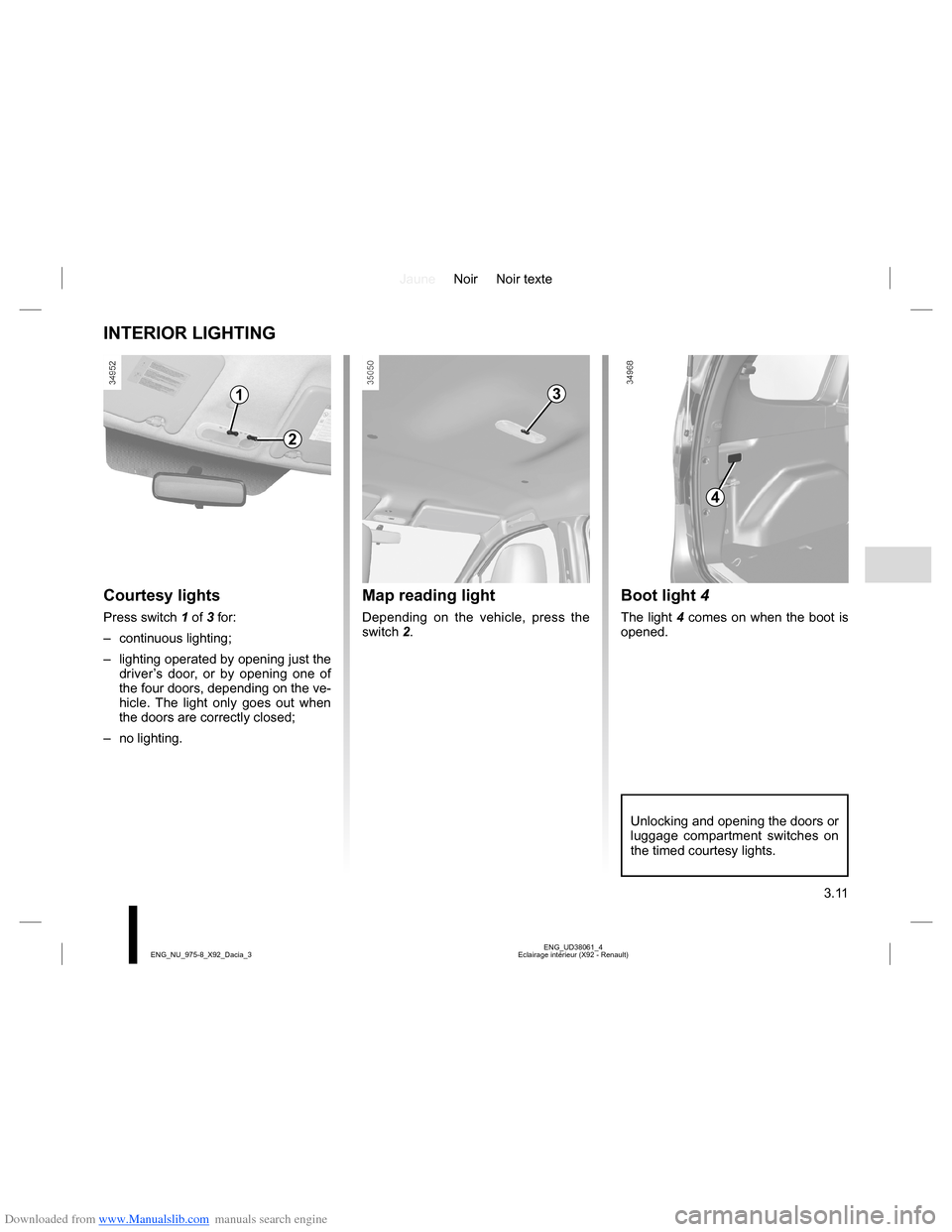
Courtesy lights
Press switch 1 of 3 for:
– continuous lighting;
– lighting operated by opening just the
driver’s door, or by opening one of
the four doors, depending on the ve-
hicle. The light only goes out when
the doors are correctly closed;
– no lighting.
Map reading light
Depending on the vehicle, press the
switch 2.
3
Unlocking and opening the doors or
luggage compartment switches on
the timed courtesy lights.
2
1
Boot light 4
The light 4 comes on when the boot is
opened.
4
Page 129 of 258
Downloaded from www.Manualslib.com manuals search engine JauneNoir Noir texte
3.19
ENG_UD37235_4
Appuis-tête arrière (X92 - Renault) ENG_NU_975-8_X92_Dacia_3
REAR HEADRESTS (1/2)
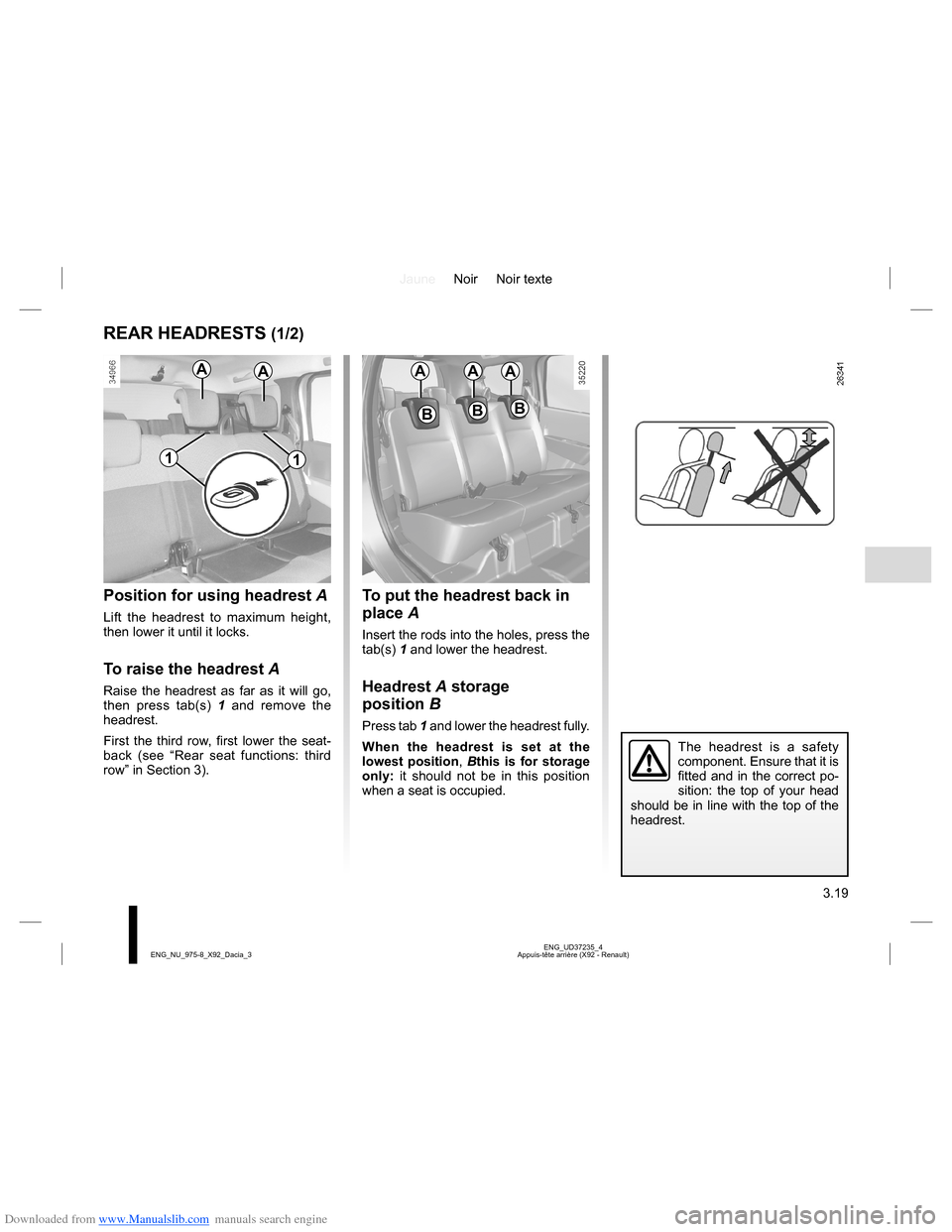
Position for using headrest A
Lift the headrest to maximum height,
then lower it until it locks.
To raise the headrest A
Raise the headrest as far as it will go,
then press tab(s) 1 and remove the
headrest.
First the third row, first lower the seat-
back (see “Rear seat functions: third
row” in Section 3).
The headrest is a safety
component. Ensure that it is
fitted and in the correct po-
sition: the top of your head
should be in line with the top of the
headrest.
11
To put the headrest back in
place A
Insert the rods into the holes, press the
tab(s) 1 and lower the headrest.
Headrest A storage
position B
Press tab 1 and lower the headrest fully.
When the headrest is set at the
lowest position, Bthis is for storage
only: it should not be in this position
when a seat is occupied.
AAA
BBB
AA
Page 130 of 258
Downloaded from www.Manualslib.com manuals search engine JauneNoir Noir texte
3.20
ENG_UD37235_4
Appuis-tête arrière (X92 - Renault) ENG_NU_975-8_X92_Dacia_3
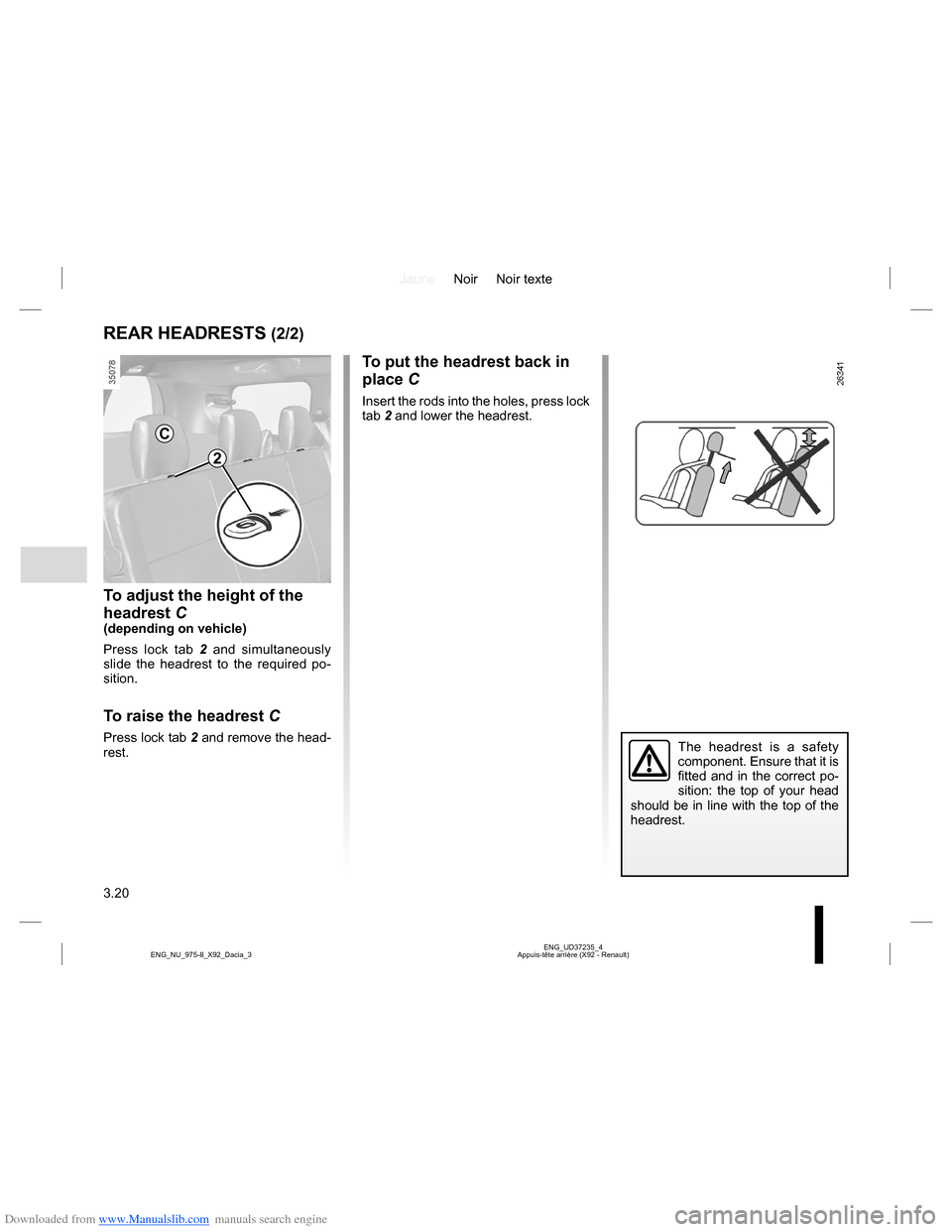
To adjust the height of the
headrest C
(depending on vehicle)
Press lock tab 2 and simultaneously
slide the headrest to the required po-
sition.
To raise the headrest C
Press lock tab 2 and remove the head-
rest.
To put the headrest back in
place C
Insert the rods into the holes, press lock
tab 2 and lower the headrest.
The headrest is a safety
component. Ensure that it is
fitted and in the correct po-
sition: the top of your head
should be in line with the top of the
headrest.
REAR HEADRESTS (2/2)
C
2
Page 131 of 258
Downloaded from www.Manualslib.com manuals search engine JauneNoir Noir texte
3.21
ENG_UD38149_4
Sièges arrière de deuxième rangée: fonctionnalité (X92 - Renault) ENG_NU_975-8_X92_Dacia_3
REAR SEAT FUNCTIONS: second row (1/3)
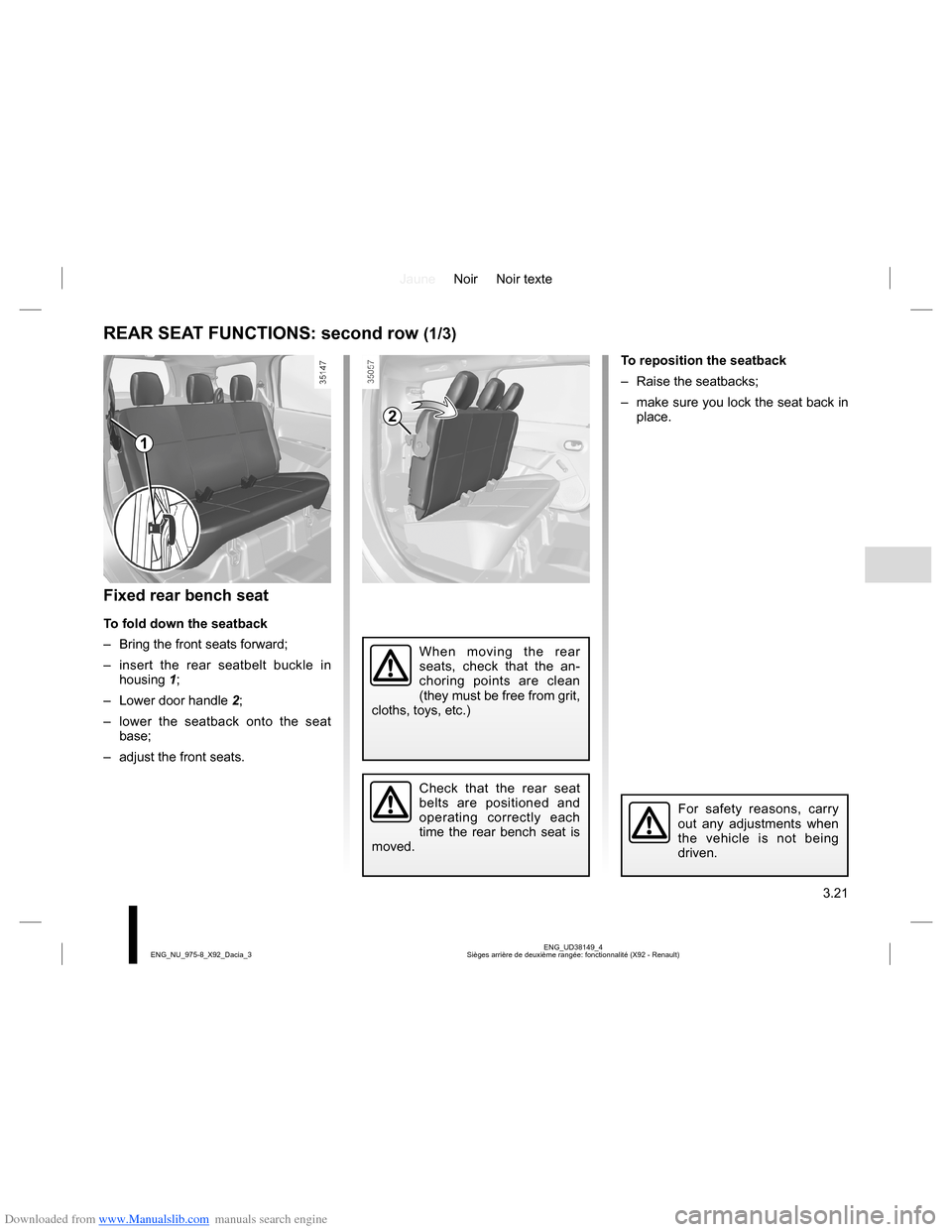
Fixed rear bench seat
To fold down the seatback
– Bring the front seats forward;
– insert the rear seatbelt buckle in
housing 1;
– Lower door handle 2;
– lower the seatback onto the seat
base;
– adjust the front seats.To reposition the seatback
– Raise the seatbacks;
– make sure you lock the seat back in
place.
When moving the rear
seats, check that the an-
choring points are clean
(they must be free from grit,
cloths, toys, etc.)
Check that the rear seat
belts are positioned and
operating correctly each
time the rear bench seat is
moved.
For safety reasons, carry
out any adjustments when
the vehicle is not being
driven.
2
1