wheel DACIA SANDERO 2012 1.G Owner's Manual
[x] Cancel search | Manufacturer: DACIA, Model Year: 2012, Model line: SANDERO, Model: DACIA SANDERO 2012 1.GPages: 183, PDF Size: 6.95 MB
Page 124 of 183

5.4
ENG_UD22290_8
Kit de gonflage des pneumatiques (B90 - L90 Ph2 - F90 Ph2 - R90 Ph2 - D\
acia)
ENG_NU_817-9_B90_Dac")
tyre inflation kit...................................... (up to the end of the DU)
5.4
ENG_UD22290_8
Kit de gonflage des pneumatiques (B90 - L90 Ph2 - F90 Ph2 - R90 Ph2 - D\
acia)
ENG_NU_817-9_B90_Dacia_5
Jaune NoirNoir texte
Tyre inflation kit
TYRE INFLATION KIT (1/3)
The kit repairs tyres with
tread A damaged by ob -
jects smaller than 4 mm. It
cannot repair all types of
puncture, such as cuts of more than
4 mm, or cuts in tyre sidewall B etc.
Ensure also that the wheel rim is in
good condition.
Do not pull out the foreign body
causing the puncture if it is still in
the tyre.
Do not attempt to use the
inflation kit if the tyre has
been damaged as a result
of driving with a puncture.
You should therefore carefully check
the condition of the tyre sidewalls
before any operation.
Driving with underinflated, flat or
punctured tyres can be dangerous
and may make the tyre impossible
to repair.
This repair is temporary
A tyre which has been punctured
should always be inspected (and re-
paired, where possible) as soon as
possible by a specialist.
When replacing a tyre repaired with
this kit, you must consult a special-
ist. When driving, vibration may be
felt due to the presence of the repair
product injected into the tyre.The kit is only approved for
inflating the tyres of the ve-
hicle originally equipped
with the kit.
It must never be used to inflate
the tyres of another vehicle, or any
other inflatable object (rubber ring,
rubber boat, etc.).
Avoid spillage on skin when han -
dling the repair liquid bottle. If drop-
lets do leak out, rinse them off with
plenty of water.
Keep the repair kit away from chil -
dren.
Do not dispose of the empty bottle
in the countryside. Return it to your
approved dealer or to a recycling or-
ganisation.
The bottle has a limited service
life which is indicated on its label.
Check the expiry date.
Contact an approved dealer to re -
place the inflation tube and repair
product bottle.
A
B
Page 125 of 183

ENG_NU_817-9_B90_Dacia_5
TYRE INFLATION KIT (2/3)
Depending on the vehicle, in")
JauneNoirNoir texte
5.5
ENG_UD22290_8
Kit de gonflage des pneumatiques (B90 - L90 Ph2 - F90 Ph2 - R90 Ph2 - D\
acia)
ENG_NU_817-9_B90_Dacia_5
TYRE INFLATION KIT (2/3)
Depending on the vehicle, in the event
of a puncture, use the kit located in the
boot. –
press switch 5 to inflate the tyre to
the recommended pressure (check
the label affixed to the edge of the
driver’s door);
– after a maximum of 5 minutes, stop
inflating and read the pressure (on
the pressure gauge 4);
Note: while the bottle is emptying
(approximately 30 seconds), pres -
sure gauge 4 will briefly indicate a
pressure of 6 bar, then the pressure
will drop.
– adjust the pressure: to increase
it, continue inflating with the kit, to
reduce it, turn button 7 located on
the inflation adapter.
If a minimum pressure of 1.8 bar is
not reached after 15 minutes, repair
is not possible; do not drive the vehi-
cle but contact an approved dealer .
1234
5
6
Before using this kit, park
the vehicle at a sufficient
distance from traffic, switch
on the hazard warning
lights, apply the handbrake, ask all
passengers to leave the vehicle and
keep them away from traffic.
8
Open the kit, remove caps 1 and 3 (it is
essential not to remove the cap from
the bottle) then screw bottle 2 to its sup-
port 3.
With the engine running and the
handbrake applied,
– unscrew the valve cap on the wheel
concerned and screw the inflation
adapter 6 onto valve;
– connect adapter 8 to accessories
socket 9 on the dashboard of the ve-
hicle;
9
7
Page 127 of 183
practical advice ..................................... (up to the end of the DU)
trims ...................................................... (up to the end of the DU)
lifting the vehicle changing a wheel ............................ (up to the end of the DU)
5.7
ENG_UD20461_5
Enjoliveurs - Jantes (B90 - Dacia)
ENG_NU_817-9_B90_Dacia_5
Wheel trim/Wheels
WHEEL TRIM/WHEELS (1/2)
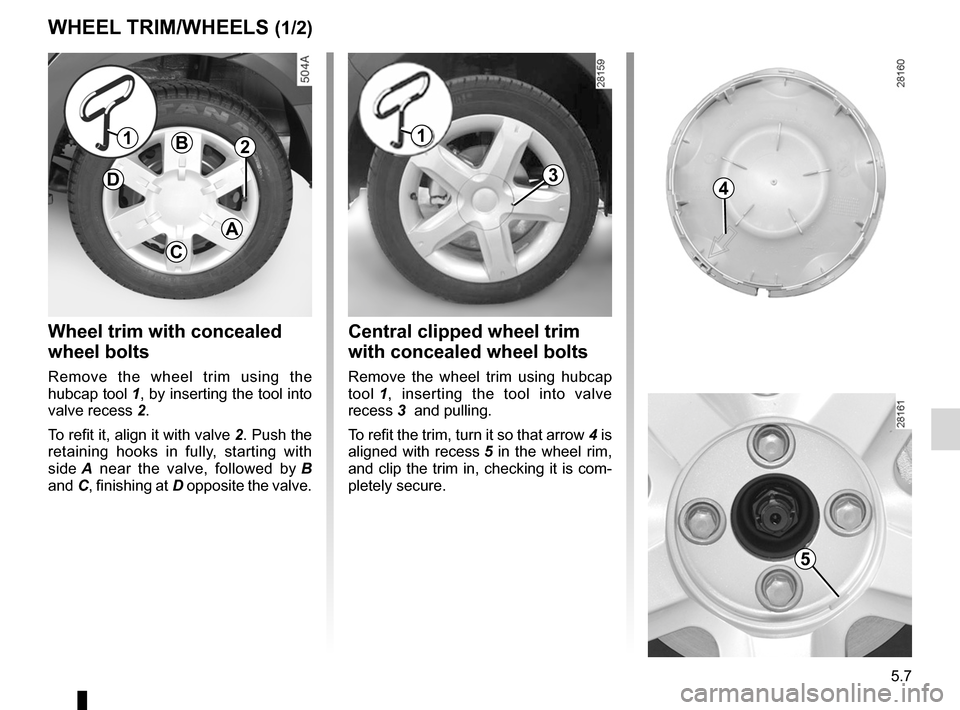
Wheel trim with concealed
wheel bolts
Remove the wheel trim using the
hubcap tool 1, by inserting the tool into
valve recess 2.
To refit it, align it with valve 2. Push the
retaining hooks in fully, starting with
side A near the valve, followed by B
and C, finishing at D opposite the valve.
B
D
C
A
121
3
Central clipped wheel trim
with concealed wheel bolts
Remove the wheel trim using hubcap
tool 1 , inserting the tool into valve
recess 3 and pulling.
To refit the trim, turn it so that arrow 4 is
aligned with recess 5 in the wheel rim,
and clip the trim in, checking it is com-
pletely secure.
5
4
Page 128 of 183
5.8
ENG_UD20461_5
Enjoliveurs - Jantes (B90 - Dacia)
ENG_NU_817-9_B90_Dacia_5
WHEEL TRIM/WHEELS (2/2)
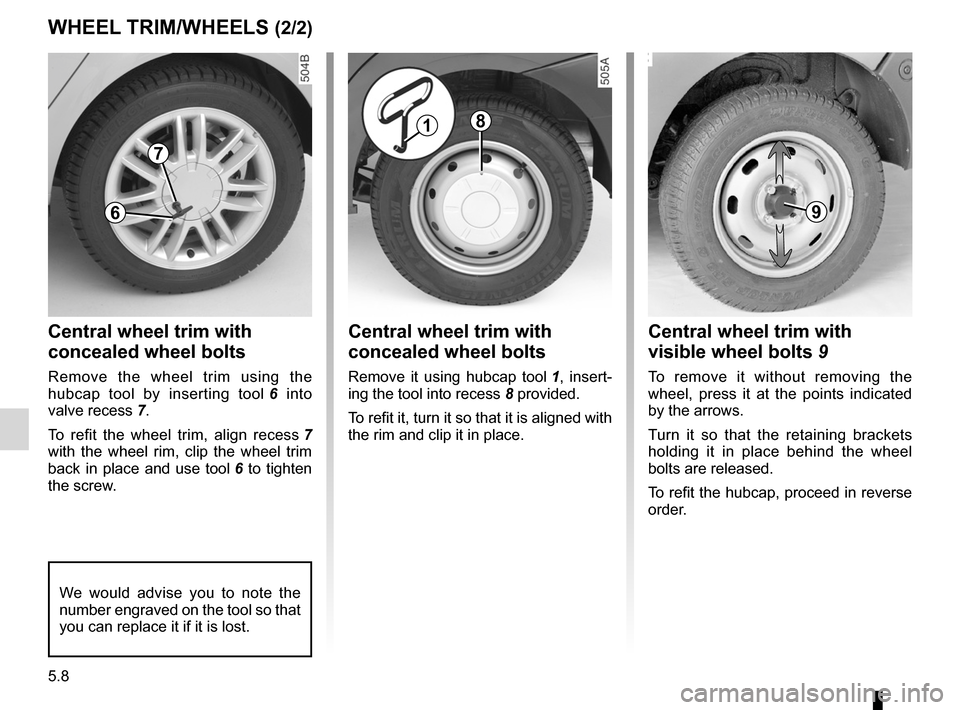
Central wheel trim with
concealed wheel bolts
Remove it using hubcap tool 1 , insert -
ing the tool into recess 8 provided.
To refit it, turn it so that it is aligned with
the rim and clip it in place.
Central wheel trim with
visible wheel bolts 9
To remove it without removing the
wheel, press it at the points indicated
by the arrows.
Turn it so that the retaining brackets
holding it in place behind the wheel
bolts are released.
To refit the hubcap, proceed in reverse
order.
18
9
Central wheel trim with
concealed wheel bolts
Remove the wheel trim using the
hubcap tool by inserting tool 6 into
valve recess 7.
To refit the wheel trim, align recess 7
with the wheel rim, clip the wheel trim
back in place and use tool 6 to tighten
the screw.
7
We would advise you to note the
number engraved on the tool so that
you can replace it if it is lost.
6
Page 129 of 183
changing a wheel.................................. (up to the end of the DU)
practical advice ..................................... (up to the end of the DU)
jack ....................................................... (up to the end of the DU)
puncture ................................................ (up to the end of the DU)
lifting the vehicle changing a wheel ............................ (up to the end of the DU)
5.9
ENG_UD20462_6
Changement de roue (B90 - Dacia)
ENG_NU_817-9_B90_Dacia_5
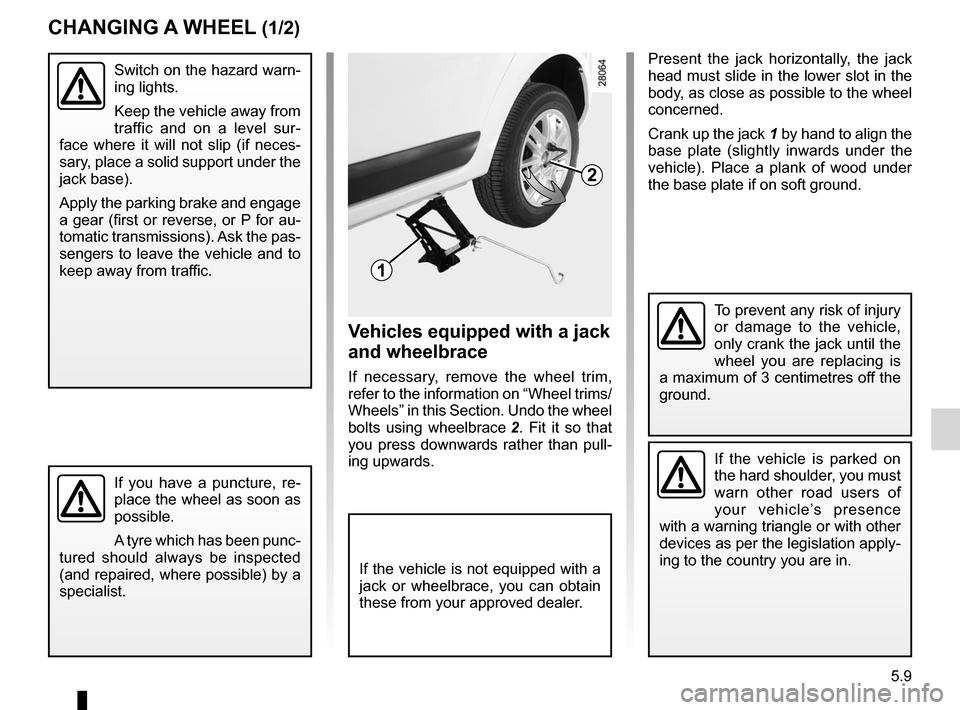
Present the jack horizontally, the jack
head must slide in the lower slot in the
body, as close as possible to the wheel
concerned.
Crank up the jack 1 by hand to align the
base plate (slightly inwards under the
vehicle). Place a plank of wood under
the base plate if on soft ground.
Changing a wheel
Switch on the hazard warn-
ing lights.
Keep the vehicle away from
traffic and on a level sur -
face where it will not slip (if neces -
sary, place a solid support under the
jack base).
Apply the parking brake and engage
a gear (first or reverse, or P for au-
tomatic transmissions). Ask the pas-
sengers to leave the vehicle and to
keep away from traffic.
If you have a puncture, re -
place the wheel as soon as
possible.
A tyre which has been punc-
tured should always be inspected
(and repaired, where possible) by a
specialist.
2
1
Vehicles equipped with a jack
and wheelbrace
If necessary, remove the wheel trim,
refer to the information on “Wheel trims/
Wheels” in this Section. Undo the wheel
bolts using wheelbrace 2 . Fit it so that
you press downwards rather than pull -
ing upwards.
To prevent any risk of injury
or damage to the vehicle,
only crank the jack until the
wheel you are replacing is
a maximum of 3 centimetres off the
ground.
If the vehicle is parked on
the hard shoulder, you must
warn other road users of
your vehicle’s presence
with a warning triangle or with other
devices as per the legislation apply-
ing to the country you are in.
CHANGING A WHEEL (1/2)
If the vehicle is not equipped with a
jack or wheelbrace, you can obtain
these from your approved dealer.
Page 130 of 183
5.10
ENG_UD20462_6
Changement de roue (B90 - Dacia)
ENG_NU_817-9_B90_Dacia_5
Turn the wheelbrace until the wheel lifts
off the ground.
Remove the bolts.
Take off the wheel.
Fit the emergency spare wheel on the
central hub and turn it to locate the
mounting holes in the wheel and the
hub.
If bolts are supplied with the emergency
spare wheel, only use these bolts for
the emergency spare wheel.
Tighten the bolts, checking that the
wheel is correctly positioned on its hub
and lower the jack.
With the wheels on the ground, tighten
the nuts as fully as possible and check
the tightness as soon as possible (tight-
ening torque 105 Nm).
If the vehicle is parked on
the hard shoulder, you must
warn other road users of
your vehicle’s presence
with a warning triangle or with other
devices as per the legislation apply-
ing to the country you are in.
CHANGING A WHEEL (2/2)
Note : ensure that the emergency
spare wheel or punctured wheel and
the wheel tray are correctly posi -
tioned so that the luggage compart-
ment carpet can be properly fitted.
Page 131 of 183
practical advice ..................................... (up to the end of the DU)
tyres ...................................................... (up to the end of the DU)
emergency spare wheel ....................... (up to the end of the DU)
5.11
ENG_UD19769_10
Pneumatiques (B90 - U90 - L90 Ph2 - F90 Ph2 - R90 Ph2 - Dacia)ENG_NU_817-9_B90_Dacia_5
Tyres (tyre and wheel safety, use in winter)
TYRES (1/3)
Tyre and wheel safety
The tyres are the only contact between
the vehicle and the road, so it is essen-
tial to keep them in good condition.
You must make sure that your tyres
conform to local road traffic regulations.
When they need to be re -
placed, only tyres of the
same make, size, type and
profile should be used.
Tyres fitted to the vehicle should
either be identical to those fitted
originally or conform to those
recommended by your approved
Dealer.Maintaining the tyres
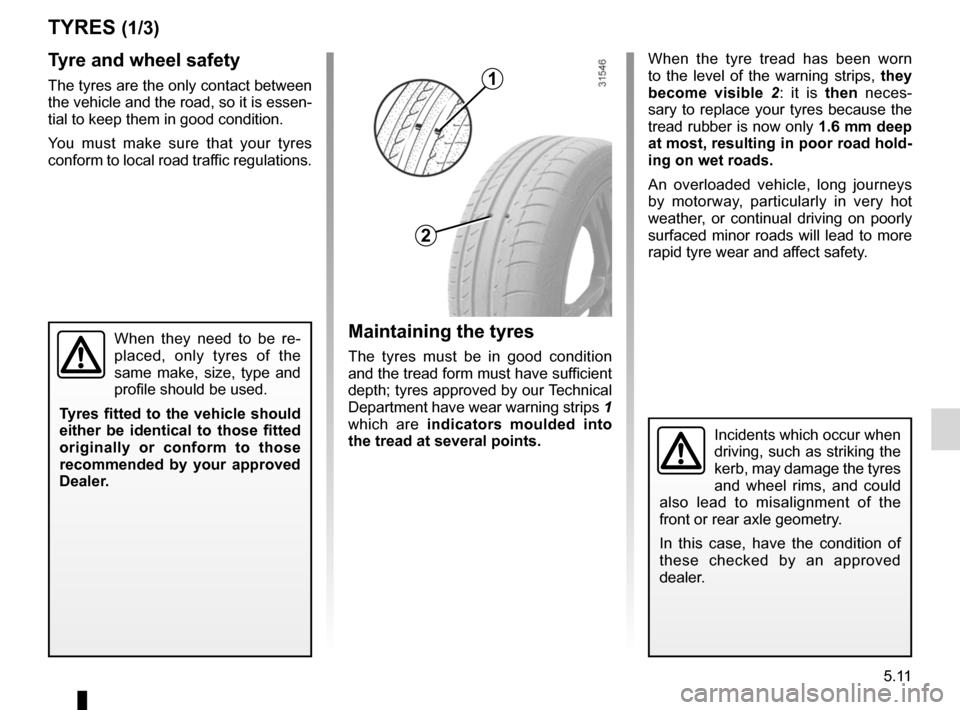
The tyres must be in good condition
and the tread form must have sufficient
depth; tyres approved by our Technical
Department have wear warning strips 1
which are indicators moulded into
the tread at several points. When the tyre tread has been worn
to the level of the warning strips, they
become visible
2: it is then neces -
sary to replace your tyres because the
tread rubber is now only 1.6 mm deep
at most, resulting in poor road hold -
ing on wet roads.
An overloaded vehicle, long journeys
by motorway, particularly in very hot
weather, or continual driving on poorly
surfaced minor roads will lead to more
rapid tyre wear and affect safety.
Incidents which occur when
driving, such as striking the
kerb, may damage the tyres
and wheel rims, and could
also lead to misalignment of the
front or rear axle geometry.
In this case, have the condition of
these checked by an approved
dealer.
1
2
Page 132 of 183
tyre pressure.......................................................... (current page)
5.12
ENG_UD19769_10
Pneumatiques (B90 - U90 - L90 Ph2 - F90 Ph2 - R90 Ph2 - Dacia)ENG_NU_817-9_B90_Dacia_5
Jaune NoirNoir texte
Changing wheels around
This practice is not recommended.
Emergency spare wheel
Refer to the information on the
“ E m e r g e n c y s p a r e w h e e l ” a n d
“Changing a wheel” in Section 5.
Fitting new tyres
TYRES (2/3)
Tyre pressures
Adhere to the tyre pressures (including
the emergency spare wheel). The tyre
pressures should be checked at least
once a month and additionally before
any long journey (refer to the label af -
fixed to the edge of the driver’s door).
Incorrect tyre pressures
lead to abnormal tyre wear
and unusually hot running.
These are factors which
may seriously affect safety and lead
to:
– poor roadholding;
– risk of blowouts or throwing a
tread.
The tyre pressure depends on the
load and speed of use; adjust the
pressures according to the condi -
tions of use (refer to the information
on “Tyre pressures” in Section 4).
Pressures should be checked when the
tyres are cold; ignore higher pressures
which may be reached in hot weather
or following a fast journey.
If tyre pressures cannot be checked
when the tyres are cold, assume an in-
crease of 0.2 to 0.3 bar.
Never deflate a hot tyre.
Special note
Depending on the vehicle, there may
be an adapter which needs to be posi-
tioned on the valve before air is added.
For safety reasons, this op-
eration must be carried out
by a specialist.
Fitting different tyres may
change your vehicle as follows:
– it may mean that your vehicle no
longer conforms to current regu-
lations;
– It may change the way it handles
when cornering;
– It may cause the steering to be
heavy;
– it may affect the use of snow
chains.
Important: a missing or
loose valve cap may com -
promise the tyre seal and
cause a loss of pressure.
Always use valve caps which are
identical to the originals.
Page 133 of 183
JauneNoirNoir texte
5.13
ENG_UD19769_10
Pneumatiques (B90 - U90 - L90 Ph2 - F90 Ph2 - R90 Ph2 - Dacia)ENG_NU_817-9_B90_Dacia_5
Use in winter
Chains
Snow chains must be fitted to the
front wheels.
TYRES (3/3)
It is forbidden to fit snow
chains to only the rear
wheels.
Snow chains may only be
fitted to tyres of the same size as
those originally fitted to your vehicle.
Only certain chains can be fitted to
tyres.
Consult an approved dealer.
Snow or Winter tyres
We would recommend that these be
fitted to all four wheels to ensure that
your vehicle retains maximum adhe -
sion.
Warning: These tyres sometimes
have a specific direction of rotation
and a maximum speed index which
may be lower than the maximum
speed of your vehicle.
Studded tyres
This type of equipment may only be
used for a limited period and as laid
down by local legislation.
It is necessary to observe the speed
specified by current legislation.
These tyres must, at a minimum, be
fitted to the two front wheels.
In all cases, we would recommend
that you contact your approved
Dealer who will be able to advise
you on the choice of equipment
which is most suitable for your ve -
hicle.
Page 149 of 183
towing hitch........................................... (up to the end of the DU)
practical advice ..................................... (up to the end of the DU)
towing breakdown ...................................... (up to the end of the DU)
5.29
ENG_UD17944_4
Remorquage : dépannage (B90 - Dacia)
ENG_NU_817-9_B90_Dacia_5
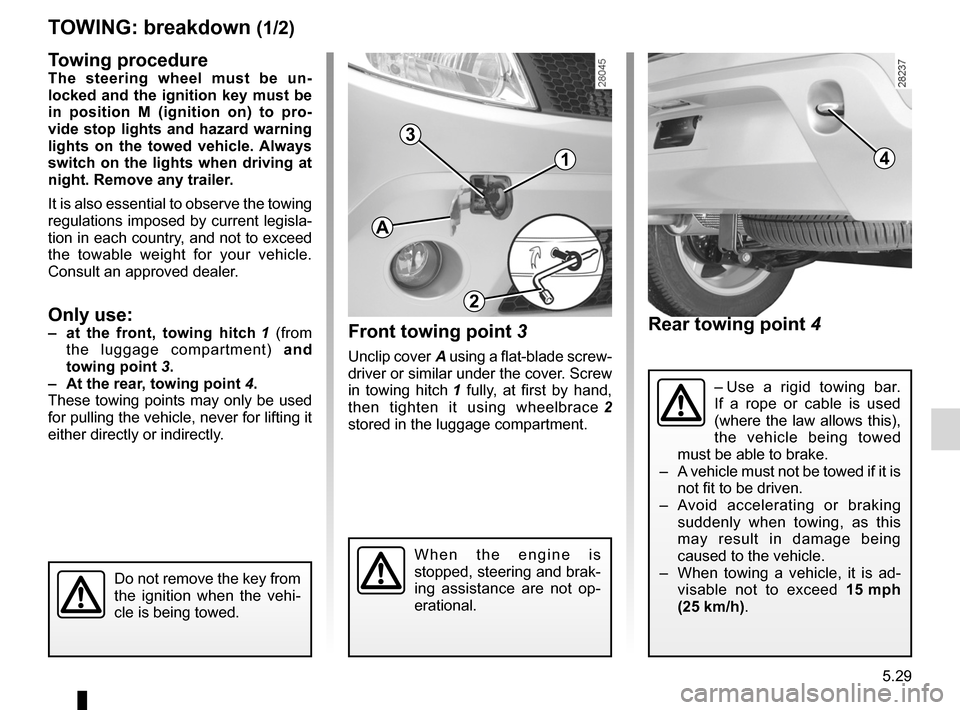
Rear towing point 4
Front towing point 3
Unclip cover A using a flat-blade screw-
driver or similar under the cover. Screw
in towing hitch 1 fully, at first by hand,
then tighten it using wheelbrace 2
stored in the luggage compartment.
Towing: breakdown
W h e n t h e e n g i n e i s
stopped, steering and brak-
ing assistance are not op -
erational.
41
3
Towing procedureThe steering wheel must be un -
locked and the ignition key must be
in position M (ignition on) to pro -
vide stop lights and hazard warning
lights on the towed vehicle. Always
switch on the lights when driving at
night. Remove any trailer.
It is also essential to observe the towing
regulations imposed by current legisla -
tion in each country, and not to exceed
the towable weight for your vehicle.
Consult an approved dealer.
Only use:– at the front, towing hitch 1 (from
the luggage compartment) and
towing point 3.
– At the rear, towing point 4.
These towing points may only be used
for pulling the vehicle, never for lifting it
either directly or indirectly.
Do not remove the key from
the ignition when the vehi -
cle is being towed.
– Use a rigid towing bar.
If a rope or cable is used
(where the law allows this),
the vehicle being towed
must be able to brake.
– A vehicle must not be towed if it is
not fit to be driven.
– Avoid accelerating or braking
suddenly when towing, as this
may result in damage being
caused to the vehicle.
– When towing a vehicle, it is ad -
visable not to exceed 15 mph
(25 km/h).
T OWING : breakdown (1/2)
A
2