start the engine DACIA SANDERO 2013 2.G User Guide
[x] Cancel search | Manufacturer: DACIA, Model Year: 2013, Model line: SANDERO, Model: DACIA SANDERO 2013 2.GPages: 146, PDF Size: 6.4 MB
Page 60 of 146
running in ...............................................................(current page)ignition switch ........................................................(current page)engine immobiliser (switch) ...................................(current page)driving ....................................................................(current page)starting ...................................................................(current page)
2.2
ENG_UD5481_1Rodage / Contacteur de démarrage (U90 - Dacia)ENG_NU_817-2_NU_Dacia_2
Rodage - Contacteur de démarrage
RUNNING IN
Petrol version
For the first 600 miles (1,000 km), do not exceed 78 mph (130 km/h) in the highest gear, or 3,000 to 3,500 rpm.
After 600 miles (1,000 km), you may use your vehicle normally. However, it is only after 1,800 miles (3,000 km) have been covered that you may rea- sonably expect full performance.
Service intervals: refer to the Mainte- nance Service Booklet for your vehicle.
Diesel version
For the first 900 miles (1,500 km), do not exceed 2,500 rpm. After complet- ing this mileage you may drive faster, although you may only expect top p e r f o r m a n c e a f t e r a p p r o x i m a t e l y 3,600 miles (6,000 km).
During the running in period, do not ac- celerate hard while the engine is still cold and do not let the engine over-rev.
Service intervals: refer to the Mainte- nance Service Booklet for your vehicle.
IGNITION SWITCH
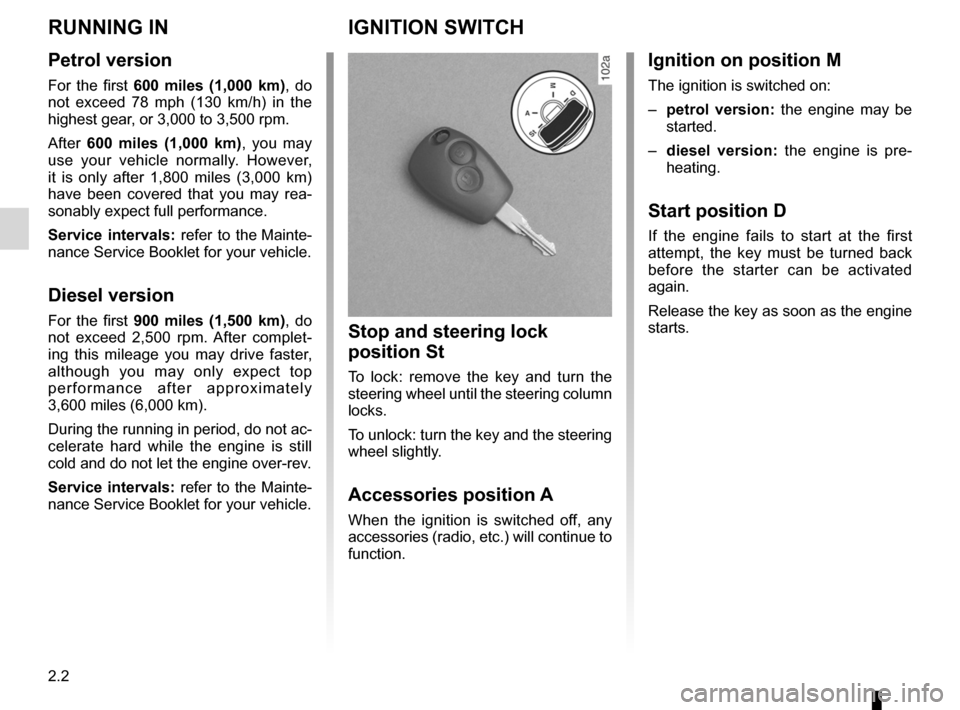
Stop and steering lock
position St
To lock: remove the key and turn the steering wheel until the steering column locks.
To unlock: turn the key and the steering wheel slightly.
Accessories position A
When the ignition is switched off, any accessories (radio, etc.) will continue to function.
Ignition on position M
The ignition is switched on:
–
petrol version: the engine may be started.
–
diesel version: the engine is pre- heating.
Start position D
If the engine fails to start at the first attempt, the key must be turned back before the starter can be activated again.
Release the key as soon as the engine starts.
Page 61 of 146
driving ...................................................(up to the end of the DU)starting ..................................................(up to the end of the DU)starting the engine ................................(up to the end of the DU)
2.3
ENG_UD5482_1Mise en route / Arrêt du moteur (U90 - Dacia)ENG_NU_817-2_NU_Dacia_2
Stopping the engine
With the engine idling, turn the key back to “Stop” position St.
ÉDiesel injection
Turn the ignition key to ignition “On” po- sition M, and hold this position until the preheating warning light goes out.
Turn the key to starter position D with- out depressing the accelerator pedal.
Release the key as soon as the engine starts.
Starting the engine
Special feature on vehicles equipped with an engine immobiliser system
In very cold conditions (temperatures below –20°C): so that it is easier to start the engine, switch on the ignition for several seconds before starting the engine.
Make sure the engine immobiliser is not activated. Refer to the information on the “Engine immobiliser” in Section 1.
Petrol injection
Engine warm or cold
– Turn the key to the start position
without depressing the accelera- tor.
– Release the key as soon as the
engine starts.
Mise en route / Arrêt du moteur
STARTING/STOPPING THE ENGINE
Never leave your vehicle with the keys inside when leaving a child (or \
animal) in the car, even for a short period.
The reason for this is that the child may endanger himself or others by starting the engine, activating equipment such
as the window winders for example, or locking the doors.
Risk of serious injury.
Never switch off the ignition before the vehicle has stopped completely. Once the engine has stopped, the brake servo, power assisted steering and passive safety equipment such as air bags wi\
ll no longer operate.
The steering is locked when the key is removed.
Page 62 of 146
driving ...................................................(up to the end of the DU)catalytic converter.................................(up to the end of the DU)catalytic converter.................................(up to the end of the DU)special features of petrol vehicles ........(up to the end of the DU)
2.4
ENG_UD5483_1Particularités des versions essence (U90 - Dacia)ENG_NU_817-2_NU_Dacia_2
Particularités des versions essence
SPECIAL FEATURES OF PETROL VERSIONS
The following operating conditions:
– driving for long periods when the low
fuel level warning light is lit up,
– using leaded petrol,
– using oil or fuel additives which are
not approved by the manufacturer.
Or operating faults such as:
– faulty ignition, running out of fuel or
spark plug disconnected resulting in engine misfiring and hesitation when driving,
– loss of power,
may cause the catalytic converter to overheat, reducing its efficiency which may irreparably damage it and cause heat damage to the vehicle.
If you notice any of the above operat- ing faults, have the necessary repairs carried out as soon as possible by your approved dealer.
These faults may be avoided by regularly taking your vehicle to your approved dealer at the intervals specified in your Maintenance Service Booklet.
Starting problems
To avoid damaging the catalytic con- verter, do not keep trying to start the engine (using the start button, or by pushing or towing the vehicle) without having identified and corrected the starting fault.
If the fault cannot be identified, do not continue to try and start the engine, but contact an approved dealer.
Do not park the vehicle or
run the engine in locations where combustible sub- stances or materials such as grass or leaves can come into contact with a hot exhaust system.
Page 63 of 146
driving ...................................................(up to the end of the DU)special features of diesel versions........(up to the end of the DU)
2.5
ENG_UD5484_1Particularités des versions diesel (U90 - Dacia)ENG_NU_817-2_NU_Dacia_2
Particularités des versions diesel
SPECIAL FEATURES OF DIESEL VERSIONS
Diesel engine speed
Diesel engines are fitted with an injec- tion pump which prevents the engine speed being exceeded irrespective of the gear selected.
Running out of fuel
You may start the engine normally after refilling the fuel tank even if you have completely run out of fuel, provided that the battery is well-charged.
However, if the engine fails to start after a few seconds and several attempts, contact an approved dealer.
Precautions to be taken in winter
To avoid any faults in icy weather:
– ensure that the battery is always fully
charged,
– always keep the diesel tank rela
- tively full to avoid water vapour con- densing in it and accumulating at the bottom of the tank.
Do not park the vehicle or
run the engine in locations where combustible sub- stances or materials such as grass or leaves can come into contact with a hot exhaust system.
Page 66 of 146
ENG_NU_817-2_NU_Dacia_2
ADVICE ON ANTIPOLLUTION, FUEL ECONOMY AND DRIVING (continued)
– In vehicles fitted")
2.8
ENG_UD5485_1Conseils antipollution, économies de carburant, conduite (U90 - Daci\
a)ENG_NU_817-2_NU_Dacia_2
ADVICE ON ANTIPOLLUTION, FUEL ECONOMY AND DRIVING (continued)
– In vehicles fitted with air condi- tioning, it is normal to observe an increase in fuel consumption (es- pecially in city conditions) when it is used. For vehicles fitted with manual air conditioning, switch off the system when it is not required.
Some advice for reducing fuel consumption and therefore help- ing to protect the environment:
– It is advisable to drive with the air
vents open and the windows closed.
– If the vehicle has been parked in the
sun, open the doors for a few mo- ments to let the hot air escape before starting the engine.
– Never fill the fuel tank to the brim to
avoid overflow.
– Do not leave an empty roof rack
fitted to the vehicle.
– It is better to fit a trailer for bulky ob
- jects.
– When towing a caravan, fit a wind
deflector and adjust it carefully.
Advice on use
– Electricity is fuel; switch off all the electrical components which are not really needed.
However (safety first), keep your lights on when the visibility is bad (“see and be seen”).
– Use the air vents. Driving with the
windows open will increase fuel consumption by 4% at a speed of 60 mph (100 km/h). –
Avoid using the vehicle for door-to
- door journeys (short journeys, with long stops in-between) because in these conditions, the engine never reaches its ideal temperature.
Tyres
Increased fuel consumption could be the result of:
– insufficient pressure,
– using non-recommended tyres.
Page 78 of 146
air conditioning .....................................(up to the end of the DU)heating system .....................................(up to the end of the DU)heating and air conditioning system .....(up to the end of the DU)ventilationheating and air conditioning system (up to the end of the DU)air conditioning ......................................................(current page)
3.8
ENG_UD5493_1Air conditionné : informations et conseils utilisation (U90 - Dacia)\
ENG_NU_817-2_NU_Dacia_3
AIR CONDITIONING: information and advice on use
Fuel consumption
You will normally notice an increase in fuel consumption (especially when driving in town) when the air conditioning is operating.
For vehicles fitted with manual air conditioning, switch off the system when it is not required.
Some advice for reducing fuel consumption and therefore help- ing to protect the environment:It is advisable to drive with the vents open and the windows closed.
If the vehicle has been parked in the sun, open the doors for a few moments to let the hot air escape before starting the engine.
Maintenance
Refer to the Maintenance Service Booklet for your vehicle for the in- spection frequency.
Operating faults
As a general rule, contact your approved dealer in the event of an operating fault.
No cold air is being produced.
Check that the controls are set cor- rectly and that the fuses are sound. Otherwise, switch off the system.
Do not open the refriger- ant fluid circuit. The fluid may damage the eyes or skin.
Presence of water under the ve- hicle. After prolonged use of the air conditioning system, it is normal for water to be present under the ve- hicle. This is caused by condensa- tion.
Page 91 of 146
capacity of mechanical components......................(current page)engine oil ..............................................(up to the end of the DU)dipstick..................................................(up to the end of the DU)levels ....................................................(up to the end of the DU)maintenance:mechanical ......................................(up to the end of the DU)
4.3
ENG_UD5591_1Niveau huile moteur/Vidange moteur (B90 - Dacia)ENG_NU_817-2_NU_Dacia_4
It is normal for an engine to use oil for lubrication and cooling of moving parts and it is sometimes necessary to top up the level between oil changes.
However, contact your approved dealer if more than 0.5 litres is being con- sumed every 600 miles (1,000 km) after the running in period.
Oil change frequency: check the oil level from time to time and certainly before any long journey to avoid the risk of damaging your engine.
Niveau huile moteur
ENGINE OIL LEVEL
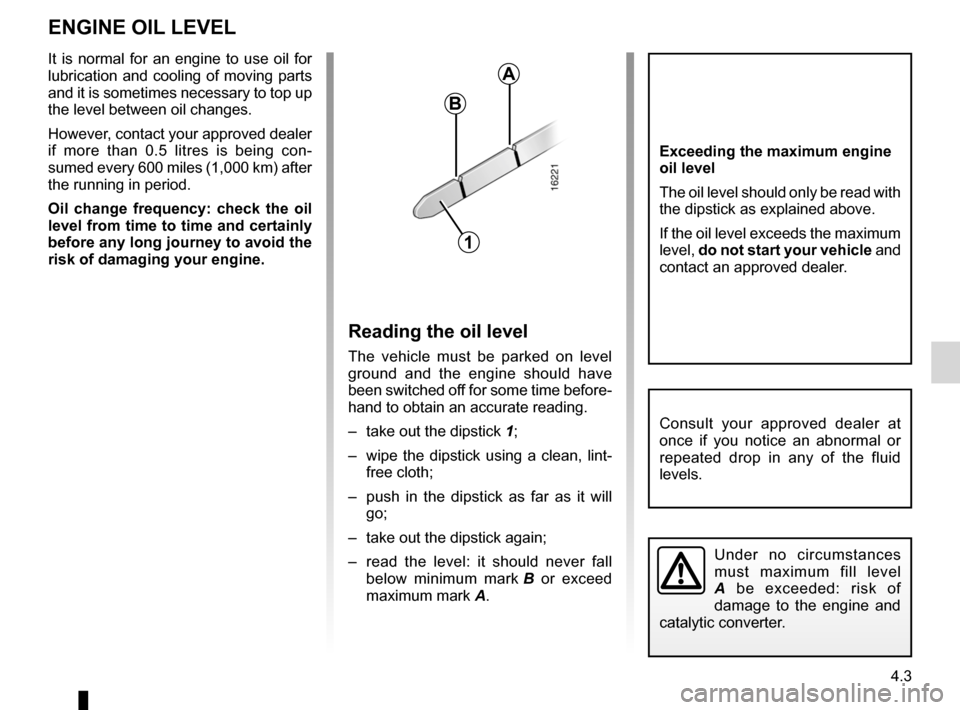
Reading the oil level
The vehicle must be parked on level ground and the engine should have been switched off for some time before- hand to obtain an accurate reading.
– take out the dipstick
1;
– wipe the dipstick using a clean, lint
- free cloth;
– push in the dipstick as far as it will
go;
– take out the dipstick again;
– read the level: it should never fall
below minimum mark B or exceed
maximum mark A.
A
B
1
Exceeding the maximum engine oil level
The oil level should only be read with the dipstick as explained above.
If the oil level exceeds the maximum level, do not start your vehicle and contact an approved dealer.
Under no circumstances must maximum fill level A be exceeded: risk of damage to the engine and catalytic converter.
Consult your approved dealer at once if you notice an abnormal or repeated drop in any of the fluid levels.
Page 92 of 146
engine oil grade ....................................(up to the end of the DU)
4.4
ENG_UD5591_1Niveau huile moteur/Vidange moteur (B90 - Dacia)ENG_NU_817-2_NU_Dacia_4
JauneNoirNoir texte
ENGINE OIL LEVEL (continued)
Topping up/filling
The vehicle must be parked on level ground and the engine should be cold (for instance, before the engine is started up for the first time in the day).
Engine oil grade
Refer to the Maintenance Service Booklet for your vehicle for information regarding which grade of oil to use. –
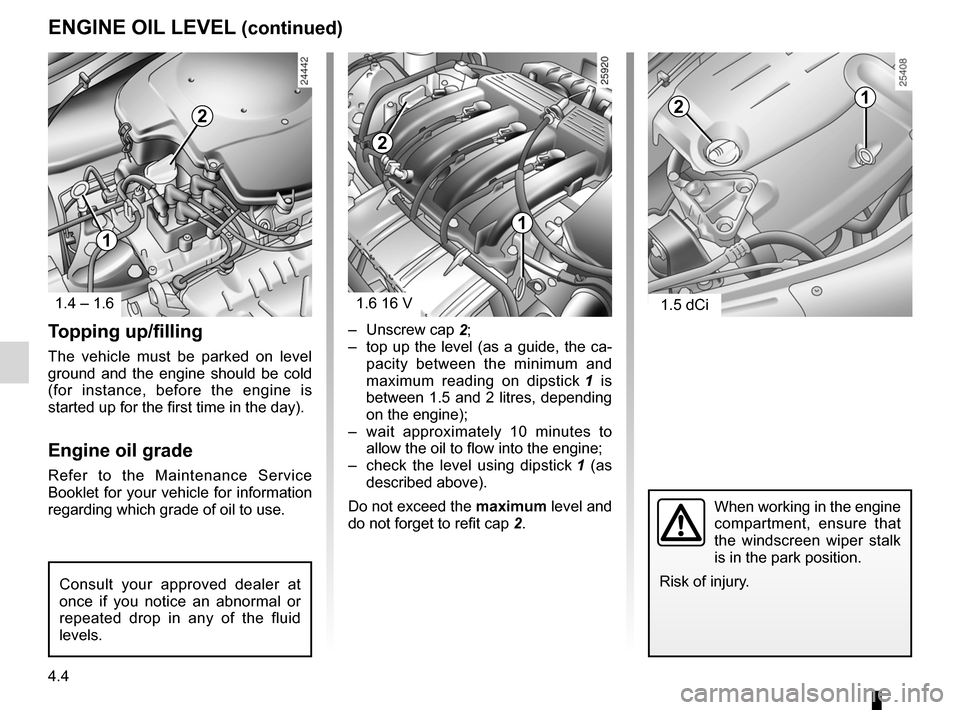
Unscrew cap
2;
– top up the level (as a guide, the ca- pacity between the minimum and
maximum reading on dipstick 1 is between 1.5 and 2 litres, depending on the engine);
– wait approximately 10 minutes to allow the oil to flow into the engine;
– check the level using dipstick 1 (as described above).
Do not exceed the maximum level and
do not forget to refit cap 2.When working in the engine compartment, ensure that the windscreen wiper stalk is in the park position.
Risk of injury.
2
1
12
1
2
1.4 – 1.6 1.6 16 V 1.5 dCi
Consult your approved dealer at once if you notice an abnormal or repeated drop in any of the fluid levels.
Page 121 of 146
JauneNoirNoir texte
5.21
ENG_UD5609_1Batterie : dépannage (B90 - Dacia)ENG_NU_817-2_NU_Dacia_5
BATTERY: troubleshooting (continued)
2
3
1
2
3
4
A
B
Connecting a battery charger
The battery charger must be com- patible with a battery with nominal voltage of 12 volts.
Switch the engine off and then discon- nect both battery leads starting with the negative terminal.
Do not disconnect the battery when the engine is running. Follow the instruc- tions given by the manufacturer of the battery charger you are using.
Starting the vehicle using the
battery from another vehicle
If you have to use the battery from an- other vehicle to start, obtain suitable jump leads (with a large cross section) from an approved dealer or, if you al- ready have jump leads, ensure that they are in perfect condition.
The two batteries must have an iden- tical nominal voltage of 12 volts. The battery supplying the current should have a capacity (amp-hours, Ah) which is at least the same as that of the dis- charged battery.
Ensure that there is no risk of contact between the two vehicles (risk of short circuiting when the positive terminals are connected) and that the discharged battery is properly connected. Switch off your vehicle ignition.
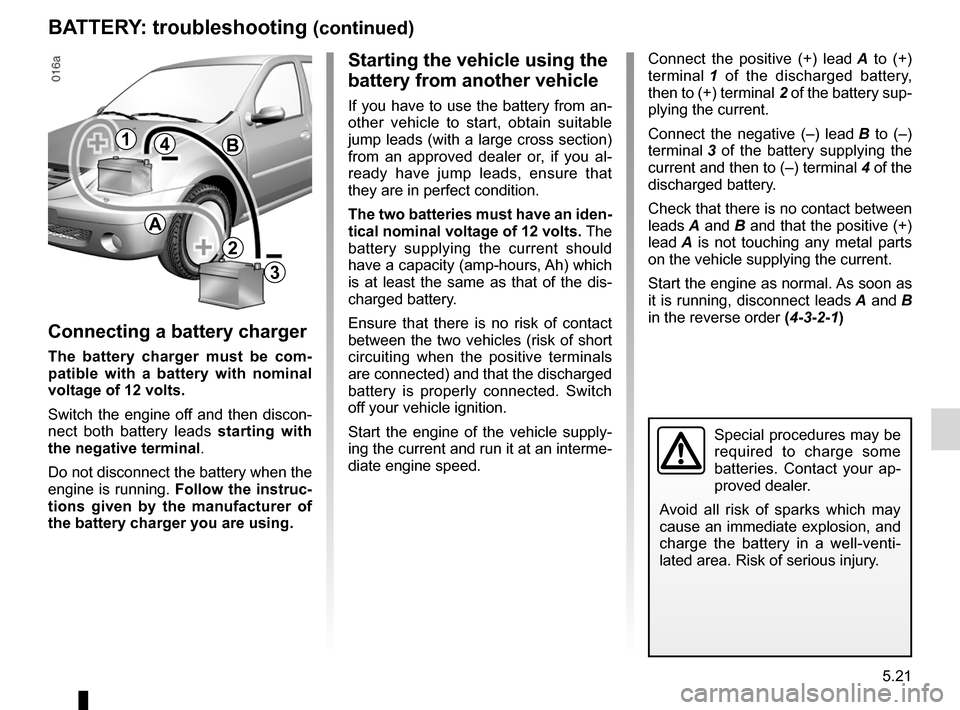
Start the engine of the vehicle supply- ing the current and run it at an interme- diate engine speed.Connect the positive (+) lead
A to (+)
terminal 1 of the discharged battery,
then to (+) terminal 2 of the battery sup- plying the current.
Connect the negative (–) lead
B to (–)
terminal 3 of the battery supplying the
current and then to (–) terminal 4 of the discharged battery.
Check that there is no contact between
leads A and B and that the positive (+)
lead A is not touching any metal parts on the vehicle supplying the current.
Start the engine as normal. As soon as
it is running, disconnect leads A and B in the reverse order (4-3-2-1)
Special procedures may be required to charge some batteries. Contact your ap- proved dealer.
Avoid all risk of sparks which may cause an immediate explosion, and charge the battery in a well-venti- lated area. Risk of serious injury.
Page 127 of 146
practical advice .....................................(up to the end of the DU)filterdiesel filter .......................................(up to the end of the DU)
5.27
ENG_UD5525_1Filtre à gazole (U90 - Dacia)ENG_NU_817-2_NU_Dacia_5
Filtre à gazole
DIESEL FILTER
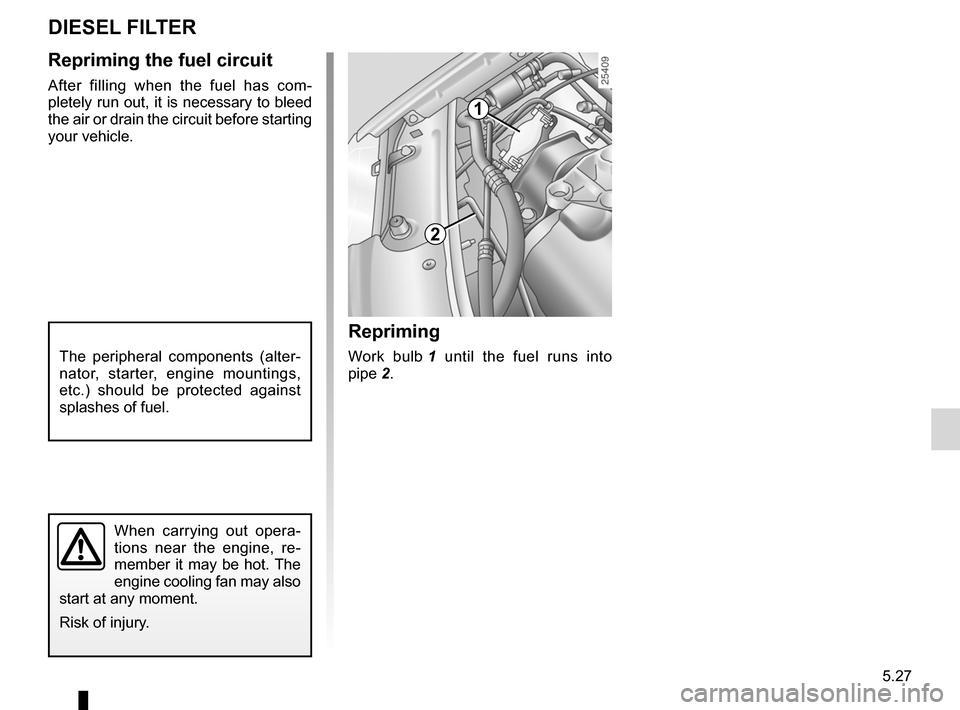
Repriming the fuel circuit
After filling when the fuel has com- pletely run out, it is necessary to bleed the air or drain the circuit before starting your vehicle.
The peripheral components (alter- nator, starter, engine mountings, etc.) should be protected against splashes of fuel.
When carrying out opera- tions near the engine, re- member it may be hot. The engine cooling fan may also start at any moment.
Risk of injury.
Repriming
Work bulb 1 until the fuel runs into
pipe 2.
1
2