engine DACIA SANDERO 2013 2.G Owner's Guide
[x] Cancel search | Manufacturer: DACIA, Model Year: 2013, Model line: SANDERO, Model: DACIA SANDERO 2013 2.GPages: 146, PDF Size: 6.4 MB
Page 97 of 146
battery...................................................(up to the end of the DU)capacity of mechanical components......................(current page)maintenance:mechanical .......................................................(current page)
4.9
ENG_UD5593_1Batterie (B90 - Dacia)ENG_NU_817-2_NU_Dacia_4
Batterie
BATTERY
Depending on the vehicle, the battery may be a low maintenance version.
Low maintenance battery
A label on the battery will indicate if the battery is the low maintenance type.
The engine may be hot during operations in close proximity. In addition, the engine cooling fan may come on at any moment.
Risk of injury.
Battery requiring
maintenance
Checking intervals:
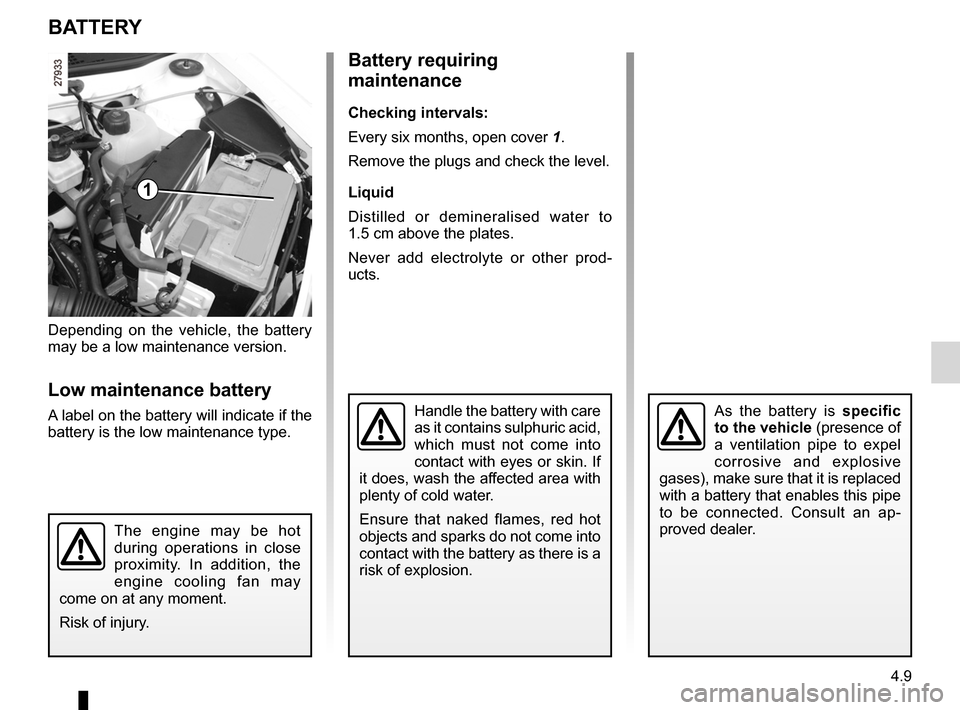
Every six months, open cover
1.
Remove the plugs and check the level.
Liquid
Distilled or demineralised water to
1.5 cm above the plates.
Never add electrolyte or other prod-
ucts.
Handle the battery with care as it contains sulphuric acid, which must not come into contact with eyes or skin. If it does, wash the affected area with
plenty of cold water.
Ensure that naked flames, red hot objects and sparks do not come into contact with the battery as there is a risk of explosion.
1
As the battery is specific to the vehicle (presence of a ventilation pipe to expel corrosive and explosive gases), make sure that it is replaced
with a battery that enables this pipe to be connected. Consult an ap- proved dealer.
Page 98 of 146
bodywork (maintenance) ......................(up to the end of the DU)maintenance:bodywork ........................................(up to the end of the DU)washing ................................................(up to the end of the DU)paintworkmaintenance ....................................................(current page)
4.10
ENG_UD5594_1Entretien de la carrosserie (B90 - Dacia)ENG_NU_817-2_NU_Dacia_4
JauneNoirNoir texte
Entretien de la carrosserie
BODYWORK MAINTENANCE
Protection against the effects
of corrosive agents
Although your vehicle has been treated with very effective anti-corrosion prod- ucts, it nevertheless remains subject to the effects of:
– corrosives in the atmosphere
– atmospheric pollution (urban and
industrial areas),
– saline atmospheres (near the sea, particularly in hot weather),
– seasonal and damp climatic con- ditions, (e.g.: road salt in winter, water from road cleaners, etc.).
– abrasives
wind-borne dust and sand, mud, road grit thrown up by other vehicles, etc
– minor impacts
You should take a minimum number of precautions in order to safeguard your vehicle against such risks and not to lose the benefit of your vehicle’s anti- corrosion protection.
You should not:
– Wash the vehicle in bright sunlight or freezing temperatures.
– Scrape off mud or dirt without pre
- wetting.
– Allow dirt to accumulate.
– Allow rust to form following minor im
- pacts.
– Use solvents not approved by the
Technical Department to remove stains as this could damage the paintwork.
– Drive frequently in snow or muddy
conditions without washing the vehicle, particularly under the wheel arches and body. –
Degrease or clean mechanical com
- ponents (e.g. engine compartment), underneath the body, parts with hinges (e.g. fuel filler cap, inside of filler flap, sunroof, etc.) and painted external plastic fittings (e.g. bump- ers) using high-pressure cleaning equipment or using spray products not approved by the Technical Department. If adequate precautions are not taken, this could give rise to corrosion or operational faults.
Page 99 of 146
JauneNoirNoir texte
4.11
ENG_UD5594_1Entretien de la carrosserie (B90 - Dacia)ENG_NU_817-2_NU_Dacia_4
BODYWORK MAINTENANCE (continued)
You should
– Wash your car frequently, with the engine off, with cleaning products recommended by the manufacturer (never use abrasive products) and be sure to jet-rinse off:
– spots of tree resin and industrial grime;
– bird droppings, which contain chemicals that rapidly discolour paintwork and may cause the paint to peel off;
Wash the vehicle immediately to
remove these marks since it is im- possible to remove them by pol- ishing;
– salt deposited in the wheel arches and underneath the body after driving in areas where the roads are chemically treated;
– mud in the wheel arches and un- derneath the body which form damp patches. –
Keep well away from the vehicle in
front when driving on gravelled sur- faces to prevent paint damage.
– Repair or have repaired quickly
patches where the paint has been damaged to prevent corrosion spreading.
– Remember to visit the body shop pe
- riodically in order to maintain your anti-corrosion warranty. Refer to the Maintenance Service Booklet.
– Respect local regulations about
washing vehicles (e.g. do not wash your vehicle on a public highway). –
Before using a roller type car wash,
put the windscreen wiper stalk in Park position (refer information on the “Windscreen wash/wipe” in Section 1), check that the external accessories, additional lights, and mirrors are securely fitted and that the wiper blades and radio aerial are taped down.
If your vehicle has a car phone and radio, remove the aerials.
– Spray mechanical components,
hinges, etc. with products approved by the Technical Department to protect them after they have been cleaned.
We have selected special products to care for your vehicle and you can obtain these from approved dealer accessory outlets.
Page 111 of 146
bulbschanging .........................................(up to the end of the DU)changing a bulb ....................................(up to the end of the DU)indicators ...............................................................(current page)practical advice .....................................(up to the end of the DU)lighting:exterior ............................................(up to the end of the DU)lights:dipped beam headlights ..................(up to the end of the DU)lights:direction indicators ..........................(up to the end of the DU)lights:side lights ........................................(up to the end of the DU)lights:main beam headlights .....................(up to the end of the DU)bulbschanging .........................................(up to the end of the DU)
5.11
ENG_UD5603_1Feux avant : remplacement des lampes (B90 - Dacia)ENG_NU_817-2_NU_Dacia_5
Remplacement des lampesFeux avant
Main beam headlights,
dipped beam headlights
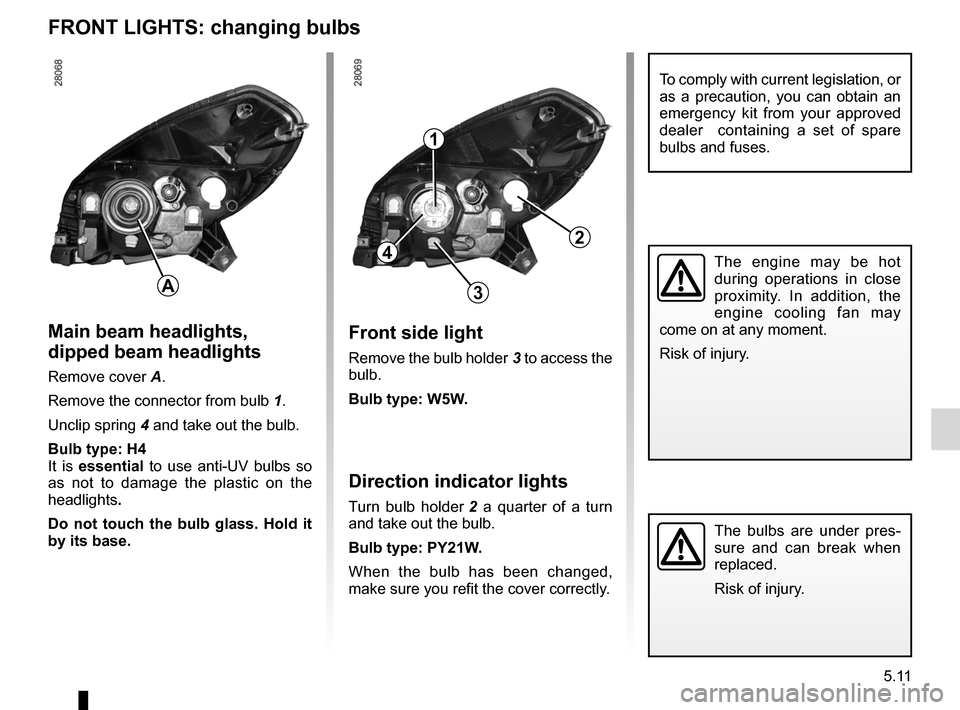
Remove cover A.
Remove the connector from bulb
1.
Unclip spring
4 and take out the bulb.
Bulb type: H4It is essential to use anti-UV bulbs so as not to damage the plastic on the headlights.
Do not touch the bulb glass. Hold it by its base.
The engine may be hot during operations in close proximity. In addition, the engine cooling fan may come on at any moment.
Risk of injury.
The bulbs are under pres- sure and can break when replaced.
Risk of injury.
Direction indicator lights
Turn bulb holder 2 a quarter of a turn and take out the bulb.
Bulb type: PY21W.
When the bulb has been changed, make sure you refit the cover correctly.
Front side light
Remove the bulb holder 3 to access the bulb.
Bulb type: W5W.
FRONT LIGHTS: changing bulbs
To comply with current legislation, or as a precaution, you can obtain an emergency kit from your approved dealer containing a set of spare bulbs and fuses.
A
1
42
3
Page 112 of 146
bulbschanging .........................................(up to the end of the DU)changing a bulb ....................................(up to the end of the DU)practical advice .....................................(up to the end of the DU)lighting:exterior ............................................(up to the end of the DU)lights:fog lights .........................................(up to the end of the DU)bulbschanging .........................................(up to the end of the DU)lightsadditional ........................................(up to the end of the DU)
5.12
ENG_UD5604_1Projecteurs antibrouillard : remplacement des lampes (B90 - Dacia)ENG_NU_817-2_NU_Dacia_5
Additional lights
If you wish to fit fog lights or long range headlights to your vehicle, consult an approved Dealer.
Feux de brouillard
FOG LIGHTS: changing bulbs
Cleaning the headlights
As the headlights are made of plastic glass, use a soft cloth or cotton wool to clean them.
If this does not clean it properly, use a soft cloth (or cotton wool) slightly mois- tened with soapy water and then wipe clean with a soft damp cloth or cotton wool.
Finally, dry off carefully with a soft dry cloth.
Cleaning products containing alco- hol must not be used under any cir- cumstances.
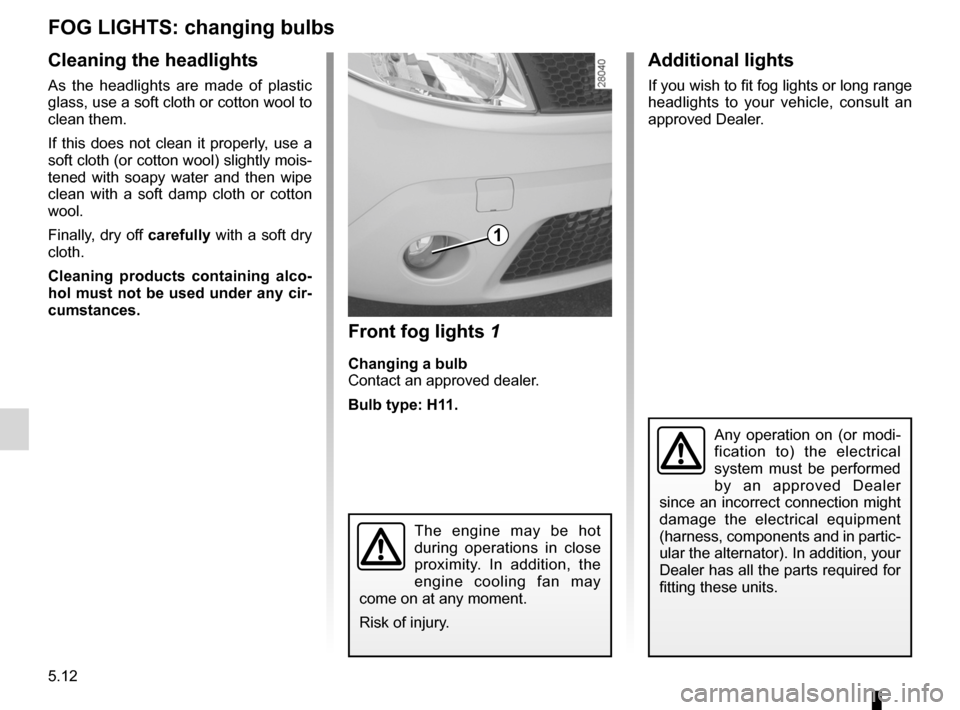
Front fog lights 1
Changing a bulbContact an approved dealer.
Bulb type: H11.
Any operation on (or modi- fication to) the electrical system must be performed by an approved Dealer since an incorrect connection might damage the electrical equipment
(harness, components and in partic- ular the alternator). In addition, your Dealer has all the parts required for fitting these units.
The engine may be hot during operations in close proximity. In addition, the engine cooling fan may come on at any moment.
Risk of injury.
1
Page 120 of 146
batterytroubleshooting ...............................(up to the end of the DU)practical advice .....................................(up to the end of the DU)
5.20
ENG_UD5609_1Batterie : dépannage (B90 - Dacia)ENG_NU_817-2_NU_Dacia_5
JauneNoirNoir texte
Batterie
BATTERY: troubleshooting
To avoid all risk of sparks:
– Ensure that any consumers (cour- tesy lights, etc.) are switched off before disconnecting or reconnect- ing the battery.
– When charging, stop the charger
before connecting or disconnecting the battery.
– Do not place metal objects on the
battery to avoid creating a short cir- cuit between the terminals.
– Always wait at least twenty seconds
after the engine has been switched off before disconnecting a battery.
– Make sure that you reconnect the
battery terminals after refitting.
Handle the battery with care as it contains sulphuric acid, which must not come into contact with eyes or skin. If it does, wash the affected area with plenty of cold water.
Ensure that naked flames, red hot objects and sparks do not come into contact with the battery as there is a risk of explosion.
The engine may be hot when car-
rying out operations in close prox- imity. In addition, the engine cooling fan can come on at any moment.
Risk of injury.
Page 121 of 146
JauneNoirNoir texte
5.21
ENG_UD5609_1Batterie : dépannage (B90 - Dacia)ENG_NU_817-2_NU_Dacia_5
BATTERY: troubleshooting (continued)
2
3
1
2
3
4
A
B
Connecting a battery charger
The battery charger must be com- patible with a battery with nominal voltage of 12 volts.
Switch the engine off and then discon- nect both battery leads starting with the negative terminal.
Do not disconnect the battery when the engine is running. Follow the instruc- tions given by the manufacturer of the battery charger you are using.
Starting the vehicle using the
battery from another vehicle
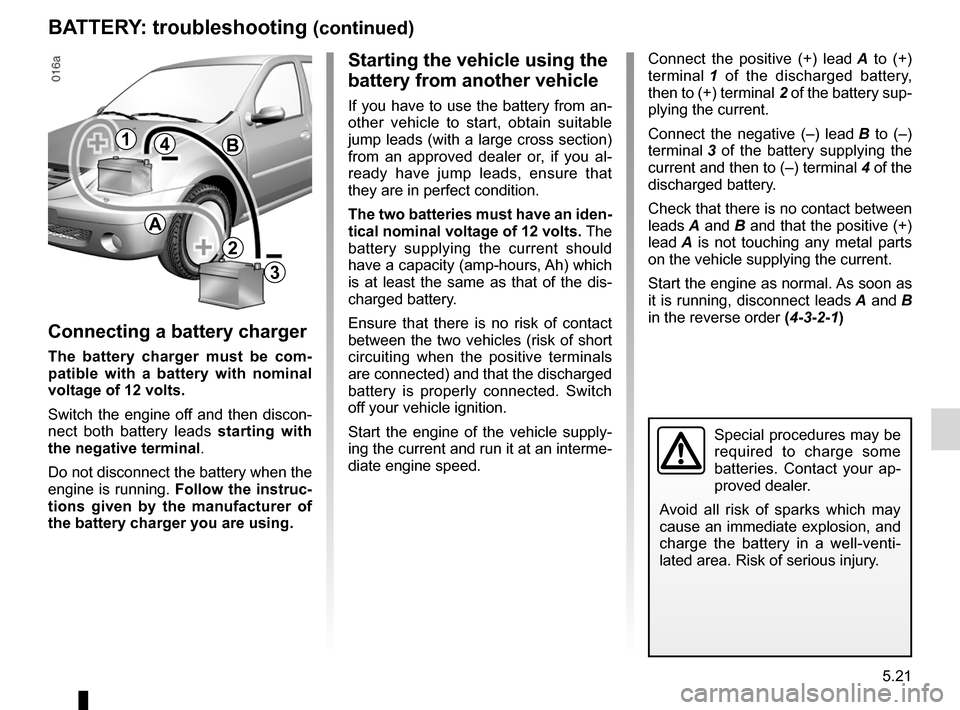
If you have to use the battery from an- other vehicle to start, obtain suitable jump leads (with a large cross section) from an approved dealer or, if you al- ready have jump leads, ensure that they are in perfect condition.
The two batteries must have an iden- tical nominal voltage of 12 volts. The battery supplying the current should have a capacity (amp-hours, Ah) which is at least the same as that of the dis- charged battery.
Ensure that there is no risk of contact between the two vehicles (risk of short circuiting when the positive terminals are connected) and that the discharged battery is properly connected. Switch off your vehicle ignition.
Start the engine of the vehicle supply- ing the current and run it at an interme- diate engine speed.Connect the positive (+) lead
A to (+)
terminal 1 of the discharged battery,
then to (+) terminal 2 of the battery sup- plying the current.
Connect the negative (–) lead
B to (–)
terminal 3 of the battery supplying the
current and then to (–) terminal 4 of the discharged battery.
Check that there is no contact between
leads A and B and that the positive (+)
lead A is not touching any metal parts on the vehicle supplying the current.
Start the engine as normal. As soon as
it is running, disconnect leads A and B in the reverse order (4-3-2-1)
Special procedures may be required to charge some batteries. Contact your ap- proved dealer.
Avoid all risk of sparks which may cause an immediate explosion, and charge the battery in a well-venti- lated area. Risk of serious injury.
Page 124 of 146
ENG_NU_817-2_NU_Dacia_5
FUSES (continued)
Allocation of fuses(the presence of certain fuses DEPENDS ON THE VEHICLE EQUIPMENT LEVEL)\
SymbolAllocation
qEngine i")
5.24
ENG_UD5610_1Fusibles (B90 - Dacia)ENG_NU_817-2_NU_Dacia_5
FUSES (continued)
Allocation of fuses(the presence of certain fuses DEPENDS ON THE VEHICLE EQUIPMENT LEVEL)\
SymbolAllocation
qEngine immobiliser
ËReversing light
uPower-assisted steering
iAutomatic transmission
Compressed Natural Gas
Some functions are protected by fuses located in the engine compartment.
However, because of their reduced ac- cessibility, you are advised to have these fuses replaced by an approved dealer.
Page 125 of 146
towing hitch...........................................(up to the end of the DU)practical advice .....................................(up to the end of the DU)towingbreakdown ......................................(up to the end of the DU)
5.25
ENG_UD5611_1Remorquage : dépannage (B90 - Dacia)ENG_NU_817-2_NU_Dacia_5
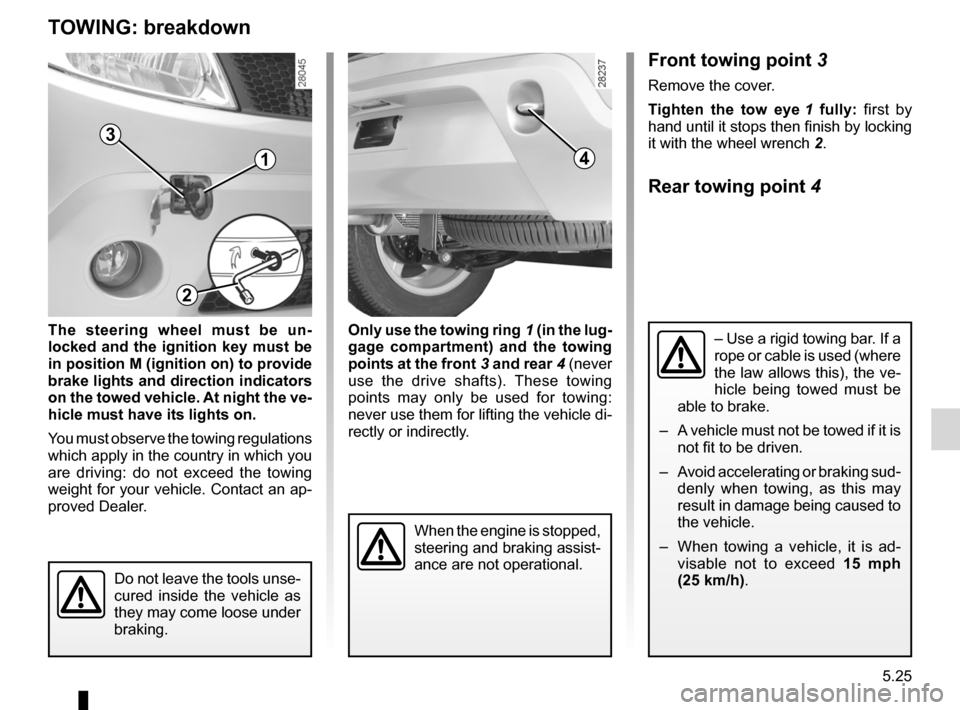
Front towing point 3
Remove the cover.
Tighten the tow eye 1 fully: first by hand until it stops then finish by locking
it with the wheel wrench 2.
Rear towing point 4
Remorquage : dépannage
TOWING: breakdown
The steering wheel must be un- locked and the ignition key must be in position M (ignition on) to provide brake lights and direction indicators on the towed vehicle. At night the ve- hicle must have its lights on.
You must observe the towing regulations which apply in the country in which you are driving: do not exceed the towing
weight for your vehicle. Contact an ap- proved Dealer.
Only use the towing ring 1 (in the lug- gage compartment) and the towing points at the front 3 and rear 4 (never use the drive shafts). These towing points may only be used for towing: never use them for lifting the vehicle di- rectly or indirectly.
When the engine is stopped, steering and braking assist- ance are not operational.Do not leave the tools unse- cured inside the vehicle as they may come loose under braking.
41
3
2
– Use a rigid towing bar. If a rope or cable is used (where the law allows this), the ve- hicle being towed must be able to brake.
– A vehicle must not be towed if it is
not fit to be driven.
– Avoid accelerating or braking sud
- denly when towing, as this may result in damage being caused to the vehicle.
– When towing a vehicle, it is ad
- visable not to exceed 15 mph
(25 km/h).
Page 127 of 146
practical advice .....................................(up to the end of the DU)filterdiesel filter .......................................(up to the end of the DU)
5.27
ENG_UD5525_1Filtre à gazole (U90 - Dacia)ENG_NU_817-2_NU_Dacia_5
Filtre à gazole
DIESEL FILTER
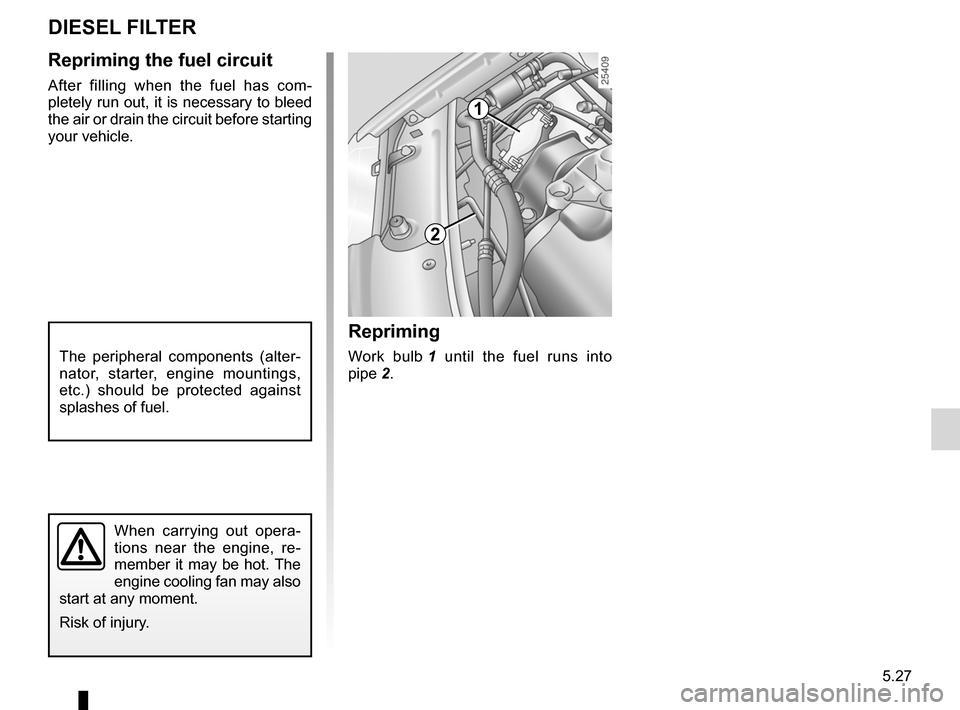
Repriming the fuel circuit
After filling when the fuel has com- pletely run out, it is necessary to bleed the air or drain the circuit before starting your vehicle.
The peripheral components (alter- nator, starter, engine mountings, etc.) should be protected against splashes of fuel.
When carrying out opera- tions near the engine, re- member it may be hot. The engine cooling fan may also start at any moment.
Risk of injury.
Repriming
Work bulb 1 until the fuel runs into
pipe 2.
1
2