temperature DACIA SANDERO 2014 User Guide
[x] Cancel search | Manufacturer: DACIA, Model Year: 2014, Model line: SANDERO, Model: DACIA SANDERO 2014Pages: 238, PDF Size: 3.19 MB
Page 118 of 238
Downloaded from www.Manualslib.com manuals search engine JauneNoir Noir texte
3.6
ENG_UD32523_2
Chauffage - Veentilation - Air conditionné (X52 - Dacia)
ENG_NU_993-5_X52_Dacia_3
HEATING, VENTILATION, AIR CONDITIONING (3/3)
Distribution of air in the
passenger compartment
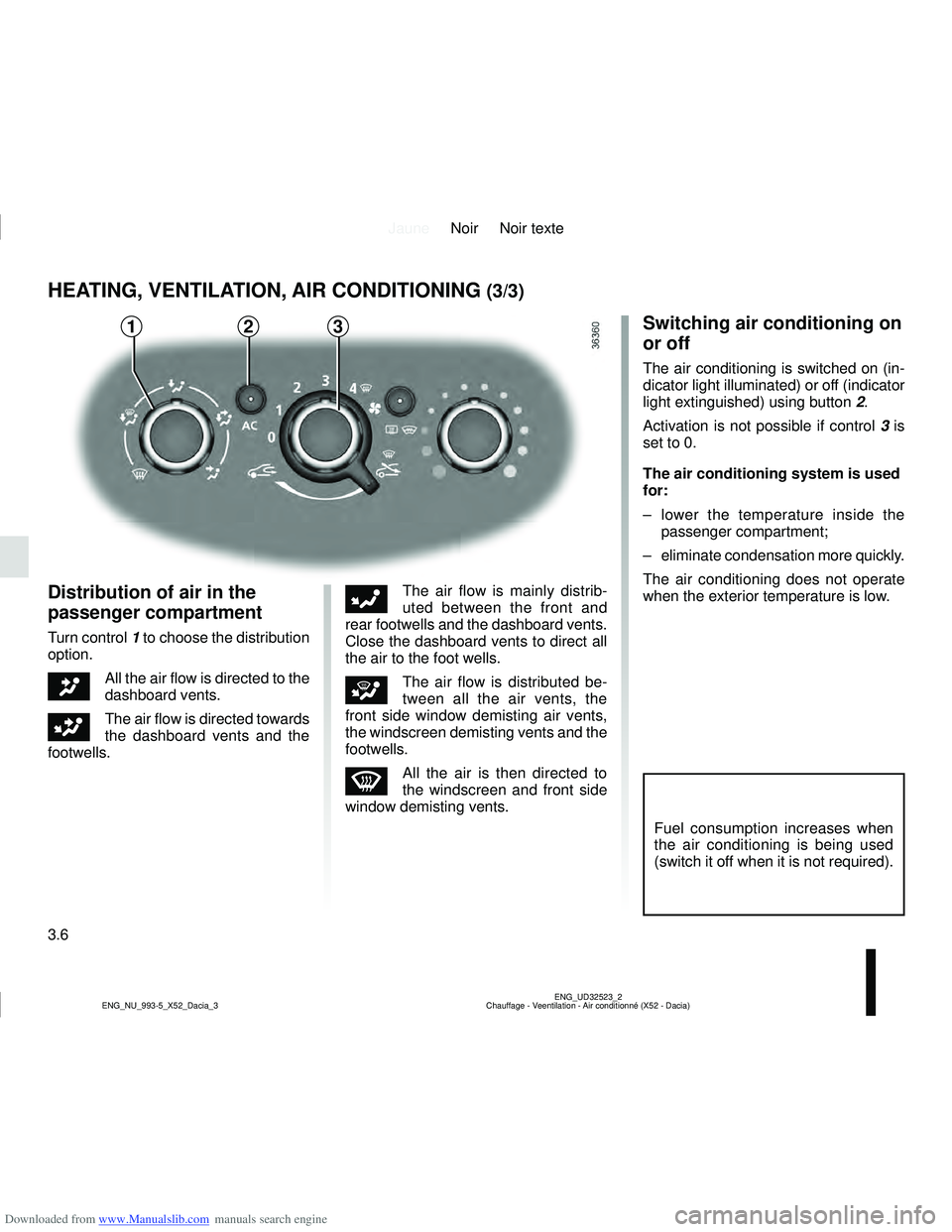
Turn control 1 to choose the distribution
option.
JAll the air flow is directed to the
dashboard vents.
GThe air flow is directed towards
the dashboard vents and the
footwells.
FThe air flow is mainly distrib-
uted between the front and
rear footwells and the dashboard vents.
Close the dashboard vents to direct all
the air to the foot wells.
iThe air flow is distributed be-
tween all the air vents, the
front side window demisting air vents,
the windscreen demisting vents and the
footwells.
WAll the air is then directed to
the windscreen and front side
window demisting vents.
Switching air conditioning on
or off
The air conditioning is switched on (in-
dicator light illuminated) or off (indicator
light extinguished) using button 2.
Activation is not possible if control 3 is
set to 0.
The air conditioning system is used
for:
– lower the temperature inside the passenger compartment;
– eliminate condensation more quickly.
The air conditioning does not operate
when the exterior temperature is low.
321
Fuel consumption increases when
the air conditioning is being used
(switch it off when it is not required).
Page 119 of 238
Downloaded from www.Manualslib.com manuals search engine JauneNoir Noir texte
3.7
ENG_UD32522_3
Air conditionné automatique (X52 - Dacia)
ENG_NU_993-5_X52_Dacia_3
Varying the ventilation speed
In automatic mode, the system uses
the most suitable amount of air to reach
and maintain the desired comfort level.
You can still adjust the ventilation
speed by turning control 6 to increase
or reduce the ventilation speed.
Adjusting the air temperature
Turn control 2 to obtain the desired
temperature.
Turning the control to the right in-
creases the temperature.
Special note: the maximum and mini-
mum settings allow the system to pro-
duce a minimum or maximum tempera-
ture (18°C and 26°C).
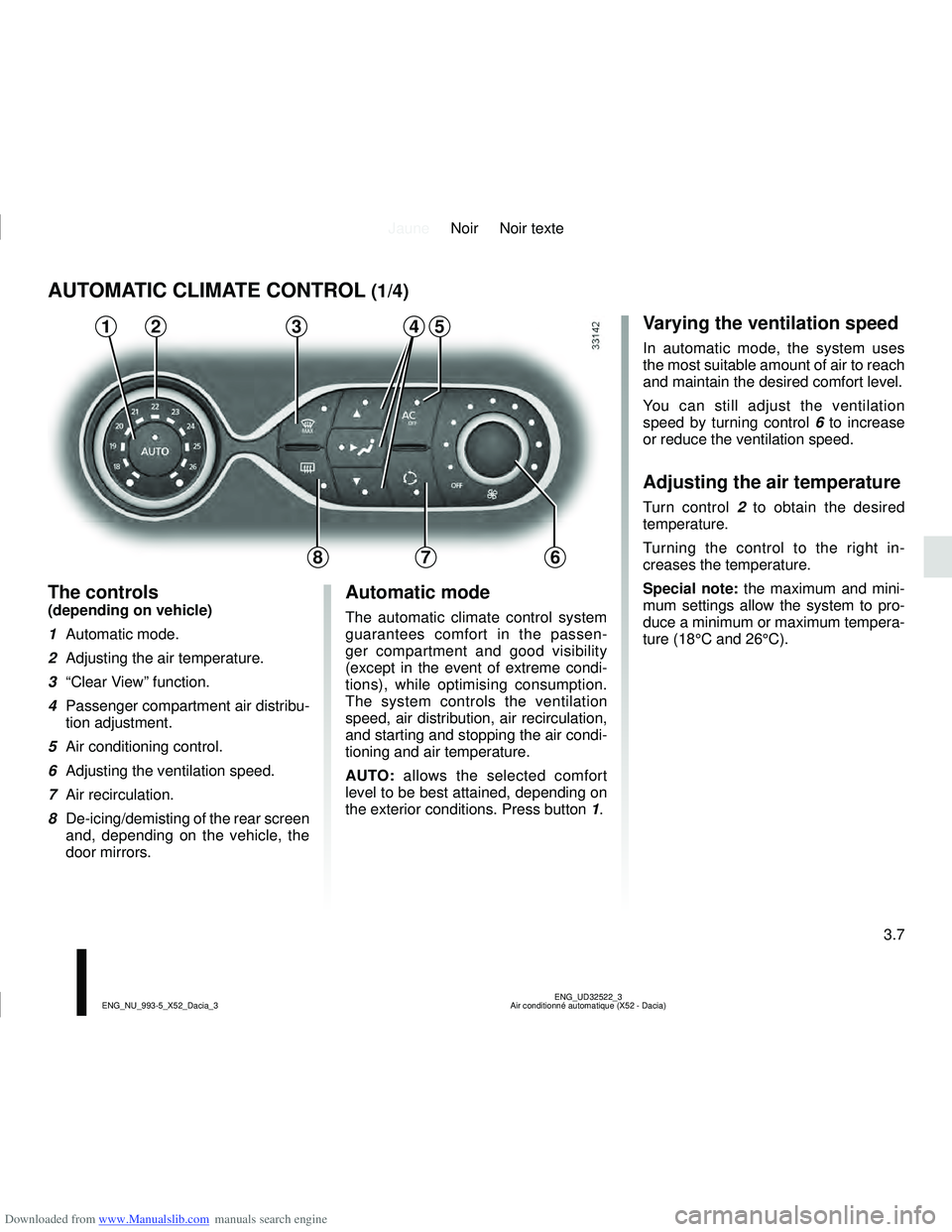
The controls(depending on vehicle)
1 Automatic mode.
2 Adjusting the air temperature.
3 “Clear View” function.
4 Passenger compartment air distribu-
tion adjustment.
5 Air conditioning control.
6 Adjusting the ventilation speed.
7 Air recirculation.
8 De-icing/demisting of the rear screen
and, depending on the vehicle, the
door mirrors.
AUTOMATIC CLIMATE CONTROL (1/4)
235
786
Automatic mode
The automatic climate control system
guarantees comfort in the passen-
ger compartment and good visibility
(except in the event of extreme condi-
tions), while optimising consumption.
The system controls the ventilation
speed, air distribution, air recirculation,
and starting and stopping the air condi-
tioning and air temperature.
AUTO: allows the selected comfort
level to be best attained, depending on
the exterior conditions. Press button 1.
14
Page 122 of 238
Downloaded from www.Manualslib.com manuals search engine JauneNoir Noir texte
3.10
ENG_UD32522_3
Air conditionné automatique (X52 - Dacia)
ENG_NU_993-5_X52_Dacia_3
AUTOMATIC CLIMATE CONTROL (4/4)
76
Air recirculation (isolation of
the passenger compartment)
K
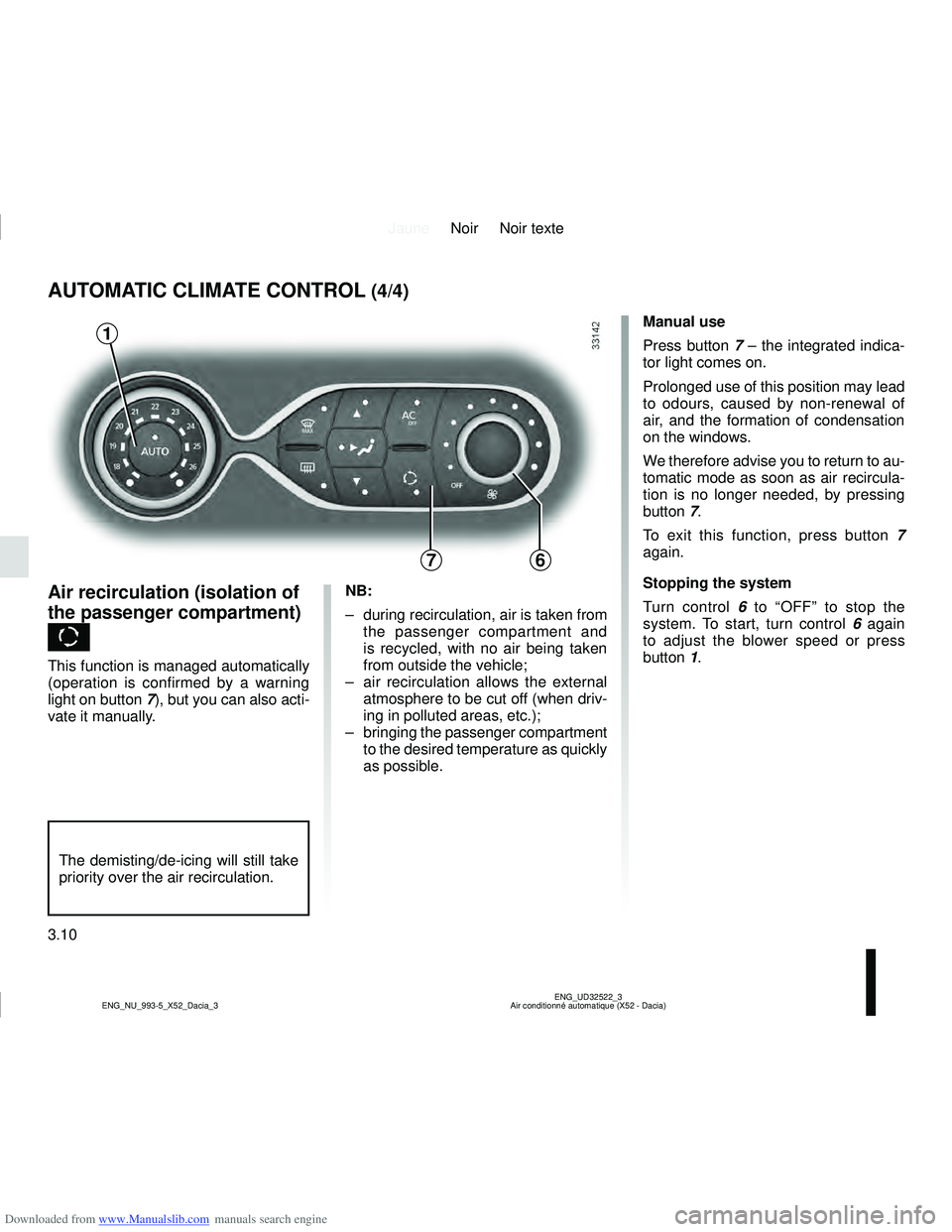
This function is managed automatically
(operation is confirmed by a warning
light on button 7), but you can also acti-
vate it manually. Manual use
Press button 7 – the integrated indica-
tor light comes on.
Prolonged use of this position may lead
to odours, caused by non-renewal of
air, and the formation of condensation
on the windows.
We therefore advise you to return to au-
tomatic mode as soon as air recircula-
tion is no longer needed, by pressing
button 7.
To exit this function, press button
7
again.
Stopping the system
Turn control 6 to “OFF” to stop the
system. To start, turn control 6 again
to adjust the blower speed or press
button 1.
1
NB:
– during recirculation, air is taken from the passenger compartment and
is recycled, with no air being taken
from outside the vehicle;
– air recirculation allows the external atmosphere to be cut off (when driv-
ing in polluted areas, etc.);
– bringing the passenger compartment to the desired temperature as quickly
as possible.
The demisting/de-icing will still take
priority over the air recirculation.
Page 159 of 238
Downloaded from www.Manualslib.com manuals search engine JauneNoir Noir texte
4.11
ENG_UD26971_1
Batterie (X52 - Dacia)
ENG_NU_993-5_X52_Dacia_4
BATTERY
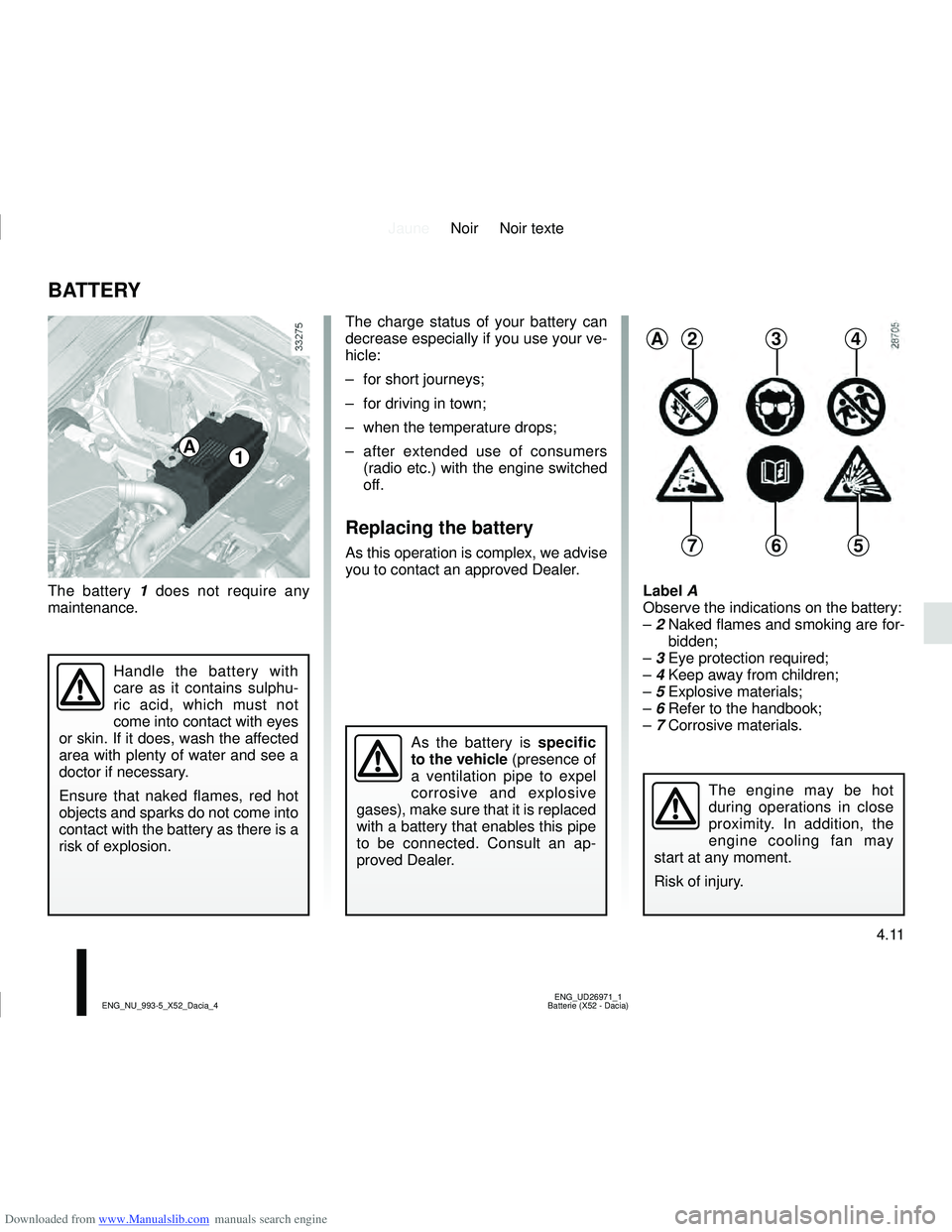
The battery 1 does not require any
maintenance.
As the battery is specific
to the vehicle (presence of
a ventilation pipe to expel
corrosive and explosive
gases), make sure that it is replaced
with a battery that enables this pipe
to be connected. Consult an ap-
proved Dealer.
Handle the battery with
care as it contains sulphu-
ric acid, which must not
come into contact with eyes
or skin. If it does, wash the affected
area with plenty of water and see a
doctor if necessary.
Ensure that naked flames, red hot
objects and sparks do not come into
contact with the battery as there is a
risk of explosion.
The charge status of your battery can
decrease especially if you use your ve-
hicle:
– for short journeys;
– for driving in town;
– when the temperature drops;
– after extended use of consumers (radio etc.) with the engine switched
off.
Replacing the battery
As this operation is complex, we advise
you to contact an approved Dealer.
1
Label A
Observe the indications on the battery:
– 2 Naked flames and smoking are for-
bidden;
– 3 Eye protection required;
– 4 Keep away from children;
– 5 Explosive materials;
– 6 Refer to the handbook;
– 7 Corrosive materials.
A234
567
The engine may be hot
during operations in close
proximity. In addition, the
engine cooling fan may
start at any moment.
Risk of injury.
A
Page 161 of 238
 (X44 - X77 - J77 - X85 - \
B90 - X61 - TEST - X77 ph2 - X95")
Downloaded from www.Manualslib.com manuals search engine JauneNoir Noir texte
4.13
ENG_UD26811_2
Entretien de la carrosserie (peinture mate) (X44 - X77 - J77 - X85 - \
B90 - X61 - TEST - X77 ph2 - X95 - B95 - D95 - K95 - J95 - R95 - L90 Ph2 - F90 Ph2 - R90 Ph2 - X62
ENG_NU_993-5_X52_Dacia_4
BODYWORK MAINTENANCE (1/2)
You should
Wash your car frequently, with the
engine off , with cleaning products rec-
ommended by the manufacturer (never
use abrasive products). Rinse thor-
oughly beforehand with a jet:
– spots of tree resin and industrial
grime;
– mud in the wheel arches and under-
neath the body which forms damp
patches;
– bird droppings , which cause a
chemical reaction with the paint that
rapidly discolours paintwork and
may even cause the paint to peel
off;
wash the vehicle immediately to
remove these marks since it is im-
possible to remove them by polish-
ing;
– salt, particularly in the wheel arches
and underneath the body after driv-
ing in areas where the roads have
been gritted.
Remove any plant matter (resin, leaves,
etc.) from the vehicle regularly.
What you should not doDo not degrease or clean mechani-
cal components (e.g. the engine com-
partment), underneath the body, parts
with hinges (e.g. inside the doors) and
painted plastic external fittings (e.g.
bumpers) using high-pressure clean-
ing equipment or by spraying on prod-
ucts not approved by our Technical
Department. Doing this could give rise
to corrosion or operational faults.
Wash the vehicle in bright sunlight or
freezing temperatures.
Do not scrape off mud or dirt without
pre-wetting.
Allow dirt to accumulate on the exterior.
Allow rust to form following minor im-
pacts.
Do not use solvents not approved by
our Technical Department to remove
stains as this could damage the paint-
work.
Do not drive in snow or muddy condi-
tions without washing the vehicle, par-
ticularly under the wheel arches and
body.
A well-maintained vehicle will last
longer. It is therefore recommended to
maintain the exterior of the vehicle reg-
ularly.
Your vehicle has been treated with very
effective anti-corrosion products. It is
nevertheless subject to various outside
influences.
Corrosive agents in the atmosphere
–
atmospheric pollution (built-up and
industrial areas),
– saline atmospheres (near the sea,
particularly in hot weather),
– seasonal and damp weather condi-
tions (e.g. road salt in winter, water
from road cleaners, etc.).
Minor impacts
Abrasive action
Dust and sand in the air, mud, road grit
thrown up by other vehicles, etc.
You should take a number of minor pre-
cautions in order to safeguard your ve-
hicle against such risks.
Page 163 of 238

Downloaded from www.Manualslib.com manuals search engine JauneNoir Noir texte
4.15
ENG_UD22866_8
Entretien des garnitures intérieures (X35 - X45 - X65 - J77 - X81 - \
J81 - X85 - X91 - B91 - K91 - D91 - X83 - X61 - X77 ph2 - X95 - B95 - D95 - E95 - K95 - J95 - R95 -
ENG_NU_993-5_X52_Dacia_4
Glass instrument panel(e.g. instrument panel, clock, exterior
temperature display, radio display, etc.)
Use a soft cloth (or cotton wool).
If this does not clean it properly, use a
soft cloth (or cotton wool) slightly mois-
tened with soapy water and then wipe
clean with a soft damp cloth or cotton
wool.
Finally, carefully dry off with a soft dry
cloth.
Cleaning products containing alco-
hol must not be used under any cir-
cumstances.
Seat belts
These must be kept clean.
Use products selected by our Technical
Department (Approved outlets) or
warm, soapy water and a sponge and
wipe with a dry cloth.
Detergents or dyes must not be used
under any circumstances.
INTERIOR TRIM MAINTENANCE (1/2)
Textiles (seats, door trim, etc)
Vacuum-clean the textiles regularly.
Liquid stain
Use soapy water.
Dab lightly (never rub) with a soft cloth,
rinse and remove the excess.
Solid or pasty stain
Carefully remove the excess solid or
pasty material immediately with a
spatula (working from the edges to the
centre to avoid spreading the stain).
Clean as for a liquid stain.
Special instructions for sweets or
chewing gum
Put an ice cube on the stain to solidify
it, then proceed as for a solid stain.
A well-maintained vehicle will last
longer. It is therefore recommended to
maintain the interior of the vehicle regu-
larly.
A stain should always be dealt with
swiftly.
Whatever type of stain is on the trim,
use
cold (or warm) soapy water with
natural soap.
Detergents (washing-up liquid, pow-
dered products, alcohol-based prod-
ucts) should not be used.
Use a soft cloth.
Rinse and soak up the excess.
For further recommendations for
maintaining the interior, and/or for
any unsatisfactory results, please
see an authorised dealer.
Page 205 of 238
Downloaded from www.Manualslib.com manuals search engine JauneNoir Noir texte
5.41
ENG_UD32462_2
Anomalies de fonctionnement (X52 - Dacia)
ENG_NU_993-5_X52_Dacia_5
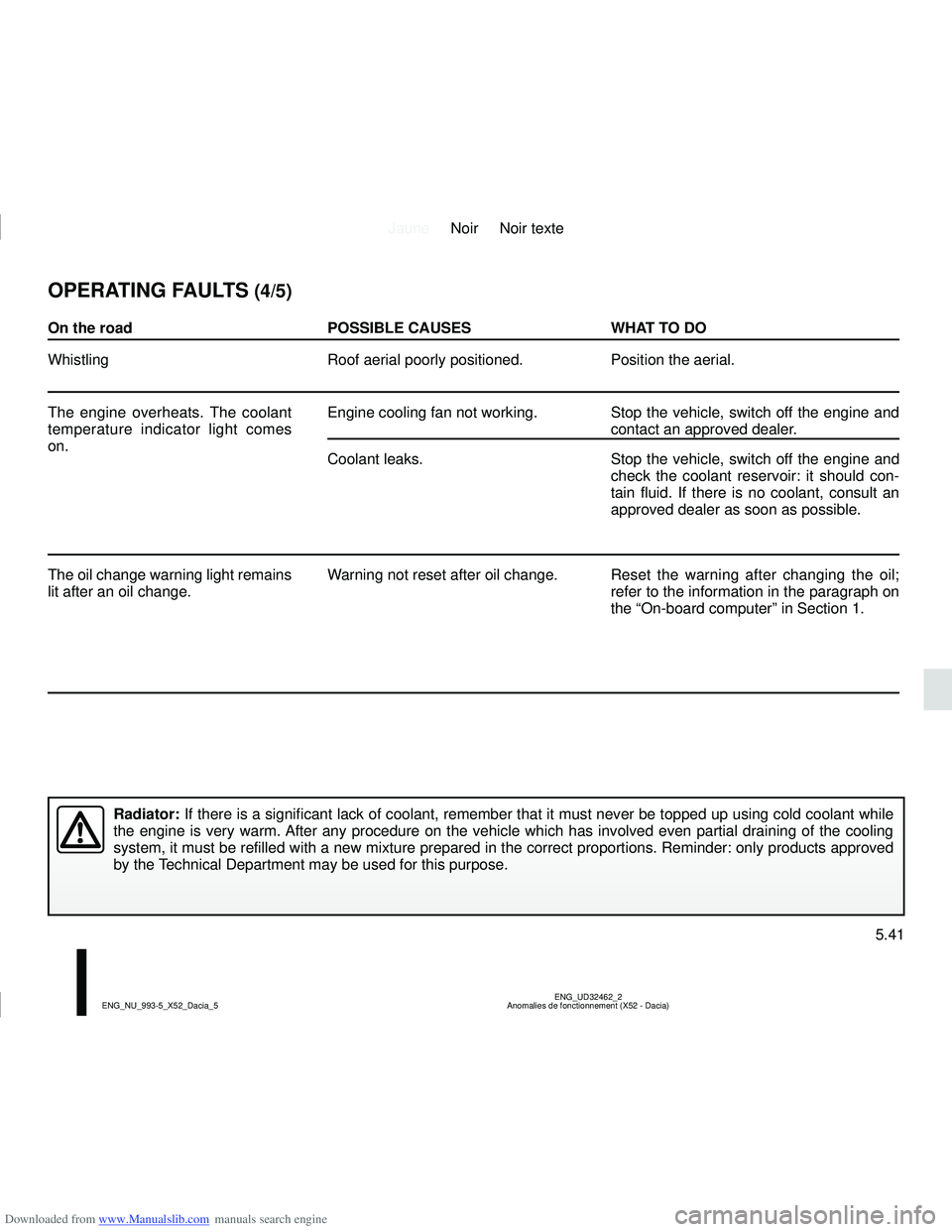
OPERATING FAULTS (4/5)
On the road POSSIBLE CAUSES WHAT TO DO
Whistling Roof aerial poorly positioned. Position the aerial.
The engine overheats. The coolant
temperature indicator light comes
on. Engine cooling fan not working. Stop the vehicle, switch off the engine and
contact an approved dealer.
Coolant leaks. Stop the vehicle, switch off the engine and
check the coolant reservoir: it should con-
tain fluid. If there is no coolant, consult an
approved dealer as soon as possible.
The oil change warning light remains
lit after an oil change. Warning not reset after oil change.
Reset the warning after changing the oil;
refer to the information in the paragraph on
the “On-board computer” in Section 1.
Radiator: If there is a significant lack of coolant, remember that it must never b\
e topped up using cold coolant while
the engine is very warm. After any procedure on the vehicle which has involved even partial draining of the cooling
system, it must be refilled with a new mixture prepared in the correct p\
roportions. Reminder: only products approved
by the Technical Department may be used for this purpose.
Page 206 of 238
Downloaded from www.Manualslib.com manuals search engine JauneNoir Noir texte
5.42
ENG_UD32462_2
Anomalies de fonctionnement (X52 - Dacia)
ENG_NU_993-5_X52_Dacia_5
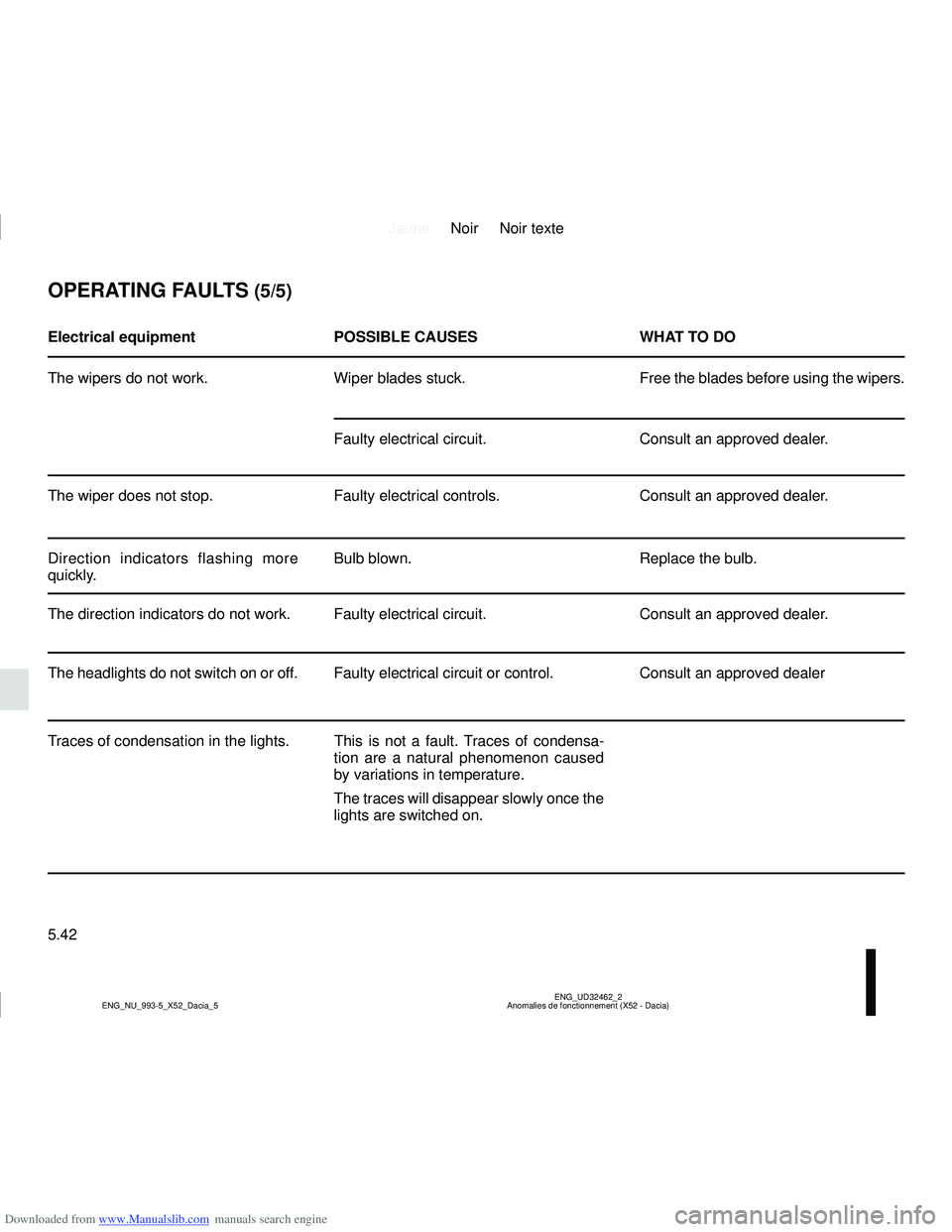
OPERATING FAULTS (5/5)
Electrical equipment POSSIBLE CAUSES WHAT TO DO
The wipers do not work. Wiper blades stuck. Free the blades before using the wipers.
Faulty electrical circuit. Consult an approved dealer.
The wiper does not stop. Faulty electrical controls. Consult an approved dealer.
Direction indicators flashing more
quickly. Bulb blown.
Replace the bulb.
The direction indicators do not work. Faulty electrical circuit. Consult an approved dealer.
The headlights do not switch on or off. Faulty electrical circuit or control. Consult an approved dealer
Traces of condensation in the lights. This is not a fault. Traces of condensa- tion are a natural phenomenon caused
by variations in temperature.
The traces will disappear slowly once the
lights are switched on.
Page 234 of 238
Downloaded from www.Manualslib.com manuals search engine JauneNoir Noir texte
7.4
FRA_UD34974_6
Index (X52 - Dacia)
ENG_NU_993-5_X52_Dacia_7
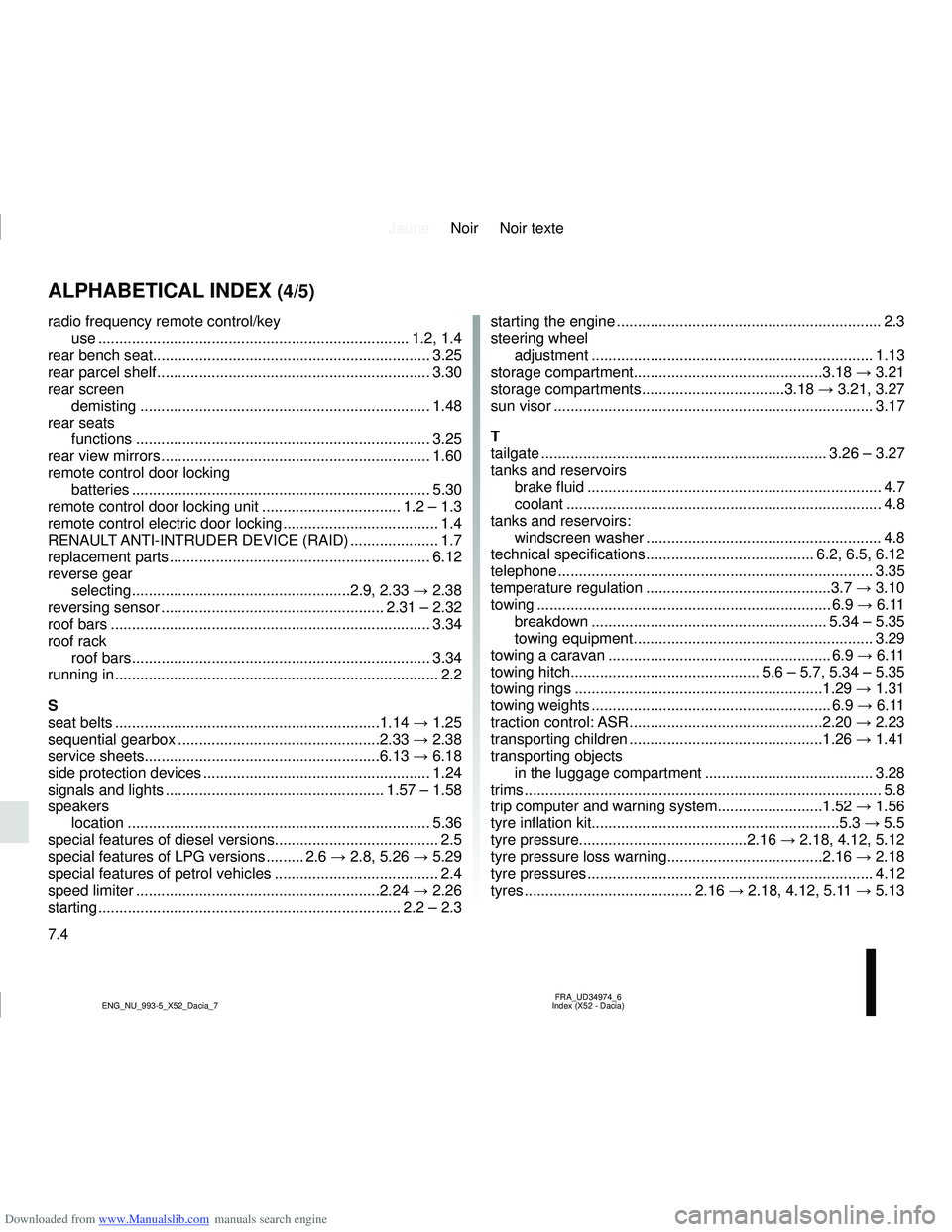
ALPHABETICAL INDEX (4/5)
radio frequency remote control/key
use ....................................................................\
...... 1.2, 1.4
rear bench seat.........................................................\
......... 3.25
rear parcel shelf ................................................................. 3.30
rear screen demisting ..............................................................\
....... 1.48
rear seats functions ...................................................................... 3.25
rear view mirrors ................................................................ 1.60
remote control door locking batteries ..............................................................\
......... 5.30
remote control door locking unit ................................. 1.2 – 1.3
remote control electric door locking ..................................... 1.4
RENAULT ANTI-INTRUDER DEVICE (RAID) ..................... 1.7
replacement parts .............................................................. 6.12
reverse gear selecting ....................................................2.9, 2.33 → 2.38
reversing sensor ..................................................... 2.31 – 2.32
roof bars ........................................................................\
.... 3.34
roof rack roof bars ...................................................................\
.... 3.34
running in ........................................................................\
..... 2.2
S
seat belts ...............................................................1.1\
4 → 1.25
sequential gearbox ................................................2.33 → 2.38
service sheets........................................................6.\
13 → 6.18
side protection devices ...................................................... 1.24
signals and lights .................................................... 1.57 – 1.58
speakers location ........................................................................\
5.36
special features of diesel versions.....................................\
.. 2.5
special features of LPG versions ......... 2.6 → 2.8, 5.26 → 5.29
special features of petrol vehicles ....................................... 2.4
speed limiter ..........................................................2.24 → 2.26
starting ........................................................................\
2.2 – 2.3 starting the engine ............................................................... 2.3
steering wheel
adjustment .............................................................\
...... 1.13
storage compartment.............................................3.18 → 3.21
storage compartments ..................................3.18 → 3.21, 3.27
sun visor ..................................................................\
.......... 3.17
T
tailgate .................................................................... 3.26 – 3.27
tanks and reservoirs brake fluid ..................................................................\
.... 4.7
coolant ................................................................\
........... 4.8
tanks and reservoirs: windscreen washer ........................................................ 4.8
technical specifications ........................................ 6.2, 6.5, 6.12
telephone ........................................................................\
... 3.35
temperature regulation ............................................3.7 → 3.10
towing .................................................................\
..... 6.9 → 6.11
breakdown ........................................................ 5.34 – 5.35
towing equipment ......................................................... 3.29
towing a caravan ..................................................... 6.9 → 6.11
towing hitch............................................. 5.6 – 5.7, 5.34 – 5.35
towing rings ...........................................................1.29 → 1.31
towing weights ......................................................... 6.9 → 6.11
traction control: ASR ..............................................2.20 → 2.23
transporting children ..............................................1.26 → 1.41
transporting objects in the luggage compartment ........................................ 3.28
trims ..................................................................\
................... 5.8
trip computer and warning system.........................1.52 → 1.56
tyre inflation kit......................................................\
.....5.3 → 5.5
tyre pressure........................................2.16 → 2.18, 4.12, 5.12
tyre pressure loss warning.....................................2.16 → 2.18
tyre pressures ..............................................................\
...... 4.12
tyres ........................................ 2.16 → 2.18, 4.12, 5.11 → 5.13