pressure DACIA SANDERO 2022 Owner's Manual
[x] Cancel search | Manufacturer: DACIA, Model Year: 2022, Model line: SANDERO, Model: DACIA SANDERO 2022Pages: 238, PDF Size: 3.19 MB
Page 169 of 238

Downloaded from www.Manualslib.com manuals search engine JauneNoir Noir texte
5.5
ENG_UD28665_3
Kit de gonflage des pneumatiques (X77 - X85 - B85 - C85 - S85 - X77 ph2\
- K85 - X95 - E95 - X67 - X92 - X10 - X98 - X52 - Renault)
ENG_NU_993-5_X52_Dacia_5
TYRE PRESSURE KIT (3/3)
Once the tyre is correctly inflated,
remove the kit: slowly unscrew the in-
flation adapter 1 to prevent any repair
product from escaping and store the
container in plastic packaging to pre-
vent the product from escaping.
– Affix the driving recommendation label to the dashboard where it can
easily be seen by the driver;
– Put the kit away.
– At the end of this initial inflation op- eration, air will still escape from the
tyre. You must drive a short distance
in order to seal the hole.
– Start immediately and drive at be- tween 12 and 40 mph (20 and
60 km/h) in order to distribute the
product evenly in the tyre and, after
driving for 2 miles (3 km), stop and
check the pressure.
– If the pressure is greater than 1.3 bar but less than the recommended
pressure (refer to the label affixed to
the edge of the driver’s door), read-
just it. Otherwise, please contact an
authorised dealer: the tyre cannot be
repaired.Precautions when using the
kit
The kit should not be operated for more
than 15 consecutive minutes.
Nothing should be placed
around the driver’s feet
as such objects may slide
under the pedals during
sudden braking manoeuvres and
obstruct their use.
1
Please be aware that a
poorly tightened or miss-
ing valve cap can make the
tyres less airtight and may
lead to pressure loss.
Always use valve caps identical to
those fitted originally and tighten
them fully.
Following repair with the kit,
do not travel further than
120 miles (200 km). In addi-
tion, reduce your speed and
under no circumstances exceed
48 mph (80 km/h). The sticker,
which you must affix in a prominent
position on the dashboard, reminds
you of this.
Depending on the country or local
legislation, a tyre repaired with the
inflation kit may need to be replaced.
Page 174 of 238
Downloaded from www.Manualslib.com manuals search engine JauneNoir Noir texte
5.10
ENG_UD34854_2
Changement de roue (X52 - Dacia)
ENG_NU_993-5_X52_Dacia_5
Undo the bolts and take off the wheel.
Fit the emergency spare wheel on the
central hub and turn it to locate the
mounting holes in the wheel and the
hub.
If bolts are supplied with the emergency
spare wheel, only use these bolts for
the emergency spare wheel.
Tighten the bolts, checking that the
wheel is correctly positioned on its hub
and lower the jack.
With the wheel on the ground, tighten
the bolts fully and have the tightness
of the bolts checked (tightening torque:
105 N.m) and the emergency spare tyre
pressure checked as soon as possible.
CHANGING A WHEEL (2/2)
If you have a puncture, re-
place the wheel as soon
as possible. A tyre which
has been punctured should
always be inspected (and repaired,
where possible) by a specialist.
Anti-theft bolts
If you use anti-theft bolts, please
refer to the instructions given on
the interior of the wheel trim to posi-
tion the bolts (wheel trim may not be
able to fit).
Page 176 of 238
Downloaded from www.Manualslib.com manuals search engine JauneNoir Noir texte
5.12
ENG_UD26982_1
Pneumatiques (X52 - Dacia)ENG_NU_993-5_X52_Dacia_5
Changing wheels around
This practice is not recommended.
Emergency spare wheel
Refer to the information on “Puncture”
and “Changing a wheel” in Section 5.
Fitting new tyres
TYRES (2/3)
Tyre pressures
Adhere to the tyre pressures (including
the emergency spare wheel). The tyre
pressures should be checked at least
once a month and additionally before
any long journey (refer to the label af-
fixed to the edge of the driver’s door).
Pressures should be checked when the
tyres are cold; ignore higher pressures
which may be reached in hot weather
or following a fast journey.
If tyre pressures cannot be checked
when the tyres are cold, assume an in-
crease of 0.2 to 0.3 bar.
Never deflate a hot tyre.
For safety reasons, this op-
eration must be carried out
by a specialist.
Fitting different tyres may
change your vehicle as follows:
– it may mean that your vehicle no longer conforms to current regu-
lations;
– It may change the way it handles when cornering;
– It may cause the steering to be heavy;
– it may affect the use of snow chains.
Please be aware that a
poorly tightened or miss-
ing valve cap can make the
tyres less airtight and lead
to pressure loss.
Always use valve caps identical to
those fitted originally and tighten
them fully.
Incorrect tyre pressures
lead to abnormal tyre wear
and unusually hot running.
These are factors which
may seriously affect safety and lead
to:
– poor road holding,
– risk of bursting or tread separa- tion.
The pressure depends on the load
and the speed of use. Adjust the
pressure according to the condi-
tions of use (refer to the label affixed
to the edge of the driver’s door).
Page 203 of 238
Downloaded from www.Manualslib.com manuals search engine JauneNoir Noir texte
5.39
ENG_UD32462_2
Anomalies de fonctionnement (X52 - Dacia)
ENG_NU_993-5_X52_Dacia_5
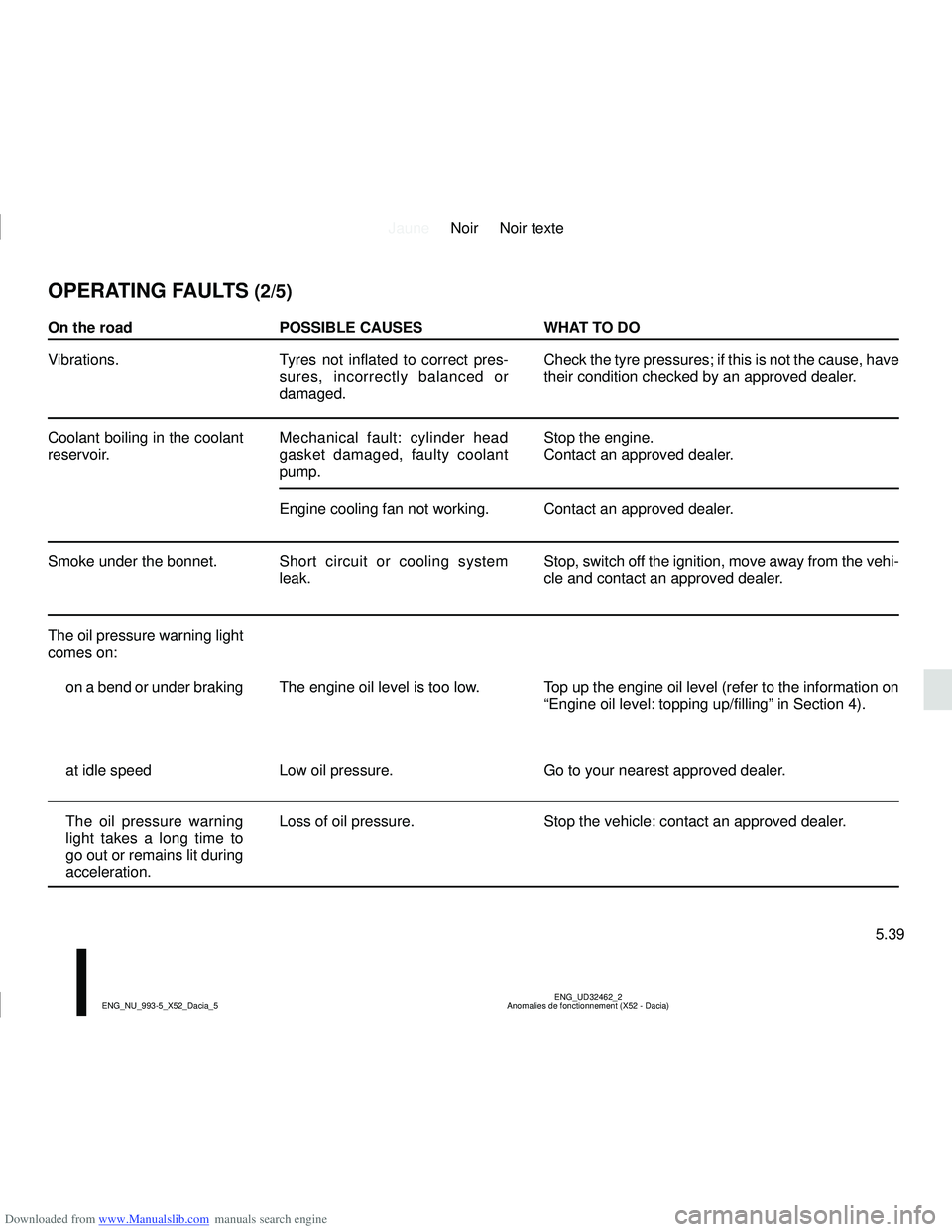
OPERATING FAULTS (2/5)
On the road POSSIBLE CAUSES WHAT TO DO
Vibrations. Tyres not inflated to correct pres-
sures, incorrectly balanced or
damaged. Check the tyre pressures; if this is not the cause, have
their condition checked by an approved dealer.
Coolant boiling in the coolant
reservoir. Mechanical fault: cylinder head
gasket damaged, faulty coolant
pump. Stop the engine.
Contact an approved dealer.
Engine cooling fan not working. Contact an approved dealer.
Smoke under the bonnet. Short circuit or cooling system
leak. Stop, switch off the ignition, move away from the vehi-
cle and contact an approved dealer.
The oil pressure warning light
comes on: on a bend or under braking The engine oil level is too low. Top up the engine oil level (refer to the information on “Engine oil level: topping up/filling” in Section 4).
at idle speed Low oil pressure. Go to your nearest approved dealer.
The oil pressure warning
light takes a long time to
go out or remains lit during
acceleration. Loss of oil pressure.
Stop the vehicle: contact an approved dealer.
Page 215 of 238
Downloaded from www.Manualslib.com manuals search engine JauneNoir Noir texte
6.9
ENG_UD30980_3
Masses (en kg) (X52 - Dacia)
ENG_NU_993-5_X52_Dacia_6
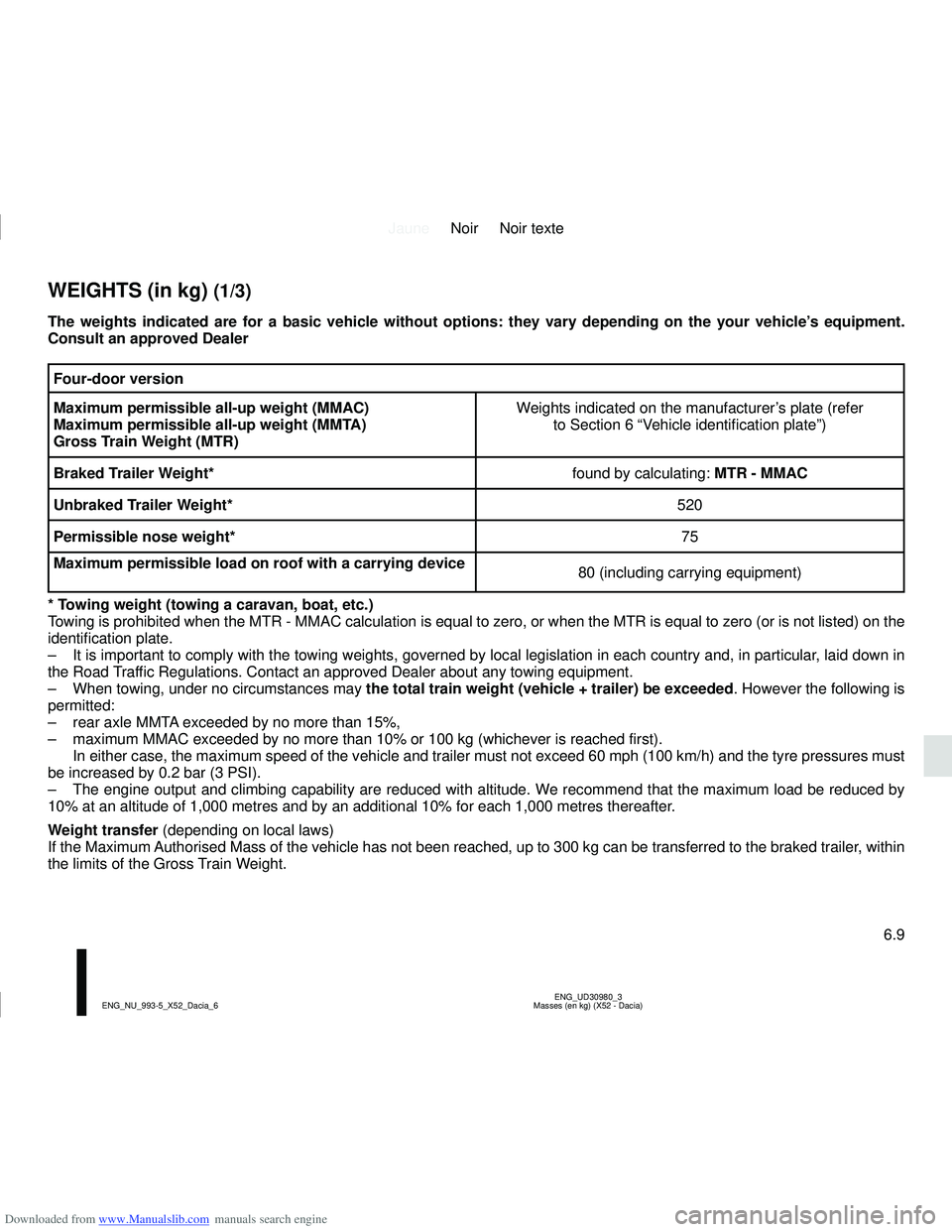
WEIGHTS (in kg) (1/3)
The weights indicated are for a basic vehicle without options: they vary\
depending on the your vehicle’s equipment.
Consult an approved Dealer
Four-door version
Maximum permissible all-up weight (MMAC)
Maximum permissible all-up weight (MMTA)
Gross Train Weight (MTR) Weights indicated on the manufacturer’s plate (refer
to Section 6 “Vehicle identification plate”)
Braked Trailer Weight* found by calculating: MTR - MMAC
Unbraked Trailer Weight* 520
Permissible nose weight* 75
Maximum permissible load on roof with a carrying device 80 (including carrying equipment)
* Towing weight (towing a caravan, boat, etc.)
Towing is prohibited when the MTR - MMAC calculation is equal to zero, or\
when the MTR is equal to zero (or is not listed) on t he
identification plate.
– It is important to comply with the towing weights, governed by local leg\
islation in each country and, in particular, laid down in
the Road Traffic Regulations. Contact an approved Dealer about any towing equipment.
– When towing, under no circumstances may the total train weight (vehicle + trailer) be exceeded . However the following is
permitted:
– rear axle MMTA exceeded by no more than 15%,
– maximum MMAC exceeded by no more than 10% or 100 kg (whichever is reach\
ed first).
In either case, the maximum speed of the vehicle and trailer must not exceed 60 mph (100 km/h) and the tyre pressures must
be increased by 0.2 bar (3 PSI).
– The engine output and climbing capability are reduced with altitude. We recommend that the maximum load be reduced by
10% at an altitude of 1,000 metres and by an additional 10% for each 1,0\
00 metres thereafter.
Weight transfer (depending on local laws)
If the Maximum Authorised Mass of the vehicle has not been reached, up to 300 kg can be transferred to the braked trailer, with in
the limits of the Gross Train Weight.
Page 216 of 238
Downloaded from www.Manualslib.com manuals search engine JauneNoir Noir texte
6.10
ENG_UD30980_3
Masses (en kg) (X52 - Dacia)
ENG_NU_993-5_X52_Dacia_6
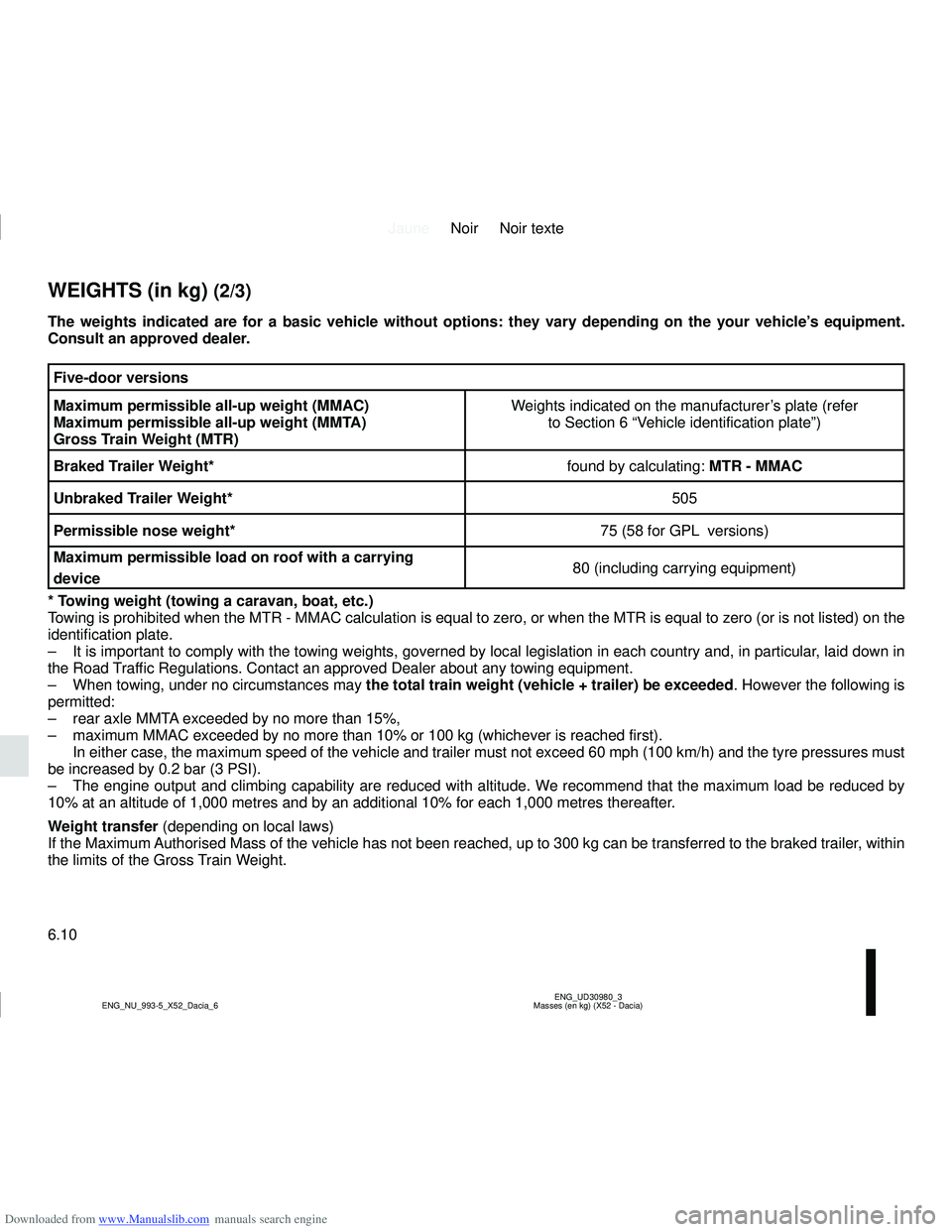
WEIGHTS (in kg) (2/3)
The weights indicated are for a basic vehicle without options: they vary\
depending on the your vehicle’s equipment.
Consult an approved dealer.
Five-door versions
Maximum permissible all-up weight (MMAC)
Maximum permissible all-up weight (MMTA)
Gross Train Weight (MTR) Weights indicated on the manufacturer’s plate (refer
to Section 6 “Vehicle identification plate”)
Braked Trailer Weight* found by calculating: MTR - MMAC
Unbraked Trailer Weight* 505
Permissible nose weight* 75 (58 for GPL versions)
Maximum permissible load on roof with a carrying
device 80 (including carrying equipment)
* Towing weight (towing a caravan, boat, etc.)
Towing is prohibited when the MTR - MMAC calculation is equal to zero, or\
when the MTR is equal to zero (or is not listed) on t he
identification plate.
– It is important to comply with the towing weights, governed by local leg\
islation in each country and, in particular, laid down in
the Road Traffic Regulations. Contact an approved Dealer about any towing equipment.
– When towing, under no circumstances may the total train weight (vehicle + trailer) be exceeded . However the following is
permitted:
– rear axle MMTA exceeded by no more than 15%,
– maximum MMAC exceeded by no more than 10% or 100 kg (whichever is reach\
ed first).
In either case, the maximum speed of the vehicle and trailer must not exceed 60 mph (100 km/h) and the tyre pressures must
be increased by 0.2 bar (3 PSI).
– The engine output and climbing capability are reduced with altitude. We recommend that the maximum load be reduced by
10% at an altitude of 1,000 metres and by an additional 10% for each 1,0\
00 metres thereafter.
Weight transfer (depending on local laws)
If the Maximum Authorised Mass of the vehicle has not been reached, up to 300 kg can be transferred to the braked trailer, with in
the limits of the Gross Train Weight.
Page 217 of 238
Downloaded from www.Manualslib.com manuals search engine JauneNoir Noir texte
6.11
ENG_UD30980_3
Masses (en kg) (X52 - Dacia)
ENG_NU_993-5_X52_Dacia_6
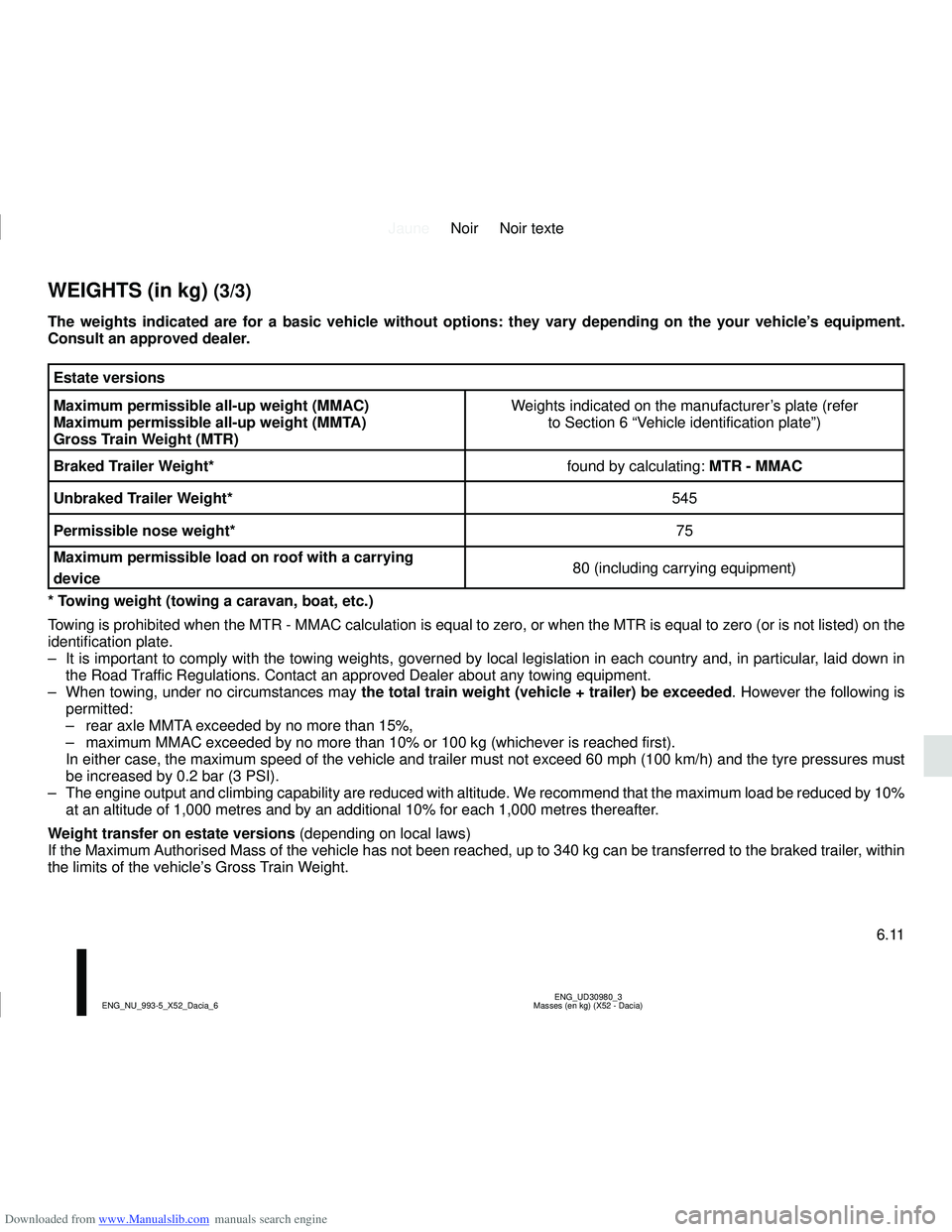
WEIGHTS (in kg) (3/3)
The weights indicated are for a basic vehicle without options: they vary\
depending on the your vehicle’s equipment.
Consult an approved dealer.
Estate versions
Maximum permissible all-up weight (MMAC)
Maximum permissible all-up weight (MMTA)
Gross Train Weight (MTR) Weights indicated on the manufacturer’s plate (refer
to Section 6 “Vehicle identification plate”)
Braked Trailer Weight* found by calculating: MTR - MMAC
Unbraked Trailer Weight* 545
Permissible nose weight* 75
Maximum permissible load on roof with a carrying
device 80 (including carrying equipment)
* Towing weight (towing a caravan, boat, etc.)
Towing is prohibited when the MTR - MMAC calculation is equal to zero, or\
when the MTR is equal to zero (or is not listed) on t he
identification plate.
– It is important to comply with the towing weights, governed by local legislation in each country and, in particular, laid down in the Road Traffic Regulations. Contact an approved Dealer about any towing equipment.
– When towing, under no circumstances may the total train weight (vehicle + trailer) be exceeded . However the following is
permitted:
– rear axle MMTA exceeded by no more than 15%,
– maximum MMAC exceeded by no more than 10% or 100 kg (whichever is reach\
ed first).
In either case, the maximum speed of the vehicle and trailer must not ex\
ceed 60 mph (100 km/h) and the tyre pressures must be increased by 0.2 bar (3 PSI).
– The engine output and climbing capability are reduced with altitude. We recommend that the maximum load be reduced by 10% at an altitude of 1,000 metres and by an additional 10% for each 1,000 m\
etres thereafter.
Weight transfer on estate versions (depending on local laws)
If the Maximum Authorised Mass of the vehicle has not been reached, up to 340 kg can be transferred to the braked trailer, with in
the limits of the vehicle’s Gross Train Weight.
Page 234 of 238
Downloaded from www.Manualslib.com manuals search engine JauneNoir Noir texte
7.4
FRA_UD34974_6
Index (X52 - Dacia)
ENG_NU_993-5_X52_Dacia_7
ALPHABETICAL INDEX (4/5)
radio frequency remote control/key
use ....................................................................\
...... 1.2, 1.4
rear bench seat.........................................................\
......... 3.25
rear parcel shelf ................................................................. 3.30
rear screen demisting ..............................................................\
....... 1.48
rear seats functions ...................................................................... 3.25
rear view mirrors ................................................................ 1.60
remote control door locking batteries ..............................................................\
......... 5.30
remote control door locking unit ................................. 1.2 – 1.3
remote control electric door locking ..................................... 1.4
RENAULT ANTI-INTRUDER DEVICE (RAID) ..................... 1.7
replacement parts .............................................................. 6.12
reverse gear selecting ....................................................2.9, 2.33 → 2.38
reversing sensor ..................................................... 2.31 – 2.32
roof bars ........................................................................\
.... 3.34
roof rack roof bars ...................................................................\
.... 3.34
running in ........................................................................\
..... 2.2
S
seat belts ...............................................................1.1\
4 → 1.25
sequential gearbox ................................................2.33 → 2.38
service sheets........................................................6.\
13 → 6.18
side protection devices ...................................................... 1.24
signals and lights .................................................... 1.57 – 1.58
speakers location ........................................................................\
5.36
special features of diesel versions.....................................\
.. 2.5
special features of LPG versions ......... 2.6 → 2.8, 5.26 → 5.29
special features of petrol vehicles ....................................... 2.4
speed limiter ..........................................................2.24 → 2.26
starting ........................................................................\
2.2 – 2.3 starting the engine ............................................................... 2.3
steering wheel
adjustment .............................................................\
...... 1.13
storage compartment.............................................3.18 → 3.21
storage compartments ..................................3.18 → 3.21, 3.27
sun visor ..................................................................\
.......... 3.17
T
tailgate .................................................................... 3.26 – 3.27
tanks and reservoirs brake fluid ..................................................................\
.... 4.7
coolant ................................................................\
........... 4.8
tanks and reservoirs: windscreen washer ........................................................ 4.8
technical specifications ........................................ 6.2, 6.5, 6.12
telephone ........................................................................\
... 3.35
temperature regulation ............................................3.7 → 3.10
towing .................................................................\
..... 6.9 → 6.11
breakdown ........................................................ 5.34 – 5.35
towing equipment ......................................................... 3.29
towing a caravan ..................................................... 6.9 → 6.11
towing hitch............................................. 5.6 – 5.7, 5.34 – 5.35
towing rings ...........................................................1.29 → 1.31
towing weights ......................................................... 6.9 → 6.11
traction control: ASR ..............................................2.20 → 2.23
transporting children ..............................................1.26 → 1.41
transporting objects in the luggage compartment ........................................ 3.28
trims ..................................................................\
................... 5.8
trip computer and warning system.........................1.52 → 1.56
tyre inflation kit......................................................\
.....5.3 → 5.5
tyre pressure........................................2.16 → 2.18, 4.12, 5.12
tyre pressure loss warning.....................................2.16 → 2.18
tyre pressures ..............................................................\
...... 4.12
tyres ........................................ 2.16 → 2.18, 4.12, 5.11 → 5.13