Locking DACIA SANDERO STEPWAY 2016 2.G User Guide
[x] Cancel search | Manufacturer: DACIA, Model Year: 2016, Model line: SANDERO STEPWAY, Model: DACIA SANDERO STEPWAY 2016 2.GPages: 174, PDF Size: 2.78 MB
Page 41 of 174
JauneNoirNoir texte
1.39
ENG_UD18230_3
Poste de conduite direction à droite (B90 - Dacia)
ENG_NU_817-10_B90_Dacia_1
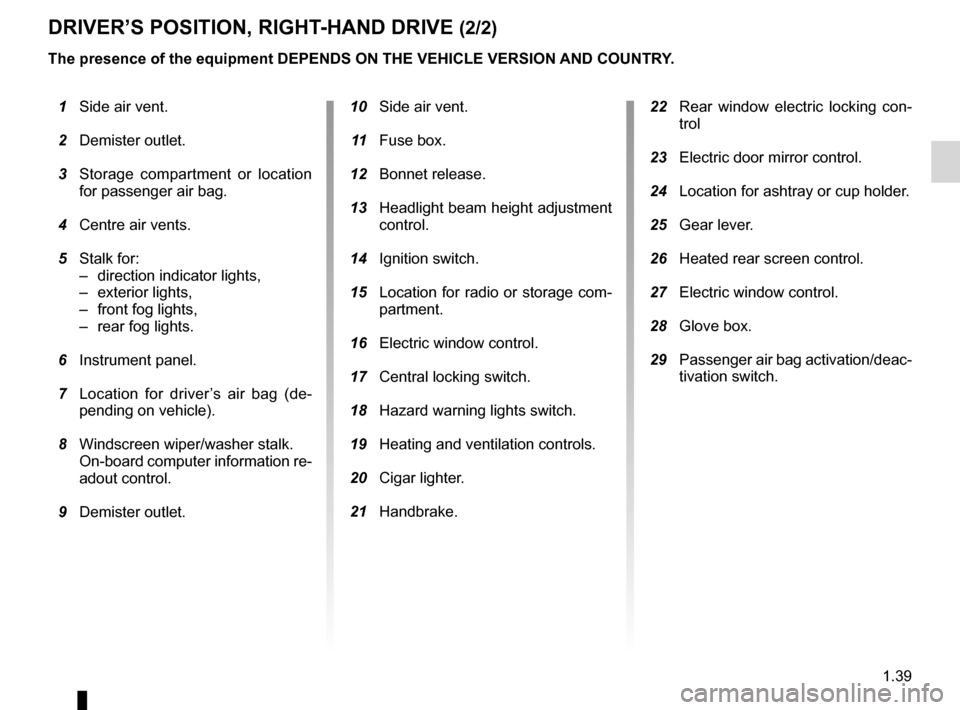
1 Side air ven t.
2
Demister ou
tlet.
3
S
torage compartment or location
for passenger air bag.
4
Centre air vents.
5
Stalk for:
–
direction indicator lights,
–
exterior lights,
–
front fog lights,
–
rear fog lights.
6
Instrument panel.
7
L
ocation for driver’s air bag (de-
pending on vehicle).
8
Windscreen
wiper/washer stalk.
On-board computer information re-
adout control.
9
Demister ou
tlet. 22 R ear window electric locking con-
trol
23
Electric doo
r mirror control.
24
Location for
ashtray or cup holder.
25
Gear lever
.
26
Heated rear
screen control.
27
Electric wind
ow control.
28
Glove box.
29
Passenger
air bag activation/deac-
tivation switch.
DRIVER’S POSITION, RIGHT- HAND DRIVE (2/2)
The presence of the equipment DEPENDS ON THE VEHICLE VERSION AND COUNTRY.
10
Side air ven
t.
1
1
Fuse box.
12
Bonnet rele
ase.
13
Headlight
beam height adjustment
control.
14
Ignition swit
ch.
15
Location
for radio or storage com-
partment.
16
Electric wind
ow control.
17
Central lock
ing switch.
18
Hazard war
ning lights switch.
19
Heating and
ventilation controls.
20
Cigar lighter
.
21
Handbrake.
Page 63 of 174
driving ................................................... (up to the end of the DU)
starting .................................................. (up to the end of the DU)
starting the engine ................................ (up to the end of the DU)
2.3
ENG_UD18206_6
Démarrage, Arrêt du moteur (B90 - L90 Ph2 - F90 Ph2 - R90 Ph2 - Dacia)
ENG_NU_817-10_B90_Dacia_2
Vehicle equipped with an automatic
gearbox
Before starting, move the lever to posi-
tion N or P.
Refer to the information on the
“Automatic gearbox” in Section 2.
Petrol injection
Engine warm or cold
–
A
ctivate the starter without de-
pressing the accelerator.
–
R
elease the key as soon as the
engine starts.ÉDiesel injection
T
urn the ignition key to ignition “On” po-
sition M, and hold this position until the
preheating warning light goes out.
Move the key to “Start” position D with-
out accelerating. Release the key as
soon as the engine starts.
Stopping the engine
With the engine idling, turn the key
back to “Stop” position St.
Starting the engine
In very cold conditions (temperatures
below –20°C): so that it is easier to
start the engine, switch on the ignition
for several seconds before starting the
engine.
Make sure the engine immobiliser is not
activated. Refer to the information on
the “Engine immobiliser” in Section 1.
Starting/stopping the engine
STARTING/STOPPING THE ENGINE
Never leave your vehicle with the key or remote control inside and never leave a child (or a pet) unsupervised, even
for a short while.
The reason for this is that the child may endanger himself or others by starting the engine, activating equipment such
as the window winders for example, or locking the doors.
Risk of serious injury.
Never switch off the ignition before the vehicle has stopped completely. Once the engine has stopped, the brake servo,
power assisted steering and passive safety equipment such as air bags wi\
ll no longer operate.
The steering is locked when the key is removed.
Page 72 of 174
driving ................................................... (up to the end of the DU)
ABS ...................................................... (up to the end of the DU)
anti-lock braking system: ABS .............. (up to the end of the DU)
2.12
ENG_UD18242_8
Dispositifs de correction et d’assistance à la conduite (B90 - U9\
0 - L90 Ph2 - F90 Ph2 - R90 Ph2 - Dacia)
ENG_NU_817-10_B90_Dacia_2
Jaune NoirNoir texte
ABS (anti-lock braking
system)
Under heavy braking, the ABS prevents
the wheels from locking, allowing the
stopping distance to be managed and
keeping control of the vehicle.
Under these circumstances, the vehi-
cle can be steered to avoid an obstacle
whilst braking. In addition, this system
can increase stopping distances, par-
ticularly on roads with low surface grip
(wet ground etc.).
You will feel a pulsation through the
brake pedal each time the system is
activated. The ABS does not in any way
improve the vehicle's physical perform-
ance relating to the road surface and
roadholding. It is still essential to follow
the rules of good driving practice (such
as driving at a safe distance from the
vehicle in front etc.).
Driver correction devices/aids
DRIVER CORRECTION DEVICES/AIDS (1/2)
Depending on the vehicle, this is com-
posed of:
–
t
h e A B S ( a n t i - l o c k b r a k i n g
system);
–
emergency brake assist.
These functions are an ad-
ditional aid in the event of
critical driving conditions,
enabling the vehicle behav-
iour to be adapted to suit the driving
conditions.
However, the functions do not take
the place of the driver. They do
not increase the vehicle’s limits
and should not encourage you
to drive more quickly. Therefore,
they can under no circumstances
replace the vigilance or responsibil-
ity of the driver when manoeuvring
the vehicle (the driver must always
be ready for sudden incidents which
may occur when driving).
In an emergency, apply firm and
continuous pressure to the brake
pedal. There is no need to pump
it repeatedly. The ABS will modu-
late the force applied in the braking
system.
Page 74 of 174
automatic gearbox (use) ....................... (up to the end of the DU)
changing gear ....................................... (up to the end of the DU)
driving ................................................... (up to the end of the DU)
automatic gearbox selector lever.......... (up to the end of the DU)
2.14
ENG_UD22554_10
Boîte automatique (B90 - L90 Ph2 - F90 Ph2 - R90 Ph2 - Dacia)
ENG_NU_817-10_B90_Dacia_2
Jaune NoirNoir texte
Automatic gearbox
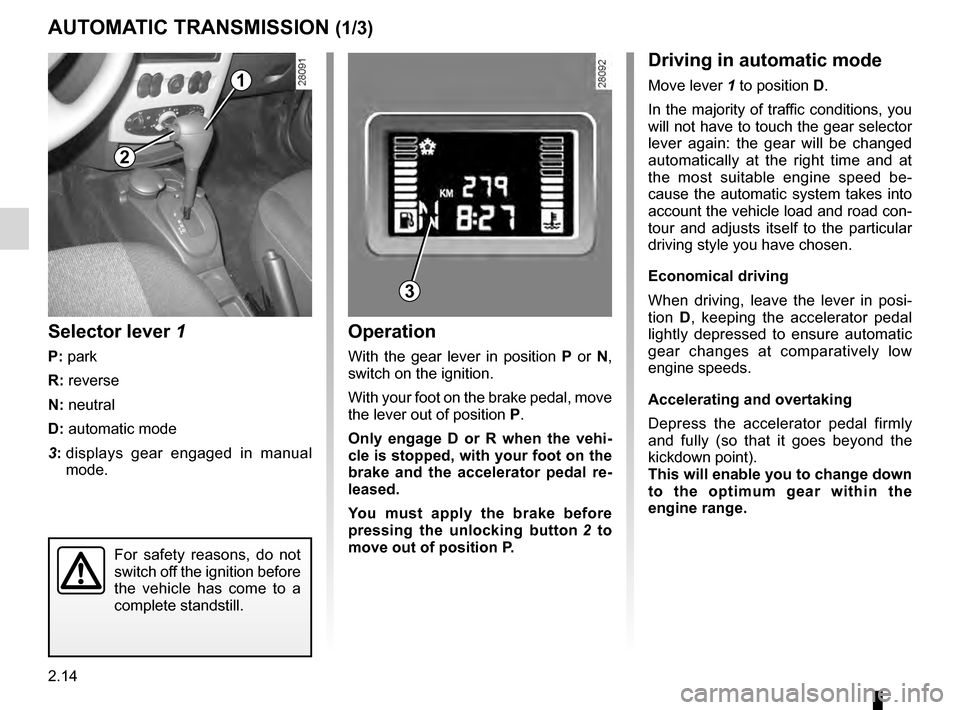
Selector lever 1
P: park
R: reverse
N: neutral
D: automatic mode
3:
d
isplays gear engaged in manual
mode.
Operation
With the gear lever in position P or N,
switch on the ignition.
With your foot on the brake pedal, move
the lever out of position P.
Only engage D or R when the vehi-
cle is stopped, with your foot on the
brake and the accelerator pedal re-
leased.
You must apply the brake before
pressing the unlocking button
2 t
o
move out of position P.
AUTOMATIC TRANSMISSION (1/3)
2
1
Driving in automatic mode
Move lever 1 to position D.
In the majority of traffic conditions, you
will not have to touch the gear selector
lever again: the gear will be changed
automatically at the right time and at
the most suitable engine speed be-
cause the automatic system takes into
account the vehicle load and road con-
tour and adjusts itself to the particular
driving style you have chosen.
Economical driving
When driving, leave the lever in posi-
tion D, keeping the accelerator pedal
lightly depressed to ensure automatic
gear changes at comparatively low
engine speeds.
Accelerating and overtaking
Depress the accelerator pedal firmly
and fully (so that it goes beyond the
kickdown point).
This will enable you to change down
to the optimum gear within the
engine range.
3
For safety reasons, do not
switch off the ignition before
the vehicle has come to a
complete standstill.
Page 76 of 174
2.16
ENG_UD22554_10
Boîte automatique (B90 - L90 Ph2 - F90 Ph2 - R90 Ph2 - Dacia)
ENG_NU_817-10_B90_Dacia_2
Parking the vehicleWhen the vehicle is stopped, move the
lever to position P while keeping your
foot on the brake pedal: the gearbox is
in neutral and the drive wheels are me-
chanically locked by the driveshaft.
Apply the handbrake.
AUTOMATIC TRANSMISSION (3/3)
An impact to the under-
side of the vehicle while
manoeuvring (e.g.: strik-
ing a post, raised kerb or
other street furniture) may result in
damage to the vehicle (e.g.: defor-
mation of an axle).
To avoid any risk of accident, have
your vehicle checked by an ap-
proved Dealer.
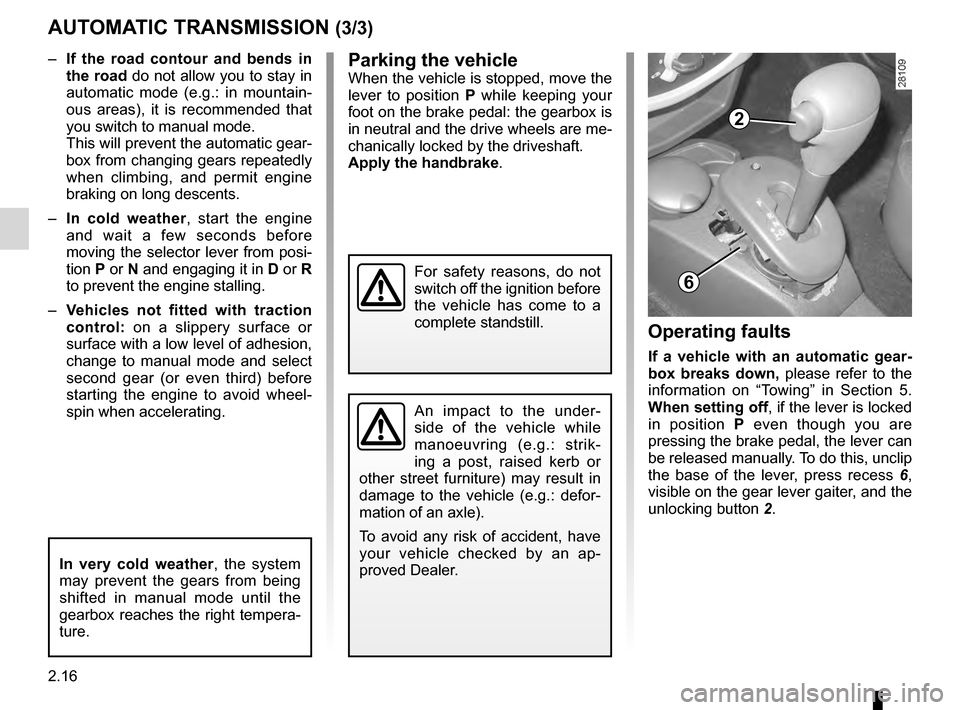
2
6
Operating faults
If a vehicle with an automatic gear-
box breaks down, please refer to the
information on “Towing” in Section 5.
When setting off, if the lever is locked
in position P even though you are
pressing the brake pedal, the lever can
be released manually. To do this, unclip
the base of the lever, press recess
6 ,
visible
on the gear lever gaiter, and the
unlocking button
2
.
–
I
f the road contour and bends in
the road do not allow you to stay in
automatic mode (e.g.: in mountain-
ous areas), it is recommended that
you switch to manual mode.
This will prevent the automatic gear-
box from changing gears repeatedly
when climbing, and permit engine
braking on long descents.
–
I
n cold weather
, start the engine
and wait a few seconds before
moving the selector lever from posi-
tion P or N and engaging it in D or R
to prevent the engine stalling.
–
V
ehicles not fitted with traction
control: on a slippery surface or
surface with a low level of adhesion,
change to manual mode and select
second gear (or even third) before
starting the engine to avoid wheel-
spin when accelerating.
In very cold weather , the system
may prevent the gears from being
shifted in manual mode until the
gearbox reaches the right tempera-
ture.
For safety reasons, do not
switch off the ignition before
the vehicle has come to a
complete standstill.
Page 87 of 174
electric windows ................................... (up to the end of the DU)
3.11
ENG_UD17904_3
Lève-vitres (B90 - Dacia)
ENG_NU_817-10_B90_Dacia_3
Electric windows
ELECTRIC WINDOWS (1/2)
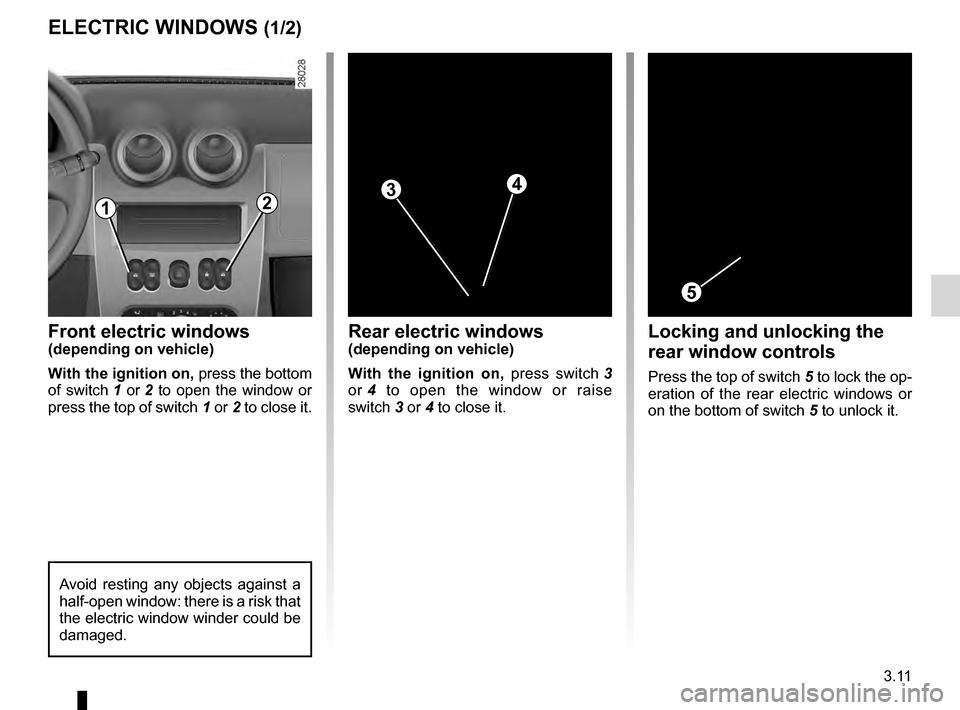
Front electric windows
(depending on vehicle)
With the ignition on, press the bottom
of switch 1 or 2 to open the window or
press the top of switch
1 or 2 to close it.Rear electric windows(depending on vehicle)
With the ignition on, press switch
3
or
4
to open the window or raise
switch
3 or 4 to close it.Locking and unlocking the
rear window controls
Press the top of switch 5 to lock the op-
e ration of the rear electric windows or
on the bottom of switch
5 to unlock it.
1234
5
Avoid resting any objects against a
half-open window: there is a risk that
the electric window winder could be
damaged.
Page 88 of 174
3.12
ENG_UD17904_3
Lève-vitres (B90 - Dacia)
ENG_NU_817-10_B90_Dacia_3
ELECTRIC WINDOWS (2/2)
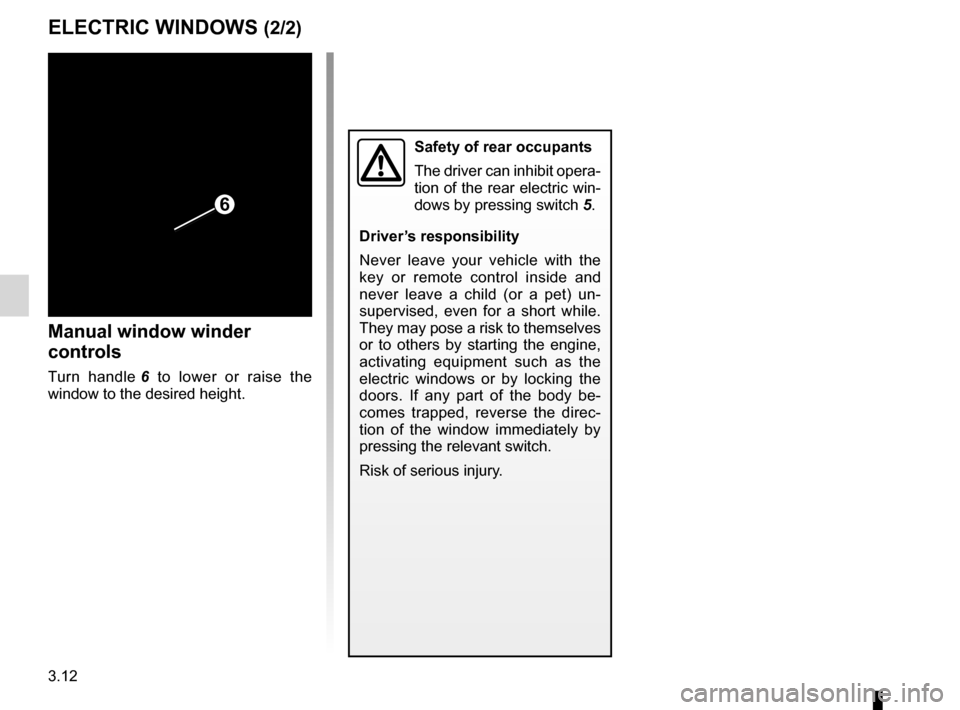
Manual window winder
controls
Turn handle 6 to lower or raise the
window to the desired height.
Safety of rear occupants
The driver can inhibit opera-
tion of the rear electric win-
dows by pressing switch
5
.
Driver’s responsibility
Never leave your vehicle with the
key or remote control inside and
never leave a child (or a pet) un-
supervised, even for a short while.
They may pose a risk to themselves
or to others by starting the engine,
activating equipment such as the
electric windows or by locking the
doors. If any part of the body be-
comes trapped, reverse the direc-
tion of the window immediately by
pressing the relevant switch.
Risk of serious injury.
6
Page 94 of 174
3.18
ENG_UD17907_4
Banquette arrière (fonctionnalité) (B90 - Dacia)
ENG_NU_817-10_B90_Dacia_3
Rear bench seat: functions
REAR BENCH SEAT: functions
When moving the rear
bench seat, make sure the
anchorage points are clean
(they should be free from
grit, cloths, toys etc.).
For safety reasons, carry
out any adjustments when
the vehicle is not being
driven.
Check that the rear seat
belts are positioned and
operating correctly each
time the rear bench seat is
moved.
– Wh e n r e t u r n i n g t h e seatback to its normal
position, make sure that
it is properly locked at the
top.
–
I
f seat covers are fitted, make
sure these do not prevent the
seatback latch from locking in.
–
W
hen moving the bench seat,
ensure the seat belt unit buck-
les do not cross over and ensure
they are correctly repositioned
before folding down the seat
base.
Once the bench seat has been re-
turned to its normal position, check
that the seat belts are correctly po-
sitioned. The seat belts must be on
the seatback.
To reposition the seatback
Raise the seatbacks.
Check the seatbacks are correctly
locked in position.
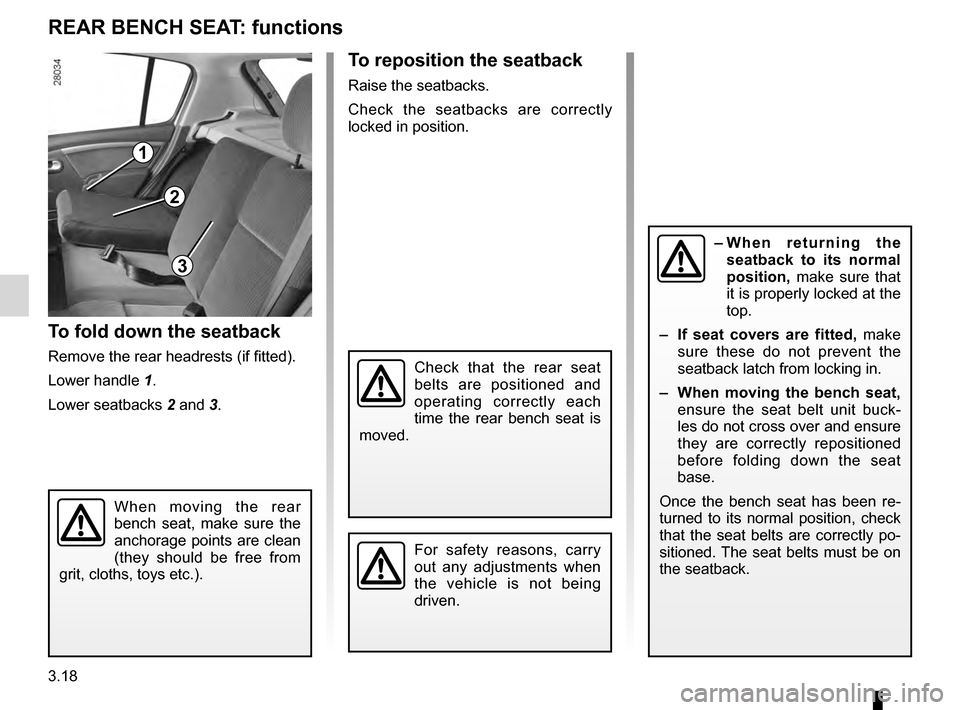
To fold down the seatback
Remove the rear headrests (if fitted).
Lower handle
1
.
Lower seatbacks
2
and 3.
1
2
3
Page 95 of 174
tailgate ................................................................... (current page)
transporting objects in the luggage compartment ............................ (current page)
3.19
ENG_UD20455_4
Coffre à bagage / transport d’objets dans le coffre (B90 - Dacia)
ENG_NU_817-10_B90_Dacia_3
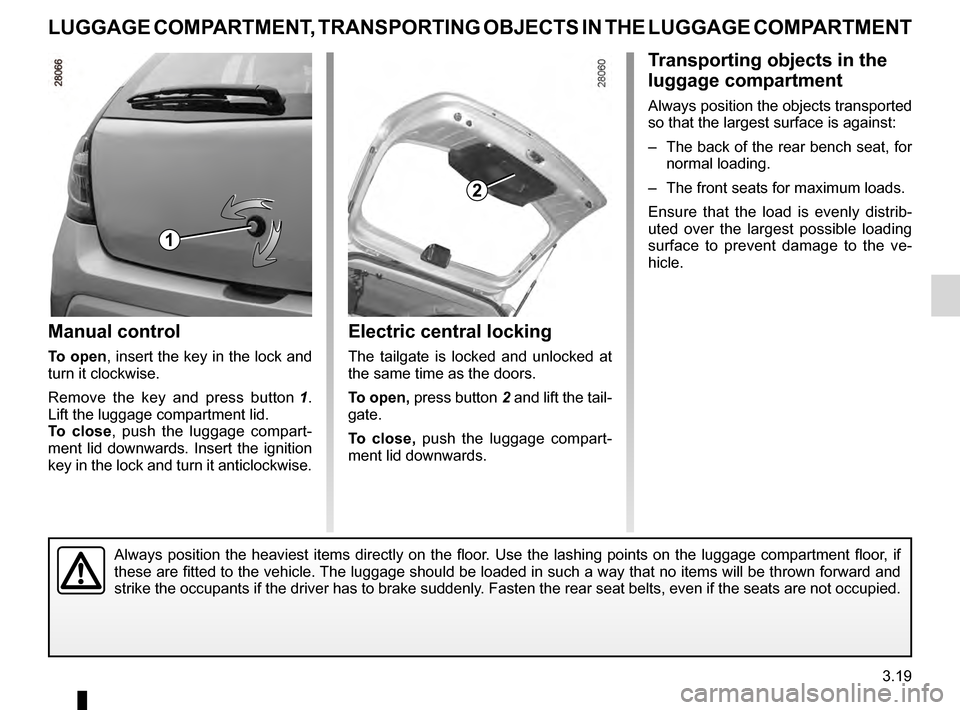
Electric central locking
The tailgate is locked and unlocked at
the same time as the doors.
To open, press button
2 and lift the tail-
gate.
To close, push the luggage compart-
ment lid downwards.
Luggage compartment/Transporting objects in the luggage compartment
LuGGAGE COMPARTMENT, TRANSPORTING OBJECTS IN THE LuGGAGE COMPARTMENT
Manual control
To open, insert the key in the lock and
turn it clockwise.
Remove the key and press button
1 .
Lift the luggage compartment lid.
T
o close , push the luggage compart-
ment lid downwards. Insert the ignition
key in the lock and turn it anticlockwise.
Always position the heaviest items directly on the floor. Use the lashing points on the luggage compartment floor, if
these are fitted to the vehicle. The luggage should be loaded in such a way that no items will be thrown forward and
strike the occupants if the driver has to brake suddenly. Fasten the rear seat belts, even if the seats are not occupied.
Transporting objects in the
luggage compartment
Always position the objects transported
so that the largest surface is against:
–
The
back of the rear bench seat, for
normal loading.
–
The front seats for maximum loads.
E
nsure that the load is evenly distrib-
uted over the largest possible loading
surface to prevent damage to the ve-
hicle.
1
2
Page 100 of 174
bonnet................................................... (up to the end of the DU)
4.2
ENG_UD22576_6
Capot moteur (B90 - Dacia)
ENG_NU_817-10_B90_Dacia_4
Jaune NoirNoir texte
Bonnet
BONNET (1/2)
The engine may be hot
during operations in close
proximity. In addition, the
engine cooling fan may
come on at any moment.
Risk of injury.In the event of even a slight
impact involving the radia-
tor grille or bonnet, have
the bonnet lock checked by
an approved Dealer as soon as pos-
sible.
1
2
3
4
5
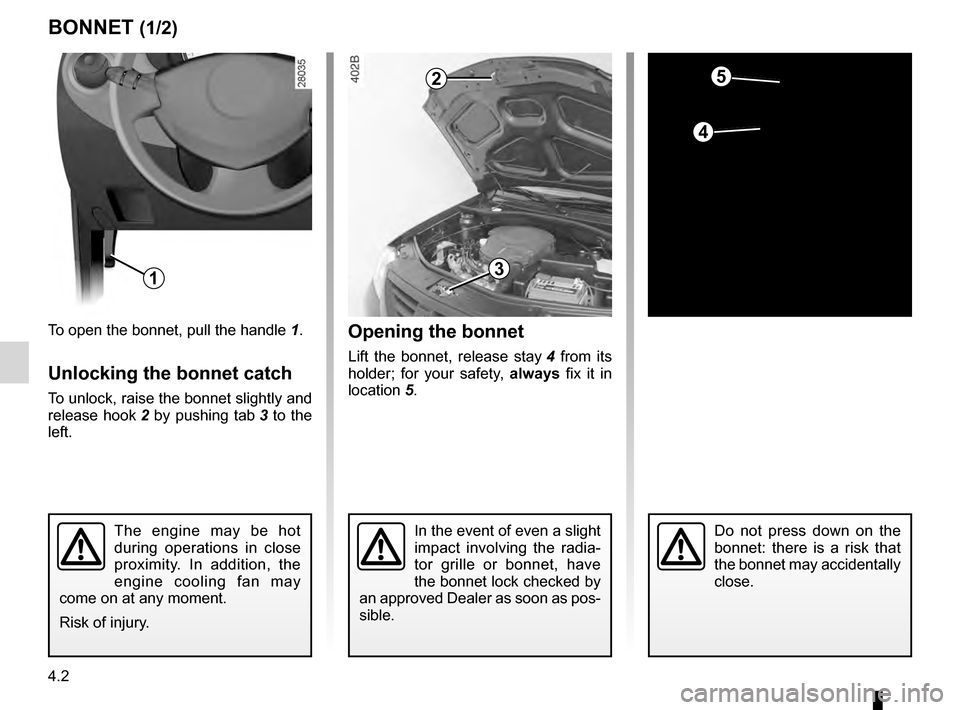
To open the bonnet, pull the handle 1 .
Unlocking the bonnet catch
To unlock, raise the bonnet slightly and
release hook
2 by pushing tab 3 to the
left.
Opening the bonnet
Lift the bonnet, release stay 4 from its
holder; for your safety, always fix it in
location
5
.
Do not press down on the
bonnet: there is a risk that
the bonnet may accidentally
close.