check engine DACIA SANDERO STEPWAY 2016 2.G User Guide
[x] Cancel search | Manufacturer: DACIA, Model Year: 2016, Model line: SANDERO STEPWAY, Model: DACIA SANDERO STEPWAY 2016 2.GPages: 174, PDF Size: 2.78 MB
Page 105 of 174
maintenance:mechanical ...................................... (up to the end of the DU)
brake fluid .............................................................. (current page)
levels .................................................... (up to the end of the DU)
tanks and reservoirs brake fluid ........................................................ (current page)
4.7
ENG_UD19766_9
Niveaux / Filtres (B90 - L90 Ph2 - Dacia)
ENG_NU_817-10_B90_Dacia_4
Levels:
Brake fluid
LEVELS (1/3)
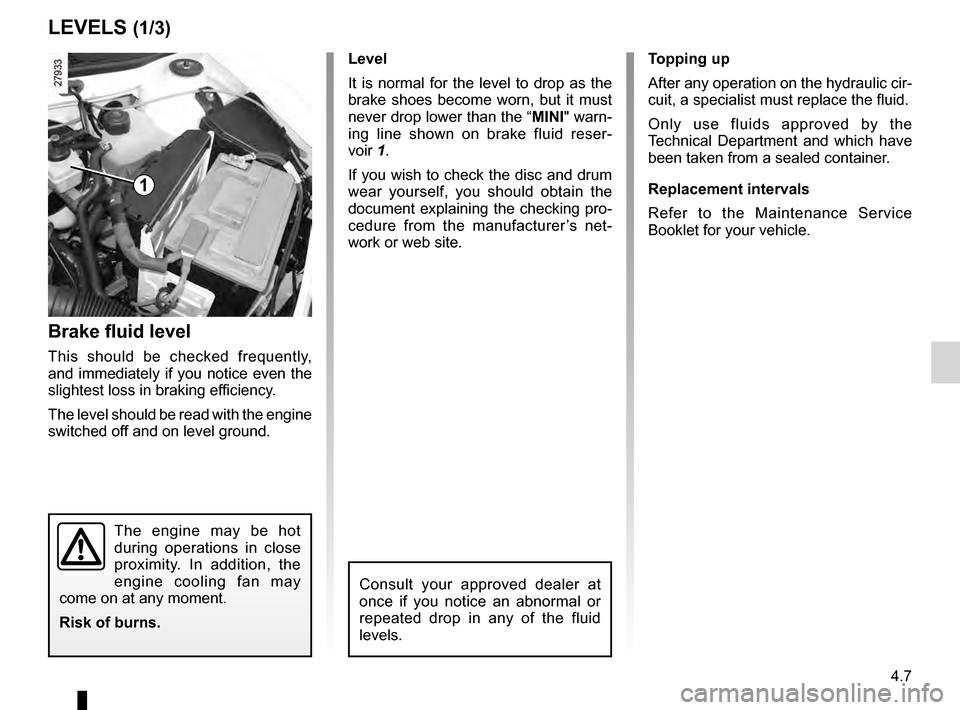
Brake fluid level
This should be checked frequently,
and immediately if you notice even the
slightest loss in braking efficiency.
The level should be read with the engine
switched off and on level ground. Level
It is normal for the level to drop as the
brake shoes become worn, but it must
never drop lower than the “MINI" warn-
ing line shown on brake fluid reser-
voir
1.
If you wish to check the disc and drum
wear yourself, you should obtain the
document explaining the checking pro-
cedure from the manufacturer ’s net-
work or web site.
1
Consult your approved dealer at
once if you notice an abnormal or
repeated drop in any of the fluid
levels.
The engine may be hot
during operations in close
proximity. In addition, the
engine cooling fan may
come on at any moment.
Risk of burns.
Topping up
After any operation on the hydraulic cir-
cuit, a specialist must replace the fluid.
Only use fluids approved by the
Technical Department and which have
been taken from a sealed container.
Replacement intervals
Refer to the Maintenance Service
Booklet for your vehicle.
Page 106 of 174
engine coolant ....................................................... (current page)
tanks and reservoirs coolant ............................................................. (current page)
tanks and reservoirs: windscreen washer .......................................... (current page)
4.8
ENG_UD19766_9
Niveaux / Filtres (B90 - L90 Ph2 - Dacia)
ENG_NU_817-10_B90_Dacia_4
Jaune NoirNoir texte
Engine coolant
Windscreen washer reservoir
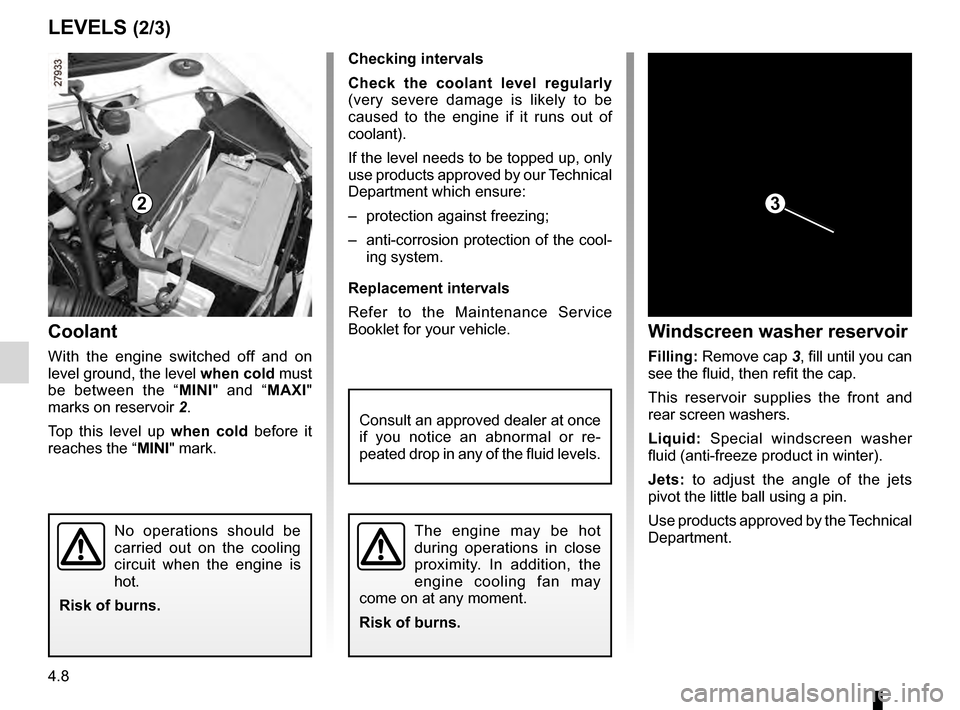
Coolant
With the engine switched off and on
level ground, the level when cold must
be between the “ MINI" and “ MAXI"
marks on reservoir
2
.
Top this level up when cold before it
reaches the “MINI" mark.
No operations should be
carried out on the cooling
circuit when the engine is
hot.
Risk of burns.
Checking intervals
Check the coolant level regularly
(very severe damage is likely to be
caused to the engine if it runs out of
coolant).
If the level needs to be topped up, only
use products approved by our Technical
Department which ensure:
–
protection against freezing;
–
anti-corrosion
protection of the cool-
ing system.
Replacement intervals
Refer to the Maintenance Service
Booklet for your vehicle.
Consult an approved dealer at once
if you notice an abnormal or re-
peated drop in any of the fluid levels.
LEVELS (2/3)
2
The engine may be hot
during operations in close
proximity. In addition, the
engine cooling fan may
come on at any moment.
Risk of burns.
Windscreen washer reservoir
Filling: Remove cap 3, fill until you can
see the fluid, then refit the cap.
This reservoir supplies the front and
rear screen washers.
Liquid: Special windscreen washer
fluid (anti-freeze product in winter).
Jets: to adjust the angle of the jets
pivot the little ball using a pin.
Use products approved by the Technical
Department.
3
Page 108 of 174
filterair filter ............................................................. (current page)
filter diesel filter ........................................................ (current page)
filter ........................................................................\
(current page)
filter passenger compartment filter .......................... (current page)
4.10
ENG_UD20151_3
Filtres (B90 - U90 - L90 Ph2 - F90 Ph2 - R90 Ph2 - H79 - Dacia)
ENG_NU_817-10_B90_Dacia_4
Filters
FILTERS
The replacement of filter elements (air
filter, passenger compartment filter,
diesel filter, etc.) is scheduled in the
maintenance operations for your vehi-
cle.
Replacement intervals for filter el-
ements: refer to the Maintenance
Service Booklet for your vehicle.
Passenger compartment filter
If your vehicle is not originally fitted with
a passenger compartment filter, it is
possible to have one retrofitted.
Contact an approved dealer.
The engine may be hot
when carrying out opera-
tions in close proximity. In
addition, the engine cooling
fan can come on at any moment.
Risk of injury.
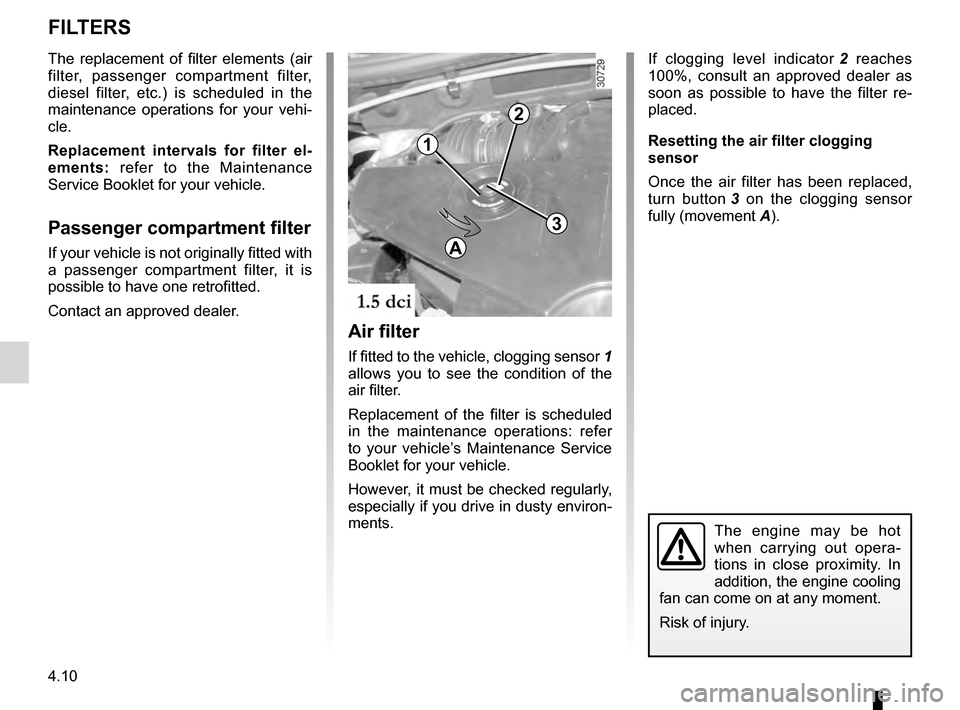
Air filter
If fitted to the vehicle, clogging sensor 1
allows you to see the condition of the
air filter.
Replacement of the filter is scheduled
in the maintenance operations: refer
to your vehicle’s Maintenance Service
Booklet for your vehicle.
However, it must be checked regularly,
especially if you drive in dusty environ-
ments.
If clogging level indicator 2 reaches
100%, consult an approved dealer as
soon as possible to have the filter re-
placed.
Resetting the air filter clogging
sensor
Once the air filter has been replaced,
turn button
3
on the clogging sensor
fully (movement
A).
1
2
3
A
Page 110 of 174
battery................................................... (up to the end of the DU)
capacity of mechanical components...................... (current page)
maintenance: mechanical ....................................................... (current page)
4.12
ENG_UD18253_10
Batterie (B90 - U90 - L90 Ph2 - F90 Ph2 - R90 Ph2 - Dacia)
ENG_NU_817-10_B90_Dacia_4
Battery
BATTERy
Depending on the vehicle, the battery
may be a low maintenance version.
Low maintenance battery
A label on the battery will indicate if the
battery is the low maintenance type.
As the battery is specific
to the vehicle (presence of
a ventilation pipe to expel
corrosive and explosive
gases), make sure that it is replaced
with a battery that enables this pipe
to be connected. Consult an ap-
proved Dealer.
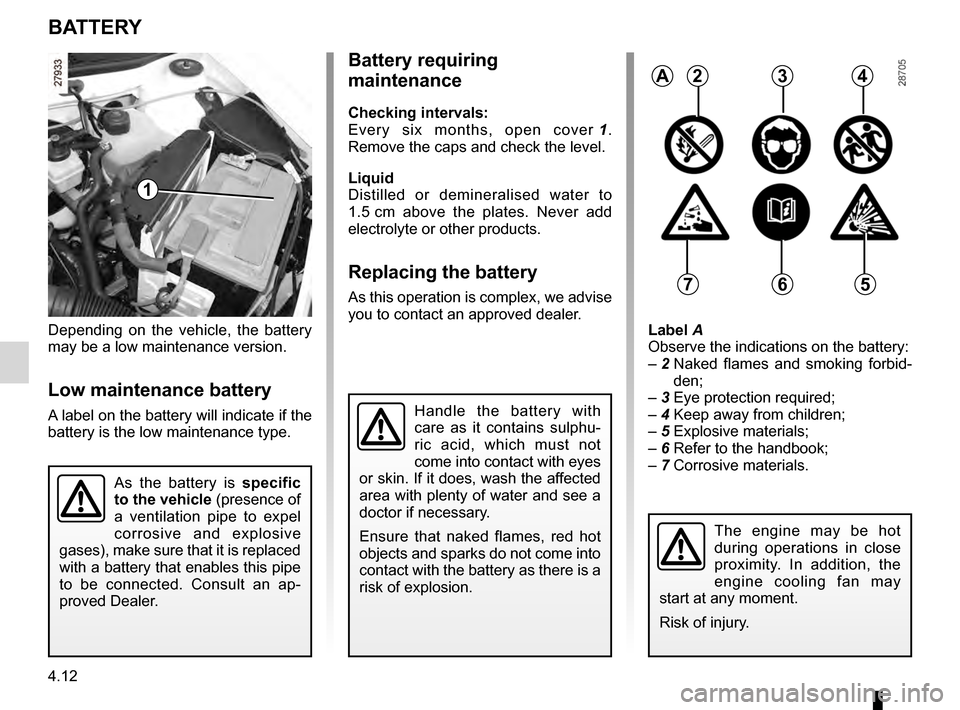
Battery requiring
maintenance
Checking intervals:
Every six months, open cover 1 .
Remove the caps and check the level.
Liquid
D
istilled or demineralised water to
1.5
c
m above the plates. Never add
electrolyte or other products.
Replacing the battery
As this operation is complex, we advise
you to contact an approved dealer.
Handle the battery with
care as it contains sulphu-
ric acid, which must not
come into contact with eyes
or skin. If it does, wash the affected
area with plenty of water and see a
doctor if necessary.
Ensure that naked flames, red hot
objects and sparks do not come into
contact with the battery as there is a
risk of explosion.
1
Label A
Observe the indications on the battery:
–
2
N
aked flames and smoking forbid-
den;
–
3 Eye protection required;
–
4 Keep away from children;
–
5 Explosive materials;
–
6 Refer to the handbook;
–
7 Corrosive materials.
The engine may be hot
during operations in close
proximity. In addition, the
engine cooling fan may
start at any moment.
Risk of injury.
A234
567
Page 119 of 174

ENG_NU_817-10_B90_Dacia_5
TYRE INFLATION KIT (2/3)
Depending on the vehicle, in")
JauneNoirNoir texte
5.5
ENG_UD22290_8
Kit de gonflage des pneumatiques (B90 - L90 Ph2 - F90 Ph2 - R90 Ph2 - D\
acia)
ENG_NU_817-10_B90_Dacia_5
TYRE INFLATION KIT (2/3)
Depending on the vehicle, in the event
of a puncture, use the kit located in the
boot. –
p
ress switch
5
to inflate the tyre to
the recommended pressure (check
the label affixed to the edge of the
driver’s door);
–
after
a maximum of
5 minutes, stop
inflating and read the pressure (on
the pressure gauge
4
);
Note: while the bottle is emptying
(approximately 30 seconds), pres-
sure gauge
4
will briefly indicate a
pressure of 6 bar, then the pressure
will drop.
–
a
djust the pressure: to increase
it, continue inflating with the kit, to
reduce it, turn button 7 located on
the inflation adapter.
If a minimum pressure of 1.8 bar is
not reached after 15 minutes, repair
is not possible; do not drive the vehi-
cle but contact an approved dealer .
1234
5
6
Before using this kit, park
the vehicle at a sufficient
distance from traffic, switch
on the hazard warning
lights, apply the handbrake, ask all
passengers to leave the vehicle and
keep them away from traffic.
8
Open the kit, remove caps 1 and 3 (it is
essential not to remove the cap from
the bottle) then screw bottle
2
to its sup-
port 3.
With the engine running and the
handbrake applied,
–
unscrew
the valve cap on the wheel
concerned and screw the inflation
adapter
6 onto valve;
–
c
onnect adapter
8
to accessories
socket
9
on the dashboard of the ve-
hicle;
9
7
Page 136 of 174
fuses ..................................................... (up to the end of the DU)
advice on antipollution .......................... (up to the end of the DU)
practical advice ..................................... (up to the end of the DU)
5.22
ENG_UD22587_8
Fusibles (B90 - Dacia)
ENG_NU_817-10_B90_Dacia_5
Jaune NoirNoir texte
Fuses
FUSES (1/3)
1
A
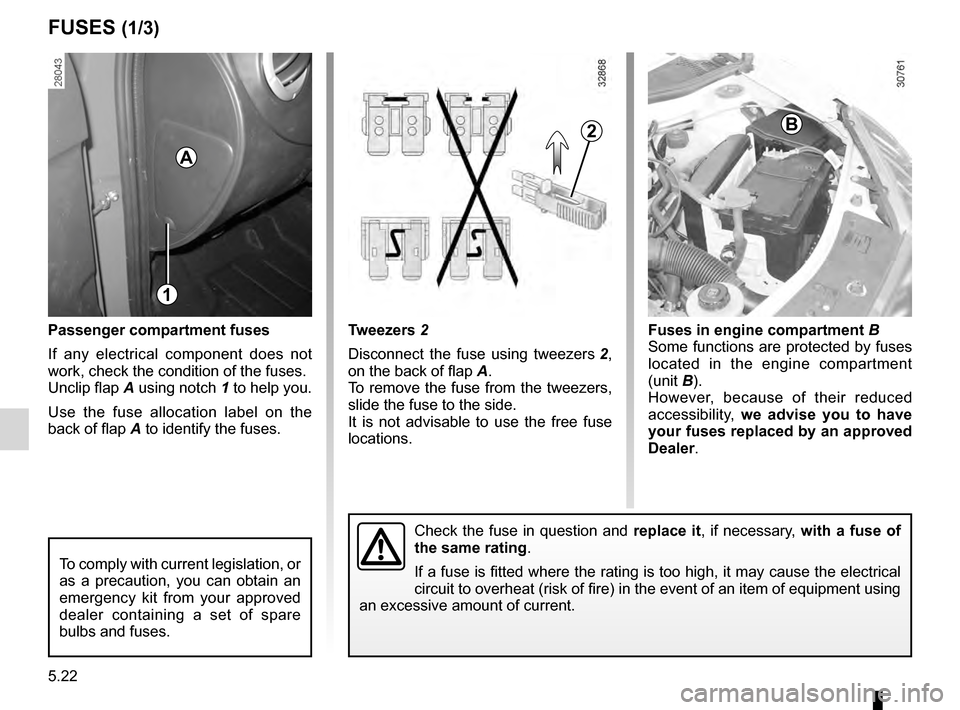
Passenger compartment fuses
If any electrical component does not
work, check the condition of the fuses.
Unclip flap
A using notch 1 to help you.
Use the fuse allocation label on the
back of flap
A to identify the fuses.
To comply with current legislation, or
as a precaution, you can obtain an
emergency kit from your approved
dealer containing a set of spare
bulbs and fuses.
Tweezers 2
D isconnect the fuse using tweezers
2,
on the back of flap
A.
To remove the fuse from the tweezers,
slide the fuse to the side.
It is not advisable to use the free fuse
locations.
Check the fuse in question and replace it, if necessary, with a fuse of
the same rating.
If a fuse is fitted where the rating is too high, it may cause the electrical
circuit to overheat (risk of fire) in the event of an item of equipment using
an excessive amount of current.
Fuses in engine compartment B
Some functions are protected by fuses
located in the engine compartment
(unit
B).
However, because of their reduced
accessibility, we advise you to have
your fuses replaced by an approved
Dealer .
B2
Page 140 of 174
5.26
ENG_UD17938_1
Batterie : dépannage (B90 - Dacia)
ENG_NU_817-10_B90_Dacia_5
BATTERY: troubleshooting (2/2)
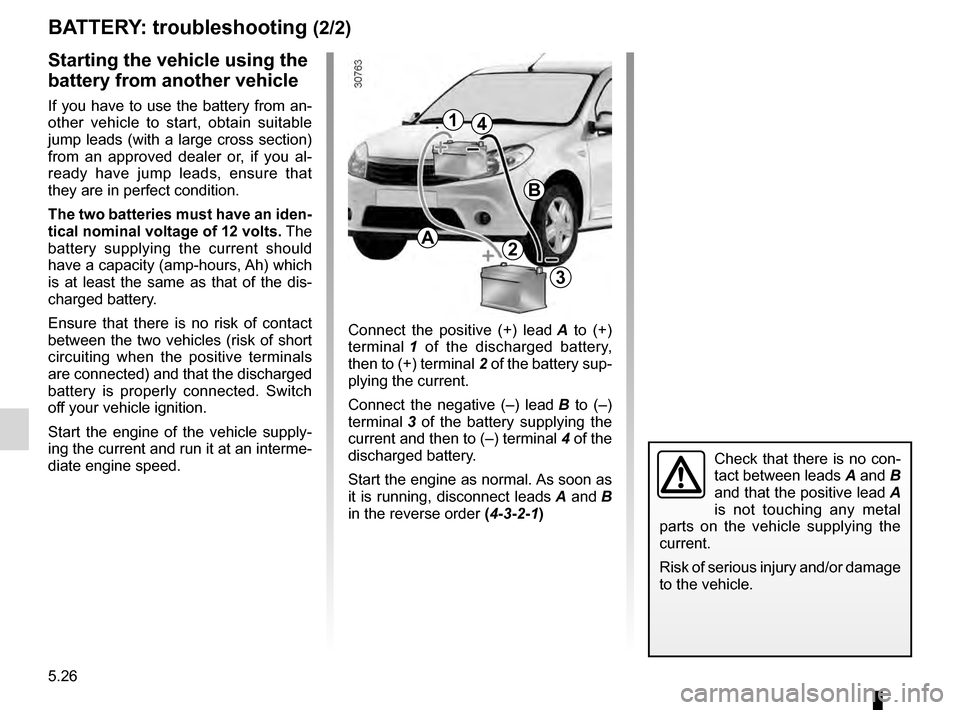
Connect the positive (+) lead A to (+)
terminal 1
of the discharged battery,
then to (+) terminal
2 of the battery sup-
plying the current.
Connect the negative (–) lead
B
to (–)
terminal
3
of the battery supplying the
current and then to (–) terminal
4 of the
discharged battery.
Start the engine as normal. As soon as
it is running, disconnect leads
A and B
in the reverse order (4-3-2-1)
Starting the vehicle using the
battery from another vehicle
If you have to use the battery from an-
other vehicle to start, obtain suitable
jump leads (with a large cross section)
from an approved dealer or, if you al-
ready have jump leads, ensure that
they are in perfect condition.
The two batteries must have an iden-
tical nominal voltage of 12 volts. The
battery supplying the current should
have a capacity (amp-hours, Ah) which
is at least the same as that of the dis-
charged battery.
Ensure that there is no risk of contact
between the two vehicles (risk of short
circuiting when the positive terminals
are connected) and that the discharged
battery is properly connected. Switch
off your vehicle ignition.
Start the engine of the vehicle supply-
ing the current and run it at an interme-
diate engine speed.
Check that there is no con-
tact between leads
A and B
and that the positive lead
A
is not touching any metal
parts on the vehicle supplying the
current.
Risk of serious injury and/or damage
to the vehicle.
14
B
A2
3
Page 149 of 174

ENG_NU_817-10_B90_Dacia_5
OPERATING FAULTS (2/5)
On the road POSSIBLE CAUSES WHAT")
JauneNoirNoir texte
5.35
ENG_UD19739_7
Anomalies de fonctionnement (B90 - U90 - L90 Ph2 - F90 Ph2 - R90 Ph2 - \
Dacia)
ENG_NU_817-10_B90_Dacia_5
OPERATING FAULTS (2/5)
On the road POSSIBLE CAUSES WHAT TO DO
Vibrations. Tyres not inflated to correct pres-
sures, incorrectly balanced or
damaged. Check the tyre pressures; if this is not the cause, have
their condition checked by an approved dealer.
Coolant boiling in the coolant
reservoir. Mechanical fault: cylinder head
gasket damaged, faulty coolant
pump. Stop the engine.
Contact an approved dealer.
Engine cooling fan not working. Contact an approved dealer.
Smoke under the bonnet. Short circuit or cooling system leak. Stop, switch off the ignition, stand away from the vehi-
cle and contact an approved Dealer.
The oil pressure warning light
comes on: on a bend or under braking The engine oil level is too low. Top up the engine oil (refer to the information on “Engine oil level, topping up/refilling” in Section 4).
at idle speed Low oil pressure. Go to your nearest approved dealer.
The oil pressure warning
light takes a long time to
go out or remains lit during
acceleration. Loss of oil pressure.
Stop the vehicle: contact an approved dealer.
Page 151 of 174

ENG_NU_817-10_B90_Dacia_5
OPERATING FAULTS (4/5)
On the road POSSIBLE CAUSES WHAT")
JauneNoirNoir texte
5.37
ENG_UD19739_7
Anomalies de fonctionnement (B90 - U90 - L90 Ph2 - F90 Ph2 - R90 Ph2 - \
Dacia)
ENG_NU_817-10_B90_Dacia_5
OPERATING FAULTS (4/5)
On the road POSSIBLE CAUSES WHAT TO DO
Whistling Roof aerial poorly positioned. Position the aerial.
The engine overheats. The coolant
temperature indicator light comes
on. Engine cooling fan not working. Stop the vehicle, switch off the engine and
contact an approved dealer.
Coolant leaks. Stop the vehicle, switch off the engine and
check the coolant reservoir: it should con-
tain fluid. If there is no coolant, consult an
approved dealer as soon as possible.
The oil change warning light remains
lit after an oil change. Warning not reset after oil change. Reset the warning after changing the oil;
refer to the information on “Resetting the
warning after an oil change” in Section 4.
Radiator: If there is a significant lack of coolant, remember that it must never be topped up using cold coolant while
the engine is very warm. After any procedure on the vehicle which has involved even partial draining of the cooling
system, it must be refilled with a new mixture prepared in the correct proportions. Reminder: only products approved
by the Technical Department may be used for this purpose.
Page 153 of 174
6.1
ENG_UD26898_12
Sommaire 6 (B90 - Dacia)
ENG_NU_817-10_B90_Dacia_6
Section 6: Technical specifications
Vehicle identification plates . . . . . . . . . . . . . . . . . . . . . . . . . . . . . . . . . . . . . . . . . . . . . . . . . . . . . . . . 6.2
Engine specifications
. . . . . . . . . . . . . . . . . . . . . . . . . . . . . . . . . . . . . . . . . . . . . . . . . . . . . . . . . . . . .
6.4
Dimensions
.
. . . . . . . . . . . . . . . . . . . . . . . . . . . . . . . . . . . . . . . . . . . . . . . . . . . . . . . . . . . . . . . . . . .
6.5
W
eights/Towing weights
.
. . . . . . . . . . . . . . . . . . . . . . . . . . . . . . . . . . . . . . . . . . . . . . . . . . . . . . . . .
6.6
Replacement parts and repairs
. . . . . . . . . . . . . . . . . . . . . . . . . . . . . . . . . . . . . . . . . . . . . . . . . . . . .
6.7
Service sheets
. . . . . . . . . . . . . . . . . . . . . . . . . . . . . . . . . . . . . . . . . . . . . . . . . . . . . . . . . . . . . . . . . .
6.8
Anti-corrosion check
.
. . . . . . . . . . . . . . . . . . . . . . . . . . . . . . . . . . . . . . . . . . . . . . . . . . . . . . . . . . . .
6.14