starting DACIA SANDERO STEPWAY 2016 2.G User Guide
[x] Cancel search | Manufacturer: DACIA, Model Year: 2016, Model line: SANDERO STEPWAY, Model: DACIA SANDERO STEPWAY 2016 2.GPages: 174, PDF Size: 2.78 MB
Page 68 of 174

ENG_NU_817-10_B90_Dacia_2
ADVICE: antipollution, fuel economy a")
2.8
ENG_UD22287_11
Conseils : antipollution, économies de carburant, conduite (B90 - U9\
0 - L90 Ph2 - F90 Ph2 - R90 Ph2 - H79 - Dacia)
ENG_NU_817-10_B90_Dacia_2
ADVICE: antipollution, fuel economy and driving (3/3)
– In vehicles fitted with air condi-
tioning, it is normal to observe an
increase in fuel consumption (es-
pecially in urban conditions) when
it is used. For vehicles fitted with
manual air conditioning, switch off
the system when it is not required.
Advice for reducing consumption
and therefore helping to preserve
the environment:
If the vehicle has been parked in the
sun, open the doors for a few mo-
ments to let the hot air escape before
starting the engine.
–
N
ever fill the fuel tank right to the
brim to avoid overflow.
–
D
o not leave an empty roof rack
fitted to the vehicle.
–
It
is better to fit a trailer for bulky ob-
jects.
–
W
hen towing a caravan, fit a wind
deflector and adjust it carefully.
Advice on use
– Electricity is fuel; switch off all the electrical components which are not
really needed.
However (safety first), keep your
lights on when the visibility is bad
(“see and be seen”).
–
U
se the air vents. Driving with the
windows open at 60 mph (100 km/h)
will increase fuel consumption by
4%. –
A
void using the vehicle for door-to-
door journeys (short journeys, with
long stops in-between) because in
these conditions, the engine never
reaches its ideal temperature.
Tyres
Increased fuel consumption could be
the result of:
–
insuf
ficient pressure,
–
using non-recommended tyres.
Page 76 of 174
2.16
ENG_UD22554_10
Boîte automatique (B90 - L90 Ph2 - F90 Ph2 - R90 Ph2 - Dacia)
ENG_NU_817-10_B90_Dacia_2
Parking the vehicleWhen the vehicle is stopped, move the
lever to position P while keeping your
foot on the brake pedal: the gearbox is
in neutral and the drive wheels are me-
chanically locked by the driveshaft.
Apply the handbrake.
AUTOMATIC TRANSMISSION (3/3)
An impact to the under-
side of the vehicle while
manoeuvring (e.g.: strik-
ing a post, raised kerb or
other street furniture) may result in
damage to the vehicle (e.g.: defor-
mation of an axle).
To avoid any risk of accident, have
your vehicle checked by an ap-
proved Dealer.
2
6
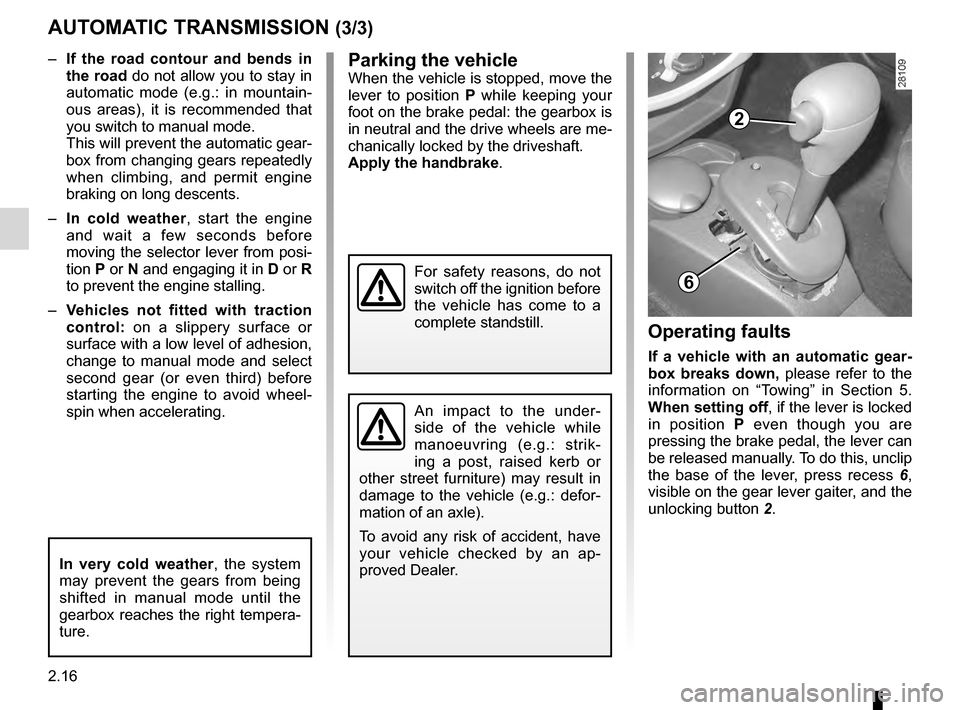
Operating faults
If a vehicle with an automatic gear-
box breaks down, please refer to the
information on “Towing” in Section 5.
When setting off, if the lever is locked
in position P even though you are
pressing the brake pedal, the lever can
be released manually. To do this, unclip
the base of the lever, press recess
6 ,
visible
on the gear lever gaiter, and the
unlocking button
2
.
–
I
f the road contour and bends in
the road do not allow you to stay in
automatic mode (e.g.: in mountain-
ous areas), it is recommended that
you switch to manual mode.
This will prevent the automatic gear-
box from changing gears repeatedly
when climbing, and permit engine
braking on long descents.
–
I
n cold weather
, start the engine
and wait a few seconds before
moving the selector lever from posi-
tion P or N and engaging it in D or R
to prevent the engine stalling.
–
V
ehicles not fitted with traction
control: on a slippery surface or
surface with a low level of adhesion,
change to manual mode and select
second gear (or even third) before
starting the engine to avoid wheel-
spin when accelerating.
In very cold weather , the system
may prevent the gears from being
shifted in manual mode until the
gearbox reaches the right tempera-
ture.
For safety reasons, do not
switch off the ignition before
the vehicle has come to a
complete standstill.
Page 81 of 174
JauneNoirNoir texte
3.5
ENG_UD25116_1
Chauffage - Ventilation - Air conditionné (B90 - L90 Ph2 - Dacia)
ENG_NU_817-10_B90_Dacia_3
HEATING, VENTILATION, AIR CONDITIONING (2/2)
In very hot weather or when the vehicle
has been parked in the sun, open the
doors for a few moments to let the hot
air escape before starting the engine.
Use the passenger compartment isola-
tion function to lower the temperature
as quickly as possible to the required
comfort level. Switch off the air recircu-
lation function once a comfortable level
has been reached. When the air conditioning system is op-
erating, all windows must be closed for
maximum efficiency.
If there is an operating fault, contact an
approved dealer.
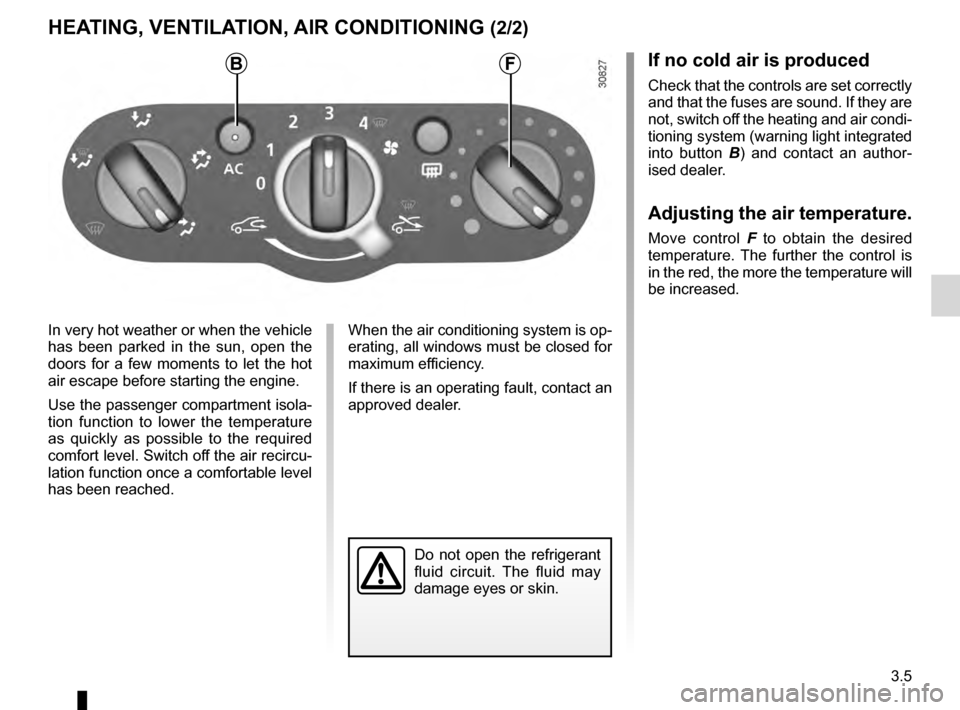
If no cold air is produced
Check that the controls are set correctly
and that the fuses are sound. If they are
not, switch off the heating and air condi-
tioning system (warning light integrated
into button
B
)
and contact an author-
ised dealer.
Adjusting the air temperature.
Move control F to obtain the desired
temperature. The further the control is
in the red, the more the temperature will
be increased.
Do not open the refrigerant
fluid circuit. The fluid may
damage eyes or skin.
BF
Page 85 of 174
air conditioning ..................................... (up to the end of the DU)
heating system ..................................... (up to the end of the DU)
heating and air conditioning system ..... (up to the end of the DU)
ventilation heating and air conditioning system (up to the end of the DU)
air conditioning ...................................................... (current page)
3.9
ENG_UD18246_14
Air conditionné : informations et conseils utilisation (B90 - U90 - \
L90 Ph2 - F90 Ph2 - R90 Ph2 - H79 - Dacia)
ENG_NU_817-10_B90_Dacia_3
Air conditioning: information and advice on use
AIR CONDITIONING: information and advice on use
Fuel consumption
You will normally notice an increase
in fuel consumption (especially
when driving in town) when the air
conditioning is operating.
For vehicles fitted with air condition-
ing with no automatic mode, switch
off the system when it is not re-
quired.
Advice for reducing consumption
and helping to preserve the envi-
ronment
Drive with the air vents open and
the windows closed.
If the vehicle has been parked in
the sun, open the doors for a few
moments to let the hot air escape
before starting the engine. Operating faults
As a general rule, contact your ap-
proved dealer in the event of an op-
erating fault.
–
R
eduction in de-icing, demist-
ing or air conditioning per-
formance.
This may be caused by the pas-
senger compartment filter car-
tridge becoming clogged.
–
No cold air is being produced .
C
heck that the controls are set
correctly and that the fuses are
sound. Otherwise, switch off the
system.
Do not open the refriger-
ant fluid circuit. The fluid
may damage eyes or skin.Presence of water under the ve-
hicle. After prolonged use of the air
conditioning system, it is normal for
water to be present under the vehi-
cle. This is caused by condensation.Maintenance
Refer to the Maintenance Service
Booklet for your vehicle for the in-
spection frequency.
Page 88 of 174
3.12
ENG_UD17904_3
Lève-vitres (B90 - Dacia)
ENG_NU_817-10_B90_Dacia_3
ELECTRIC WINDOWS (2/2)
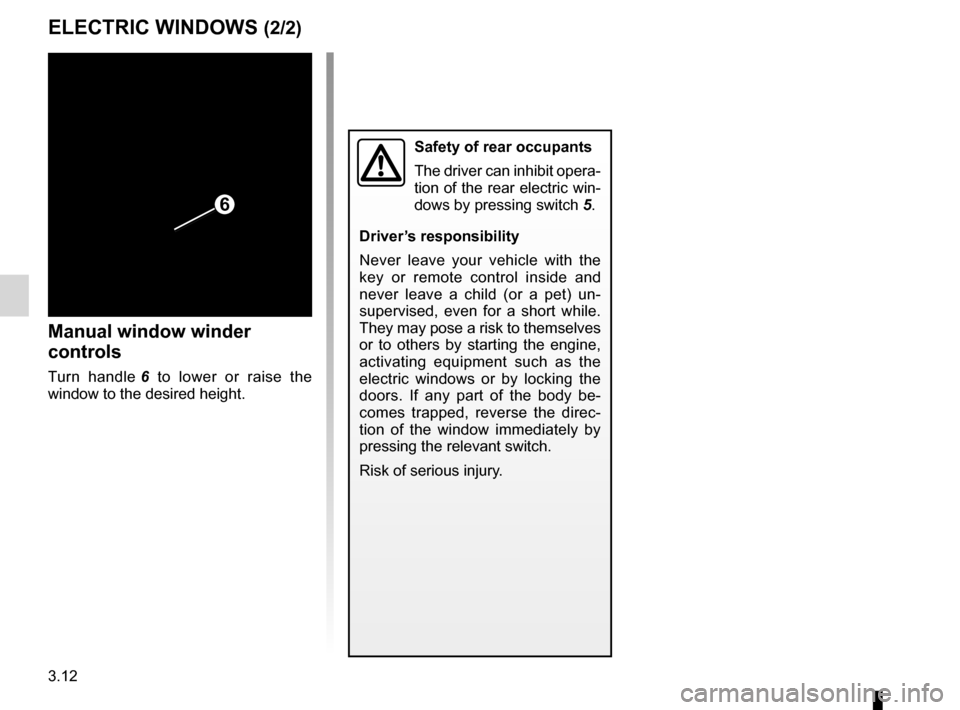
Manual window winder
controls
Turn handle 6 to lower or raise the
window to the desired height.
Safety of rear occupants
The driver can inhibit opera-
tion of the rear electric win-
dows by pressing switch
5
.
Driver’s responsibility
Never leave your vehicle with the
key or remote control inside and
never leave a child (or a pet) un-
supervised, even for a short while.
They may pose a risk to themselves
or to others by starting the engine,
activating equipment such as the
electric windows or by locking the
doors. If any part of the body be-
comes trapped, reverse the direc-
tion of the window immediately by
pressing the relevant switch.
Risk of serious injury.
6
Page 121 of 174
practical advice ..................................... (up to the end of the DU)
trims ...................................................... (up to the end of the DU)
lifting the vehicle changing a wheel ............................ (up to the end of the DU)
5.7
ENG_UD20461_5
Enjoliveurs - Jantes (B90 - Dacia)
ENG_NU_817-10_B90_Dacia_5
Wheel trim/Wheels
WHEEL TRIM/WHEELS (1/2)
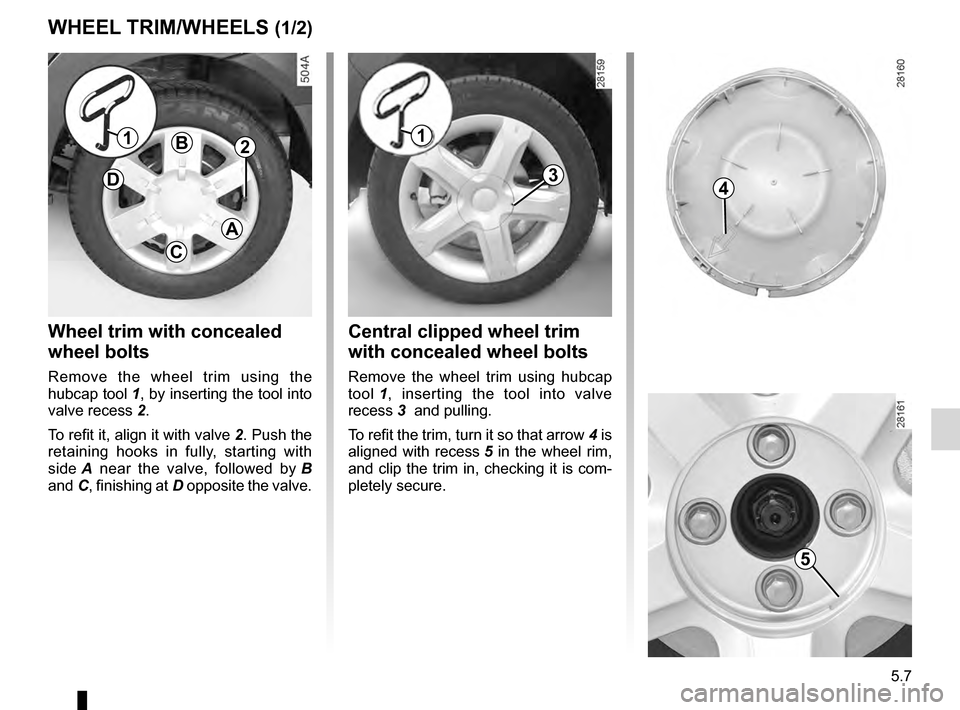
Wheel trim with concealed
wheel bolts
Remove the wheel trim using the
hubcap tool
1, by inserting the tool into
valve recess
2.
To refit it, align it with valve
2. Push the
retaining hooks in fully, starting with
side
A
near the valve, followed by
B
and
C, finishing at D opposite the valve.
B
D
C
A
121
3
Central clipped wheel trim
with concealed wheel bolts
Remove the wheel trim using hubcap
tool 1,
inserting the tool into valve
recess
3 and pulling.
To refit the trim, turn it so that arrow
4 is
aligned with recess
5 in the wheel rim,
and clip the trim in, checking it is com-
pletely secure.
5
4
Page 140 of 174
5.26
ENG_UD17938_1
Batterie : dépannage (B90 - Dacia)
ENG_NU_817-10_B90_Dacia_5
BATTERY: troubleshooting (2/2)
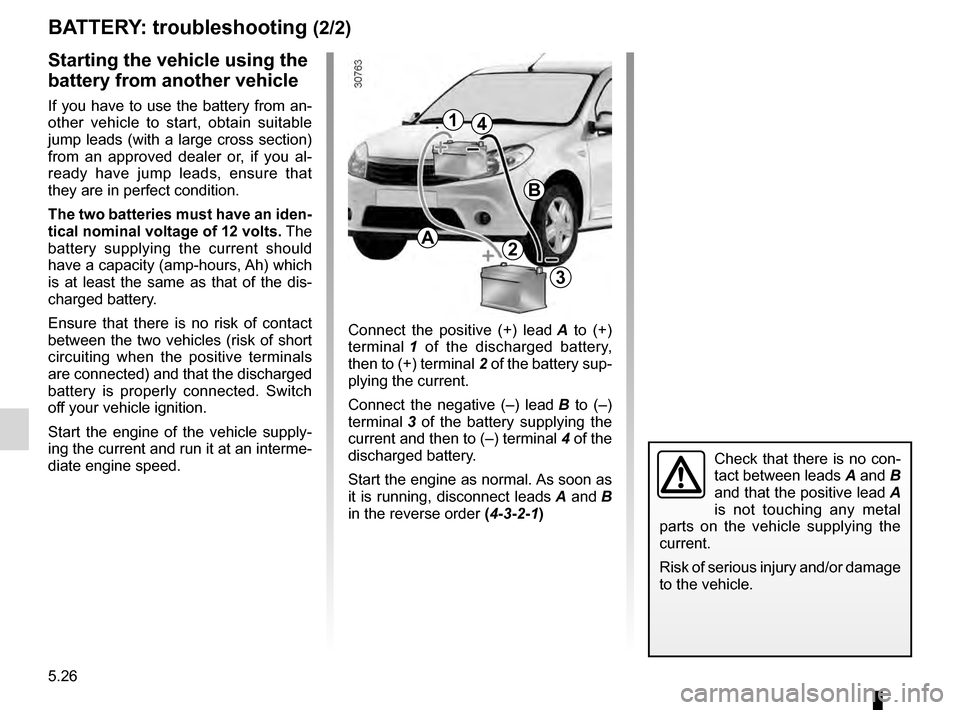
Connect the positive (+) lead A to (+)
terminal 1
of the discharged battery,
then to (+) terminal
2 of the battery sup-
plying the current.
Connect the negative (–) lead
B
to (–)
terminal
3
of the battery supplying the
current and then to (–) terminal
4 of the
discharged battery.
Start the engine as normal. As soon as
it is running, disconnect leads
A and B
in the reverse order (4-3-2-1)
Starting the vehicle using the
battery from another vehicle
If you have to use the battery from an-
other vehicle to start, obtain suitable
jump leads (with a large cross section)
from an approved dealer or, if you al-
ready have jump leads, ensure that
they are in perfect condition.
The two batteries must have an iden-
tical nominal voltage of 12 volts. The
battery supplying the current should
have a capacity (amp-hours, Ah) which
is at least the same as that of the dis-
charged battery.
Ensure that there is no risk of contact
between the two vehicles (risk of short
circuiting when the positive terminals
are connected) and that the discharged
battery is properly connected. Switch
off your vehicle ignition.
Start the engine of the vehicle supply-
ing the current and run it at an interme-
diate engine speed.
Check that there is no con-
tact between leads
A and B
and that the positive lead
A
is not touching any metal
parts on the vehicle supplying the
current.
Risk of serious injury and/or damage
to the vehicle.
14
B
A2
3
Page 148 of 174
operating faults ..................................... (up to the end of the DU)
practical advice ..................................... (up to the end of the DU)
faults operating faults ............................... (up to the end of the DU)
5.34
ENG_UD19739_7
Anomalies de fonctionnement (B90 - U90 - L90 Ph2 - F90 Ph2 - R90 Ph2 - \
Dacia)
ENG_NU_817-10_B90_Dacia_5
Jaune NoirNoir texte
Operating faults
OPERATING FAULTS (1/5)
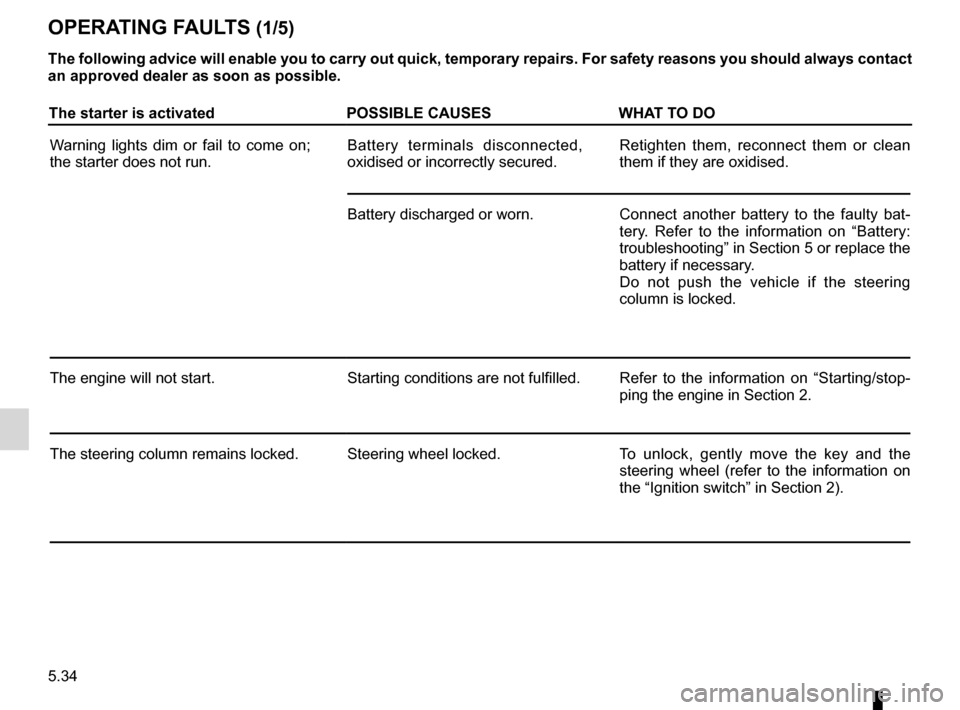
The following advice will enable you to carry out quick, temporary repairs. For safety reasons you should always contact
an approved dealer as soon as possible.
The starter is activated POSSIBLE CAUSESWHAT TO DO
Warning lights dim or fail to come on;
the starter does not run. Battery terminals disconnected,
oxidised or incorrectly secured.Retighten them, reconnect them or clean
them if they are oxidised.
Battery discharged or worn. Connect another battery to the faulty bat-
tery. Refer to the information on “Battery:
troubleshooting” in Section 5 or replace the
battery if necessary.
Do not push the vehicle if the steering
column is locked.
The engine will not start. Starting conditions are not fulfilled. Refer to the information on “Starting/stop-
ping the engine in Section 2.
The steering column remains locked. Steering wheel locked. To unlock, gently move the key and the
steering wheel (refer to the information on
the “Ignition switch” in Section 2).
Page 174 of 174

ENG_NU_817-10_B90_Dacia_7
AlphAbeticAl index (4/4)
starting ........................................................................\
2.2 – 2.3
starting t")
7.4
FRA_UD26899_12
Index (B90 - Dacia)
ENG_NU_817-10_B90_Dacia_7
AlphAbeticAl index (4/4)
starting ........................................................................\
2.2 – 2.3
starting the engine ............................................................... 2.3
steering wheel adjustment
......
............................................................. 1.10
storage compartment.............................................. 3.15
– 3.16
storage compartments
............................................ 3.15
– 3.16
sun visor
........................................................................\
.... 3.13
ttailgate ...................................................................... 3.19,
3.21
tanks and reservoirs brake fluid
......
................................................................ 4.7
coolant
......
..................................................................... 4.8
tanks and reservoirs: windscreen washer
......
.................................................. 4.8
technical specifications
.............................................. 6.2 → 6.7
telephone ........................................................................\
... 3.22
temperature regulation ............................................... 3.4
– 3.5
towing
........................................................................\
.......... 6.6
breakdown ......
.................................................. 5.29 – 5.30
towing equipment
.......
.................................................. 5.31
towing a caravan
................................................................. 6.6
towing hitch...................................................... 5.2,
5.29 – 5.30
towing weights
..................................................................... 6.6
transporting children .............................................. 1.21 → 1.31
transporting objects in the luggage compartment
......
.................................. 3.19
trims
........................................................................\
.... 5.7
– 5.8
trip computer and warning system.........................1.45 → 1.48
tyre inflation kit........................................................... 5.4 → 5.6
tyre pressure............................................................. 4.11,
5.12
tyre pressures
.................................................................... 4.1
1
tyres
.............................................................. 4.1
1, 5.11 → 5.13
V
vehicle identification
................................................... 6.2
– 6.3vehicle identification plates ......................................... 6.2
– 6.3
ventilation .................................................................. 3.4 → 3.8
heating and air conditioning system ......
........................ 3.9
W
warning buzzer
.................................................................. 1.50
warning lights......................................................... 1.40 → 1.48
washing
.................................................................. 4.13
– 4.14
weight
........................................................................\
.......... 6.6
weights ........................................................................\
........ 6.6
wheelbrace ........................................................................\
.. 5.2
windscreen washer ..................................................... 1.53,
4.9
wiper blades
...................................................................... 5.28
wipers ........................................................................\
........ 1.53
blades ......
.................................................................... 5.28