water DACIA SANDERO STEPWAY 2016 2.G User Guide
[x] Cancel search | Manufacturer: DACIA, Model Year: 2016, Model line: SANDERO STEPWAY, Model: DACIA SANDERO STEPWAY 2016 2.GPages: 174, PDF Size: 2.78 MB
Page 118 of 174

5.4
ENG_UD22290_8
Kit de gonflage des pneumatiques (B90 - L90 Ph2 - F90 Ph2 - R90 Ph2 - D\
acia)
ENG_NU_817-10_B90_Da")
tyre inflation kit...................................... (up to the end of the DU)
5.4
ENG_UD22290_8
Kit de gonflage des pneumatiques (B90 - L90 Ph2 - F90 Ph2 - R90 Ph2 - D\
acia)
ENG_NU_817-10_B90_Dacia_5
Jaune NoirNoir texte
Tyre inflation kit
TYRE INFLATION KIT (1/3)
The kit repairs tyres with
tread A
damaged by ob-
jects smaller than 4 mm. It
cannot repair all types of
puncture, such as cuts of more than
4 mm, or cuts in tyre sidewall
B etc.
Ensure also that the wheel rim is in
good condition.
Do not pull out the foreign body
causing the puncture if it is still in
the tyre.
Do not attempt to use the
inflation kit if the tyre has
been damaged as a result
of driving with a puncture.
You should therefore carefully check
the condition of the tyre sidewalls
before any operation.
Driving with underinflated, flat or
punctured tyres can be dangerous
and may make the tyre impossible
to repair.
This repair is temporary
A tyre which has been punctured
should always be inspected (and re-
paired, where possible) as soon as
possible by a specialist.
When replacing a tyre repaired with
this kit, you must consult a special-
ist. When driving, vibration may be
felt due to the presence of the repair
product injected into the tyre.The kit is only approved for
inflating the tyres of the ve-
hicle originally equipped
with the kit.
It must never be used to inflate
the tyres of another vehicle, or any
other inflatable object (rubber ring,
rubber boat, etc.).
Avoid spillage on skin when han-
dling the repair liquid bottle. If drop-
lets do leak out, rinse them off with
plenty of water.
Keep the repair kit away from chil-
dren.
Do not dispose of the empty bottle
in the countryside. Return it to your
approved dealer or to a recycling or-
ganisation.
The bottle has a limited service
life which is indicated on its label.
Check the expiry date.
Contact an approved dealer to re-
place the inflation tube and repair
product bottle.
A
B
Page 139 of 174
batterytroubleshooting ............................... (up to the end of the DU)
practical advice ..................................... (up to the end of the DU)
5.25
ENG_UD17938_1
Batterie : dépannage (B90 - Dacia)
ENG_NU_817-10_B90_Dacia_5
Battery
BATTERY: troubleshooting (1/2)
To avoid all risk of sparks:
– Ensure that any consumers (cour- tesy lights, etc.) are switched off
before disconnecting or reconnect-
ing the battery;
–
w
hen charging, stop the charger
before connecting or disconnecting
the battery;
–
t
o avoid creating a short circuit be-
tween the terminals, do not place
metal objects on the battery;
–
always
wait at least one minute after
the engine has been switched off
before disconnecting a battery;
–
m
ake sure that you reconnect the
battery terminals after refitting.
Handle the battery with care
as it contains sulphuric acid,
which must not come into
contact with eyes or skin. If
it does, wash the affected area with
plenty of cold water and consult a
doctor, if necessary.
Ensure that naked flames, red hot
objects and sparks do not come into
contact with the battery as there is a
risk of explosion.
The engine may be hot when car-
rying out operations in close prox-
imity. In addition, the engine cooling
fan can come on at any moment.
Risk of injury.
Connecting a battery charger
The battery charger must be com-
patible with a battery with nominal
voltage of 12 volts.
Do not disconnect the battery when the
engine is running. Follow the instruc-
tions given by the manufacturer of
the battery charger you are using.
When many accessories are fitted to
the vehicle, have them connected to
the + after ignition feed.
Some batteries may have
specific conditions for re-
charging. Consult your ap-
proved dealer. Avoid the
risk of sparks, as this could cause
a sudden explosion, and always
charge the battery in a well-venti-
lated area.
Risk of serious injury.
Page 142 of 174
wiper blades ......................................... (up to the end of the DU)
practical advice ..................................... (up to the end of the DU)
wipers blades ............................................. (up to the end of the DU)
5.28
ENG_UD20464_6
Balais d’essuie-vitre (B90 - Dacia)
ENG_NU_817-10_B90_Dacia_5
Wiper blades
WIPER BLADES
12
3
4
Check the condition of the wiper
blades. You are responsible for their
service life:
–
clean
the blades, windscreen and
rear screen regularly with soapy
water;
–
do
not use them when the wind-
screen or rear screen are dry;
–
free
them from the windscreen or
rear screen when they have not
been used for a long time.
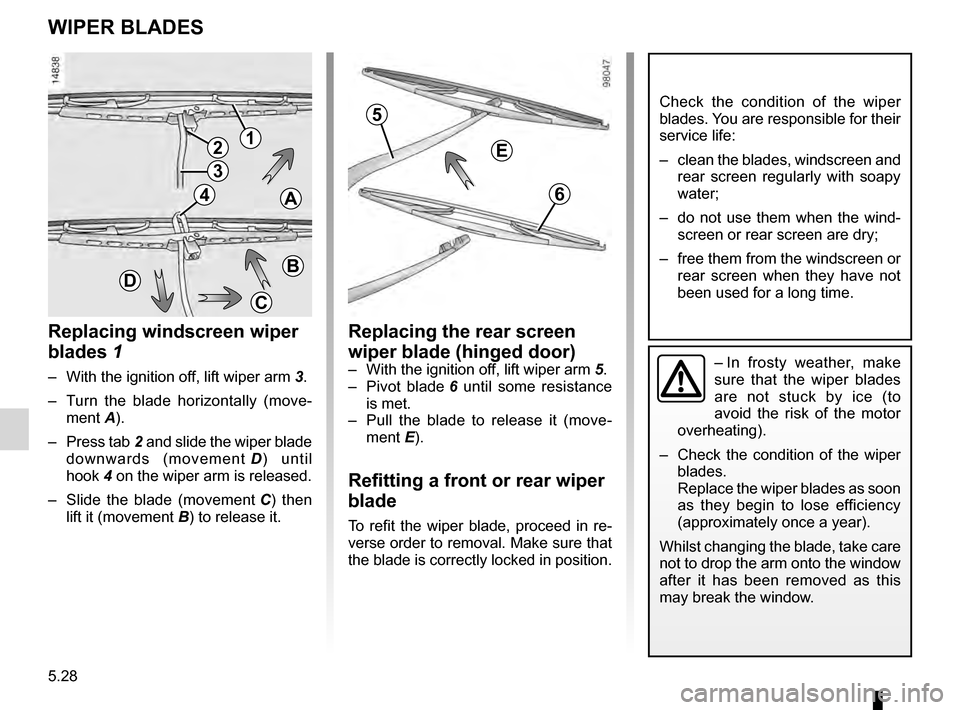
Replacing windscreen wiper
blades 1
– With the ignition of f, lift wiper arm 3.
–
T
urn the blade horizontally (move-
ment
A).
–
Press
tab 2 and slide the wiper blade
downwards (movement
D )
until
hook
4 on the wiper arm is released.
–
S
lide the blade (movement
C)
then
lift it (movement
B) to release it.
Replacing the rear screen
wiper blade (hinged door)
– With the ignition of f, lift wiper arm 5.
– P ivot blade 6
until some resistance
is met.
–
P
ull the blade to release it (move-
ment
E).
Refitting a front or rear wiper
blade
To refit the wiper blade, proceed in re-
verse order to removal. Make sure that
the blade is correctly locked in position.
A
C
BD
6
5
E
– In frosty weather, make
sure that the wiper blades
are not stuck by ice (to
avoid the risk of the motor
overheating).
–
Check
the condition of the wiper
blades.
Replace the wiper blades as soon
as they begin to lose efficiency
(approximately once a year).
Whilst changing the blade, take care
not to drop the arm onto the window
after it has been removed as this
may break the window.