Adjust DACIA SANDERO STEPWAY 2016 2.G Owner's Manual
[x] Cancel search | Manufacturer: DACIA, Model Year: 2016, Model line: SANDERO STEPWAY, Model: DACIA SANDERO STEPWAY 2016 2.GPages: 174, PDF Size: 2.78 MB
Page 68 of 174

ENG_NU_817-10_B90_Dacia_2
ADVICE: antipollution, fuel economy a")
2.8
ENG_UD22287_11
Conseils : antipollution, économies de carburant, conduite (B90 - U9\
0 - L90 Ph2 - F90 Ph2 - R90 Ph2 - H79 - Dacia)
ENG_NU_817-10_B90_Dacia_2
ADVICE: antipollution, fuel economy and driving (3/3)
– In vehicles fitted with air condi-
tioning, it is normal to observe an
increase in fuel consumption (es-
pecially in urban conditions) when
it is used. For vehicles fitted with
manual air conditioning, switch off
the system when it is not required.
Advice for reducing consumption
and therefore helping to preserve
the environment:
If the vehicle has been parked in the
sun, open the doors for a few mo-
ments to let the hot air escape before
starting the engine.
–
N
ever fill the fuel tank right to the
brim to avoid overflow.
–
D
o not leave an empty roof rack
fitted to the vehicle.
–
It
is better to fit a trailer for bulky ob-
jects.
–
W
hen towing a caravan, fit a wind
deflector and adjust it carefully.
Advice on use
– Electricity is fuel; switch off all the electrical components which are not
really needed.
However (safety first), keep your
lights on when the visibility is bad
(“see and be seen”).
–
U
se the air vents. Driving with the
windows open at 60 mph (100 km/h)
will increase fuel consumption by
4%. –
A
void using the vehicle for door-to-
door journeys (short journeys, with
long stops in-between) because in
these conditions, the engine never
reaches its ideal temperature.
Tyres
Increased fuel consumption could be
the result of:
–
insuf
ficient pressure,
–
using non-recommended tyres.
Page 74 of 174
automatic gearbox (use) ....................... (up to the end of the DU)
changing gear ....................................... (up to the end of the DU)
driving ................................................... (up to the end of the DU)
automatic gearbox selector lever.......... (up to the end of the DU)
2.14
ENG_UD22554_10
Boîte automatique (B90 - L90 Ph2 - F90 Ph2 - R90 Ph2 - Dacia)
ENG_NU_817-10_B90_Dacia_2
Jaune NoirNoir texte
Automatic gearbox
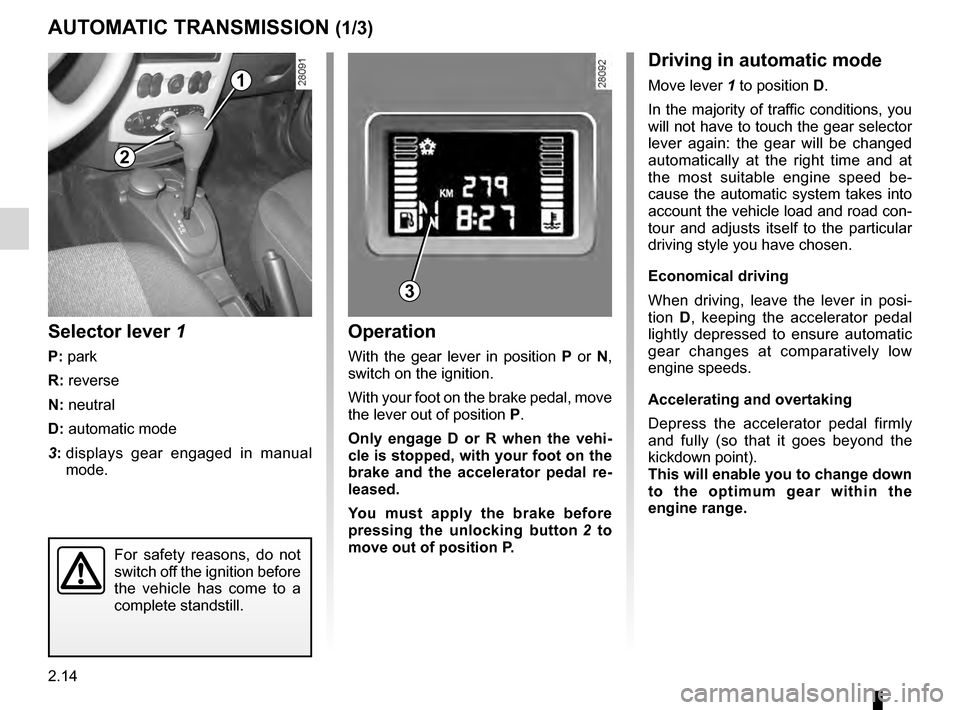
Selector lever 1
P: park
R: reverse
N: neutral
D: automatic mode
3:
d
isplays gear engaged in manual
mode.
Operation
With the gear lever in position P or N,
switch on the ignition.
With your foot on the brake pedal, move
the lever out of position P.
Only engage D or R when the vehi-
cle is stopped, with your foot on the
brake and the accelerator pedal re-
leased.
You must apply the brake before
pressing the unlocking button
2 t
o
move out of position P.
AUTOMATIC TRANSMISSION (1/3)
2
1
Driving in automatic mode
Move lever 1 to position D.
In the majority of traffic conditions, you
will not have to touch the gear selector
lever again: the gear will be changed
automatically at the right time and at
the most suitable engine speed be-
cause the automatic system takes into
account the vehicle load and road con-
tour and adjusts itself to the particular
driving style you have chosen.
Economical driving
When driving, leave the lever in posi-
tion D, keeping the accelerator pedal
lightly depressed to ensure automatic
gear changes at comparatively low
engine speeds.
Accelerating and overtaking
Depress the accelerator pedal firmly
and fully (so that it goes beyond the
kickdown point).
This will enable you to change down
to the optimum gear within the
engine range.
3
For safety reasons, do not
switch off the ignition before
the vehicle has come to a
complete standstill.
Page 81 of 174
JauneNoirNoir texte
3.5
ENG_UD25116_1
Chauffage - Ventilation - Air conditionné (B90 - L90 Ph2 - Dacia)
ENG_NU_817-10_B90_Dacia_3
HEATING, VENTILATION, AIR CONDITIONING (2/2)
In very hot weather or when the vehicle
has been parked in the sun, open the
doors for a few moments to let the hot
air escape before starting the engine.
Use the passenger compartment isola-
tion function to lower the temperature
as quickly as possible to the required
comfort level. Switch off the air recircu-
lation function once a comfortable level
has been reached. When the air conditioning system is op-
erating, all windows must be closed for
maximum efficiency.
If there is an operating fault, contact an
approved dealer.
If no cold air is produced
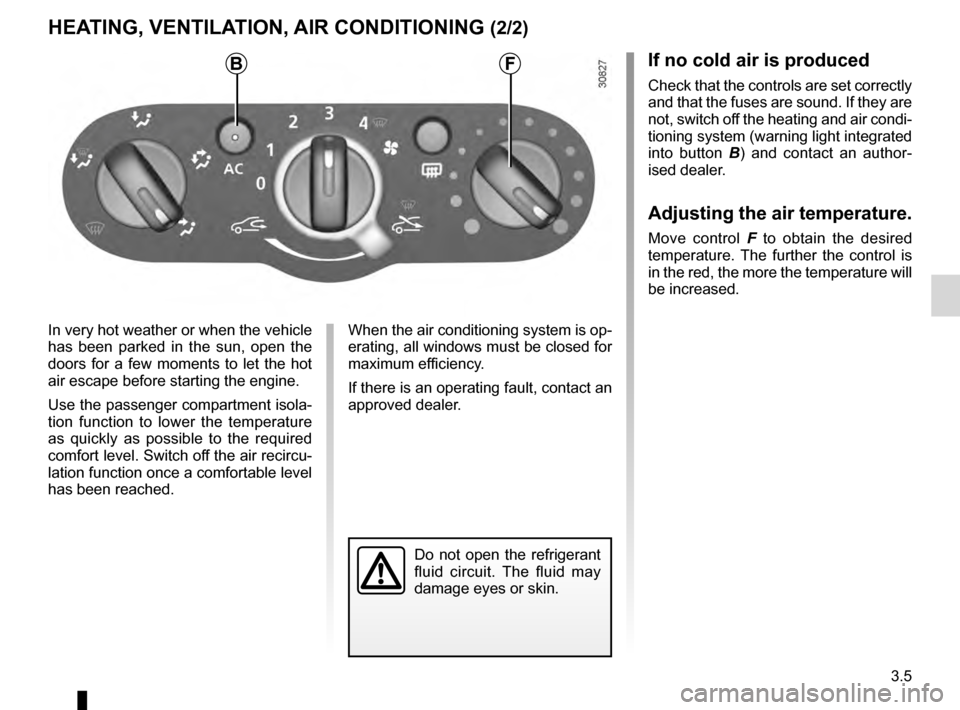
Check that the controls are set correctly
and that the fuses are sound. If they are
not, switch off the heating and air condi-
tioning system (warning light integrated
into button
B
)
and contact an author-
ised dealer.
Adjusting the air temperature.
Move control F to obtain the desired
temperature. The further the control is
in the red, the more the temperature will
be increased.
Do not open the refrigerant
fluid circuit. The fluid may
damage eyes or skin.
BF
Page 82 of 174
heating system ..................................... (up to the end of the DU)
ventilation ............................................. (up to the end of the DU)
3.6
ENG_UD25103_1
air conditionné manuel (B90 - L90 Ph2 - Dacia)
ENG_NU_817-10_B90_Dacia_3
Jaune NoirNoir texte
Manual air conditioning
MANuAL AIR CONDITIONING (1/3)
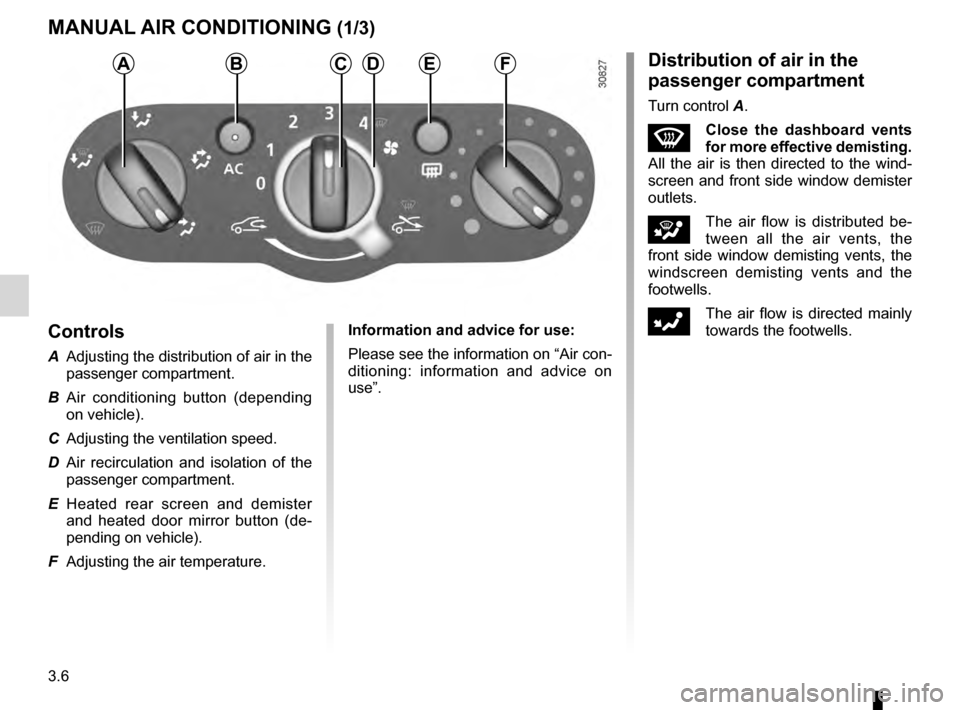
Distribution of air in the
passenger compartment
Turn control A.
WClose the dashboard vents
for more effective demisting.
All the air is then directed to the wind-
screen and front side window demister
outlets.
iThe air flow is distributed be-
tween all the air vents, the
front side window demisting vents, the
windscreen demisting vents and the
footwells.
FThe air flow is directed mainly
towards the footwells.
Controls
A Adjusting the distribution of air in the
passenger compartment.
B
A
ir conditioning button (depending
on vehicle).
C
Adjusting the ventilation speed.
D
A
ir recirculation and isolation of the
passenger compartment.
E
H
eated rear screen and demister
and heated door mirror button (de-
pending on vehicle).
F
Adjusting the air temperature. Information and advice for use:
Please
see the information on “Air con-
ditioning: information and advice on
use”.
FABCDE
Page 83 of 174
demistingrear screen ....................................................... (current page)
rear screen demisting ......................................................... (current page)
Jaune NoirNoir texte
3.7
ENG_UD25103_1
air conditionné manuel (B90 - L90 Ph2 - Dacia)
ENG_NU_817-10_B90_Dacia_3
MANuAL AIR CONDITIONING (2/3)
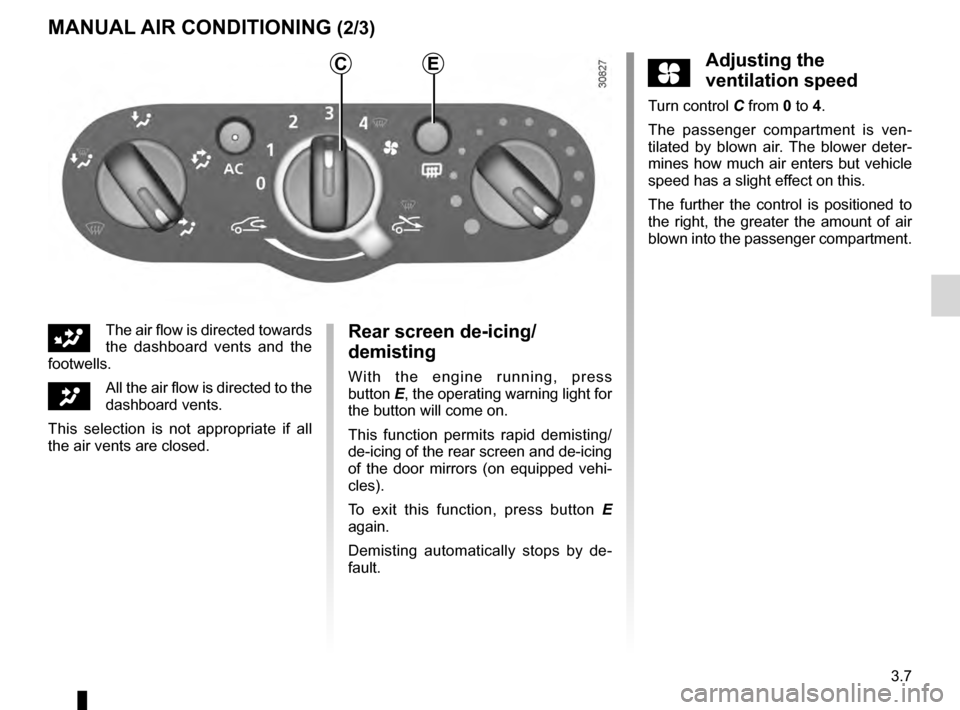
GThe air flow is directed towards
the dashboard vents and the
footwells.
JAll the air flow is directed to the
dashboard vents.
This selection is not appropriate if all
the air vents are closed.
Rear screen de-icing/
demisting
W i t h t h e e n g i n e r u n n i n g , p r e s s
button E , the operating warning light for
the button will come on.
This function permits rapid demisting/
de-icing of the rear screen and de-icing
of the door mirrors (on equipped vehi-
cles).
To exit this function, press button
E
again.
Demisting automatically stops by de-
fault.
yAdjusting the
ventilation speed
Turn control C from 0 to 4.
T he passenger compartment is ven-
tilated by blown air. The blower deter-
mines how much air enters but vehicle
speed has a slight effect on this.
The further the control is positioned to
the right, the greater the amount of air
blown into the passenger compartment.
EC
Page 93 of 174
headrest................................................ (up to the end of the DU)
adjusting your driving position .............. (up to the end of the DU)
3.17
ENG_UD20454_5
Appuis-tête arrière (B90 - Dacia)
ENG_NU_817-10_B90_Dacia_3
Rear headrests
REAR HEADRESTS
The headrest is a safety
component. Ensure that it is
fitted and in the correct po-
sition: the top of your head
should be in line with the top of the
headrest.
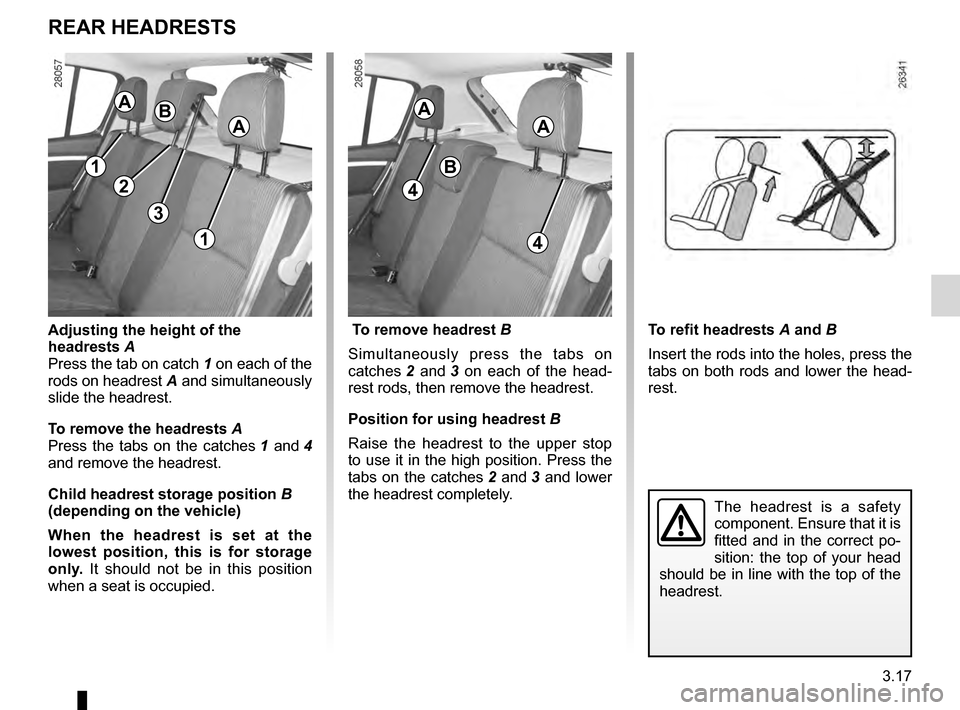
Adjusting the height of the
headrests A
Press the tab on catch
1 on each of the
rods on headrest
A and simultaneously
slide the headrest.
To remove the headrests
A
Press the tabs on the catches
1 and 4
and remove the headrest.
Child headrest storage position
B
(depending on the vehicle)
W
hen the headrest is set at the
lowest position, this is for storage
only. It should not be in this position
when a seat is occupied. To remove headrest
B
Simultaneously press the tabs on
catches
2
and
3
on each of the head-
rest rods, then remove the headrest.
Position for using headrest
B
R
aise the headrest to the upper stop
to use it in the high position. Press the
tabs on the catches
2 and 3 and lower
the headrest completely. To refit headrests
A and B
Insert the rods into the holes, press the
tabs on both rods and lower the head-
rest.
1
2
3
1
ABA
A
B
A
4
4
Page 94 of 174
3.18
ENG_UD17907_4
Banquette arrière (fonctionnalité) (B90 - Dacia)
ENG_NU_817-10_B90_Dacia_3
Rear bench seat: functions
REAR BENCH SEAT: functions
When moving the rear
bench seat, make sure the
anchorage points are clean
(they should be free from
grit, cloths, toys etc.).
For safety reasons, carry
out any adjustments when
the vehicle is not being
driven.
Check that the rear seat
belts are positioned and
operating correctly each
time the rear bench seat is
moved.
– Wh e n r e t u r n i n g t h e seatback to its normal
position, make sure that
it is properly locked at the
top.
–
I
f seat covers are fitted, make
sure these do not prevent the
seatback latch from locking in.
–
W
hen moving the bench seat,
ensure the seat belt unit buck-
les do not cross over and ensure
they are correctly repositioned
before folding down the seat
base.
Once the bench seat has been re-
turned to its normal position, check
that the seat belts are correctly po-
sitioned. The seat belts must be on
the seatback.
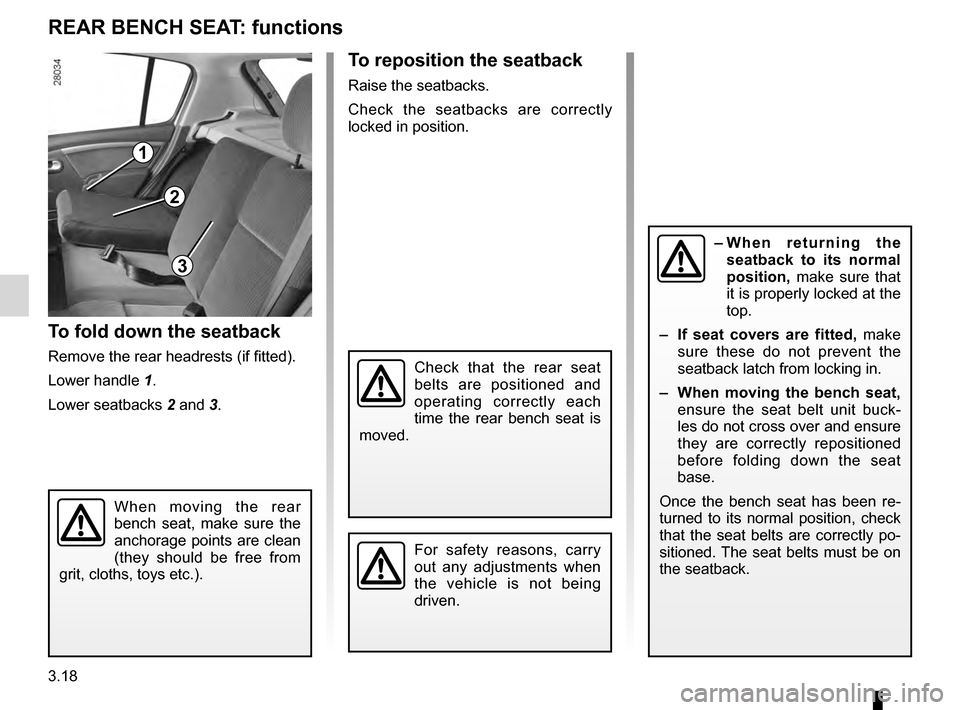
To reposition the seatback
Raise the seatbacks.
Check the seatbacks are correctly
locked in position.
To fold down the seatback
Remove the rear headrests (if fitted).
Lower handle
1
.
Lower seatbacks
2
and 3.
1
2
3
Page 106 of 174
engine coolant ....................................................... (current page)
tanks and reservoirs coolant ............................................................. (current page)
tanks and reservoirs: windscreen washer .......................................... (current page)
4.8
ENG_UD19766_9
Niveaux / Filtres (B90 - L90 Ph2 - Dacia)
ENG_NU_817-10_B90_Dacia_4
Jaune NoirNoir texte
Engine coolant
Windscreen washer reservoir
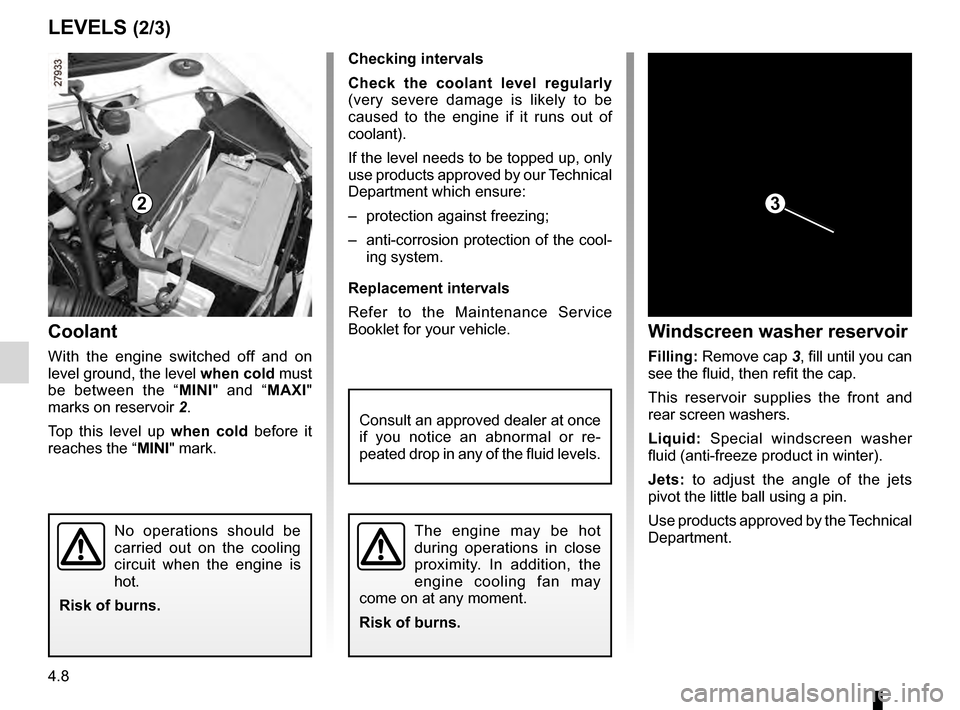
Coolant
With the engine switched off and on
level ground, the level when cold must
be between the “ MINI" and “ MAXI"
marks on reservoir
2
.
Top this level up when cold before it
reaches the “MINI" mark.
No operations should be
carried out on the cooling
circuit when the engine is
hot.
Risk of burns.
Checking intervals
Check the coolant level regularly
(very severe damage is likely to be
caused to the engine if it runs out of
coolant).
If the level needs to be topped up, only
use products approved by our Technical
Department which ensure:
–
protection against freezing;
–
anti-corrosion
protection of the cool-
ing system.
Replacement intervals
Refer to the Maintenance Service
Booklet for your vehicle.
Consult an approved dealer at once
if you notice an abnormal or re-
peated drop in any of the fluid levels.
LEVELS (2/3)
2
The engine may be hot
during operations in close
proximity. In addition, the
engine cooling fan may
come on at any moment.
Risk of burns.
Windscreen washer reservoir
Filling: Remove cap 3, fill until you can
see the fluid, then refit the cap.
This reservoir supplies the front and
rear screen washers.
Liquid: Special windscreen washer
fluid (anti-freeze product in winter).
Jets: to adjust the angle of the jets
pivot the little ball using a pin.
Use products approved by the Technical
Department.
3
Page 120 of 174

ENG_NU_817-10_B90_Dacia_5
TYRE INFLATION KIT (3/3)
Once the tyre is inflated correctly:
–
stop usin")
5.6
ENG_UD22290_8
Kit de gonflage des pneumatiques (B90 - L90 Ph2 - F90 Ph2 - R90 Ph2 - D\
acia)
ENG_NU_817-10_B90_Dacia_5
TYRE INFLATION KIT (3/3)
Once the tyre is inflated correctly:
–
stop using the kit;
–
close
the integrated cap on the bottle
again;
–
disconnect adapter
8;–
a
ff i x d r i v i n g r e c o m m e n d a t i o n
label
1
0
to the dashboard where it
can easily be seen by the driver;
–
store the kit;
–
after
the first inflation procedure the
tyre will still be leaking; it is vital to
drive in order to plug the hole;
–
s
tart immediately and drive at be-
tween 12 and 36
m
ph (20 and
60
k
m/h) to distribute the product
evenly throughout the tyre, stopping
after a distance of 2 miles (3 kilome-
tres) to check the pressure; –
i
f the pressure is above 1.3 bar but
lower than the recommended pres-
sure, readjust it (refer to the label
affixed to the edge of the driver ’s
door), otherwise contact an ap-
proved dealer: repair is not possible.
Note : after using the inflation kit, you
should visit an approved dealer to re-
place the inflation hose and the bottle
of repair product.
Precautions when using the
kit
The kit should not be operated for more
than 15 consecutive minutes.
Important: a missing or
loose valve cap may com-
promise the tyre seal and
cause a loss of pressure.
Always use valve caps which are
identical to the originals and fully
tightened.
Following repair with the kit,
do not travel further than
120 miles (200 km). In addi-
tion, reduce your speed and
under no circumstances exceed 48
mph (80 km/h). The sticker, which
you must affix in a prominent posi-
tion on the dashboard, reminds you
of this.
Depending on the country or local
legislation, a tyre repaired with the
tyre pressure kit will need to be re-
placed.
Nothing should be placed
around the driver ’s feet
as such objects may slide
under the pedals during
sudden braking manoeuvres and
obstruct their use.
8
10
Page 126 of 174
tyre pressure.......................................................... (current page)
5.12
ENG_UD19769_10
Pneumatiques (B90 - U90 - L90 Ph2 - F90 Ph2 - R90 Ph2 - Dacia)ENG_NU_817-10_B90_Dacia_5
Jaune NoirNoir texte
Changing wheels around
This practice is not recommended.
Emergency spare wheel
Refer to the information on the
“ E m e r g e n c y s p a r e w h e e l ” a n d
“Changing a wheel” in Section 5.
Fitting new tyres
TYRES (2/3)
Tyre pressures
Adhere to the tyre pressures (including
the emergency spare wheel). The tyre
pressures should be checked at least
once a month and additionally before
any long journey (refer to the label af-
fixed to the edge of the driver’s door).
Incorrect tyre pressures
lead to abnormal tyre wear
and unusually hot running.
These are factors which
may seriously affect safety and lead
to:
–
poor roadholding;
–
r
isk of blowouts or throwing a
tread.
The tyre pressure depends on the
load and speed of use; adjust the
pressures according to the condi-
tions of use (refer to the information
on “Tyre pressures” in Section 4).
Pressures should be checked when the
tyres are cold; ignore higher pressures
which may be reached in hot weather
or following a fast journey.
If tyre pressures cannot be checked
when the tyres are cold, assume an in-
crease of 0.2 to 0.3 bar.
Never deflate a hot tyre.
Special note
Depending on the vehicle, there may
be an adapter which needs to be posi-
tioned on the valve before air is added.
For safety reasons, this op-
eration must be carried out
by a specialist.
Fitting different tyres may
change your vehicle as follows:
–
it
may mean that your vehicle no
longer conforms to current regu-
lations;
–
It
may change the way it handles
when cornering;
–
I
t may cause the steering to be
heavy;
–
i
t may affect the use of snow
chains.
Important: a missing or
loose valve cap may com-
promise the tyre seal and
cause a loss of pressure.
Always use valve caps which are
identical to the originals.