Eco DACIA SANDERO STEPWAY 2016 2.G Owner's Guide
[x] Cancel search | Manufacturer: DACIA, Model Year: 2016, Model line: SANDERO STEPWAY, Model: DACIA SANDERO STEPWAY 2016 2.GPages: 174, PDF Size: 2.78 MB
Page 102 of 174

ENG_NU_817-10_B90_Dacia_4
It is normal for an engine to use oil for
lubrication and coo")
4.4
ENG_UD18250_2
Niveau huile moteur : généralités (B90 - L90 Ph2 - F90 Ph2 - R\
90 Ph2 - Dacia)
ENG_NU_817-10_B90_Dacia_4
It is normal for an engine to use oil for
lubrication and cooling of moving parts
and it is sometimes necessary to top up
the level between oil changes.
However, contact your approved dealer
if more than 0.5 litres is being con-
sumed every 600 miles (1,000 km) after
the running in period.
Oil change frequency: check the oil
level from time to time and certainly
before any long journey to avoid the
risk of damaging your engine.
The vehicle must be parked on level
ground and the engine should have
been switched off for some time before-
hand to obtain an accurate reading.
Engine oil level: general information
ENGINE OIL LEVEL: general information
Reading the oil level
– Remove dipstick 1 and wipe with a
clean, lint-free cloth;
–
p
ush in the dipstick as far as it will
go;
–
take out the dipstick again;
–
r
ead the level: it should never fall
below minimum mark
B
or exceed
maximum mark
A.
Once the level has been read, push the
dipstick in as far as it will go.
A
B
1
Exceeding the maximum engine
oil level
The oil level should only be read with
the dipstick as explained above.
If the oil level exceeds the maximum
level, do not start your vehicle and
contact an approved dealer.
Under no circumstances
must maximum fill level
A be exceeded: risk of
damage to the engine and
catalytic converter.
Consult your approved dealer at
once if you notice an abnormal or
repeated drop in any of the fluid
levels.
In order to prevent splashback, it is
recommended that a funnel be used
when topping up/filling with oil.
Page 104 of 174
filteroil filter ............................................................. (current page)
oil change .............................................................. (current page)
4.6
ENG_UD19757_10
Niveau huile moteur : appoint / remplissage (B90 - L90 Ph2 - Dacia)
ENG_NU_817-10_B90_Dacia_4
Engine oil change
ENGINE OIL LEVEL: topping up/filling (2/2)
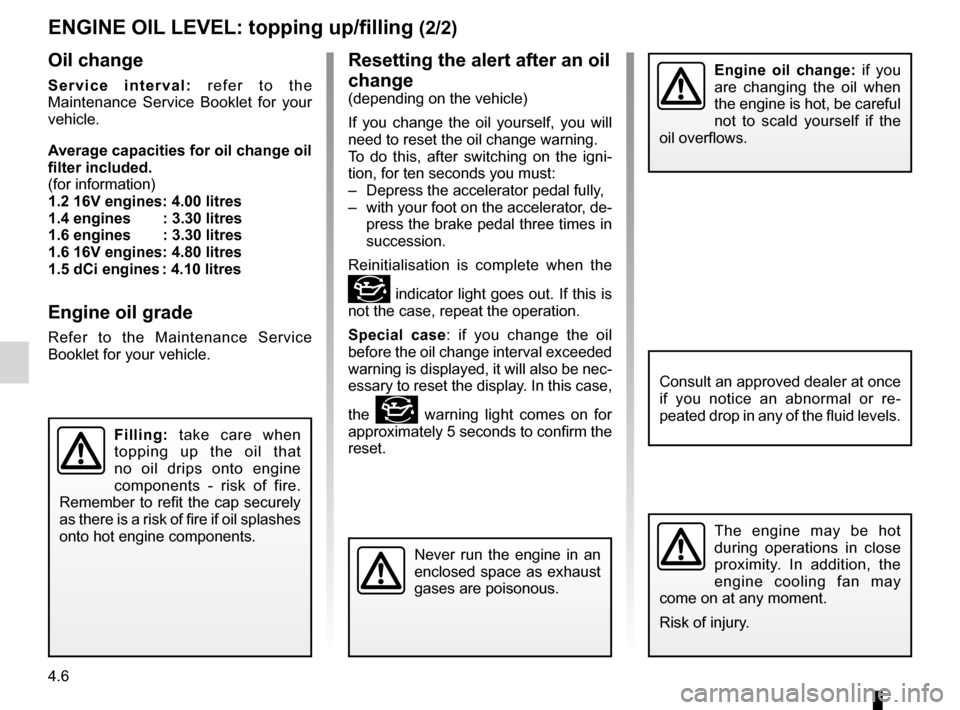
Oil change
S e r v i c e i n t e r v a l : r e f e r t o t h e
Maintenance Service Booklet for your
vehicle.
Average capacities for oil change oil
filter included.
(for information)
1.2 16V engines: 4.00 litres
1.4 engines
: 3.30 litres
1.6 engines
: 3.30 litres
1.6 16V engines: 4.80 litres
1.5 dCi engines
: 4.10 litres
Engine oil grade
Refer to the Maintenance Service
Booklet for your vehicle.
Filling: take care when
topping up the oil that
no oil drips onto engine
components - risk of fire.
Remember to refit the cap securely
as there is a risk of fire if oil splashes
onto hot engine components.
Engine oil change: if you
are changing the oil when
the engine is hot, be careful
not to scald yourself if the
oil overflows.
The engine may be hot
during operations in close
proximity. In addition, the
engine cooling fan may
come on at any moment.
Risk of injury.
Consult an approved dealer at once
if you notice an abnormal or re-
peated drop in any of the fluid levels.
Resetting the alert after an oil
change
(depending on the vehicle)
If you change the oil yourself, you will
need to reset the oil change warning.
To do this, after switching on the igni-
tion, for ten seconds you must:
–
Depress the accelerator pedal fully
,
–
with
your foot on the accelerator, de-
press the brake pedal three times in
succession.
Reinitialisation is complete when the
# indicator light goes out. If this is
not the case, repeat the operation.
Special case : if you change the oil
before the oil change interval exceeded
warning is displayed, it will also be nec-
essary to reset the display. In this case,
the
# warning light comes on for
approximately 5 seconds to confirm the
reset.
Never run the engine in an
enclosed space as exhaust
gases are poisonous.
Page 105 of 174
maintenance:mechanical ...................................... (up to the end of the DU)
brake fluid .............................................................. (current page)
levels .................................................... (up to the end of the DU)
tanks and reservoirs brake fluid ........................................................ (current page)
4.7
ENG_UD19766_9
Niveaux / Filtres (B90 - L90 Ph2 - Dacia)
ENG_NU_817-10_B90_Dacia_4
Levels:
Brake fluid
LEVELS (1/3)
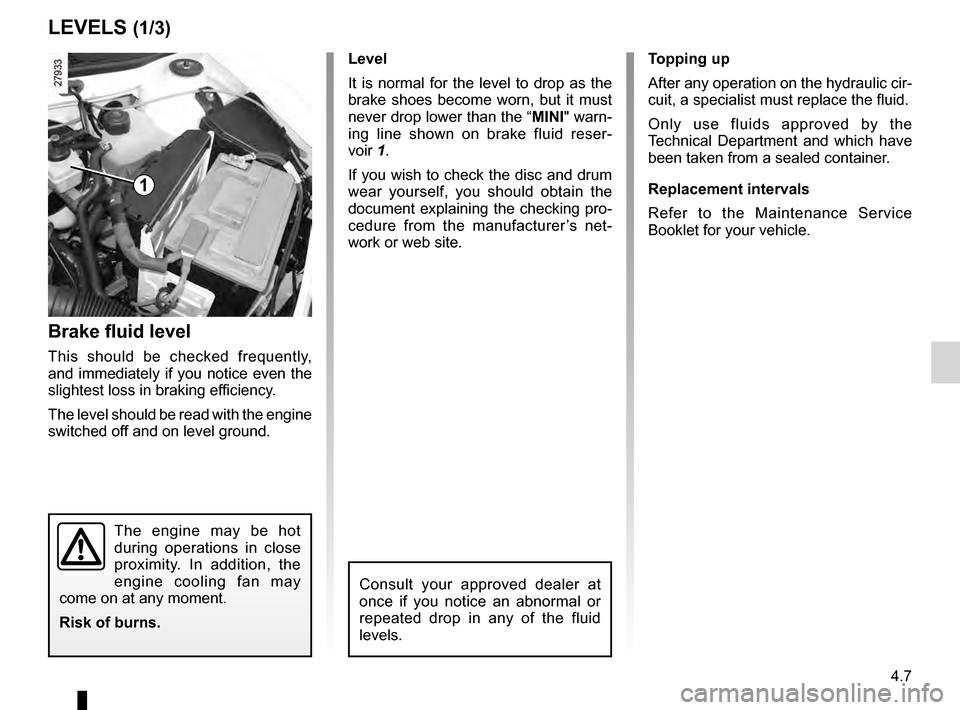
Brake fluid level
This should be checked frequently,
and immediately if you notice even the
slightest loss in braking efficiency.
The level should be read with the engine
switched off and on level ground. Level
It is normal for the level to drop as the
brake shoes become worn, but it must
never drop lower than the “MINI" warn-
ing line shown on brake fluid reser-
voir
1.
If you wish to check the disc and drum
wear yourself, you should obtain the
document explaining the checking pro-
cedure from the manufacturer ’s net-
work or web site.
1
Consult your approved dealer at
once if you notice an abnormal or
repeated drop in any of the fluid
levels.
The engine may be hot
during operations in close
proximity. In addition, the
engine cooling fan may
come on at any moment.
Risk of burns.
Topping up
After any operation on the hydraulic cir-
cuit, a specialist must replace the fluid.
Only use fluids approved by the
Technical Department and which have
been taken from a sealed container.
Replacement intervals
Refer to the Maintenance Service
Booklet for your vehicle.
Page 109 of 174
tyre pressures ....................................... (up to the end of the DU)
tyres ...................................................... (up to the end of the DU)
tyre pressure......................................... (up to the end of the DU)
4.11
ENG_UD19741_9
Pressions de gonflage des pneumatiques à froid (B90 - U90 - L90 Ph2 \
- F90 Ph2 - R90 Ph2 - Dacia)
ENG_NU_817-10_B90_Dacia_4
Tyre pressures
TyRE PRESSURE
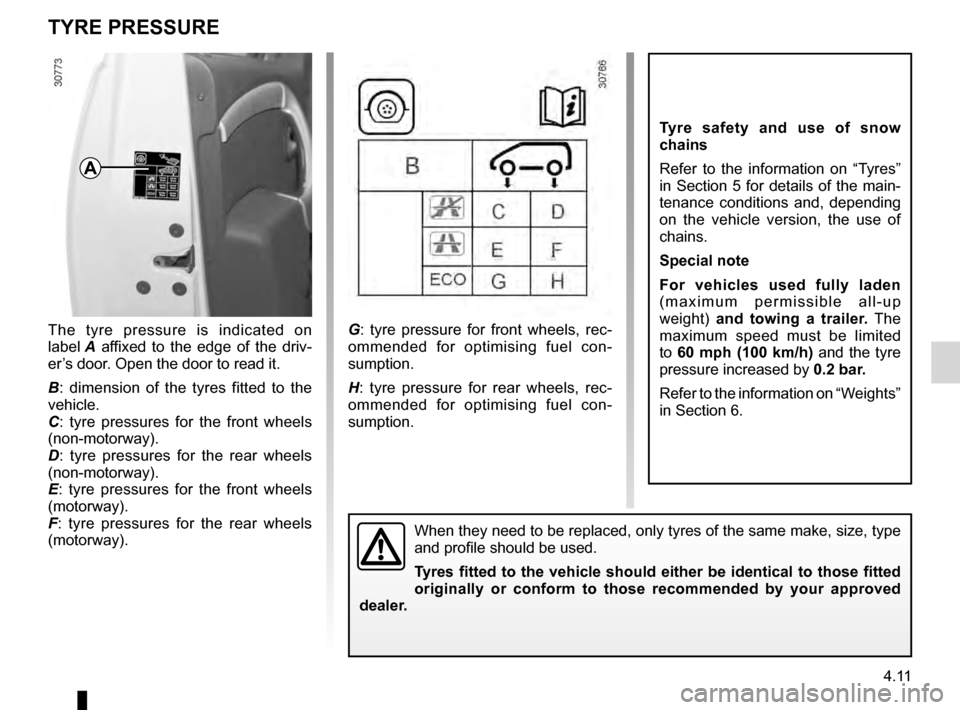
The tyre pressure is indicated on
label A
affixed to the edge of the driv-
er’s door. Open the door to read it.
B : dimension of the tyres fitted to the
vehicle.
C : tyre pressures for the front wheels
(non-motorway).
D : tyre pressures for the rear wheels
(non-motorway).
E : tyre pressures for the front wheels
(motorway).
F : tyre pressures for the rear wheels
(motorway). G
: tyre pressure for front wheels, rec-
ommended for optimising fuel con-
sumption.
H : tyre pressure for rear wheels, rec-
ommended for optimising fuel con-
sumption.
Tyre safety and use of snow
chains
Refer to the information on “Tyres”
in Section 5 for details of the main-
tenance conditions and, depending
on the vehicle version, the use of
chains.
Special note
For vehicles used fully laden
( m a x i m u m p e r m i s s i b l e a l l - u p
weight) and towing a trailer. The
maximum speed must be limited
to 60 mph (100 km/h) and the tyre
pressure increased by 0.2 bar.
Refer to the information on “Weights”
in Section 6.
When they need to be replaced, only tyres of the same make, size, type
and profile should be used.
Tyres fitted to the vehicle should either be identical to those fitted
originally or conform to those recommended by your approved
dealer.
A
Page 111 of 174
maintenance:bodywork ........................................ (up to the end of the DU)
washing ................................................ (up to the end of the DU)
paintwork maintenance ................................... (up to the end of the DU)
anti-corrosion protection ........................................ (current page)
4.13
ENG_UD26811_2
Entretien de la carrosserie (peinture mate) (X44 - X77 - J77 - X85 - \
B90 - X61 - TEST - X77 ph2 - X95 - B95 - D95 - K95 - J95 - R95 - L90 Ph2 - F90 Ph2 - R90\
Ph2 - X62
ENG_NU_817-10_B90_Dacia_4
Bodywork maintenance
BOdyWORk MAINTENANCE (1/2)
you should
Wash your car frequently, with the
engine off, with cleaning products rec-
ommended by the manufacturer (never
use abrasive products). Rinse thor-
oughly beforehand with a jet:
–
s
pots of tree resin and industrial
grime;
–
mud
in the wheel arches and under-
neath the body which forms damp
patches;
–
b
ird droppings , which cause a
chemical reaction with the paint that
rapidly discolours paintwork and
may even cause the paint to peel
off;
w
ash the vehicle immediately to
remove these marks since it is im-
possible to remove them by polish-
ing;
–
salt,
particularly in the wheel arches
and underneath the body after driv-
ing in areas where the roads have
been gritted.
Remove any plant matter (resin, leaves,
etc.) from the vehicle regularly.
What you should not doDo not degrease or clean mechani-
cal components (e.g. the engine com-
partment), underneath the body, parts
with hinges (e.g. inside the doors) and
painted plastic external fittings (e.g.
bumpers) using high-pressure clean-
ing equipment or by spraying on prod-
ucts not approved by our Technical
Department. Doing this could give rise
to corrosion or operational faults.
Wash the vehicle in bright sunlight or
freezing temperatures.
Do not scrape off mud or dirt without
pre-wetting.
Allow dirt to accumulate on the exterior.
Allow rust to form following minor im-
pacts.
Do not use solvents not approved by
our Technical Department to remove
stains as this could damage the paint-
work.
Do not drive in snow or muddy condi-
tions without washing the vehicle, par-
ticularly under the wheel arches and
body.
A well-maintained vehicle will last
longer. It is therefore recommended to
maintain the exterior of the vehicle reg-
ularly.
Your vehicle has been treated with very
effective anti-corrosion products. It is
nevertheless subject to various outside
influences.
Corrosive agents in the atmosphere
–
a
tmospheric pollution (built-up and
industrial areas),
–
s
aline atmospheres (near the sea,
particularly in hot weather),
–
s
easonal and damp weather condi-
tions (e.g. road salt in winter, water
from road cleaners, etc.).
Minor impacts
Abrasive action
Dust and sand in the air, mud, road grit
thrown up by other vehicles, etc.
You should take a number of minor pre-
cautions in order to safeguard your ve-
hicle against such risks.
Page 114 of 174

ENG_NU_817-10_B90_Dacia_4
Removing/refitting factory
fitted removable equipment
in")
4.16
ENG_UD22288_6
Entretien des garnitures intérieures (B90 - U90 - L90 Ph2 - F90 Ph2 \
- R90 Ph2 - H79 - Dacia)
ENG_NU_817-10_B90_Dacia_4
Removing/refitting factory
fitted removable equipment
in the vehicle
If you need to remove equipment to
clean the passenger compartment (e.g.
mats), always make you refit it properly
and on the correct side (driver’s side
mats must be fitted on the driver’s side,
etc.), using retaining components sup-
plied with the equipment (e.g. the driv-
er’s side mat must always be secured
using prefitted retaining devices).
In all cases, with the vehicle stationary,
ensure that nothing can hinder driving
(obstacle underneath the pedals, heel
trapped by the mat, etc.).
What you should not do
You are strongly advised not to place
items such as air fresheners, perfume
etc. near the air vents as these could
damage the dashboard fittings.
INTERIOR TRIM MAINTENANCE (2/2)
You are strongly recom-
mended not to use high-
pressure or spray cleaning
equipment inside the pas-
senger compartment: this equip-
ment could impair the correct func-
tioning of the electrical or electronic
components in the vehicle, or have
other detrimental effects.
Page 119 of 174

ENG_NU_817-10_B90_Dacia_5
TYRE INFLATION KIT (2/3)
Depending on the vehicle, in")
JauneNoirNoir texte
5.5
ENG_UD22290_8
Kit de gonflage des pneumatiques (B90 - L90 Ph2 - F90 Ph2 - R90 Ph2 - D\
acia)
ENG_NU_817-10_B90_Dacia_5
TYRE INFLATION KIT (2/3)
Depending on the vehicle, in the event
of a puncture, use the kit located in the
boot. –
p
ress switch
5
to inflate the tyre to
the recommended pressure (check
the label affixed to the edge of the
driver’s door);
–
after
a maximum of
5 minutes, stop
inflating and read the pressure (on
the pressure gauge
4
);
Note: while the bottle is emptying
(approximately 30 seconds), pres-
sure gauge
4
will briefly indicate a
pressure of 6 bar, then the pressure
will drop.
–
a
djust the pressure: to increase
it, continue inflating with the kit, to
reduce it, turn button 7 located on
the inflation adapter.
If a minimum pressure of 1.8 bar is
not reached after 15 minutes, repair
is not possible; do not drive the vehi-
cle but contact an approved dealer .
1234
5
6
Before using this kit, park
the vehicle at a sufficient
distance from traffic, switch
on the hazard warning
lights, apply the handbrake, ask all
passengers to leave the vehicle and
keep them away from traffic.
8
Open the kit, remove caps 1 and 3 (it is
essential not to remove the cap from
the bottle) then screw bottle
2
to its sup-
port 3.
With the engine running and the
handbrake applied,
–
unscrew
the valve cap on the wheel
concerned and screw the inflation
adapter
6 onto valve;
–
c
onnect adapter
8
to accessories
socket
9
on the dashboard of the ve-
hicle;
9
7
Page 120 of 174

ENG_NU_817-10_B90_Dacia_5
TYRE INFLATION KIT (3/3)
Once the tyre is inflated correctly:
–
stop usin")
5.6
ENG_UD22290_8
Kit de gonflage des pneumatiques (B90 - L90 Ph2 - F90 Ph2 - R90 Ph2 - D\
acia)
ENG_NU_817-10_B90_Dacia_5
TYRE INFLATION KIT (3/3)
Once the tyre is inflated correctly:
–
stop using the kit;
–
close
the integrated cap on the bottle
again;
–
disconnect adapter
8;–
a
ff i x d r i v i n g r e c o m m e n d a t i o n
label
1
0
to the dashboard where it
can easily be seen by the driver;
–
store the kit;
–
after
the first inflation procedure the
tyre will still be leaking; it is vital to
drive in order to plug the hole;
–
s
tart immediately and drive at be-
tween 12 and 36
m
ph (20 and
60
k
m/h) to distribute the product
evenly throughout the tyre, stopping
after a distance of 2 miles (3 kilome-
tres) to check the pressure; –
i
f the pressure is above 1.3 bar but
lower than the recommended pres-
sure, readjust it (refer to the label
affixed to the edge of the driver ’s
door), otherwise contact an ap-
proved dealer: repair is not possible.
Note : after using the inflation kit, you
should visit an approved dealer to re-
place the inflation hose and the bottle
of repair product.
Precautions when using the
kit
The kit should not be operated for more
than 15 consecutive minutes.
Important: a missing or
loose valve cap may com-
promise the tyre seal and
cause a loss of pressure.
Always use valve caps which are
identical to the originals and fully
tightened.
Following repair with the kit,
do not travel further than
120 miles (200 km). In addi-
tion, reduce your speed and
under no circumstances exceed 48
mph (80 km/h). The sticker, which
you must affix in a prominent posi-
tion on the dashboard, reminds you
of this.
Depending on the country or local
legislation, a tyre repaired with the
tyre pressure kit will need to be re-
placed.
Nothing should be placed
around the driver ’s feet
as such objects may slide
under the pedals during
sudden braking manoeuvres and
obstruct their use.
8
10
Page 125 of 174
practical advice ..................................... (up to the end of the DU)
tyres ...................................................... (up to the end of the DU)
emergency spare wheel ....................... (up to the end of the DU)
5.11
ENG_UD19769_10
Pneumatiques (B90 - U90 - L90 Ph2 - F90 Ph2 - R90 Ph2 - Dacia)ENG_NU_817-10_B90_Dacia_5
Tyres (tyre and wheel safety, use in winter)
TYRES (1/3)
Tyre and wheel safety
The tyres are the only contact between
the vehicle and the road, so it is essen-
tial to keep them in good condition.
You must make sure that your tyres
conform to local road traffic regulations.
When they need to be re-
placed, only tyres of the
same make, size, type and
profile should be used.
Tyres fitted to the vehicle should
either be identical to those fitted
originally or conform to those
recommended by your approved
Dealer.Maintaining the tyres
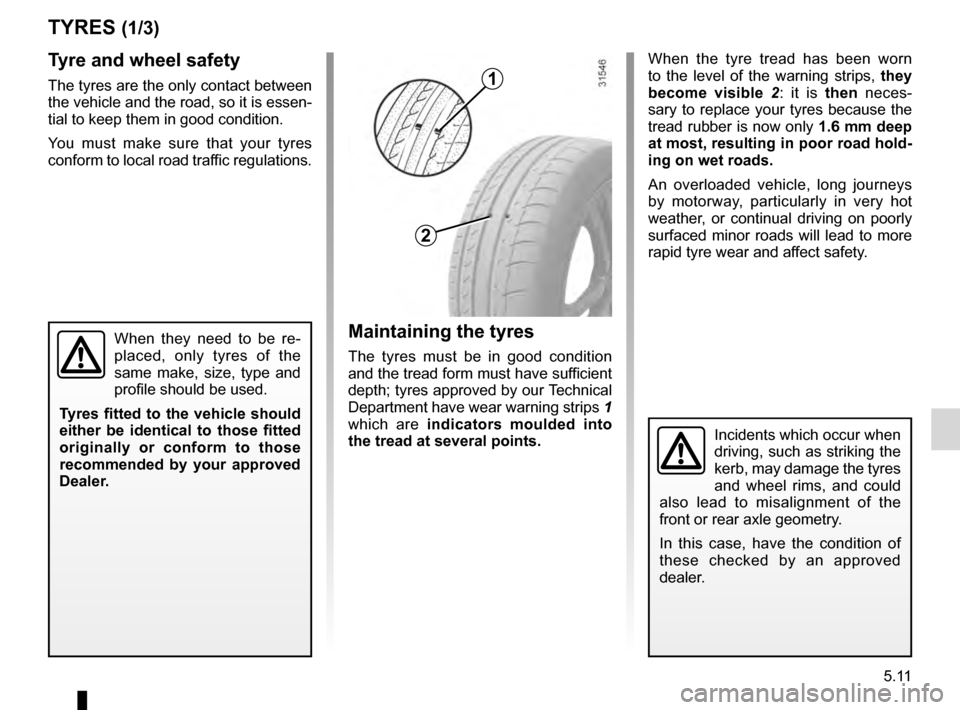
The tyres must be in good condition
and the tread form must have sufficient
depth; tyres approved by our Technical
Department have wear warning strips
1
which are indicators moulded into
the tread at several points. When the tyre tread has been worn
to the level of the warning strips, they
become visible
2: it is then neces-
sary to replace your tyres because the
tread rubber is now only 1.6 mm deep
at most, resulting in poor road hold-
ing on wet roads.
An overloaded vehicle, long journeys
by motorway, particularly in very hot
weather, or continual driving on poorly
surfaced minor roads will lead to more
rapid tyre wear and affect safety.
Incidents which occur when
driving, such as striking the
kerb, may damage the tyres
and wheel rims, and could
also lead to misalignment of the
front or rear axle geometry.
In this case, have the condition of
these checked by an approved
dealer.
1
2
Page 126 of 174
tyre pressure.......................................................... (current page)
5.12
ENG_UD19769_10
Pneumatiques (B90 - U90 - L90 Ph2 - F90 Ph2 - R90 Ph2 - Dacia)ENG_NU_817-10_B90_Dacia_5
Jaune NoirNoir texte
Changing wheels around
This practice is not recommended.
Emergency spare wheel
Refer to the information on the
“ E m e r g e n c y s p a r e w h e e l ” a n d
“Changing a wheel” in Section 5.
Fitting new tyres
TYRES (2/3)
Tyre pressures
Adhere to the tyre pressures (including
the emergency spare wheel). The tyre
pressures should be checked at least
once a month and additionally before
any long journey (refer to the label af-
fixed to the edge of the driver’s door).
Incorrect tyre pressures
lead to abnormal tyre wear
and unusually hot running.
These are factors which
may seriously affect safety and lead
to:
–
poor roadholding;
–
r
isk of blowouts or throwing a
tread.
The tyre pressure depends on the
load and speed of use; adjust the
pressures according to the condi-
tions of use (refer to the information
on “Tyre pressures” in Section 4).
Pressures should be checked when the
tyres are cold; ignore higher pressures
which may be reached in hot weather
or following a fast journey.
If tyre pressures cannot be checked
when the tyres are cold, assume an in-
crease of 0.2 to 0.3 bar.
Never deflate a hot tyre.
Special note
Depending on the vehicle, there may
be an adapter which needs to be posi-
tioned on the valve before air is added.
For safety reasons, this op-
eration must be carried out
by a specialist.
Fitting different tyres may
change your vehicle as follows:
–
it
may mean that your vehicle no
longer conforms to current regu-
lations;
–
It
may change the way it handles
when cornering;
–
I
t may cause the steering to be
heavy;
–
i
t may affect the use of snow
chains.
Important: a missing or
loose valve cap may com-
promise the tyre seal and
cause a loss of pressure.
Always use valve caps which are
identical to the originals.