Car seat DACIA SANDERO STEPWAY 2016 2.G Owners Manual
[x] Cancel search | Manufacturer: DACIA, Model Year: 2016, Model line: SANDERO STEPWAY, Model: DACIA SANDERO STEPWAY 2016 2.GPages: 174, PDF Size: 2.78 MB
Page 11 of 174
front seat adjustment ............................ (up to the end of the DU)
front seats adjustment ...................................... (up to the end of the DU)
1.9
ENG_UD17772_6
Sièges avant (B90 - Dacia)
ENG_NU_817-10_B90_Dacia_1
Front seats
FRONT SEATS
For safety reasons, carry
out any adjustments when
the vehicle is not being
driven.
We would advise you not to recline
the seatbacks too far to ensure that
the effectiveness of the seat belts is
not reduced.
Make sure that the seatbacks are
correctly locked in place.
Nothing should be placed on the
floor (area in front of driver) as such
objects may slide under the pedal
during braking manoeuvres, thus
obstructing its use.
1
23
4
2
5
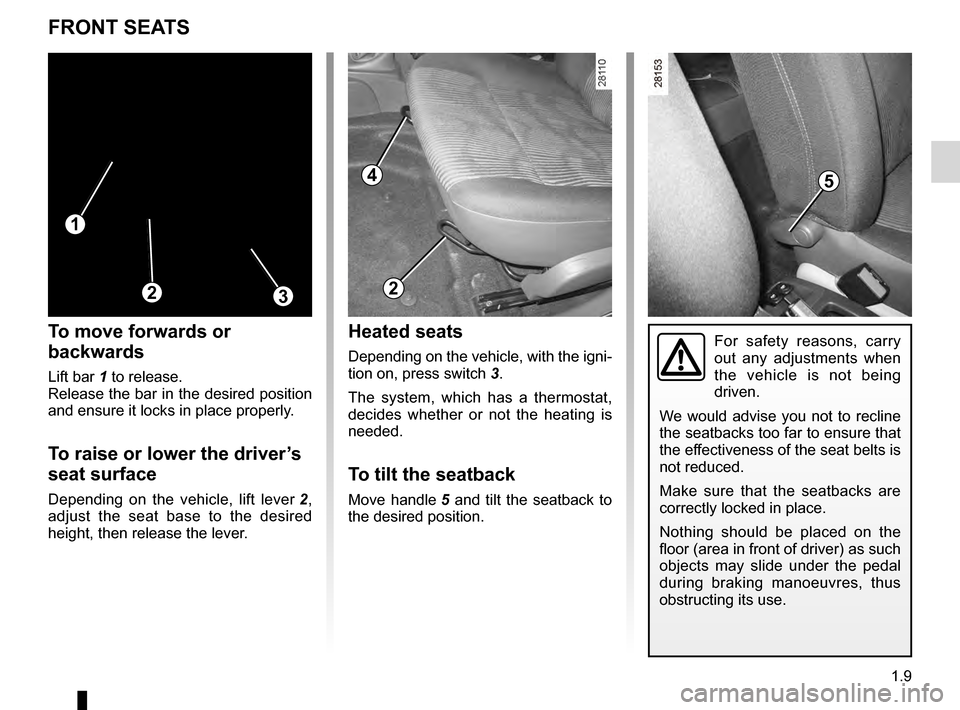
To move forwards or
backwards
Lift bar 1 to release.
Release the bar in the desired position
and ensure it locks in place properly.
To raise or lower the driver’s
seat surface
Depending on the vehicle, lift lever 2 ,
a djust the seat base to the desired
height, then release the lever.
Heated seats
Depending on the vehicle, with the igni-
tion on, press switch 3.
The system, which has a thermostat,
decides whether or not the heating is
needed.
To tilt the seatback
Move handle 5 and tilt the seatback to
the desired position.
Page 16 of 174
seat belts .............................................. (up to the end of the DU)
children ................................................. (up to the end of the DU)
1.14
ENG_UD26577_9
Ceintures de sécurité (B90 - Dacia)
ENG_NU_817-10_B90_Dacia_1
The following information applies to the vehicle’s front and rear seat belts.
– No modification may be made to the component parts of the originally fitted restraint system: belts, seats and their
mountings. For special operations (e.g. fitting child seats), please c\
ontact an authorised dealer.
–
Do
not use devices which allow any slack in the belts (e.g. clothes pegs, clips, etc.): a seat belt which is worn too
loosely may cause injury in the event of an accident.
–
Never wear the shoulder strap under your arm or behind your
back.
–
Never
use the same belt for more than one person and never hold a baby or child on your lap with your seat belt around
them.
–
The belt should never be twisted.
–
Follow
ing an accident, have the seat belts checked and replaced if necessary. Always replace your seat belts as soon as
they show any signs of wear.
–
Make sure that the buckle is inserted into the appropriate catc
h.
–
When refitting the rear bench seat, take care that the seat belts are co\
rrectly positioned so that they can be used properly
.
–
Ensure
that no objects are placed in the area around the seat belt catch as they could prevent it from being properly se-
cured.
–
Make
sure the seat belt catch is properly positioned (it should not be hidden away, crushed or flattened by people or ob-
jects).
SEAT BELTS (4/4)
Page 21 of 174
seat belts .............................................. (up to the end of the DU)
air bag................................................... (up to the end of the DU)
1.19
ENG_UD18027_3
Dispositifs de protection latérale (B90 - L90 Ph2 - H79 - Dacia)
ENG_NU_817-10_B90_Dacia_1
Side protection devices
SIDE PROTECTION DEVICES
Side air bags
These air bags may be fitted to the front
seats and are deployed at the sides of
the seats (door side) to protect the oc-
cupants in the event of a severe side
impact.
Warnings concerning the side air bag
–
F
itting seat covers: seats equipped with an air bag require covers
specifically designed for your vehicle. Contact an approved dealer to find
out if such covers are available from our Network. The use of any covers
other than those designed for your vehicle (including those designed for an-
other vehicle) may affect the operation of the air bags and reduce your protec-
tion.
–
Do
not place any accessories, objects, or even pets, between the seatback,
the door and the internal fittings. Do not cover the seatback with objects such
as clothes or accessories. This may prevent the air bag from operating cor-
rectly or cause injury when the air bag is deployed.
–
No
work or modification whatsoever may be carried out on the seat or internal
fittings, except by qualified personnel from our Network.
Page 22 of 174
air bag.................................................................... (current page)
seat belts ............................................................... (current page)
methods of restraint in addition to the front seat belts (current page)
1.20
ENG_UD18226_6
Dispositifs de retenue complémentaires (B90 - L90 Ph2 - Dacia)
ENG_NU_817-10_B90_Dacia_1
Additional methods of restraint
The airbag is designed to complement the action of the seat belt. Both the airbags and seat belts are integral parts of
the same protection system. It is therefore essential to wear the seat belt at all times. If seat belts are not worn, the oc-
cupants are exposed to the risk of serious injury in the event of an accident. It may also increase the risk of minor su-
perficial injuries occurring when the airbag is deployed, although such minor injuries are always possible with airbags.
If the vehicle should overturn or suffer a rear impact, however severe, the pretensioners and air bags are not always triggered.
Impacts to the underside of the vehicle, e.g. from pavements, potholes o\
r stones, can all trigger these systems.
–
No
work or modification whatsoever may be carried out on any part of the driver or passenger air bag system (air bag, elec-
tronic unit, wiring, etc.), except by qualified personnel from our Netw\
ork.
–
T
o ensure that the system is in good working order and to avoid accidental triggering of the system which could cause injury,
only qualified personnel from our Network may work on the air bag system\
.
–
As
a safety precaution, have the air bag system checked if your vehicle has been involved in an accident, or is stolen or
broken into.
–
When selling or lending the vehicle, inform the user of these p
oints and hand over this driver’s handbook with the vehicle.
–
When scrapping your vehicle, contact your approved Dealer fo
r disposal of the gas generator(s).
All of the warnings below are given so that the air bag is not obstructed in any way when it is inflated and also to prevent
the risk of serious injuries caused by items which may be dislodged when\
the air bag inflates.
ADDITIONAL METHODS OF RESTRAINT
Page 23 of 174
child restraint/seat ................................ (up to the end of the DU)
child restraint/seat ................................ (up to the end of the DU)
child restraint/seat ................................ (up to the end of the DU)
child seats............................................. (up to the end of the DU)
child booster seat ................................. (up to the end of the DU)
transporting children ............................. (up to the end of the DU)
child safety............................................ (up to the end of the DU)
1.21
ENG_UD24012_11
Sécurite enfants : généralités (B90 - F90 - U90 - R90 - F90\
Ph2 - R90 Ph2 - H79 - Dacia)
ENG_NU_817-10_B90_Dacia_1
Child safety: general information
CHILD SAFETY: General information (1/2)
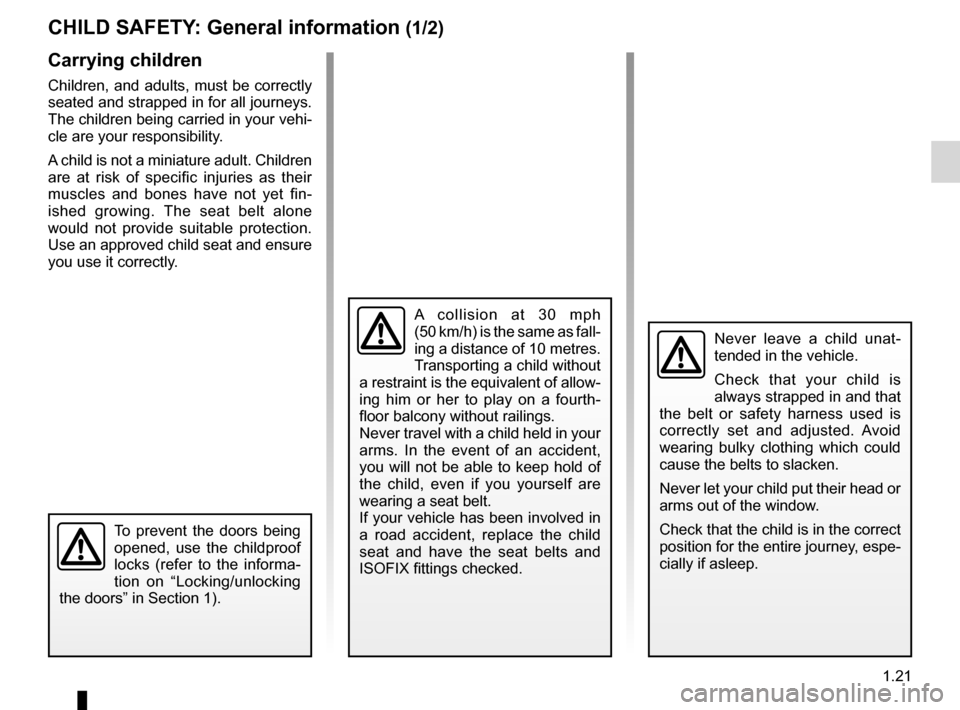
Carrying children
Children, and adults, must be correctly
seated and strapped in for all journeys.
The children being carried in your vehi-
cle are your responsibility.
A child is not a miniature adult. Children
are at risk of specific injuries as their
muscles and bones have not yet fin-
ished growing. The seat belt alone
would not provide suitable protection.
Use an approved child seat and ensure
you use it correctly.
A collision at 30 mph
(50 km/h) is the same as fall-
ing a distance of 10
metres.
Transporting a child without
a restraint is the equivalent of allow-
ing him or her to play on a fourth-
floor balcony without railings.
Never travel with a child held in your
arms. In the event of an accident,
you will not be able to keep hold of
the child, even if you yourself are
wearing a seat belt.
If your vehicle has been involved in
a road accident, replace the child
seat and have the seat belts and
ISOFIX fittings checked.
Never leave a child unat-
tended in the vehicle.
Check that your child is
always strapped in and that
the belt or safety harness used is
correctly set and adjusted. Avoid
wearing bulky clothing which could
cause the belts to slacken.
Never let your child put their head or
arms out of the window.
Check that the child is in the correct
position for the entire journey, espe-
cially if asleep.
To prevent the doors being
opened, use the childproof
locks (refer to the informa-
tion on “Locking/unlocking
the doors” in Section 1).
Page 24 of 174

ENG_NU_817-10_B90_Dacia_1
Jaune NoirNoir texte
CHILD SAFETY: General information (2/")
1.22
ENG_UD24012_11
Sécurite enfants : généralités (B90 - F90 - U90 - R90 - F90\
Ph2 - R90 Ph2 - H79 - Dacia)
ENG_NU_817-10_B90_Dacia_1
Jaune NoirNoir texte
CHILD SAFETY: General information (2/2)
Using a child seat
The level of protection offered by the
child seat depends on its ability to re-
strain your child and on its installation.
Incorrect installation compromises the
protection it offers the child in the event
of harsh braking or an impact.
Before purchasing a child seat, check
that it complies with the regulations for
the country you are in and that it can
be fitted in your vehicle. Consult an ap-
proved dealer to find out which seats
are recommended for your vehicle.
Before fitting a child seat, read the
manual and respect its instructions. If
you experience any difficulties during
installation, contact the manufacturer
of the equipment. Keep the instructions
with the seat.Set a good example by always fas-
tening your seat belt and teaching
your child:
–
to strap themselves in correctly;
–
to
always get in and out of the car
at the kerb, away from busy traf-
fic.
Do not use a second-hand child
seat or one without an instruction
manual.
Check that there are no objects in
the vicinity of the child seat which
could impede its operation.
Never leave a child unat-
tended in the vehicle.
Check that your child is
always strapped in and that
the belt or safety harness used is
correctly set and adjusted. Avoid
wearing bulky clothing which could
cause the belts to slacken.
Never let your child put their head or
arms out of the window.
Check that the child is in the correct
position for the entire journey, espe-
cially if asleep.
Page 29 of 174
\
ENG_NU_817-10_B90_Dacia_1
In the rear side seat
A carrycot can be installed across the")
JauneNoirNoir texte
1.27
ENG_UD25178_7
Sécurité enfants : installation du siège enfant (B90 - Dacia)\
ENG_NU_817-10_B90_Dacia_1
In the rear side seat
A carrycot can be installed across the
vehicle and will take up at least two
seats. Position the child with his or her
feet nearest the door.
Before installing a child seat in the
ISOFIX anchoring points on a rear side
seat, check that the seat belt buckles
are not placed between the two ISOFIX
anchorage points in this seat. If neces-
sary, move the buckle for the seat con-
cerned towards the centre of the vehi-
cle.
Move the front seat as far forward as
possible to install a rear-facing child
seat, then move back the seat in front
as far as it will go, although without al-
lowing it to come into contact with the
child seat.For the safety of the child in the for-
ward-facing seat, do not move the seat
in front back past the middle of the
runner, do not tilt the seatback too far
(maximum of 25° ) and raise the seat as
much as possible.
Check that the forward-facing child seat
is resting against the back of the vehi-
cle seat and that the headrest of the ve-
hicle is not obstructing its use. Rear centre seat
A child seat may only be fitted in this
seat if it is equipped with an inertia-reel
seat belt. For any additional informa-
tion, contact an approved dealer.
CHILD SAFETY:
Fitting a child seat (2/6)
Check that neither the child
seat nor the child’s feet
prevent the front seat from
locking into place. Refer to
the information on the “Front seat”
in Section 1.
Page 30 of 174
\
ENG_NU_817-10_B90_Dacia_1
Jaune NoirNoir texte
CHILD SAFETY: Fitting a child seat (3/6)
² Seat not suitable f")
1.28
ENG_UD25178_7
Sécurité enfants : installation du siège enfant (B90 - Dacia)\
ENG_NU_817-10_B90_Dacia_1
Jaune NoirNoir texte
CHILD SAFETY: Fitting a child seat (3/6)
² Seat not suitable for fitting child
seats.
Child seat attached using the belt
¬ Seat which allows a child seat
with “Universal” approval to be attached
by a seat belt.
− Seat which only allows a rear-
facing seat with “Universal” approval
to be attached with a seat belt.
Only
if the seat is equipped with an
inertia-reel belt.
³ Check the status of the air bag
before fitting a child seat or allowing a
passenger to use the seat.
R I S K O F D E AT H O R
SERIOUS INJURY: before
installing a child/baby seat
on the front passenger seat,
check that the air bag has been de-
activated (refer to “Deactivating the
front passenger air bag” at the end
of the paragraph).
Vehicles without airbag or with airbag deactivated
1
Child seat attached using the ISOFIX
mounting
ü Seat which allows an ISOFIX
child seat to be fitted.
± The rear seats are fitted with
an anchorage point which allows a
forward-facing ISOFIX child seat with
universal approval to be fitted. The an-
chorage points are located under the
luggage compartment carpet and are
indicated by a marking.
The size of the ISOFIX child seat is in-
dicated by a letter:
–
A,
B and B1: for forward-facing seats
in group 1 (9 to 18 kg);
–
C:
rear-facing seats in group 1 (9 to
18 kg);
–
D
and E: shell seat or rear-facing
seats in group 0 or 0+ (less than
13
kg);
–
F
and G: cots in group 0 (less than
10 kg).
Using a child safety system
which is not approved for
this vehicle will not correctly
protect the baby or child.
They risk serious or even fatal injury.
1
Page 31 of 174
\
ENG_NU_817-10_B90_Dacia_1
CHILD SAFETY: Fitting a child seat (4/6)
² A child seat must not b")
JauneNoirNoir texte
1.29
ENG_UD25178_7
Sécurité enfants : installation du siège enfant (B90 - Dacia)\
ENG_NU_817-10_B90_Dacia_1
CHILD SAFETY: Fitting a child seat (4/6)
² A child seat must not be fitted in
this seat
Vehicles with passenger air bag not deactivated
1
R I S K O F D E AT H O R
SERIOUS INJURY: never
fit a child seat to this seat.
Child seat attached using the ISOFIX
mounting
ü Seat which allows an ISOFIX
child seat to be fitted.
± The rear seats are fitted with
an anchorage point which allows a
forward-facing ISOFIX child seat with
universal approval to be fitted. The an-
chorage points are located under the
luggage compartment carpet and are
indicated by a marking.
The size of the ISOFIX child seat is in-
dicated by a letter:
–
A,
B and B1: for forward-facing seats
in group 1 (9 to 18 kg);
–
C:
rear-facing seats in group 1 (9 to
18 kg);
–
D
and E: shell seat or rear-facing
seats in group 0 or 0+ (less than
13
kg);
–
F
and G: cots in group 0 (less than
10 kg).
Using a child safety system which is not approved for this vehicle will not
correctly protect the baby or child. They risk serious or even fatal injury.
Child seat attached using the belt
¬ Seat which allows a child seat
with “Universal” approval to be attached
by a seat belt.
Only
if the seat is equipped with an
inertia-reel belt.
1
Page 33 of 174
\
ENG_NU_817-10_B90_Dacia_1
CHILD SAFETY: Fitting a child seat (6/6)
X = Seat not suitable for")
JauneNoirNoir texte
1.31
ENG_UD25178_7
Sécurité enfants : installation du siège enfant (B90 - Dacia)\
ENG_NU_817-10_B90_Dacia_1
CHILD SAFETY: Fitting a child seat (6/6)
X = Seat not suitable for fitting child seats.
U = Seat which allows a child seat with “Universal” approval to b e installed using a seat belt; check that it can be fitted.
IUF =
Seat
which, on equipped vehicles, allows forward-facing child seats with “Universal” approval to be attached by the ISOFIX
system; check that it can be fitted.
IL =
Seat
which, on equipped vehicles, allows child seats with “Semi-Universal” or “Specific to vehicle” approval to be attached by
the ISOFIX system; check that it can be fitted.
Refer to the brochure “Child safety equipment” available from the Network to choose the seat suited to your child and
recommended for your vehicle.
(1)
Only
a rear-facing child seat can be fitted in this seat: raise the seat to the maximum and position it as far back as possible,
tilting the seatback slightly (approximately 25°).
(2)
A
carrycot can be installed across the vehicle and will take up two seats. Position the child with his or her feet nearest the door.
(3)
Move
the front seat as far forward as possible to install a rear-facing child seat, then move back the seat in front as far as it will
go, although without allowing it to come into contact with the child sea\
t.
(4)
Forward-facing
child seat; position the seatback of the child seat in contact with the seatback of the vehicle seat. Adjust the
headrest, or remove it if necessary. Do not push the seat in front of the child more than halfway back on its runners and do not
recline the seatback more than 25°.
(7)
Only if the seat is equipped with an inertia-reel belt.