cooling DAEWOO LACETTI 2004 Service Owners Manual
[x] Cancel search | Manufacturer: DAEWOO, Model Year: 2004, Model line: LACETTI, Model: DAEWOO LACETTI 2004Pages: 2643, PDF Size: 80.54 MB
Page 2003 of 2643

SECTION : 7B
MANUAL CONTROL HEATING, VENTILATION
AND AIR CONDITIONING SYSTEM
CAUTION : Disconnect the negative battery cable before removing or installing any electrical unit or when a tool
or equipment could easily come in contact with exposed electrical terminals. Disconnecting this cable will help
prevent personal injury and damage to the vehicle. The ignition must also be in LOCK unless otherwise noted.
TABLE OF CONTENTS
SPECIFICATIONS7B–2 . . . . . . . . . . . . . . . . . . . . . . . . . .
General Specifications 7B–2. . . . . . . . . . . . . . . . . . . . .
Fastener Tightening Specifications 7B–2. . . . . . . . . . .
SPECIAL TOOLS7B–3 . . . . . . . . . . . . . . . . . . . . . . . . . . .
Special Tools Table 7B–3. . . . . . . . . . . . . . . . . . . . . . . .
SCHEMATIC AND ROUTING DIAGRAMS7B–6 . . . . .
A/C System – Typical 7B–6. . . . . . . . . . . . . . . . . . . . . .
Manual Control A/C Diagram 7B–7. . . . . . . . . . . . . . . .
DIAGNOSIS7B–8 . . . . . . . . . . . . . . . . . . . . . . . . . . . . . . . .
GENERAL DIAGNOSIS 7B–8. . . . . . . . . . . . . . . . . . . . . .
Testing the Refrigerant System 7B–8. . . . . . . . . . . . . .
Insufficient Cooling ”Quick Check” Procedure 7B–8. .
A/C Performance Test 7B–9. . . . . . . . . . . . . . . . . . . . . .
Pressure–Temperature Relationship of
R–134A 7B–10. . . . . . . . . . . . . . . . . . . . . . . . . . . . . . .
Leak Testing Refrigerant System 7B–11. . . . . . . . . . . .
V5 SYSTEM AIR CONDITIONING DIAGNOSIS 7B–12
Insufficient Cooling Diagnosis 7B–12. . . . . . . . . . . . . .
SYMPTOM DIAGNOSIS 7B–16. . . . . . . . . . . . . . . . . . . .
Pressure Test Chart (R–134A System) 7B–16. . . . . .
Low and High Side Pressure Relationship
Chart 7B–18. . . . . . . . . . . . . . . . . . . . . . . . . . . . . . . . . .
MAINTENANCE AND REPAIR7B–19 . . . . . . . . . . . . . .
ON–VEHICLE SERVICE 7B–19. . . . . . . . . . . . . . . . . . . .
GENERAL A/C SYSTEM SERVICE
PROCEDURES 7B–19. . . . . . . . . . . . . . . . . . . . . . . . . .
O–Ring Replacement 7B–19. . . . . . . . . . . . . . . . . . . . .
Handling Refrigerant 7B–19. . . . . . . . . . . . . . . . . . . . . .
Handling of Refrigerant Lines and Fittings 7B–19. . . .
Maintaining Chemical Stability in the Refrigeration
System 7B–20. . . . . . . . . . . . . . . . . . . . . . . . . . . . . . . .
Discharging, Adding Oil, Evacuating, and Charging
Procedures for A/C System 7B–20. . . . . . . . . . . . . .
SERVICEABLE COMPONENTS 7B–23. . . . . . . . . . . . . Components Used In Non–A/C Systems 7B–23. . . . .
A/C Pressure Transducer 7B–24. . . . . . . . . . . . . . . . . .
A/C Compressor Relay 7B–24. . . . . . . . . . . . . . . . . . . .
Air Filter 7B–25. . . . . . . . . . . . . . . . . . . . . . . . . . . . . . . . .
A/C Expansion Valve 7B–25. . . . . . . . . . . . . . . . . . . . . .
A/C High–Pressure Pipe Line 7B–26. . . . . . . . . . . . . . .
Evaporator Core 7B–29. . . . . . . . . . . . . . . . . . . . . . . . . .
A/C Suction Hose Assembly 7B–30. . . . . . . . . . . . . . .
A/C Discharge Hose Compressor to
Condenser 7B–31. . . . . . . . . . . . . . . . . . . . . . . . . . . . .
Receiver–Dryer 7B–32. . . . . . . . . . . . . . . . . . . . . . . . . . .
Compressor 7B–33. . . . . . . . . . . . . . . . . . . . . . . . . . . . . .
Condenser 7B–35. . . . . . . . . . . . . . . . . . . . . . . . . . . . . . .
UNIT REPAIR 7B–37. . . . . . . . . . . . . . . . . . . . . . . . . . . . .
COMPONENT LOCATOR 7B–37. . . . . . . . . . . . . . . . . . .
V5 Compressor 7B–37. . . . . . . . . . . . . . . . . . . . . . . . . . .
V5 AIR CONDITIONING COMPRESSOR
OVERHAUL 7B–38. . . . . . . . . . . . . . . . . . . . . . . . . . . . .
Clutch Plate and Hub Assembly 7B–38. . . . . . . . . . . .
Clutch Rotor and Bearing 7B–40. . . . . . . . . . . . . . . . . .
Clutch Coil 7B–42. . . . . . . . . . . . . . . . . . . . . . . . . . . . . . .
Shaft Seal Replacement 7B–44. . . . . . . . . . . . . . . . . . .
Control Valve Assembly 7B–46. . . . . . . . . . . . . . . . . . .
Rear Head, Gasket, Valve Plate, Reed Plate,
and O–ring 7B–47. . . . . . . . . . . . . . . . . . . . . . . . . . . . .
Cylinder to Front Head O–ring 7B–48. . . . . . . . . . . . . .
Leak Testing (External) 7B–50. . . . . . . . . . . . . . . . . . . .
GENERAL DESCRIPTION AND SYSTEM
OPERATION7B–51 . . . . . . . . . . . . . . . . . . . . . . . . . . . . .
GENERAL INFORMATION 7B–51. . . . . . . . . . . . . . . . . .
The V5 A/C System 7B–51. . . . . . . . . . . . . . . . . . . . . . .
System Components – Functional 7B–51. . . . . . . . . .
System Components – Control 7B–52. . . . . . . . . . . . .
V5 Compressor – General Description 7B–52. . . . . . .
V5 Compressor – Description of Operation 7B–52. . .
Page 2010 of 2643

7B – 8IMANUAL CONTROL HEATING, VENTILATION AND AIR CONDITIONING SYSTEM
DAEWOO V–121 BL4
DIAGNOSIS
GENERAL DIAGNOSIS
TESTING THE REFRIGERANT
SYSTEM
If you suspect a problem in the refrigerant system, check
for the following conditions:
1. Check the outer surfaces of the radiator and the
condenser cores to be sure that the airflow is not
blocked by dirt, leaves, or other foreign material.
Check between the condenser and the radiator, as
well as all outer surfaces.
2. Check for restrictions or kinks in the condenser
core, the hoses, and the tubes.
3. Check the operation of the blower fan.
4. Check all the air ducts for leaks or restrictions. Low
airflow rate may indicate a restricted evaporator
core.
5. Check for slippage of the compressor clutch.
6. Check the drive belt tension.
INSUFFICIENT COOLING ”QUICK
CHECK” PROCEDURE
Perform the following ”hand–feel” procedure to get a quick
idea of whether the A/C system has the proper charge of
Refrigerant–134a. The air temperature must be above
21°C (70°F) for most models.
1. Warm up engine. Run the engine at idle.
2. Open the hood and all the doors.
3. Turn the A/C switch ON.
4. Set the temperature control to the full cold position.
5. Set the blower speed switch on the maximum
speed setting.
6. ”Hand–feel” the temperature of the evaporator out-
let pipe. The pipe should be cold.
7. Check for other problems. Refer to ”Testing the Re-
frigerant System” in this section.
8. Leak check the system. Refer to ”Leak Testing the
Refrigerant System” in this section. If you find a
leak, discharge the system and repair the leak as
required. After completing the repair, evacuate the
system and charge it.
9. If there is no leak, refer to ”Insufficient Cooling
Diagnosis” in this section.
Page 2014 of 2643

7B – 12IMANUAL CONTROL HEATING, VENTILATION AND AIR CONDITIONING SYSTEM
DAEWOO V–121 BL4
V5 SYSTEM AIR CONDITIONING DIAGNOSIS
INSUFFICIENT COOLING DIAGNOSIS
Test Description
The numbers below refer to steps on the diagnostic table.
13. See the Important below.
32. See the Important below.Important : Perform this test under garage conditions with
the air temperature at 21–32°C (70–90°F), and no sun
load. Follow this test carefully for accurate results.
Important : Perform this test exactly as described to ob-
tain accurate results.
Step
ActionValue(s)YesNo
1Record the customer’s complaint.
Can you verify the customer’s complaint?–Go to Step 2System OK
21. Check the A/C fuse.
2. Check the blower fan operation.
3. Check the engine cooling fan operation.
4. Check the A/C compressor belt.
5. Check the A/C condenser for restricted airflow.
6. Check the clutch coil connection.
7. Repair or replace any components as needed.
8. Check the discharge air temperature with the
A/C turned ON.
Is the discharge air temperature normal?At least 7°C
(12°F) below
ambient air
temperatureSystem OKGo to Step 3
31. Turn the ignition switch to LOCK.
2. Connect the high– and the low–pressure
gauges.
Are both pressures within the value specified?69–345 kPa
(10–50 psi)Go to Step 4Go to Step 5
41. Check the A/C system for leaks.
2. Repair any refrigerant leaks as needed.
3. Recover, evacuate, and recharge the A/C sys-
tem.
4. Observe the two pressure gauges.
Are both pressures above the value specified?345 kPa
(50 psi)Go to Step 7–
5Observe the two pressure gauges.
Are both pressures below the value specified?69 kPa
(10 psi)Go to Step 6Go to Step 7
61. Add 0.45 kg (1 pound) of refrigerant R–134a.
2. Check the A/C system for leaks.
3. Repair any refrigerant leaks, as needed.
4. Recover, evacuate, and recharge the A/C sys-
tem.
5. Observe the two pressure gauges.
Are both pressures above the value specified?345 kPa
(50 psi)Go to Step 7–
71. Start the engine and allow it to run at idle.
2. Set the A/C controls to the following positions:
S The A/C switch to the ON.
S The fresh air control switch to fresh air (in-
dicator lamp OFF).
S The blower motor to 4.
S The temperature to full cold.
Does the A/C compressor clutch engage?–Go to Step 8Go to Step 10
Page 2016 of 2643

7B – 14IMANUAL CONTROL HEATING, VENTILATION AND AIR CONDITIONING SYSTEM
DAEWOO V–121 BL4
StepNo Yes Value(s) Action
151. Record the low– and the high–side pressures
after the A/C system has been operating for 5
minutes or more with the engine cooling fan
ON.
2. Locate the intersection of the low– and the high
side pressures. Refer to ”Low– and High–Side
Pressure Relationship Chart” in this section.
Do the low– and the high–side pressures intersect
in the white area of the chart?–System OKGo to Step 16
16Check the high– and the low–side pressures.
Do the low– and the high–side pressures intersect
in the grey area of the chart?–Go to Step 17Go to Step 20
17Feel the liquid pipe between the condenser and the
expansion valve.
Is the pipe cold?–Go to Step 18Go to Step 19
181. Examine the condenser for any restriction of
the airflow.
2. Check the cooling fans for proper operation.
3. Remove the restriction or repair the fans, as
required.
Is the pipe temperature normal now?At least 7°C
(12°F) below
ambient air
temperatureGo to Step 13–
191. Recover, evacuate, and recharge the A/C sys-
tem.
2. Check the A/C system for leaks.
Is the system free from leaks?–Go to Step 13–
20Observe the readings on the pressure gauges.
Are the A/C compressor high– and the low–side
pressures within the specified value of each other?207 kPa
(30 psi)Go to Step 21Go to Step 26
211. Run the engine at 3,000 rpm.
2. Set the A/C controls to the following positions:
S The A/C switch to the ON.
S The fresh air control switch to fresh air.
S The blower motor to 4.
S The temperature to full cold.
3. Close all of the vehicle’s windows and doors.
4. Turn the A/C switch ON and OFF every 20
seconds for 3 minutes.
Are the A/C compressor high– and the low–side
pressures within the specified value of each other?207 kPa
(30 psi)Go to Step 22Go to Step 13
22Observe the pressure rise on both gauges and the
temperatures of both the compressor suction pipe
and the discharge pipe.
Is the pressure rise on both gauges slow and the
suction pipe warm with the discharge pipe very hot?–Go to Step 25Go to Step 23
231. Turn the ignition switch to LOCK.
2. Make sure the compressor clutch is disen-
gaged.
3. Attempt to turn the clutch driver (not the
pulley).
Can you turn the clutch driver freely by hand?–Go to Step 25Go to Step 24
Page 2017 of 2643

MANUAL CONTROL HEATING, VENTILATION AND AIR CONDITIONING SYSTEM 7B – 15
DAEWOO V–121 BL4
StepNo Yes Value(s) Action
241. Start the engine.
2. Observe the low–side pressure gauge while
running the engine between 3,000 and 3,800
rpm.
Does the low–side pressure rise rapidly?–Go to Step 32Go to Step 25
251. Recover the A/C system refrigerant.
2. Replace the A/C compressor.
3. Evacuate and recharge the A/C system.
Is the compressor functioning normally?–Go to Step 13–
26Check the low–side pressure.
Is the low–side pressure within the specified value?172–241 kPa
(25–35 psi)Go to Step 27Go to Step 32
27Feel the high–side pipe leading up to the expansion
valve connecting block.
Is the pipe cold before the connecting block?–Go to Step 28Go to Step 29
281. Check for a restriction in the high–side pipe
before the expansion valve.
2. Repair or replace the high–side pipe.
Is the pipe performing normally?–Go to Step 13–
29Add the specified amount of refrigerant to the A/C
system.
Does the cooling performance improve?0.40 kg
(14 ounces)Go to Step 30Go to Step 31
301. Check the A/C system for leaks.
2. Repair any refrigerant leaks, as needed.
3. Evacuate and recharge the A/C system.
4. Check the A/C system for leaks.
Is the system free from leaks?–Go to Step 13–
311. Recover the refrigerant.
2. Check the expansion valve for obstructions.
3. Repair or replace the expansion valve, as re-
quired.
4. Evacuate and recharge the system.
5. Check the A/C system for leaks.
Is the system free from leaks?–Go to Step 13–
321. Run the engine for 5 minutes at 2,000 rpm.
2. Set the A/C controls to the following positions:
S The A/C switch to the ON position.
S The fresh air control switch to recirculate
(indicator lamp ON).
S The blower motor to 1.
S The temperature to full cold.
3. Close all of the vehicle’s windows and doors.
4. Open the vehicle hood.
Is the low–side pressure within the specified value?172–241 kPa
(25–35 psi)Go to Step 13Go to Step 33
331. Recover the A/C system refrigerant.
2. Replace the A/C compressor control valve.
3. Evacuate and recharge the A/C system.
4. Check the A/C system for leaks.
Is the system free from leaks?–Go to Step 13–
Page 2019 of 2643

MANUAL CONTROL HEATING, VENTILATION AND AIR CONDITIONING SYSTEM 7B – 17
DAEWOO V–121 BL4
Test ResultsRemedy Probable Cause Related Symptioms
Suction pressure ab-
normally highSuction pressure is lowered
when the condenser is
cooled by water.Excessive refrigerant in the sys-
tem.Recover, evacuate, and re-
charge the system.
High and low pressure are
equalized as soon as the
compressor is stopped and
both gauges fluctuate while
the compressor is running.Faulty gasket.Repair or replace the com-
pressor.
Faulty high–pressure valve. (V5
compressor only)
Foreign particles stuck in the
high–pressure valve. (V5 com-
pressor only)
Suction and dis-
charge pressure ab-
ll hi h
Reduced airflow through
the condenser.Clogged condenser or radiator
fins.Clean the condenser and
the radiator.
g
normally highRadiator cooling fans working im-
properly.Check the voltage and the
radiator cooling fan rpm.
Check the fan direction.
Condenser is excessively
hot.Excessive refrigerant in the sys-
tem.Recover, evacuate, and re-
charge the system.
Suction and dis-
charge pressure ab-
normally lowLow–pressure hose and
metal end areas are cooler
than the evaporator.Clogged or kinked low–pressure
hose.Repair or replace the low–
pressure hose.
Temperature around the ex-
pansion valve is low
compared to that around
the receiver–dryer.Clogged high–pressure line.Repair or replace the high–
pressure line.
Refrigerant leaksThe compressor clutch is
dirty.Leaking compressor shaft seal.Repair or replace the com-
pressor.
The compressor bolts are
dirty.Leaking around a compressor
housing bolt.Tighten the bolt(s) or re-
place the compressor.
The compressor gasket is
wet with oil.Leaking compressor gasket.Repair or replace the com-
pressor.
Page 2038 of 2643
7B – 36IMANUAL CONTROL HEATING, VENTILATION AND AIR CONDITIONING SYSTEM
DAEWOO V–121 BL4
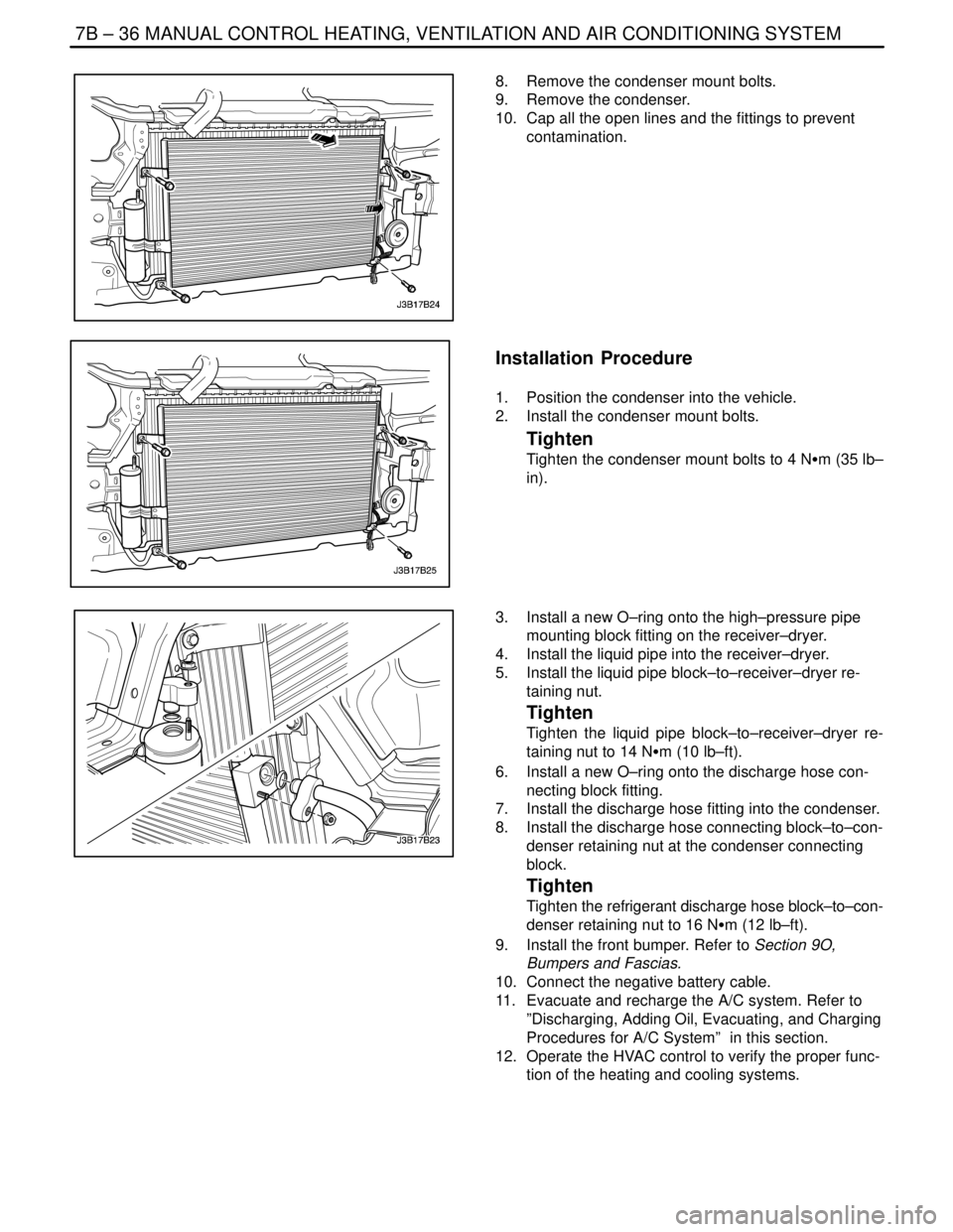
8. Remove the condenser mount bolts.
9. Remove the condenser.
10. Cap all the open lines and the fittings to prevent
contamination.
Installation Procedure
1. Position the condenser into the vehicle.
2. Install the condenser mount bolts.
Tighten
Tighten the condenser mount bolts to 4 NSm (35 lb–
in).
3. Install a new O–ring onto the high–pressure pipe
mounting block fitting on the receiver–dryer.
4. Install the liquid pipe into the receiver–dryer.
5. Install the liquid pipe block–to–receiver–dryer re-
taining nut.
Tighten
Tighten the liquid pipe block–to–receiver–dryer re-
taining nut to 14 NSm (10 lb–ft).
6. Install a new O–ring onto the discharge hose con-
necting block fitting.
7. Install the discharge hose fitting into the condenser.
8. Install the discharge hose connecting block–to–con-
denser retaining nut at the condenser connecting
block.
Tighten
Tighten the refrigerant discharge hose block–to–con-
denser retaining nut to 16 NSm (12 lb–ft).
9. Install the front bumper. Refer to Section 9O,
Bumpers and Fascias.
10. Connect the negative battery cable.
11. Evacuate and recharge the A/C system. Refer to
”Discharging, Adding Oil, Evacuating, and Charging
Procedures for A/C System” in this section.
12. Operate the HVAC control to verify the proper func-
tion of the heating and cooling systems.
Page 2053 of 2643

MANUAL CONTROL HEATING, VENTILATION AND AIR CONDITIONING SYSTEM 7B – 51
DAEWOO V–121 BL4
GENERAL DESCRIPTION
AND SYSTEM OPERATION
GENERAL INFORMATION
THE V5 A/C SYSTEM
The V5 variable displacement compressor along with the
thermal expansion valve on the evaporator, constitutes a
largely self–regulating system. There is no pressure cycl-
ing switch, no high–pressure cut–off switch and no low–
pressure cut–off switch. The compressor clutch is con-
trolled by the electronic control module (ECM), which
receives data from various engine systems and from a
pressure transducer located in the high–pressure refriger-
ant pipe. In normal operation, the clutch is engaged contin-
uously. Should one of the monitored conditions become
abnormal, the ECM will disengage the compressor clutch
until normal operation is restored. These conditions in-
clude the following:
S Wide–open throttle.
S High engine coolant temperature.
S High engine RPM.
S Refrigerant low pressure.
S Refrigerant high pressure.
The compressor clutch will remain disengaged until nor-
mal operation is established.
SYSTEM
COMPONENTS–FUNCTIONAL
Compressor
All compressors are belt–driven from the engine crank-
shaft through the compressor clutch pulley. The compres-
sor pulley rotates without driving the compressor shaft un-
til an electromagnetic clutch coil is energized. When
voltage is applied to energize the clutch coil, the clutch
plate and hub assembly is drawn rearward toward the
pulley. The magnetic force locks the clutch plate and
pulley together as one unit to drive the compressor shaft.
As the compressor shaft is driven, it compresses the low–
pressure refrigerant vapor from the evaporator into a
high–pressure, high–temperature vapor. The refrigerant
oil which is used to lubricate the compressor is carried with
the refrigerant. Refer to ”V5 Air Conditioning Compressor
Overhaul” in this section.
Condenser Core
The condenser assembly in front of the radiator consists
of coils which carry the refrigerant, and cooling fins that
provide the rapid transfer of heat. The air passing through
the condenser cools the high–pressure refrigerant vapor
and causes it to condense into a liquid.
Expansion Valve
The expansion valve is located with the evaporator core,
on the front passenger side fire wall.
The expansion valve can fail in three different positions:
open, closed, or restricted.
An expansion valve that fails in the open position will result
in a noisy A/C compressor or no cooling. The cause can
be a broken spring, a broken ball, or excessive moisture
in the A/C system. If the spring or the ball are found to be
defective, replace the expansion valve. If excessive mois-
ture is found in the A/C system, recycle the refrigerant.
An expansion valve that fails in the closed position will re-
sult in low suction pressure and no cooling. This may be
caused by a failed power dome or excessive moisture in
the A/C system. If the power dome on the expansion valve
is found to be defective, replace the expansion valve. If ex-
cessive moisture is found in the A/C system, recycle the
refrigerant.
A restricted expansion valve will result in low suction pres-
sure and no cooling. This may be caused by debris in the
refrigerant system. If debris is believed to be the cause, re-
cycle the refrigerant, replace the expansion valve, and re-
place the receiver–dryer.
Evaporator Core
The evaporator is a device which cools and dehumidifies
the air before it enters the vehicle. High–pressure liquid re-
frigerant flows through the expansion tube orifice and be-
comes a low–pressure gas in the evaporator. The heat in
the air passing through the evaporator core is transferred
to the cooler surface of the core, which cools the air. As the
process of heat transfer from the air to the evaporator core
surface is taking place, any moisture or humidity in the air
condenses on the outside surface of the evaporator core
and is drained off as water.
Receiver–Dryer
The sealed receiver–dryer assembly is connected to the
condenser outlet pipe. It acts as a refrigerant storing con-
tainer, receiving liquid, vapor, and refrigerant oil from the
evaporator.
At the bottom of the receiver–dryer is the desiccant, which
acts as a drying agent for the moisture that may have en-
tered the system. An oil bleed hole is located near the bot-
tom of the receiver–dryer outlet pipe to provide an oil re-
turn path to the compressor. The receiver–dryer is
serviceable only as an assembly.
Heater Core
The heater core heats the air before it enters the vehicle.
Engine coolant is circulated through the core to heat the
outside air passing over the fins of the core. The core is
functional at all times and may be used to temper condi-
tioned air in the A/C mode as well as in the heat or the vent
modes.
Page 2054 of 2643

7B – 52IMANUAL CONTROL HEATING, VENTILATION AND AIR CONDITIONING SYSTEM
DAEWOO V–121 BL4
SYSTEM COMPONENTS–CONTROL
Controller
The operation of the A/C system is controlled by the
switches and the lever on the control head. The compres-
sor clutch and the blower are connected electrically to the
control head by a wiring harness. The blower circuit is
open in the OFF mode. Airflow is provided by the four
blower speeds available in the remaining modes. Cooled
and dehumidified air is available in the MAX, NORMAL,
BI–LEVEL, and DEFROST modes.
The temperature is controlled by the position of the tem-
perature knob on the control head. A cable connects this
knob to the temperature door, which controls the airflow
through the heater core. As the temperature knob is
moved through its range of travel, a sliding clip on the
cable at the temperature valve connection should assume
a position ensuring that the temperature door will seat in
both extreme positions. The temperature door position is
independent of the mode control switch. The temperature
door on some models is controlled electrically, eliminating
the need for the temperature cable.
The electric engine cooling fan on some vehicles is not
part of the A/C control system; however, the fan is opera-
tional any time the A/C control is in the MAX, NORMAL,
or BI–LEVEL modes. Some models provide for engine
cooling fan operation when the controller is in the DE-
FROST mode. This added feature is part of the A/C con-
troller function and is aimed at preventing excessive com-
pressor head temperatures. It also allows the A/C system
to function more efficiently. On some models, the engine
cooling fan will be turned off during road speed conditions
above 56 km/h (35 mph), when the airflow though the con-
denser coil is adequate for efficient cooling. The operation
of the cooling fan is controlled by the powertrain control
module (PCM), or the engine control module (ECM),
through the cooling fan relay.
Pressure Transducer
The pressure transducer incorporates the functions of the
high–pressure and the low–pressure cutout switches
along with the fan cycling switch. The pressure transducer
is located in the high–side liquid refrigerant line near the
right front strut tower and the air filter assembly.
Wide–Open Throttle (WOT) Compressor
Cutoff
During full throttle acceleration on vehicles equipped with
multi–port injection (MPI), the throttle position sensor
(TPS) sends a signal to the PCM or the ECM, which then
controls the compressor clutch.
A/C Time Delay Relay
This relay on some vehicles controls the current to the en-
tire A/C system and provides a short delay of A/C opera-
tion upon start–up.
V5 COMPRESSOR–GENERAL
DESCRIPTION
Different vehicles with V5 compressors may exhibit differ-
ences in mounting and installation, but overhaul proce-
dures are similar.
Before removing the compressor or performing on–ve-
hicle repairs, clean the compressor connections and the
outside of the compressor.
Important : After removing a compressor from the vehicle
for servicing, drain the oil by removing the oil drain plug.
Also drain the oil from the suction and the discharge ports
to insure complete draining. Measure the amount of oil
drained, and record that amount. Discard the used oil and
add the same amount of new polyalkaline glycol (PAG) re-
frigerant oil to the compressor.
The compressor has been removed from the vehicle un-
less otherwise indicated.
Clean tools and a clean work area are important for proper
servicing. Keep dirt and foreign material from getting on or
into the compressor parts. Parts that are to be reassem-
bled should be cleaned with trichloroethane, naphtha,
stoddard solvent, kerosene, or equivalent solvents. Dry
the cleaned parts with clean dry air. Use only lint–free
cloths to wipe the parts.
V5 COMPRESSOR–DESCRIPTION OF
OPERATION
The V5 is a variable displacement compressor that can
match the automotive air conditioning (A/C) demand un-
der all conditions without cycling. The basic compressor
mechanism is a variable angle wobble–plate with five ax-
ially oriented cylinders. The center of control of the com-
pressor displacement is a bellows–actuated control valve
located in the rear head of the compressor. The control
valve senses compressor suction pressure.
The wobble–plate angle and the compressor displace-
ment are controlled by the crankcase suction pressure dif-
ferential. When the A/C capacity demand is high, the suc-
tion pressure will be above the control point. The valve will
maintain a bleed from crankcase to suction. With no
crankcase suction pressure differential, the compressor
will have maximum displacement.
When the A/C capacity demand is lower and the suction
pressure reaches the control point, the valve will bleed dis-
charge gas into the crankcase and close off a passage
from the crankcase to the suction plenum. The angle of the
wobble–plate is controlled by a force balance on the five
pistons. A slight elevation of the crankcase suction pres-
sure differential creates total force on the pistons resulting
in a movement about the wobbleplate pivot pin that re-
duces the plate angle.
The compressor has a unique lubrication system. The
crankcase suction bleed is routed through the rotating
wobble–plate for lubrication of the wobble–plate bearing.
The rotation acts as an oil separator which removes some
Page 2060 of 2643

AUTOMATIC TEMPERATURE CONTROL HEATING, VENTILATION, AND AIR CONDITIONING SYSTEM 7D – 5
DAEWOO V–121 BL4
DIAGNOSIS
GENERAL A/C DIAGNOSTICS
Refer to Section 7B, Manual Control Heating, Ventilation,
and Air Conditioning System for details of the following
procedures:
S A/C Performance Test.
S Insufficient Cooling ”Quick Check” Procedure.
S Insufficient Cooling Diagnosis.S Leak Testing the Refrigerant System.
S Low– and High–Side Pressure Relationship Chart.
S Pressure Test Chart (R–134a System).
S Pressure–Temperature Relationship of R–134a.
S Testing the Refrigerant System.
V5 SYSTEM AIR CONDITIONING AND AUTOMATIC
TEMPERATURE CONTROL (ATC)
SELF–DIAGNOSTIC CIRCUIT CHECK
The Daewoo fully automatic temperature controller
(FATC) contains a self–diagnosis function to aid in finding
any problem with the system. To enter the diagnostic
mode, perform the following procedure:
1. Turn the ignition to ON.
2. Set the temperature control to 26°C (79°F).3. Within 3 seconds, push the AUTO and the OFF
switches simultaneously, more than three times.
4. Count the number of times the temperature indica-
tor screen blinks.
5. If there are no error codes set, the screen will not
blink. When the controller indicates an error code,
proceed to the table for that code.
6. Push the OFF switch to return the controller to its
normal functions.