speed sensor DAEWOO LACETTI 2004 Service Owners Manual
[x] Cancel search | Manufacturer: DAEWOO, Model Year: 2004, Model line: LACETTI, Model: DAEWOO LACETTI 2004Pages: 2643, PDF Size: 80.54 MB
Page 875 of 2643

ENGINE CONTROLS 1F – 629
DAEWOO V–121 BL4
tentially interfere with the operation of the Exhaust Gas
Recirculation (EGR) valve and thereby turn on the MIL.
Small leaks in the exhaust system near the post catalyst
oxygen sensor can also cause the MIL to turn on.
Aftermarket electronics, such as cellular phones, stereos,
and anti–theft devices, may radiate electromagnetic inter-
ference (EMI) into the control system if they are improperly
installed. This may cause a false sensor reading and turn
on the MIL.
Environment
Temporary environmental conditions, such as localized
flooding, will have an effect on the vehicle ignition system.
If the ignition system is rain–soaked, it can temporarily
cause engine misfire and turn on the MIL.
Refueling
A new EOBD diagnostic checks the integrity of the entire
Evaporative (EVAP) Emission system. If the vehicle is re-
started after refueling and the fuel cap is not secured cor-
rectly, the on–board diagnostic system will sense this as
a system fault, turn on the MIL, and set DTC P0440.
Vehicle Marshaling
The transportation of new vehicles from the assembly
plant to the dealership can involve as many as 60 key
cycles within 2 to 3 miles of driving. This type of operation
contributes to the fuel fouling of the spark plugs and will
turn on the MIL with a set DTC P0300.
Poor Vehicle Maintenance
The sensitivity of EOBD diagnostics will cause the MIL to
turn on if the vehicle is not maintained properly. Restricted
air filters, fuel filters, and crankcase deposits due to lack
of oil changes or improper oil viscosity can trigger actual
vehicle faults that were not previously monitored prior to
EOBD. Poor vehicle maintenance can not be classified as
a ”non–vehicle fault,” but with the sensitivity of EOBD
diagnostics, vehicle maintenance schedules must be
more closely followed.
Severe Vibration
The Misfire diagnostic measures small changes in the
rotational speed of the crankshaft. Severe driveline vibra-
tions in the vehicle, such as caused by an excessive
amount of mud on the wheels, can have the same effect
on crankshaft speed as misfire and, therefore, may set
DTC P0300.
Related System Faults
Many of the EOBD system diagnostics will not run if the
engine controlmodule (ECM) detects a fault on a related
system or component. One example would be that if the
ECM detected a Misfire fault, the diagnostics on the cata-
lytic converter would be suspended until the Misfire fault
was repaired. If the Misfire fault is severe enough, the cat-
alytic converter can be damaged due to overheating andwill never set a Catalyst DTC until the Misfire fault is re-
paired and the Catalyst diagnostic is allowed to run to
completion. If this happens, the customer may have to
make two trips to the dealership in order to repair the ve-
hicle.
SERIAL DATA COMMUNICATIONS
Class II Serial Data Communications
Government regulations require that all vehicle manufac-
turers establish a common communication system. This
vehicle utilizes the ”Class II” communication system. Each
bit of information can have one of two lengths: long or
short. This allows vehicle wiring to be reduced by transmit-
ting and receiving multiple signals over a single wire. The
messages carried on Class II data streams are also priori-
tized. If two messages attempt to establish communica-
tions on the data line at the same time, only the message
with higher priority will continue. The device with the lower
priority message must wait. Themost significant result of
this regulation is that it provides scan tool manufacturers
with the capability to access data from any make or model
vehicle that is sold.
The data displayed on the other scan tool will appear the
same, with some exceptions. Some scan tools will only be
able to display certain vehicle parameters as values that
are a coded representation of the true or actual value. On
this vehicle the scan tool displays the actual values for ve-
hicle parameters. It will not be necessary to perform any
conversions from coded values to actual values.
ON–BOARD DIAGNOSTIC (EOBD)
On–Board Diagnostic Tests
A diagnostic test is a series of steps, the result of which is
a pass or fail reported to the diagnostic executive. When
a diagnostic test reports a pass result, the diagnostic
executive records the following data:
S The diagnostic test has been completed since the
last ignition cycle.
S The diagnostic test has passed during the current
ignition cycle.
S The fault identified by the diagnostic test is not cur-
rently active.
When a diagnostic test reports a fail result, the diagnostic
executive records the following data:
S The diagnostic test has been completed since the
last ignition cycle.
S The fault identified by the diagnostic test is current-
ly active.
S The fault has been active during this ignition cycle.
S The operating conditions at the time of the failure.
Remember, a fuel trim Diagnostic Trouble Code (DTC)
may be triggered by a list of vehicle faults. Make use of all
information available (other DTCs stored, rich or lean con-
dition, etc.) when diagnosing a fuel trim fault.
Page 876 of 2643

1F – 630IENGINE CONTROLS
DAEWOO V–121 BL4
COMPREHENSIVE COMPONENT
MONITOR DIAGNOSTIC OPERATION
Comprehensive component monitoring diagnostics are
required to monitor emissions–related input and output
powertrain components.
Input Components
Input components are monitored for circuit continuity and
out–of–range values. This includes rationality checking.
Rationality checking refers to indicating a fault when the
signal from a sensor does not seem reasonable, i.e.
Throttle Position (TP) sensor that indicates high throttle
position at low engine loads or Manifold Absolute Pressure
(MAP) voltage. Input components may include, but are not
limited to, the following sensors:
S Vehicle Speed Sensor (VSS).
S Crankshaft Position (CKP) sensor.
S Throttle Position (TP) sensor.
S Engine Coolant Temperature (ECT) sensor.
S Camshaft Position (CMP) sensor.
S Manifold Absolute Pressure (MAP) sensor.
In addition to the circuit continuity and rationality check,
the ECT sensor is monitored for its ability to achieve a
steady state temperature to enable closed loop fuel con-
trol.
Output Components
Output components are diagnosed for proper response to
control module commands. Components where functional
monitoring is not feasible will be monitored for circuit conti-
nuity and out–of–range values if applicable. Output com-
ponents to be monitored include, but are not limited to the
following circuit:
S Idle Air Control (IAC) Motor.
S Control module controlled EVAP Canister Purge
Valve.
S A/C relays.
S Cooling fan relay.
S VSS output.
S MIL control.
Refer to ”Engine Control Module” and Sensors in this sec-
tion.
Passive and Active Diagnostic Tests
A passive test is a diagnostic test which simply monitors
a vehicle system or component. Conversely, an active
test, actually takes some sort of action when performing
diagnostic functions, often in response to a failed passive
test. For example, the Exhaust Gas Recirculation (EGR)
diagnostic active test will force the EGR valve open during
closed throttle deceleration and/or force the EGR valve
closed during a steady state. Either action should result in
a change in manifold pressure.
Intrusive Diagnostic Tests
This is any on–board test run by the Diagnostic Manage-
ment System which may have an effect on vehicle perfor-
mance or emission levels.
Warm–Up Cycle
A warm–up cycle means that engine temperature must
reach aminimum of 160°F (70°C) and rise at least 72°F
(22°C) over the course of a trip.
Freeze Frame
Freeze Frame is an element of the Diagnostic Manage-
ment System which stores various vehicle information at
the moment an emissions–related fault is stored in
memory and when the Malfunction Indicator Lamp (MIL)
is commanded on. These data can help to identify the
cause of a fault.
Failure Records
Failure Records data is an enhancement of the EOBD
Freeze Frame feature. Failure Records store the same ve-
hicle information as does Freeze Frame, but it will store
that information for any fault which is stored in onboard
memory, while Freeze Frame stores information only for
emission–related faults that command the MIL on.
COMMON EOBD TERMS
Diagnostic
When used as a noun, the word diagnostic refers to any
on–board test run by the vehicle’s Diagnostic Manage-
ment System. A diagnostic is simply a test run on a system
or component to determine if the system or component is
operating according to specification. There are many diag-
nostics, shown in the following list:
S Misfire
S Front Heated Oxygen Sensor (HO2S1)
S Rear Heated Oxygen Sensor (HO2S2)
S Exhaust Gas Recirculation (EGR)
S Catalyst monitoring
Enable Criteria
The term ”enable criteria” is engineering language for the
conditions necessary for a given diagnostic test to run.
Each diagnostic has a specific list of conditions which
must be met before the diagnostic will run.
”Enable criteria” is another way of saying ”conditions re-
quired.”
The enable criteria for each diagnostic is listed on the first
page of the Diagnostic Trouble Code (DTC) description
under the heading ”Conditions for Setting the DTC.” En-
able criteria varies with each diagnostic and typically in-
cludes, but is not limited to, the following items:
S Engine speed.
S Vehicle speed
S Engine Coolant Temperature (ECT)
S Manifold Absolute Pressure (MAP)
Page 880 of 2643

1F – 634IENGINE CONTROLS
DAEWOO V–121 BL4
A rough road sensor, or G sensor, works together with the
misfire detection system. The G sensor produces a volt-
age that varies along with the intensity of road vibrations.
When the ECM detects a rough road, the misfire detection
system is temporarily disabled.
Misfire Counters
Whenever a cylinder misfires, the misfire diagnostic
counts the misfire and notes the crankshaft position at the
time the misfire occurred. These ”misfire counters” are ba-
sically a file on each engine cylinder. A current and a histo-
ry misfire counter are maintained for each cylinder. The
misfire current counters (Misfire Cur #1–4) indicate the
number of firing events out of the last 200 cylinder firing
events which were misfires. The misfire current counter
will display real time data without a misfire Diagnostic
Trouble Code (DTC) stored. The misfire history counters
(Misfire Hist #1–4) indicate the total number of cylinder fir-
ing events which were misfires. The misfire history count-
ers will display 0 until the misfire iagnostic has failed and
a DTC P0300 is set. Once the misfire DTC P0300 is set,
the misfire history counters will be updated every 200 cyl-
inder firing events. A misfire counter is maintained for each
cylinder.
If the misfire diagnostic reports a failure, the diagnostic
executive reviews all of the misfire counters before report-
ing a DTC. This way, the diagnostic executive reports the
most current information.
When crankshaft rotation is erratic, a misfire condition will
be detected. Because of this erratic condition, the data
that is collected by the diagnostic can sometimes incor-
rectly identify which cylinder is misfiring.
Use diagnostic equipment to monitor misfire counter data
on On–Board Diagnostic (EOBD) compliant vehicles.
Knowing which specific cylinder(s) misfired can lead to the
root cause, even when dealing with amultiple cylinder mis-
fire. Using the information in the misfire counters, identify
which cylinders are misfiring. If the counters indicate cylin-
ders numbers 1 and 4 misfired, look for a circuit or compo-
nent common to both cylinders number 1 and 4.
The misfire diagnostic may indicate a fault due to a tempo-
rary fault not necessarily caused by a vehicle emission
system malfunction. Examples include the following
items:
S Contaminated fuel.S Low fuel.
S Fuel–fouled spark plugs.
S Basic engine fault.
Fuel Trim System Monitor Diagnostic
Operation
This system monitors the averages of short–term and
long–term fuel trim values. If these fuel trim values stay at
their limits for a calibrated period of time, a malfunction is
indicated. The fuel trim diagnostic compares the averages
of short–term fuel trim values and long–term fuel trim val-
ues to rich and lean thresholds. If either value is within the
thresholds, a pass is recorded. If both values are outside
their thresholds, a rich or lean DTC will be recorded.
The fuel trim system diagnostic also conducts an intrusive
test. This test determines if a rich condition is being
caused by excessive fuel vapor from the Evaporative
(EVAP) Emission canister. In order to meet EOBD require-
ments, the control module uses weighted fuel trim cells to
determine the need to set a fuel trim DTC. A fuel trim DTC
can only be set if fuel trim counts in the weighted fuel trim
cells exceed specifications. This means that the vehicle
could have a fuel trim problem which is causing a problem
under certain conditions (i.e., engine idle high due to a
small vacuum leak or rough idle due to a large vacuum
leak) while it operates fine at other times. No fuel trim DTC
would set (although an engine idle speed DTC or HO2S2
DTC may set). Use a scan tool to observe fuel trim counts
while the problem is occurring.
A fuel trim DTC may be triggered by a number of vehicle
faults. Make use of all information available (other DTCs
stored, rich or lean condition, etc.) when diagnosing a fuel
trim fault.
Fuel Trim Cell Diagnostic Weights
No fuel trim DTC will set regardless of the fuel trim counts
in cell 0 unless the fuel trim counts in the weighted cells are
also outside specifications. This means that the vehicle
could have a fuel trim problem which is causing a problem
under certain conditions (i.e. engine idle high due to a
small vacuum leak or rough due to a large vacuum leak)
while it operates fine at other times. No fuel trim DTC
would set (although an engine idle speed DTC or HO2S2
DTC may set). Use a scan tool to observe fuel trim counts
while the problem is occurring.
Page 928 of 2643
FRONT SUSPENSION 2C – 11
DAEWOO V–121 BL4
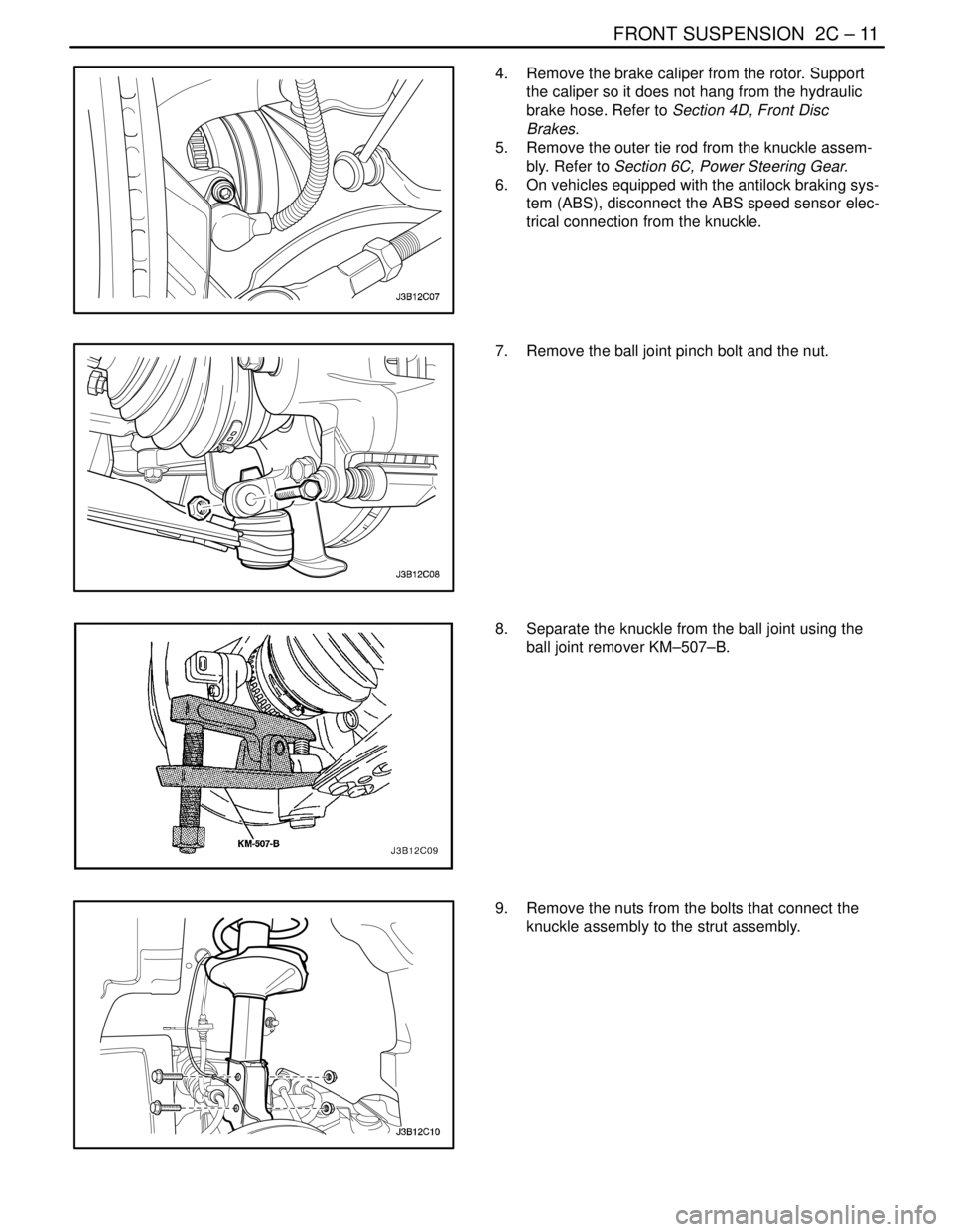
4. Remove the brake caliper from the rotor. Support
the caliper so it does not hang from the hydraulic
brake hose. Refer to Section 4D, Front Disc
Brakes.
5. Remove the outer tie rod from the knuckle assem-
bly. Refer to Section 6C, Power Steering Gear.
6. On vehicles equipped with the antilock braking sys-
tem (ABS), disconnect the ABS speed sensor elec-
trical connection from the knuckle.
7. Remove the ball joint pinch bolt and the nut.
8. Separate the knuckle from the ball joint using the
ball joint remover KM–507–B.
9. Remove the nuts from the bolts that connect the
knuckle assembly to the strut assembly.
Page 929 of 2643
2C – 12IFRONT SUSPENSION
DAEWOO V–121 BL4
Notice : Do not over extend the axle joints. When either
end of the shaft is disconnected, overextension of the joint
can result in separation of internal components and pos-
sible joint failure. Use drive axle joint seal protectors when-
ever performing service on or near the drive axles. Failure
to do so can cause internal joint or seal damage and result
in possible joint failure.
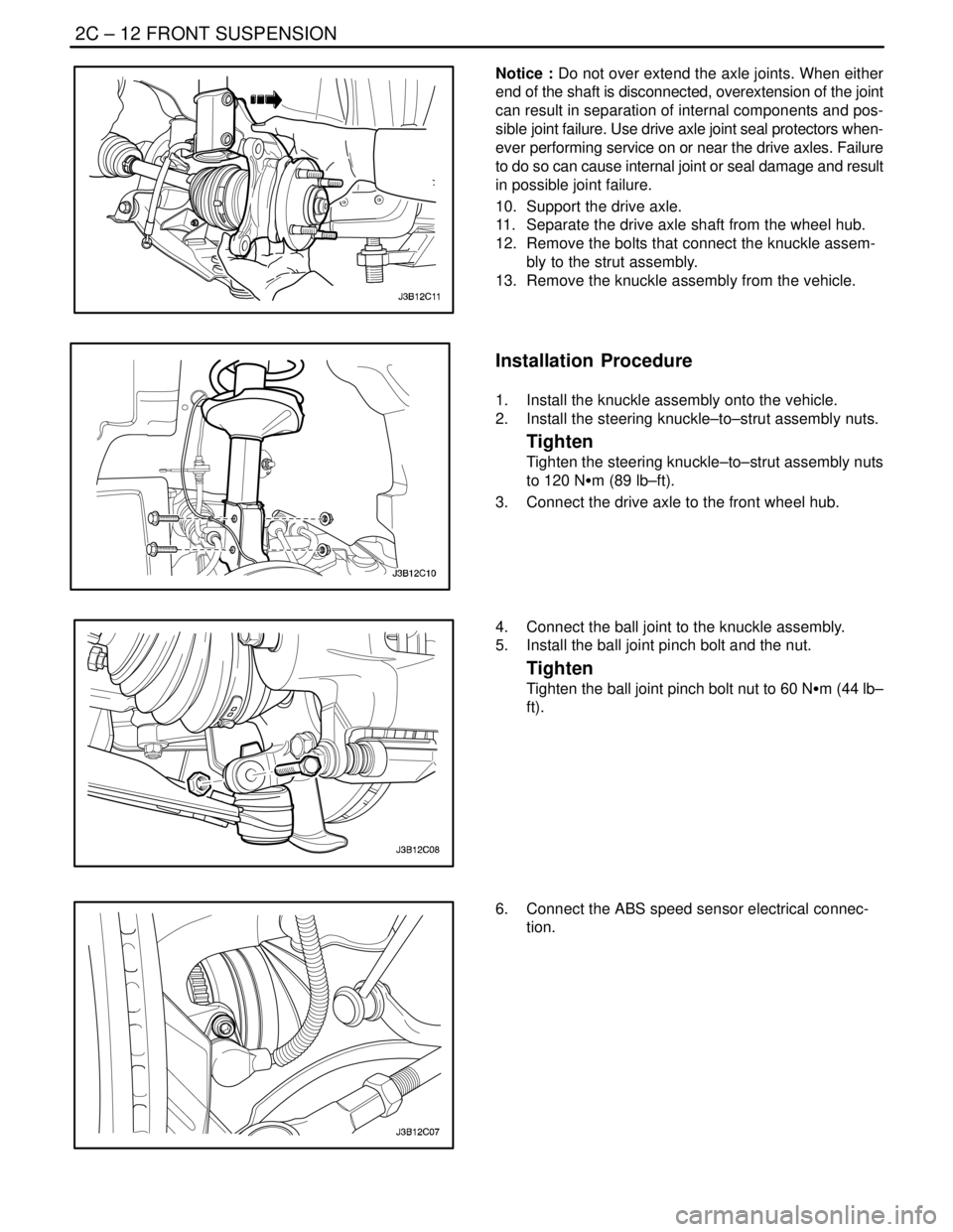
10. Support the drive axle.
11. Separate the drive axle shaft from the wheel hub.
12. Remove the bolts that connect the knuckle assem-
bly to the strut assembly.
13. Remove the knuckle assembly from the vehicle.
Installation Procedure
1. Install the knuckle assembly onto the vehicle.
2. Install the steering knuckle–to–strut assembly nuts.
Tighten
Tighten the steering knuckle–to–strut assembly nuts
to 120 NSm (89 lb–ft).
3. Connect the drive axle to the front wheel hub.
4. Connect the ball joint to the knuckle assembly.
5. Install the ball joint pinch bolt and the nut.
Tighten
Tighten the ball joint pinch bolt nut to 60 NSm (44 lb–
ft).
6. Connect the ABS speed sensor electrical connec-
tion.
Page 951 of 2643
REAR SUSPENSION 2D – 9
DAEWOO V–121 BL4
9. Install the trunk carpeting over the rear strut mount-
ing nuts. For station wagons, remove the panels
that cover the luggage compartment wheelhouse
trim panel (wagon). Refer to Section 9G, Interior
Trim.
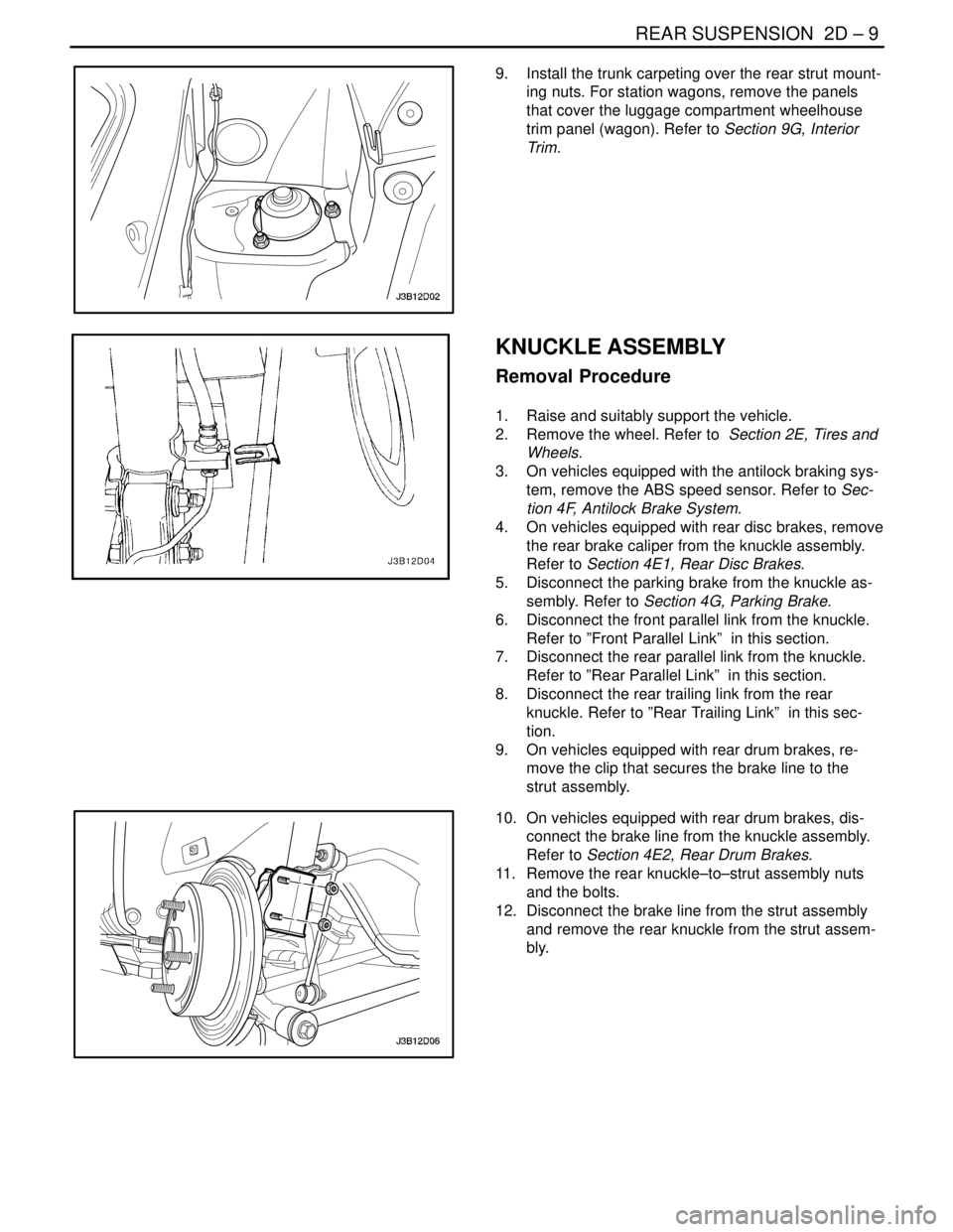
KNUCKLE ASSEMBLY
Removal Procedure
1. Raise and suitably support the vehicle.
2. Remove the wheel. Refer to Section 2E, Tires and
Wheels.
3. On vehicles equipped with the antilock braking sys-
tem, remove the ABS speed sensor. Refer to Sec-
tion 4F, Antilock Brake System.
4. On vehicles equipped with rear disc brakes, remove
the rear brake caliper from the knuckle assembly.
Refer to Section 4E1, Rear Disc Brakes.
5. Disconnect the parking brake from the knuckle as-
sembly. Refer to Section 4G, Parking Brake.
6. Disconnect the front parallel link from the knuckle.
Refer to ”Front Parallel Link” in this section.
7. Disconnect the rear parallel link from the knuckle.
Refer to ”Rear Parallel Link” in this section.
8. Disconnect the rear trailing link from the rear
knuckle. Refer to ”Rear Trailing Link” in this sec-
tion.
9. On vehicles equipped with rear drum brakes, re-
move the clip that secures the brake line to the
strut assembly.
10. On vehicles equipped with rear drum brakes, dis-
connect the brake line from the knuckle assembly.
Refer to Section 4E2, Rear Drum Brakes.
11. Remove the rear knuckle–to–strut assembly nuts
and the bolts.
12. Disconnect the brake line from the strut assembly
and remove the rear knuckle from the strut assem-
bly.
Page 952 of 2643
2D – 10IREAR SUSPENSION
DAEWOO V–121 BL4
Installation Procedure
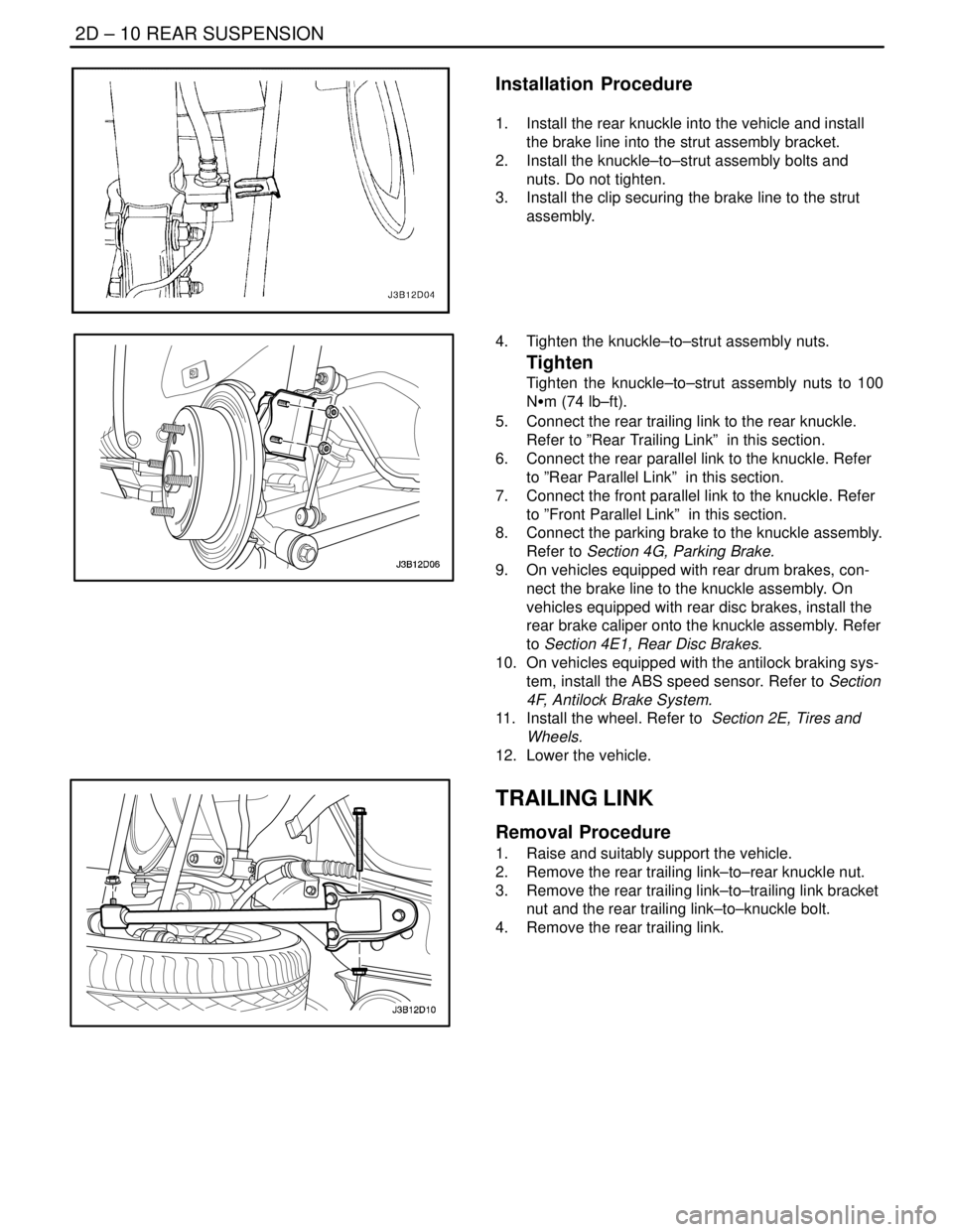
1. Install the rear knuckle into the vehicle and install
the brake line into the strut assembly bracket.
2. Install the knuckle–to–strut assembly bolts and
nuts. Do not tighten.
3. Install the clip securing the brake line to the strut
assembly.
4. Tighten the knuckle–to–strut assembly nuts.
Tighten
Tighten the knuckle–to–strut assembly nuts to 100
NSm (74 lb–ft).
5. Connect the rear trailing link to the rear knuckle.
Refer to ”Rear Trailing Link” in this section.
6. Connect the rear parallel link to the knuckle. Refer
to ”Rear Parallel Link” in this section.
7. Connect the front parallel link to the knuckle. Refer
to ”Front Parallel Link” in this section.
8. Connect the parking brake to the knuckle assembly.
Refer to Section 4G, Parking Brake.
9. On vehicles equipped with rear drum brakes, con-
nect the brake line to the knuckle assembly. On
vehicles equipped with rear disc brakes, install the
rear brake caliper onto the knuckle assembly. Refer
to Section 4E1, Rear Disc Brakes.
10. On vehicles equipped with the antilock braking sys-
tem, install the ABS speed sensor. Refer to Section
4F, Antilock Brake System.
11. Install the wheel. Refer to Section 2E, Tires and
Wheels.
12. Lower the vehicle.
TRAILING LINK
Removal Procedure
1. Raise and suitably support the vehicle.
2. Remove the rear trailing link–to–rear knuckle nut.
3. Remove the rear trailing link–to–trailing link bracket
nut and the rear trailing link–to–knuckle bolt.
4. Remove the rear trailing link.
Page 956 of 2643
2D – 14IREAR SUSPENSION
DAEWOO V–121 BL4
Installation Procedure
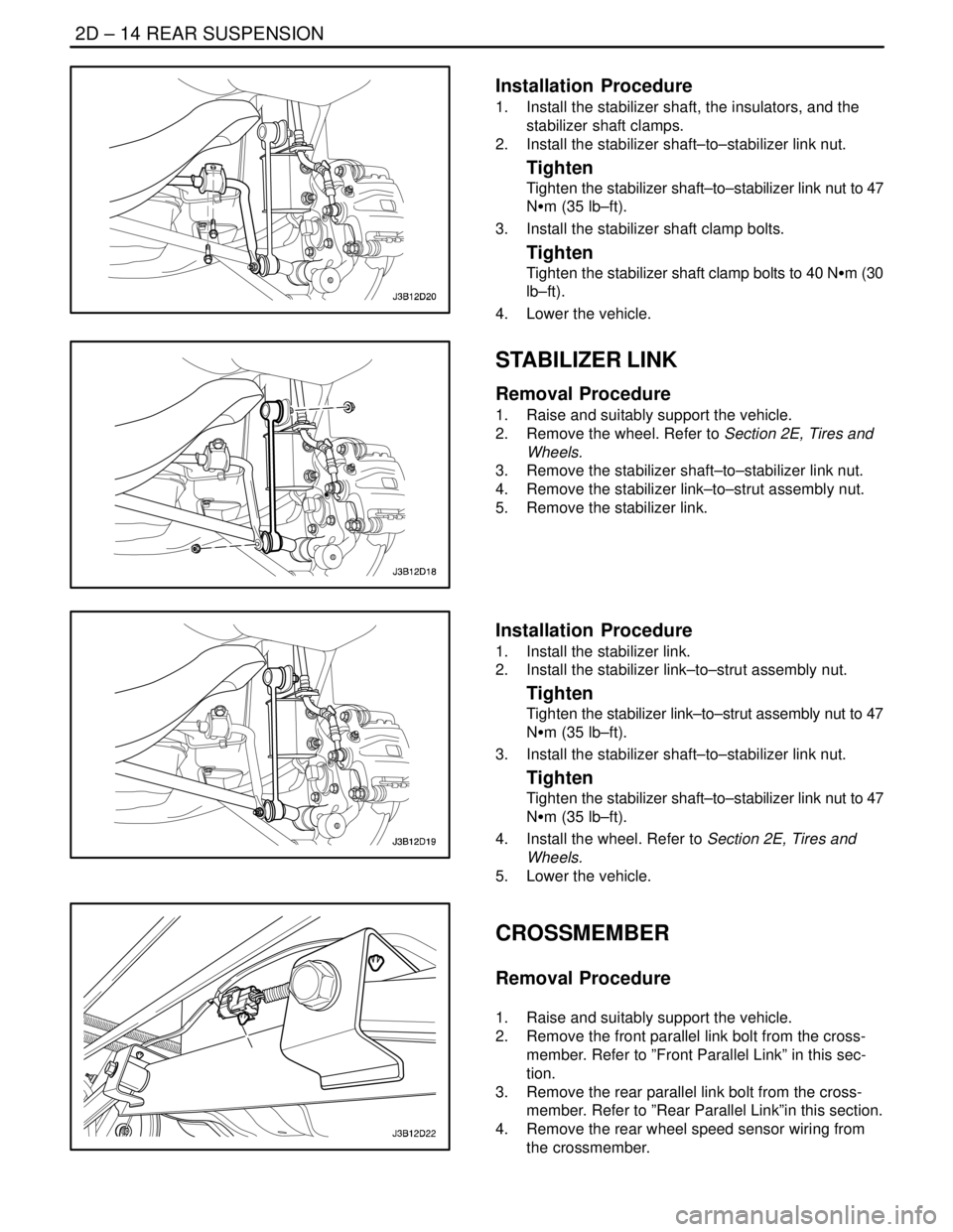
1. Install the stabilizer shaft, the insulators, and the
stabilizer shaft clamps.
2. Install the stabilizer shaft–to–stabilizer link nut.
Tighten
Tighten the stabilizer shaft–to–stabilizer link nut to 47
NSm (35 lb–ft).
3. Install the stabilizer shaft clamp bolts.
Tighten
Tighten the stabilizer shaft clamp bolts to 40 NSm (30
lb–ft).
4. Lower the vehicle.
STABILIZER LINK
Removal Procedure
1. Raise and suitably support the vehicle.
2. Remove the wheel. Refer to Section 2E, Tires and
Wheels.
3. Remove the stabilizer shaft–to–stabilizer link nut.
4. Remove the stabilizer link–to–strut assembly nut.
5. Remove the stabilizer link.
Installation Procedure
1. Install the stabilizer link.
2. Install the stabilizer link–to–strut assembly nut.
Tighten
Tighten the stabilizer link–to–strut assembly nut to 47
NSm (35 lb–ft).
3. Install the stabilizer shaft–to–stabilizer link nut.
Tighten
Tighten the stabilizer shaft–to–stabilizer link nut to 47
NSm (35 lb–ft).
4. Install the wheel. Refer to Section 2E, Tires and
Wheels.
5. Lower the vehicle.
CROSSMEMBER
Removal Procedure
1. Raise and suitably support the vehicle.
2. Remove the front parallel link bolt from the cross-
member. Refer to ”Front Parallel Link” in this sec-
tion.
3. Remove the rear parallel link bolt from the cross-
member. Refer to ”Rear Parallel Link”in this section.
4. Remove the rear wheel speed sensor wiring from
the crossmember.
Page 957 of 2643
REAR SUSPENSION 2D – 15
DAEWOO V–121 BL4
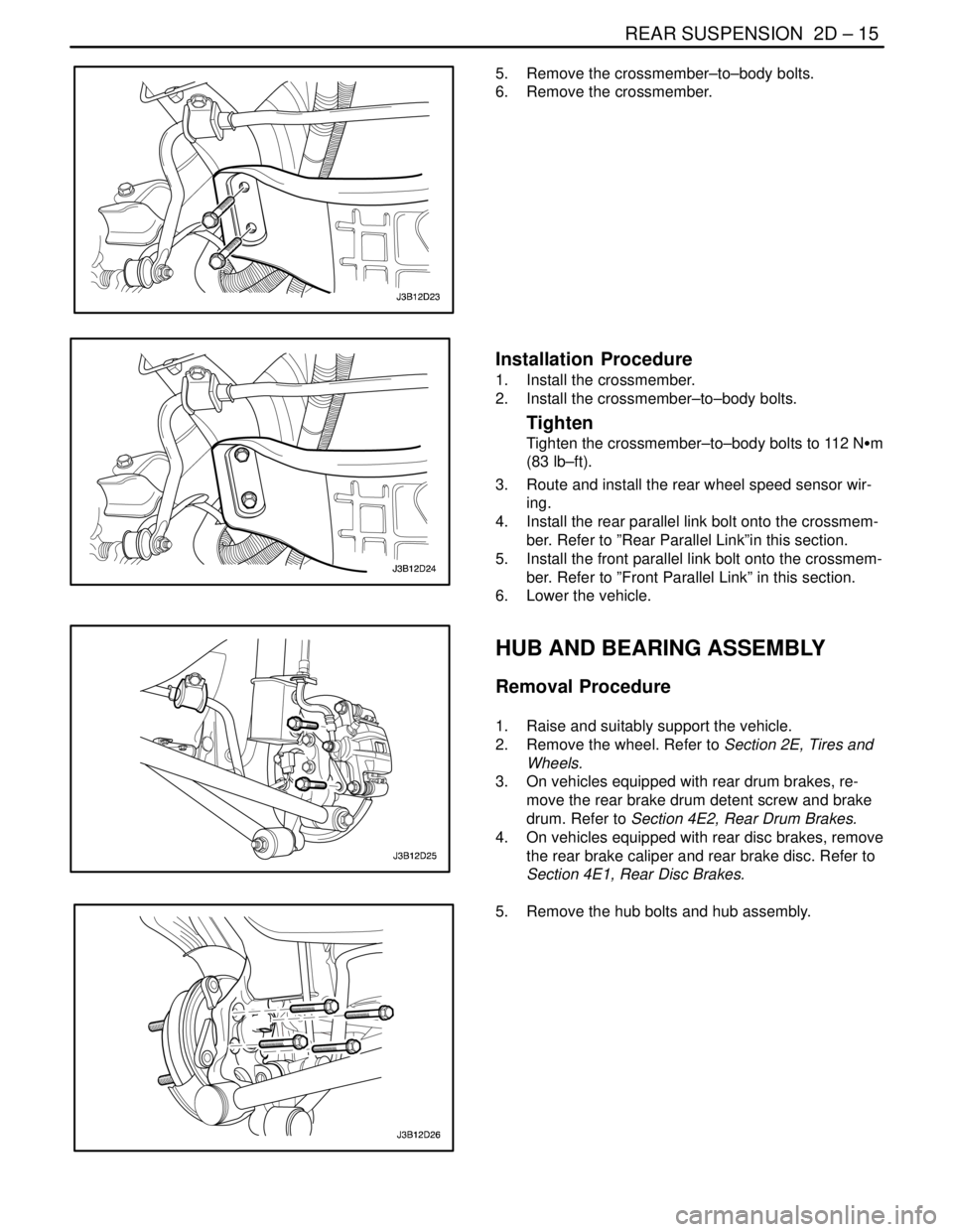
5. Remove the crossmember–to–body bolts.
6. Remove the crossmember.
Installation Procedure
1. Install the crossmember.
2. Install the crossmember–to–body bolts.
Tighten
Tighten the crossmember–to–body bolts to 112 NSm
(83 lb–ft).
3. Route and install the rear wheel speed sensor wir-
ing.
4. Install the rear parallel link bolt onto the crossmem-
ber. Refer to ”Rear Parallel Link”in this section.
5. Install the front parallel link bolt onto the crossmem-
ber. Refer to ”Front Parallel Link” in this section.
6. Lower the vehicle.
HUB AND BEARING ASSEMBLY
Removal Procedure
1. Raise and suitably support the vehicle.
2. Remove the wheel. Refer to Section 2E, Tires and
Wheels.
3. On vehicles equipped with rear drum brakes, re-
move the rear brake drum detent screw and brake
drum. Refer to Section 4E2, Rear Drum Brakes.
4. On vehicles equipped with rear disc brakes, remove
the rear brake caliper and rear brake disc. Refer to
Section 4E1, Rear Disc Brakes.
5. Remove the hub bolts and hub assembly.
Page 1077 of 2643
4E2 – 8IREAR DRUM BRAKES
DAEWOO V–121 BL4
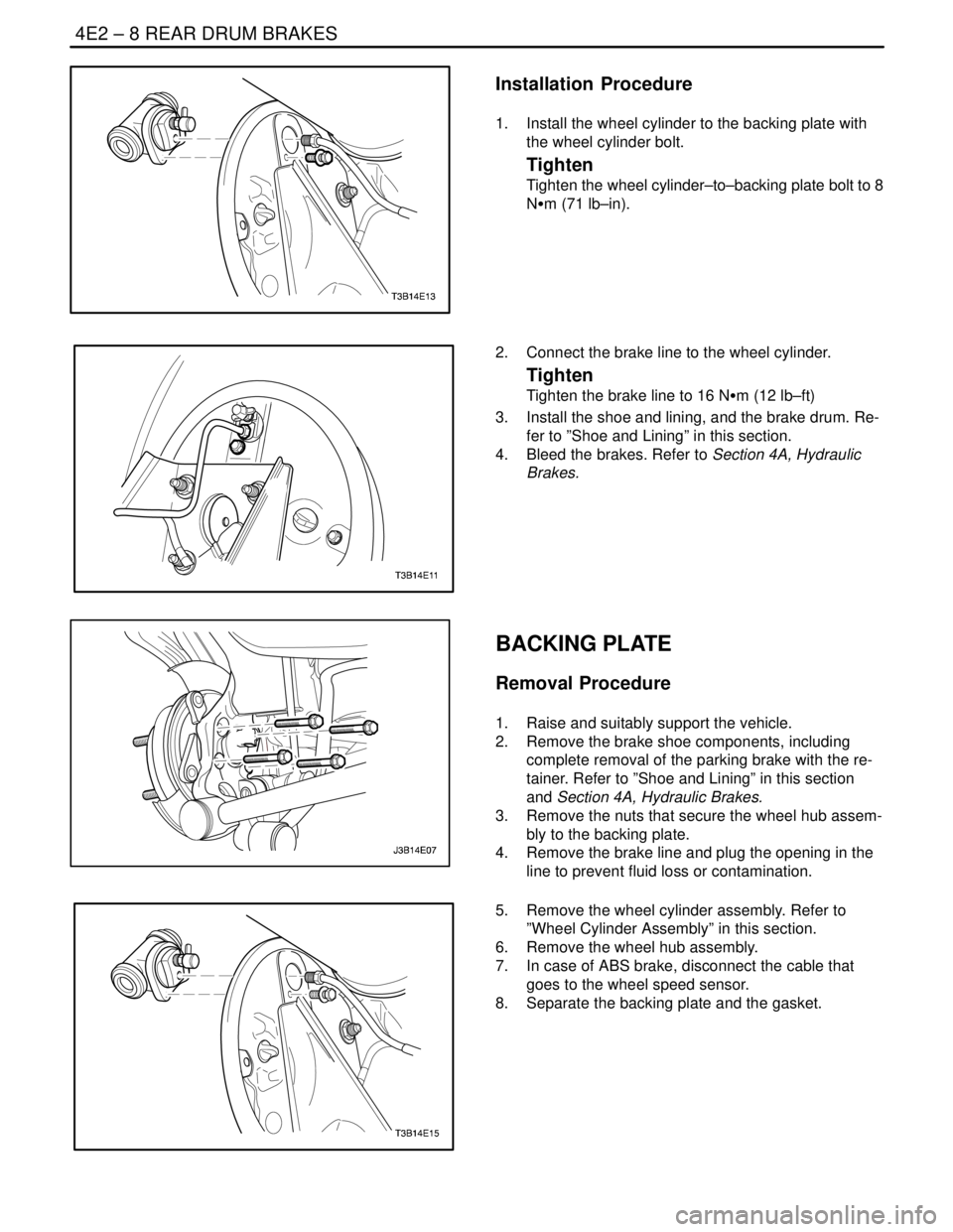
Installation Procedure
1. Install the wheel cylinder to the backing plate with
the wheel cylinder bolt.
Tighten
Tighten the wheel cylinder–to–backing plate bolt to 8
NSm (71 lb–in).
2. Connect the brake line to the wheel cylinder.
Tighten
Tighten the brake line to 16 NSm (12 lb–ft)
3. Install the shoe and lining, and the brake drum. Re-
fer to ”Shoe and Lining” in this section.
4. Bleed the brakes. Refer to Section 4A, Hydraulic
Brakes.
BACKING PLATE
Removal Procedure
1. Raise and suitably support the vehicle.
2. Remove the brake shoe components, including
complete removal of the parking brake with the re-
tainer. Refer to ”Shoe and Lining” in this section
and Section 4A, Hydraulic Brakes.
3. Remove the nuts that secure the wheel hub assem-
bly to the backing plate.
4. Remove the brake line and plug the opening in the
line to prevent fluid loss or contamination.
5. Remove the wheel cylinder assembly. Refer to
”Wheel Cylinder Assembly” in this section.
6. Remove the wheel hub assembly.
7. In case of ABS brake, disconnect the cable that
goes to the wheel speed sensor.
8. Separate the backing plate and the gasket.