Points DAEWOO LACETTI 2004 Service User Guide
[x] Cancel search | Manufacturer: DAEWOO, Model Year: 2004, Model line: LACETTI, Model: DAEWOO LACETTI 2004Pages: 2643, PDF Size: 80.54 MB
Page 1588 of 2643
ZF 4 HP 16 AUTOMATIC TRANSAXLE 5A1 – 239
DAEWOO V–121 BL4
S Excessive transaxle fluid leaking into the connector,
wicking up into the external wiring harness, and
degrading the wire insulation.
S Water/moisture intrusion in the connector.
S Low pin retention in the external connector from
excessive connection and disconnection of the wir-
ing connector assembly.
S Pin corrosion from contamination.
S Broken/cracked connector assembly.
S Points to remember when working with transaxle
wiring connector assembly.
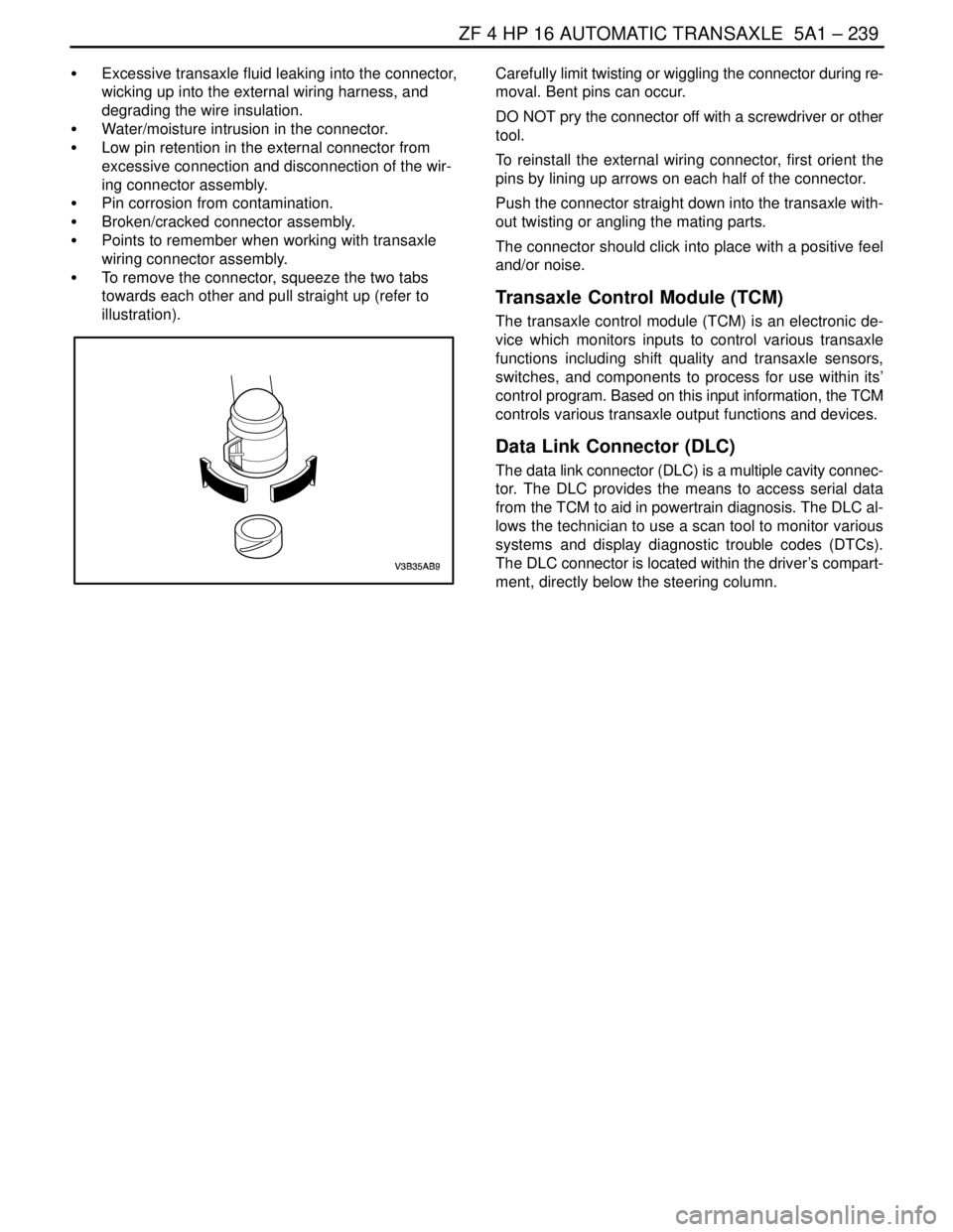
S To remove the connector, squeeze the two tabs
towards each other and pull straight up (refer to
illustration).Carefully limit twisting or wiggling the connector during re-
moval. Bent pins can occur.
DO NOT pry the connector off with a screwdriver or other
tool.
To reinstall the external wiring connector, first orient the
pins by lining up arrows on each half of the connector.
Push the connector straight down into the transaxle with-
out twisting or angling the mating parts.
The connector should click into place with a positive feel
and/or noise.
Transaxle Control Module (TCM)
The transaxle control module (TCM) is an electronic de-
vice which monitors inputs to control various transaxle
functions including shift quality and transaxle sensors,
switches, and components to process for use within its’
control program. Based on this input information, the TCM
controls various transaxle output functions and devices.
Data Link Connector (DLC)
The data link connector (DLC) is a multiple cavity connec-
tor. The DLC provides the means to access serial data
from the TCM to aid in powertrain diagnosis. The DLC al-
lows the technician to use a scan tool to monitor various
systems and display diagnostic trouble codes (DTCs).
The DLC connector is located within the driver’s compart-
ment, directly below the steering column.
Page 1808 of 2643
5A2 – 218IAISIN AUTOMATIC TRANSAXLE
DAEWOO V–121 BL4
GENERAL DESCRIPTION
AND SYSTEM OPERATION
TRANSAXLE DESCRIPTION
The new automatic transmission is an electronically con-
trolled 4–speed automatic transmission with Lock–up
mechanism.
The transmission is mainly composed of the torque con-
verter with lock up clutch, newly developed 4–speed plan-
etary gear unit, the hydraulic control system and the elec-
tric control system.
ELECTRONICAL COMPONENTS
Transmission Control Module (TCM)
The TCM primarily controls shift points and lockup en-
gagement. It is located on the driver side under the instru-
ment panel.
The transmission is controlled by an electronic shift sys-
tem. The Transmission Control Module (TCM) processes
input signals. From the information received, the TCM
controls the transmission hydraulic system.
The electronic shift system consists of the following :
S Transmission control module (TCM)
S Shift solenoids (SS1 and SS2)
S Pressure control solenoid (PCS)
S Lockup solenoid
S Input shaft speed (ISS) sensor
S Output shaft speed (OSS) sensor
S Transmission Fluid Temperature (TFT) sensor
S Transmission Range (TR) Switch
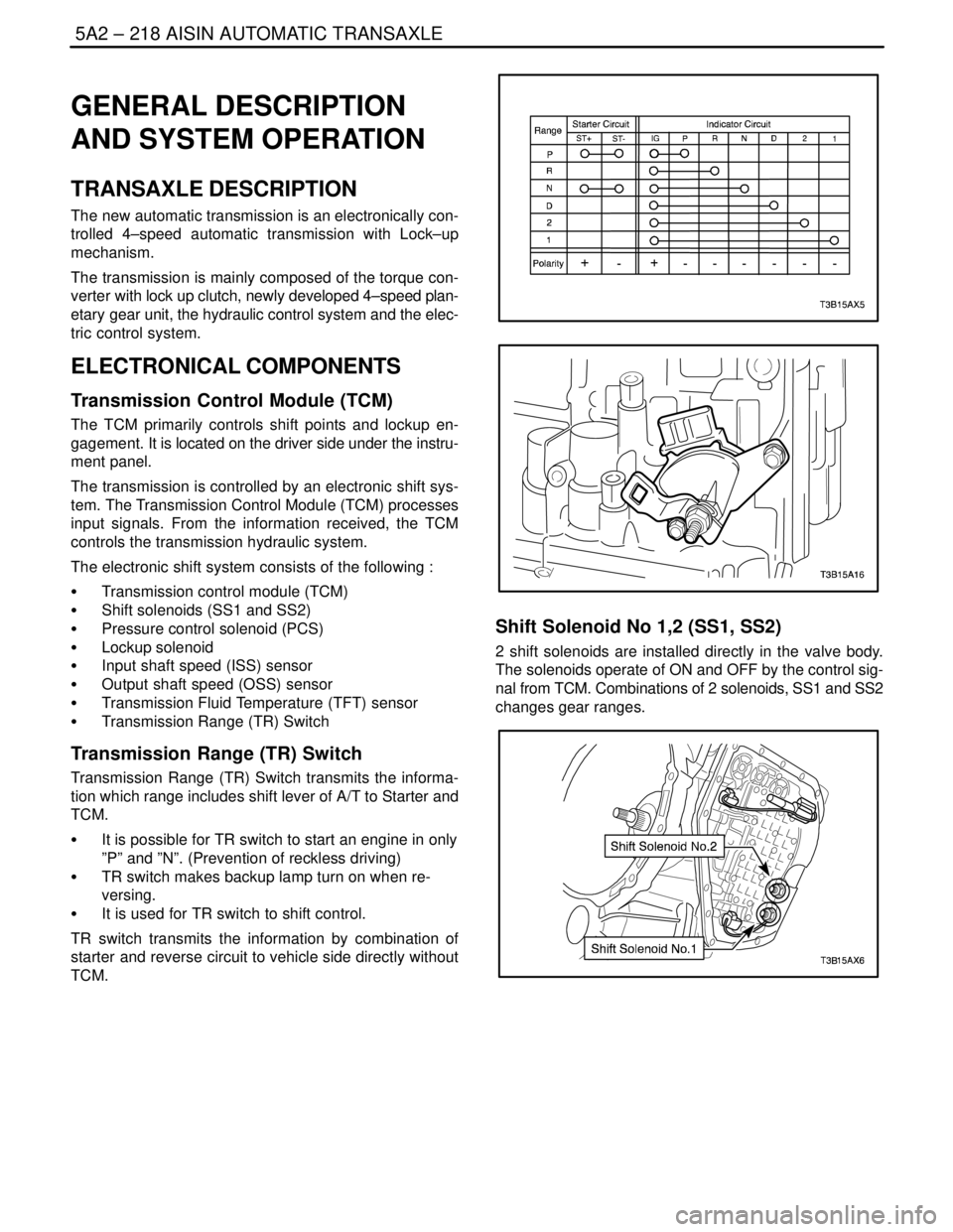
Transmission Range (TR) Switch
Transmission Range (TR) Switch transmits the informa-
tion which range includes shift lever of A/T to Starter and
TCM.
S It is possible for TR switch to start an engine in only
”P” and ”N”. (Prevention of reckless driving)
S TR switch makes backup lamp turn on when re-
versing.
S It is used for TR switch to shift control.
TR switch transmits the information by combination of
starter and reverse circuit to vehicle side directly without
TCM.
Shift Solenoid No 1,2 (SS1, SS2)
2 shift solenoids are installed directly in the valve body.
The solenoids operate of ON and OFF by the control sig-
nal from TCM. Combinations of 2 solenoids, SS1 and SS2
changes gear ranges.
Page 1809 of 2643
AISIN AUTOMATIC TRANSAXLE 5A2 – 219
DAEWOO V–121 BL4
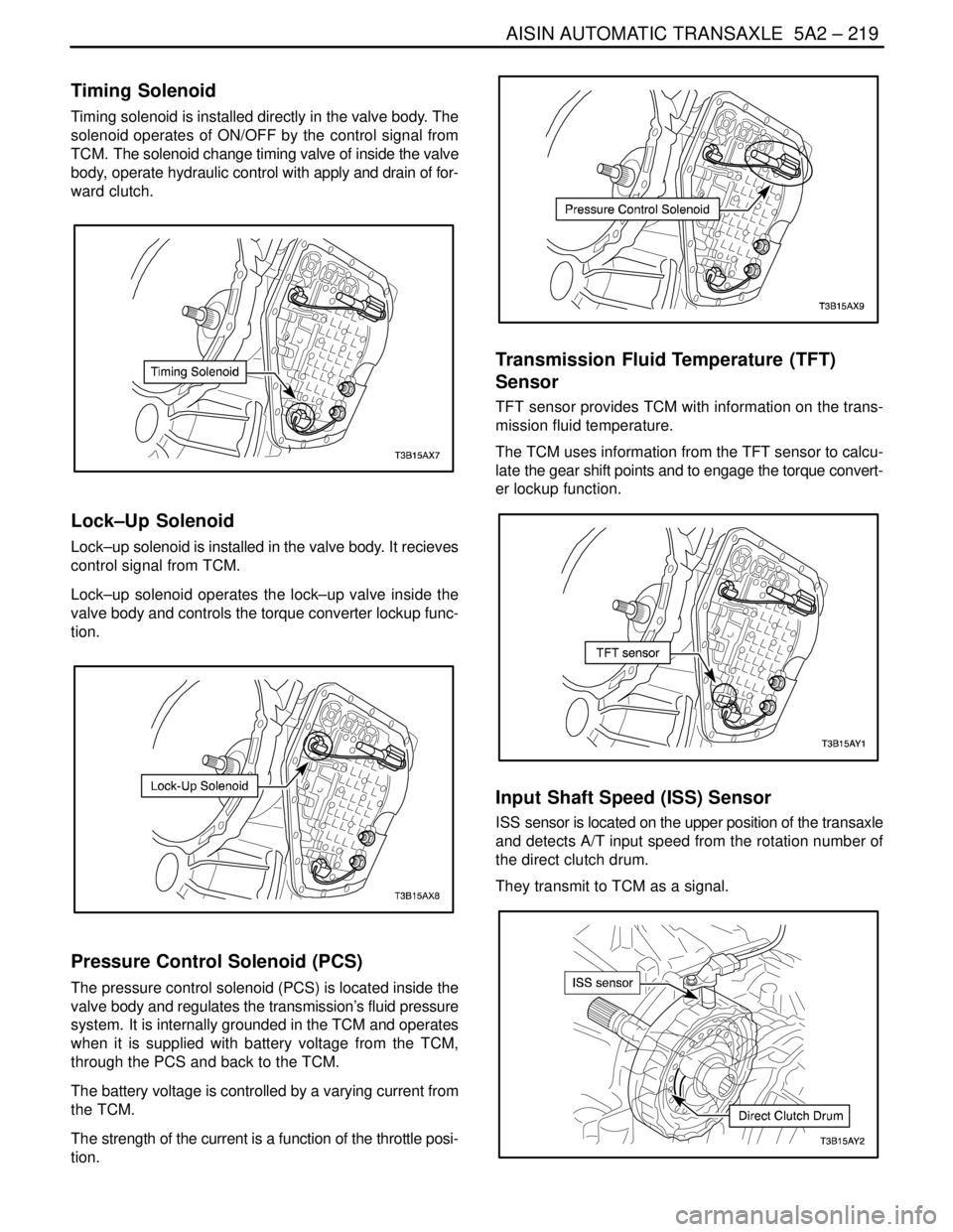
Timing Solenoid
Timing solenoid is installed directly in the valve body. The
solenoid operates of ON/OFF by the control signal from
TCM. The solenoid change timing valve of inside the valve
body, operate hydraulic control with apply and drain of for-
ward clutch.
Lock–Up Solenoid
Lock–up solenoid is installed in the valve body. It recieves
control signal from TCM.
Lock–up solenoid operates the lock–up valve inside the
valve body and controls the torque converter lockup func-
tion.
Pressure Control Solenoid (PCS)
The pressure control solenoid (PCS) is located inside the
valve body and regulates the transmission’s fluid pressure
system. It is internally grounded in the TCM and operates
when it is supplied with battery voltage from the TCM,
through the PCS and back to the TCM.
The battery voltage is controlled by a varying current from
the TCM.
The strength of the current is a function of the throttle posi-
tion.
Transmission Fluid Temperature (TFT)
Sensor
TFT sensor provides TCM with information on the trans-
mission fluid temperature.
The TCM uses information from the TFT sensor to calcu-
late the gear shift points and to engage the torque convert-
er lockup function.
Input Shaft Speed (ISS) Sensor
ISS sensor is located on the upper position of the transaxle
and detects A/T input speed from the rotation number of
the direct clutch drum.
They transmit to TCM as a signal.
Page 1922 of 2643

POWER STEERING GEAR 6C – 5
DAEWOO V–121 BL4
POWER RACK AND PINION
STEERING GEAR BENCH TESTING
Removal, Setup and Testing Procedure
Notice : Pressure checks or pressure and flow checks
may also be conducted using this set–up.
1. Disconnect and remove the power steering gear.
Refer to ”Rack and Pinion Assembly” in this sec-
tion.
2. Place the power steering gear on a bench next to
the vehicle.
3. Disconnect the pressure line at the point where the
hose connects to the pipe. Extend this line in order
to reach the power steering gear on the bench.
4. Disconnect the return line from the the power steer-
ing fluid reservoir. Extend this line in order to reach
the power steering gear on the bench.
5. Connect the power steering pipes to the power
steering gear.6. Start the engine and allow it to idle for 10 seconds.
7. Check the power steering fluid level. Refer to Sec-
tion 6A, Power Steering System.
8. Start the engine and turn the rack and pinion stub
shaft to a full turn in each direction. Hold the shaft
against each stop for 5 seconds.
9. Inspect for possible leak points. Refer to Section
6A, Power Steering System.
Installation Procedure
1. Stop the engine.
2. Disconnect the power steering pipes from the pow-
er steering gear.
3. Remove the extensions and reconnect the pressure
and return lines.
4. Install and connect the power steering gear. Refer
to ”Rack and Pinion Assembly” in this section.
5. Start the engine and stay idle for 10 seconds.
6. Check the power steering fluid level. Refer to Sec-
tion 6A, Power Steering System.
Page 1974 of 2643

6E – 20ISTEERING WHEEL AND COLUMN
DAEWOO V–121 BL4
GENERAL DESCRIPTION
AND SYSTEM OPERATION
STEERING WHEEL AND COLUMN
CAUTION : To ensure the energy–absorbing action of
the steering column, it is important to use only the
specified screws, bolts, and nuts, tightened to the
specified torque.
In addition to the steering function, the steering column
provides safety and security.
The energy–absorbing column is designed to compress in
a front–end collision to lessen the chance of driver injury.
The ignition switch and the lock are mounted on the col-
umn, allowing the ignition and steering operations to be
locked to inhibit theft of the car.
The column levers trigger the turn signals, the headlight
beams, and the windshield washer and wipers.The tilt steering column uses telescopic function to allow
the steering wheel to tilt up and down in and out. This en-
ables the driver to adjust the steering wheel to a comfort-
able position.
Notice : Apply a thin coat of lithium grease to all friction
points when reassembling.
The column may be disassembled and reassembled easi-
ly.IGNITION KEY REMINDER
The ignition key reminder alerts the driver that the key is
still in the ignition when the driver attempts to exit the ve-
hicle.
An internal switch in the ignition lock cylinder supplies bat-
tery voltage to the reminder chime module when all of the
following conditions are true:
S The key is in the ignition switch.
S The ignition is OFF.
S The driver’s door is open.
For information on removal and installation of the reminder
chime module, refer to Section 9E, Instrumentation/Driver
Information.
Page 2193 of 2643

SUPPLEMENTAL INFLATABLE RESTRAINTS (SIR) 8B – 89
DAEWOO V–121 BL4
HANDLING, INSTALLATION AND
DIAGNOSIS
S Airbag modules should not be subjected to temper-
ature above 65 degrees Celsius(149 degrees Fahr-
enheit).
S An airbag and SDM should not be used if it has
been dropped from height of 0.9 meters(3 feet) or
greater.
S When an SDM is replaced, it must be oriented with
the arrow on the SDM pointing toward the front of
the vehicle.
S It is very important for the SDM to be installed flat
on the mounting surface, parallel to the vehicle’s
longitudinal axis.
S To avoid setting diagnostic trouble codes(DTCs), do
not apply power to the SIR unless all components
are connected or a diagnostic chart request it.
S The SIR Diagnostic System Check must be the
starting point of any SIR diagnostics. The SIR Diag-
nostic System Check will verify proper airbag indi-
cator operation and will lead you to correct chart to
diagnose any SIR malfunctions. Bypassing these
procedures may result in extended diagnostic time
incorrect parts replacement.
REPAIRS AND INSPECTIONS
REQUIRED AFTER AN ACCIDENT
CAUTION : Any repairs to the vehicle’s structure
must return it to the original production configu-
ration. Deployment requires replacement of
SDM, the inflator modules and a dimensional in-
spection of the steering column.
S If any SIR components are damaged, they must be
replaced. If SIR components mounting points are
damaged, they must be repaired or replaced.
S Never use SIR parts from another vehicle. This
does not include remanufactured parts purchased
from an authorized source.
S Do not attempt to service the SDM, the clock spring
or other airbag modules, these items must be re-
placed if they are defective.
S Verify the part number of replaced airbag modules.
Some inflator modules look identical but contain
different internal components.
Page 2194 of 2643

8B – 90ISUPPLEMENTAL INFLATABLE RESTRAINTS (SIR)
DAEWOO V–121 BL4
ACCIDENT WITH DEPLOYMENT
COMPONENTS REPLACEMENTS
All SIR components must be replaced after frontal
crash involving airbag deployment. After deployment,
a powdery residue may be on the surface of the air-
bag. The powder consists primarily of corn-
starch(used to lubricate the bag as it inflates) and by–
products of the chemical reaction. The sodium
hydroxide then quickly reacts with atmospheric mois-
ture and is converted to sodium bicarbonate(also
known as baking soda). Therefore, it is unlikely that
sodium hydroxide will be present after deployment.
Replace the following SIR components.
CAUTION : Wear gloves and safely glasses dur-
ing the disposal procedure. Refer to ”Deployed
airbag module disposal procedure” in this sec-
tion.
S The SDM
S Airbag modules and pretensioners
S SIR wiring
S Clock spring
ACCIDENT WITHOUT DEPLOYMENT
COMPONENT INSPECTION
Certain inspection must be performed after any
crash, whether the airbag has deployed or not. :
S The steering column must be dimensionally in-
spected.
S Inspect the knee bolsters and mounting points for
distortion, bending and cracking or other damages.
S Inspect the instrument panel(I/P) and steering col-
umn reinforcement plate for distorsion, bending and
cracking or other damage.
S Inspect the I/P braces for distortion, bending and
cracking or other damage.
S Inspect the seat belt and mounting points. Refer to
Section 8A, Seat Belts.
SENSING AND DIAGNOSTIC
MODULE (SDM)
CAUTION : During service procedure, be very
careful when handling the SDM. Never strike or
jar the SDM. Never power the supplemental inflat-
able restraints(SIR) when the SDM is not rigidly
attached to the vehicle. All SDM mounting bolts
must be carefully tightened , and the arrow on the
SDM must be point toward the front of the vehicle
to ensure proper operation of the SIR. The SDM
could be activated if it is powered when it is not
rigidly attached to the vehicle, resulting in unex-
pected deployment and possible injury.
Page 2506 of 2643

NUBIRA/LACETTISERVICE NOTICE 0–3
1. HOW TO USE THIS MANUAL
.
This manual covers the repairs of NUBIRA/LACETTI
automobile which has been involved in accidents, and it
describes the work related to the replacement of dam-
aged body parts.
Please read through these instructions and familiarize
yourself with them before actually using this manual.
.
Note : Refer to NUBIRA/LACETTI Service Manual for
specifications, wire harness locations, safety stand sup-
port points, etc.
2. SPECIAL INFORMATION
.
Indicates a strong possibility of personal injury or equip-
ment damage if instructions are not followed.
.
Note : Gives helpful information.
.
CAUTION : Detailed descriptions of standard work-
shop procedures, safety principles and service op-
erations are not included. Please note that this manu-
al does contain warnings and cautions against some
specific service methods which could cause PER-
SONAL INJURY, or could damage a vehicle or make
it unsafe. Please understand that these warnings can-
not cover all conceivable ways in which service,
whether or not recommended by GM DAEWOO might
be done or of the possible hazardous consequences
of each conceivable way, not could GM DAEWOO in-
vestigate all such ways. Anyone using service proce-
dures or tools, whether or not recommended by GM
DAEWOO, must satisfy himself thoroughly that nei-
ther personal safety or tools, whether or not recom-
mended by GM DAEWOO, must satisfy himself thor-
oughly that neither personal safety or vehicle safety
will be jeopardized.
.
All information contained in this manual is based on the
latest product information available at the time of print-
ing. We reserve the right to make changes at any time
without notice. No part of this publication may be repro-
duced, stored in retrieval system, or transmitted, in any
form by any means, electronic, mechanical, photocopy-
ing, recording, or otherwise, without the prior written
permission of the publisher. This includes text, figures
and tables.
Page 2521 of 2643

NUBIRA/LACETTI PREPARATIONS OF BODYWORK 2–1
SECTION 2
PREPARATIONS OF BODYWORK
CONTENTS
1. GENERAL DESCRIPTION 2 – 2. . . . . . . . . . . . . . . . . . . . . . . . . . . . . . . . . . . . . . . . . . .
2. CHECKPOINTS 2 – 4. . . . . . . . . . . . . . . . . . . . . . . . . . . . . . . . . . . . . . . . . . . . . . . . . . . .
3. CORRECTION OF THE DAMAGED AREA 2 – 5. . . . . . . . . . . . . . . . . . . . . . . . . . . .
4. MEASURING SYSTEMS (WITHOUT SMALL DAMAGE) 2 – 6. . . . . . . . . . . . . . . .
Page 2524 of 2643

2–4 PREPARATIONS OF BODYWORK NUBIRA/LACETTI
2. CHECKPOINTS
S Accurate Inspection of Damaged Parts(Visual)
.
Seat Belts
Always replace the seat belt if :
1. The belt material is cut, punctured, burned or in any
way damaged.
2. The buckle or retractor does not work properly.
3. They were being worn at the time of a collision(also
check for damage at the seat belt anchor points).
4. Their condition is questionable.
.
Front Section :
1. Is there any bending, splitting, denting or other dam-
age to the suspension and its related parts?
2. Is there any deformation of the front panel or radiator
crossmember? Have any of the connected sections
come apart?
3. Are there any creases or distortion in the front wheel-
house or side frame? Have any of the connected sec-
tions come apart?
4. Is there any bending or twisting of the whole front
area?
5. Is there any deformation like creases, bulges, or dents
in the front pillar, dash panel, floor, etc.?
6. Is there any vertical twisting or misaligned clearance
in the door?
7. Is the windshield seal broken?
8. Is there any deformation in the vicinity of the top part
of the roof panel’s center pillar?
9. Is there any damage inside the automobile(is there
any twisting of the dash panel, or anything irregular with
the clearances or sheet–mounting parts)?
10. Is there any damage to the steering wheel? Is there
any deformation in the column and the column–mounted
parts?
11. Is there any oil or water leakage and damage to the en-
gine, transmission or brakes?
12. Is there any irregular noise in the gear changing opera-
tion, engine and transmission rotation?
13. Are there any traces of contact between the engine
block and the center crossmember ?
14. Is there any damage to brake or fuel lines, or wire har-
nesses?Rear Section :
1. Is there any twisting, bulging or denting of the rear floor
any rear bolsters? Have any of the connected sections
come apart?
2. Is there any irregular bulging or denting in the rear
fender?
3. Is there any distortion in the rear inner panel? Is there
any bending and denting in the vicinity of the rear pillar?
4. Is there any distortion or creasing is the rear wheel-
house and arch sections? Have any of the connected
sections come apart?
5. Is there anything irregular in the rear glass seal clear-
ance?
6. Is there any twisting or misalignment of the clearance
of the trunk lid opening section?
7. Is there any bending, splitting, denting or other dam-
age to the suspension and its related parts?
8. Is there any deformation of the rear floor crossmem-
ber, trunk floor panel and back panel? Have any of the
connected sections come apart?
.
Impact Beam :
Always replace the door assembly if :
1. The external force makes the impact beam of door in-
ner deform.
Always replace impact beam if :
2. The external force makes the impact beam of front
bumper and rear bumper deform.