horn DAEWOO LACETTI 2004 Service User Guide
[x] Cancel search | Manufacturer: DAEWOO, Model Year: 2004, Model line: LACETTI, Model: DAEWOO LACETTI 2004Pages: 2643, PDF Size: 80.54 MB
Page 1966 of 2643
6E – 12ISTEERING WHEEL AND COLUMN
DAEWOO V–121 BL4
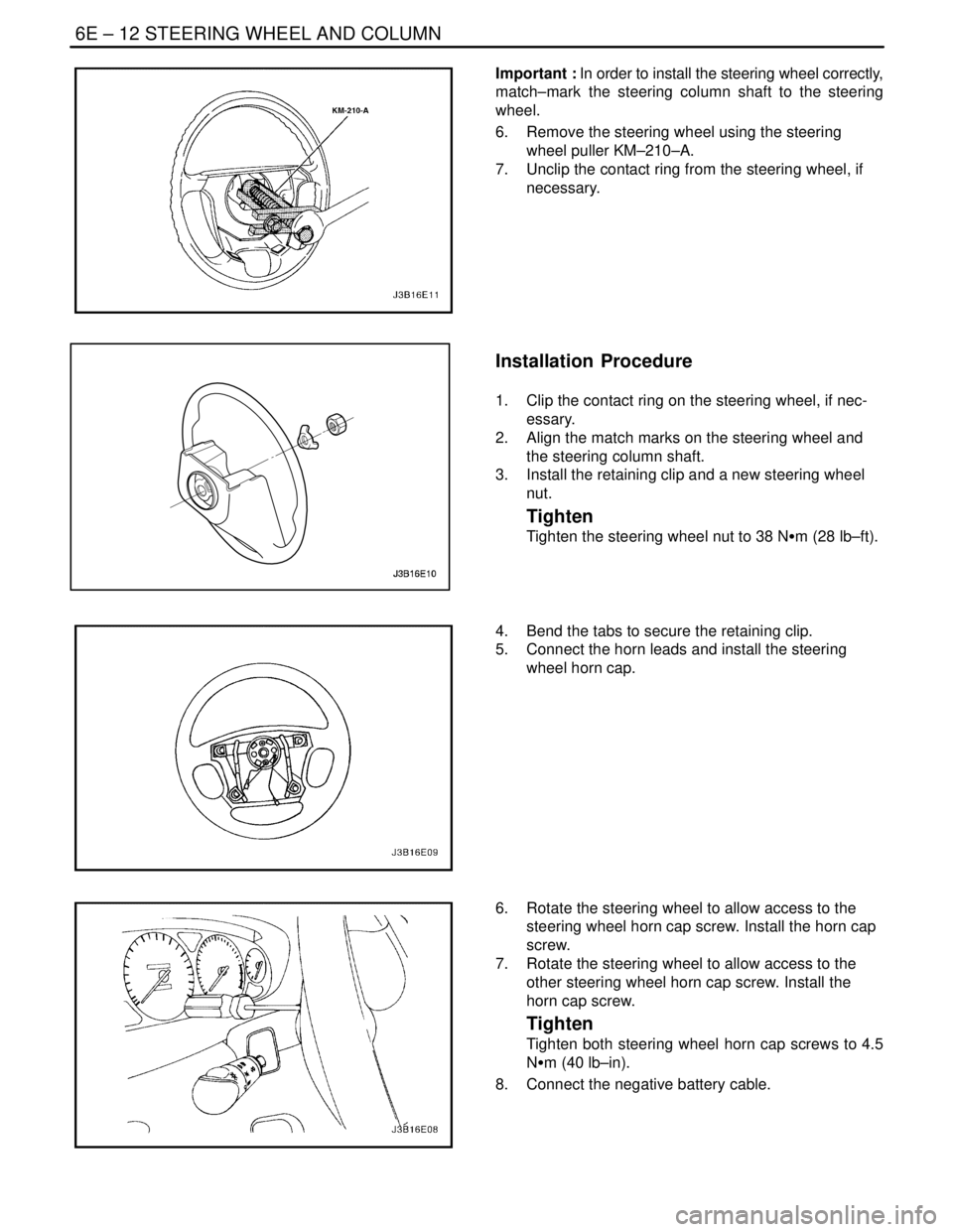
Important : In order to install the steering wheel correctly,
match–mark the steering column shaft to the steering
wheel.
6. Remove the steering wheel using the steering
wheel puller KM–210–A.
7. Unclip the contact ring from the steering wheel, if
necessary.
Installation Procedure
1. Clip the contact ring on the steering wheel, if nec-
essary.
2. Align the match marks on the steering wheel and
the steering column shaft.
3. Install the retaining clip and a new steering wheel
nut.
Tighten
Tighten the steering wheel nut to 38 NSm (28 lb–ft).
4. Bend the tabs to secure the retaining clip.
5. Connect the horn leads and install the steering
wheel horn cap.
6. Rotate the steering wheel to allow access to the
steering wheel horn cap screw. Install the horn cap
screw.
7. Rotate the steering wheel to allow access to the
other steering wheel horn cap screw. Install the
horn cap screw.
Tighten
Tighten both steering wheel horn cap screws to 4.5
NSm (40 lb–in).
8. Connect the negative battery cable.
Page 2197 of 2643
SUPPLEMENTAL INFLATABLE RESTRAINTS (SIR) 8B – 93
DAEWOO V–121 BL4
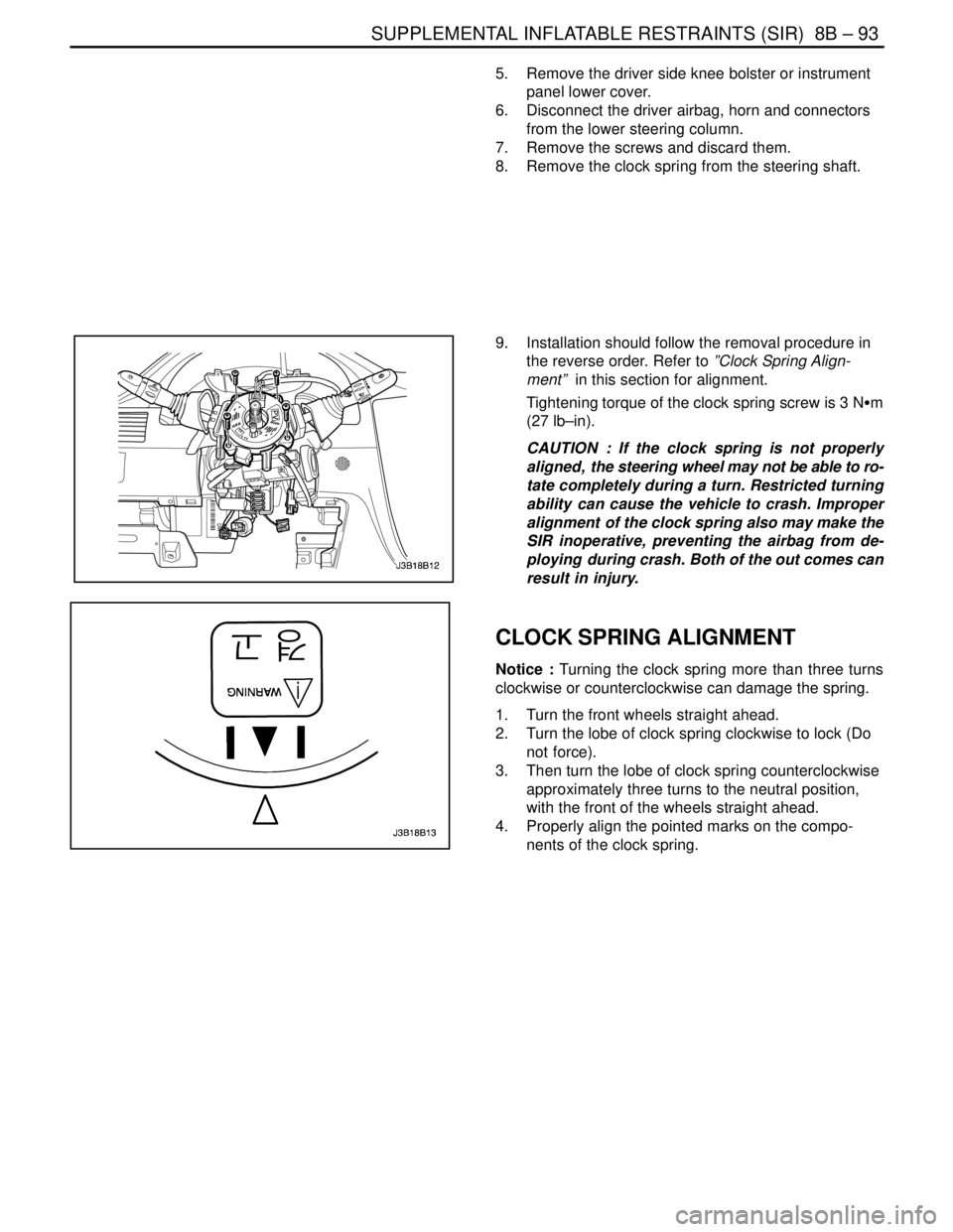
5. Remove the driver side knee bolster or instrument
panel lower cover.
6. Disconnect the driver airbag, horn and connectors
from the lower steering column.
7. Remove the screws and discard them.
8. Remove the clock spring from the steering shaft.
9. Installation should follow the removal procedure in
the reverse order. Refer to ”Clock Spring Align-
ment” in this section for alignment.
Tightening torque of the clock spring screw is 3 NSm
(27 lb–in).
CAUTION : If the clock spring is not properly
aligned, the steering wheel may not be able to ro-
tate completely during a turn. Restricted turning
ability can cause the vehicle to crash. Improper
alignment of the clock spring also may make the
SIR inoperative, preventing the airbag from de-
ploying during crash. Both of the out comes can
result in injury.
CLOCK SPRING ALIGNMENT
Notice : Turning the clock spring more than three turns
clockwise or counterclockwise can damage the spring.
1. Turn the front wheels straight ahead.
2. Turn the lobe of clock spring clockwise to lock (Do
not force).
3. Then turn the lobe of clock spring counterclockwise
approximately three turns to the neutral position,
with the front of the wheels straight ahead.
4. Properly align the pointed marks on the compo-
nents of the clock spring.
Page 2206 of 2643
8B – 102ISUPPLEMENTAL INFLATABLE RESTRAINTS (SIR)
DAEWOO V–121 BL4
spring should never be disassembled, and there is no
timekeeping function. The clock spring contains two or
three current–carrying coils. One of the current–carrying
coils maintains continuous contact within the driver de-
ployment loop while the steering wheel is rotated. The
clock spring also contains coils that maintain continuous
contact for horn and remote audio control switch circuit.
Turning the steering wheel in one direction tightens the
coil, and turning the steering wheel in the opposite direc-
tion loosens the coil. Do not turn the clock spring when the
steering wheel is not attached. Refer to ”Clock Spring” in
this section for proper installation of the clock spring.
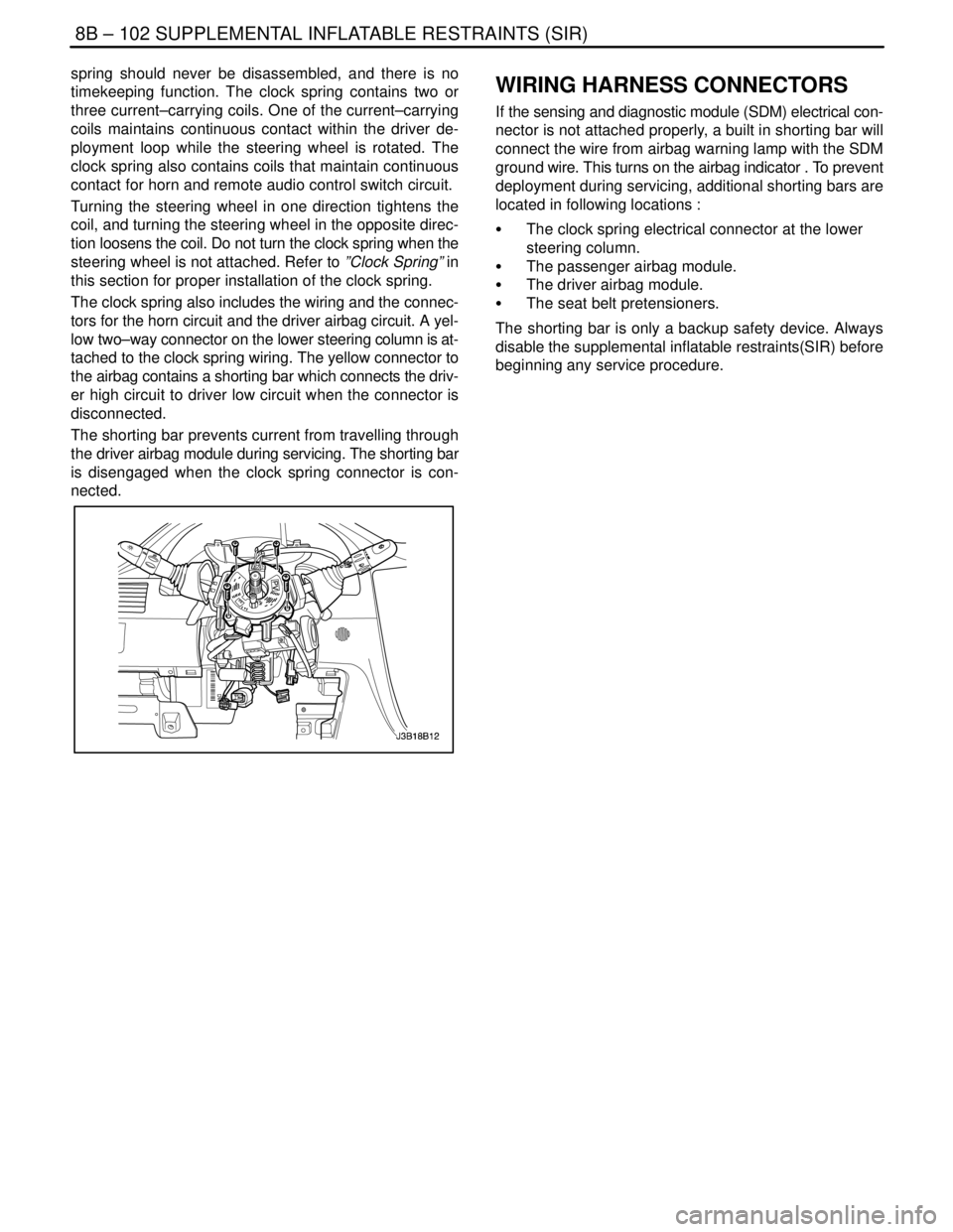
The clock spring also includes the wiring and the connec-
tors for the horn circuit and the driver airbag circuit. A yel-
low two–way connector on the lower steering column is at-
tached to the clock spring wiring. The yellow connector to
the airbag contains a shorting bar which connects the driv-
er high circuit to driver low circuit when the connector is
disconnected.
The shorting bar prevents current from travelling through
the driver airbag module during servicing. The shorting bar
is disengaged when the clock spring connector is con-
nected.WIRING HARNESS CONNECTORS
If the sensing and diagnostic module (SDM) electrical con-
nector is not attached properly, a built in shorting bar will
connect the wire from airbag warning lamp with the SDM
ground wire. This turns on the airbag indicator . To prevent
deployment during servicing, additional shorting bars are
located in following locations :
S The clock spring electrical connector at the lower
steering column.
S The passenger airbag module.
S The driver airbag module.
S The seat belt pretensioners.
The shorting bar is only a backup safety device. Always
disable the supplemental inflatable restraints(SIR) before
beginning any service procedure.
Page 2219 of 2643

BODY WIRING SYSTEM 9A – 13
DAEWOO V–121 BL4
FUSE CHART
Engine Room Fuse Block
FuseRating/SourceCircuit
EF130AB+Battery Main (F13~F16, F21~F24)
EF260AB+EBCM, Oil Feeding Connector
EF330AB+Blower Relay
EF430AB+Ignition Switch–2
EF530AB+Ignition Switch–1
EF620AB+Cooling Fan Low Relay
EF730AB+Defog Relay
EF830AB+Cooling Fan HI Relay
EF920AIGN 2Power Window Switch
EF1015AIGN 1Fuel Connector, ECM (MR–140), LEGR, EI Sys-
tem
EF1110AB+ECM, Main Relay (Sirius D4)
EF1225AB+Head Lamp Relay, ILLUM. Relay
EF1315AB+Brake Switch
EF1420AIGN 2Power Window Switch
EF1515ALightHead Lamp HI
EF1615AB+Horn Relay, Siren, Hood Contact Switch
EF1710AB+A/C Comp. Relay
EF1815AIGN 1Fuel Pump
EF1915AB+Cluster, Key Remind S/W, Folding Mirror Unit,
MAP Lamp, Room Lamp, Trunk Open Lamp,
Trunk Open S/W
EF2010ALightHead Lamp Low
EF2115AIGN 1/B+EVAP Canister Purge Solenoid, HO2S, Cooling
Fan Relay
EF2215AIGN 1/B+Injector, EGR, EEGR
EF2310AIlluminationLicense Plate Lamp, Chime Bell, Tail Lamp,
Head Lamp
EF2415AB+Fog LampRelay
EF2510AIGN 2Electric OSRV Mirror
EF2615AB+Central Door Lock Unit
EF2710ALightHead Lamp Low
EF2810AIlluminationILLUM. Circuit, Head Lamp, Tail Lamp
EF2910ASpareNot Used
EF3015ASpareNot Used
EF3125ASpareNot Used
Page 2274 of 2643

SECTION : 9C
HORN(S)
CAUTION : Disconnect the negative battery cable before removing or installing any electrical unit or when a tool
or equipment could easily come in contact with exposed electrical terminals. Disconnecting this cable will help
prevent personal injury and damage to the vehicle. The ignition must also be in LOCK unless otherwise noted.
TABLE OF CONTENTS
SPECIFICATIONS9C–1 . . . . . . . . . . . . . . . . . . . . . . . . . .
Fastener Tightening Specifications 9C–1. . . . . . . . . . .
SCHEMATIC AND ROUTING DIAGRAMS9C–2 . . . . .
Horn Wiring System 9C–2. . . . . . . . . . . . . . . . . . . . . . . .
MAINTENANCE AND REPAIR9C–3 . . . . . . . . . . . . . . . ON–VEHICLE SERVICE 9C–3. . . . . . . . . . . . . . . . . . . . .
Horn(s) 9C–3. . . . . . . . . . . . . . . . . . . . . . . . . . . . . . . . . . .
GENERAL DESCRIPTION AND SYSTEM
OPERATION9C–4 . . . . . . . . . . . . . . . . . . . . . . . . . . . . . .
Horn(s) 9C–4. . . . . . . . . . . . . . . . . . . . . . . . . . . . . . . . . . .
SPECIFICATIONS
FASTENER TIGHTENING SPECIFICATIONS
ApplicationNSmLb–FtLb–In
Horn Bolt2015–
Page 2275 of 2643
9C – 2IHORN(S)
DAEWOO V–121 BL4
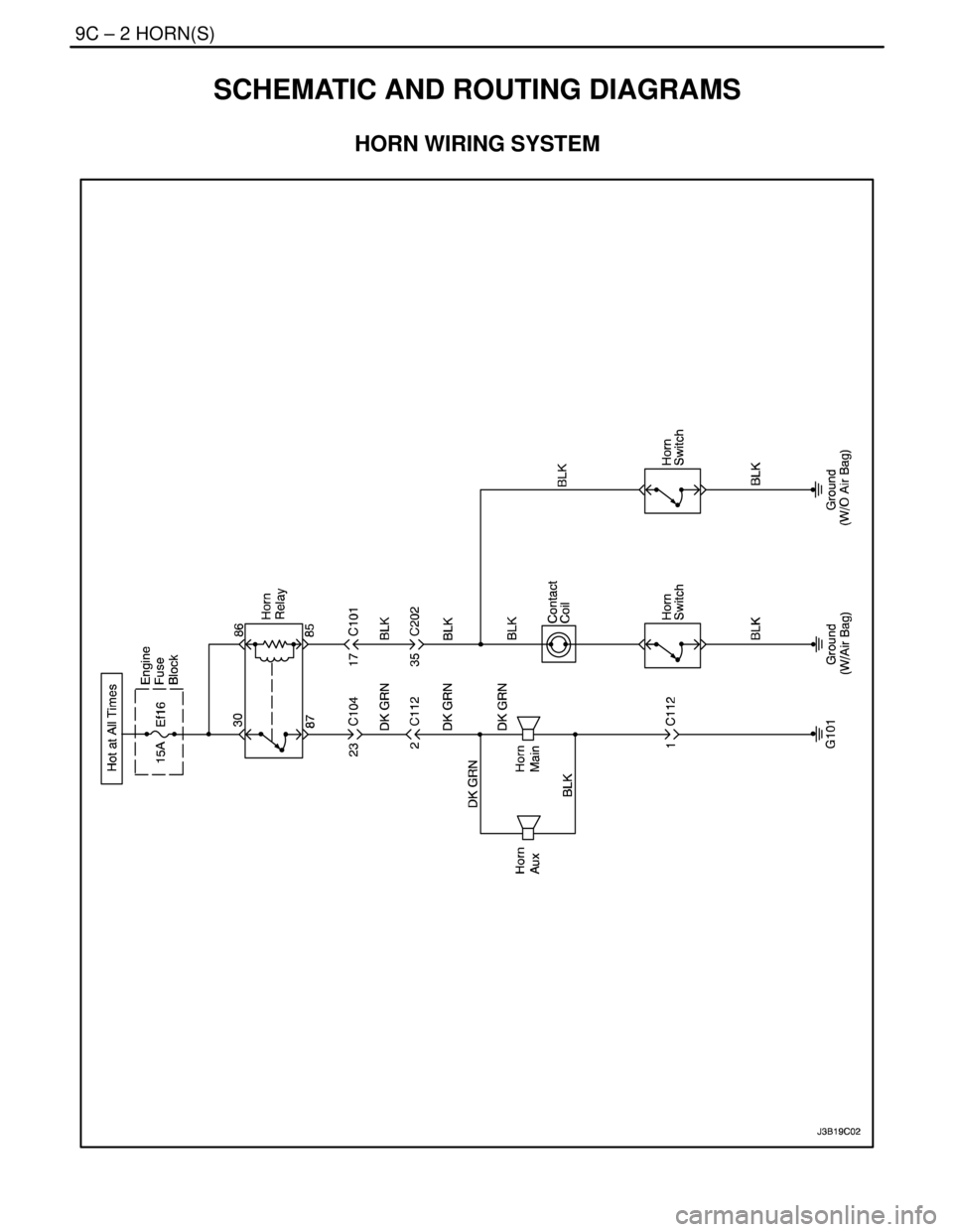
SCHEMATIC AND ROUTING DIAGRAMS
HORN WIRING SYSTEM
Page 2276 of 2643
HORN(S) 9C – 3
DAEWOO V–121 BL4
MAINTENANCE AND REPAIR
ON–VEHICLE SERVICE
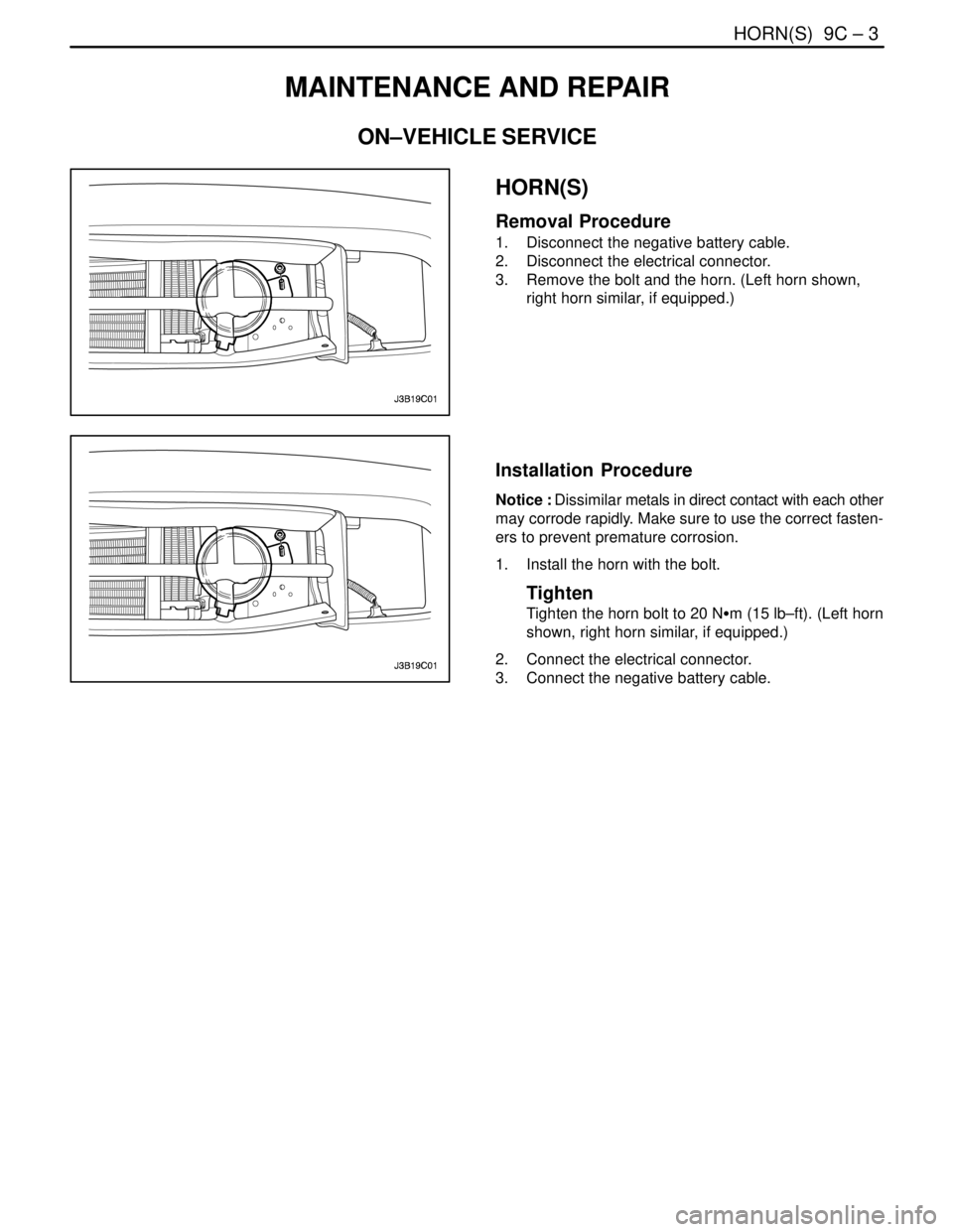
HORN(S)
Removal Procedure
1. Disconnect the negative battery cable.
2. Disconnect the electrical connector.
3. Remove the bolt and the horn. (Left horn shown,
right horn similar, if equipped.)
Installation Procedure
Notice : Dissimilar metals in direct contact with each other
may corrode rapidly. Make sure to use the correct fasten-
ers to prevent premature corrosion.
1. Install the horn with the bolt.
Tighten
Tighten the horn bolt to 20 NSm (15 lb–ft). (Left horn
shown, right horn similar, if equipped.)
2. Connect the electrical connector.
3. Connect the negative battery cable.
Page 2277 of 2643

9C – 4IHORN(S)
DAEWOO V–121 BL4
GENERAL DESCRIPTION
AND SYSTEM OPERATION
HORN(S)
The horns are located under the hood. They are attached
near the radiator at the front of the vehicle. The horns are
actuated by pressing the steering wheel pad, which
grounds the horns’ electrical circuit.