valve vacuum DAEWOO LACETTI 2004 Service User Guide
[x] Cancel search | Manufacturer: DAEWOO, Model Year: 2004, Model line: LACETTI, Model: DAEWOO LACETTI 2004Pages: 2643, PDF Size: 80.54 MB
Page 464 of 2643
1F – 218IENGINE CONTROLS
DAEWOO V–121 BL4
DIAGNOSTIC TROUBLE CODE (DTC) P0400
EXHAUST GAS RECIRCULATION OUT OF LIMIT
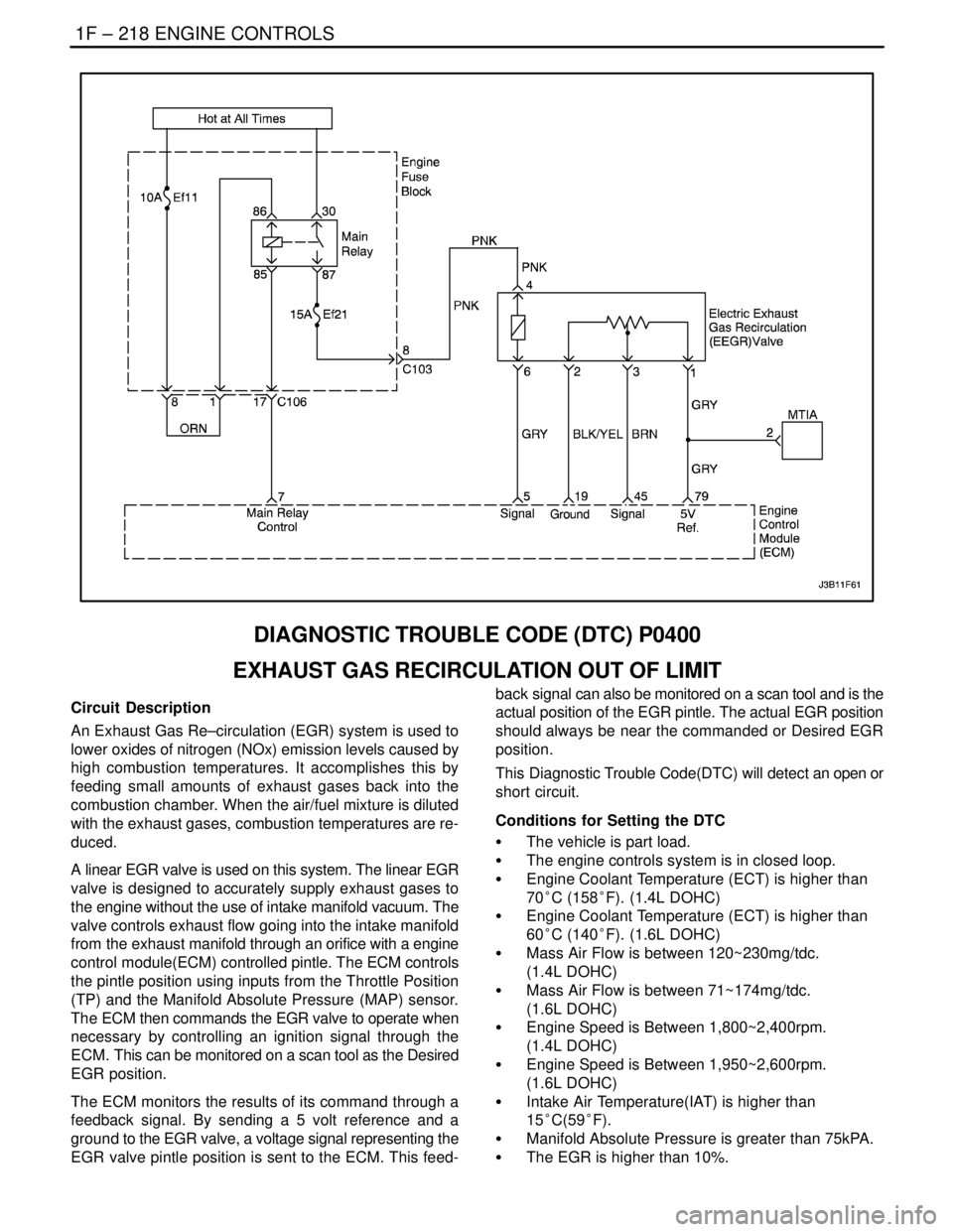
Circuit Description
An Exhaust Gas Re–circulation (EGR) system is used to
lower oxides of nitrogen (NOx) emission levels caused by
high combustion temperatures. It accomplishes this by
feeding small amounts of exhaust gases back into the
combustion chamber. When the air/fuel mixture is diluted
with the exhaust gases, combustion temperatures are re-
duced.
A linear EGR valve is used on this system. The linear EGR
valve is designed to accurately supply exhaust gases to
the engine without the use of intake manifold vacuum. The
valve controls exhaust flow going into the intake manifold
from the exhaust manifold through an orifice with a engine
control module(ECM) controlled pintle. The ECM controls
the pintle position using inputs from the Throttle Position
(TP) and the Manifold Absolute Pressure (MAP) sensor.
The ECM then commands the EGR valve to operate when
necessary by controlling an ignition signal through the
ECM. This can be monitored on a scan tool as the Desired
EGR position.
The ECM monitors the results of its command through a
feedback signal. By sending a 5 volt reference and a
ground to the EGR valve, a voltage signal representing the
EGR valve pintle position is sent to the ECM. This feed-back signal can also be monitored on a scan tool and is the
actual position of the EGR pintle. The actual EGR position
should always be near the commanded or Desired EGR
position.
This Diagnostic Trouble Code(DTC) will detect an open or
short circuit.
Conditions for Setting the DTC
S The vehicle is part load.
S The engine controls system is in closed loop.
S Engine Coolant Temperature (ECT) is higher than
70°C (158°F). (1.4L DOHC)
S Engine Coolant Temperature (ECT) is higher than
60°C (140°F). (1.6L DOHC)
S Mass Air Flow is between 120~230mg/tdc.
(1.4L DOHC)
S Mass Air Flow is between 71~174mg/tdc.
(1.6L DOHC)
S Engine Speed is Between 1,800~2,400rpm.
(1.4L DOHC)
S Engine Speed is Between 1,950~2,600rpm.
(1.6L DOHC)
S Intake Air Temperature(IAT) is higher than
15°C(59°F).
S Manifold Absolute Pressure is greater than 75kPA.
S The EGR is higher than 10%.
Page 467 of 2643
ENGINE CONTROLS 1F – 221
DAEWOO V–121 BL4
DIAGNOSTIC TROUBLE CODE (DTC) P0404
EXHAUST GAS RECIRCULATION OPENED
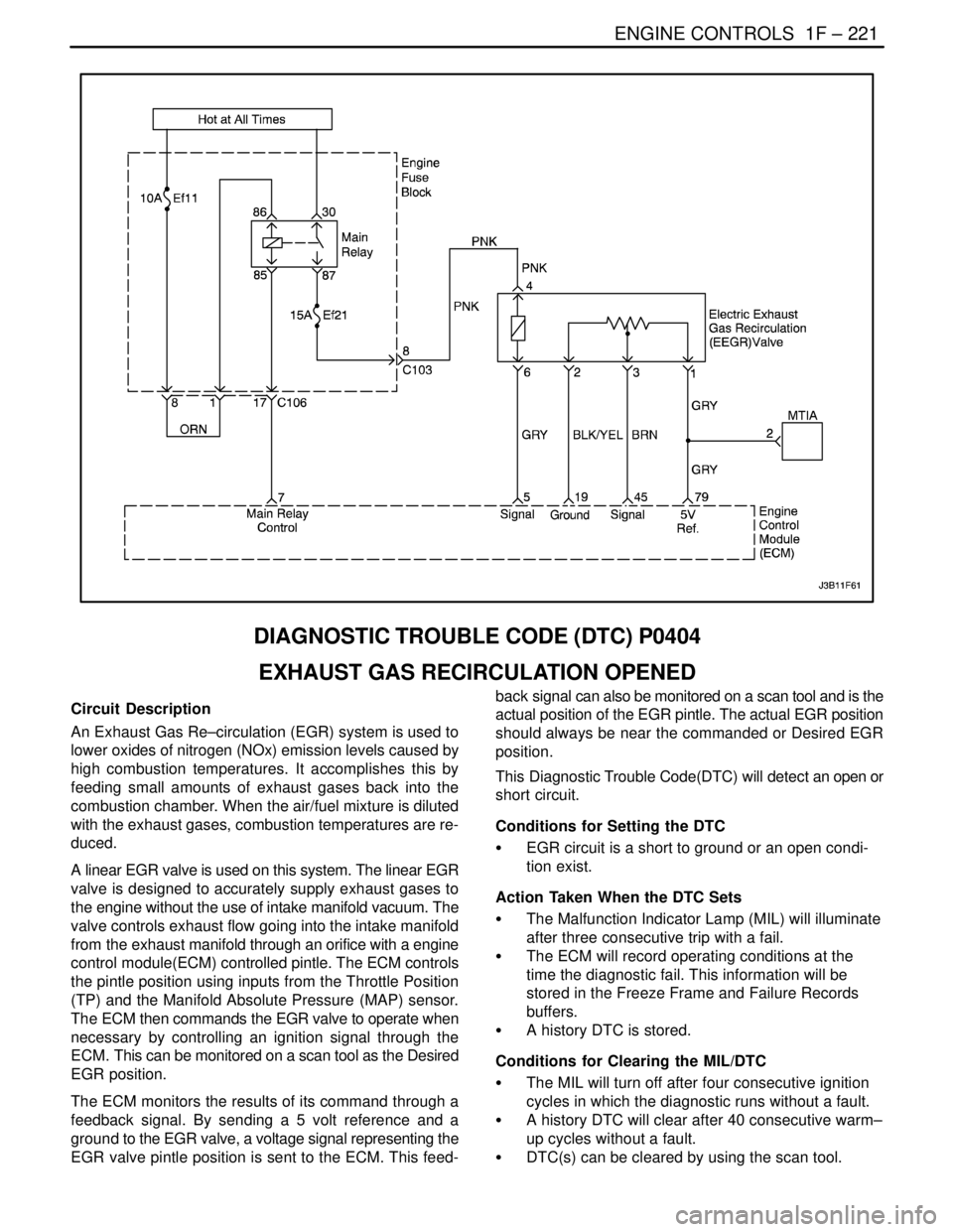
Circuit Description
An Exhaust Gas Re–circulation (EGR) system is used to
lower oxides of nitrogen (NOx) emission levels caused by
high combustion temperatures. It accomplishes this by
feeding small amounts of exhaust gases back into the
combustion chamber. When the air/fuel mixture is diluted
with the exhaust gases, combustion temperatures are re-
duced.
A linear EGR valve is used on this system. The linear EGR
valve is designed to accurately supply exhaust gases to
the engine without the use of intake manifold vacuum. The
valve controls exhaust flow going into the intake manifold
from the exhaust manifold through an orifice with a engine
control module(ECM) controlled pintle. The ECM controls
the pintle position using inputs from the Throttle Position
(TP) and the Manifold Absolute Pressure (MAP) sensor.
The ECM then commands the EGR valve to operate when
necessary by controlling an ignition signal through the
ECM. This can be monitored on a scan tool as the Desired
EGR position.
The ECM monitors the results of its command through a
feedback signal. By sending a 5 volt reference and a
ground to the EGR valve, a voltage signal representing the
EGR valve pintle position is sent to the ECM. This feed-back signal can also be monitored on a scan tool and is the
actual position of the EGR pintle. The actual EGR position
should always be near the commanded or Desired EGR
position.
This Diagnostic Trouble Code(DTC) will detect an open or
short circuit.
Conditions for Setting the DTC
S EGR circuit is a short to ground or an open condi-
tion exist.
Action Taken When the DTC Sets
S The Malfunction Indicator Lamp (MIL) will illuminate
after three consecutive trip with a fail.
S The ECM will record operating conditions at the
time the diagnostic fail. This information will be
stored in the Freeze Frame and Failure Records
buffers.
S A history DTC is stored.
Conditions for Clearing the MIL/DTC
S The MIL will turn off after four consecutive ignition
cycles in which the diagnostic runs without a fault.
S A history DTC will clear after 40 consecutive warm–
up cycles without a fault.
S DTC(s) can be cleared by using the scan tool.
Page 470 of 2643
1F – 224IENGINE CONTROLS
DAEWOO V–121 BL4
DIAGNOSTIC TROUBLE CODE (DTC) P0405
EGR PINTLE POSITION SENSOR LOW VOLTAGE
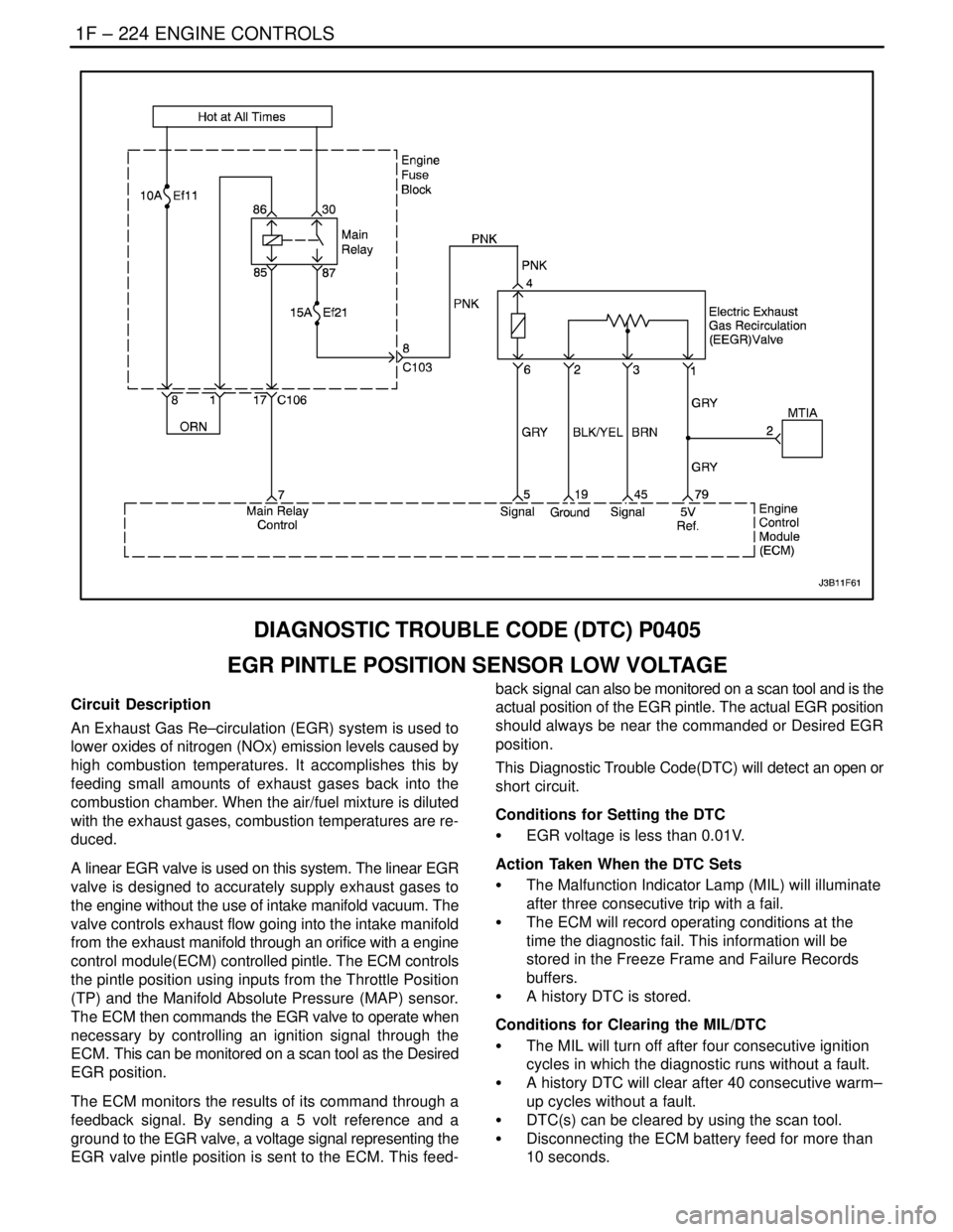
Circuit Description
An Exhaust Gas Re–circulation (EGR) system is used to
lower oxides of nitrogen (NOx) emission levels caused by
high combustion temperatures. It accomplishes this by
feeding small amounts of exhaust gases back into the
combustion chamber. When the air/fuel mixture is diluted
with the exhaust gases, combustion temperatures are re-
duced.
A linear EGR valve is used on this system. The linear EGR
valve is designed to accurately supply exhaust gases to
the engine without the use of intake manifold vacuum. The
valve controls exhaust flow going into the intake manifold
from the exhaust manifold through an orifice with a engine
control module(ECM) controlled pintle. The ECM controls
the pintle position using inputs from the Throttle Position
(TP) and the Manifold Absolute Pressure (MAP) sensor.
The ECM then commands the EGR valve to operate when
necessary by controlling an ignition signal through the
ECM. This can be monitored on a scan tool as the Desired
EGR position.
The ECM monitors the results of its command through a
feedback signal. By sending a 5 volt reference and a
ground to the EGR valve, a voltage signal representing the
EGR valve pintle position is sent to the ECM. This feed-back signal can also be monitored on a scan tool and is the
actual position of the EGR pintle. The actual EGR position
should always be near the commanded or Desired EGR
position.
This Diagnostic Trouble Code(DTC) will detect an open or
short circuit.
Conditions for Setting the DTC
S EGR voltage is less than 0.01V.
Action Taken When the DTC Sets
S The Malfunction Indicator Lamp (MIL) will illuminate
after three consecutive trip with a fail.
S The ECM will record operating conditions at the
time the diagnostic fail. This information will be
stored in the Freeze Frame and Failure Records
buffers.
S A history DTC is stored.
Conditions for Clearing the MIL/DTC
S The MIL will turn off after four consecutive ignition
cycles in which the diagnostic runs without a fault.
S A history DTC will clear after 40 consecutive warm–
up cycles without a fault.
S DTC(s) can be cleared by using the scan tool.
S Disconnecting the ECM battery feed for more than
10 seconds.
Page 473 of 2643

ENGINE CONTROLS 1F – 227
DAEWOO V–121 BL4
DIAGNOSTIC TROUBLE CODE (DTC) P0406
EGR PINTLE POSITION SENSOR HIGH VOLTAGE
Circuit Description
An Exhaust Gas Re–circulation (EGR) system is used to
lower oxides of nitrogen (NOx) emission levels caused by
high combustion temperatures. It accomplishes this by
feeding small amounts of exhaust gases back into the
combustion chamber. When the air/fuel mixture is diluted
with the exhaust gases, combustion temperatures are re-
duced.
A linear EGR valve is used on this system. The linear EGR
valve is designed to accurately supply exhaust gases to
the engine without the use of intake manifold vacuum. The
valve controls exhaust flow going into the intake manifold
from the exhaust manifold through an orifice with a engine
control module(ECM) controlled pintle. The ECM controls
the pintle position using inputs from the Throttle Position
(TP) and the Manifold Absolute Pressure (MAP) sensor.
The ECM then commands the EGR valve to operate when
necessary by controlling an ignition signal through the
ECM. This can be monitored on a scan tool as the Desired
EGR position.
The ECM monitors the results of its command through a
feedback signal. By sending a 5 volt reference and a
ground to the EGR valve, a voltage signal representing the
EGR valve pintle position is sent to the ECM. This feed-back signal can also be monitored on a scan tool and is the
actual position of the EGR pintle. The actual EGR position
should always be near the commanded or Desired EGR
position.
This Diagnostic Trouble Code(DTC) will detect an open or
short circuit.
Conditions for Setting the DTC
S EGR voltage is higher than 4.99V.
Action Taken When the DTC Sets
S The Malfunction Indicator Lamp (MIL) will illuminate
after three consecutive trip with a fail.
S The ECM will record operating conditions at the
time the diagnostic fail. This information will be
stored in the Freeze Frame and Failure Records
buffers.
S A history DTC is stored.
Conditions for Clearing the MIL/DTC
S The MIL will turn off after four consecutive ignition
cycles in which the diagnostic runs without a fault.
S A history DTC will clear after 40 consecutive warm–
up cycles without a fault.
S DTC(s) can be cleared by using the scan tool.
S Disconnecting the ECM battery feed for more than
10 seconds.
Page 478 of 2643

1F – 232IENGINE CONTROLS
DAEWOO V–121 BL4
DIAGNOSTIC TROUBLE CODE (DTC) P0444
EVAP PURGE CONTROL CIRCUIT NO SIGNAL
Circuit Description
The evaporative emission (EVAP) system includes the fol-
lowing components :
S Fuel tank.
S EVAP vent solenoid.
S Fuel tank pressure sensor.
S Fuel pipes and hoses.
S Fuel vapor lines.
S Fuel cap.
S EVAP canister.
S Purge lines.
S EVAP canister purge valve.
S EVAP service port.
The evaporative emission system is checked by applying
vacuum to the EVAP system and monitoring for a vacuum
decay. The engine control module(ECM) monitors the
vacuum level through the fuel tank pressure sensor signal.
At the appropriate time, the EVAP canister purge valve
and the EVAP vent solenoid are turned on, allowing the en-
gine to draw a small vacuum on the entire EVAP system.
After the desired vacuum level has been achieved, the
EVAP canister purge valve is turned OFF, sealing the sys-tem. If a sufficient vacuum level cannot be achieved, a
large leak is indicated. This can be caused by the following
conditions :
Missing or faulty fuel cap.
Disconnected or faulty fuel tank pressure sensor.
Disconnected, damaged, pinched, or blocked EVAP
purge line.
Disconnected or faulty EVAP canister purge valve.
Disconnected or faulty EVAP vent solenoid.
Open ignition feed circuit to the EVAP vent or purge sole-
noid.
Damaged EVAP canister.
Leaking fuel sensor assembly O–ring.
Leaking fuel tank or fuel filler beck.
Any of the above conditions can set DTC P0444.
The test is failed if the tank vacuum is less than 10 in H20
for 15 seconds and the manifold vacuum integral is greater
than 49512 (proportional to purge mass from the tank).
Conditions for Setting the DTC
S The canister purge solenoid circuit is an open con-
dition exist.
Page 479 of 2643

ENGINE CONTROLS 1F – 233
DAEWOO V–121 BL4
Action Taken When the DTC Sets
S The Malfunction Indicator Lamp (MIL) will illuminate
after three consecutive trip with a fail.
S The ECM will record operating conditions at the
time the diagnostic fail. This information will be
stored in the Freeze Frame and Failure Records
buffers.
S A history DTC is stored.
Conditions for Clearing the MIL/DTC
S The MIL will turn off after four consecutive ignition
cycles in which the diagnostic runs without a fault.
S A history DTC will clear after 40 consecutive warm–
up cycles without a fault.
S DTC(s) can be cleared by using the scan tool.
S Disconnecting the ECM battery feed for more than
10 seconds.
Diagnostic Aids
Although this DTC is considered a type. A diagnostic, it
acts like a type B diagnostic under certain conditions.
Whenever this diagnostic reports the system has passed,
or if the battery is disconnected, the diagnostic must fail
twice before setting a DTC. The initial failure is not re-ported to the diagnostic executive or displayed on a scan
tool. A passing system always reports to the diagnostic
executive immediately.
Check for the following conditions :
S Missing or damaged fuel cap.
S Missing or damaged O–rings at fuel vapor and
EVAP purge line canister fittings.
S Cracked or punctured EVAP canister.
S Damaged source vacuum line, EVAP purge line,
EVAP vent hose or fuel tank vapor line.
S Poor connection at the ECM. Inspect the harness
connectors for the following conditions.
S Backed–out terminals.
S Improper mating.
S Broken locks.
S Improperly formed.
S Damaged terminals.
S Poor terminal–to–wire connection.
S Damaged harness. Inspect the wiring harness to
the EVAP vent solenoid, EVAP canister purge
valve, and the fuel tank pressure sensor for an in-
termittent open or short circuit.
S Kinked, pinched or plugged vacuum source, EVAP
purge, or fuel tank vapor line. Verify that the lines
are not restricted.
DTC P0444 – EVAP Purge Control Circuit No Signal
StepActionValue(s)YesNo
1Perform an Euro On–Board Diagnostic (EOBD)
System Check.
Is the system check complete?–Go to Step 2Go to
”On–Board
Diagnostic Sys-
tem Check”
21. Disconnect the evaporative emission (EVAP)
canister purge valve connector.
2. Connect a test light between the EVAP canister
purge valve connector terminal 1 and battery
positive.
Is the test light ON?–Go to Step 3Go to Step 5
31. Disconnect the ECM connector.
2. Connect a test light between the ECM connec-
tor terminal 65 and ground.
Is the test light ON?–Go to Step 4Go to Step 6
41. Repair the line break in the wire between the
EVAP canister purge valve connector 2 and the
ECM connector terminal 65.
2. Clear any Diagnostic Trouble Codes (DTCs)
from the ECM.
3. Perform the diagnostic system check.
Is the repair complete?–System OK–
Page 481 of 2643

ENGINE CONTROLS 1F – 235
DAEWOO V–121 BL4
DIAGNOSTIC TROUBLE CODE (DTC) P0445
EVAP PURGE CONTROL CIRCUIT FAULT
Circuit Description
The evaporative emission (EVAP) system includes the fol-
lowing components :
S Fuel tank.
S EVAP vent solenoid.
S Fuel tank pressure sensor.
S Fuel pipes and hoses.
S Fuel vapor lines.
S Fuel cap.
S EVAP canister.
S Purge lines.
S EVAP canister purge valve.
S EVAP service port.
The evaporative emission system is checked by applying
vacuum to the EVAP system and monitoring for a vacuum
decay. The engine control module(ECM) monitors the
vacuum level through the fuel tank pressure sensor signal.
At the appropriate time, the EVAP canister purge valve
and the EVAP vent solenoid are turned on, allowing the en-
gine to draw a small vacuum on the entire EVAP system.
After the desired vacuum level has been achieved, the
EVAP canister purge valve is turned OFF, sealing the sys-tem. If a sufficient vacuum level cannot be achieved, a
large leak is indicated. This can be caused by the following
conditions :
Missing or faulty fuel cap.
Disconnected or faulty fuel tank pressure sensor.
Disconnected, damaged, pinched, or blocked EVAP
purge line.
Disconnected or faulty EVAP canister purge valve.
Disconnected or faulty EVAP vent solenoid.
Open ignition feed circuit to the EVAP vent or purge sole-
noid.
Damaged EVAP canister.
Leaking fuel sensor assembly O–ring.
Leaking fuel tank or fuel filler beck.
Any of the above conditions can set DTC P0445.
The test is failed if the tank vacuum is less than 10 in H20
for 15 seconds and the manifold vacuum integral is greater
than 49512 (proportional to purge mass from the tank).
Conditions for Setting the DTC
S The canister purge solenoid valve circuit is a short
to battery or short to ground condition exist.
Page 482 of 2643

1F – 236IENGINE CONTROLS
DAEWOO V–121 BL4
Action Taken When the DTC Sets
S The Malfunction Indicator Lamp (MIL) will illuminate
after three consecutive trip with a fail.
S The ECM will record operating conditions at the
time the diagnostic fail. This information will be
stored in the Freeze Frame and Failure Records
buffers.
S A history DTC is stored.
Conditions for Clearing the MIL/DTC
S The MIL will turn off after four consecutive ignition
cycles in which the diagnostic runs without a fault.
S A history DTC will clear after 40 consecutive warm–
up cycles without a fault.
S DTC(s) can be cleared by using the scan tool.
S Disconnecting the ECM battery feed for more than
10 seconds.
Diagnostic Aids
Although this DTC is considered a type. A diagnostic, it
acts like a type B diagnostic under certain conditions.
Whenever this diagnostic reports the system has passed,
or if the battery is disconnected, the diagnostic must fail
twice before setting a DTC. The initial failure is not re-ported to the diagnostic executive or displayed on a scan
tool. A passing system always reports to the diagnostic
executive immediately.
Check for the following conditions :
S Missing or damaged fuel cap.
S Missing or damaged O–rings at fuel vapor and
EVAP purge line canister fittings.
S Cracked or punctured EVAP canister.
S Damaged source vacuum line, EVAP purge line,
EVAP vent hose or fuel tank vapor line.
S Poor connection at the ECM. Inspect the harness
connectors for the following conditions.
S Backed–out terminals.
S Improper mating.
S Broken locks.
S Improperly formed.
S Damaged terminals.
S Poor terminal–to–wire connection.
S Damaged harness. Inspect the wiring harness to
the EVAP vent solenoid, EVAP canister purge
valve, and the fuel tank pressure sensor for an in-
termittent open or short circuit.
S Kinked, pinched or plugged vacuum source, EVAP
purge, or fuel tank vapor line. Verify that the lines
are not restricted.
DTC P0445 – EVAP Purge Control Circuit Fault
StepActionValue(s)YesNo
1Perform an Euro On–Board Diagnostic (EOBD)
System Check.
Is the system check complete?–Go to Step 2Go to
”On–Board
Diagnostic Sys-
tem Check”
21. Disconnect the evaporative emission (EVAP)
canister purge valve connector.
2. Measure the resistance of the EVAP canister
purge valve connector.
Does the resistance measure near within the value
specified?30WGo to Step 3Go to Step 9
3Connect a test light between EVAP canister purge
valve connector terminal 2 and ground.
Is the test light ON?–Go to Step 4Go to Step 6
41. Disconnect the ECM connector.
2. Connect a test light between the ECM connec-
tor terminal 65 and ground.
Is the test light ON?–Go to Step 5Go to Step 7
51. Repair the high voltage or ground in the wire
between the EVAP canister purge valve con-
nector terminal 2 and the ECM connector ter-
minal 65.
2. Clear any Diagnostic Trouble Codes (DTCs)
from the ECM.
3. Perform the diagnostic system check.
Is the repair complete?–System OK–
Page 554 of 2643
1F – 308IENGINE CONTROLS
DAEWOO V–121 BL4
DIAGNOSTIC TROUBLE CODE (DTC) P1402
EXHAUST GAS RECIRCULATION BLOCKED
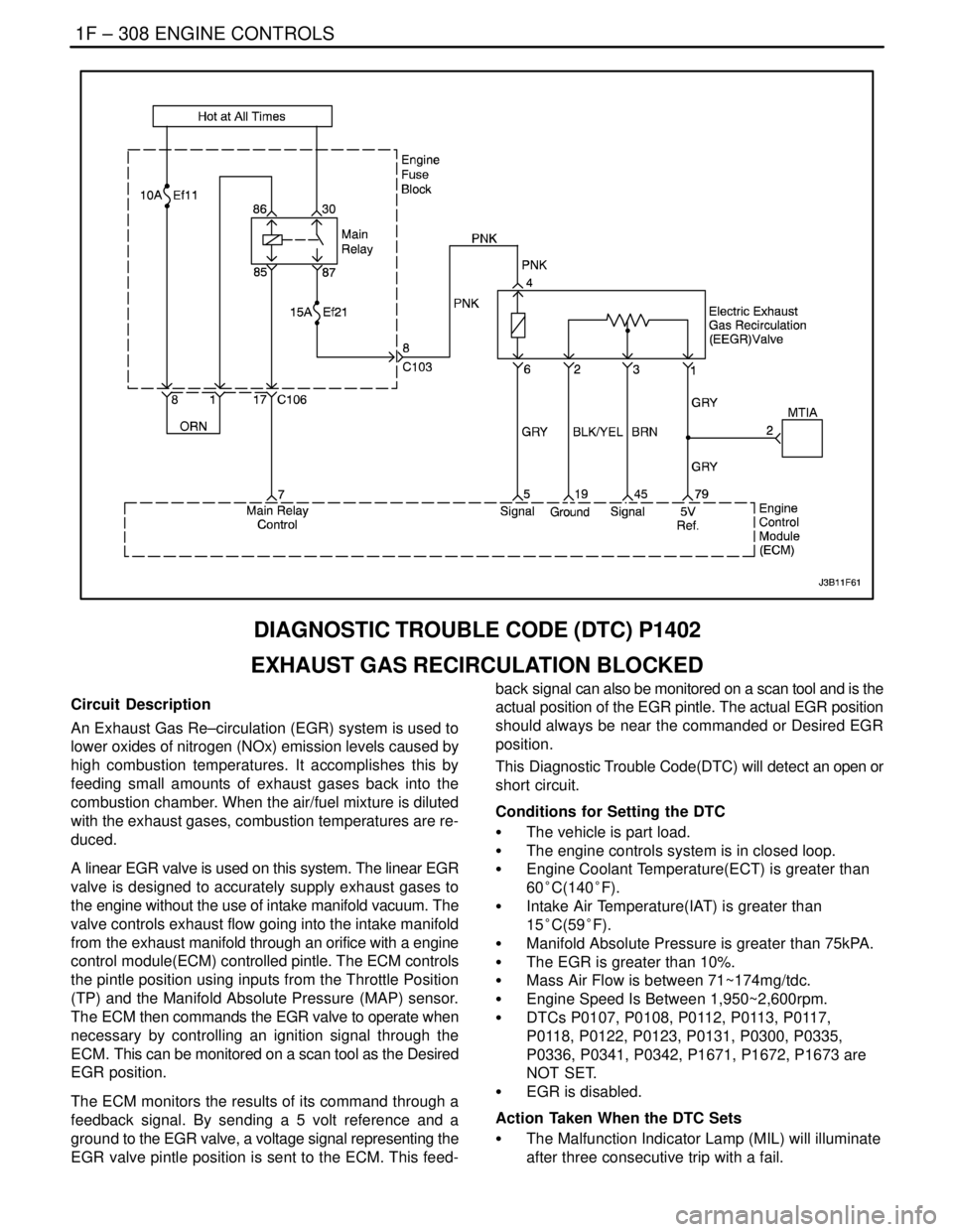
Circuit Description
An Exhaust Gas Re–circulation (EGR) system is used to
lower oxides of nitrogen (NOx) emission levels caused by
high combustion temperatures. It accomplishes this by
feeding small amounts of exhaust gases back into the
combustion chamber. When the air/fuel mixture is diluted
with the exhaust gases, combustion temperatures are re-
duced.
A linear EGR valve is used on this system. The linear EGR
valve is designed to accurately supply exhaust gases to
the engine without the use of intake manifold vacuum. The
valve controls exhaust flow going into the intake manifold
from the exhaust manifold through an orifice with a engine
control module(ECM) controlled pintle. The ECM controls
the pintle position using inputs from the Throttle Position
(TP) and the Manifold Absolute Pressure (MAP) sensor.
The ECM then commands the EGR valve to operate when
necessary by controlling an ignition signal through the
ECM. This can be monitored on a scan tool as the Desired
EGR position.
The ECM monitors the results of its command through a
feedback signal. By sending a 5 volt reference and a
ground to the EGR valve, a voltage signal representing the
EGR valve pintle position is sent to the ECM. This feed-back signal can also be monitored on a scan tool and is the
actual position of the EGR pintle. The actual EGR position
should always be near the commanded or Desired EGR
position.
This Diagnostic Trouble Code(DTC) will detect an open or
short circuit.
Conditions for Setting the DTC
S The vehicle is part load.
S The engine controls system is in closed loop.
S Engine Coolant Temperature(ECT) is greater than
60°C(140°F).
S Intake Air Temperature(IAT) is greater than
15°C(59°F).
S Manifold Absolute Pressure is greater than 75kPA.
S The EGR is greater than 10%.
S Mass Air Flow is between 71~174mg/tdc.
S Engine Speed Is Between 1,950~2,600rpm.
S DTCs P0107, P0108, P0112, P0113, P0117,
P0118, P0122, P0123, P0131, P0300, P0335,
P0336, P0341, P0342, P1671, P1672, P1673 are
NOT SET.
S EGR is disabled.
Action Taken When the DTC Sets
S The Malfunction Indicator Lamp (MIL) will illuminate
after three consecutive trip with a fail.
Page 556 of 2643
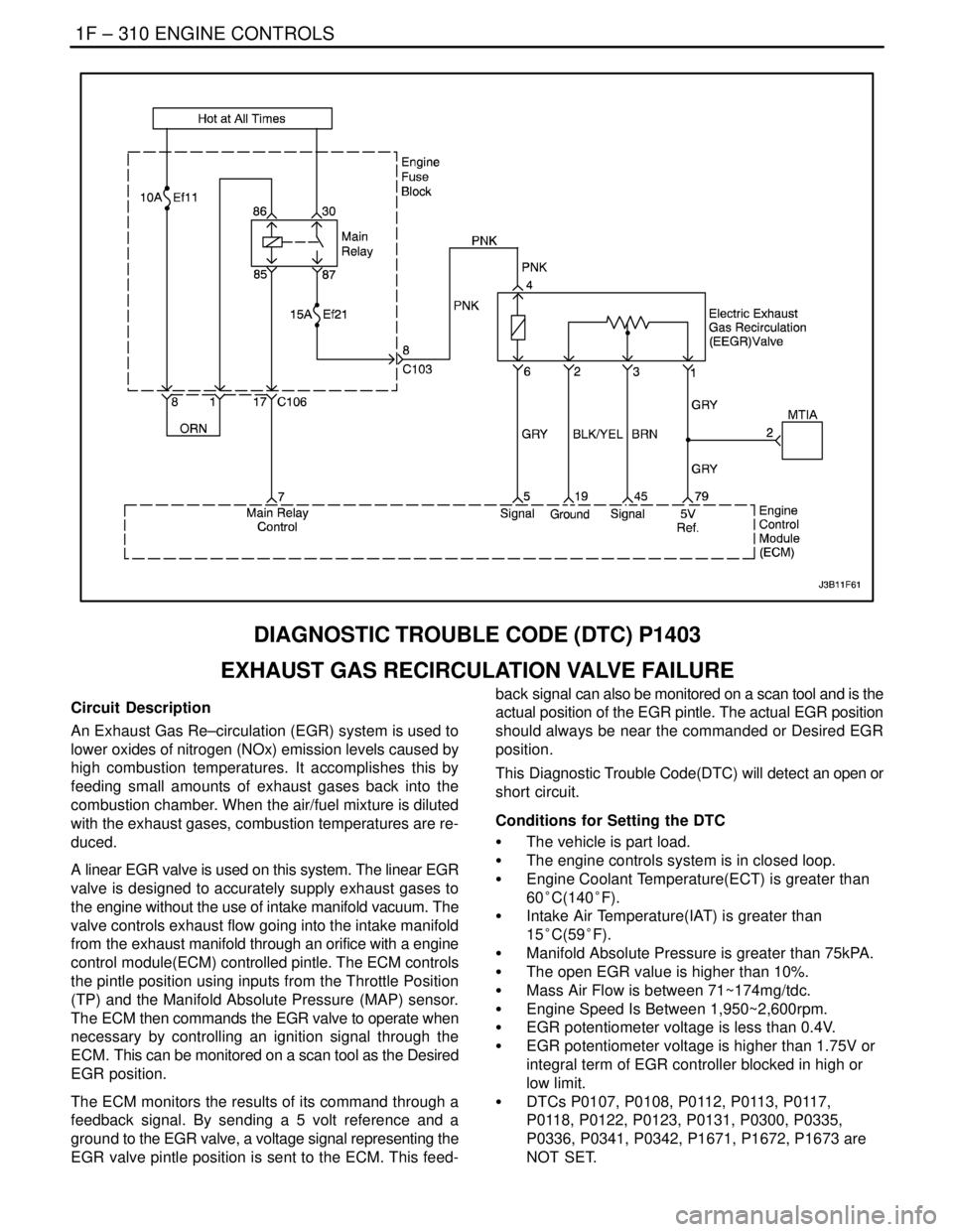
1F – 310IENGINE CONTROLS
DAEWOO V–121 BL4
DIAGNOSTIC TROUBLE CODE (DTC) P1403
EXHAUST GAS RECIRCULATION VALVE FAILURE
Circuit Description
An Exhaust Gas Re–circulation (EGR) system is used to
lower oxides of nitrogen (NOx) emission levels caused by
high combustion temperatures. It accomplishes this by
feeding small amounts of exhaust gases back into the
combustion chamber. When the air/fuel mixture is diluted
with the exhaust gases, combustion temperatures are re-
duced.
A linear EGR valve is used on this system. The linear EGR
valve is designed to accurately supply exhaust gases to
the engine without the use of intake manifold vacuum. The
valve controls exhaust flow going into the intake manifold
from the exhaust manifold through an orifice with a engine
control module(ECM) controlled pintle. The ECM controls
the pintle position using inputs from the Throttle Position
(TP) and the Manifold Absolute Pressure (MAP) sensor.
The ECM then commands the EGR valve to operate when
necessary by controlling an ignition signal through the
ECM. This can be monitored on a scan tool as the Desired
EGR position.
The ECM monitors the results of its command through a
feedback signal. By sending a 5 volt reference and a
ground to the EGR valve, a voltage signal representing the
EGR valve pintle position is sent to the ECM. This feed-back signal can also be monitored on a scan tool and is the
actual position of the EGR pintle. The actual EGR position
should always be near the commanded or Desired EGR
position.
This Diagnostic Trouble Code(DTC) will detect an open or
short circuit.
Conditions for Setting the DTC
S The vehicle is part load.
S The engine controls system is in closed loop.
S Engine Coolant Temperature(ECT) is greater than
60°C(140°F).
S Intake Air Temperature(IAT) is greater than
15°C(59°F).
S Manifold Absolute Pressure is greater than 75kPA.
S The open EGR value is higher than 10%.
S Mass Air Flow is between 71~174mg/tdc.
S Engine Speed Is Between 1,950~2,600rpm.
S EGR potentiometer voltage is less than 0.4V.
S EGR potentiometer voltage is higher than 1.75V or
integral term of EGR controller blocked in high or
low limit.
S DTCs P0107, P0108, P0112, P0113, P0117,
P0118, P0122, P0123, P0131, P0300, P0335,
P0336, P0341, P0342, P1671, P1672, P1673 are
NOT SET.