service DAEWOO LACETTI 2004 Service Repair Manual
[x] Cancel search | Manufacturer: DAEWOO, Model Year: 2004, Model line: LACETTI, Model: DAEWOO LACETTI 2004Pages: 2643, PDF Size: 80.54 MB
Page 2380 of 2643

SECTION : 9L
GLASS AND MIRRORS
CAUTION : Disconnect the negative battery cable before removing or installing any electrical unit or when a tool
or equipment could easily come in contact with exposed electrical terminals. Disconnecting this cable will help
prevent personal injury and damage to the vehicle. The ignition must also be in LOCK unless otherwise noted.
TABLE OF CONTENTS
SPECIFICATIONS9L–2 . . . . . . . . . . . . . . . . . . . . . . . . . . .
Fastener Tightening Specifications 9L–2. . . . . . . . . . . .
SPECIAL TOOLS9L–2 . . . . . . . . . . . . . . . . . . . . . . . . . . . .
Special Tools Table 9L–2. . . . . . . . . . . . . . . . . . . . . . . . .
SCHEMATIC AND ROUTING DIAGRAMS9L–3 . . . . . .
Defogger System 9L–3. . . . . . . . . . . . . . . . . . . . . . . . . . .
Electric Control OSRV (Outside Rear View)
Mirror System 9L–4. . . . . . . . . . . . . . . . . . . . . . . . . . . .
DIAGNOSIS9L–5 . . . . . . . . . . . . . . . . . . . . . . . . . . . . . . . . .
Testing Rear Window Defogger Grid Line 9L–5. . . . . .
Outside Rearview Mirror Defoggers 9L–5. . . . . . . . . . .
Electric Control Outside Rearview Mirrors 9L–6. . . . . .
Folding Mirror Unit 9L–8. . . . . . . . . . . . . . . . . . . . . . . . . .
MAINTENANCE AND REPAIR9L–10 . . . . . . . . . . . . . . .
ON–VEHICLE SERVICE 9L–10. . . . . . . . . . . . . . . . . . . . .
Windshield 9L–10. . . . . . . . . . . . . . . . . . . . . . . . . . . . . . . . Rear Window Glass 9L–11. . . . . . . . . . . . . . . . . . . . . . . .
Rear Window Defogger Grid Line Repair 9L–13. . . . . .
Rear Window Defogger Braided Lead Wire
Repair 9L–15. . . . . . . . . . . . . . . . . . . . . . . . . . . . . . . . . .
Front Door Glass 9L–15. . . . . . . . . . . . . . . . . . . . . . . . . .
Rear Door Glass 9L–16. . . . . . . . . . . . . . . . . . . . . . . . . . .
Rear Door Quarter Glass 9L–16. . . . . . . . . . . . . . . . . . .
Inside Rearview Mirror 9L–17. . . . . . . . . . . . . . . . . . . . .
Outside Rearview Mirrors 9L–18. . . . . . . . . . . . . . . . . . .
Folding Mirrors Unit 9L–18. . . . . . . . . . . . . . . . . . . . . . . .
GENERAL DESCRIPTION AND SYSTEM
OPERATION9L–19 . . . . . . . . . . . . . . . . . . . . . . . . . . . . . .
Stationary Glass 9L–19. . . . . . . . . . . . . . . . . . . . . . . . . . .
Electric Control Heated Outside Rearview
Mirror 9L–19. . . . . . . . . . . . . . . . . . . . . . . . . . . . . . . . . .
Inside Rearview Mirror 9L–19. . . . . . . . . . . . . . . . . . . . .
Folding Mirror Unit 9L–19. . . . . . . . . . . . . . . . . . . . . . . . .
Page 2389 of 2643
9L – 10IGLASS AND MIRRORS
DAEWOO V–121 BL4
MAINTENANCE AND REPAIR
ON–VEHICLE SERVICE
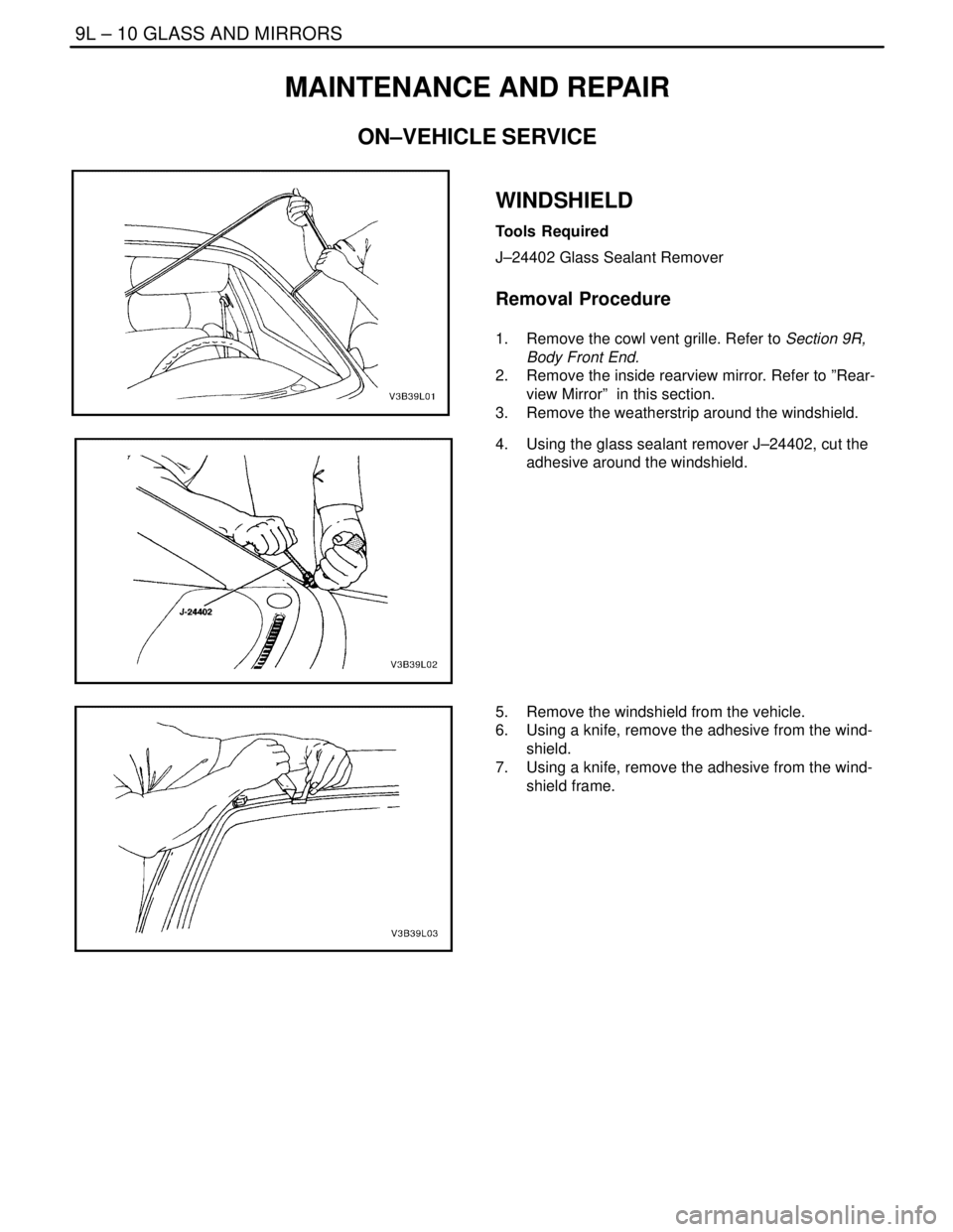
WINDSHIELD
Tools Required
J–24402 Glass Sealant Remover
Removal Procedure
1. Remove the cowl vent grille. Refer to Section 9R,
Body Front End.
2. Remove the inside rearview mirror. Refer to ”Rear-
view Mirror” in this section.
3. Remove the weatherstrip around the windshield.
4. Using the glass sealant remover J–24402, cut the
adhesive around the windshield.
5. Remove the windshield from the vehicle.
6. Using a knife, remove the adhesive from the wind-
shield.
7. Using a knife, remove the adhesive from the wind-
shield frame.
Page 2396 of 2643
GLASS AND MIRRORS 9L – 17
DAEWOO V–121 BL4
INSIDE REARVIEW MIRROR
The inside rearview mirror is attached to a support which
is secured to the windshield glass. The support is installed
by the glass supplier using a plastic–polyvinyl butyl adhe-
sive.
Service replacement windshield glass has the mirror sup-
port bonded to the glass assembly. In order to install a de-
tached mirror support or to install a new part, the following
items will be needed:
S Loctite® Minute–Bond Adhesive.
S Original or replacement mirror support.
S Wax marking pencil or crayon.
S Rubbing alcohol.
S Clean paper towel.
S Fine grit sandpaper (grit #320 or #360).
S 2 mm allen wrench.
Installation Procedure
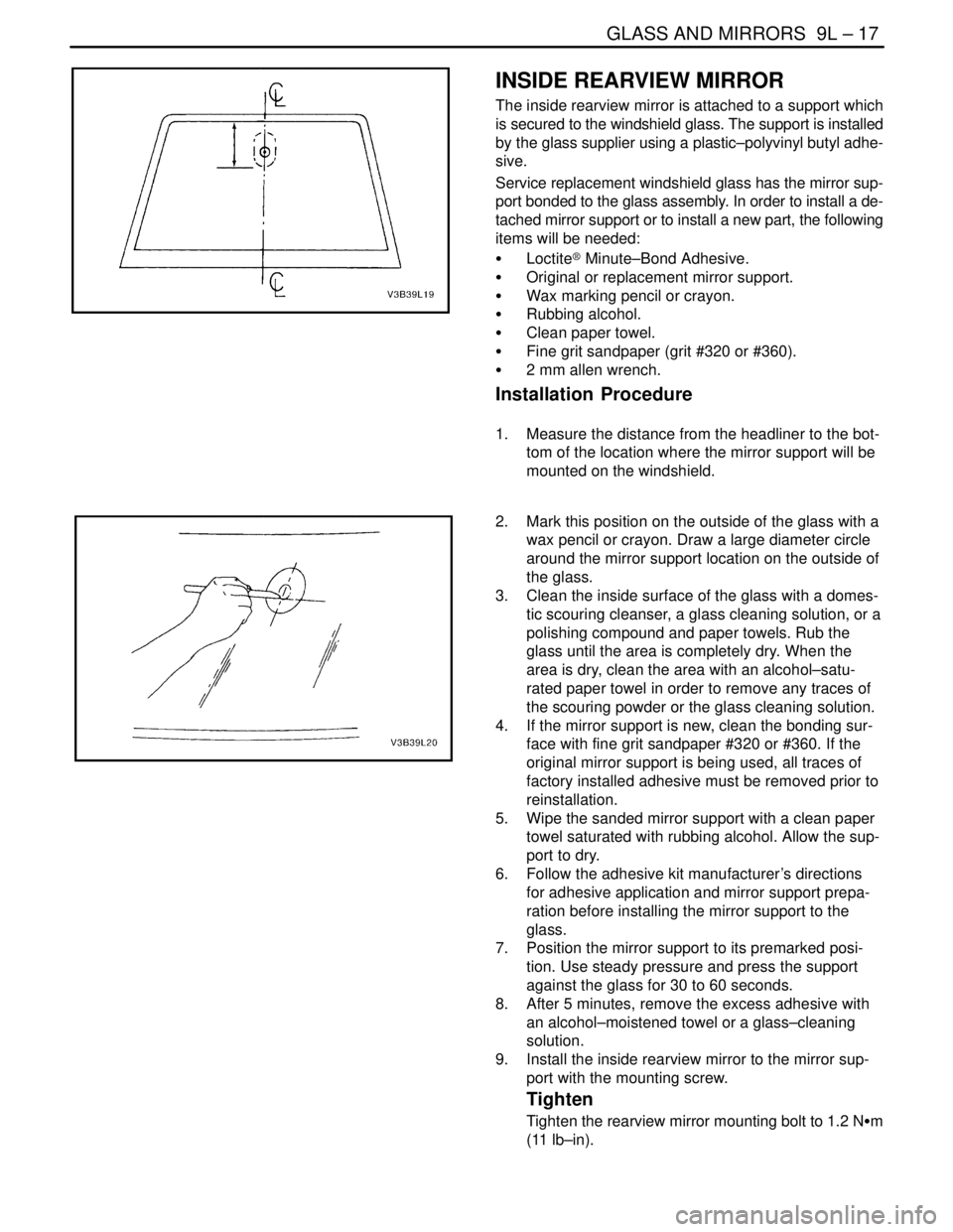
1. Measure the distance from the headliner to the bot-
tom of the location where the mirror support will be
mounted on the windshield.
2. Mark this position on the outside of the glass with a
wax pencil or crayon. Draw a large diameter circle
around the mirror support location on the outside of
the glass.
3. Clean the inside surface of the glass with a domes-
tic scouring cleanser, a glass cleaning solution, or a
polishing compound and paper towels. Rub the
glass until the area is completely dry. When the
area is dry, clean the area with an alcohol–satu-
rated paper towel in order to remove any traces of
the scouring powder or the glass cleaning solution.
4. If the mirror support is new, clean the bonding sur-
face with fine grit sandpaper #320 or #360. If the
original mirror support is being used, all traces of
factory installed adhesive must be removed prior to
reinstallation.
5. Wipe the sanded mirror support with a clean paper
towel saturated with rubbing alcohol. Allow the sup-
port to dry.
6. Follow the adhesive kit manufacturer’s directions
for adhesive application and mirror support prepa-
ration before installing the mirror support to the
glass.
7. Position the mirror support to its premarked posi-
tion. Use steady pressure and press the support
against the glass for 30 to 60 seconds.
8. After 5 minutes, remove the excess adhesive with
an alcohol–moistened towel or a glass–cleaning
solution.
9. Install the inside rearview mirror to the mirror sup-
port with the mounting screw.
Tighten
Tighten the rearview mirror mounting bolt to 1.2 NSm
(11 lb–in).
Page 2399 of 2643

SECTION : 9M
EXTERIOR TRIM
TABLE OF CONTENTS
SPECIFICATIONS9M–1 . . . . . . . . . . . . . . . . . . . . . . . . . .
Fastener Tightening Specifications 9M–1. . . . . . . . . . .
MAINTENANCE AND REPAIR9M–2 . . . . . . . . . . . . . . .
ON–VEHICLE SERVICE 9M–2. . . . . . . . . . . . . . . . . . . . .
B–Pillar Molding 9M–2. . . . . . . . . . . . . . . . . . . . . . . . . . .
Roof Molding 9M–2. . . . . . . . . . . . . . . . . . . . . . . . . . . . . . Mud Guards 9M–3. . . . . . . . . . . . . . . . . . . . . . . . . . . . . .
Hatchback Rear Spoiler 9M–3. . . . . . . . . . . . . . . . . . . .
GENERAL DESCRIPTION AND SYSTEM
OPERATION9M–5 . . . . . . . . . . . . . . . . . . . . . . . . . . . . . .
Emblems and Lettering 9M–5. . . . . . . . . . . . . . . . . . . . .
Mud Guards 9M–5. . . . . . . . . . . . . . . . . . . . . . . . . . . . . .
SPECIFICATIONS
FASTENER TIGHTENING SPECIFICATIONS
ApplicationNSmLb–FtLb–In
B–Pillar Molding Screws1.3–12
Mud Guard Bolts2–18
Page 2400 of 2643
9M – 2IEXTERIOR TRIM
DAEWOO V–121 BL4
MAINTENANCE AND REPAIR
ON–VEHICLE SERVICE
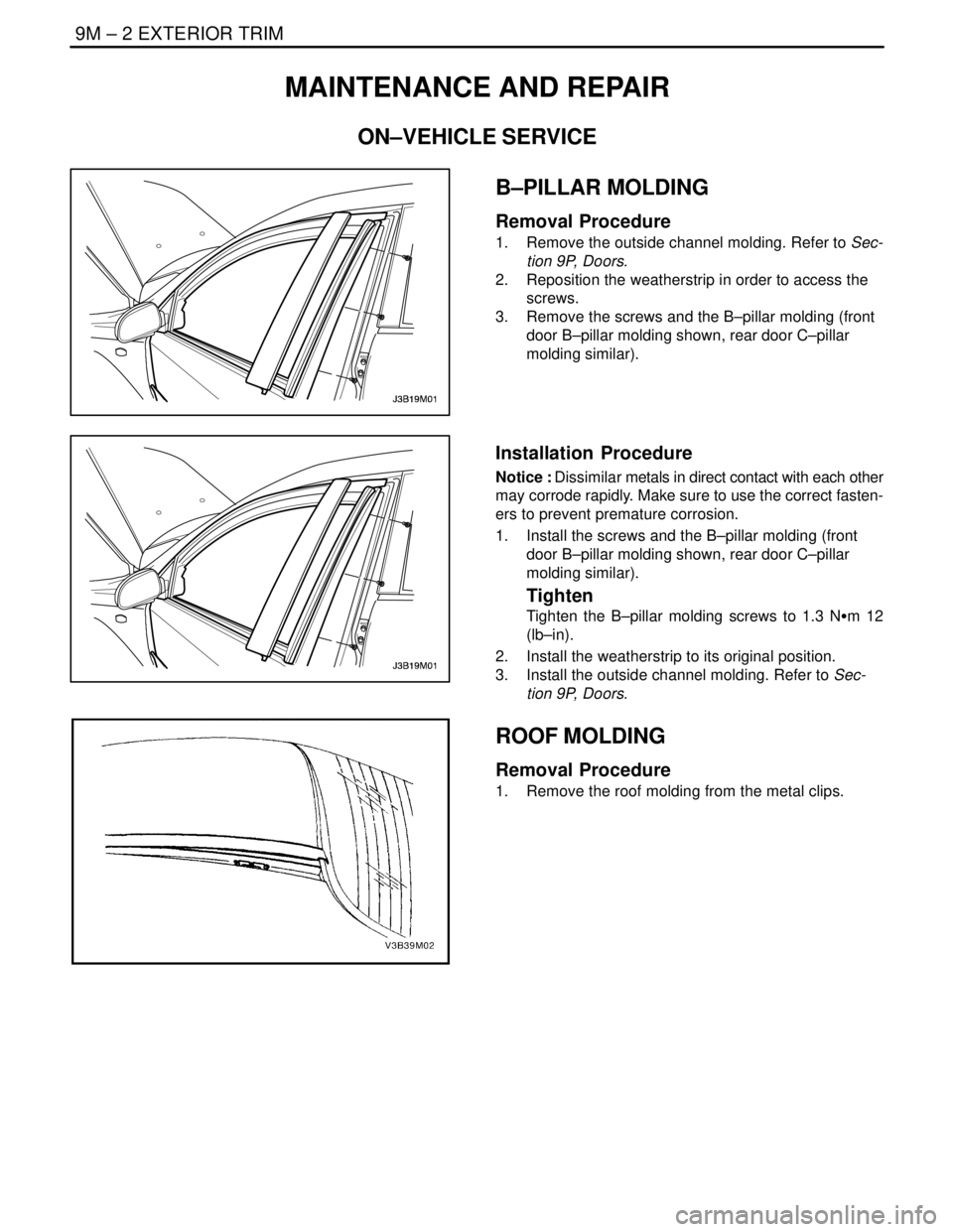
B–PILLAR MOLDING
Removal Procedure
1. Remove the outside channel molding. Refer to Sec-
tion 9P, Doors.
2. Reposition the weatherstrip in order to access the
screws.
3. Remove the screws and the B–pillar molding (front
door B–pillar molding shown, rear door C–pillar
molding similar).
Installation Procedure
Notice : Dissimilar metals in direct contact with each other
may corrode rapidly. Make sure to use the correct fasten-
ers to prevent premature corrosion.
1. Install the screws and the B–pillar molding (front
door B–pillar molding shown, rear door C–pillar
molding similar).
Tighten
Tighten the B–pillar molding screws to 1.3 NSm 12
(lb–in).
2. Install the weatherstrip to its original position.
3. Install the outside channel molding. Refer to Sec-
tion 9P, Doors.
ROOF MOLDING
Removal Procedure
1. Remove the roof molding from the metal clips.
Page 2404 of 2643

SECTION : 9N
FRAME AND UNDERBODY
TABLE OF CONTENTS
SPECIFICATIONS9N–1 . . . . . . . . . . . . . . . . . . . . . . . . . .
Fastener Tightening Specifications 9N–1. . . . . . . . . . .
Notchback Underbody Dimensions 9N–2. . . . . . . . . . .
Hatchback Underbody Dimensions 9N–4. . . . . . . . . . .
MAINTENANCE AND REPAIR9N–6 . . . . . . . . . . . . . . .
ON–VEHICLE SERVICE 9N–6. . . . . . . . . . . . . . . . . . . . . Alignment Checking 9N–6. . . . . . . . . . . . . . . . . . . . . . . .
Floor Pan Insulators 9N–6. . . . . . . . . . . . . . . . . . . . . . . .
Engine Under Covers 9N–7. . . . . . . . . . . . . . . . . . . . . .
GENERAL DESCRIPTION AND SYSTEM
OPERATION9N–8 . . . . . . . . . . . . . . . . . . . . . . . . . . . . . .
General Body Construction 9N–8. . . . . . . . . . . . . . . . .
Engine Under Covers 9N–8. . . . . . . . . . . . . . . . . . . . . .
SPECIFICATIONS
FASTENER TIGHTENING SPECIFICATIONS
ApplicationNSmLb–FtLb–In
Engine Under Cover Bolts3.5–31
Page 2409 of 2643

9N – 6IFRAME AND UNDERBODY
DAEWOO V–121 BL4
MAINTENANCE AND REPAIR
ON–VEHICLE SERVICE
ALIGNMENT CHECKING
An accurate method of determining the alignment of the
underbody uses a measuring tram gauge. The tram gauge
set used to perform the recommended measuring checks
must include a vertical pointer able to reach 457 mm (18
inches).
Two types of measurements can be made with a tram
gauge: direct point–to–point measurements and mea-
surements calculated on a horizontal plane (datum line)
parallel to the underbody. Point–to–point measurements
are generally taken on steering and suspension engine
compartment parts and simply require the vertical pointers
to be set equally.
For horizontal plane measurements, the vertical pointers
must be set as specified for each point to be measured.
Dimensions–to–gauge holes are measured to the center
of the holes and flush to the adjacent surface metal unless
otherwise specified. It is recommended that the diagonal
dimensions to the cross–body be checked on both sides
in order to verify the dimensional accuracy of the vehicle
underbody.
FLOOR PAN INSULATORS
The floor pan insulators have been designed for the higher
floor pan temperatures that result from the use of the cata-
lytic converter in the exhaust system. Therefore, when
servicing a vehicle, it is essential that any insulators that
may have been disturbed or removed be reinstalled in the
original sequence and location. Also, if an insulator needs
to be replaced, use only the insulation specified for that
location on the floor pan.
When servicing or replacing interior insulators, observe
the following instructions.
S Install the insulators in the original position and se-
quence. Butt the pieces together in order to avoid
gapping or overlapping.
S If it is necessary to replace an insulator, use only
the specified insulation.
S Use the original part to determine the amount of
replacement material required and as a template for
cutting and fitting the new piece to the floor pan.
S When installing the insulator, do not enlarge any
cutouts or holes that are used for the attachment of
interior parts such as the instrument panel or the
floor console.
S Route the cross–body harness for interior parts
over the floor pan insulators. Clip it in the original
location.
S Do not apply spray–on deadeners or trim adhesives
to the top of the floor pan at the area directly over
the catalytic converter or the muffler.
Page 2410 of 2643
FRAME AND UNDERBODY 9N – 7
DAEWOO V–121 BL4
Any insulator service repair or replacement should be the
same thickness, size, and location as the original installa-
tion in the vehicle.
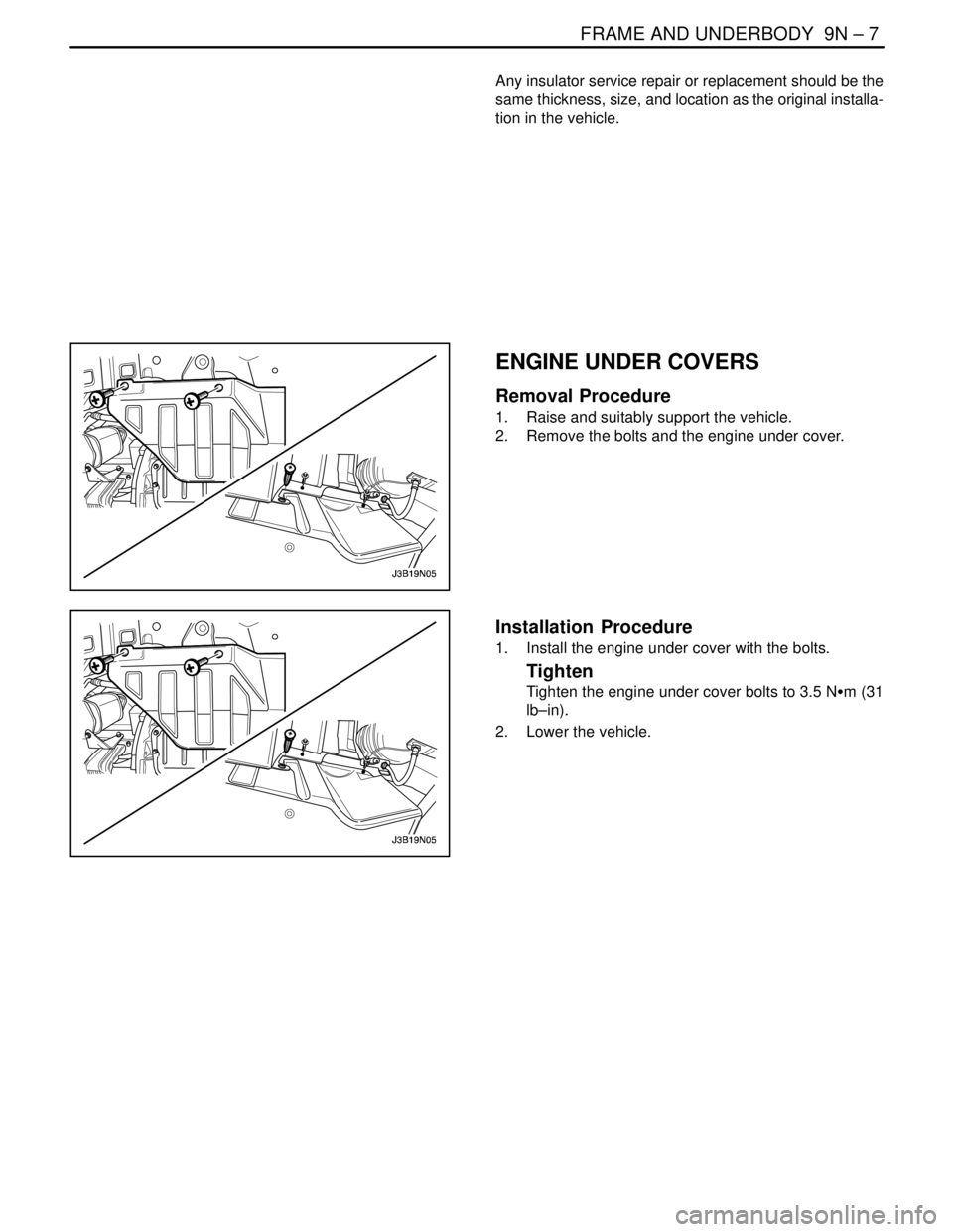
ENGINE UNDER COVERS
Removal Procedure
1. Raise and suitably support the vehicle.
2. Remove the bolts and the engine under cover.
Installation Procedure
1. Install the engine under cover with the bolts.
Tighten
Tighten the engine under cover bolts to 3.5 NSm (31
lb–in).
2. Lower the vehicle.
Page 2411 of 2643

9N – 8IFRAME AND UNDERBODY
DAEWOO V–121 BL4
GENERAL DESCRIPTION
AND SYSTEM OPERATION
GENERAL BODY CONSTRUCTION
This vehicle is constructed with a unitized body which in-
corporates integral front and rear frame side rails.
The front suspension lower control arms are bolted to and
retained by supports, one each on the right and left sides.
The front suspension lower control arm supports are at-
tached to the underbody with three bolts at two locations.
The engine is bolted to the integral front side rails. The
suspension strut towers must be dimensionally correct in
relation to the remainder of the underbody in order to main-
tain specified suspension strut and caster/ camber angles.Since the individual underbody parts contribute directly to
the overall strength of the body, it is essential to observe
proper welding techniques during service repair opera-
tions. The underbody parts should be properly sealed and
rustproofed whenever body repair operations destroy or
damage the original sealing and rustproofing. When rust-
proofing critical underbody parts, use a good–quality type
of air–dry primer, such as a corrosion–resistant chromate
or an equivalent material. Combination–type primer/sur-
facers are not recommended.
ENGINE UNDER COVERS
The engine under covers are molded pieces of plastic that
serve as shields for the underside of the engine. The cov-
ers help protect the engine from small rocks, gravel and
other objects that would otherwise come into contact with
the engine during normal driving conditions.
Page 2412 of 2643

SECTION : 9O
BUMPERS AND FASCIAS
CAUTION : Disconnect the negative battery cable before removing or installing any electrical unit or when a tool
or equipment could easily come in contact with exposed electrical terminals. Disconnecting this cable will help
prevent personal injury and damage to the vehicle. The ignition must also be in LOCK unless otherwise noted.
TABLE OF CONTENTS
SPECIFICATIONS9O–1 . . . . . . . . . . . . . . . . . . . . . . . . . .
Fastener Tightening Specifications 9O–1. . . . . . . . . . .
MAINTENANCE AND REPAIR9O–2 . . . . . . . . . . . . . . .
ON–VEHICLE SERVICE 9O–2. . . . . . . . . . . . . . . . . . . . .
Front Bumper Fascia 9O–2. . . . . . . . . . . . . . . . . . . . . . .
Front Bumper Energy Absorber 9O–3. . . . . . . . . . . . . . Front Bumper Impact Bar 9O–4. . . . . . . . . . . . . . . . . . .
Notchback Rear Bumper Fascia 9O–4. . . . . . . . . . . . .
Hatchback Rear Bumper Fascia 9O–6. . . . . . . . . . . . .
Rear Bumper Impact Bar 9O–7. . . . . . . . . . . . . . . . . . .
GENERAL DESCRIPTION AND SYSTEM
OPERATION9O–9 . . . . . . . . . . . . . . . . . . . . . . . . . . . . . .
Bumpers 9O–9. . . . . . . . . . . . . . . . . . . . . . . . . . . . . . . . .
SPECIFICATIONS
FASTENER TIGHTENING SPECIFICATIONS
ApplicationNSmLb–FtLb–In
Fender–to–Fascia Bolts10–89
Fender–to–Fascia Screws2–18
Front Impact Bar Bolts3929–
Lower Fascia Screws2–18
Luggage Compartment Fascia Bolts10–89
Luggage Compartment Fascia Screws2–18
Rear Wheel Well Fascia Bolts2–18