Air Conditioning System DAEWOO LACETTI 2004 Service Owner's Manual
[x] Cancel search | Manufacturer: DAEWOO, Model Year: 2004, Model line: LACETTI, Model: DAEWOO LACETTI 2004Pages: 2643, PDF Size: 80.54 MB
Page 754 of 2643

1F – 508IENGINE CONTROLS
DAEWOO V–121 BL4
DTC P0532 – A/C Pressure Sensor Low Voltage
StepActionValue(s)YesNo
1Perform an On–Board Diagnostic (EOBD) System
Check.
Was the check performed? –Go to Step 2Go to
”On–Board
Diagnostic Sys-
tem Check”
21. Install a scan tool to the Data Link Connector
(DLC).
2. Idle the engine.
Does the scan tool display Air Conditioning Pressure
(ACP) sensor voltage below the specified value?0.06 VGo to Step 3Go to Step 4
31. Turn the ignition OFF.
2. Disconnect the ACP sensor connector.
3. Jumper the ACP signal circuit, terminal 2 to the
5 volt reference circuit, terminal 1.
4. Turn the ignition switch on.
Does the ACP voltage read more than the specified
value?4.9 VGo to Step 5Go to Step 6
41. Turn the ignition ON, with the engine OFF.
2. Operate the vehicle within the Failure Record
conditions and Conditions For Setting the DTC
as noted.
Does the scan tool display ACP voltage below the
specified value?0.06 VGo to Step 3Go to
”Diagnostic
Aids”
5Inspect the ACP sensor harness connector termi-
nals for the following conditions:
S Poor connections
S Proper contact tension
S Poor terminal–to–wire connection
Is a problem found?–Go to Step 8Go to Step 9
61. Turn the ignition OFF.
2. Remove the jumper wire.
3. Probe the ACP sensor signal circuit terminal 2
with a test light to B+.
4. Turn the ignition ON.
Does the scan tool read over the specified value?4 VGo to Step 7Go to Step 11
7Check the ACP sensor 5 volt reference circuit for an
open or short to ground and repair as needed.
Is the repair complete?–Go to Step 13Go to Step 10
8Repair the connection terminals as necessary.
Is the repair complete?–Go to Step 13–
91. Turn the ignition OFF.
2. Replace the ACP sensor.
Is the repair complete?–Go to Step 13–
101. Turn the ignition OFF.
2. Replace the engine control module (ECM).
Is the repair complete?–Go to Step 13–
Page 756 of 2643

1F – 510IENGINE CONTROLS
DAEWOO V–121 BL4
DIAGNOSTIC TROUBLE CODE (DTC) P0533
A/C PRESSURE SENSOR HIGH VOLTAGE
Circuit Description
The Air Conditioning (A/C) system uses an A/C refrigerant
pressure sensor mounted in the high pressure side of the
A/C refrigerant system to monitor A/C refrigerant pres-
sure. The Engine Control Module (ECM) uses this infor-
mation to turn ON the engine coolant fans when the A/C
refrigerant pressure is high and to keep the compressor
disengaged when A/C refrigerant pressure is excessively
high or low.
The Air Conditioning Pressure (ACP) sensor operates like
other 3–wire sensors. The ECM applies a 5.0 volt refer-
ence and a sensor ground to the sensor. Changes in the
A/C refrigerant pressure will cause the ACP sensor input
to the ECM to vary. The ECM monitors the ACP sensor
signal circuit and can determine when the signal is outside
of the possible range of the sensor. When the signal is out
of range for a prolonged period of time, the ECM will not
allow the A/C compressor clutch to engage. This is done
to protect the compressor.
Conditions for Setting the DTC
S A/C pressure is greater than 99% of the sensor
reading scale.
S Engine is running.
Action Taken When the DTC Sets
S The Malfunction Indicator Lamp (MIL) will not illumi-
nate.S The ECM will record operating conditions at the
time the diagnostic fails. This information will be
stored in the Failure Records buffers.
S A history DTC is stored.
S The A/C compressor operation will be disabled
while the high voltage indication exists.
Conditions for Clearing the MIL/DTC
S A history DTC will clear after 40 consecutive warm–
up cycles without a fault.
S DTC(s) can be cleared by using the scan tool.
S Disconnecting the ECM battery feed for more than
10 seconds.
Diagnostic Aids
Inspect harness connectors for backed–out terminals, im-
proper mating, broken locks, improperly formed or dam-
aged terminals, and poor terminal–to–wire connection at
the ECM.
Inspect the wiring harness for damage. If the harness ap-
pears to be OK, observe the A/C pressure display on the
scan tool while moving the connectors and wiring har-
nesses related to the ACP sensor. A change in the A/C
pressure display will indicate the location of the fault.
If DTC P0533 cannot be duplicated, reviewing the Fail Re-
cords vehicle mileage since the diagnostic test last failed
may help determine how often the condition that caused
the DTC to set occurs. This may assist in diagnosing the
condition.
Page 757 of 2643

ENGINE CONTROLS 1F – 511
DAEWOO V–121 BL4
DTC P0533 – A/C Pressure Sensor High Voltage
StepActionValue(s)YesNo
1Perform an On–Board Diagnostic (EOBD) System
Check.
Was the check performed?–Go to Step 2Go to
”On–Board
Diagnostic Sys-
tem Check”
21. Install a scan tool to the Data Link Connector
(DLC).
2. Idle the engine.
Does the scan tool display Air Conditioning Pressure
(ACP) sensor voltage below the specified value?0.06 VGo to Step 3Go to Step 4
31. Turn the ignition OFF.
2. Disconnect the ACP sensor connector.
3. Jumper the ACP signal circuit, terminal 2 to the
5 volt reference circuit, terminal 1.
4. Turn the ignition switch on.
Does the ACP voltage read more than the specified
value?4.9 VGo to Step 5Go to Step 6
41. Turn the ignition ON, with the engine OFF.
2. Operate the vehicle within the Failure Record
conditions and Conditions For Setting the DTC
as noted.
Does the scan tool display ACP voltage below the
specified value?0.06 VGo to Step 3Go to
”Diagnostic
Aids”
5Inspect the ACP sensor harness connector termi-
nals for the following conditions:
S Poor connections
S Proper contact tension
S Poor terminal–to–wire connection
Is a problem found?–Go to Step 8Go to Step 9
61. Turn the ignition OFF.
2. Remove the jumper wire.
3. Probe the ACP sensor signal circuit terminal 2
with a test light to B+.
4. Turn the ignition ON.
Does the scan tool read over the specified value?4 VGo to Step 7Go to Step 11
7Check the ACP sensor 5 volt reference circuit for an
open or short to ground and repair as needed.
Is the repair complete?–Go to Step 13Go to Step 10
8Repair the connection terminals as necessary.
Is the repair complete?–Go to Step 13–
91. Turn the ignition OFF.
2. Replace the ACP sensor.
Is the repair complete?–Go to Step 13–
101. Turn the ignition OFF.
2. Replace the engine control module (ECM).
Is the repair complete?–Go to Step 13–
Page 862 of 2643
1F – 616IENGINE CONTROLS
DAEWOO V–121 BL4
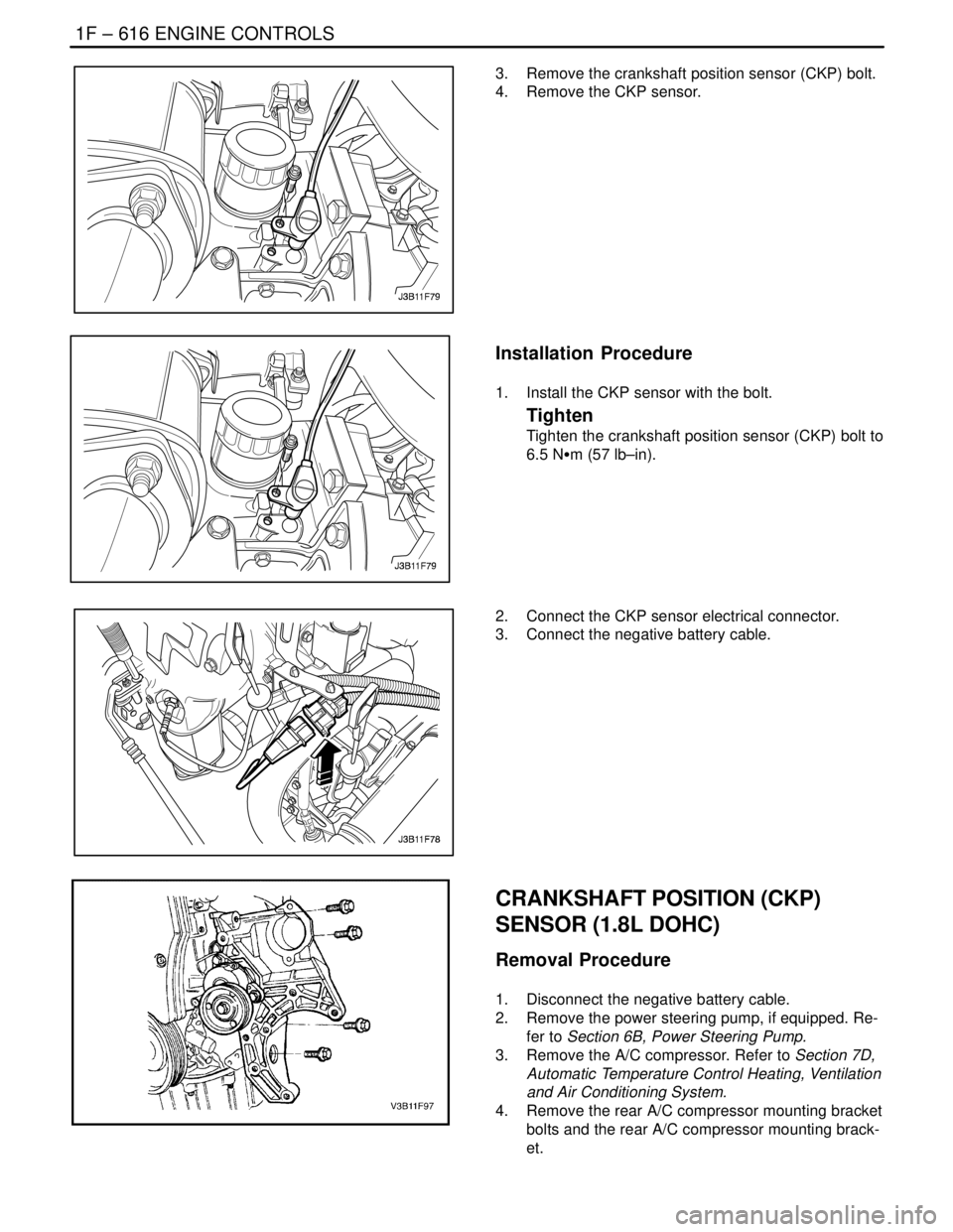
3. Remove the crankshaft position sensor (CKP) bolt.
4. Remove the CKP sensor.
Installation Procedure
1. Install the CKP sensor with the bolt.
Tighten
Tighten the crankshaft position sensor (CKP) bolt to
6.5 NSm (57 lb–in).
2. Connect the CKP sensor electrical connector.
3. Connect the negative battery cable.
CRANKSHAFT POSITION (CKP)
SENSOR (1.8L DOHC)
Removal Procedure
1. Disconnect the negative battery cable.
2. Remove the power steering pump, if equipped. Re-
fer to Section 6B, Power Steering Pump.
3. Remove the A/C compressor. Refer to Section 7D,
Automatic Temperature Control Heating, Ventilation
and Air Conditioning System.
4. Remove the rear A/C compressor mounting bracket
bolts and the rear A/C compressor mounting brack-
et.
Page 863 of 2643
ENGINE CONTROLS 1F – 617
DAEWOO V–121 BL4
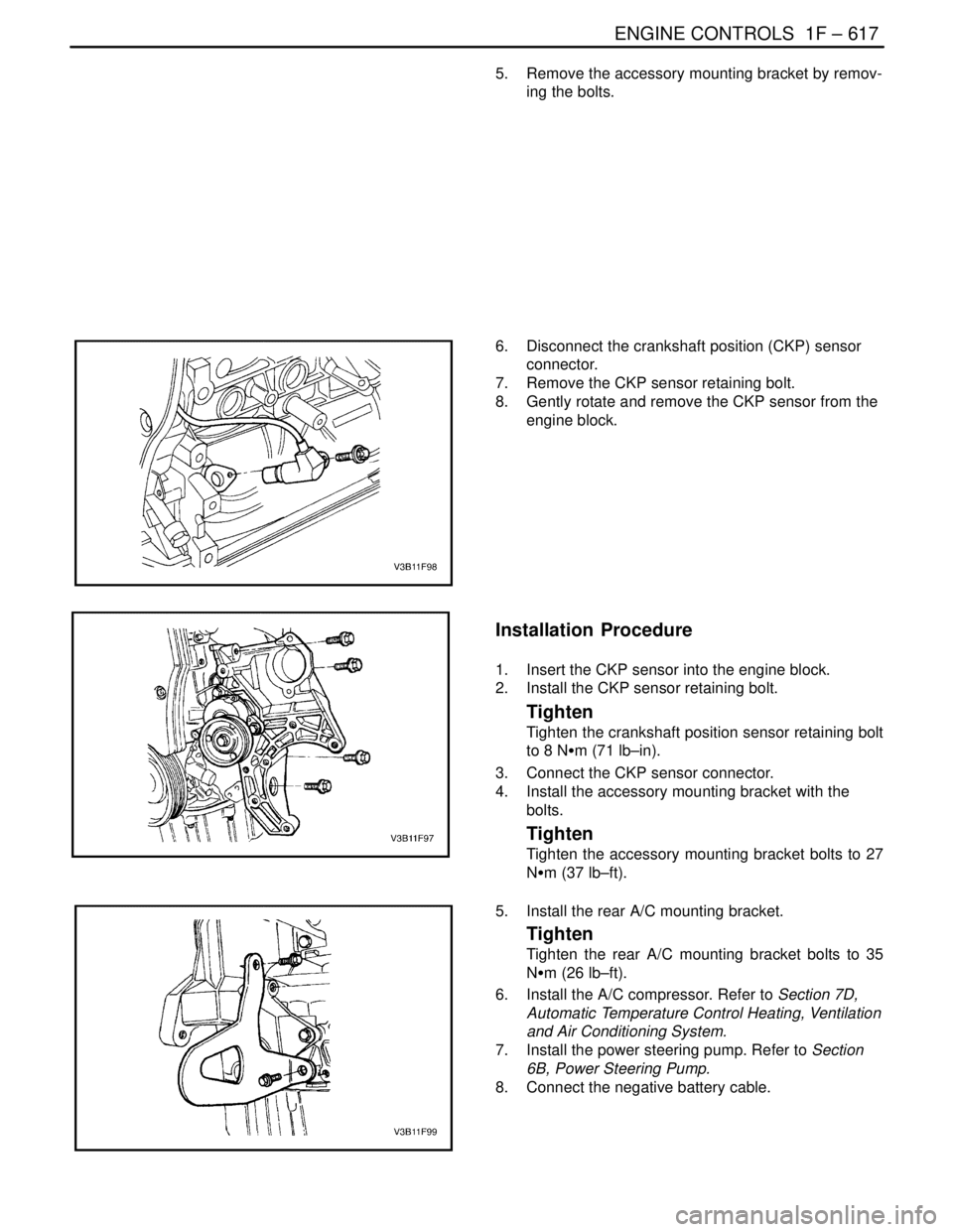
5. Remove the accessory mounting bracket by remov-
ing the bolts.
6. Disconnect the crankshaft position (CKP) sensor
connector.
7. Remove the CKP sensor retaining bolt.
8. Gently rotate and remove the CKP sensor from the
engine block.
Installation Procedure
1. Insert the CKP sensor into the engine block.
2. Install the CKP sensor retaining bolt.
Tighten
Tighten the crankshaft position sensor retaining bolt
to 8 NSm (71 lb–in).
3. Connect the CKP sensor connector.
4. Install the accessory mounting bracket with the
bolts.
Tighten
Tighten the accessory mounting bracket bolts to 27
NSm (37 lb–ft).
5. Install the rear A/C mounting bracket.
Tighten
Tighten the rear A/C mounting bracket bolts to 35
NSm (26 lb–ft).
6. Install the A/C compressor. Refer to Section 7D,
Automatic Temperature Control Heating, Ventilation
and Air Conditioning System.
7. Install the power steering pump. Refer to Section
6B, Power Steering Pump.
8. Connect the negative battery cable.
Page 1980 of 2643

7A – 6IHEATING AND VENTILATION SYSTEM
DAEWOO V–121 BL4
DIAGNOSIS
HEATER SYSTEM
INSUFFICIENT HEATING OR DEFROSTING
CAUTION : The cooling system is pressurized when hot. Injury can result from removing the surge tank cap be-
fore the engine is sufficiently cool.
Step
ActionValue(s)YesNo
1Verify the customer’s complaint.
Are the customer’s concerns verified?–Go to Step 2System OK
2Check the coolant level.
Is the coolant level correct?–Go to Step 4Go to Step 3
3Add coolant as needed.
Is the repair complete?–System OKGo to Step 4
4Check the timing belt for tension or damage.
Are the drive belts OK?–Go to Step 6Go to Step 5
5Correct any problem with the timing belt.
Is the repair complete?–System OKGo to Step 6
6Check the coolant hoses for leaks or kinks.
Are the coolant hoses OK?–Go to Step 8Go to Step 7
7Repair any problem with the coolant hoses.
Is the repair complete?–System OKGo to Step 8
8Check the surge tank cap. Refer to Section 2D, En-
gine Cooling.
Is the surge tank cap OK?–Go to Step 10Go to Step 9
9Repair or replace the surge tank cap as needed.
Is the repair complete?–System OKGo to Step 10
101. Turn the A/C switch OFF on vehicles equipped
with air conditioning (A/C).
2. Set the blower motor switch on maximum
speed.
3. Set the heater control to full hot.
4. Turn the ignition ON.
5. Check for airflow from the vent outlet.
Is there heavy airflow from the heater outlet?–Go to Step 11Go to Step 26
11Check for a change in the airflow at various blower
speeds.
Does the blower speed increase as the switch is
turned from 1 to 4.–Go to Step 12Go to ”Blower
Electrical
(Manual and
Non–A/C)”
121. Turn the A/C switch OFF.
2. Set the temperature lever to full hot.
3. Set the blower motor switch on maximum
speed.
4. With the engine sufficiently cool, remove the
surge tank cap.
5. Start the vehicle and idle the engine.
6. Watch for the flow of the coolant.
Is the coolant flow visible?–Go to Step 14Go to Step 13
Page 2002 of 2643

7A – 28IHEATING AND VENTILATION SYSTEM
DAEWOO V–121 BL4
GENERAL DESCRIPTION
AND SYSTEM OPERATION
HEATING AND VENTILATION
SYSTEMS
The base heater system is designed to provide heating,
ventilation, windshield defrosting, side window defogging,
and on some vehicles, heating directly to the rear seat
area.
The heater and fan assembly blower regulates the airflow
from the air inlet for further processing and distribution.
The heater core transfers the heat from the engine coolant
to the inlet air.
The temperature door regulates the amount of the air that
passes through the heater core. The temperature door
also controls the temperature of the air by controlling the
mix of the heated air and the ambient air.
The mode door regulates the flow and the distribution of
the processed air to the heater ducts and to the defroster
ducts.
This console–mounted heating and ventilation panel con-
tains the following:
The Rotary Temperature Control Knob
1. The Rotary Temperature Control Knob
S Actuates by cable.
S Raises the temperature of the air entering the
vehicle by rotation toward the right, or the red
portion of the knob.
2. The Rotary Blower Control Knob
S Turns ON to operate the blower motor at four
speeds.
S Turns OFF to stop the blower.
S Operates completely independently both from
the mode control that regulates the defroster
door and from the temperature control knob.S Changes the fan speed in any mode and at any
temperature setting.
3. The Rotary Mode Control Knob
S Actuates by cable.
S Regulates the air distribution between the wind-
shield, the instrument panel, and the floor vents.
Two Push Knobs
1. The Rear Window Defogger Push Knob
S Controls the rear window defogger.
S Turns ON the rear window defogger when the
push knob is pressed and the indicator lamp is
illuminated.
2. The A/C Push Knob (if the vehicle is equipped with
air conditioning)
S Controls the A/C.
S Turns the A/C ON when the push knob is down.
However, if the blower control knob is OFF, the
A/C system is OFF, regardless of the position of
the A/C knob.
Fresh Air Control Level Or Push Knob
1. The Fresh Air Control Level
S Operates by cable.
S Switches between recirculating passenger
compartment air and bringing outside air into the
passenger compartment.
S Draws in outside air when the lever is moved to
the right.
S Recirculates inside air when the lever is moved
to the left.
2. The Fresh Air Control Push Knob
S Operates by cable.
S Switches between recirculating passenger
compartment air and bringing outside air into the
passenger compartment.
S Draws in outside air when knob is off.
S Recirculates inside air when the knob is down
with the indicator lamp illuminated.
Page 2003 of 2643

SECTION : 7B
MANUAL CONTROL HEATING, VENTILATION
AND AIR CONDITIONING SYSTEM
CAUTION : Disconnect the negative battery cable before removing or installing any electrical unit or when a tool
or equipment could easily come in contact with exposed electrical terminals. Disconnecting this cable will help
prevent personal injury and damage to the vehicle. The ignition must also be in LOCK unless otherwise noted.
TABLE OF CONTENTS
SPECIFICATIONS7B–2 . . . . . . . . . . . . . . . . . . . . . . . . . .
General Specifications 7B–2. . . . . . . . . . . . . . . . . . . . .
Fastener Tightening Specifications 7B–2. . . . . . . . . . .
SPECIAL TOOLS7B–3 . . . . . . . . . . . . . . . . . . . . . . . . . . .
Special Tools Table 7B–3. . . . . . . . . . . . . . . . . . . . . . . .
SCHEMATIC AND ROUTING DIAGRAMS7B–6 . . . . .
A/C System – Typical 7B–6. . . . . . . . . . . . . . . . . . . . . .
Manual Control A/C Diagram 7B–7. . . . . . . . . . . . . . . .
DIAGNOSIS7B–8 . . . . . . . . . . . . . . . . . . . . . . . . . . . . . . . .
GENERAL DIAGNOSIS 7B–8. . . . . . . . . . . . . . . . . . . . . .
Testing the Refrigerant System 7B–8. . . . . . . . . . . . . .
Insufficient Cooling ”Quick Check” Procedure 7B–8. .
A/C Performance Test 7B–9. . . . . . . . . . . . . . . . . . . . . .
Pressure–Temperature Relationship of
R–134A 7B–10. . . . . . . . . . . . . . . . . . . . . . . . . . . . . . .
Leak Testing Refrigerant System 7B–11. . . . . . . . . . . .
V5 SYSTEM AIR CONDITIONING DIAGNOSIS 7B–12
Insufficient Cooling Diagnosis 7B–12. . . . . . . . . . . . . .
SYMPTOM DIAGNOSIS 7B–16. . . . . . . . . . . . . . . . . . . .
Pressure Test Chart (R–134A System) 7B–16. . . . . .
Low and High Side Pressure Relationship
Chart 7B–18. . . . . . . . . . . . . . . . . . . . . . . . . . . . . . . . . .
MAINTENANCE AND REPAIR7B–19 . . . . . . . . . . . . . .
ON–VEHICLE SERVICE 7B–19. . . . . . . . . . . . . . . . . . . .
GENERAL A/C SYSTEM SERVICE
PROCEDURES 7B–19. . . . . . . . . . . . . . . . . . . . . . . . . .
O–Ring Replacement 7B–19. . . . . . . . . . . . . . . . . . . . .
Handling Refrigerant 7B–19. . . . . . . . . . . . . . . . . . . . . .
Handling of Refrigerant Lines and Fittings 7B–19. . . .
Maintaining Chemical Stability in the Refrigeration
System 7B–20. . . . . . . . . . . . . . . . . . . . . . . . . . . . . . . .
Discharging, Adding Oil, Evacuating, and Charging
Procedures for A/C System 7B–20. . . . . . . . . . . . . .
SERVICEABLE COMPONENTS 7B–23. . . . . . . . . . . . . Components Used In Non–A/C Systems 7B–23. . . . .
A/C Pressure Transducer 7B–24. . . . . . . . . . . . . . . . . .
A/C Compressor Relay 7B–24. . . . . . . . . . . . . . . . . . . .
Air Filter 7B–25. . . . . . . . . . . . . . . . . . . . . . . . . . . . . . . . .
A/C Expansion Valve 7B–25. . . . . . . . . . . . . . . . . . . . . .
A/C High–Pressure Pipe Line 7B–26. . . . . . . . . . . . . . .
Evaporator Core 7B–29. . . . . . . . . . . . . . . . . . . . . . . . . .
A/C Suction Hose Assembly 7B–30. . . . . . . . . . . . . . .
A/C Discharge Hose Compressor to
Condenser 7B–31. . . . . . . . . . . . . . . . . . . . . . . . . . . . .
Receiver–Dryer 7B–32. . . . . . . . . . . . . . . . . . . . . . . . . . .
Compressor 7B–33. . . . . . . . . . . . . . . . . . . . . . . . . . . . . .
Condenser 7B–35. . . . . . . . . . . . . . . . . . . . . . . . . . . . . . .
UNIT REPAIR 7B–37. . . . . . . . . . . . . . . . . . . . . . . . . . . . .
COMPONENT LOCATOR 7B–37. . . . . . . . . . . . . . . . . . .
V5 Compressor 7B–37. . . . . . . . . . . . . . . . . . . . . . . . . . .
V5 AIR CONDITIONING COMPRESSOR
OVERHAUL 7B–38. . . . . . . . . . . . . . . . . . . . . . . . . . . . .
Clutch Plate and Hub Assembly 7B–38. . . . . . . . . . . .
Clutch Rotor and Bearing 7B–40. . . . . . . . . . . . . . . . . .
Clutch Coil 7B–42. . . . . . . . . . . . . . . . . . . . . . . . . . . . . . .
Shaft Seal Replacement 7B–44. . . . . . . . . . . . . . . . . . .
Control Valve Assembly 7B–46. . . . . . . . . . . . . . . . . . .
Rear Head, Gasket, Valve Plate, Reed Plate,
and O–ring 7B–47. . . . . . . . . . . . . . . . . . . . . . . . . . . . .
Cylinder to Front Head O–ring 7B–48. . . . . . . . . . . . . .
Leak Testing (External) 7B–50. . . . . . . . . . . . . . . . . . . .
GENERAL DESCRIPTION AND SYSTEM
OPERATION7B–51 . . . . . . . . . . . . . . . . . . . . . . . . . . . . .
GENERAL INFORMATION 7B–51. . . . . . . . . . . . . . . . . .
The V5 A/C System 7B–51. . . . . . . . . . . . . . . . . . . . . . .
System Components – Functional 7B–51. . . . . . . . . .
System Components – Control 7B–52. . . . . . . . . . . . .
V5 Compressor – General Description 7B–52. . . . . . .
V5 Compressor – Description of Operation 7B–52. . .
Page 2004 of 2643

7B – 2IMANUAL CONTROL HEATING, VENTILATION AND AIR CONDITIONING SYSTEM
DAEWOO V–121 BL4
SPECIFICATIONS
GENERAL SPECIFICATIONS
ApplicationUnitDescription
Compressor–V5
Receiver–Dryer–AL R/DRIER
RefrigerantType–R–134a System
Capacityg640±20 (RHD : 680±20)
Refrigerant Oil in A/C SystemType–Union Carbide 488 PAG OIL
Capacitycc (ml)220
Evaporator Capacity (Airflow rate 8.7 kg/min)Kcal/h6000±10%
FASTENER TIGHTENING SPECIFICATIONS
ApplicationNSmLb–FtLb–In
Pressure Transducer7–62
Expansion Valve Stud Bolts8–71
Liquid Pipe Support Clamp Bolts4–35
Liquid Pipe Block–to–Receiver Dryer Retaining Nut1410–
Liquid Pipe Block–to–Expansion Valve Retaining Nut1410–
Refrigerant Discharge Hose Block–to–Condenser Retaining Nut1612–
Refrigerant Discharge Hose Block–to–Compressor Retaining Nut3324–
Evaporator Core Cover Screws1.2–11
Heater Core Housing–to–Evaporator Housing Retaining Screws1.2–11
Suction Hose Block–to–Compressor Retaining Nut3324–
Suction Hose Support Clamp–to–Longitudinal Member Bolt8–71
Suction Hose Support Clamp–to–Engine Bracket Bolt (1.4D, 1.6D only)4–35
Suction Hose Support Clamp–to–Engine Bracket Bolt (1.8D, 2.0D only)1410–
Suction Hose Block–to–Expansion Valve Retaining Nut1410–
(Receiver Dryer) Band Clamp Bolt5–44
Receiver Dryer–to–Condenser Pipe Block Bolt5–44
Upper Compressor–to–Bracket Mounting Bolts (1.4D, 1.6D only)2518–
Lower Compressor–to–Bracket Mounting Bolts (1.4D, 1.6D only)4533–
Front Compressor–to–Bracket Mounting Bolts (1.8D, 2.0D only)3526–
Rear Compressor–to–Bracket Mounting Bolts (1.8D, 2.0D only)2015–
Condenser Mount Bolts4–35
(Compressor) Clutch Plate and Hub Assembly Retaining Nut1713–
(Compressor) Through Bolts10–89
Page 2005 of 2643
MANUAL CONTROL HEATING, VENTILATION AND AIR CONDITIONING SYSTEM 7B – 3
DAEWOO V–121 BL4
SPECIAL TOOLS
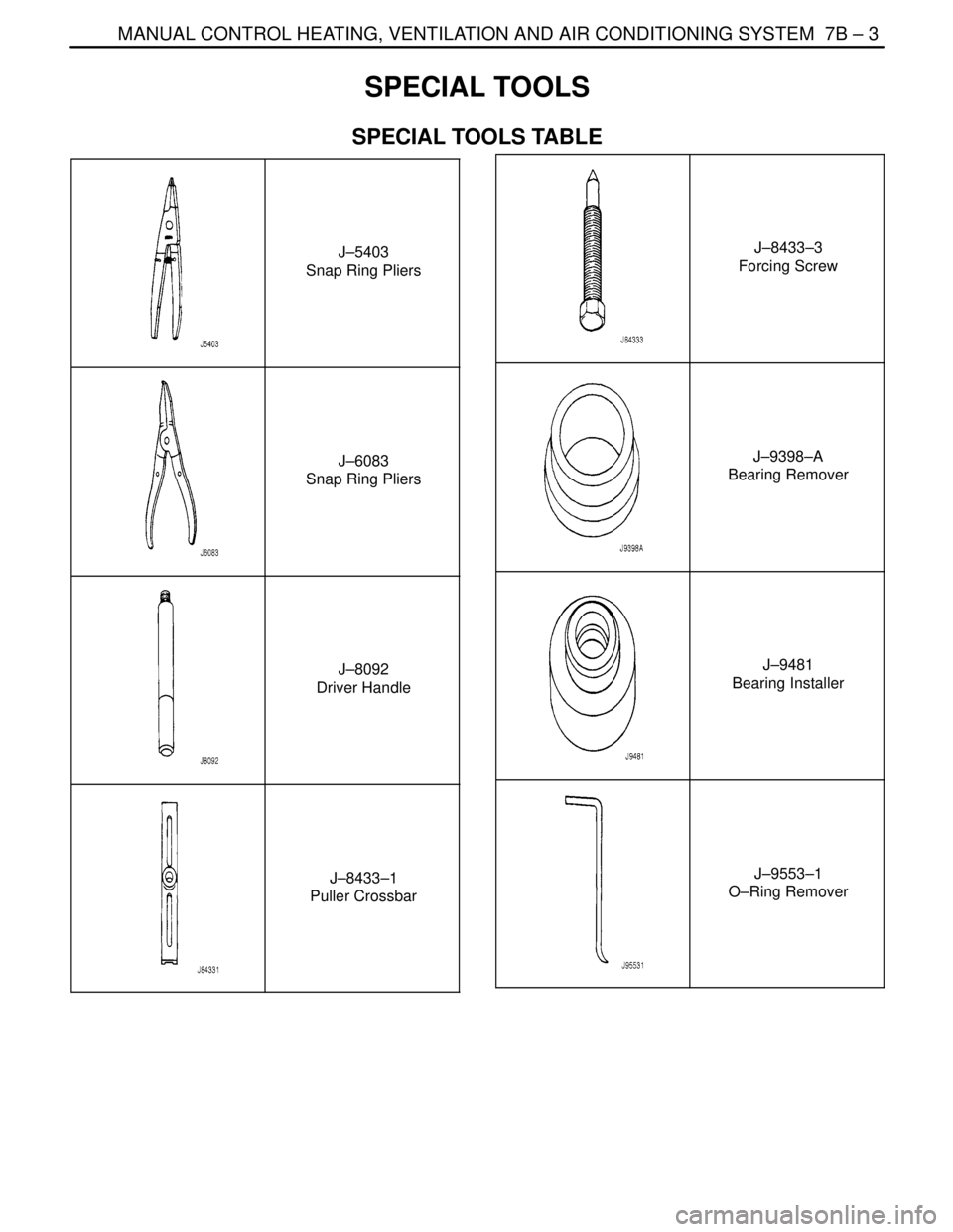
SPECIAL TOOLS TABLE
J–5403
Snap Ring Pliers
J–6083
Snap Ring Pliers
J–8092
Driver Handle
J–8433–1
Puller Crossbar
J–8433–3
Forcing Screw
J–9398–A
Bearing Remover
J–9481
Bearing Installer
J–9553–1
O–Ring Remover