ECO mode DAEWOO LACETTI 2004 Service Owner's Manual
[x] Cancel search | Manufacturer: DAEWOO, Model Year: 2004, Model line: LACETTI, Model: DAEWOO LACETTI 2004Pages: 2643, PDF Size: 80.54 MB
Page 875 of 2643

ENGINE CONTROLS 1F – 629
DAEWOO V–121 BL4
tentially interfere with the operation of the Exhaust Gas
Recirculation (EGR) valve and thereby turn on the MIL.
Small leaks in the exhaust system near the post catalyst
oxygen sensor can also cause the MIL to turn on.
Aftermarket electronics, such as cellular phones, stereos,
and anti–theft devices, may radiate electromagnetic inter-
ference (EMI) into the control system if they are improperly
installed. This may cause a false sensor reading and turn
on the MIL.
Environment
Temporary environmental conditions, such as localized
flooding, will have an effect on the vehicle ignition system.
If the ignition system is rain–soaked, it can temporarily
cause engine misfire and turn on the MIL.
Refueling
A new EOBD diagnostic checks the integrity of the entire
Evaporative (EVAP) Emission system. If the vehicle is re-
started after refueling and the fuel cap is not secured cor-
rectly, the on–board diagnostic system will sense this as
a system fault, turn on the MIL, and set DTC P0440.
Vehicle Marshaling
The transportation of new vehicles from the assembly
plant to the dealership can involve as many as 60 key
cycles within 2 to 3 miles of driving. This type of operation
contributes to the fuel fouling of the spark plugs and will
turn on the MIL with a set DTC P0300.
Poor Vehicle Maintenance
The sensitivity of EOBD diagnostics will cause the MIL to
turn on if the vehicle is not maintained properly. Restricted
air filters, fuel filters, and crankcase deposits due to lack
of oil changes or improper oil viscosity can trigger actual
vehicle faults that were not previously monitored prior to
EOBD. Poor vehicle maintenance can not be classified as
a ”non–vehicle fault,” but with the sensitivity of EOBD
diagnostics, vehicle maintenance schedules must be
more closely followed.
Severe Vibration
The Misfire diagnostic measures small changes in the
rotational speed of the crankshaft. Severe driveline vibra-
tions in the vehicle, such as caused by an excessive
amount of mud on the wheels, can have the same effect
on crankshaft speed as misfire and, therefore, may set
DTC P0300.
Related System Faults
Many of the EOBD system diagnostics will not run if the
engine controlmodule (ECM) detects a fault on a related
system or component. One example would be that if the
ECM detected a Misfire fault, the diagnostics on the cata-
lytic converter would be suspended until the Misfire fault
was repaired. If the Misfire fault is severe enough, the cat-
alytic converter can be damaged due to overheating andwill never set a Catalyst DTC until the Misfire fault is re-
paired and the Catalyst diagnostic is allowed to run to
completion. If this happens, the customer may have to
make two trips to the dealership in order to repair the ve-
hicle.
SERIAL DATA COMMUNICATIONS
Class II Serial Data Communications
Government regulations require that all vehicle manufac-
turers establish a common communication system. This
vehicle utilizes the ”Class II” communication system. Each
bit of information can have one of two lengths: long or
short. This allows vehicle wiring to be reduced by transmit-
ting and receiving multiple signals over a single wire. The
messages carried on Class II data streams are also priori-
tized. If two messages attempt to establish communica-
tions on the data line at the same time, only the message
with higher priority will continue. The device with the lower
priority message must wait. Themost significant result of
this regulation is that it provides scan tool manufacturers
with the capability to access data from any make or model
vehicle that is sold.
The data displayed on the other scan tool will appear the
same, with some exceptions. Some scan tools will only be
able to display certain vehicle parameters as values that
are a coded representation of the true or actual value. On
this vehicle the scan tool displays the actual values for ve-
hicle parameters. It will not be necessary to perform any
conversions from coded values to actual values.
ON–BOARD DIAGNOSTIC (EOBD)
On–Board Diagnostic Tests
A diagnostic test is a series of steps, the result of which is
a pass or fail reported to the diagnostic executive. When
a diagnostic test reports a pass result, the diagnostic
executive records the following data:
S The diagnostic test has been completed since the
last ignition cycle.
S The diagnostic test has passed during the current
ignition cycle.
S The fault identified by the diagnostic test is not cur-
rently active.
When a diagnostic test reports a fail result, the diagnostic
executive records the following data:
S The diagnostic test has been completed since the
last ignition cycle.
S The fault identified by the diagnostic test is current-
ly active.
S The fault has been active during this ignition cycle.
S The operating conditions at the time of the failure.
Remember, a fuel trim Diagnostic Trouble Code (DTC)
may be triggered by a list of vehicle faults. Make use of all
information available (other DTCs stored, rich or lean con-
dition, etc.) when diagnosing a fuel trim fault.
Page 878 of 2643

1F – 632IENGINE CONTROLS
DAEWOO V–121 BL4
READING DIAGNOSTIC TROUBLE
CODES
The procedure for reading diagnostic trouble code(s) is to
use a diagnostic scan tool. When reading Diagnostic
Trouble Codes (DTCs), follow the instructions supplied by
tool manufacturer.
DTC Modes
On On–Board Diagnostic (EOBD) passenger cars there
are five options available in the scan tool DTC mode to dis-
play the enhanced information available. A description of
the new modes, DTC Info and Specific DTC, follows. After
selecting DTC, the following menu appears:
S DTC Info.
S Specific DTC.
S Freeze Frame.
S Fail Records (not all applications).
S Clear Info.
The following is a brief description of each of the sub me-
nus in DTC Info and Specific DTC. The order in which they
appear here is alphabetical and not necessarily the way
they will appear on the scan tool.
DTC Information Mode
Use the DTC info mode to search for a specific type of
stored DTC information. There are seven choices. The
service manual may instruct the technician to test for
DTCs in a certain manner. Always follow published service
procedures.
To get a complete description of any status, press the ”En-
ter” key before pressing the desired F–key. For example,
pressing ”Enter” then an F–key will display a definition of
the abbreviated scan tool status.
DTC Status
This selection will display any DTCs that have not run dur-
ing the current ignition cycle or have reported a test failure
during this ignition up to a maximum of 33 DTCs. DTC
tests which run and pass will cause that DTC number to
be removed from the scan tool screen.
Fail This Ign. (Fail This Ignition)
This selection will display all DTCs that have failed during
the present ignition cycle.
History
This selection will display only DTCs that are stored in the
ECM’s history memory. It will not display type CNL DTCs
that have not requested the Malfunction Indicator Lamp
(MIL). It will display all type A, B and E DTCs that have re-
quested the MIL and have failed within the last 40 warm–
up cycles. In addition, it will display all type C and type D
DTCs that have failed within the last 40 warm–up cycles.
Last Test Fail
This selection will display only DTCs that failed the last
time the test ran. The last test may have run during a pre-
vious ignition cycle if a type A or type B DTC is displayed.
For type C and type D DTCs, the last failure must have oc-
curred during the current ignition cycle to appear as Last
Test Fail.
MIL Request
This selection will display only DTCs that are requesting
the MIL. Type C and type D DTCs cannot be displayed us-
ing this option. This selection will report type B DTCs only
after the MIL has been requested.
Not Run SCC (Not Run Since Code Clear)
This option will display up to 33 DTCs that have not run
since the DTCs were last cleared. Since any displayed
DTCs have not run, their condition (passing or failing) is
unknown.
Test Fail SCC (Test Failed Since Code
Clear)
This selection will display all active and history DTCs that
have reported a test failure since the last time DTCs were
cleared. DTCs that last failed more than 40 warm–up
cycles before this option is selected will not be displayed.
Specific DTC Mode
This mode is used to check the status of individual diag-
nostic tests by DTC number. This selection can be ac-
cessed if a DTC has passed, failed or both. Many EOBD
DTC mode descriptions are possible because of the ex-
tensive amount of information that the diagnostic execu-
tive monitors regarding each test. Some of the many pos-
sible descriptions follow with a brief explanation.
The ”F2” key is used, in this mode, to display a description
of the DTC. The ”Yes” and ”No” keys may also be used to
display more DTC status information. This selection will
only allow entry of DTC numbers that are supported by the
vehicle being tested. If an attempt is made to enter DTC
numbers for tests which the diagnostic executive does not
recognize, the requested information will not be displayed
correctly and the scan tool may display an error message.
The same applies to using the DTC trigger option in the
Snapshot mode. If an invalid DTC is entered, the scan tool
will not trigger.
Failed Last Test
This message display indicates that the last diagnostic
test failed for the selected DTC. For type A and type B
DTCs, this message will be displayed during subsequent
ignition cycles until the test passes or DTCs are cleared.
For type C and type D DTCs, this message will clear when
the ignition is cycled.
Failed Since Clear
This message display indicates that the DTC has failed at
least once within the last 40 warm–up cycles since the last
time DTCs were cleared.
Page 1356 of 2643

ZF 4 HP 16 AUTOMATIC TRANSAXLE 5A1 – 7
DAEWOO V–121 BL4
RangePark/
Neutr
alRever
seD321
GearNR1st2nd3rd4th1st2nd3rd1st2nd1st
Solenoid Valve
1ONON/
OFFON/
OFFON/
OFFON/
OFFON/
OFFON/
OFFON/
OFFON/
OFFON/
OFFON/
OFFON/
OFF
Solenoid Valve
2ONONONOFFOFFOFFONOFFOFFONOFFON
Line Pressure
Control Sole-
noid Valve 3
(EDS 3)OFFOFFOFFONON/
OFFON/
OFFOFFONON/
OFFOFFONOFF
Line Pressure
Control Sole-
noid Valve 4
(EDS 4)ONOFFONONONOFFONONONONONON
Line Pressure
Control Sole-
noid Valve 5
(EDS 5)OFFOFFONONOFFOFFONONOFFONONON
Line Pressure
Control Sole-
noid Valve 6
(EDS 6)ONOFFONONONOFFONONONONONON
Brake BAAAAAAAA
Brake CH
Brake DH
Clutch EAAAAAA
Brake FHHHHHHH
Lock–up
ClutchA
A = Applied
H = Holding
ON = The solenoid is energized.
OFF = The solenoid is de–energized.
** = Manual Second–Third gear is only available above approximately 100 km/h (62 mph).
*** = Manual First–Second gear is only available above approximately 60 km/h (37 mph).
Note : Manual First–Third gear is also possible at high vehicle speed as a safety feature.
SHIFT SPEED CHART
Up Shift Speed
MODELFirst–Second gear (±3.0
mph (4.8km/h))Second–Third gear (±4.0
mph (6.4km/h))Third–Fourth gear (±5.0
mph (8km/h))
10%
TPS25%
TPS50%
TPS100%
TPS10%
TPS25%
TPS50%
TPS100%
TPS10%
TPS25%
TPS50%
TPS100%
TPS
1.8 DOHC
mph (km/h)9
(15)11
(18)18
(29)32
(52)18
(29)23
(37)34
(55)62
(99)25
(45)34
(55)47
(76)98
(157)
Page 1357 of 2643

5A1 – 8IZF 4 HP 16 AUTOMATIC TRANSAXLE
DAEWOO V–121 BL4
Down Shift Speed
MODELDown Shift (±4.0 mph (6.4km/h))Lock Up Clutch Applied
(Fourth)Lock Up Clutch
Released
(Fourth)
Fourth–Th
ird
(Coast)Third–Sec
ond
(Coast)Second–Fi
rst
(Coast)10%25%10%25%
1.8 DOHC
mph (km/h)25 (41)13 (21)7 (11)48 (77)48 (77)42 (68)42 (68)
LINE PRESSURE
Gear RangeSolenoidLine PressureB PortE Port
Park / NeutralONLOW90~124.7 psi
(6.2~8.6 bar)
OFFHIGH221.9~252.3 psi
(15.3~17.4 bar)
ReverseONLOW89.9~124.7 psi
(6.2~8.6 bar)
OFFHIGH221.9~252.3 psi
(15.3~17.4 bar)
DriveONLOW90~124.7 psi
(6.2~8.6 bar)
OFFHIGH137.7~162.4 psi
(9.5~11.2 bar)
3ONLOW90~124.7 psi
(6.2~8.6 bar)90~124.7 psi
(6.2~8.6 bar)
OFFHIGH221.9~252.3 psi
(15.3~17.4 bar)137.7~162.4 psi
(9.5~11.2 bar)
2ONLOW90~124.7 psi
(6.2~8.6 bar)
OFFHIGH137.7~162.4 psi
(9.5~11.2 bar)
1ONLOW90~124.7 psi
(6.2~8.6 bar)
OFFHIGH221.9~252.3 psi
(15.3~17.4 bar)
Page 1362 of 2643

ZF 4 HP 16 AUTOMATIC TRANSAXLE 5A1 – 13
DAEWOO V–121 BL4
SHIFT MODE DIAGRAM
Economic Mode (1.8 DOHC)
Page 1363 of 2643
5A1 – 14IZF 4 HP 16 AUTOMATIC TRANSAXLE
DAEWOO V–121 BL4
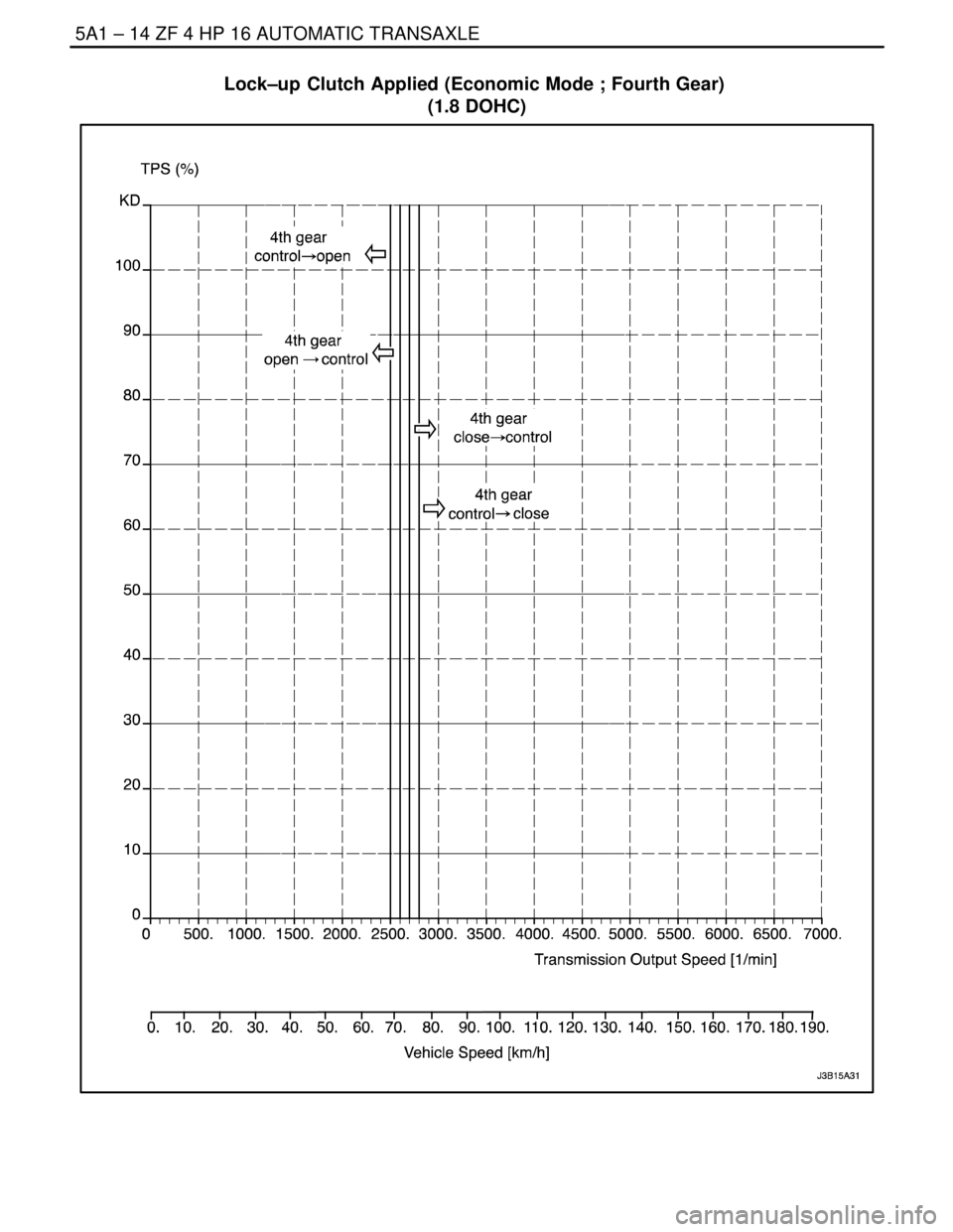
Lock–up Clutch Applied (Economic Mode ; Fourth Gear)
(1.8 DOHC)
Page 1396 of 2643

ZF 4 HP 16 AUTOMATIC TRANSAXLE 5A1 – 47
DAEWOO V–121 BL4
Repairing the Fluid Leak
Once the leak point is found the source of the leak must
be determined. The following list describes the potential
causes for the leak:
S Fasteners are not torqued to specification.
S Fastener threads and fastener holes are dirty or
corroded.
S Gaskets, seals or sleeves are misarranged, dam-
aged or worn.
S Damaged, warped or scratched seal bore or gasket
surface.
S Loose or worn bearing causing excess seal or
sleeve wears.
S Case or component porosity.
S Fluid level is too high.
S Plugged vent or damaged vent tube.
S Water or coolant in fluid.
S Fluid drain back holes plugged.
ELECTRICAL/GARAGE SHIFT TEST
This preliminary test should be performed before a hoist
or road test to make sure electronic control inputs is con-
nected and operating. If the inputs are not checked before
operating the transaxle, a simple electrical condition could
be misdiagnosed as a major transaxle condition.
A scan tool provides valuable information and must be
used on the automatic transaxle for accurate diagnosis.
1. Move gear selector to P (Park) and set the parking
brake.
2. Connect scan tool to Data Link Connector (DLC)
terminal.
3. Start engine.
4. Turn the scan tool ON.
5. Verify that the appropriate signals are present.
These signals may include:
S ENGINE SPEED
S VEHICLE SPEED
S THROTTLE POSITION
S TRANSAXLE GEAR STATE
S GEAR SHIFT LEVER POSITION
S TRANSAXLE FLUID TEMPERATURE
S CLOSED THROTTLE POSITION LEARN
S OPEN THROTTLE POSITION LEARNT
S CLOSED ACCEL. PEDAL POSITION LEARNT
S OPEN ACCEL. PEDAL POSITION LEARNT
S A/C COMPRESSOR STATUS
S MODE SWITCH
S THROTTLE POSITION VOLTAGE
S GEAR SHIFT LEVER POSITION VOLTAGE
S TRANS. FLUID TEMPERATURE VOLTAGE
S A/C SWITCH
S MODE SWITCH VOLTAGE
S BATTERY VOLTAGE
6. Monitor the A/C COMPRESSOR STATUS signal
while pushing the A/C switch.S The A/C COMPRESSOR STATUS should come
ON when the A/C switch is pressed, and turns
OFF when the A/C switch is repushed.
7. Monitor the GEAR SHIFT LEVER POSITION signal
and move the gear shift control lever through all the
ranges.
S Verify that the GEAR SHIFT LEVER POSITION
value matches the gear range indicated on the
instrument panel or console.
S Gear selections should be immediate and not
harsh.
8. Move gear shift control lever to neutral and monitor
the THROTTLE POSITION signal while increasing
and decreasing engine speed with the accelerator
pedal.
S THROTTLE POSITION should increase with
engine speed.
ROAD TEST PROCEDURE
S Perform the road test using a scan tool.
S This test should be performed when traffic and road
conditions permit.
S Observe all traffic regulations.
The TCM calculates upshift points based primarily on two
inputs : throttle angle and vehicle speed. When the TCM
wants a shift to occur, an electrical signal is sent to the shift
solenoids which in turn moves the valves to perform the
upshift.
The shift speed charts reference throttle angle instead of
”min throttle” or ”wot” to make shift speed measurement
more uniform and accurate. A scan tool should be used to
monitor throttle angle. Some scan tools have been pro-
grammed to record shift point information. Check the
introduction manual to see if this test is available.
Upshift Procedure
With gear selector in drive(D)
1. Look at the shift speed chart contained in this sec-
tion and choose a percent throttle angle of 10 or
25%.
2. Set up the scan tool to monitor throttle angle and
vehicle speed.
3. Accelerate to the chosen throttle angle and hold the
throttle steady.
4. As the transaxle upshifts, note the shift speed and
commanded gear changes for :
S Second gear.
S Third gear.
S Fourth gear.
Important : Shift speeds may vary due to slight hydraulic
delays responding to electronic controls. A change from
the original equipment tire size affects shift speeds.
Note when TCC applies. This should occur in fourth gear.
If the apply is not noticed by an rpm drop, refer to the
”Lock–up Clutch Diagnosis” information contained in this
section.
Page 1400 of 2643

ZF 4 HP 16 AUTOMATIC TRANSAXLE 5A1 – 51
DAEWOO V–121 BL4
SHIFT SPEED CHART
Up Shift Speed
MODELFirst–Second gear
(±3.0 mph (4.8km/h))Second–Third gear
(±4.0 mph (6.4km/h))Third–Fourth gear
(±5.0 mph (8km/h))
10%
TPS25%
TPS50%
TPS100%
TPS10%
TPS25%
TPS50%
TPS100%
TPS10%
TPS25%
TPS50%
TPS100%
TPS
1.8 DOHC
mph (km/h)9 (15)11
(18)18
(29)32
(52)18
(29)23
(37)34
(55)62
(99)25
(45)34
(55)47
(76)98
(157)
Down Shift Speed
MODELDown Shift (±4.0 mph (6.4km/h))Lock Up Clutch
Applied
(Fourth)Lock Up Clutch
Released
(Fourth)
Fourth–
Third
(Coast)Third–
Second
(Coast)Second–
First
(Coast)10%25%10%25%
1.8 DOHC
mph (km/h)25 (41)13 (21)7 (11)48 (77)48 (77)42 (68)42 (68)
INTERNAL WIRING HARNESS CHECK
StepActionValue(s)YesNo
11. Disconnect the transaxle harness.
2. Measure the resistance between terminals 3
and 13 of the transaxle wiring connector.
Is the resistance within the values shown?Refer to Com-
ponent Resist-
ance ChartGo to Step 3Go to Step 2
21. Disconnect the internal transaxle harness from
the first solenoid valve.
2. Measure the resistance of the first solenoid
valve.
Is the resistance within the values shown?Refer to Com-
ponent Resist-
ance ChartGo to Step 20Go to Step 22
3Measure the resistance between terminals 3 and 13
the second solenoid valve.
Is the resistance within the values shown?Refer to Com-
ponent Resist-
ance ChartGo to Step 5Go to Step 4
41. Disconnect the internal transaxle harness from
the second solenoid valve.
2. Measure the resistance of the second solenoid
valve.
Is the resistance within the values shown?Refer to Com-
ponent Resist-
ance ChartGo to Step 20Go to Step 22
5Measure the resistance between terminals 5 and 6
the transaxle wiring connector(EDS 3).
Is the resistance within the values shown?Refer to Com-
ponent Resist-
ance ChartGo to Step 7Go to Step 6
61. Disconnect the internal transaxle harness from
the pressure control valve 3(EDS 3).
2. Measure the resistance of the EDS 3.
Is the resistance within the values shown?Refer to Com-
ponent Resist-
ance ChartGo to Step 20Go to Step 22
7Measure the resistance between terminals 5 and 7
the transaxle wiring connector(EDS 4).
Is the resistance within the values shown?Refer to Com-
ponent Resist-
ance ChartGo to Step 9Go to Step 8
Page 1409 of 2643

5A1 – 60IZF 4 HP 16 AUTOMATIC TRANSAXLE
DAEWOO V–121 BL4
DIAGNOSTIC TROUBLE CODE DIAGNOSIS
DIAGNOSTIC TROUBLE CODE (DTC) IDENTIFICATION
DTCDescriptionIndicationDefault Action
P0562System Voltage LowMIL ONS The TCM will record operating conditions at the time
the diagnostic fails. This information will be stored in
the Failure Records buffer.
S Adopt Emergency/Substitute mode and constant 4th
gear by hydraulic control.
S After ignition OFF/ON: 3rd gear by hydraulic control.
Possible P, R and N also possible.
S Power supply cut off to the EDS valve.
P0563System Voltage HighMIL ONS The TCM will record operating conditions at the time
the diagnostic fails. This information will be stored in
the Failure Records buffer.
S Adopt Emergency/Substitute mode and constant 4th
gear by hydraulic control.
S After ignition OFF/ON: 3rd gear by hydraulic control.
Possible P, R and N also possible.
S Power supply cut off to the EDS valve.
P0601Internal Control Module
Memory Checksum ErrorMIL ONS The TCM will record operating conditions at the time
the diagnostic fails. This information will be stored in
the Failure Records buffer.
S Adopt Emergency/Substitute mode and constant 4th
gear by hydraulic control.
S After ignition OFF/ON : 3rd gear by hydraulic control.
Possible P, R and N also possible.
S Power supply cut off to the EDS valve.
P0603S Internal Control Module
Keep Alive
Memory(KAM)ErrorMIL ONS The TCM will record operating conditions at he time
the diagnostic fails. This information will be stored in
the Failure Records buffer.
S Adopt Emergency/Substitute mode and constant 4th
gear by hydraulic control.
S After ignition OFF/ON: 3rd gear by hydraulic control.
Possible P, R and N also possible.
S Power supply cut off to the EDS valve.
P0604Internal Control Module
Random Access Memory
(RAM) ErrorMIL ONS The TCM will record operating conditions at the time
the diagnostic fails. This information will be stored in
the Failure Records buffer.
S Adopt Emergency/ Substitute mode and constant 4th
gear by hydraulic control.
S After ignition OFF/ON : 3rd gear by hydraulic control.
Possible P, R and N also possible.
S Power supply cut off to the EDS valve.
P0606S Transaxle Control Mod-
ule Processor FaultMIL ONS The TCM will record operating conditions at the time
the diagnostic fails. This information will be stored in
the Failure Records buffer.
S Adopt Emergency/Substitute mode and constant 4th
gear by hydraulic control.
S After ignition OFF/ON: 3rd gear by hydraulic control.
Possible P, R and N also possible.
S Power supply cut off to the EDS valve.
Page 1410 of 2643

ZF 4 HP 16 AUTOMATIC TRANSAXLE 5A1 – 61
DAEWOO V–121 BL4
DTCDefault Action Indication Description
P0703Brake Switch Circuit
MalfunctionNo ChangeS TCM assume that the brake light always active.
S Open lock up clutch.
P0705Transmission Range Sen-
sor Circuit Malfunction
(PRNDL Input)MIL ONS The TCM will record operating conditions at the time
the diagnostic fails. This information will be stored in
the Failure Records buffer.
S Adopt Emergency/ Substitute mode and constant 4th
gear by hydraulic control.
S After ignition OFF/ON : 3rd gear by hydraulic control,
position P, R and N also possible.
P0710S Transmission Fluid
Temperature Sensor
Circuit MalfunctionNo ChangeS TCM assume the transaxle fluid temperature is
140°F (60°C).
S No influence at vehicle running.
P0715S Input Speed Sensor
Circuit MalfunctionMIL ONS The TCM will record operating conditions at the time
the diagnostic fails. This information will be stored in
the Failure Records buffer.
S Adopt Emergency/Substitute mode and constant 4th
gear by hydraulic control.
S After ignition OFF/ON : 3rd gear by hydraulic control,
position P, R and N also possible.
S Open lock up clutch.
P0716S Input Speed Sensor
Circuit Range/Perfor-
manceMIL ONS The TCM will record operating conditions at the time
the diagnostic fails. This information will be stored in
the Failure Records buffer.
S Adopt Emergency/ Substitute mode and constant 4th
gear by hydraulic control.
S After ignition OFF/ON : 3rd gear by hydraulic control,
position P, R and N also possible.
S Open lock up clutch.
P0717S Input Speed Sensor
Circuit Range/Perfor-
manceMIL ONS The TCM will record operating conditions at the time
the diagnostic fails. This information will be stored in
the Failure Records buffer.
S Adopt Emergency/ Substitute mode and constant 4th
gear by hydraulic control.
S After ignition OFF/ON : 3rd gear by hydraulic control,
position P, R and N also possible.
S Open lock up clutch.
P0720Output Speed Sensor Cir-
cuit MalfunctionMIL ONS The TCM will record operating conditions at the time
the diagnostic fails. This information will be stored in
the Failure Records buffer.
S Adopt Emergency/ Substitute mode and constant 4th
gear.
S Open lock up clutch.
P0721Output Speed Sensor Cir-
cuit Range/PerformanceMIL ONS The TCM will record operating conditions at the time
the diagnostic fails. This information will be stored in
the Failure Records buffer.
S Adopt Emergency/ Substitute mode and constant 4th
gear.
S Open lock up clutch.