driver DAEWOO LACETTI 2004 Service Repair Manual
[x] Cancel search | Manufacturer: DAEWOO, Model Year: 2004, Model line: LACETTI, Model: DAEWOO LACETTI 2004Pages: 2643, PDF Size: 80.54 MB
Page 2329 of 2643

9E – 30IINSTRUMENTATION/DRIVER INFORMATION
DAEWOO V–121 BL4
GENERAL DESCRIPTION
AND SYSTEM OPERATION
CIGAR LIGHTER
The cigar lighter is located in the front portion of the floor
console. To use the lighter, push it in completely. When the
lighter is hot, it will release itself from contact with the heat-
ing element. The lighter and the heating element can be
damaged if the lighter is not allowed to release itself fully
from the heating element.
ASHTRAY
The ashtray is located below the audio system. To access
the ashtray, pull it out from the center console. The ashtray
lamp will go on when the parking lamps or the headlamps
are turned on.
INSTRUMENT PANEL VENTS
The center and the side vents in the instrument panel can
be adjusted up and down and from side to side. The side
vents can also be aimed toward the side windows in order
to defog them.
GLOVE BOX
The glove box can be opened by pulling up on the latch
handle. The glove box must be removed in order to gain
access to the passenger’s side airbag module.
DIGTAL CLOCK
The digital clock is located in the instrument panel, above
the audio system. The clock is capable of a 12–hour or a
24–hour display.
INSTRUMENT CLUSTER
The instrument cluster is located above the steering col-
umn and in the instrument cluster trim panel. The instru-
ment cluster contains the instruments that provide the
driver with vehicle performance information. The instru-
ment cluster contains a speedometer, an odometer, a trip
odometer, a temperature gauge, a fuel gauge, and several
indicator lamps. For replacement of the indicator lamp
bulbs contained in the instrument cluster, refer to ”Instru-
ment Cluster Indicator Lamps Specifications” and”Instru-
ment Cluster Indicator Lamps” in this section.
SPEEDOMETER/ODOMETER/TRIP
ODOMETER
The speedometer measures the speed of the vehicle in
km/h (mph in some countries). It consists of an instrument
cluster gauge connected to the vehicle speed sensor
(VSS) on the transaxle output shaft.The odometer measures in kilometers (miles in some
countries) the total distance the vehicle has traveled since
it was manufactured. It consists of an instrument cluster
gauge connected to the VSS on the transaxle output shaft.
The trip odometer measures the distance the vehicle has
traveled since the odometer was last reset. It consists of
an instrument cluster gauge connected to the VSS on the
transaxle output shaft. The trip odometer can be reset to
zero at any time so that the driver can record the distance
traveled from any starting point.
FUEL GAUGE
The fuel gauge consists of an instrument cluster gauge
connected to a sending unit in the fuel tank.
The fuel gauge indicates the quantity of fuel in the tank
only when the ignition switch is turned to ON or ACC.
When the ignition is turned to LOCK or START, the pointer
may come to rest at any position.
TEMPERATURE GAUGE
The temperature gauge consists of an instrument cluster
gauge connected to a temperature sensor that is in con-
tact with the circulating engine coolant.
The temperature gauge indicates the temperature of the
coolant. Prolonged driving or idling in very hot weather
may cause the pointer to move beyond the center of the
gauge. The engine is overheating if the pointer moves into
the red zone at the upper limit of the gauge.
INSTRUMENT CLUSTER INDICATOR
LAMPS
The instrument cluster contains indicator lamps that indi-
cate the functioning of certain systems or the existence of
potential problems with the operation of the vehicle. The
indicator lamps are replaceable. For replacement of the in-
dicator lamps contained in the instrument cluster, refer to
”Instrument Cluster Indicator Lamps Specifications”
and”Instrument Cluster Indicator Lamps” in this section.
CHIME MODULE
The chime module is located above the instrument panel
fuse block and will sound in order to bring attention to one
or more of the following conditions:
S The lamps are on, the door is ajar, and the ignition
switch is not in ACC, ON, or START.
S The seat belt is unbuckled when the ignition switch
is in ON or START.
S The door is open when the ignition switch is in ON
or START.
S The key is left in the ignition switch when the igni-
tion is in LOCK and the door is open.
Page 2341 of 2643

SECTION : 9G
INTERIOR TRIM
CAUTION : Disconnect the negative battery cable before removing or installing any electrical unit or when a tool
or equipment could easily come in contact with exposed electrical terminals. Disconnecting this cable will help
prevent personal injury and damage to the vehicle. The ignition must also be in LOCK unless otherwise noted.
TABLE OF CONTENTS
SPECIFICATIONS9G–1 . . . . . . . . . . . . . . . . . . . . . . . . . .
Fastener Tightening Specifications 9G–1. . . . . . . . . . .
SPECIAL TOOLS9G–2 . . . . . . . . . . . . . . . . . . . . . . . . . . .
Special Tools Table 9G–2. . . . . . . . . . . . . . . . . . . . . . . .
MAINTENANCE AND REPAIR9G–3 . . . . . . . . . . . . . . .
ON–VEHICLE SERVICE 9G–3. . . . . . . . . . . . . . . . . . . . .
Front Door Trim Panel 9G–3. . . . . . . . . . . . . . . . . . . . . .
Rear Door Trim Panel 9G–4. . . . . . . . . . . . . . . . . . . . . .
A–pillar Trim Panel 9G–4. . . . . . . . . . . . . . . . . . . . . . . . .
Upper B–pillar Trim Panel 9G–5. . . . . . . . . . . . . . . . . . .
Lower B–pillar Trim Panel 9G–5. . . . . . . . . . . . . . . . . . .
C–pillar Trim Panel 9G–6. . . . . . . . . . . . . . . . . . . . . . . . .
Deck Lid Sill Plate Cover 9G–6. . . . . . . . . . . . . . . . . . .
Front Rocker Trim Panel 9G–7. . . . . . . . . . . . . . . . . . . .
Rear Rocker Trim Panel 9G–7. . . . . . . . . . . . . . . . . . . .
Front Wheelhouse Trim 9G–8. . . . . . . . . . . . . . . . . . . . .
Rear Wheelhouse Trim 9G–8. . . . . . . . . . . . . . . . . . . . .
Floor Console 9G–9. . . . . . . . . . . . . . . . . . . . . . . . . . . . . Floor Carpet 9G–10. . . . . . . . . . . . . . . . . . . . . . . . . . . . .
Luggage Compartment Rear Low Cover 9G–11. . . . .
Luggage Compartment Wheelhouse Trim
Panel 9G–12. . . . . . . . . . . . . . . . . . . . . . . . . . . . . . . . . .
Driver’s Side Knee Bolster 9G–12. . . . . . . . . . . . . . . . .
Hatchback Door Lower Garnish Molding 9G–13. . . . .
Hatchback Door Upper Garnish Molding 9G–14. . . . .
Luggage Compartment Wheelhouse Trim Panel
(HATCHBACK) 9G–14. . . . . . . . . . . . . . . . . . . . . . . . .
Luggage Compartment Rear Trim Panel 9G–14. . . . .
GENERAL DESCRIPTION AND SYSTEM
OPERATION9G–16 . . . . . . . . . . . . . . . . . . . . . . . . . . . . .
Interior Trim Panels 9G–16. . . . . . . . . . . . . . . . . . . . . . .
Pressure Relief Vent 9G–16. . . . . . . . . . . . . . . . . . . . . .
Floor Console 9G–16. . . . . . . . . . . . . . . . . . . . . . . . . . . .
Floor Carpet 9G–16. . . . . . . . . . . . . . . . . . . . . . . . . . . . .
Rear Compartment Security Cover
(HATCHBACK) 9G–16. . . . . . . . . . . . . . . . . . . . . . . . .
SPECIFICATIONS
FASTENER TIGHTENING SPECIFICATIONS
ApplicationNSmLb–FtLb–In
Door Trim Panel Screws2.5–22
Driver’s Side Knee Bolster Mounting Bolts10–89
Floor Console Screws2.5–22
Gearshift Housing Bolts8–70
Hood Latch Release Handle Mounting Screw3–27
Seat Belt Anchor Bolt3828–
Page 2352 of 2643
9G – 12IINTERIOR TRIM
DAEWOO V–121 BL4
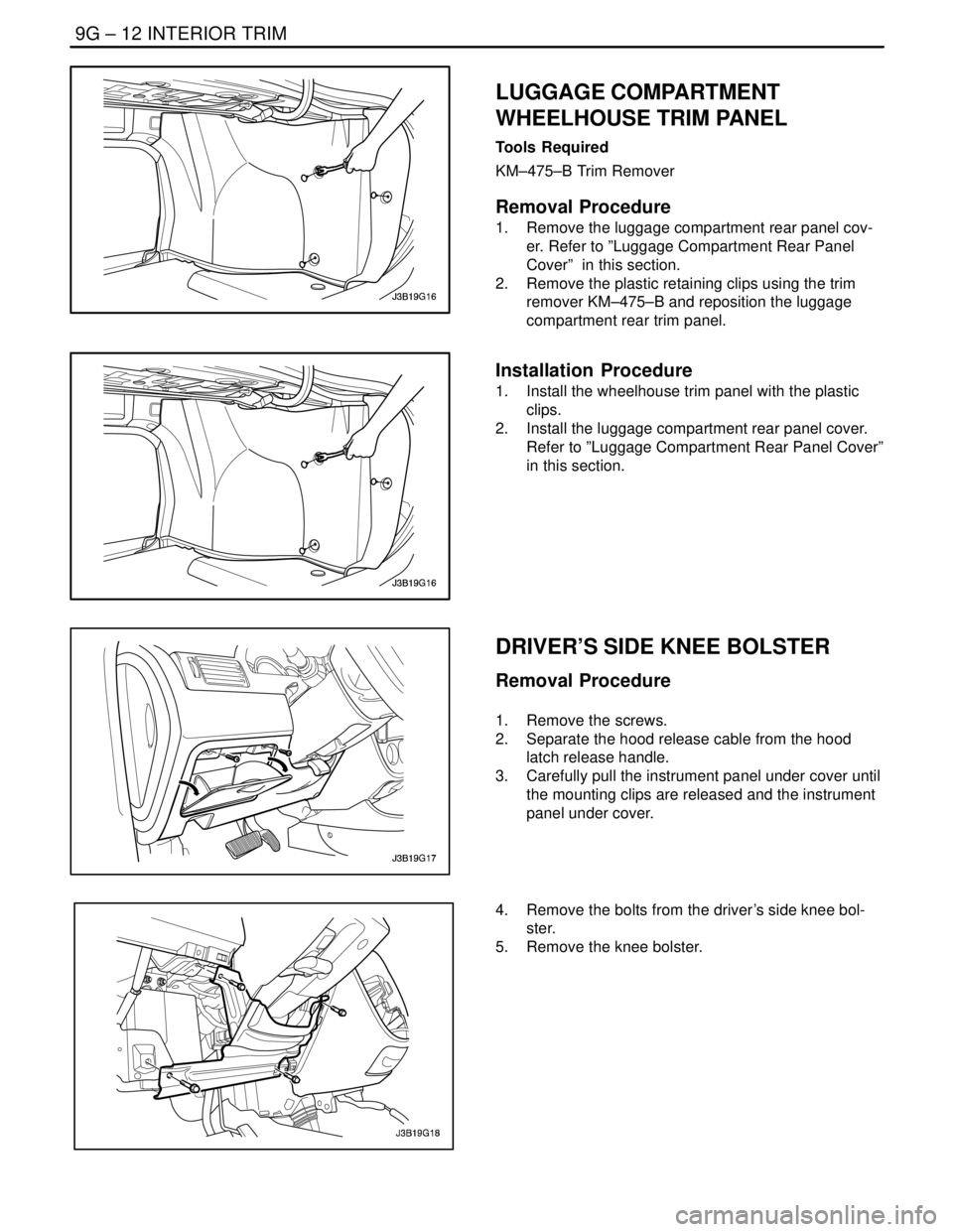
LUGGAGE COMPARTMENT
WHEELHOUSE TRIM PANEL
Tools Required
KM–475–B Trim Remover
Removal Procedure
1. Remove the luggage compartment rear panel cov-
er. Refer to ”Luggage Compartment Rear Panel
Cover” in this section.
2. Remove the plastic retaining clips using the trim
remover KM–475–B and reposition the luggage
compartment rear trim panel.
Installation Procedure
1. Install the wheelhouse trim panel with the plastic
clips.
2. Install the luggage compartment rear panel cover.
Refer to ”Luggage Compartment Rear Panel Cover”
in this section.
DRIVER’S SIDE KNEE BOLSTER
Removal Procedure
1. Remove the screws.
2. Separate the hood release cable from the hood
latch release handle.
3. Carefully pull the instrument panel under cover until
the mounting clips are released and the instrument
panel under cover.
4. Remove the bolts from the driver’s side knee bol-
ster.
5. Remove the knee bolster.
Page 2353 of 2643
INTERIOR TRIM 9G – 13
DAEWOO V–121 BL4
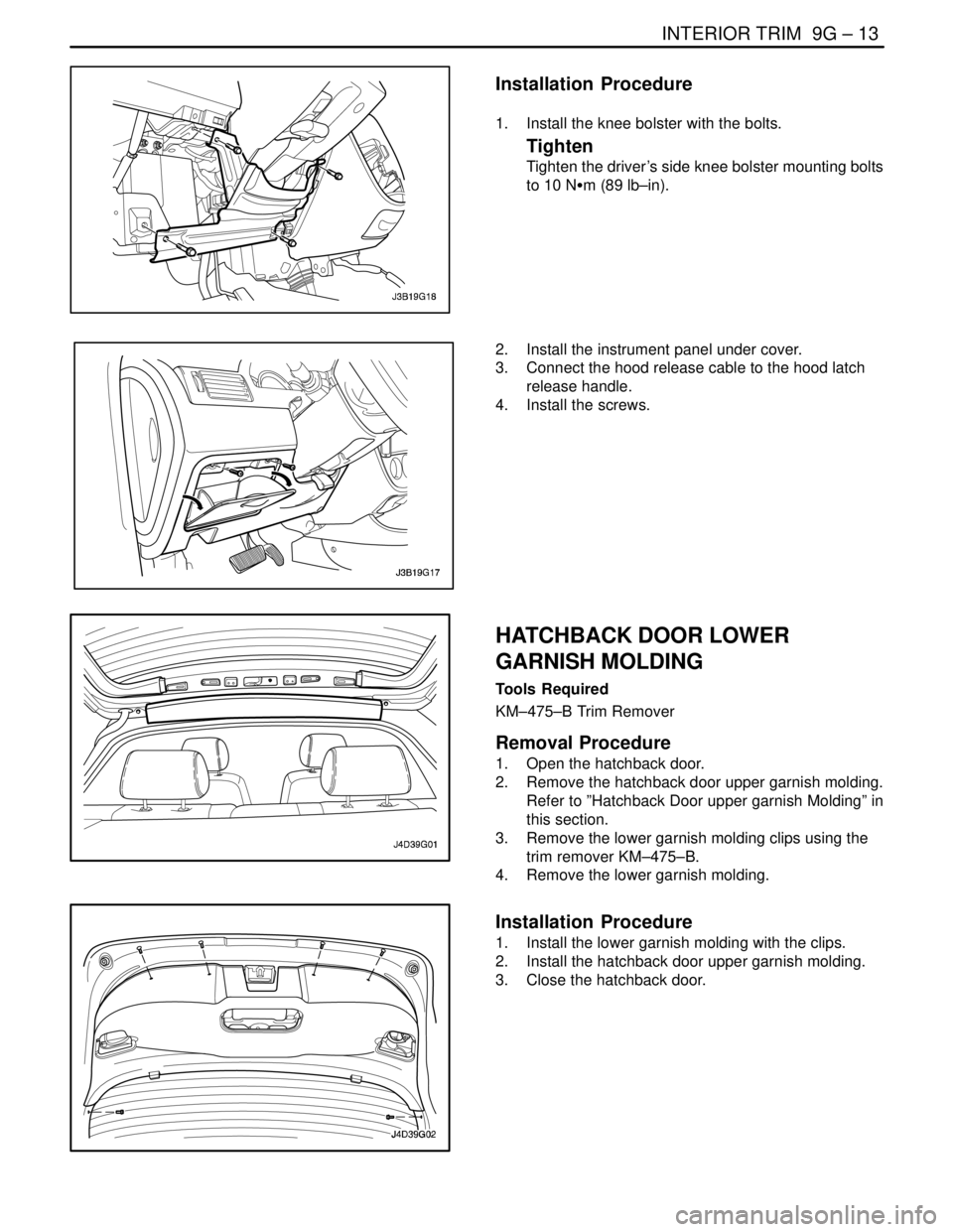
Installation Procedure
1. Install the knee bolster with the bolts.
Tighten
Tighten the driver’s side knee bolster mounting bolts
to 10 NSm (89 lb–in).
2. Install the instrument panel under cover.
3. Connect the hood release cable to the hood latch
release handle.
4. Install the screws.
HATCHBACK DOOR LOWER
GARNISH MOLDING
Tools Required
KM–475–B Trim Remover
Removal Procedure
1. Open the hatchback door.
2. Remove the hatchback door upper garnish molding.
Refer to ”Hatchback Door upper garnish Molding” in
this section.
3. Remove the lower garnish molding clips using the
trim remover KM–475–B.
4. Remove the lower garnish molding.
Installation Procedure
1. Install the lower garnish molding with the clips.
2. Install the hatchback door upper garnish molding.
3. Close the hatchback door.
Page 2363 of 2643
SEATS 9H – 7
DAEWOO V–121 BL4
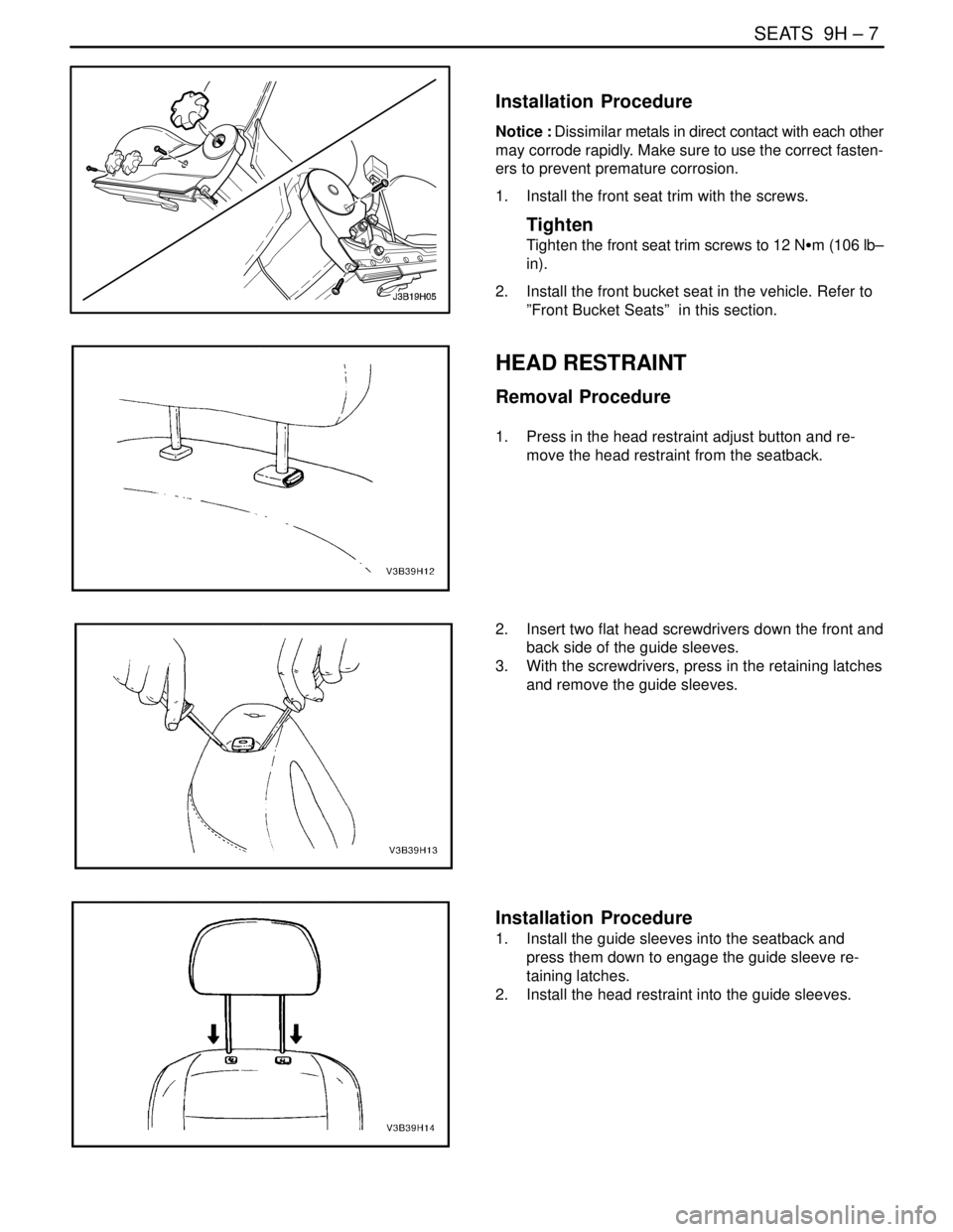
Installation Procedure
Notice : Dissimilar metals in direct contact with each other
may corrode rapidly. Make sure to use the correct fasten-
ers to prevent premature corrosion.
1. Install the front seat trim with the screws.
Tighten
Tighten the front seat trim screws to 12 NSm (106 lb–
in).
2. Install the front bucket seat in the vehicle. Refer to
”Front Bucket Seats” in this section.
HEAD RESTRAINT
Removal Procedure
1. Press in the head restraint adjust button and re-
move the head restraint from the seatback.
2. Insert two flat head screwdrivers down the front and
back side of the guide sleeves.
3. With the screwdrivers, press in the retaining latches
and remove the guide sleeves.
Installation Procedure
1. Install the guide sleeves into the seatback and
press them down to engage the guide sleeve re-
taining latches.
2. Install the head restraint into the guide sleeves.
Page 2368 of 2643

9H – 12ISEATS
DAEWOO V–121 BL4
GENERAL DESCRIPTION
AND SYSTEM OPERATION
SEATS
Do not attempt to change the designed seat position by al-
tering the designed seat adjuster–to–floor pan anchor pro-
visions or the seat adjuster–to–seat frame anchor provi-
sions. Changing the seat position could affect the
performance of the seat system.This vehicle is equipped with front bucket seats with sepa-
rate, adjustable head restraints, and a three–passenger
rear bench seat with an optional split folding rear seat. The
front bucket seats also have a recline, a height, and a lum-
bar adjustment. A power driver seat is optional. Seat cush-
ions and seatbacks have formed foam pads, which fit the
contours of the full panel seatback frame assembly and
the designed contour of the seat cushion frame.
Page 2375 of 2643
SECTION : 9J
WINDNOISE
TABLE OF CONTENTS
DIAGNOSIS9J–1 . . . . . . . . . . . . . . . . . . . . . . . . . . . . . . . . .
Windnoise Diagnosis 9J–1. . . . . . . . . . . . . . . . . . . . . . . .
MAINTENANCE AND REPAIR9J–2 . . . . . . . . . . . . . . . . ON–VEHICLE SERVICE 9J–2. . . . . . . . . . . . . . . . . . . . . .
Windnoise Repair 9J–2. . . . . . . . . . . . . . . . . . . . . . . . . . .
DIAGNOSIS
WINDNOISE DIAGNOSIS
CAUTION : An assistant should drive the vehicle
while the technician checks for the location of the
windnoise, in order to prevent personal injury or ve-
hicle damage.
A test drive in the vehicle is necessary to accurately deter-
mine the location of the windnoise. Often there is a primary
leak and secondary leaks. Failure to repair all leaks will
only reduce the windnoise, not eliminate it.
During the test drive the technician should bring the follow-
ing items to aid in determining the location of the wind-
noise.
S A mechanics stethoscope or vacuum hose
S Masking tape
S Strip caulk
S A china marking pencil
S A screwdriver
Perform the following steps in order to conduct the road
test:
1. Choose a route that includes smooth straight
streets that run in all four directions (north, south,
east, and west).
2. Choose streets with little traffic or noise that would
interfere with the test.
3. Drive the vehicle at the speeds at which the noise
was noticed by the customer or until the noise is
produced. Do not exceed legal speed limits.
4. The windnoise is external if any of the following
conditions occur:
S The windnoise is caused by the wind.S The windnoise can be heard with the door glass
lowered and while the vehicle is being driven.
S The windnoise is eliminated when tape is placed
over various moldings and gaps.
5. Internal windnoise is air leaving the vehicle and
should be repaired in the following manner.
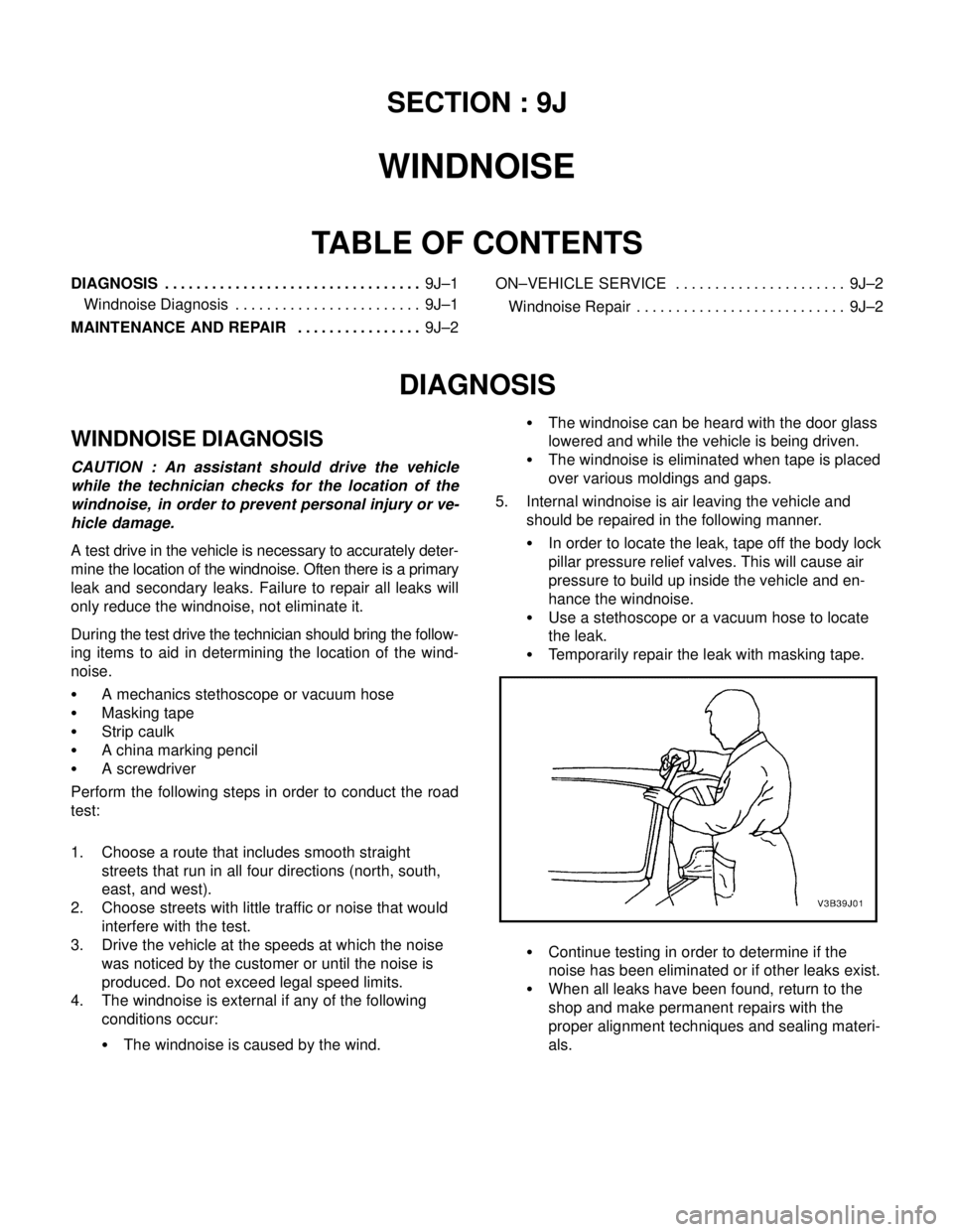
S In order to locate the leak, tape off the body lock
pillar pressure relief valves. This will cause air
pressure to build up inside the vehicle and en-
hance the windnoise.
S Use a stethoscope or a vacuum hose to locate
the leak.
S Temporarily repair the leak with masking tape.
S Continue testing in order to determine if the
noise has been eliminated or if other leaks exist.
S When all leaks have been found, return to the
shop and make permanent repairs with the
proper alignment techniques and sealing materi-
als.
Page 2386 of 2643

GLASS AND MIRRORS 9L – 7
DAEWOO V–121 BL4
StepNo Yes Value(s) Action
101. Turn the ignition ON.
2. Check the voltage at terminal 8 (BRN) of the
electric control outside rearview mirror switch
connector.
Is the voltage equal to the specified value?11–14 vGo to Step 12 Go to Step 11
11Repair the open power supply circuit for the electric
control outside rearview mirror switch.
Is the repair complete?–System OK–
12Replace the electric control outside rearview mirror
switch.
Is the repair complete?–System OK–
131. On the side which has the inoperative mirror,
remove the black plastic escutcheon from the
trim panel side of the door.
2. Disconnect the electric control outside rearview
mirror electrical connector.
3. Turn the ignition ON.
4. At the electric control outside rearview mirror
connector, connect a voltmeter between termi-
nal 4 (GRY) and terminal 6 (LT GRN if testing
the driver side or PPL/WHT if testing the pas-
senger side).
5. Operate the in/out adjustment on the switch,
and record the voltage indicated in each switch
position.
6. Connect a voltmeter between terminal 4 (GRY)
and terminal 7 (LT GRN if testing the left side
or RED/WHT if testing the right side).
7. Operate the up/down adjustment on the switch,
and record the voltage indicated in each switch
position.
Does the voltmeter indicate the specified voltage for
each test, with the polarity reversing when the switch
is changed from in to out or up to down?11–14 vGo to Step 14 Go to Step 15
14Replace the electric control outside rearview mirror.
Is the repair complete?–System OK–
Page 2398 of 2643

GLASS AND MIRRORS 9L – 19
DAEWOO V–121 BL4
GENERAL DESCRIPTION
AND SYSTEM OPERATION
STATIONARY GLASS
Stationary glass consists of all the glass on the vehicle
which is immovable within its frame, such as the wind-
shield glass, the back glass, and the inside rearview mir-
ror.
ELECTRIC CONTROL HEATED
OUTSIDE REARVIEW MIRROR
The electric control for the heated outside rearview mirroris on the driver’s side door. The mirror defogger is acti-
vated by the rear window defogger switch.
INSIDE REARVIEW MIRROR
The rearview mirror pivots at the ball–and–socket mirror
pivot and can be manually adjusted up/down and left/right.
FOLDING MIRROR UNIT
The folding mirror system is automatically folding the mir-
ror in parking state.
Page 2449 of 2643

DOORS 9P – 29
DAEWOO V–121 BL4
GENERAL DESCRIPTION
AND SYSTEM OPERATION
DOOR LOCK STRIKER
The front and the rear door lock strikers each consist of a
striker with two screws threaded into a floating cage plate
in the B–pillars and the C–pillars. The door is secured in
the closed position when the door lock fork snaps over and
engages the striker.
CHILDPROOF REAR DOOR LOCK
The childproof rear door locks help prevent passengers,
especially children, from opening the rear doors of the ve-
hicle from the inside.
To activate the locks, move the levers of both rear doors
to the lock position. Then, close both doors. The rear pas-
sengers will be unable to open the doors from inside of the
vehicle.
To deactivate the locks, unlock the door from the inside of
the vehicle and open the door from the outside. Move the
lever to the unlock position. The rear door will now work
normally.
POWER DOOR LOCKS
The power door locks use a solenoid that is contained in
each door lock assembly. The door locks are activated by
the actuator on the inside door handle or by the lock cylin-
der on the driver’s side door only. When the driver’s side
door is locked or unlocked by the actuator or the lock cylin-
der, all doors are locked or unlocked accordingly.
POWER WINDOWS
The power windows are controlled by electrical switches
on the door panels and are operated by a motor at each
window regulator. Each door has a switch to control its
window, and the driver’s side door has four switches to
control all door windows on the vehicle. The windows are
lowered by pressing the switch and raised by pulling up on
the switch. The window will stop movement when the
switch is released or when the window is completely open
or closed.
The driver’s side window opens automatically. By pressing
and releasing the switch, the driver ’s side window will low-
er and will stop only when the switch is activated again, or
when the window is completely open.
The driver’s side door control also contains a window lock
button that will prevent the operation of the front passen-
ger door or the rear door windows when pressed.