catalytic converter DAEWOO LACETTI 2004 Service Owner's Guide
[x] Cancel search | Manufacturer: DAEWOO, Model Year: 2004, Model line: LACETTI, Model: DAEWOO LACETTI 2004Pages: 2643, PDF Size: 80.54 MB
Page 885 of 2643
ENGINE EXHAUST 1G – 5
DAEWOO V–121 BL4
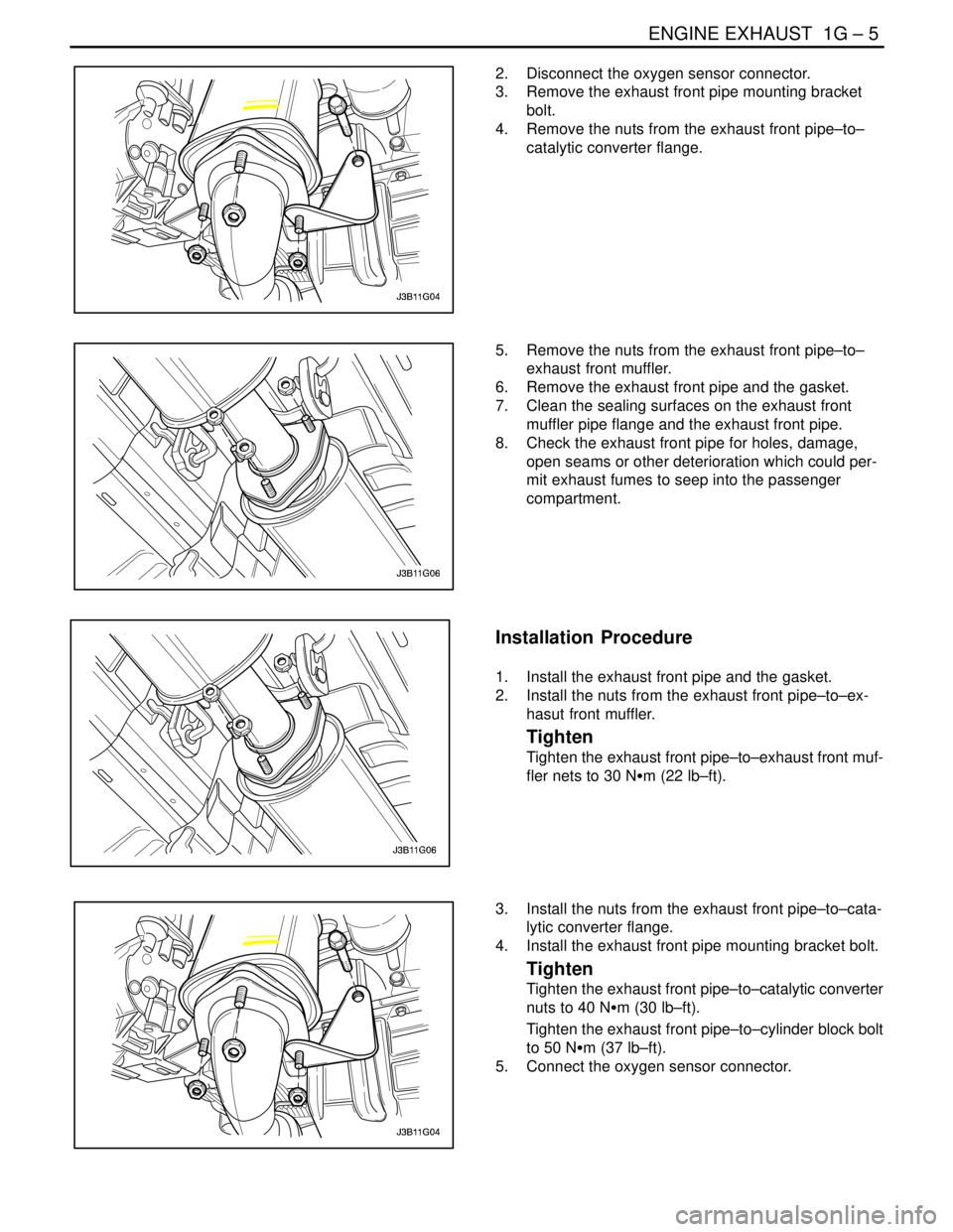
2. Disconnect the oxygen sensor connector.
3. Remove the exhaust front pipe mounting bracket
bolt.
4. Remove the nuts from the exhaust front pipe–to–
catalytic converter flange.
5. Remove the nuts from the exhaust front pipe–to–
exhaust front muffler.
6. Remove the exhaust front pipe and the gasket.
7. Clean the sealing surfaces on the exhaust front
muffler pipe flange and the exhaust front pipe.
8. Check the exhaust front pipe for holes, damage,
open seams or other deterioration which could per-
mit exhaust fumes to seep into the passenger
compartment.
Installation Procedure
1. Install the exhaust front pipe and the gasket.
2. Install the nuts from the exhaust front pipe–to–ex-
hasut front muffler.
Tighten
Tighten the exhaust front pipe–to–exhaust front muf-
fler nets to 30 NSm (22 lb–ft).
3. Install the nuts from the exhaust front pipe–to–cata-
lytic converter flange.
4. Install the exhaust front pipe mounting bracket bolt.
Tighten
Tighten the exhaust front pipe–to–catalytic converter
nuts to 40 NSm (30 lb–ft).
Tighten the exhaust front pipe–to–cylinder block bolt
to 50 NSm (37 lb–ft).
5. Connect the oxygen sensor connector.
Page 889 of 2643

ENGINE EXHAUST 1G – 9
DAEWOO V–121 BL4
GENERAL DESCRIPTION
AND SYSTEM OPERATION
EXHAUST SYSTEM
Notice : When you are inspecting or replacing the exhaust
system components, make sure there is adequate clear-
ance from all points on the underbody to avoid possible
overheating of the floor pan and possible damage to the
passenger compartment insulation and trim materials.
CAUTION : Check the complete exhaust system and
the nearby body areas and the trunk lid for broken,
damaged, missing, or mispositioned parts, open
seams, holes, loose connections, or other deteriora-
tion which could permit hazardous exhaust fumes to
seep into the trunk or the passenger compartment.
Dust or water in the trunk may be an indication of a
problem in one of these areas. Any defects should be
corrected immediately.
MUFFLER
If holes, open seams or any deterioration is discovered
upon inspection of the front muffler and pipe assembly, the
complete assembly should be replaced. The same proce-
dure is applicable to the rear muffler assembly.
Heat shields in the front and the rear muffler assembly
positions, as well as for the catalytic converter and the
connecting pipe, protect the vehicle and the environment
from high temperatures the exhaust system develops.
CATALYTIC CONVERTERS
Notice : The catalytic converter requires the use of un-
leaded fuel only, or damage to the catalyst will result.
The catalytic converters are emission control devices add-
ed to the exhaust system to reduce pollutants from the ex-
haust pipes.
The three–way catalyst has coatings which contain palla-
dium, platinum and rhodium, which simultaneouly lower
the levels of HC, CO and NOx.
Page 935 of 2643
2C – 18IFRONT SUSPENSION
DAEWOO V–121 BL4
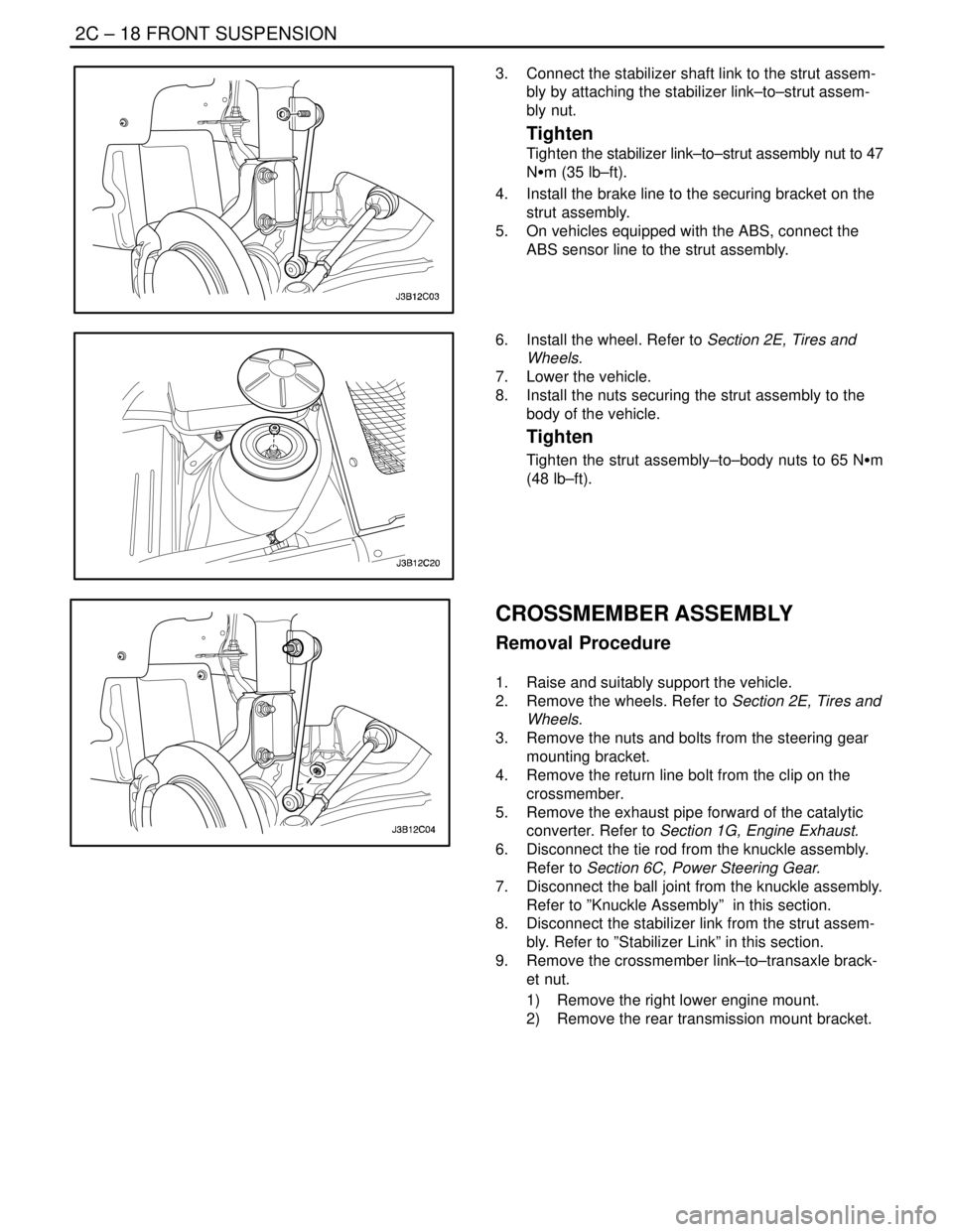
3. Connect the stabilizer shaft link to the strut assem-
bly by attaching the stabilizer link–to–strut assem-
bly nut.
Tighten
Tighten the stabilizer link–to–strut assembly nut to 47
NSm (35 lb–ft).
4. Install the brake line to the securing bracket on the
strut assembly.
5. On vehicles equipped with the ABS, connect the
ABS sensor line to the strut assembly.
6. Install the wheel. Refer to Section 2E, Tires and
Wheels.
7. Lower the vehicle.
8. Install the nuts securing the strut assembly to the
body of the vehicle.
Tighten
Tighten the strut assembly–to–body nuts to 65 NSm
(48 lb–ft).
CROSSMEMBER ASSEMBLY
Removal Procedure
1. Raise and suitably support the vehicle.
2. Remove the wheels. Refer to Section 2E, Tires and
Wheels.
3. Remove the nuts and bolts from the steering gear
mounting bracket.
4. Remove the return line bolt from the clip on the
crossmember.
5. Remove the exhaust pipe forward of the catalytic
converter. Refer to Section 1G, Engine Exhaust.
6. Disconnect the tie rod from the knuckle assembly.
Refer to Section 6C, Power Steering Gear.
7. Disconnect the ball joint from the knuckle assembly.
Refer to ”Knuckle Assembly” in this section.
8. Disconnect the stabilizer link from the strut assem-
bly. Refer to ”Stabilizer Link” in this section.
9. Remove the crossmember link–to–transaxle brack-
et nut.
1) Remove the right lower engine mount.
2) Remove the rear transmission mount bracket.
Page 1406 of 2643

ZF 4 HP 16 AUTOMATIC TRANSAXLE 5A1 – 57
DAEWOO V–121 BL4
Symptom ActionPossible Cause
Sealing Ring Selector ShaftS Check sealing ring.
S Replace sealing ring as described in the repair
instruction.
O–ring at Socket OutletS Check O–ring.
S Replace O–ring as described in the repair in-
struction.
O–ring and Speed Sensor ConnectionS Check O–ring.
S Replace O–ring as described in the repair in-
struction.
Oil Leak Incorrectly IdentifiedS No oil leak is possible at this point.
Speed Sensor Itself Is LeakingS Check speed sensor.
S Replace speed sensor as described in the re-
pair instruction.
Hair Line Crack at the Piping in the Con-
nection Area, Sealing Ring Fit in Trans-
axle HousingS Pressurize the line with compressed air and
check it.
S Replace lines as described in the repair in-
struction.
O–ring Defective, IncorrectCheck O–ring.
Replace O–rings as described in the repair instruc-
tion.
Plug LooseCheck the Tightening Torque for the screw plug.
Tighten to torque specified in the repair instruction.
Noise
SymptomPossible CauseAction
NoiseTFT Level Too LowS When the TFT level is too low, the gear wheels
from the transaxle oil pump might generate
noise.
S Check the TFT level as described in the repair
instruction and fill to the proper level.
Monolith in Catalytic Converter Has
BrokenS Check according to the exhaust gas diagnostic
procedure or by shaking the catalytic converter
casing.
S Replace catalytic converter if necessary.
Noise from Auxiliaries (e.g. exhaust
system, alternator, drive shafts.)S Check these components; if necessary, elimi-
nate the faults as described in the repair in-
struction
Noise from Tires or Wheel BearingsS Eliminate fault if necessary
Noise from Planetary GearsS Whistling noise on traction and overrun(in first
gear only)caused by high rotating speeds(func-
tionally unavoidable)
Cumulative Tooth Backlash in the Com-
plete Drive LineS Production status. Customer must be con-
vinced.
Jerky Noise of the Parking Lock (e.g.
when the car is standing on a gradient)S Load–reversal reaction
S Apply the handbrake before selection the park-
ing Lock (position P)
Page 2409 of 2643

9N – 6IFRAME AND UNDERBODY
DAEWOO V–121 BL4
MAINTENANCE AND REPAIR
ON–VEHICLE SERVICE
ALIGNMENT CHECKING
An accurate method of determining the alignment of the
underbody uses a measuring tram gauge. The tram gauge
set used to perform the recommended measuring checks
must include a vertical pointer able to reach 457 mm (18
inches).
Two types of measurements can be made with a tram
gauge: direct point–to–point measurements and mea-
surements calculated on a horizontal plane (datum line)
parallel to the underbody. Point–to–point measurements
are generally taken on steering and suspension engine
compartment parts and simply require the vertical pointers
to be set equally.
For horizontal plane measurements, the vertical pointers
must be set as specified for each point to be measured.
Dimensions–to–gauge holes are measured to the center
of the holes and flush to the adjacent surface metal unless
otherwise specified. It is recommended that the diagonal
dimensions to the cross–body be checked on both sides
in order to verify the dimensional accuracy of the vehicle
underbody.
FLOOR PAN INSULATORS
The floor pan insulators have been designed for the higher
floor pan temperatures that result from the use of the cata-
lytic converter in the exhaust system. Therefore, when
servicing a vehicle, it is essential that any insulators that
may have been disturbed or removed be reinstalled in the
original sequence and location. Also, if an insulator needs
to be replaced, use only the insulation specified for that
location on the floor pan.
When servicing or replacing interior insulators, observe
the following instructions.
S Install the insulators in the original position and se-
quence. Butt the pieces together in order to avoid
gapping or overlapping.
S If it is necessary to replace an insulator, use only
the specified insulation.
S Use the original part to determine the amount of
replacement material required and as a template for
cutting and fitting the new piece to the floor pan.
S When installing the insulator, do not enlarge any
cutouts or holes that are used for the attachment of
interior parts such as the instrument panel or the
floor console.
S Route the cross–body harness for interior parts
over the floor pan insulators. Clip it in the original
location.
S Do not apply spray–on deadeners or trim adhesives
to the top of the floor pan at the area directly over
the catalytic converter or the muffler.