lighting DAEWOO LACETTI 2004 Service Service Manual
[x] Cancel search | Manufacturer: DAEWOO, Model Year: 2004, Model line: LACETTI, Model: DAEWOO LACETTI 2004Pages: 2643, PDF Size: 80.54 MB
Page 2259 of 2643

LIGHTING SYSTEMS 9B – 33
DAEWOO V–121 BL4
StepNo Yes Value(s) Action
11Use an ohmmeter to check the resistance between
ground and the BLK wire at the luggage compart-
ment lamp switch connector (harness side).
Is the resistance equal to the specified value?0WGo to Step 12Go to Step 13
12Replace the luggage compartment lamp switch.
Is the repair complete?–System OK–
13Repair the ground circuit for the interior courtesy
lamp.
Is the repair complete?–System OK–
Page 2260 of 2643

9B – 34ILIGHTING SYSTEMS
DAEWOO V–121 BL4
FOG LAMPS
Diagnostic Aids
The front fog lamps will not operate unless the illumination lamps or daytime running lamps are on. If the illumination lamps
or daytime running lamps are not operating, repair that problem before attempting to diagnose the fog lamps.
Front Fog Lamps Inoperative
StepActionValue(s)YesNo
1Check fuse Ef24.
Is fuse Ef24 blown?–Go to Step 2Go to Step 3
21. Check for a short circuit and repair it, if neces-
sary.
2. Replace the fuse.
Is the repair complete?–System OK–
3Use a voltmeter to check fuse Ef24.
Does the battery voltage available at fuse Ef24 equal
the specified value?11–14 vGo to Step 5Go to Step 4
4Repair the open circuit from the battery to fuse Ef24.
Is the repair complete?–System OK–
5Remove the fog lamp relay and temporarily substi-
tute a known good relay, such as the headlamp relay.
(Do not substitute the illumination lamp relay.)
Do the fog lamps work with the substituted relay?–Go to Step 6Go to Step 7
61. Return the substituted relay to its original posi-
tion.
2. Replace the inoperative fog lamp relay.
Is the repair complete?–System OK–
71. Return the substituted relay to its original posi-
tion, but do not reinstall the fog lamp relay.
2. Turn on the exterior lamps and the front fog
lamps.
3. Using a voltmeter, check the fog lamp relay
socket at the connector for fog lamp relay ter-
minal 30.
Does the voltage available at the fog lamp relay
socket equal the specified value?11–14 vGo to Step 9Go to Step 8
8Repair the open circuit between fuse Ef24 and the
fog lamp relay.
Is the repair complete?–System OK–
9At the fog lamp relay socket, use an ohmmeter to
verify that the connector for relay terminal 85 is con-
nected to ground.
Does the resistance equal the specified value?0 WGo to Step 11Go to Step 10
10Repair the ground circuit for the fog lamp relay.
Is the repair complete?–System OK–
111. Reinstall the fog lamp relay.
2. Turn ON the exterior lamps and the front fog
lamps.
3. Test for voltage at terminal 2 of the fog lamp
connector.
Does the battery voltage available at terminal 2 of
the fog lamp connector equal the specified value?11–14 vGo to Step 13Go to Step 12
Page 2261 of 2643

LIGHTING SYSTEMS 9B – 35
DAEWOO V–121 BL4
StepNo Yes Value(s) Action
12Repair the open circuit between the fog lamp relay
terminal 87 and the fog lamps.
Is the repair complete?–System OK–
13Use an ohmmeter (or test lamp) to check the ground
at terminal 1 of the fog lamp connector.
Does the resistance equal the specified value?0 WGo to Step 15Go to Step 14
14Repair the fog lamp ground circuit.
Is the repair complete?–System OK–
15Replace the faulty fog lamp bulbs.
Is the repair complete?–System OK–
Page 2272 of 2643

9B – 46ILITHING SYSTEMS
DAEWOO V–121 BL4
GENERAL DESCRIPTION
AND SYSTEM OPERATION
HEADLAMPS–ON REMINDER CHIME
When the headlamp switch is in the headlamps–on or
parking lamps–on position, voltage is applied to the chime
module. When the ignition is in ON, ACC or START, volt-
age is applied through the fuse block to the module. These
two voltages are sensed, and the chime module is not
sounded.
When the ignition is not in ON, ACC or START, the module
loses voltage. The chime module senses change. If the
voltage is still available, it is applied to sound the chime.
The chime can be turned off by turning the headlamp
switch off. The module no longer senses voltage from the
headlamp switch, so the chime module does not sound.
HEADLAMPS
The headlamps are controlled by the multifunction lever
located on the left side of the steering column. They will
come on with the ignition switch in any position. Turning
the headlamp switch to the first position turns on the park-
ing lamps, the license plate lamps and the instrument pan-
el illumination. Turning the switch to the second position
turns on all of the previous lamps and the headlamps.
Turning the switch to the OFF position turns off all the
lamps.
Headlamp high beams and low beams are also controlled
by this lever. When the headlamps are on, pushing the le-
ver away from the driver until the switch clicks changes the
lamp from low beam to high beam. An indicator lamp on
the instrument cluster assembly will come on when the
high beam headlamps are on. To return the headlamps to
low beam, pull the lever toward the driver.
The headlamps must be aimed for proper illumination of
the road. Headlamp aim should be checked whenever a
new headlamp assembly is installed, or whenever service
repairs to the front end area may have disturbed the head-
lamp assembly or its mountings.
DAYTIME RUNNING LAMPS
The Daytime Running Lamps (DRL) will come on when:
S The ignition is ON.
S The light is OFF.
S The parking brake is released.
When the exterior lights are on, the DRL will turn off. To
turn the DRL off when idling, apply the parking brake.
PARKING AND TURN SIGNAL LAMPS
The parking lamps can be turned on by turning the lighting
switch to the first position. The parking lamps can be
turned off by turning the switch to the OFF position.When the turn signals are activated, the front and rear turn
signal lamps flash to signal a turn. The turn signals work
only when the ignition is ON.
The turn signals are controlled by the light switch on the
left side of the steering column. Moving the lever all the
way up or down (past the detent) will turn on the front and
rear turn signals. When the turn is completed, the lever will
return to horizontal and the turn signals will stop flashing.
For changing lanes, or for shallow turns in which the steer-
ing wheel does not turn far enough to cancel the signal,
move the signal lever only to the first detent and hold it
there. When the lever is released, it will return to horizontal
and the turn signals will cancel.
FOG LAMPS
The fog lamp switch is on the instrument panel to the right
of the steering column. To use the fog lamps, first turn on
the headlamps or the parking lamps. Then push the fog
lamp switch. The indicator light in the switch will illuminate
to indicate that the fog lamps are on. Push the switch again
to turn off the fog lamps. The indicator light will then go off.
The fog lamps should not be used as a substitute for the
headlamps.
The fog lamps must be aimed for proper illumination of the
road. Fog lamp aim should be checked when a new bulb
is installed or if service or repairs in the front end area may
have disturbed the fog lamp mountings.
REAR COMBINATION LAMPS
The taillamps, stoplamps, turn signal lamps and backup
lamp are one assembly.
Turning on either the headlamps or the parking lamps will
also turn on the taillamps. When the brake pedal is
pushed, the taillamps will glow brighter to serve as sto-
plamps.
The center high–mounted stoplamp is located in the rear
window and will come on when the brake pedal is pressed.
LICENSE PLATE LAMP
The license plate lamps will come on when the headlamps
or the parking lamps are on. The license plate lamps are
mounted above the license plate.
INTERIOR COURTESY LAMP
The courtesy lamp is located on the headliner just behind
the front seats. The lamp switch has three positions. If the
switch is left in the center position, the lamp will go on
whenever a door is opened and go off when it is closed.
In the ON position, the lamp will stay on until it is turned off.
In the OFF position, the lamp will not come on, even when
a door is opened.
LUGGAGE COMPARTMENT LAMP
The luggage compartment lamp is located under the deck
lid sill plate on the notchback. The lamp is located on the
left–side wheelhouse trim panel on the hatchback. It will
come on whenever the luggage compartment is opened.
Page 2413 of 2643
9O – 2IBUMPERS AND FASCIAS
DAEWOO V–121 BL4
MAINTENANCE AND REPAIR
ON–VEHICLE SERVICE
FRONT BUMPER FASCIA
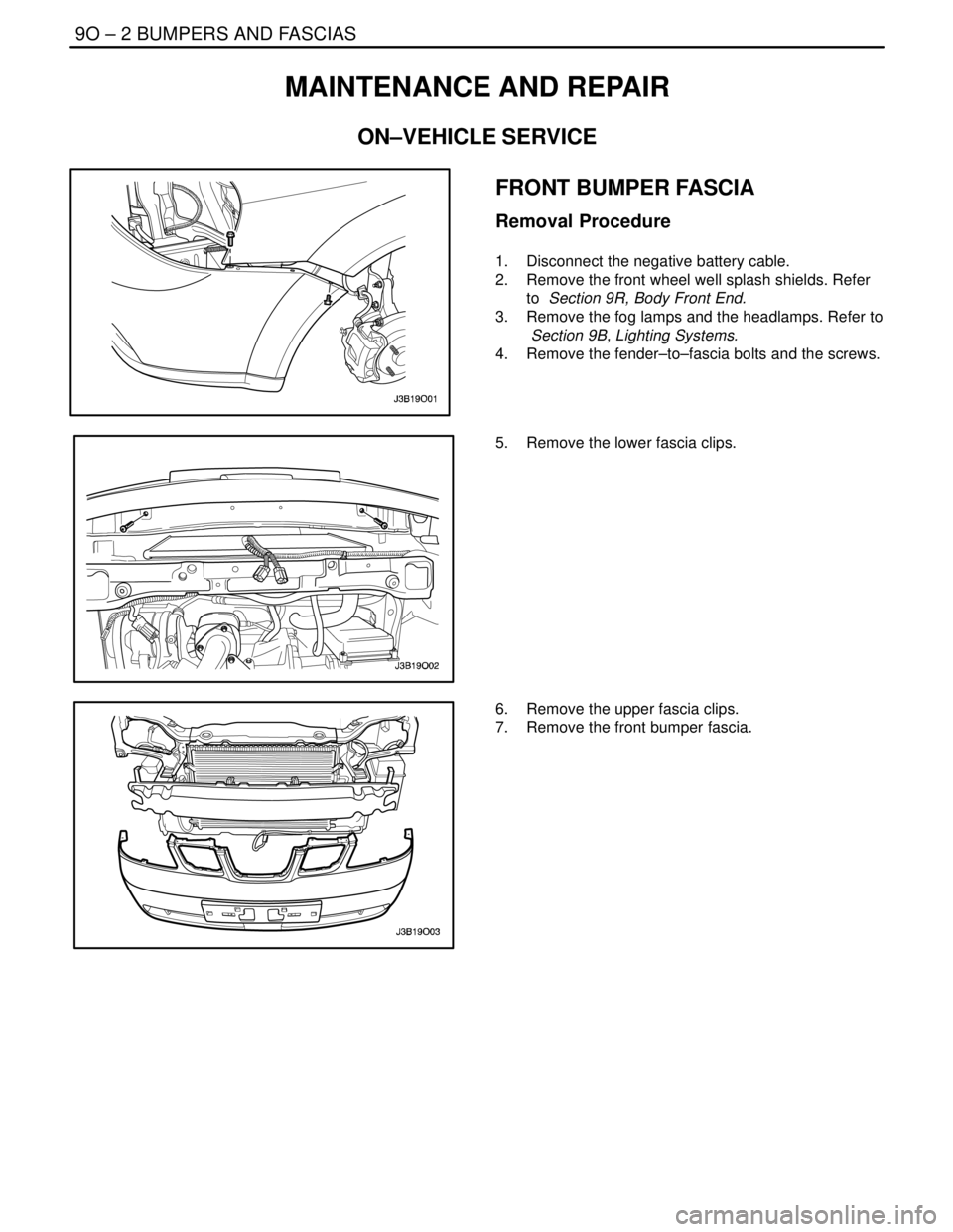
Removal Procedure
1. Disconnect the negative battery cable.
2. Remove the front wheel well splash shields. Refer
to Section 9R, Body Front End.
3. Remove the fog lamps and the headlamps. Refer to
Section 9B, Lighting Systems.
4. Remove the fender–to–fascia bolts and the screws.
5. Remove the lower fascia clips.
6. Remove the upper fascia clips.
7. Remove the front bumper fascia.
Page 2414 of 2643
BUMPERS AND FASCIAS 9O – 3
DAEWOO V–121 BL4
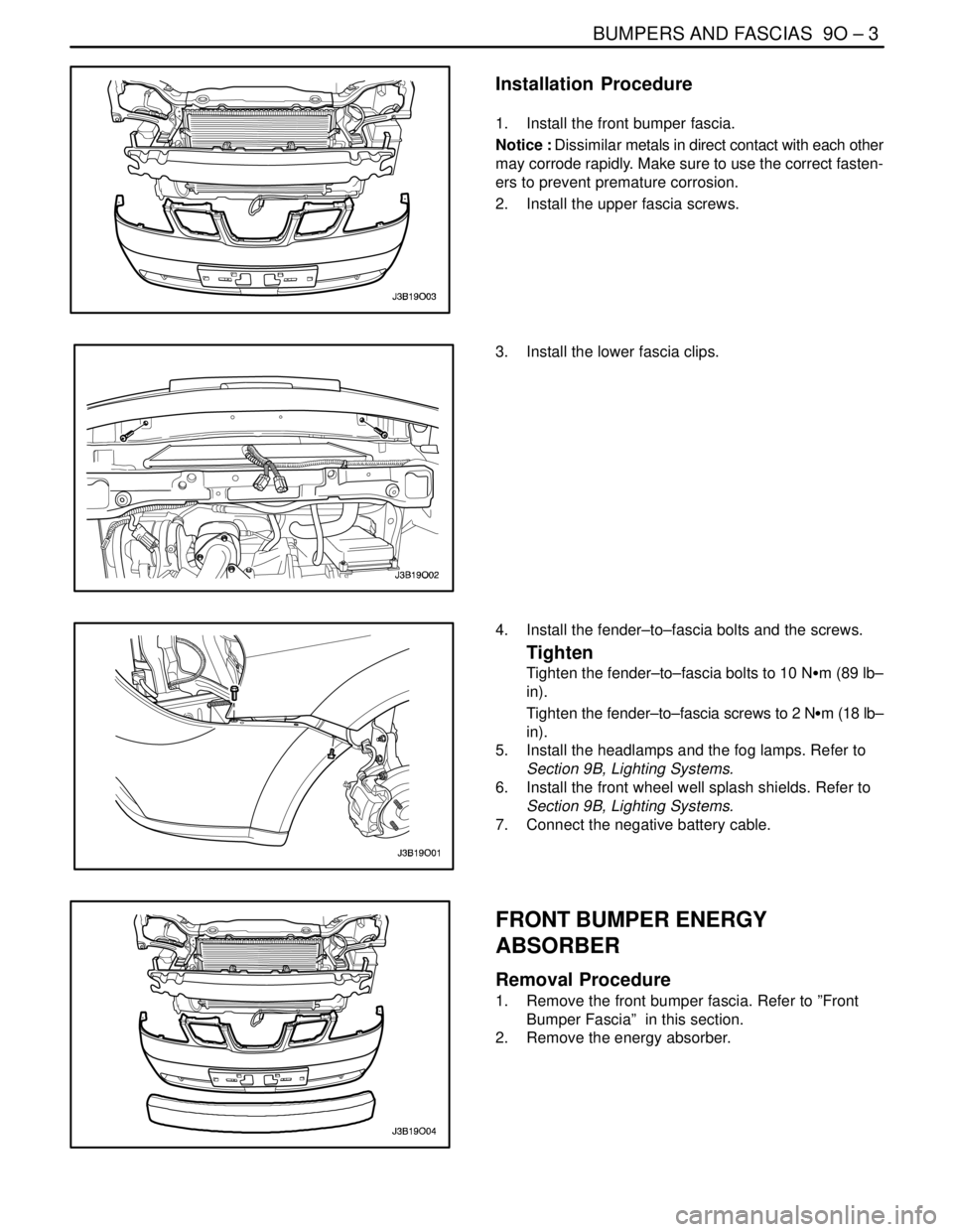
Installation Procedure
1. Install the front bumper fascia.
Notice : Dissimilar metals in direct contact with each other
may corrode rapidly. Make sure to use the correct fasten-
ers to prevent premature corrosion.
2. Install the upper fascia screws.
3. Install the lower fascia clips.
4. Install the fender–to–fascia bolts and the screws.
Tighten
Tighten the fender–to–fascia bolts to 10 NSm (89 lb–
in).
Tighten the fender–to–fascia screws to 2 NSm (18 lb–
in).
5. Install the headlamps and the fog lamps. Refer to
Section 9B, Lighting Systems.
6. Install the front wheel well splash shields. Refer to
Section 9B, Lighting Systems.
7. Connect the negative battery cable.
FRONT BUMPER ENERGY
ABSORBER
Removal Procedure
1. Remove the front bumper fascia. Refer to ”Front
Bumper Fascia” in this section.
2. Remove the energy absorber.
Page 2459 of 2643
9Q – 10IROOF
DAEWOO V–121 BL4
SUN VISORS WITH VANITY MIRROR
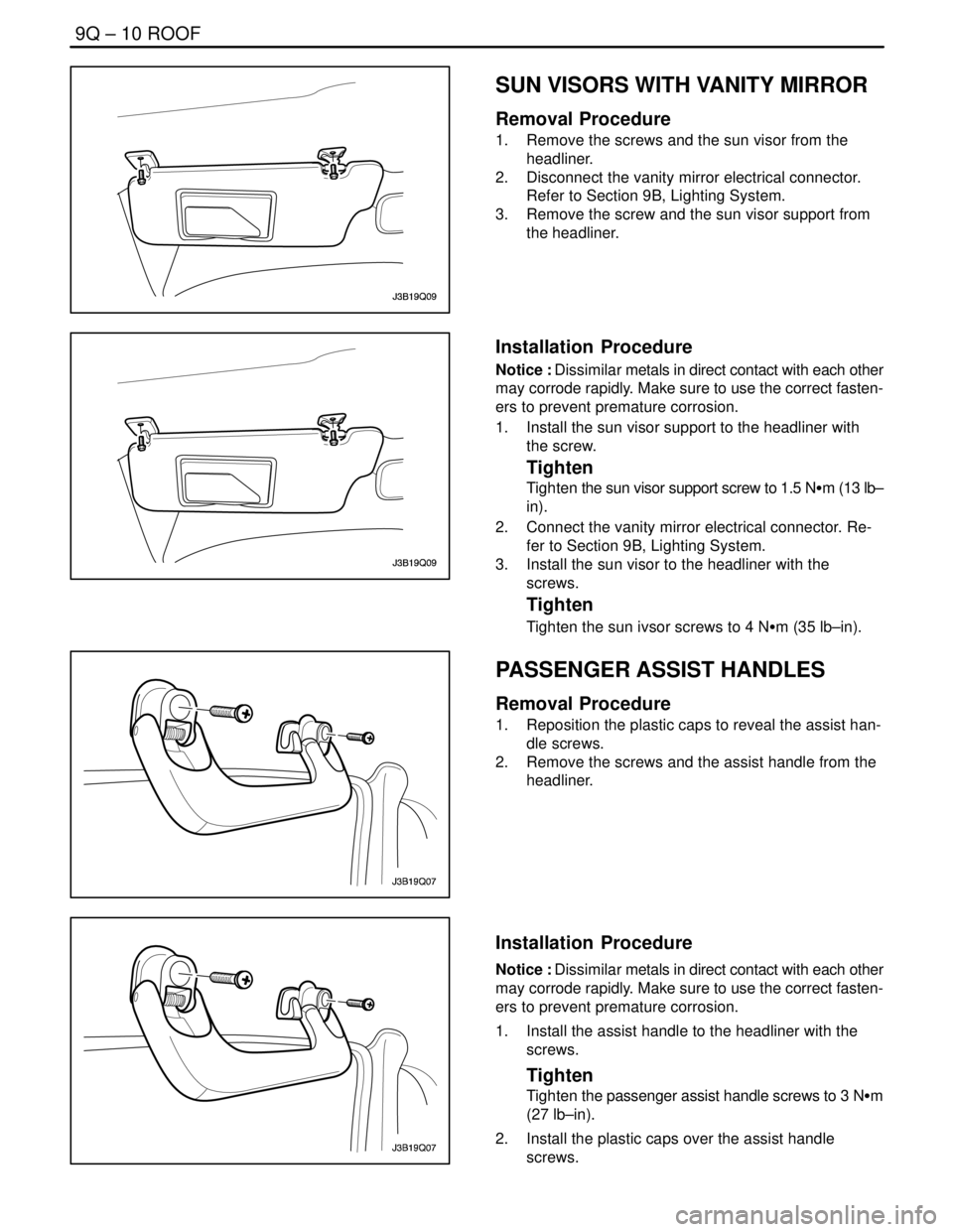
Removal Procedure
1. Remove the screws and the sun visor from the
headliner.
2. Disconnect the vanity mirror electrical connector.
Refer to Section 9B, Lighting System.
3. Remove the screw and the sun visor support from
the headliner.
Installation Procedure
Notice : Dissimilar metals in direct contact with each other
may corrode rapidly. Make sure to use the correct fasten-
ers to prevent premature corrosion.
1. Install the sun visor support to the headliner with
the screw.
Tighten
Tighten the sun visor support screw to 1.5 NSm (13 lb–
in).
2. Connect the vanity mirror electrical connector. Re-
fer to Section 9B, Lighting System.
3. Install the sun visor to the headliner with the
screws.
Tighten
Tighten the sun ivsor screws to 4 NSm (35 lb–in).
PASSENGER ASSIST HANDLES
Removal Procedure
1. Reposition the plastic caps to reveal the assist han-
dle screws.
2. Remove the screws and the assist handle from the
headliner.
Installation Procedure
Notice : Dissimilar metals in direct contact with each other
may corrode rapidly. Make sure to use the correct fasten-
ers to prevent premature corrosion.
1. Install the assist handle to the headliner with the
screws.
Tighten
Tighten the passenger assist handle screws to 3 NSm
(27 lb–in).
2. Install the plastic caps over the assist handle
screws.
Page 2461 of 2643

9Q – 12IROOF
DAEWOO V–121 BL4
GENERAL DESCRIPTION
AND SYSTEM OPERATION
ROOF
The roof is a one–piece painted metal unit which incorpo-
rates a single solid headliner. There are two moldings, one
per side on the vehicle’s roof, which enclose and hide the
roof rail seams. The roof moldings are serviceable as indi-
vidual units.
The one–piece formed headliner consists of a molded
substrate covered with a foam–backed cloth facing. The
one–piece construction requires that the headliner be ser-
viced as a complete assembly.
POWER SUNROOF/SUNROOF
CONTROL SWITCH
The sunroof has the following characteristics:
S Intended to provide light and air through the roof
the vehicle.
S Built into the roof.
S Made of glass.
S Equipped with a sunshade that opens and closes
manually.
S Powered by an electric motor.
S Controlled by a toggle switch built into the interior
courtesy lamp assembly.
The sunroof control switch is a toggle button located on the
right side of the interior courtesy lamp assembly.
To operate the sunroof, the ignition must be ON.Tilting the Sunroof, Open and Closed
To tilt open the rear end of the sunroof, press and hold the
forward portion of the toggle button until the sunroof tilts
open.
To close the sunroof from a tilted–open position, press and
hold the rear portion of the toggle button until the sunroof
tilts closed.
Sliding the Sunroof, Open and Closed
To slide open the sunroof, press the rear portion of the
toggle button until the sunroof slides. If the sun shade is
closed, the sunroof will pull the sunshade open when the
sunroof slides open.
To close the sunroof from a slid–open position, press the
forward portion of the toggle button until the sunroof slides
closed.
SUN VISORS WITH VANITY MIRROR
The sun visors swing down in order to block out glare.
They also swing to the side when they are released from
the support. To replace the vanity mirror lamp, refer to
Section 9B, Lighting Systems.
PASSENGER ASSIST HANDLES
There is a passenger assist handle for each rear outboard
seat and for the front passenger seat. Passengers can use
these handles to assist in keeping their balance over rough
roads or during sharp turns.
COAT HOOKS
The coat hooks are located on the left and the right rear
passenger assist handles.