spark DAEWOO LACETTI 2004 Service Workshop Manual
[x] Cancel search | Manufacturer: DAEWOO, Model Year: 2004, Model line: LACETTI, Model: DAEWOO LACETTI 2004Pages: 2643, PDF Size: 80.54 MB
Page 436 of 2643

1F – 190IENGINE CONTROLS
DAEWOO V–121 BL4
StepNo Yes Value(s) Action
19Repair the open ignition feed circuit between the fuel
injector harness connector and the fuel injector con-
nector.
Is the repair complete?–Go to Step 27–
20Measure the resistance of the spark plug cable that
the spark plug tester did not spark.
Is the resistance of the spark plug cable less than the
specified value?30000WGo to Step 21Go to Step 25
21Inspect the Engine Control Module (ECM) connec-
tor and connections.
Are the connections OK?–Go to Step 22Go to Step 23
22Check the affected cylinders ignition control circuit
for an open or short and repair as necessary.
Is the repair complete?–Go to Step 27Go to Step 26
23Repair the connector or connections.
Is the repair complete?–Go to Step 27–
241. Turn the ignition OFF.
2. Replace the ECM.
Is the repair complete?–Go to Step 27–
25Replace the spark plug cable.
Is the repair complete?–Go to Step 27–
26Replace the faulty ignition coil.
Is the repair complete?–Go to Step 27Go to Step 24
271. Using the scan tool, clear the DTCs.
2. Start the engine and idle at normal operating
temperature.
3. Operate the vehicle within the conditions for
setting this DTC as supported in the text.
Does the scan tool indicate that this diagnostic ran
and passed?–Go to Step 28Go to Step 2
28Check if any additional DTCs are set.
Are any DTCs displayed that have not been diag-
nosed?–Go to
Applicable DTC
tableSystem OK
Page 439 of 2643

ENGINE CONTROLS 1F – 193
DAEWOO V–121 BL4
StepNo Yes Value(s) Action
71. Turn the engine OFF.
2. Install a fuel pressure gauge to the fuel rail.
3. Observe the fuel pressure with the engine run-
ning.
Is the fuel pressure within the specified value?284–325 kPa
(41–47 psi)Go to Step 8Go to
”Fuel System
Diagnosis”
8Check the fuel for contamination.
Is the fuel OK?–Go to Step 9Go to Step 10
9Check for a basic engine problem and repair as nec-
essary.
Is the repair complete?–Go to Step 27–
10Replace the contaminated fuel.
Is the repair complete?–Go to Step 27–
111. Turn the engine OFF.
2. Disconnect the fuel injector harness connector.
3. Install a spark tester on cylinder #1 spark plug
cable.
4. Crank the engine and check for spark.
5. Repeat the above procedure on cylinders #2,
#3 and #4.
Is a spark observed on all four spark plug cables?–Go to Step 12Go to Step 20
12Replace any malfunctioning spark plugs if neces-
sary.
Is the repair complete?–Go to Step 27Go to Step 13
131. Turn the engine OFF.
2. Disconnect the fuel injector connectors from
the injectors.
3. Install an injector test light on the injector har-
ness connector for the cylinders that had mis-
fired.
4. Crank the engine and note the test light.
Does the injector test light blink?–Go to Step 14Go to Step 15
14Perform the Fuel Injector Balance Test.
Are the fuel injectors OK?–Go to Step 9Go to Step 16
151. Disconnect the injector test light.
2. With a test light connected to ground, probe
the ignition feed terminal 2 of the injector har-
ness connector for each cylinder that had mis-
fire.
3. Crank the engine.
Does the test light illuminate?–Go to Step 17Go to Step 19
16Replace any malfunctioning fuel injectors.
Is the repair complete?Go to Step 27–
17Check the affected fuel injector driver circuit at termi-
nals 59, 89, 90, and 60 for an open, short, or short
to voltage.
Is a problem found?–Go to Step 18Go to Step 24
18Repair the open or the shorted fuel injector driver cir-
cuit.
Is the repair complete?–Go to Step 27–
Page 440 of 2643

1F – 194IENGINE CONTROLS
DAEWOO V–121 BL4
StepNo Yes Value(s) Action
19Repair the open ignition feed circuit between the fuel
injector harness connector and the fuel injector con-
nector.
Is the repair complete?–Go to Step 27–
20Measure the resistance of the spark plug cable that
the spark plug tester did not spark.
Is the resistance of the spark plug cable less than the
specified value?30000WGo to Step 21Go to Step 25
21Inspect the Engine Control Module (ECM) connec-
tor and connections.
Are the connections OK?–Go to Step 22Go to Step 23
22Check the affected cylinders ignition control circuit
for an open or short and repair as necessary.
Is the repair complete?–Go to Step 27Go to Step 26
23Repair the connector or connections.
Is the repair complete?–Go to Step 27–
241. Turn the ignition OFF.
2. Replace the ECM.
Is the repair complete?–Go to Step 27–
25Replace the spark plug cable.
Is the repair complete?–Go to Step 27–
26Replace the faulty ignition coil.
Is the repair complete?–Go to Step 27Go to Step 24
271. Using the scan tool, clear the DTCs.
2. Start the engine and idle at normal operating
temperature.
3. Operate the vehicle within the conditions for
setting this DTC as supported in the text.
Does the scan tool indicate that this diagnostic ran
and passed?–Go to Step 28Go to Step 2
28Check if any additional DTCs are set.
Are any DTCs displayed that have not been diag-
nosed?–Go to
Applicable DTC
tableSystem OK
Page 441 of 2643

ENGINE CONTROLS 1F – 195
DAEWOO V–121 BL4
DIAGNOSTIC TROUBLE CODE (DTC) P0327
KNOCK SENSOR CIRCUIT FAULT (1.4L DOHC)
Circuit Description
The knock sensor (KS) system is used to detect engine
detonation, allowing the engine control module (ECM) to
retard ignition control spark timing based on the KS signal
being received. The KS produces an AC signal so that un-
der a no knock condition the signal on the KS circuit mea-
sures about 0.007V AC. The KS signal’s amplitude and
frequency depend upon the amount of knock being experi-
enced. The ECM contains a non–replaceable knock filter
module called a signal–to–noise enhancement filter
(SNEF) module. This filter module in the ECM determines
whether knock is occurring by comparing the signal level
on the KS circuit with the voltage level on the noise chan-
nel. The noise channel allows the ECM to reject any false
knock signal by knowing the amount of normal engine me-
chanical noise present. Normal engine noise varies de-
pending on engine speed and load. When the ECM deter-
mines that an abnormally low noise channel voltage level
is being experienced, a DTC P0327 will set.
Conditions for Setting the DTC
S The knock sensor SPI bus in failure during 8 sec-
onds.
Or
S The knock sensor voltage is less than 0.3V.
S The engine coolant temperature is greater than
60°C (145°F).
S The engine speed is greater than 1,500 rpm.
S The mass air flow is higer than 180mg/tdc.
Or
S When difference between a original signal valve
and filtering valve is less than 5%.S The engine coolant temperature is greater than
60°C (145°F).
S The mass air flow is greater than 180mg/tdc.
Action Taken When the DTC Sets
S The Malfunction Indicator Lamp (MIL) will not illumi-
nate.
S The ECM will store wnditions which were present
when the DTC was set as Failure Records data
only.
S This information will not be stored in the Freeze
Frame data.
Conditions for Clearing the MIL/DTC
S A history DTC will clear after 40 consecutive warm–
up cycles without a fault.
S DTC(s) can be cleared by using the scan tool.
S Disconnecting the ECM battery feed for more than
10 seconds.
Diagnostic Aids
Check and correct any abnormal engine noise before us-
ing the diagnostic table.
Any circuitry that is suspected as causing engine noise
complaint should be thoroughly checked for the following
conditions :
S Backed–out terminals
S Improper mating
S Broken locks
S Improperly formed
S Damaged terminals
S Poor terminal–to–wire connection
S Physical damage to the wiring harness
Page 444 of 2643

1F – 198IENGINE CONTROLS
DAEWOO V–121 BL4
DIAGNOSTIC TROUBLE CODE (DTC) P0327
KNOCK SENSOR CIRCUIT FAULT (1.6L DOHC)
Circuit Description
The knock sensor (KS) system is used to detect engine
detonation, allowing the transaxle control module
(TCM)/engine control module (ECM) to retard ignition con-
trol spark timing based on the KS signal being received.
The KS produces an AC signal so that under a no knock
condition the signal on the KS circuit measures about
0.007V AC. The KS signal’s amplitude and frequency de-
pend upon the amount of knock being experienced. The
ECM contains a non–replaceable knock filter module
called a signal–to–noise enhancement filter (SNEF) mod-
ule. This filter module in the ECM determines whether
knock is occurring by comparing the signal level on the KS
circuit with the voltage level on the noise channel. The
noise channel allows the ECM to reject any false knock
signal by knowing the amount of normal engine mechani-
cal noise present. Normal engine noise varies depending
on engine speed and load. When the ECM determines that
an abnormally low noise channel voltage level is being ex-
perienced, a DTC P0327 will set.
Conditions for Setting the DTC
S The knock sensor SPI bus in failure during 10 sec-
onds.
Or
S The knock sensor voltage is less than 0.3V.
S The engine coolant temperature is greater than
60°C(145°F).
S The engine speed is greater than 1,500rpm.
S The mass air flow is higer than 180mg/tdc.
Or
S When difference between a original signal valve
and filtering valve is less than 5%.S The engine coolant temperature is greater than
60°C(145°F).
S The mass air flow is greater than 170mg/tdc.
Action Taken When the DTC Sets
S The Malfunction Indicator Lamp (MIL) will illuminate
after three consecutive trip with a fail.
S The ECM will record operating conditions at the
time the diagnostic fail. This information will be
stored in the Freeze Frame and Failure Records
buffers.
S A history DTC is stored.
Conditions for Clearing the MIL/DTC
S The MIL will turn off after four consecutive ignition
cycles in which the diagnostic runs without a fault.
S A history DTC will clear after 40 consecutive warm–
up cycles without a fault.
S DTC(s) can be cleared by using the scan tool.
S Disconnecting the ECM battery feed for more than
10 seconds.
Diagnostic Aids
Check and correct any abnormal engine noise before us-
ing the diagnostic table.
Any circuitry that is suspected as causing engine noise
complaint should be thoroughly checked for the following
conditions :
S Backed–out terminals
S Improper mating
S Broken locks
S Improperly formed
S Damaged terminals
S Poor terminal–to–wire connection
S Physical damage to the wiring harness
Page 460 of 2643

1F – 214IENGINE CONTROLS
DAEWOO V–121 BL4
DIAGNOSTIC TROUBLE CODE (DTC) P0351
IGNITION SIGNAL COIL A FAULT
Circuit Description
The engine control module (ECM) provides a ground for
the electronic spark timing 1 circuit. When the ECM re-
moves the ground path of the ignition primary coil, the
magnetic field produced by the coil collapses. The collaps-
ing magnetic field produces a voltage in the secondary coil
which fires the spark plug. The circuit between the ECM
and the electronic ignition system is monitored for an open
circuit, short to voltage, and low voltage. When the ECM
detects a problem in the spark timing 1 circuit, it will set
DTC P0351.
Conditions for Setting the DTC
S The ignition signal coil A circuit is an open or a
short to ground or short to battery condition exists.
Action Taken When the DTC Sets
S The Malfunction Indicator Lamp (MIL) will illumi-
nate.
S The ECM will record operating conditions at the
time the diagnostic fails. This information will be
stored in the Freeze Frame and Failure Records
buffers.S A history DTC is stored.
Conditions for Clearing the MIL/DTC
S The MIL will turn off after four consecutive ignition
cycles in which the diagnostic runs without a fault.
S A history DTC will clear after 40 consecutive warm–
up cycles without a fault.
S DTC(s) can be cleared by using the scan tool.
S Disconnecting the ECM battery feed for more than
10 seconds.
Diagnostic Aids
Check and correct any abnormal engine noise before us-
ing the diagnostic table.
Any circuitry that is suspected as causing engine noise
complaint should be thoroughly checked for the following
conditions :
S Backed–out terminals
S Improper mating
S Broken locks
S Improperly formed
S Damaged terminals
S Poor terminal–to–wire connection
S Physical damage to the wiring harness
Page 462 of 2643
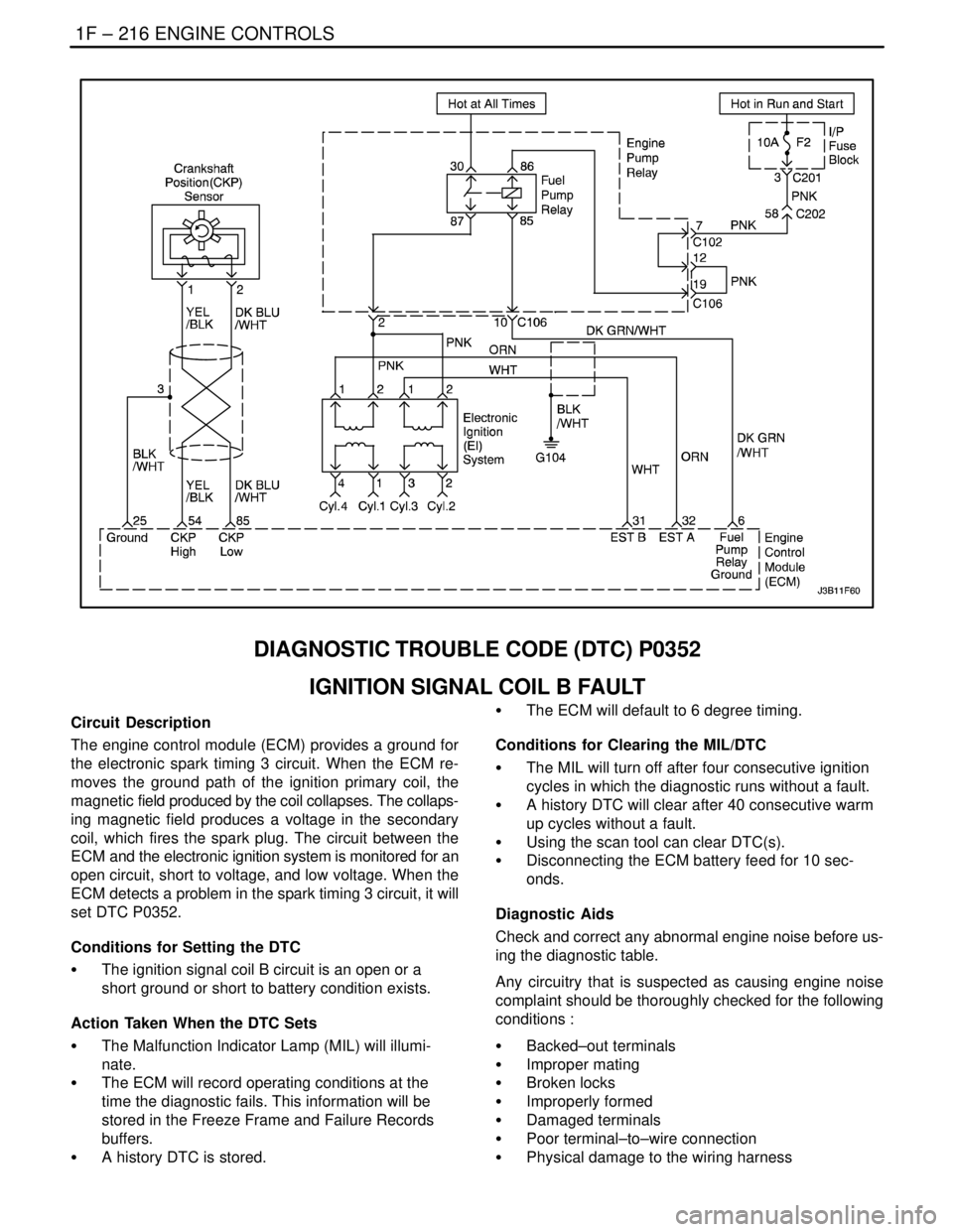
1F – 216IENGINE CONTROLS
DAEWOO V–121 BL4
DIAGNOSTIC TROUBLE CODE (DTC) P0352
IGNITION SIGNAL COIL B FAULT
Circuit Description
The engine control module (ECM) provides a ground for
the electronic spark timing 3 circuit. When the ECM re-
moves the ground path of the ignition primary coil, the
magnetic field produced by the coil collapses. The collaps-
ing magnetic field produces a voltage in the secondary
coil, which fires the spark plug. The circuit between the
ECM and the electronic ignition system is monitored for an
open circuit, short to voltage, and low voltage. When the
ECM detects a problem in the spark timing 3 circuit, it will
set DTC P0352.
Conditions for Setting the DTC
S The ignition signal coil B circuit is an open or a
short ground or short to battery condition exists.
Action Taken When the DTC Sets
S The Malfunction Indicator Lamp (MIL) will illumi-
nate.
S The ECM will record operating conditions at the
time the diagnostic fails. This information will be
stored in the Freeze Frame and Failure Records
buffers.
S A history DTC is stored.S The ECM will default to 6 degree timing.
Conditions for Clearing the MIL/DTC
S The MIL will turn off after four consecutive ignition
cycles in which the diagnostic runs without a fault.
S A history DTC will clear after 40 consecutive warm
up cycles without a fault.
S Using the scan tool can clear DTC(s).
S Disconnecting the ECM battery feed for 10 sec-
onds.
Diagnostic Aids
Check and correct any abnormal engine noise before us-
ing the diagnostic table.
Any circuitry that is suspected as causing engine noise
complaint should be thoroughly checked for the following
conditions :
S Backed–out terminals
S Improper mating
S Broken locks
S Improperly formed
S Damaged terminals
S Poor terminal–to–wire connection
S Physical damage to the wiring harness
Page 668 of 2643

1F – 422IENGINE CONTROLS
DAEWOO V–121 BL4
8. Check fuel for water, alcohol, etc.
9. A basic engine problem that affects all cylinders is
the only possibility at this point. (Cam timing,
throttle body leak, restricted air flow, etc.)
11. Tests the ignition system voltage output using a
spark tester.
12. Replace any spark plugs that are worn, cracked or
fouled.
13. Checks for voltage at the ignition feed circuit.
18. Whenever the driver circuit is shorted to ground,
the light will be on steady. When the driver circuit is
shorted to voltage or open, the light will be off.19. Since voltage is supplied to the fuel injector on a
single circuit, the malfunction could only be a poor
connection or open in the fuel injector harness. An
open before the harness would result in an ”Engine
Cranks But Will Not Run” complaint.
28. Before replacing the ECM, check terminals for im-
proper mating, broken locks, or physical damage to
the wiring harness. The replacement ECM must be
reprogrammed. Refer to the latest Techline proce-
dure for ECM reprogramming.
DTC P0300 – Multiple Cylinder Misfire Detected
StepActionValue(s)YesNo
1Perform an On–Board Diagnostic (EOBD) System
Check.
Was the check performed?–Go to Step 2Go to
”On–Board
Diagnostic Sys-
tem Check”
21. Install a scan tool to the Data Link Connector
(DLC).
2. Turn the ignition ON, with the engine OFF.
3. Request Diagnostic Trouble Codes (DTCs)
Are DTCs P0201, P0202, P0203, P0204 set?–Go to applica-
ble DTCGo to Step 3
31. Perform a visual/physical inspection.
2. Make any repairs that are necessary.
Is the repair complete?–Go to Step 27Go to Step 4
4Start the engine and allow it to idle.
Are any Misfire Current counters incrementing?–Go to Step 5Go to Step 6
5Are all counters equal (within a percentage of each
other)?–Go to Step 7Go to Step 11
61. Turn the ignition ON, with the engine OFF.
2. Review the Freeze Frame data, and note the
parameters.
3. Operate the vehicle within the Freeze Frame
conditions and conditions for setting this DTC
as noted.
Are any Misfire Current counters incrementing?–Go to Step 5Go to
”Diagnostic
Aids”
71. Turn the engine OFF.
2. Install a fuel pressure gauge to the fuel rail.
3. Observe the fuel pressure with the engine run-
ning.
Is the fuel pressure within the specified value?284–325 kPa
(41–47 psi)Go to Step 8Go to
”Fuel System
Diagnosis”
8Check the fuel for contamination.
Is the fuel OK?–Go to Step 9Go to Step 10
9Check for a basic engine problem and repair as nec-
essary.
Is the repair complete?–Go to Step 27–
10Replace the contaminated fuel.
Is the repair complete?–Go to Step 27–
Page 669 of 2643

ENGINE CONTROLS 1F – 423
DAEWOO V–121 BL4
StepNo Yes Value(s) Action
111. Turn the engine OFF.
2. Disconnect the fuel injector harness connector.
3. Install a spark tester on cylinder #1 spark plug
cable.
4. Crank the engine and check for spark.
5. Repeat the above procedure on cylinders #2,
#3 and #4.
Is a spark observed on all four spark plug cables?–Go to Step 12Go to Step 20
12Replace any malfunctioning spark plugs if neces-
sary.
Is the repair complete?–Go to Step 27Go to Step 13
131. Turn the engine OFF.
2. Disconnect the fuel injector connectors from
the injectors.
3. Install an injector test light on the injector har-
ness connector for the cylinders that had mis-
fired.
4. Crank the engine and note the test light.
Does the injector test light blink?–Go to Step 14Go to Step 15
14Perform the Fuel Injector Balance Test.
Are the fuel injectors OK?–Go to Step 9Go to Step 16
151. Disconnect the injector test light.
2. With a test light connected to ground, probe
the ignition feed terminal 2 of the injector har-
ness connector for each cylinder that had mis-
fire.
3. Crank the engine.
Does the test light illuminate?–Go to Step 17Go to Step 19
16Replace any malfunctioning fuel injectors.
Is the repair complete?Go to Step 27–
17Check the affected fuel injector driver circuit at termi-
nals M25, M22, M24, and M11 for an open, short, or
short to voltage.
Is a problem found?–Go to Step 18Go to Step 24
18Repair the open or the shorted fuel injector driver cir-
cuit.
Is the repair complete?–Go to Step 26–
19Repair the open ignition feed circuit between the fuel
injector harness connector and the fuel injector con-
nector.
Is the repair complete?–Go to Step 27–
20Measure the resistance of the spark plug cable that
the spark plug tester did not spark.
Is the resistance of the spark plug cable less than the
specified value?30,000 WGo to Step 21Go to Step 25
21Inspect the Engine Control Module (ECM) connec-
tor and connections.
Are the connections OK?–Go to Step 22Go to Step 23
22Check the affected cylinders ignition control circuit
for an open or short and repair as necessary.
Is the repair complete?–Go to Step 27Go to Step 26
Page 670 of 2643

1F – 424IENGINE CONTROLS
DAEWOO V–121 BL4
StepNo Yes Value(s) Action
23Repair the connector or connections.
Is the repair complete?–Go to Step 27–
241. Turn the ignition OFF.
2. Replace the ECM.
Is the repair complete?–Go to Step 27–
25Replace the spark plug cable.
Is the repair complete?–Go to Step 27–
26Replace the faulty ignition coil.
Is the repair complete?–Go to Step 27Go to Step 24
271. Using the scan tool, clear the DTCs.
2. Start the engine and idle at normal operating
temperature.
3. Operate the vehicle within the conditions for
setting this DTC as supported in the text.
Does the scan tool indicate that this diagnostic ran
and passed?–Go to Step 28Go to Step 2
28Check if any additional DTCs are set.
Are any DTCs displayed that have not been diag-
nosed?–Go to
Applicable DTC
tableSystem OK