Brake DAEWOO LACETTI 2004 Service Manual PDF
[x] Cancel search | Manufacturer: DAEWOO, Model Year: 2004, Model line: LACETTI, Model: DAEWOO LACETTI 2004Pages: 2643, PDF Size: 80.54 MB
Page 965 of 2643

TIRES AND WHEELS 2E – 3
DAEWOO V–121 BL4
MAINTENANCE AND REPAIR
ON–VEHICLE SERVICE
WHEEL
Removal Procedure
1. Loosen the wheel bolts.
2. Raise and suitably support the vehicle.
3. Remove the wheel bolts.
Notice : Never use heat to loosen a tight wheel. It can
shorten the life of the wheel, the wheel nuts and the wheel
bearings. Excessive force, such as hammering the wheel
or tire, can also cause damage and is not recommended.
Slight tapping of the wheel sidewall with one’s hand or with
a rubber mallet is acceptable.
4. Remove the wheel.
Difficulty in removing the wheels from the vehicle can be
due to foreign material or to a tight fit between the wheel
centerhole and the hub or the rotor. These wheels can be
removed by
5. Retightening the wheel bolts on the affected wheel
and then loosening the wheel bolts by two turns.
6. Lowering the vehicle and rocking it from side to side
as hard as possible, using one or more person’s
body weight to loosen the wheel.
7. Raising the vehicle and removing the wheel.
CAUTION : Do not allow the penetrating oil to get on
the vertical surfaces between the wheel and the drum
(or rotor) because penetrating oil in this area could
cause the wheel to work loose as the vehicle is driven,
resulting in loss of control and an injury accident.
Penetrating oil is not effective in removing tight wheels. If
it is used, however, apply it sparingly and only to the
wheel’s centerhole area.
Installation Procedure
Notice : Before installing the wheels, remove any buildup
of corrosion on the wheel mounting surface and the brake
drum or the rotor mounting surface by scraping and brush-
ing them with a wire brush. Installing the wheels without
good metal–to–metal contact at the mounting surfaces
can cause the wheel nuts to loosen, which can later allow
a wheel to come off while the vehicle is moving. Wheel
bolts must be tightened in sequence and to the proper
torque to avoid bending the wheel, the brake drum or the
rotor.
1. Mount the wheel.
2. Install the wheel bolts in the sequence shown. Do
not tighten the wheel bolts.
3. Lower the vehicle.
Tighten
Tighten the wheel bolts to 100 NSm (74 lb–ft).
Page 966 of 2643
2E – 4ITIRES AND WHEELS
DAEWOO V–121 BL4
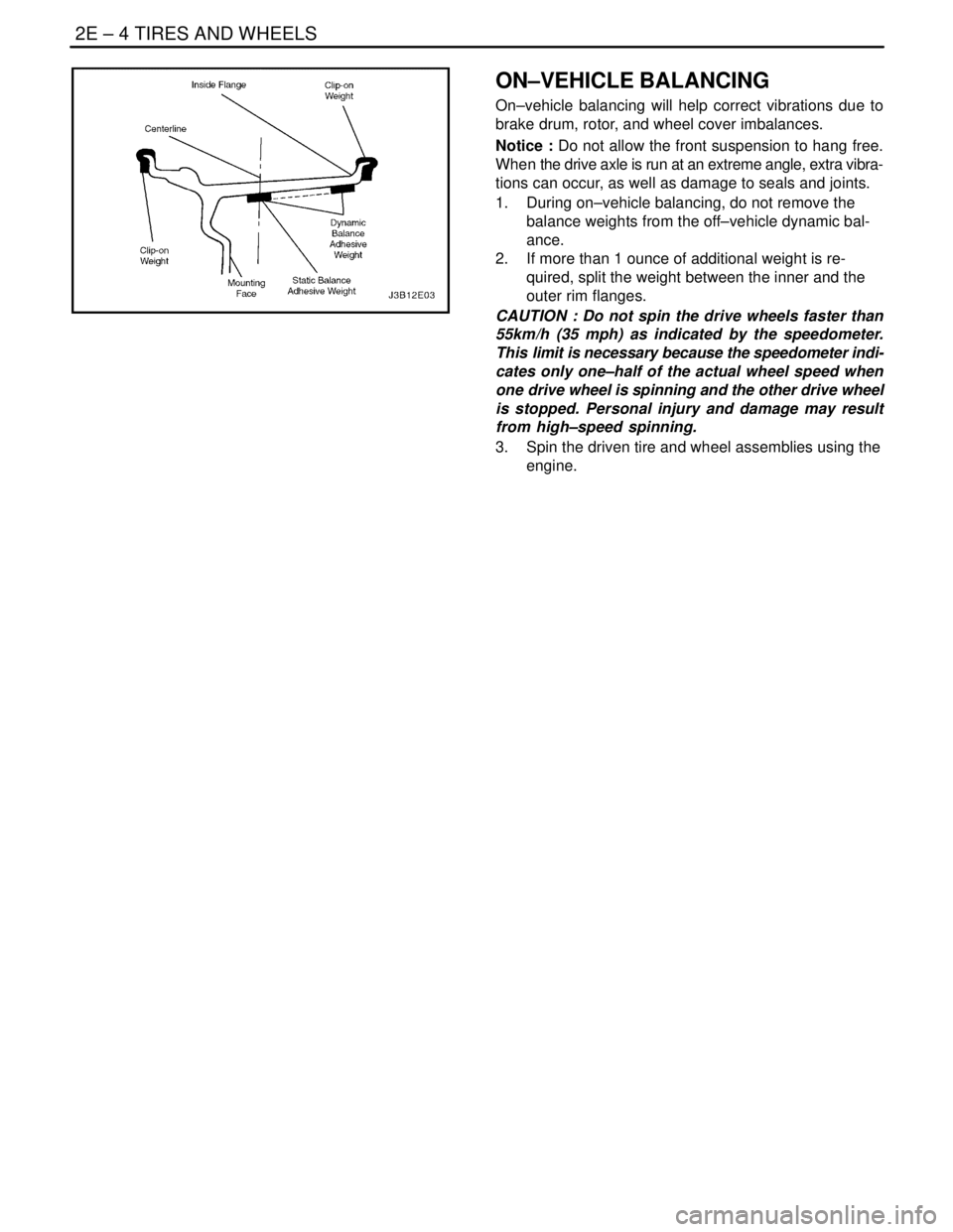
ON–VEHICLE BALANCING
On–vehicle balancing will help correct vibrations due to
brake drum, rotor, and wheel cover imbalances.
Notice : Do not allow the front suspension to hang free.
When the drive axle is run at an extreme angle, extra vibra-
tions can occur, as well as damage to seals and joints.
1. During on–vehicle balancing, do not remove the
balance weights from the off–vehicle dynamic bal-
ance.
2. If more than 1 ounce of additional weight is re-
quired, split the weight between the inner and the
outer rim flanges.
CAUTION : Do not spin the drive wheels faster than
55km/h (35 mph) as indicated by the speedometer.
This limit is necessary because the speedometer indi-
cates only one–half of the actual wheel speed when
one drive wheel is spinning and the other drive wheel
is stopped. Personal injury and damage may result
from high–speed spinning.
3. Spin the driven tire and wheel assemblies using the
engine.
Page 968 of 2643

2E – 6ITIRES AND WHEELS
DAEWOO V–121 BL4
S Amchem Alodine No. 1001. Stock No. DX50T or
equivalent coating chemical for alloys.
S Ditzler Delclear Acrylic Urethane Clear, Stock No.
DAU–75 or equivalent.
S Ditzler Delthane Ultra–Urethane Additive, Stock No.
DXR–80 or equivalent.
Before repairing the alloy damage or the clear coat dam-
age, prepare the wheels and the tires.
1. Remove the wheel from the vehicle.
2. Mark the location of the outboard weights and re-
move them.
3. Wash the wheel inside and out with a water–based,
all–purpose cleaner. Remove the grease and oil
with a solvent cleaner.
4. Mask the tire prior to painting.
5. Using a 400–grit wet or dry sandpaper, sand over
the painted areas that will not require recoloring.
Sanding will promote the adhesion of the clear coat.
Alloy Damage on Wheel Surface
1. Mount the wheel on a brake lathe and spin the as-
sembly slowly.
2. Sand the wheel with a backing block or pad. Hold
the backing block or pad flat to the surface of the
wheel and sand slowly back and forth from the cen-
ter to the outer edge of the tire to remove the dam-
age. Use the following sandpaper grits in the order
listed:
1) 80 grit.
2) 150 grit.
3) 240 grit.
Clear Coat Damage on Unpainted Wheels
1. Apply the chemical stripper Amchem Alumi Prep
No. 33. Use a small 1/4–inch detail brush to apply
the stripper around the perimeter and spoke–like
areas.
2. Remove the stripper according to the manufactur-
er’s recommendations.
CAUTION : To avoid serious personal injury, do not
use engine power to rotate the wheel while sanding.
3. Sand the wheel with 240–grit sandpaper by rotating
the wheel on a slow–spinning brake lathe or by
mounting the wheel on the car and spinning it by
hand. Sanding restores the machined appearance
and promotes adhesion.
After repairing the alloy or clear coat damage, the wheels
must be recoated.
Page 973 of 2643

TIRES AND WHEELS 2E – 11
DAEWOO V–121 BL4
pacity, diameter, rim width, offset, and mounting configu-
ration. A wheel of improper size or type may affect wheel
and bearing life, brake cooling, speedometer/odometer
calibration, vehicle ground clearance, and tire clearance
to the body and the chassis. The wheel offset is 49 ± 1 mm
(1.93 ± 0.04 inches). Steel wheels may be identified by a
two– or three–letter code stamped into the rim near the
valve stem. Alloy wheels should have the code, the part
number, and the manufacturer ID cast into the back side.
INFLATION O TIRES
The pressure recommended for any vehicle line is careful-
ly calculated to give a satisfactory ride, handling, tread life,
and load–carrying capacity.
Tire pressure should be checked monthly or before any
extended trip. Check the tires when they are cold, after the
vehicle has sat for 3 hours or more, or has been driven less
than 1 mile. Set the tire pressure to the specifications on
the tire label located on the rear face of the driver’s door.
Tire inflation pressure is also given under ”Tire Size and
Pressure Specifications” in this section.
Valve caps or extensions should be on the valves to keep
dust and water out.
For sustained driving at speeds up to 140 km/h (85 mph),
inflate the tires to the pressure recommended on the tire.
Sustained driving at speeds faster than 140 km/h (85mph), even if permitted by law, is not advised unless the
vehicle has special high–speed tires available from many
tire dealers. Tire pressures may increase as much as 41
kPa (6 psi) when the tires are hot.
Higher than recommended tire pressure can cause
S Hard ride.
S Tire bruising or damage.
S Rapid tread wear at the center of the tire.
Lower than recommended pressure can cause
S Tire squeal on turns.
S Hard steering.
S Rapid and uneven wear on the edges of the tread.
S Tire rim bruises and rupture.
S Tire cord breakage.
S High tire temperatures.
Unequal tire pressures on same axle can cause
S Uneven braking.
S Steering lead.
S Reduced handling.
S Swerve on acceleration.
S Torque steer.
Page 1014 of 2643

4–2WUSAGE AND CAPACITY OF FUSES IN FUSE BLOCK
1. ENGINE ROOM RELAY AND FUSE BLOCK
1) POSITION OF RELAY AND FUSE
2) USAGE OF FUSE IN ENGINE FUSE BLOCK
Power
Supply
ClassificationFuse
NoCapacityUsage
Ef130ABattery Main(F13~F16, F21~F24)
Ef260AEBCM, Oil Feeding Conenctor
Ef330ABlower Relay
30SBEf430AIgnition Switch–2
BAT (+)(Slow–BlownEf530AIgnition Switch–1
Fuse)Ef620ACooling Fan Low Relay
Ef730ADefog Relay
Ef830ACooling Fan HI Relay
IGN2 (15A)Ef920APower Window Switch
IGN1 (15)Ef1015AFuel Connector, ECM (MR–140), LEGR, EI
System
30Ef1110AECM, Main Relay (Sirius D4)
BAT(+)Ef1225AHead lamp Relay, ILLUM. Relay
Ef1315ABrake Switch
IGN2 (15A)Ef1420APower Window Switch
56 LIGHTEf1515AHead Lamp HI
30Ef1615AHorn Relay, siren, Hood Contact Switch
BAT(+)Ef1710AA/C Comp. Relay
IGN1 (15)Ef1815AFuel Pump
30 BAT(+)Ef1915ACluster, Key Remind S/W, Folding Mirror Unit, MAP
Lamp, Room Lamp, Trunk Open lamp, Trunk
Open S/W
56 LIGHTBlade TypeEf2010AHead Lamp Low
IGN1 (15)/FuseEf2115AEVAP Canister Purge Solenoid, HO2S, Cooling
Fan Relay
30 BAT(+)Ef2215Ainjector, EGR, EEGR
ILLUM. (58)Ef2310ALicense Plate Lamp, Chime Bell, Tail Lamp, Head
Lamp
30 BAT (+)Ef2415AFog Lamp Relay
IGN2 (15A)Ef2510AElectric OSRV Mirror
30 BAT (+)Ef2615ACentral Door Lock Unit
56 LIGHTEf2710AHead Lamp Low
ILLUM. (58)Ef2810AILLUM. Circuit, Head Lamp, Tail Lamp
SPAREEf2910ANot Used
Ef3015ANot Used
Ef3125ANot Used
Page 1015 of 2643

USAGE AND CAPACITY OF FUSES IN FUSE BLOCKW4–3
2. I.P FUSE BLOCK
1) POSITION OF FUSE AND RELAY
2) USAGE OF FUSE IN I.P FUSE BLOCK
Power
Supply
ClassificationFuse
NoCapacityUsage
IGN1 (15)Blade TypeF110ASDM
FuseF210ATCM, ECM, Generator, VGIS,VSS
F315AHazard Switch
F410ACluster, Chime Bell, Brake Switch, SSPS Module,
A/C Control Switch
–F5––
IGN2 (15A)F610AA/C Comp. Relay, Defog Relay, Power Window
Relay, Head Lamp Relay
F720ABlower Relay, A/C Control Switch, FATC
F815AElectric Mirror Switch, Folding Mirror, Sun Roof
Module
IGN1 (15)F925AWiper Motor, Wiper Switch
–F10––
IGN1 (15)F1110AEBCM, Oil Feeding Connector
F1210AImmobilizer, Anti Theft Control Unit, Rain Sensor
Unit
30 BAT(+)F1310ATCM
F1415AHazard Switch
F1515AAnti Theft Control Unit
F1610ADLC
ACC (15C)F1710AAudio, Clock
F1815AExtra Power Jack
F1915ACigar Lighter
IGN1 (15)F2010AReverse Lamp Switch, PNP Switch
30 BAT(+)F2115ARear Fog Relay
F2215AClock, FATC, A/C Control Switch
F2315AAudio
F2410AImmobilizer
Page 1017 of 2643

SECTION : 4A
HYDRAULIC BRAKES
CAUTION : Disconnect the negative battery cable before removing or installing any electrical unit or when a tool
or equipment could easily come in contact with exposed electrical terminals. Disconnecting this cable will help
prevent personal injury and damage to the vehicle. The ignition must also be in LOCK unless otherwise noted.
TABLE OF CONTENTS
SPECIFICATIONS4A–2 . . . . . . . . . . . . . . . . . . . . . . . . . .
General Specifcations 4A–2. . . . . . . . . . . . . . . . . . . . .
Fastener Tightening Specifications 4A–2. . . . . . . . . .
COMPONENT LOCATOR4A–3 . . . . . . . . . . . . . . . . . . . .
Brake System (ABS) 4A–3. . . . . . . . . . . . . . . . . . . . . . .
Brake System (NON–ABS) 4A–4. . . . . . . . . . . . . . . . .
DIAGNOSIS4A–5 . . . . . . . . . . . . . . . . . . . . . . . . . . . . . . . .
Brake System Testing 4A–5. . . . . . . . . . . . . . . . . . . . .
Brake Hose Inspection 4A–5. . . . . . . . . . . . . . . . . . . . .
Warning Lamp Operation 4A–5. . . . . . . . . . . . . . . . . . .
Stop Lamp Warning Circuit Diagnosis 4A–6. . . . . . . . MAINTENANCE AND REPAIR4A–10 . . . . . . . . . . . . . .
ON–VEHICLE SERVICE 4A–10. . . . . . . . . . . . . . . . . . . .
Manual Bleeding the Brakes 4A–10. . . . . . . . . . . . . . .
Pressure Bleeding the Brakes 4A–12. . . . . . . . . . . . . .
Brake Hose Rear 4A–13. . . . . . . . . . . . . . . . . . . . . . . . .
Brake Hose Front 4A–14. . . . . . . . . . . . . . . . . . . . . . . . .
Stoplamp Switch 4A–15. . . . . . . . . . . . . . . . . . . . . . . . .
Brake Pedal 4A–16. . . . . . . . . . . . . . . . . . . . . . . . . . . . .
GENERAL DESCRIPTION AND SYSTEM
OPERATION4A–17 . . . . . . . . . . . . . . . . . . . . . . . . . . . . .
Warning Lamp Operation 4A–17. . . . . . . . . . . . . . . . . .
Page 1018 of 2643

4A – 2IHYDRAULIC BRAKES
DAEWOO V–121 BL4
SPECIFICATIONS
GENERAL SPECIFCATIONS
1.4/1.6/1.8/2.0 DOHC Engine
ApplicationMillimetersInches
Brake Drums:
Inside Diameter
Maximum Rebore Diameter
Out–of–Round200.00
201.00
0.047.87
7.91
0.0016
Front Brake Rotors:
Discard Thickness
Lateral Runout (Installed)
Rotor Diameter
Rotor Thickness (New)
Thickness Variation22.00
0.030
256
24.00
0.010.87
0.001
10.07
0.95
0.0004
Rear Brake Rotors:
Discard Thickness
Lateral Runout (Installed)
Rotor Diameter
Rotor Thickness (New)
Thickness Variation8
0.030
258
10.4
0.010.31
0.001
10.15
0.40
0.0004
Master Cylinder:
Bore Diameter (Nominal)
Bore Diameter (Maximum)22.22
22.290.875
0.878
Caliper:
Minimum Piston Diameter (Front)
Minimum Piston Diameter (Rear)54.00
322.126
1.260
Wheel Cylinder Diameter:
Maximum
Nominal20.7
20.640.815
0.812
FASTENER TIGHTENING SPECIFICATIONS
ApplicationNSmLb–FtLb–In
Bleeder Screw8–71
Brake Lines1612–
Brake Pedal–to–Pedal Bracket Hex Nut1813–
Front Disc Brake Hose–to–Caliper Bolt4030–
Rear Disc Brake Hose–to–Caliper Bol3224–
Page 1019 of 2643
HYDRAULIC BRAKES 4A – 3
DAEWOO V–121 BL4
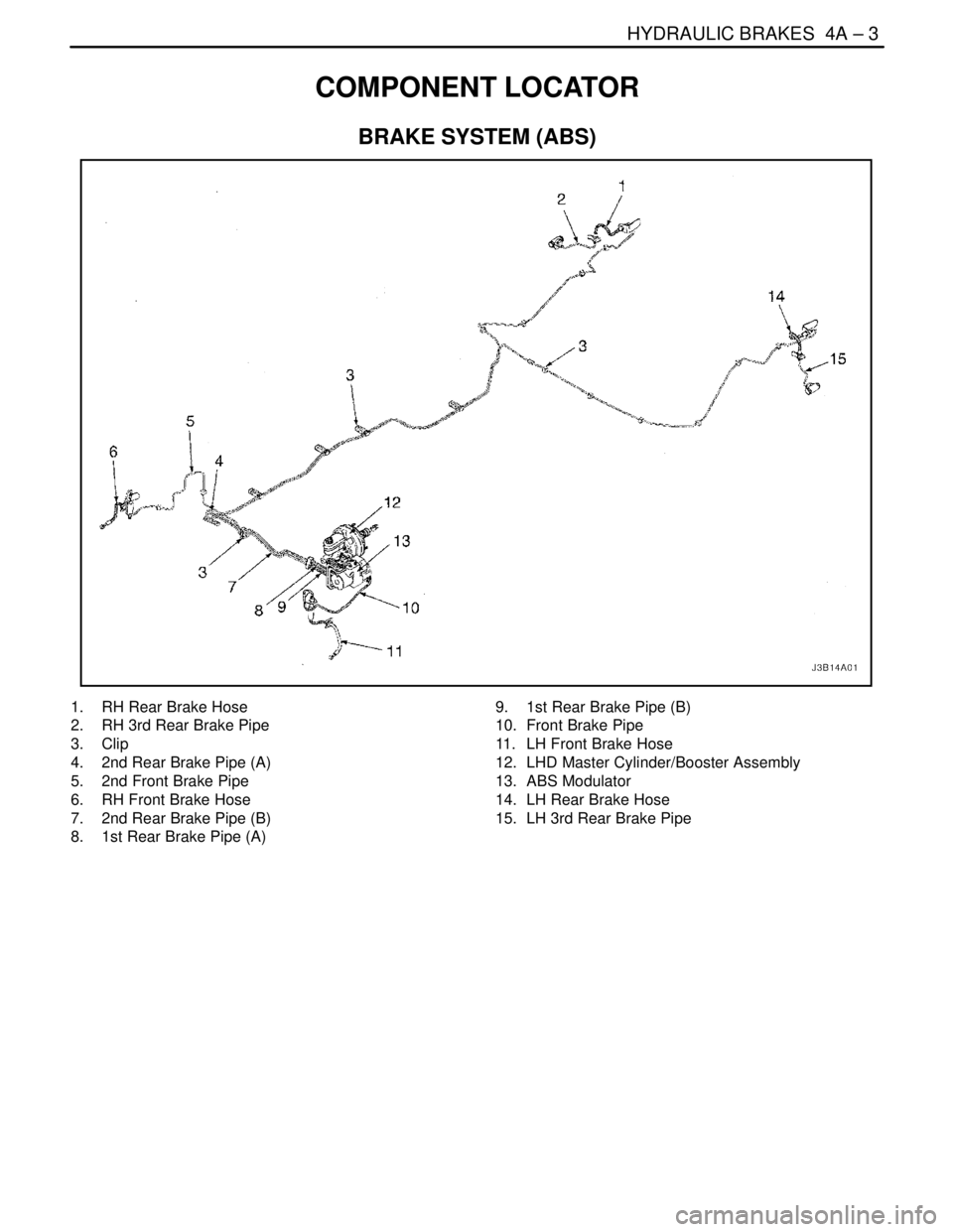
COMPONENT LOCATOR
BRAKE SYSTEM (ABS)
1. RH Rear Brake Hose
2. RH 3rd Rear Brake Pipe
3. Clip
4. 2nd Rear Brake Pipe (A)
5. 2nd Front Brake Pipe
6. RH Front Brake Hose
7. 2nd Rear Brake Pipe (B)
8. 1st Rear Brake Pipe (A)9. 1st Rear Brake Pipe (B)
10. Front Brake Pipe
11. LH Front Brake Hose
12. LHD Master Cylinder/Booster Assembly
13. ABS Modulator
14. LH Rear Brake Hose
15. LH 3rd Rear Brake Pipe
Page 1020 of 2643
4A – 4IHYDRAULIC BRAKES
DAEWOO V–121 BL4
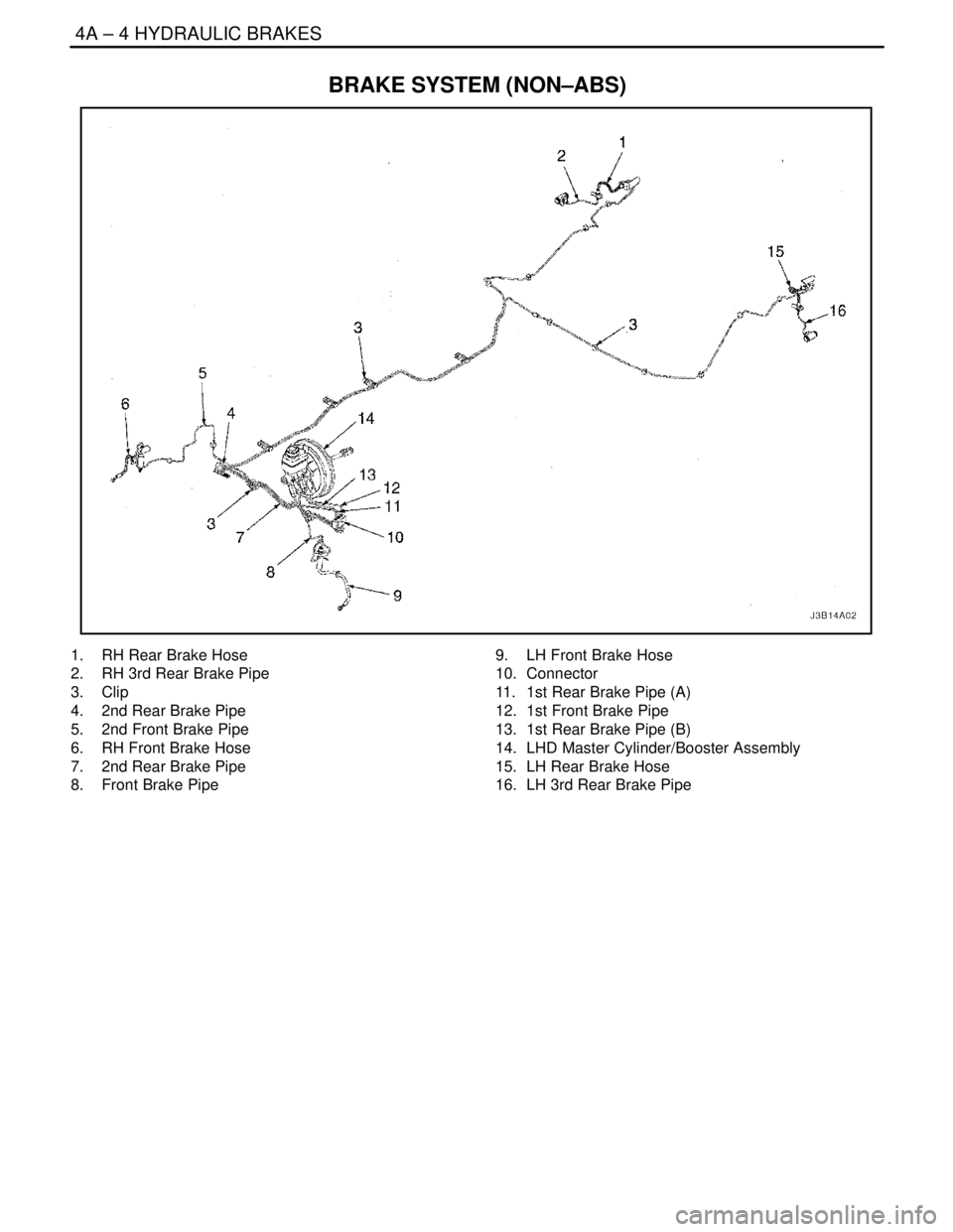
BRAKE SYSTEM (NON–ABS)
1. RH Rear Brake Hose
2. RH 3rd Rear Brake Pipe
3. Clip
4. 2nd Rear Brake Pipe
5. 2nd Front Brake Pipe
6. RH Front Brake Hose
7. 2nd Rear Brake Pipe
8. Front Brake Pipe9. LH Front Brake Hose
10. Connector
11. 1st Rear Brake Pipe (A)
12. 1st Front Brake Pipe
13. 1st Rear Brake Pipe (B)
14. LHD Master Cylinder/Booster Assembly
15. LH Rear Brake Hose
16. LH 3rd Rear Brake Pipe