Gear DAEWOO LACETTI 2004 Service Manual PDF
[x] Cancel search | Manufacturer: DAEWOO, Model Year: 2004, Model line: LACETTI, Model: DAEWOO LACETTI 2004Pages: 2643, PDF Size: 80.54 MB
Page 906 of 2643

SUSPENSION DIAGNOSIS 2A – 5
DAEWOO V–121 BL4
Steering Wheel Kickback
ChecksAction
Inspect for air in the power steering system.Purge the power steering system of air.
Inspect for a loose steering gear mounting.Tighten the steering gear mounting bracket nuts.
Inspect the joint from the column to the steering gear for
loose connections or wear.Tighten the intermediate shaft pinch bolts. Replace the in-
termediate shaft as needed.
Inspect for loose tie rod ends.Tighten the tie rod ends. Replace the outer tie rods as
needed.
Inspect for loose or worn wheel bearings.Tighten the drive axle nut. Replace the wheel bearings as
needed.
Steering Wheel Surges or Jerks
ChecksAction
Check the hydraulic system. Test the power steering sys-
tem pressure with a gauge.Replace the seals and the hoses as needed.
Inspect for a sluggish steering gear valve.Clean the pinion valve assembly. Replace the pinion valve
assembly as needed.
Inspect for a loose power steering pump serpentine belt.Adjust the power steering pump serpentine belt.
Cupped Tires
ChecksAction
Check the front–wheel and the rear–wheel alignment.Align the front and the rear wheels.
Inspect for worn strut dampeners.Replace the strut dampeners.
Inspect for worn or loose wheel bearings.Tighten the drive axle nut. Replace the wheel bearings as
needed.
Inspect for excessive tire or wheel runout.Match–mount the tires. Replace the tires as needed. Re-
place the wheels as needed.
Inspect for a worn ball joint.Replace the ball joint.
Check the steering gear preload adjustment.Perform a rack bearing preload adjustment.
TORQUE STEER
A degree of torque steer to the right may be experienced
during the use of heavy throttle on some front–wheel drive
cars with drive axles of unequal length. This torque steer
to the right results from the right drive axle being longer
than the left drive axle, which creates a difference in the
drive axle angle. Cars with intermediate shaft assemblies
have axles of almost equal length.
A difference in the drive axle lengths results in more torque
toe–in in the left front wheel. You will notice the torque toe–
in when the vehicle accelerates from a standing start or at
lower speeds.
Inspection Procedure
1. Place a small piece of tape at the top center of the
steering wheel.2. Note the inches of steering wheel deflection re-
quired to keep the vehicle straight during heavy ac-
celeration.
3. Compare this finding with similar cars.
Factors that may cause torque steer to be more apparent
on a particular vehicle include:
S Variations in the tire and wheel assemblies. This
has the most significant effect on torque steer. A
slightly smaller diameter on the right front tire will
increase a right torque lead.
S Large differences in the right and the left front tire
pressure.
S Looseness in the control arm bushings, the tie rod
assemblies, or the steering gear mounting. This
looseness permits a front wheel to pull forward and
toe–in under a torque greater than the wheel on the
opposite side. A loose suspension component may
result in an opposite lead upon deceleration.
Page 915 of 2643
2B – 8IWHEEL ALIGNMENT
DAEWOO V–121 BL4
PRELIMINARY INSPECTION
ChecksAction
Check the tires for proper inflation pressures and normal
tread wear.Inflate the tires to the proper tire pressure. Replace the
tires as needed.
Check the wheel bearings for looseness.Tighten the axle nut to the proper specification. Replace
the strut wheel bearing as needed.
Check for loose ball joints and tie rod ends.Tighten the ball joints and the tie rods.
Check the runout of the wheels and the tires.Measure and correct the tire runout.
Check the vehicle trim heights.Correct the trim heights. Make the correction before ad-
justing the toe.
Check for loose rack and pinion mounting.Tighten the mounting brackets for the rack and pinion as-
sembly.
Check for improperly operating struts.Replace the strut assembly.
Check for loose control arms.Tighten the control arm attachment bolts. Replace the con-
trol arm bushings as needed.
FRONT TOE ADJUSTMENT
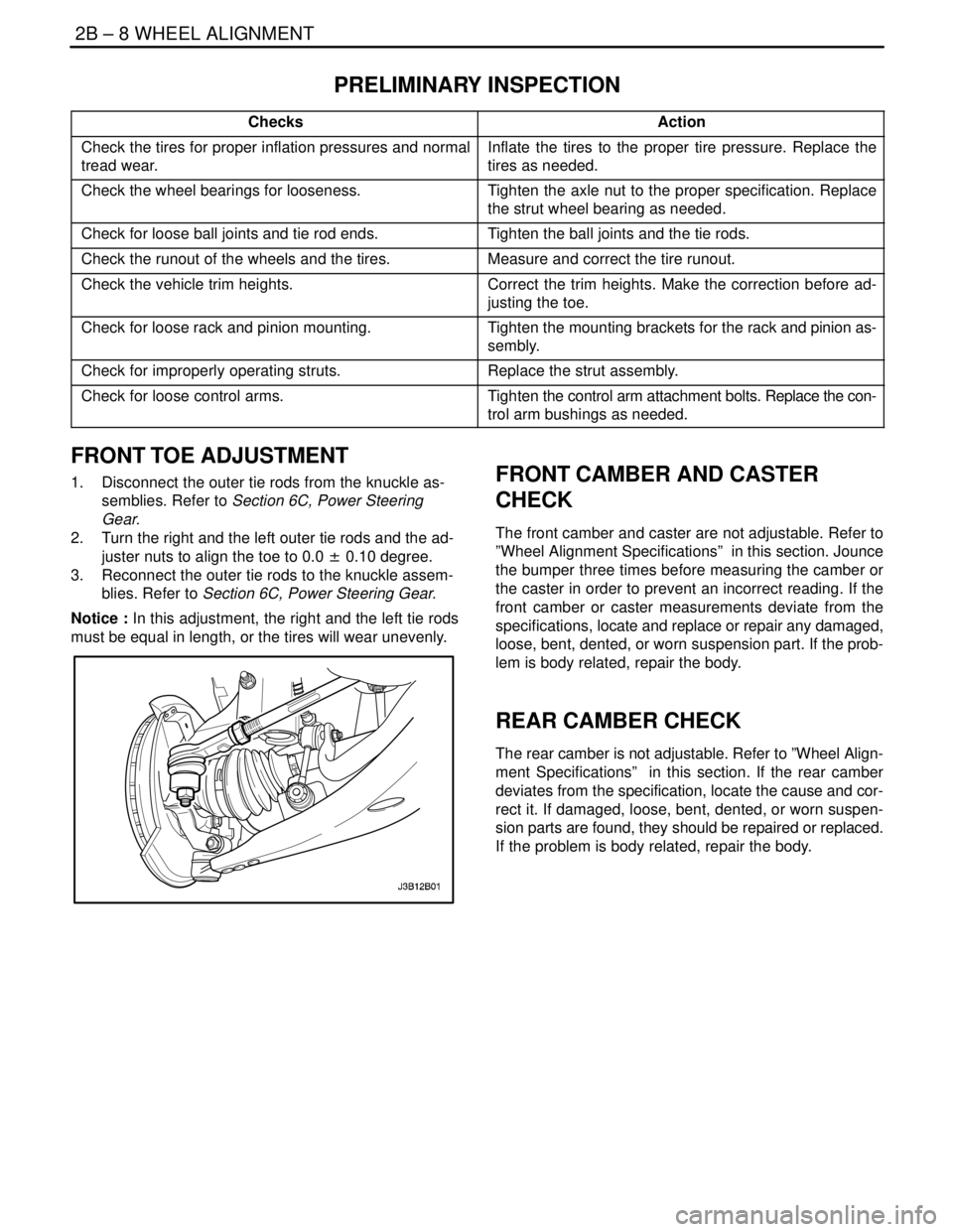
1. Disconnect the outer tie rods from the knuckle as-
semblies. Refer to Section 6C, Power Steering
Gear.
2. Turn the right and the left outer tie rods and the ad-
juster nuts to align the toe to 0.0 ± 0.10 degree.
3. Reconnect the outer tie rods to the knuckle assem-
blies. Refer to Section 6C, Power Steering Gear.
Notice : In this adjustment, the right and the left tie rods
must be equal in length, or the tires will wear unevenly.FRONT CAMBER AND CASTER
CHECK
The front camber and caster are not adjustable. Refer to
”Wheel Alignment Specifications” in this section. Jounce
the bumper three times before measuring the camber or
the caster in order to prevent an incorrect reading. If the
front camber or caster measurements deviate from the
specifications, locate and replace or repair any damaged,
loose, bent, dented, or worn suspension part. If the prob-
lem is body related, repair the body.
REAR CAMBER CHECK
The rear camber is not adjustable. Refer to ”Wheel Align-
ment Specifications” in this section. If the rear camber
deviates from the specification, locate the cause and cor-
rect it. If damaged, loose, bent, dented, or worn suspen-
sion parts are found, they should be repaired or replaced.
If the problem is body related, repair the body.
Page 928 of 2643
FRONT SUSPENSION 2C – 11
DAEWOO V–121 BL4
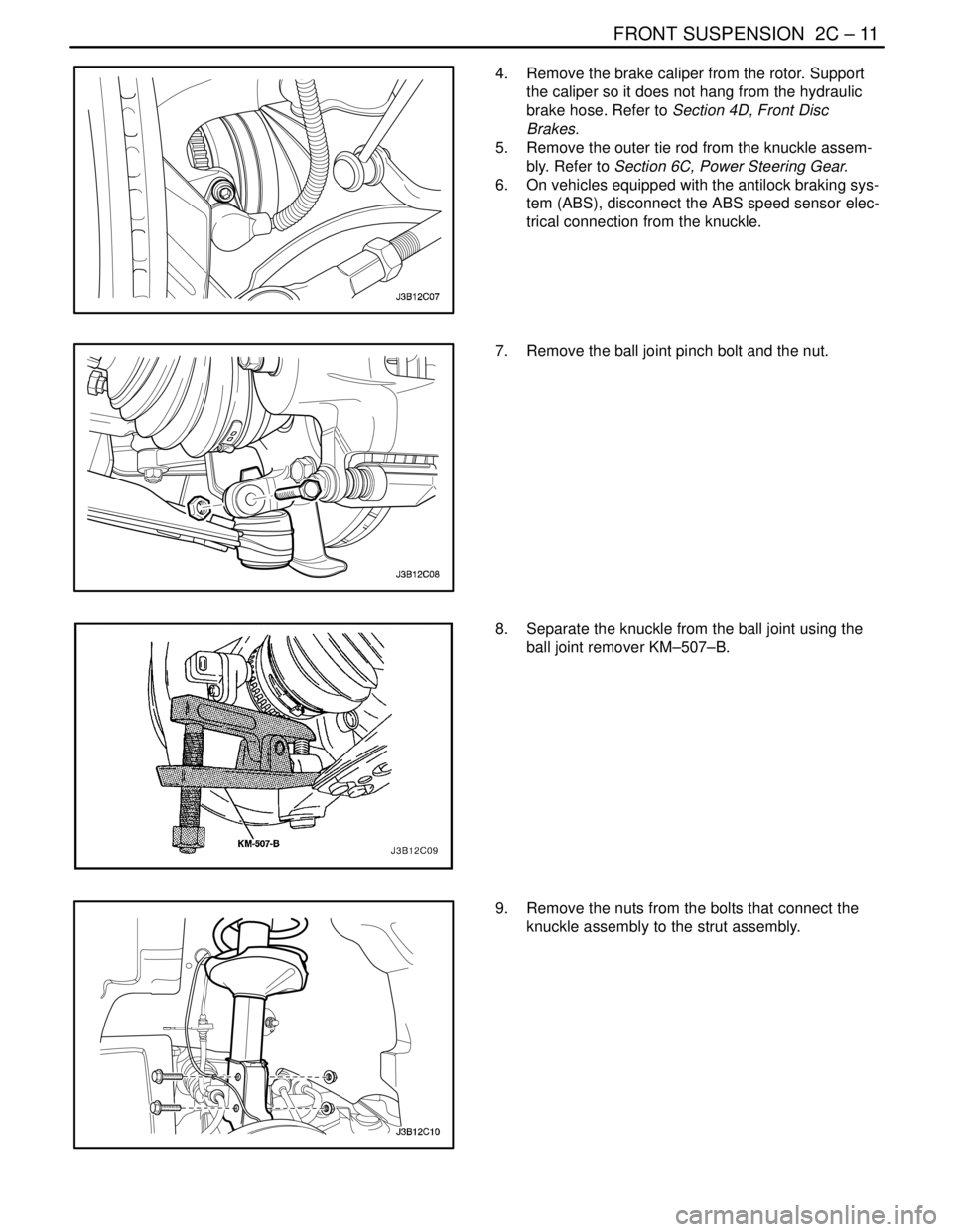
4. Remove the brake caliper from the rotor. Support
the caliper so it does not hang from the hydraulic
brake hose. Refer to Section 4D, Front Disc
Brakes.
5. Remove the outer tie rod from the knuckle assem-
bly. Refer to Section 6C, Power Steering Gear.
6. On vehicles equipped with the antilock braking sys-
tem (ABS), disconnect the ABS speed sensor elec-
trical connection from the knuckle.
7. Remove the ball joint pinch bolt and the nut.
8. Separate the knuckle from the ball joint using the
ball joint remover KM–507–B.
9. Remove the nuts from the bolts that connect the
knuckle assembly to the strut assembly.
Page 930 of 2643
FRONT SUSPENSION 2C – 13
DAEWOO V–121 BL4
7. Connect the outer tie rod to the knuckle assembly.
Refer to Section 6C, Power Steering Gear.
8. Install the brake caliper onto the rotor. Refer to
Section 4D, Front Disc Brakes.
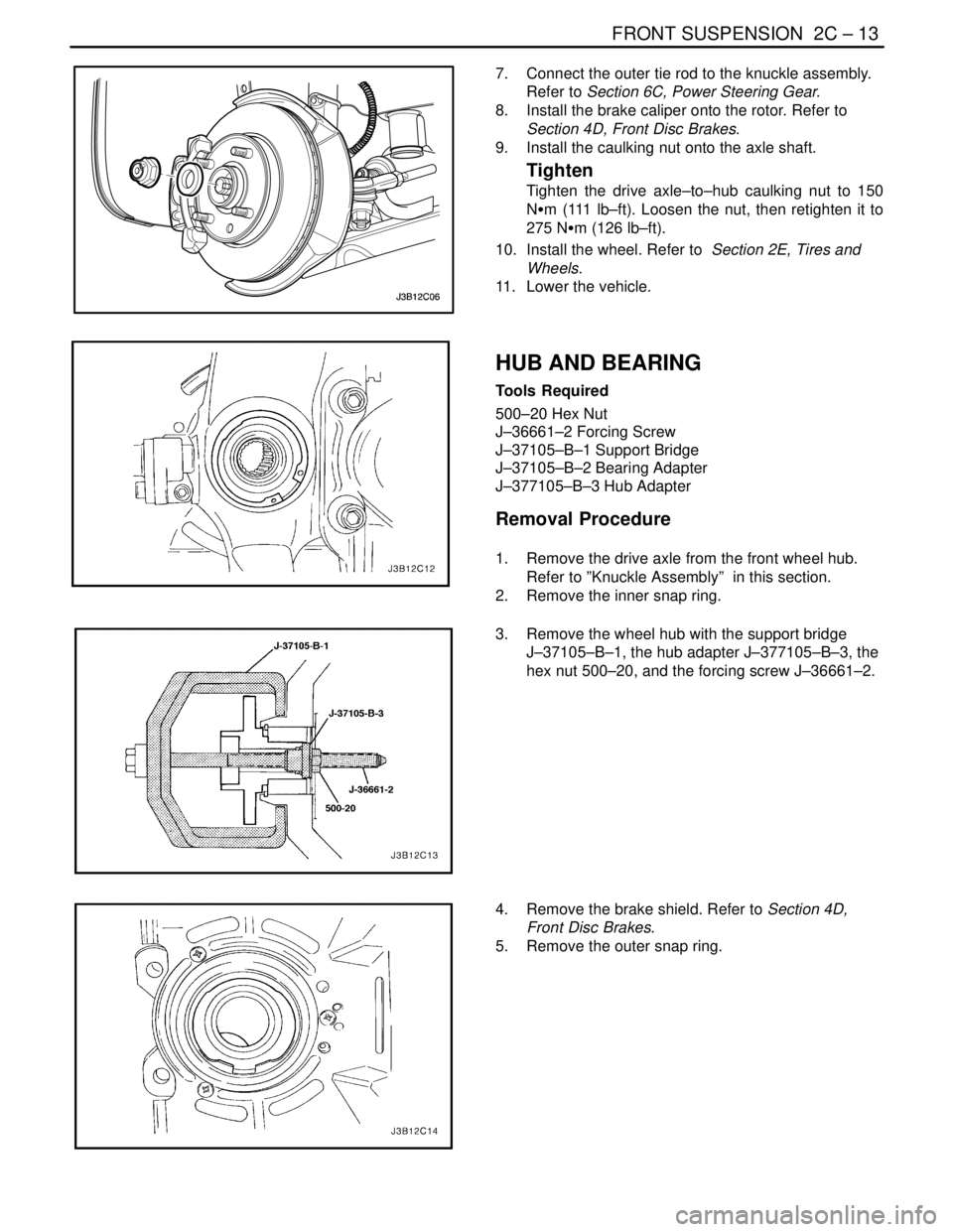
9. Install the caulking nut onto the axle shaft.
Tighten
Tighten the drive axle–to–hub caulking nut to 150
NSm (111 lb–ft). Loosen the nut, then retighten it to
275 NSm (126 lb–ft).
10. Install the wheel. Refer to Section 2E, Tires and
Wheels.
11. Lower the vehicle.
HUB AND BEARING
Tools Required
500–20 Hex Nut
J–36661–2 Forcing Screw
J–37105–B–1 Support Bridge
J–37105–B–2 Bearing Adapter
J–377105–B–3 Hub Adapter
Removal Procedure
1. Remove the drive axle from the front wheel hub.
Refer to ”Knuckle Assembly” in this section.
2. Remove the inner snap ring.
3. Remove the wheel hub with the support bridge
J–37105–B–1, the hub adapter J–377105–B–3, the
hex nut 500–20, and the forcing screw J–36661–2.
4. Remove the brake shield. Refer to Section 4D,
Front Disc Brakes.
5. Remove the outer snap ring.
Page 935 of 2643
2C – 18IFRONT SUSPENSION
DAEWOO V–121 BL4
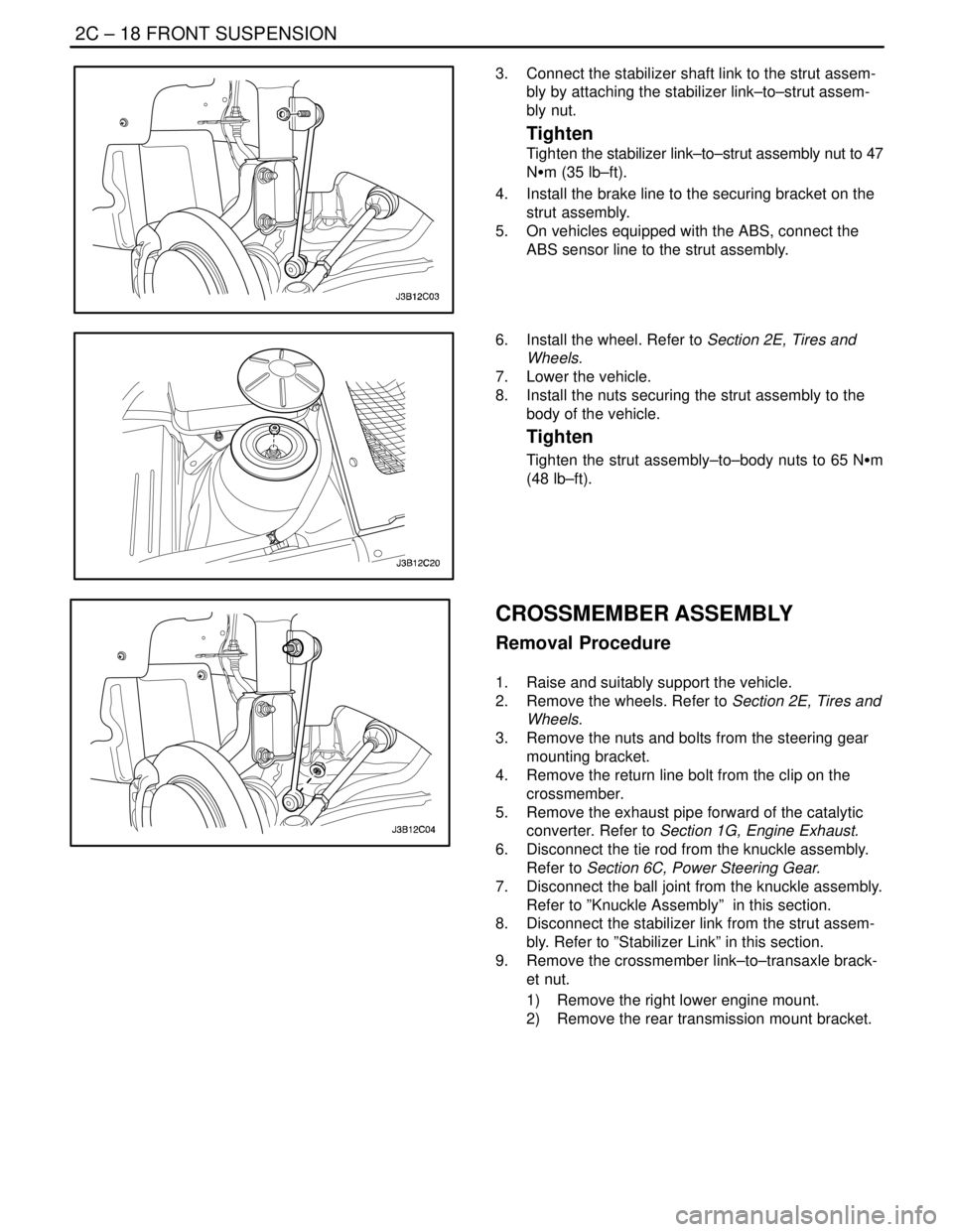
3. Connect the stabilizer shaft link to the strut assem-
bly by attaching the stabilizer link–to–strut assem-
bly nut.
Tighten
Tighten the stabilizer link–to–strut assembly nut to 47
NSm (35 lb–ft).
4. Install the brake line to the securing bracket on the
strut assembly.
5. On vehicles equipped with the ABS, connect the
ABS sensor line to the strut assembly.
6. Install the wheel. Refer to Section 2E, Tires and
Wheels.
7. Lower the vehicle.
8. Install the nuts securing the strut assembly to the
body of the vehicle.
Tighten
Tighten the strut assembly–to–body nuts to 65 NSm
(48 lb–ft).
CROSSMEMBER ASSEMBLY
Removal Procedure
1. Raise and suitably support the vehicle.
2. Remove the wheels. Refer to Section 2E, Tires and
Wheels.
3. Remove the nuts and bolts from the steering gear
mounting bracket.
4. Remove the return line bolt from the clip on the
crossmember.
5. Remove the exhaust pipe forward of the catalytic
converter. Refer to Section 1G, Engine Exhaust.
6. Disconnect the tie rod from the knuckle assembly.
Refer to Section 6C, Power Steering Gear.
7. Disconnect the ball joint from the knuckle assembly.
Refer to ”Knuckle Assembly” in this section.
8. Disconnect the stabilizer link from the strut assem-
bly. Refer to ”Stabilizer Link” in this section.
9. Remove the crossmember link–to–transaxle brack-
et nut.
1) Remove the right lower engine mount.
2) Remove the rear transmission mount bracket.
Page 936 of 2643
FRONT SUSPENSION 2C – 19
DAEWOO V–121 BL4
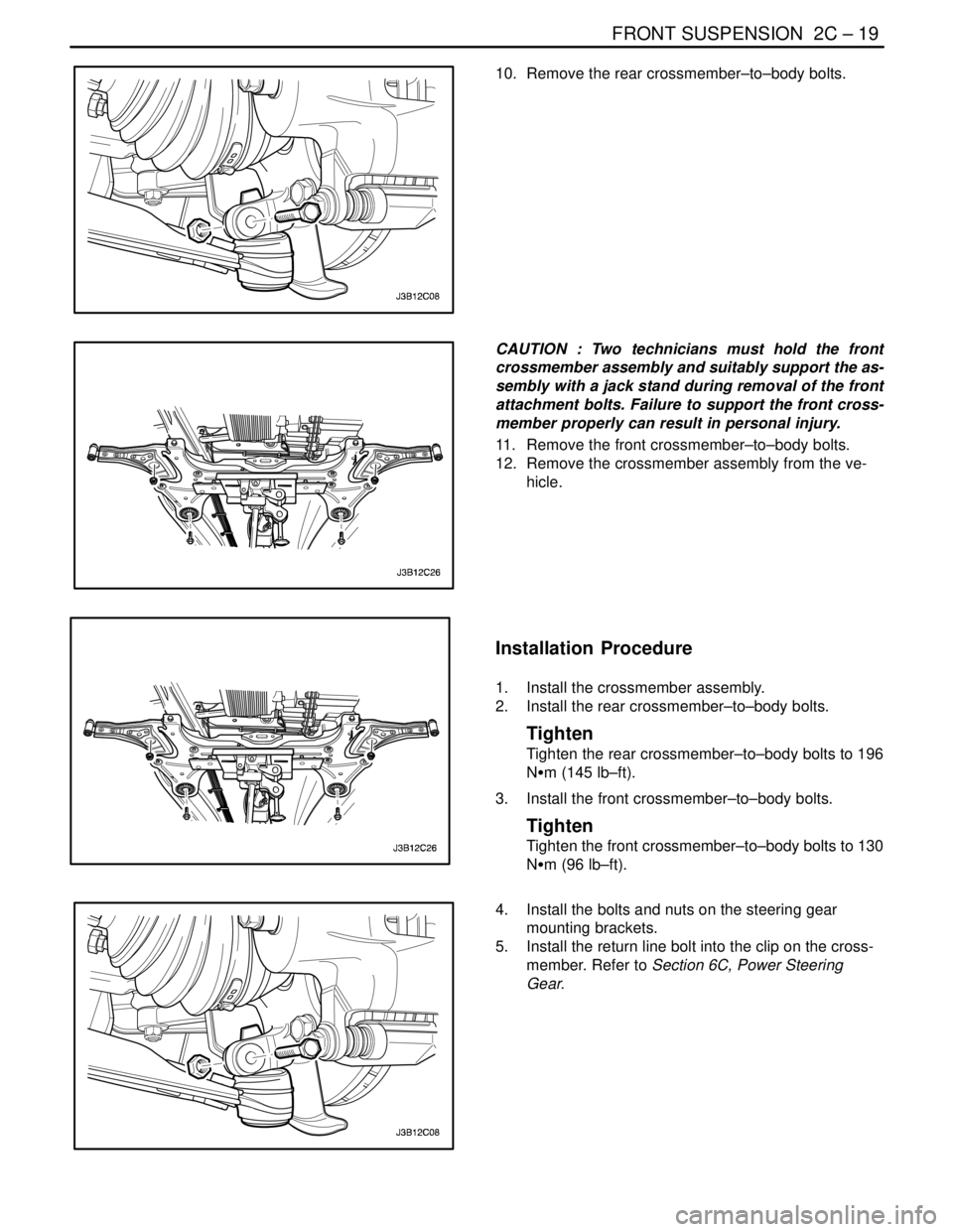
10. Remove the rear crossmember–to–body bolts.
CAUTION : Two technicians must hold the front
crossmember assembly and suitably support the as-
sembly with a jack stand during removal of the front
attachment bolts. Failure to support the front cross-
member properly can result in personal injury.
11. Remove the front crossmember–to–body bolts.
12. Remove the crossmember assembly from the ve-
hicle.
Installation Procedure
1. Install the crossmember assembly.
2. Install the rear crossmember–to–body bolts.
Tighten
Tighten the rear crossmember–to–body bolts to 196
NSm (145 lb–ft).
3. Install the front crossmember–to–body bolts.
Tighten
Tighten the front crossmember–to–body bolts to 130
NSm (96 lb–ft).
4. Install the bolts and nuts on the steering gear
mounting brackets.
5. Install the return line bolt into the clip on the cross-
member. Refer to Section 6C, Power Steering
Gear.
Page 937 of 2643

2C – 20IFRONT SUSPENSION
DAEWOO V–121 BL4
6. Install the crossmember link–to–transaxle bracket
nut.
Tighten
Tighten the crossmember link–to–transaxle bracket
nut to 169 NSm (125 lb–ft).
7. Connect the stabilizer link to the strut assembly.
Refer to ”Stabilizer Link” in this section.
8. Connect the ball joint to the knuckle assembly. Re-
fer to ”Knuckle Assembly” in this section.
9. Connect the tie rod from the knuckle assembly. Re-
fer to Section 6C, Power Steering Gear.
10. Install the exhaust pipe into the vehicle. Refer to
Section 1G, Engine Exhaust.
11. Install the wheels. Refer to Section 2E, Tires and
Wheels.
12. Lower the vehicle.
Page 1154 of 2643
4G – 2IPARKING BRAKE
DAEWOO V–121 BL4
MAINTENANCE AND REPAIR
ON–VEHICLE SERVICE
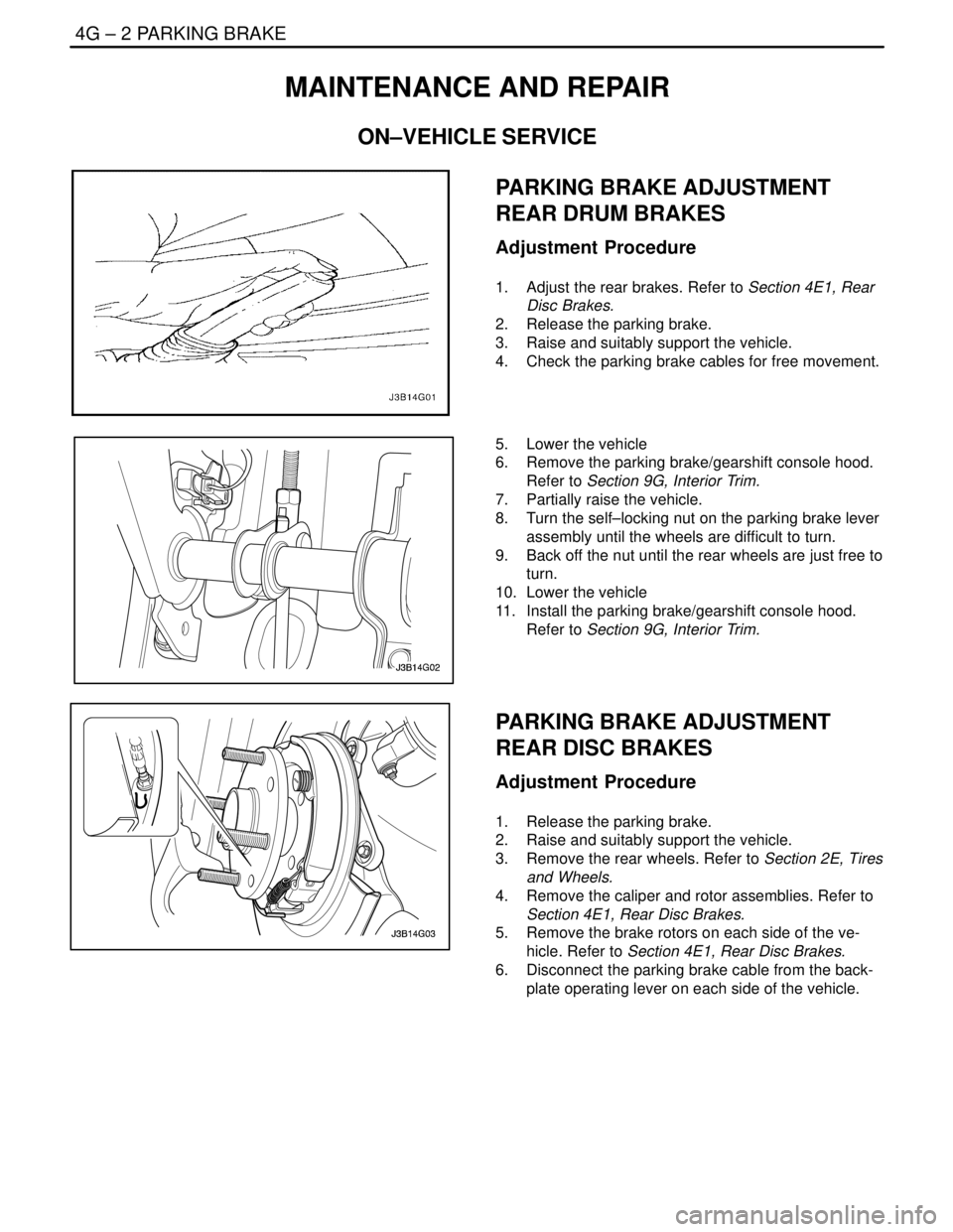
PARKING BRAKE ADJUSTMENT
REAR DRUM BRAKES
Adjustment Procedure
1. Adjust the rear brakes. Refer to Section 4E1, Rear
Disc Brakes.
2. Release the parking brake.
3. Raise and suitably support the vehicle.
4. Check the parking brake cables for free movement.
5. Lower the vehicle
6. Remove the parking brake/gearshift console hood.
Refer to Section 9G, Interior Trim.
7. Partially raise the vehicle.
8. Turn the self–locking nut on the parking brake lever
assembly until the wheels are difficult to turn.
9. Back off the nut until the rear wheels are just free to
turn.
10. Lower the vehicle
11. Install the parking brake/gearshift console hood.
Refer to Section 9G, Interior Trim.
PARKING BRAKE ADJUSTMENT
REAR DISC BRAKES
Adjustment Procedure
1. Release the parking brake.
2. Raise and suitably support the vehicle.
3. Remove the rear wheels. Refer to Section 2E, Tires
and Wheels.
4. Remove the caliper and rotor assemblies. Refer to
Section 4E1, Rear Disc Brakes.
5. Remove the brake rotors on each side of the ve-
hicle. Refer to Section 4E1, Rear Disc Brakes.
6. Disconnect the parking brake cable from the back-
plate operating lever on each side of the vehicle.
Page 1155 of 2643
PARKING BRAKE 4G – 3
DAEWOO V–121 BL4
7. Inspect and replace any parts of doubtful strength
or quality. This can be shown by discoloration from
heat or stress.
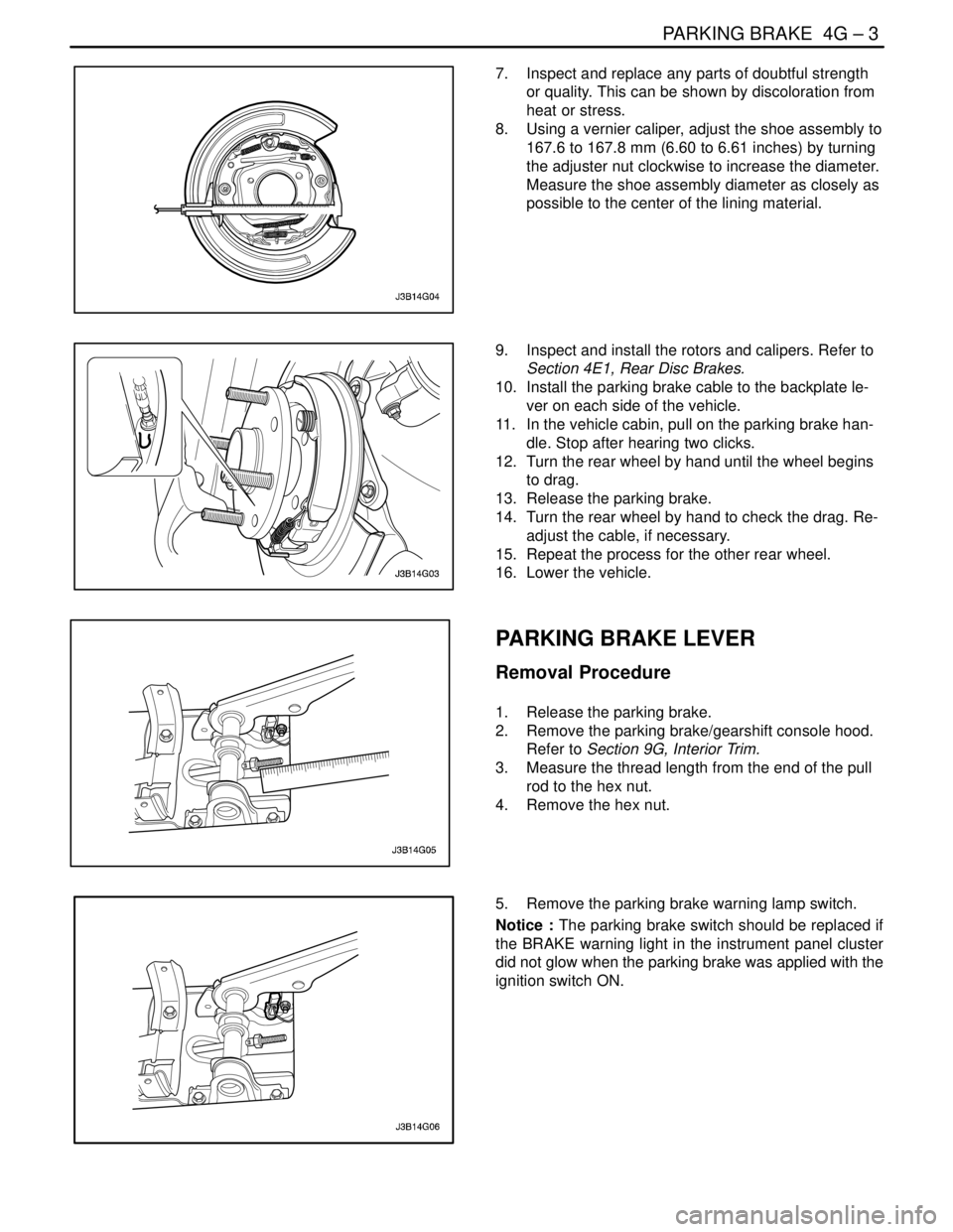
8. Using a vernier caliper, adjust the shoe assembly to
167.6 to 167.8 mm (6.60 to 6.61 inches) by turning
the adjuster nut clockwise to increase the diameter.
Measure the shoe assembly diameter as closely as
possible to the center of the lining material.
9. Inspect and install the rotors and calipers. Refer to
Section 4E1, Rear Disc Brakes.
10. Install the parking brake cable to the backplate le-
ver on each side of the vehicle.
11. In the vehicle cabin, pull on the parking brake han-
dle. Stop after hearing two clicks.
12. Turn the rear wheel by hand until the wheel begins
to drag.
13. Release the parking brake.
14. Turn the rear wheel by hand to check the drag. Re-
adjust the cable, if necessary.
15. Repeat the process for the other rear wheel.
16. Lower the vehicle.
PARKING BRAKE LEVER
Removal Procedure
1. Release the parking brake.
2. Remove the parking brake/gearshift console hood.
Refer to Section 9G, Interior Trim.
3. Measure the thread length from the end of the pull
rod to the hex nut.
4. Remove the hex nut.
5. Remove the parking brake warning lamp switch.
Notice : The parking brake switch should be replaced if
the BRAKE warning light in the instrument panel cluster
did not glow when the parking brake was applied with the
ignition switch ON.
Page 1156 of 2643
4G – 4IPARKING BRAKE
DAEWOO V–121 BL4
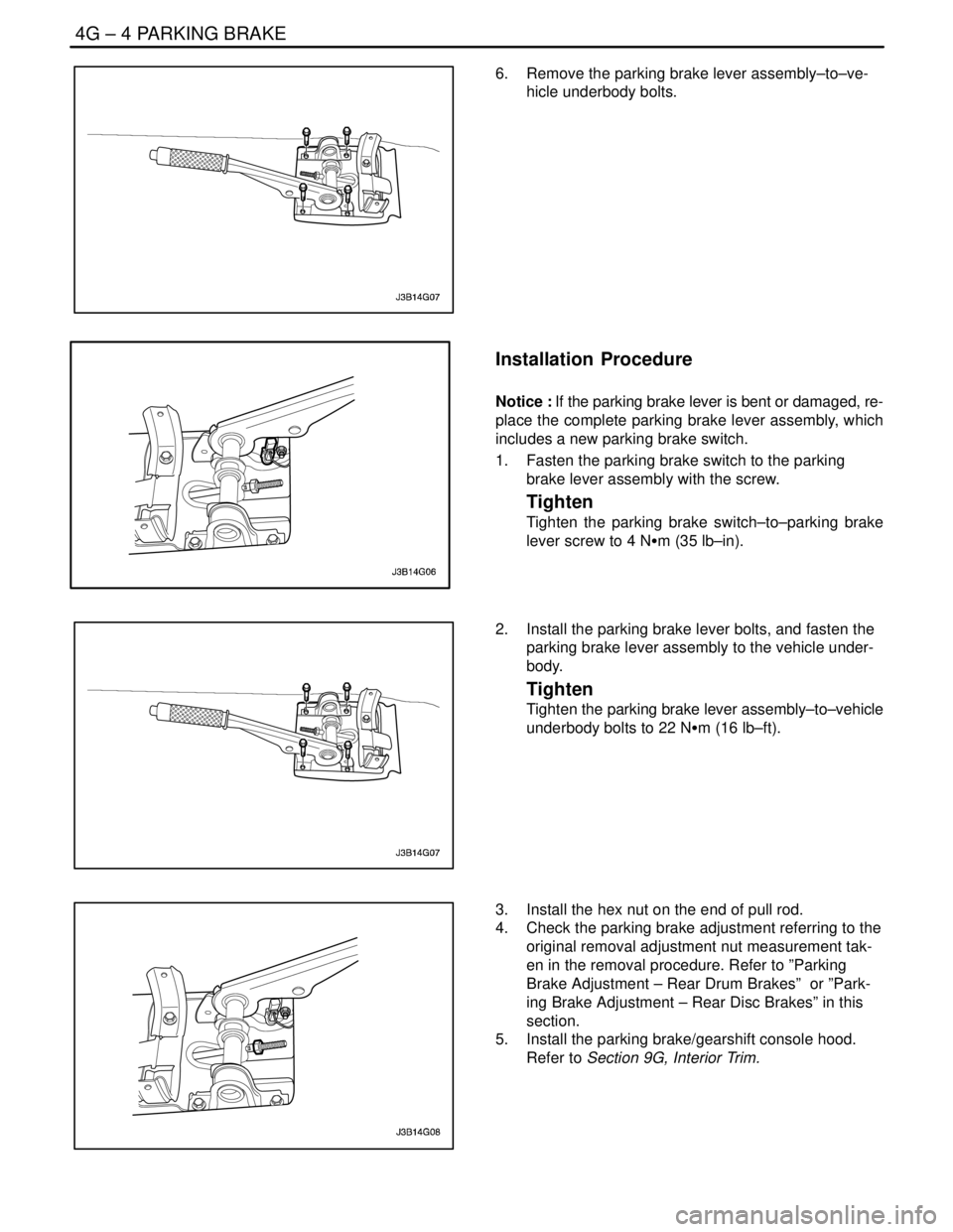
6. Remove the parking brake lever assembly–to–ve-
hicle underbody bolts.
Installation Procedure
Notice : If the parking brake lever is bent or damaged, re-
place the complete parking brake lever assembly, which
includes a new parking brake switch.
1. Fasten the parking brake switch to the parking
brake lever assembly with the screw.
Tighten
Tighten the parking brake switch–to–parking brake
lever screw to 4 NSm (35 lb–in).
2. Install the parking brake lever bolts, and fasten the
parking brake lever assembly to the vehicle under-
body.
Tighten
Tighten the parking brake lever assembly–to–vehicle
underbody bolts to 22 NSm (16 lb–ft).
3. Install the hex nut on the end of pull rod.
4. Check the parking brake adjustment referring to the
original removal adjustment nut measurement tak-
en in the removal procedure. Refer to ”Parking
Brake Adjustment – Rear Drum Brakes” or ”Park-
ing Brake Adjustment – Rear Disc Brakes” in this
section.
5. Install the parking brake/gearshift console hood.
Refer to Section 9G, Interior Trim.