tran DAEWOO LACETTI 2004 Service Repair Manual
[x] Cancel search | Manufacturer: DAEWOO, Model Year: 2004, Model line: LACETTI, Model: DAEWOO LACETTI 2004Pages: 2643, PDF Size: 80.54 MB
Page 2490 of 2643

REMOTE KEYLESS ENTRY AND ANTI–THEFT SYSTEM 9T1 – 9
DAEWOO V–121 BL4
length of time between flashes is used to indicate certain
vehicle conditions. Refer to ”Fault or Alarm Indication” in
this section.
AUTOLOCKING (SAFETY LOCK)
The remote keyless entry system features an autolocking
feature. If the doors are unlocked with the remote transmit-
ter when the control module/receiver is in the armed
mode, the doors are automatically re–locked after 30 sec-
onds unless any of the following events occur:
S A door is opened.
S The ignition is ON.
S The trunk is opened.
S The hood is opened.
CONTROL MODULE/RECEIVER
The remote keyless entry control module/receiver is con-
tained in the floor console. The module/receiver pro-
cesses signals from the remote transmitter and various
switches. It activates the alarm if an intrusion is detected.
The control module/receiver also has a self–diagnostic
function which will display trouble codes. In order to dis-
play trouble codes, a scan tool must be connected to the
data link connector (DLC).
The control module/receiver will not communicate with
transmitters from other vehicles because there are over
four billion possible electronic password combinations. Itis highly unlikely that any transmitters will use the same
password. The control module/receiver has an attached
antenna to detect signals from the transmitter.
FAULT OR ALARM INDICATION
When the UNLOCK button on the remote transmitter is
pressed, the control module/receiver will flash the parking
lights to indicate information about the remote keyless
entry and anti–theft system.
Normal Condition: If there has not been an intrusion, and
no fault has been detected, the control module/receiver
will signal a normal condition when the UNLOCK button is
pressed. The parking lights will flash twice for 0.5 second,
with a 0.5 second pause between flashes.
Fault Indication: If there is a fault in the remote keyless
entry and anti–theft system, the control module/receiver
will signal the fault when the UNLOCK button is pressed.
The parking lights will flash twice for 1 second, with a 0.5
second pause between flashes.
Alarm Indication: If there has been an intrusion since the
last time the LOCK button was pressed, the control mod-
ule/receiver will signal that there has been an intrusion
when the UNLOCK button is pressed. The parking lights
will flash twice for 0.5 second, with a 1.5 second pause be-
tween flashes.
Alarm and fault information will be erased the next time the
transmitter arms the control module/receiver by transmit-
ting a LOCK message.
Page 2491 of 2643

SECTION : 9T2
IMMOBILIZER ANTI–THEFT SYSTEM
CAUTION : Disconnect the negative battery cable before removing or installing any electrical unit or when a tool
or equipment could easily come in contact with exposed electrical terminals. Disconnecting this cable will help
prevent personal injury and damage to the vehicle. The ignition must also be in LOCK unless otherwise noted.
TABLE OF CONTENTS
SCHEMATIC AND ROUTING DIAGRAMS9T2–2 . . . .
Immobilizer Anti–Theft System 9T2–2. . . . . . . . . . . . .
DIAGNOSTIC INFORMATION AND
PROCEDURES9T2–3 . . . . . . . . . . . . . . . . . . . . . . . . . .
Immobilizer System
(MR–140, HV–240, SIRIUS D4) 9T2–3. . . . . . . . . . .
Diagnostic Trouble Code (DTC) P1626 (MR–140,
HV–240), P1628 (SIRIUS) 9T2–4. . . . . . . . . . . . . . .
Diagnostic Trouble Code (DTC) P1631 (MR–140,
HV–240), P1629 (SIRIUS D4) 9T2–6. . . . . . . . . . . .
Key Status Errors
(MR–140, HV–240, SIRIUS D4) 9T2–8. . . . . . . . . . .
Communication Between Immobilizer Control Unit and
Test Equipment
(MR–140, HV–240, SIRIUS D4) 9T2–8. . . . . . . . . . . MAINTENANCE AND REPAIR9T2–9 . . . . . . . . . . . . . .
ON–VEHICLE SERVICE 9T2–9. . . . . . . . . . . . . . . . . . . .
Key Coding Procedure 9T2–9. . . . . . . . . . . . . . . . . . . .
ID Code Reprogramming 9T2–9. . . . . . . . . . . . . . . . . .
Transponder 9T2–9. . . . . . . . . . . . . . . . . . . . . . . . . . . . .
Immobilizer Control Unit 9T2–9. . . . . . . . . . . . . . . . . . .
GENERAL DESCRIPTION AND SYSTEM
OPERATION9T2–11 . . . . . . . . . . . . . . . . . . . . . . . . . . . .
Immobilizer System 9T2–11. . . . . . . . . . . . . . . . . . . . . .
Electronically Coded Keys 9T2–11. . . . . . . . . . . . . . . .
Detection Coil 9T2–11. . . . . . . . . . . . . . . . . . . . . . . . . . .
Immobilizer Control Unit 9T2–11. . . . . . . . . . . . . . . . . .
Serial Data Link 9T2–12. . . . . . . . . . . . . . . . . . . . . . . . .
Electronic Control Moudle (ECM) 9T2–12. . . . . . . . . .
Page 2493 of 2643

IMMOBILIZER ANTI–THEFT SYSTEM 9T2 – 3
DAEWOO V–121 BL4
DIAGNOSTIC INFORMATION AND
PROCEDURES
IMMOBILIZER SYSTEM (MR–140,
HV–240, SIRIUS D4)
The immobilizer anti–theft system requires diagnosis
when it is not possible to start the engine. If the no–start
condition occurs because of the immobilizer system, a
diagnostic trouble code (P) 1626, 1628, 1629, 1631 should
be set.
The immobilizer control unit monitors the detection and
the reading of the ignition key. The self–test capacity is lim-
ited to those functions. Faults are communicated to a scan
tool during diagnosis, but they are not stored in the immo-
bilizer control unit’s memory.Unauthorized use of a scan tool could be a method of de-
feating the immobilizer anti–theft system, so certain scan
tool procedures require the use of a password. The follow-
ing functions are password protected:
S Coding of an additional key.
S Deleting all key codes.
The following functions do not require a password:
S Reading an ignition key to determine if the trans-
ponder is working or if a key is authorized.
S Reading the immobilizer ID code to verify that it
matches the ECM ID code.
Page 2498 of 2643

9T2 – 8IIMMOBILIZER ANTI–THEFT SYSTEM
DAEWOO V–121 BL4
KEY STATUS ERRORS (MR–140,
HV–240, SIRIUS D4)
The following KEY STATUS messages may be shown on
the scan tool after commanding FIRST KEY CODING and
KEY ADD:
S IGNITION OFF STATUS. This message informs
the technician that the ignition is off during the key
coding process. Turn the ignition ON during key
coding, but do not start the engine.
S KEY IS OCCUPIED. Only five keys may be coded.
If a new key is desired, the previous key codes
must be deleted. Up to five keys may then be au-
thorized.
S ALREADY AUTHORIZED. Key coding is being at-
tempted with a key that is already authorized.
S ERROR NO. A3, A4, A5. There is no communica-
tion between the transponder in the ignition key and
the detection coil. Follow the steps below to diag-
nose the problem:
1) Try a different key. If a different key works, the
problem was in the original key.
2) If trying a different key resulted in the same
error message, replace the detection coil.
S INVALID KEY. The communication between the
immobilizer control unit and the key transponder
has not validated the key. Follow the steps below to
diagnose the problem:
1) Code the key. Refer to ”Key Coding Procedure”
in this section.
2) If the same message is received after key cod-
ing, check the connection of the detection coil.
3) If the detection coil is okay, replace the immo-
bilizer. Refer to ”Immobilizer Control Unit” in
this section.S NO TRANSPONDER DETECTED. The fault may
be in ignition key transponder, the detection coil, or
the Immobilizer. Follow the steps below to diagnose
the problem:
1) Try a different key. If a different key works, the
problem was in the original key.
2) If trying a different key resulted in the same
error message, check the connection of the
detection coil.
3) If the connection of the detection coil is okay,
disconnect the detection coil and use an ohm-
meter to check for an open detection coil.
4) If the detection coil was not open, replace the
immobilizer control unit. Refer to ”Immobilizer
Control Unit” in this section.
COMMUNICATION BETWEEN
IMMOBILIZER CONTROL UNIT AND
TEST EQUIPMENT (MR–140, HV–240,
SIRIUS D4)
1. Connect the test equipment as described in the
Scan Tool Equipment Manual.
2. If communication between the scan tool and the
test equipment was unsuccessful, wait 30 seconds
and try again.
3. If communication was not successful on the second
try, turn the ignition OFF and check the wire and
connectors between the immobilizer control unit
terminal 7 and the data link connector (DLC) termi-
nal 7.
4. If the wire and connectors between the DLC and
the immobilizer control unit are okay, replace the
immobilizer control unit. Refer to ”Immobilizer Con-
trol Unit” in this section.
Page 2499 of 2643
IMMOBILIZER ANTI–THEFT SYSTEM 9T2 – 9
DAEWOO V–121 BL4
MAINTENANCE AND REPAIR
ON–VEHICLE SERVICE
KEY CODING PROCEDURE
1. Install the immobilizer control unit cartridge in the
scan tool.
2. Turn the ignition off
3. Connect the scan tool
4. Turn the ignition on with the key to be coded
5. Enter the four–digit password that enables service
personnel to use the scan tool for key coding.
6. Use the scan tool command.
7. Verify that the key coding was successful by start-
ing the engine with each of the authorized keys.
ID CODE REPROGRAMMING
Reprogram the identification (ID) code in the following si-
tuations:
S An immobilizer control unit has been replaced.
S An electronic control module (ECM) has been re-
placed.
If a valid key has been lost, refer to ”Key Coding Proce-
dure” in this section.
TRANSPONDER
Each valid ignition key has an internal transponder which
is a read /write transponder.
The transponder contains an implementation of a crypto–
algorithm with 96 bits of user configurable secret–key con-
tained in EEPROM and transmits data to the ICU by mod-
ulating the amplitude of the electromagnetic field, and
receives data and commands in a similar way.
IMMOBILIZER CONTROL UNIT
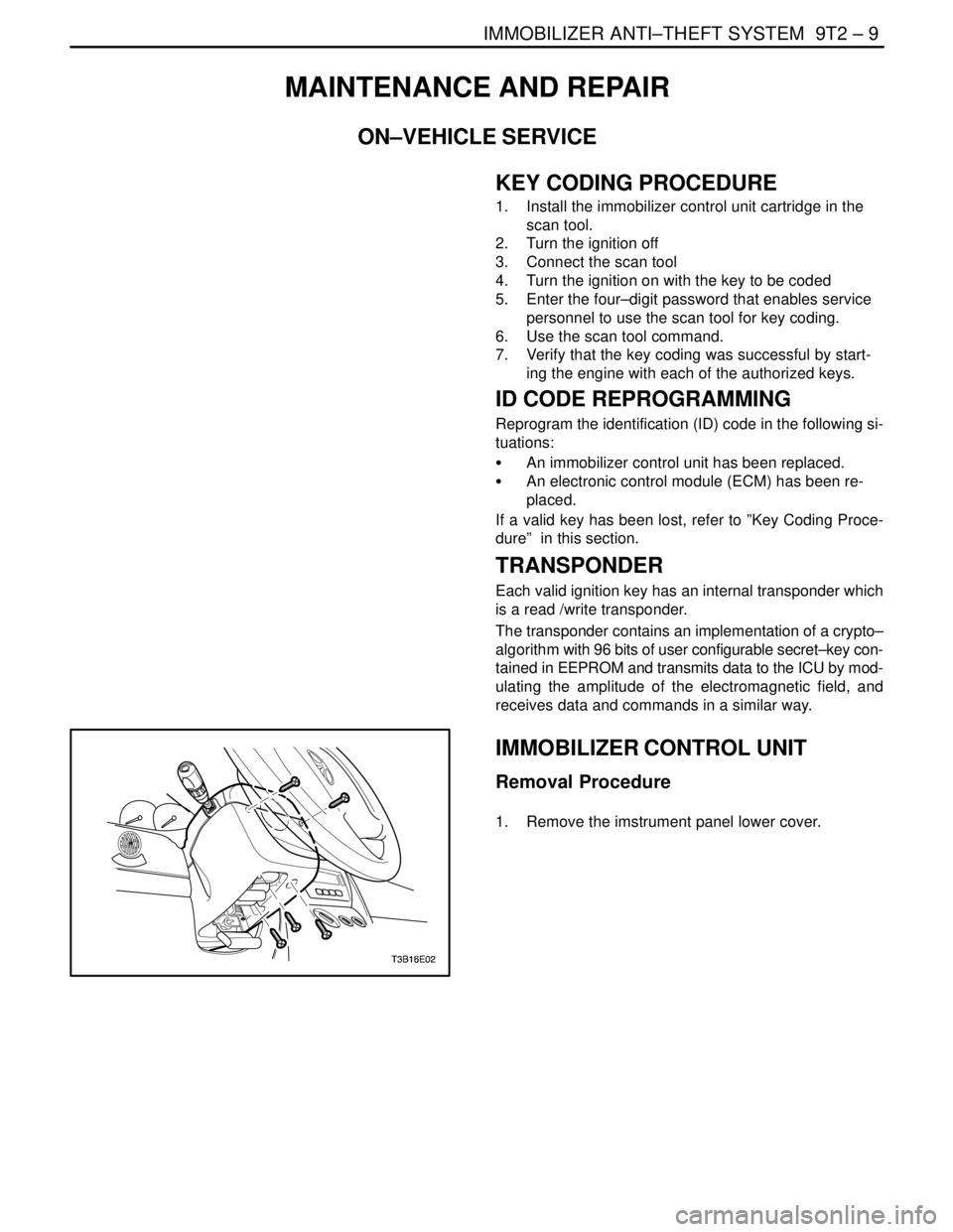
Removal Procedure
1. Remove the imstrument panel lower cover.
Page 2501 of 2643

IMMOBILIZER ANTI–THEFT SYSTEM 9T2 – 11
DAEWOO V–121 BL4
GENERAL DESCRIPTION
AND SYSTEM OPERATION
IMMOBILIZER SYSTEM
The purpose of the Immobilizer system is to provide addi-
tional theft deterrence to the vehicle in which it is installed
and to prevent it from being stolen or driven by unautho-
rized users.
The verification of the user authorization is done by an igni-
tion key with integrated transponder.
The external LED displays the Immobilizer status and has
an additional theft deterrence function.
To secure the communication, the status is exchanged be-
tween the Immobilizer and the ECM in a 5 byte of encoded
data.
These 5 bytes are composed by a mixture of random data
and two types of fixed code
S a vehicle model identification number : MIN
S a vehicle specific identification : VIN
The MIN is known from the first supply of the system.
The VIN is realized by ICU on the special order from the
key coding (reading of transponder code and storing it as
valid key code in Immobilizer EEPROM).
A different random data is computed at each key transi-
tion.
All the immobilization communication between the ECM
and ICU is made on K–line (K line : Serial data line ’7’).
Due to the learning of the Vehicle specific identification
Number, both ICU and ECM can stay in 3 stable modes
S Virgin mode (VIN not learnt)
S Learnt mode (VIN learnt)
S Neutral mode (for a new VIN learning)
In case of using valid key, the release message commu-
nication with the ECM take place and the LED displays the
Immobilizer status valid key In case of using invalid key,
the ECM disables the fuel injector circuit with coded inter-
vention and sets DTC(Diagnostic Trouble Code)
The above conditions are maintained until the ignition is
switched off.
An ECM without an immobilizer control unit cannot be in-
terchanged for an ECM that is used with an immobilizer
control unit system. The Immobilizer control unit and ECM
must have a matching ID code. ID coding and key coding
are accomplished by using Scanner–100
The Immobilizer system consists of
S a maximum or 5 ignition keys with integrated trans-
ponder
S the toroidal coil (Detection coil) for energizing and
reading the transponder mounted at the ignition
lock.S the Immobilizer control unit(ICU) with :
– power supply
– ignition input circuit
– transponder modulation and demodulation unit
– EEPROM
– driver electronic for the external status LED
– serial data link hardware
S the external status LED for displaying the Immobi-
lizer status
S the serial data link between Immobilizer and ECM
ELECTRONICALLY CODED KEYS
Each valid ignition key has an internal transponder which
is a read /write transponder.
The transponder contains an implementation of a crypto–
algorithm with 96 bits of user configurable s cret–key con-
tained in EEPROM and transmits data to the ICU by mod-
ulating the amplitude of the ele tromagnetic field, and
receives data and commands in a similar way.
DETECTION COIL
The toroidal coil is mounted at the ignition lock in front of
the key barrel.
It is connected to the ICU with a four terminal connector
fixed at the body of the coil.
The length of the connection between coil and Immobilizer
is restricted to 50cm. The correct placement on the ignition
lock and the exact electrical data is very important for the
reading distance of transponder.
he toroidal coil and receiving coil inside the transponder
built a transformer. During the readingprocess the coil in-
duces energy into the transponder. The transponder
charges the field and generates an amplitude modulated
signal with the manchester coded data. This charge of the
field is demodulated inside the Immobilizer.
The Immobilizer contains the coil driver hardware for di-
rect connection of the toroidal coil.
IMMOBILIZER CONTROL UNIT
The function of the Immobilizer System is shared between
the ICU and the ECM.
The task of the Immobilizer Electronic Control unit (ICU)
are:
S Reading of the input information ”ignition ON/OFF”
S Controlling the states LED
S Controlling the transponder read/write process
(modulation, demodulation, decoding, comparison
of the read code with the code of the valid keys).
S Communication with the ECM after ignition ON (re-
ceiving of the ECM–request and transmission of
release message).
S Special functions for calculation and handling of the
VIN–code.
The VIN code is calculated by the Immobilizer using a ran-
dom generator.
Page 2502 of 2643

9T2 – 12IIMMOBILIZER ANTI–THEFT SYSTEM
DAEWOO V–121 BL4
The VIN code is transmitted from the Immobilizer in the re-
lease message communication only incase of using an au-
thorized key. Without an authorized key it is not possible
to getthe system VIN code.In case of ECM internal state
is in Virgin mode or neutral mode the ECM learns the sys-
tem VIN code automatically after receiving the first release
response message.
To get a synchronized Immobilizer system (same VIN–
code in Immobilizer and ECM,authorized key) the DLC
test equipment has to be used for authorization of the
keys(first key coding). The usage of this test equipment is
restricted to authorized persons.
S Communication with the DLC–test equipment. Main
functions are the key coding procedure, the VIN–
code handling and the support for system test func-
tions.
S Handling of the software watchdog
Operation
In the active mode of immobilizer (engine OFF, IG key
OFF) the status LED isblinking as mode A. When ignition
is turned ON, the system wakes up and tries to read out
the transponder.
In case of the detection of a valid key , The release mes-
sage communication with the ECM takes place. The sta-
tus LED displays the Immobilizer state ”valid key”.
After turning off the ignition(ignition OFF detection similar
to the ECM ignition OFF detection), the Immobilizer
changes to the active mode. The status LED is blinking as
Mode A.
Data Link Connector (DLC) Mode
When the ignition is on, a scan tool can switch the immobi-
lizer control unit to the DLC mode for diagnostics, key cod-
ing and ID coding.
S The status LED is turned off during DLC–mode
S The Immobilizer will answer all correct messages,
which are defined as Immobilizer messages.
ID Code Handling
One of 65,535 VIN codes is stored in the immobilizer EE-
PROM.
The VIN code can be erased by using ”Reset VIN code”
command of the scan tool.
When the immobilizer control unit calculates a new VIN
code, ECM VIN code should be reset to get identical with
the immobilizer control unit’s.
During diagnostic procedures, the VIN code can be read
for comparison with the ECM VIN code by using the scan
tool’s ”Read immobilizer control unit VIN code” command.
SERIAL DATA LINK
Serial data can be exchanged between a scan tool and the
ECM and the Immobilizer control unit.
ELECTRONIC CONTROL MOUDLE
(ECM)
S ECM in Virgin mode
In this mode, the ECM knows only the model
vehicle identifier code.
The engine can be locked/unlocked.
ECM requests to ICU the VIN number. As soon
as the ECM receives two correct consecutive
communication frames with the same VIN code
the ECM learns it.
The VIN code will be stored in non–volatile
memory at the end of power latch phase. ECM
enters in Learnt mode.
S ECM in Learnt mode
In such a state, ECM checks on every commu-
nication, the correct encoding of the ICU.
If the code received is not correct, then the vehicle is im-
mobilized.
The coded 5 bytes of data emitted by ECM are
a mixture of MIN code and random.
The coded 5 bytes of data emitted by ICU are a
mixture of VIN code and random.
S ECM in Neutral mode
This mode is a special intermediate mode, used
for ICU replacement or immobilizer option instal-
lation.
ECM request to ICU the VIN number. As soon
as the ECM receives two correct consecutive
communication frames with the same VIN code
the ECM learns it. The VIN code will be stored
in non–volatile memory at the end of power latch
phase. ECM enters in Learnt mode.
S After turning on the ignition the ECM will control the
engine in a normal way for starting and running
while waiting for a valid release response message
from the Immobilizer.
Page 2506 of 2643

NUBIRA/LACETTISERVICE NOTICE 0–3
1. HOW TO USE THIS MANUAL
.
This manual covers the repairs of NUBIRA/LACETTI
automobile which has been involved in accidents, and it
describes the work related to the replacement of dam-
aged body parts.
Please read through these instructions and familiarize
yourself with them before actually using this manual.
.
Note : Refer to NUBIRA/LACETTI Service Manual for
specifications, wire harness locations, safety stand sup-
port points, etc.
2. SPECIAL INFORMATION
.
Indicates a strong possibility of personal injury or equip-
ment damage if instructions are not followed.
.
Note : Gives helpful information.
.
CAUTION : Detailed descriptions of standard work-
shop procedures, safety principles and service op-
erations are not included. Please note that this manu-
al does contain warnings and cautions against some
specific service methods which could cause PER-
SONAL INJURY, or could damage a vehicle or make
it unsafe. Please understand that these warnings can-
not cover all conceivable ways in which service,
whether or not recommended by GM DAEWOO might
be done or of the possible hazardous consequences
of each conceivable way, not could GM DAEWOO in-
vestigate all such ways. Anyone using service proce-
dures or tools, whether or not recommended by GM
DAEWOO, must satisfy himself thoroughly that nei-
ther personal safety or tools, whether or not recom-
mended by GM DAEWOO, must satisfy himself thor-
oughly that neither personal safety or vehicle safety
will be jeopardized.
.
All information contained in this manual is based on the
latest product information available at the time of print-
ing. We reserve the right to make changes at any time
without notice. No part of this publication may be repro-
duced, stored in retrieval system, or transmitted, in any
form by any means, electronic, mechanical, photocopy-
ing, recording, or otherwise, without the prior written
permission of the publisher. This includes text, figures
and tables.
Page 2524 of 2643

2–4 PREPARATIONS OF BODYWORK NUBIRA/LACETTI
2. CHECKPOINTS
S Accurate Inspection of Damaged Parts(Visual)
.
Seat Belts
Always replace the seat belt if :
1. The belt material is cut, punctured, burned or in any
way damaged.
2. The buckle or retractor does not work properly.
3. They were being worn at the time of a collision(also
check for damage at the seat belt anchor points).
4. Their condition is questionable.
.
Front Section :
1. Is there any bending, splitting, denting or other dam-
age to the suspension and its related parts?
2. Is there any deformation of the front panel or radiator
crossmember? Have any of the connected sections
come apart?
3. Are there any creases or distortion in the front wheel-
house or side frame? Have any of the connected sec-
tions come apart?
4. Is there any bending or twisting of the whole front
area?
5. Is there any deformation like creases, bulges, or dents
in the front pillar, dash panel, floor, etc.?
6. Is there any vertical twisting or misaligned clearance
in the door?
7. Is the windshield seal broken?
8. Is there any deformation in the vicinity of the top part
of the roof panel’s center pillar?
9. Is there any damage inside the automobile(is there
any twisting of the dash panel, or anything irregular with
the clearances or sheet–mounting parts)?
10. Is there any damage to the steering wheel? Is there
any deformation in the column and the column–mounted
parts?
11. Is there any oil or water leakage and damage to the en-
gine, transmission or brakes?
12. Is there any irregular noise in the gear changing opera-
tion, engine and transmission rotation?
13. Are there any traces of contact between the engine
block and the center crossmember ?
14. Is there any damage to brake or fuel lines, or wire har-
nesses?Rear Section :
1. Is there any twisting, bulging or denting of the rear floor
any rear bolsters? Have any of the connected sections
come apart?
2. Is there any irregular bulging or denting in the rear
fender?
3. Is there any distortion in the rear inner panel? Is there
any bending and denting in the vicinity of the rear pillar?
4. Is there any distortion or creasing is the rear wheel-
house and arch sections? Have any of the connected
sections come apart?
5. Is there anything irregular in the rear glass seal clear-
ance?
6. Is there any twisting or misalignment of the clearance
of the trunk lid opening section?
7. Is there any bending, splitting, denting or other dam-
age to the suspension and its related parts?
8. Is there any deformation of the rear floor crossmem-
ber, trunk floor panel and back panel? Have any of the
connected sections come apart?
.
Impact Beam :
Always replace the door assembly if :
1. The external force makes the impact beam of door in-
ner deform.
Always replace impact beam if :
2. The external force makes the impact beam of front
bumper and rear bumper deform.
Page 2544 of 2643

4–10 FRONTNUBIRA/LACETTI
3. FRONT LONGITUDINAL
3–1. GENERAL DESCRIPTION
The front longitudinal is joined to the wheelhouse and
front panel, it forms the base for the front suspension,
engine, transmission and others. Therefore, replace-ment of the component affects the front wheel align-
ment and maintains the rigidity of the front section.
When assembling it, either use a jig or follow dimen-
sions on the body repair chart for positioning. It must be
welded carefully.
Fig. 16 Front Longitudinal Welding Assembly