Dipstick DAEWOO LACETTI 2004 Service Repair Manual
[x] Cancel search | Manufacturer: DAEWOO, Model Year: 2004, Model line: LACETTI, Model: DAEWOO LACETTI 2004Pages: 2643, PDF Size: 80.54 MB
Page 1405 of 2643

5A1 – 56IZF 4 HP 16 AUTOMATIC TRANSAXLE
DAEWOO V–121 BL4
SYMPTOM DIAGNOSIS
Oil Leakage
Notice :
– Careful localization of leakage points may make it
possible to prevent incorrect or cost–intensive re-
pairs.
Test Steps :– Thoroughly clean the transaxle, engine, and sur-
rounding area(using a steam jet, for example).
– To locate leakage, use a suitable identifying spray
or similar product.
– Depending on the amount of leakage, take the
car for a short or a longer test drive – It may prove
sufficient to place the car on a hoist and run the
engine at idle speed to trace the leak.
– If possible, determine exactly which type of oil is
escaping.
Symptom
Possible CauseAction
Transaxle Oil Leak-
ageOil Pump(Torque Converter Sealing)S Visually check torque converter sealing.
S Replace the converter sealing as described in
the transaxle repair on the vehicle service.
Crankshaft Sealing RingS Check whether engine oil or TFT is leaking out.
S If leak is engine oil, replace the sealing ring as
described in the engine repair instruction.
Torque ConverterS Visual check.
S Fit an exchange converter as described in the
repair instruction.
Oil Content Too HighS Check oil level(TFT and axle oil) as described
in this chapter.
S Correct oil level, and recheck after a test drive.
Notice : Comply with the measuring procedure (fill-
ing procedure) in the repair instruction. Check the oil
level at the overflow plug adjust to proper level if nec-
essary.
O–ring at Bolt Head Damaged or Miss-
ingS Check O–ring.
S Replace O–ring as described in the repair in-
struction.
Shaft SealS Visually check the shaft seal.
S Replace the sealing ring as described in the
repair instruction.
Hose Clamp LooseS Check to ensure that the hose clamp fits tightly.
S If necessary, retighten clamp.
Oil Pan Gasket Not Installed ProperlyS Check to see if the gasket was positioned
properly.
S Install gasket properly as described in the re-
pair instruction.
Oil Pan Gasket DamagedS Check the gasket visually.
S Replace gasket as described in the repair in-
struction.
Bolt at Bracket LooseCheck the Tightening Torque
Retighten bolt
Sealing Ring at Oil DipstickS Check O–ring.
S If necessary, replace O–ring.
Sealing Ring Near End–Cover Connec-
tion DefectiveS Check sealing rings.
S Put in new sealing ring Check O–ring as de-
scribed in the repair instruction.
Page 1687 of 2643
AISIN AUTOMATIC TRANSAXLE 5A2 – 97
DAEWOO V–121 BL4
MAINTENANCE AND REPAIR
ON–VEHICLE SERVICE
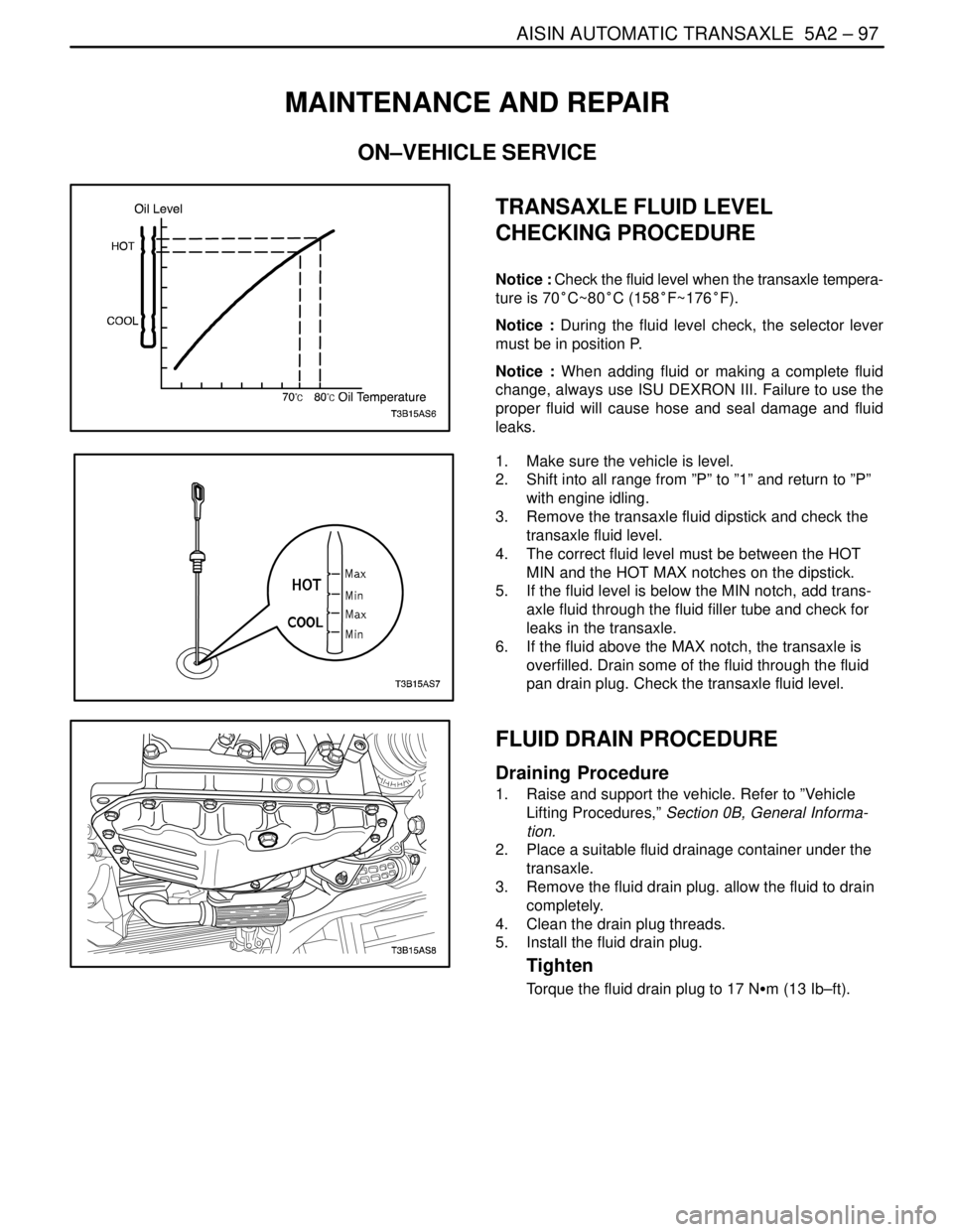
TRANSAXLE FLUID LEVEL
CHECKING PROCEDURE
Notice : Check the fluid level when the transaxle tempera-
ture is 70°C~80°C (158°F~176°F).
Notice : During the fluid level check, the selector lever
must be in position P.
Notice : When adding fluid or making a complete fluid
change, always use ISU DEXRON III. Failure to use the
proper fluid will cause hose and seal damage and fluid
leaks.
1. Make sure the vehicle is level.
2. Shift into all range from ”P” to ”1” and return to ”P”
with engine idling.
3. Remove the transaxle fluid dipstick and check the
transaxle fluid level.
4. The correct fluid level must be between the HOT
MIN and the HOT MAX notches on the dipstick.
5. If the fluid level is below the MIN notch, add trans-
axle fluid through the fluid filler tube and check for
leaks in the transaxle.
6. If the fluid above the MAX notch, the transaxle is
overfilled. Drain some of the fluid through the fluid
pan drain plug. Check the transaxle fluid level.
FLUID DRAIN PROCEDURE
Draining Procedure
1. Raise and support the vehicle. Refer to ”Vehicle
Lifting Procedures,” Section 0B, General Informa-
tion.
2. Place a suitable fluid drainage container under the
transaxle.
3. Remove the fluid drain plug. allow the fluid to drain
completely.
4. Clean the drain plug threads.
5. Install the fluid drain plug.
Tighten
Torque the fluid drain plug to 17 NSm (13 Ib–ft).
Page 1688 of 2643

5A2 – 98IAISIN AUTOMATIC TRANSAXLE
DAEWOO V–121 BL4
Filling Procedure
1. Remove the drainage container and lower the ve-
hicle.
2. Add three–fourths of the recommended amount of
ISU DEXRON III.
3. Start the engine and allow it to reach normal oper-
ating temperature.
4. Shift the gear selector through all positions.
5. Check the fluid level and add fluid until the dipstick
indicates a safe level.
LOCATING FLUID LEAKS
General Method
1. Verify that the material leaking is transaxle fluid.
2. Thoroughly clean the suspected leak area.
3. Allow the transaxle to reach the normal operating
temperature of 176–194°F (80–90°C).
4. Park the vehicle over a clean paper or a clean card-
board.
5. Turn the engine OFF and look for fluid spots on the
paper.
6. Make the necessary repairs to correct that leak.
Powder Method
1. Thoroughly clean the suspected leak area.
2. Apply an aerosol type powder, such as foot powder,
to the suspected leak area.
3. Allow the transaxle to reach the normal operating
temperature of 176–194°F (80–90°C).
4. Turn the engine OFF.
5. Inspect the suspected leak area and trace the leak
path through the powder to find the source of the
leak.
6. Make the necessary repairs to correct the leak.
Once the leak point is found, the source of the leak must
be determined and repaired.
CASE PORSITY REPAIR
1. Determine the leak area. Refer to ”Locating Fluid
Leaks” in this section.
2. Clean the leak area with the solvent. Air dry.
CAUTION : Epoxy cement may cause skin irritations
and eye damage. Read and follow all information on
the container label as provided by the manufacturer.
3. Mix a sufficient amount of epoxy cement following
the manufacturer’s recommendations.
4. While the transaxle case is hot, apply epoxy ce-
ment with a clean, dry soldering acid brush.
5. Allow the epoxy cement to dry for 3 hours before
starting the engine.