hood DAEWOO LACETTI 2004 Service Repair Manual
[x] Cancel search | Manufacturer: DAEWOO, Model Year: 2004, Model line: LACETTI, Model: DAEWOO LACETTI 2004Pages: 2643, PDF Size: 80.54 MB
Page 18 of 2643

GENERAL INFORMATION 0B – 11
DAEWOO V–121 BL4
Chassis and Body
Maintenance ItemMaintenance Interval
Kilometers or time in months, whichever comes first
x 1,000 km1153045607590105120
x 1,000 miles0.6918273645546372
Months–1224364860728496
Interior air filter (A/C)RRRRRRRR
Exhaust pipes & mountingsIIIIIIII
Brake/Clutch fluid (1) (4)IIRIRIRIR
Front brake pads and discs(3)IIIIIIII
Rear brake pads & discs or drums and
linings (3)IIIIIIII
Parking brakeIIIIIIIII
Brake line and connections (Including
booster)IIIIIIII
Manual Transaxle Oil *(1)IIIIIIII
Automatic transaxle fluid *(1) (5)IIIIIIII
Tighten chassis and underbody bolts
and nutsIIIIIIII
Tire condition and inflation pressureIIIIIIIII
Wheel alignment (2)Inspect when abnormal condition is noted
Steering wheel and linkageIIIIIIII
Power steering fluid & lines* (1)IIIIIIIII
Drive shaft bootsIIIIIIII
Seat belts, buckles and anchorsIIIIIIII
Lubricate locks, hinges and hood
latchIIIIIIII
Chart Symbols:
I – Inspect and if necessary correct, clean, replenish, or adjust.
R – Replace or change:
(1) Refer to Recommended Fluids And Lubricants.
(2) And if necessary, rotate and balance wheels.
(3) More frequent if operated under severe conditions: short distance driving, extensive idling, frequent low–speed oper-
aion in stop and go traffic, or driving in dusty conditions.
(4) Change the brake/clutch fluid every 15,000 km (9,000 miles), if the vehicle is mainly driven under the following severe
conditions: driving in hilly or mountainous terrain, or towing a trailer/caravan frequently.
(5) 1.8 DOHC model (ZF 4HP16 Automatic Transaxle): Change automatic transaxle fluid every 60,000 Km (36,000 miles)
if the vehicle is mainly driven under any of the following severe conditions:
S In heavy city traffic where the outside temperature regularly reaches 32°C (90°F) or higher, or
S In hilly or mountainous terrain, or
S When doing frequent trailer towing, or
S Uses such as taxi, police or delivery service.
Page 20 of 2643

GENERAL INFORMATION 0B – 13
DAEWOO V–121 BL4
EACH TIME THE OIL IS CHANGED
Automatic Transaxle Fluid
Refer to fluid level service procedure of Section 5A, ZF
4HP16 Automatic Transaxle.
Manual Transaxle
Check the fluid level and add fluid as required. Refer to
Section 5B, Five–Speed Manual Transaxle.
Brake System Inspection
This inspection should be done when the wheels are re-
moved for rotation. Inspect the lines and the hoses for
proper hookup, binding, leaks, cracks, chafing, etc. In-
spect the disc brake pads for wear. Inspect the rotors for
surface condition. Also inspect the drum brake linings for
wear and cracks. Inspect other brake parts, including the
drums, the wheels cylinders, the parking brake, etc., at the
same time. Check the parking brake adjustment. Inspect
the brakes more often if habit or conditions result in fre-
quent braking.
Steering, Suspension and Front Drive Axle
Boot And Seal Inspection
Inspect the front and rear suspension and the steering
system for damaged, loose or missing parts, signs of wear
or lack of lubrication. Inspect the power steering lines and
the hoses for proper hookup, binding, leaks, cracks, chaf-
ing, etc. Clean and inspect the drive axle boot and seals
for damage, tears or leakage. Replace the seals if neces-
sary.
Exhaust System Inspection
Inspect the complete system (including the catalytic con-
verter if equipped). Inspect the body near the exhaust sys-
tem. Look for broken, damaged, missing, or out–of–posi-
tion parts as well as open seams, holes, loose
connections, or other conditions which could cause heat
buildup in the floor pan or could let exhaust fumes seep
into the trunk or passenger compartment.
Throttle Linkage Inspection
Inspect the throttle linkage for interference or binding,
damaged, or missing parts. Lubricate all linkage joints and
throttle cable joints, the intermediate throttle shaft bearing,
the return spring at throttle valve assembly, and the accel-
erator pedal sliding face with suitable grease. Check the
throttle cable for free movements.
Engine Drive Belts
Inspect all belts for cracks, fraying, wear and proper ten-
sion. Adjust or replace the belts as needed.
Hood Latch Operation
When opening the hood, note the operation of the secon-
dary latch. It should keep the hood from opening all the
way when the primary latch is released. The hood must
close firmly.
AT LEAST ANNUALLY
Lap and Shoulder Belts Condition and
Operation
Inspect the belt system including: the webbing, the
buckles, the latch plates, the retractor, the guide loops and
the anchors.
Movable Head Restraint Operation
On vehicles with movable head restraints, the restraints
must stay in the desired position.
Spare Tire and Jack Storage
Be alert to rattles in the rear of the vehicle. The spare tire,
all the jacking equipment, and the tools must be securely
stowed at all times. Oil the jack ratchet or the screw mech-
anism after each use.
Key Lock Service
Lubricate the key lock cylinder.
Body Lubrication Service
Lubricate all the body door hinges including the hood, the
fuel door, the rear compartment hinges and the latches,
the glove box and the console doors, and any folding seat
hardware.
Transaxle Neutral Switch Operation on
Automatic Transaxle
CAUTION : Take the following precautions because
the vehicle could move without warning and possibly
cause personal injury or property damage:
S Firmly apply the parking brake and the regular
brakes.
S Do not use the accelerator pedal.
S Be ready to promptly turn off the ignition if the ve-
hicle starts.
On automatic transaxle vehicles, try to start the engine in
each gear. The starter should crank only in P (Park) or N
(Neutral).
Parking Brake and Transaxle P (Park)
Mechanism Operation
CAUTION : In order to reduce the risk of personal in-
jury or property damage, be prepared to apply the reg-
ular brakes promptly if the vehicle begins to move.
Park on a fairly steep hill with enough room for movement
in the downhill direction. To check the parking brake, with
the engine running and the transaxle in N (Neutral), slowly
remove foot pressure from the regular brake pedal (until
only the parking brake is holding the vehicle).
To check the automatic transaxle P (Park) mechanism’s
holding ability, release all brakes after shifting the trans-
axle to P (Park).
Underbody Flushing
Flushing the underbody will remove any corrosive materi-
als used for ice and snow removal and dust control. At
least every spring clean the underbody. First, loosen the
sediment packed in closed areas of the vehicle. Then flush
the underbody with plain water.
Page 21 of 2643

0B – 14IGENERAL INFORMATION
DAEWOO V–121 BL4
Engine Cooling System
Inspect the coolant and freeze protection fluid. If the fluid
is dirty or rusty, drain, flush and refill the engine cooling
system with new coolant. Keep the coolant at the proper
mixture in order to ensure proper freeze protection, corro-sion protection and engine operating temperature. Inspect
the hoses. Replace the cracked, swollen, or deteriorated
hoses. Tighten the clamps. Clean the outside of the radia-
tor and the air conditioning condenser. Wash the filler cap
and the neck. Pressure test the cooling system and the
cap in order to help ensure proper operation.
RECOMMENDED FLUIDS AND LUBRICANTS
UsageCapacityFluid/Lubricant
Engine Oil3.75L (4.0 qt) : 1.4L DOHC
3.75L (4.0 qt) : 1.6L DOHC
4.0L (4.2 qt) : 1.8L DOHCAPI SL (ILSAC GF–III) grade or better
SAE 5W–30, SAE10W–30, SAE15W–40
(Cold area : SAE5W–30
Hot area : SAE 15W–40)
Engine Coolant7.0L (7.49 qt) : 1.4L DOHC
7.2L (7.6 qt) : 1.6L DOHC
7.4L (7.8 qt) : 1.8L DOHCMixture of water and good quality ethylene gly-
col base antifreeze (year–round coolant)
Brake Fluid and Clutch Fluid0.5L (0.5 qt)DOT–3 or DOT–4
Power Steering System1.1L (1.2 qt)DEXRON®–III or DEXRON®–IID
Automatic Transaxle5.77 ± 0.2L (6.1 ± 0.2 qts) :
1.6L DOHC (AISIN 81–40LE)ESSO JWS 3309 or ISU DEXRON III
6.9 ± 0.2L (7.3 ± 0.2 qts) :
1.8L DOHC (ZF 4HP16)ESSO LT 71141 or TOTAL ATF H50235
Manual Transaxle1.8L (2.0 qt)Manual Transaxle Fluid
SAE80W (Cold Area : SAE 75W)
Manual Transaxle Shift LinkageAs requiredMultipurpose type grease meeting require-
ments NLGI No. 1 or 2
Key Lock CylindersAs requiredSilicone lubricant
Automatic Transaxle Shift Link-
ageAs requiredEngine oil
Clutch Linkage Pivot PointsAs requiredEngine oil
Floor Shift Linkage PointsAs requiredEngine oil
Hood Latch Assembly
a. Pivots and Spring Anchor
b. Release PawlAs requireda. Engine oil
b. Multipurpose type grease meeting require-
ments NLGI No. 1 or 2
Hood and door hinges
Fuel door hinge
Rear compartment lid hingesAs requiredEngine oil
WeatherstripsAs requiredSilicone grease
Page 91 of 2643
1C1 – 48I1.4L/1.6L DOHC ENGINE MECHANICAL
DAEWOO V–121 BL4
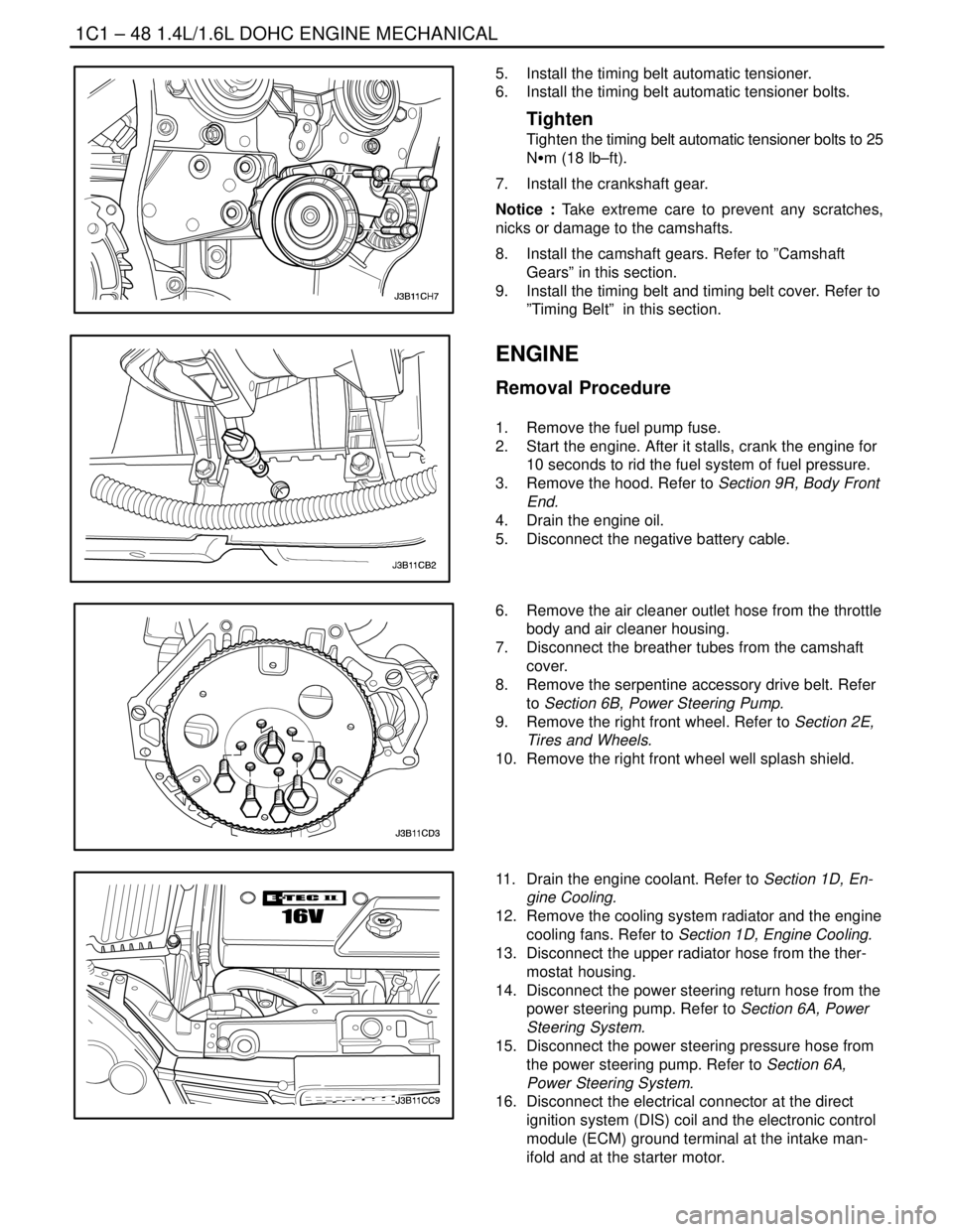
5. Install the timing belt automatic tensioner.
6. Install the timing belt automatic tensioner bolts.
Tighten
Tighten the timing belt automatic tensioner bolts to 25
NSm (18 lb–ft).
7. Install the crankshaft gear.
Notice : Take extreme care to prevent any scratches,
nicks or damage to the camshafts.
8. Install the camshaft gears. Refer to ”Camshaft
Gears” in this section.
9. Install the timing belt and timing belt cover. Refer to
”Timing Belt” in this section.
ENGINE
Removal Procedure
1. Remove the fuel pump fuse.
2. Start the engine. After it stalls, crank the engine for
10 seconds to rid the fuel system of fuel pressure.
3. Remove the hood. Refer to Section 9R, Body Front
End.
4. Drain the engine oil.
5. Disconnect the negative battery cable.
6. Remove the air cleaner outlet hose from the throttle
body and air cleaner housing.
7. Disconnect the breather tubes from the camshaft
cover.
8. Remove the serpentine accessory drive belt. Refer
to Section 6B, Power Steering Pump.
9. Remove the right front wheel. Refer to Section 2E,
Tires and Wheels.
10. Remove the right front wheel well splash shield.
11. Drain the engine coolant. Refer to Section 1D, En-
gine Cooling.
12. Remove the cooling system radiator and the engine
cooling fans. Refer to Section 1D, Engine Cooling.
13. Disconnect the upper radiator hose from the ther-
mostat housing.
14. Disconnect the power steering return hose from the
power steering pump. Refer to Section 6A, Power
Steering System.
15. Disconnect the power steering pressure hose from
the power steering pump. Refer to Section 6A,
Power Steering System.
16. Disconnect the electrical connector at the direct
ignition system (DIS) coil and the electronic control
module (ECM) ground terminal at the intake man-
ifold and at the starter motor.
Page 96 of 2643
1.4L/1.6L DOHC ENGINE MECHANICAL 1C1 – 53
DAEWOO V–121 BL4
39. Connect the lower radiator hose to the coolant pipe.
40. Connect the upper radiator hose to the thermostat
housing.
41. Connect the surge tank coolant hose to the radia-
tor.
42. Connect the heater inlet hose to the cylinder head.
43. Connect the heater outlet hose to the coolant pipe.
44. Connect the coolant surge tank hose to the coolant
pipe.
45. Connect the surge tank coolant hose to the throttle
body.
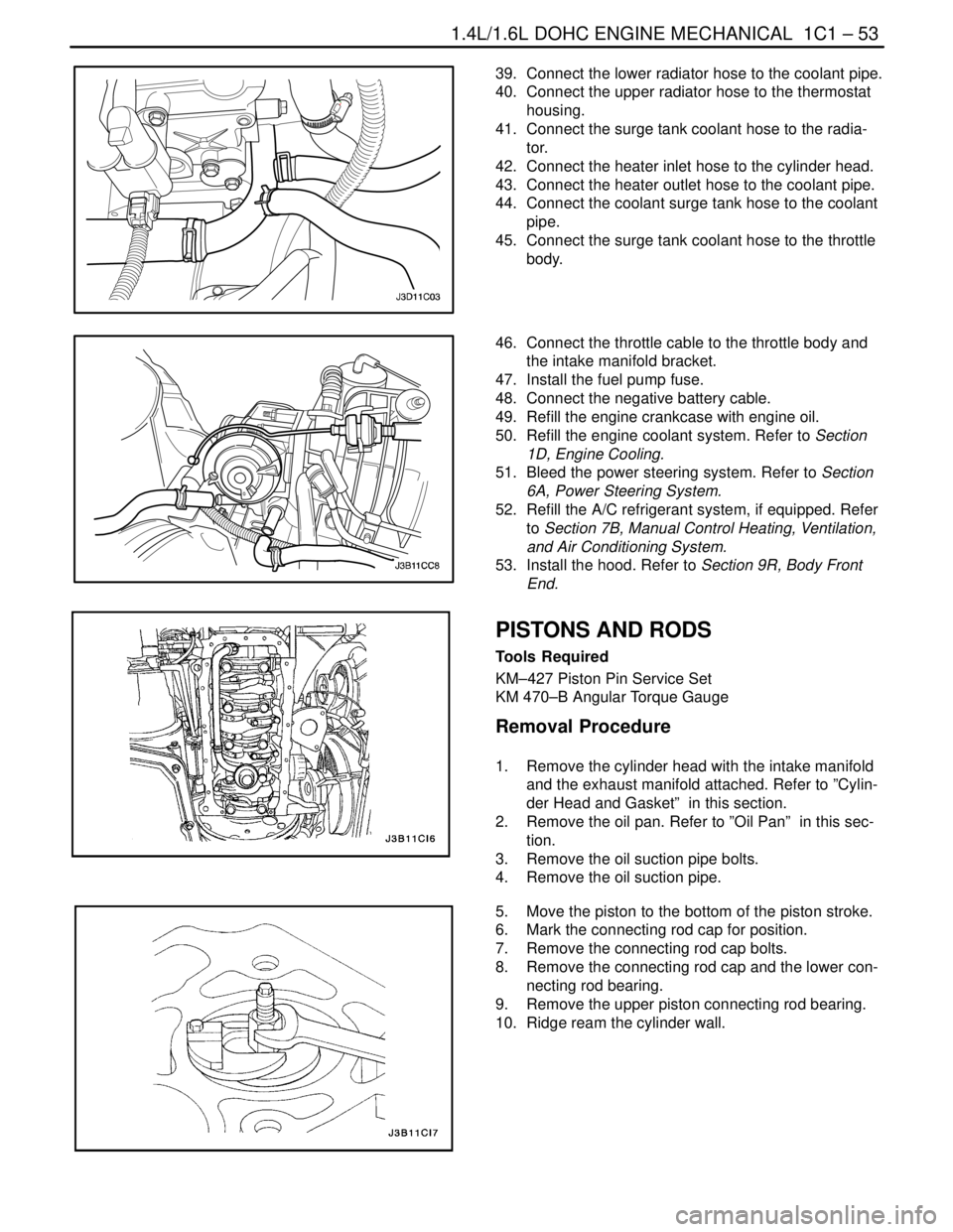
46. Connect the throttle cable to the throttle body and
the intake manifold bracket.
47. Install the fuel pump fuse.
48. Connect the negative battery cable.
49. Refill the engine crankcase with engine oil.
50. Refill the engine coolant system. Refer to Section
1D, Engine Cooling.
51. Bleed the power steering system. Refer to Section
6A, Power Steering System.
52. Refill the A/C refrigerant system, if equipped. Refer
to Section 7B, Manual Control Heating, Ventilation,
and Air Conditioning System.
53. Install the hood. Refer to Section 9R, Body Front
End.
PISTONS AND RODS
Tools Required
KM–427 Piston Pin Service Set
KM 470–B Angular Torque Gauge
Removal Procedure
1. Remove the cylinder head with the intake manifold
and the exhaust manifold attached. Refer to ”Cylin-
der Head and Gasket” in this section.
2. Remove the oil pan. Refer to ”Oil Pan” in this sec-
tion.
3. Remove the oil suction pipe bolts.
4. Remove the oil suction pipe.
5. Move the piston to the bottom of the piston stroke.
6. Mark the connecting rod cap for position.
7. Remove the connecting rod cap bolts.
8. Remove the connecting rod cap and the lower con-
necting rod bearing.
9. Remove the upper piston connecting rod bearing.
10. Ridge ream the cylinder wall.
Page 166 of 2643
1C2 – 46I1.8L DOHC ENGINE MECHANICAL
DAEWOO V–121 BL4
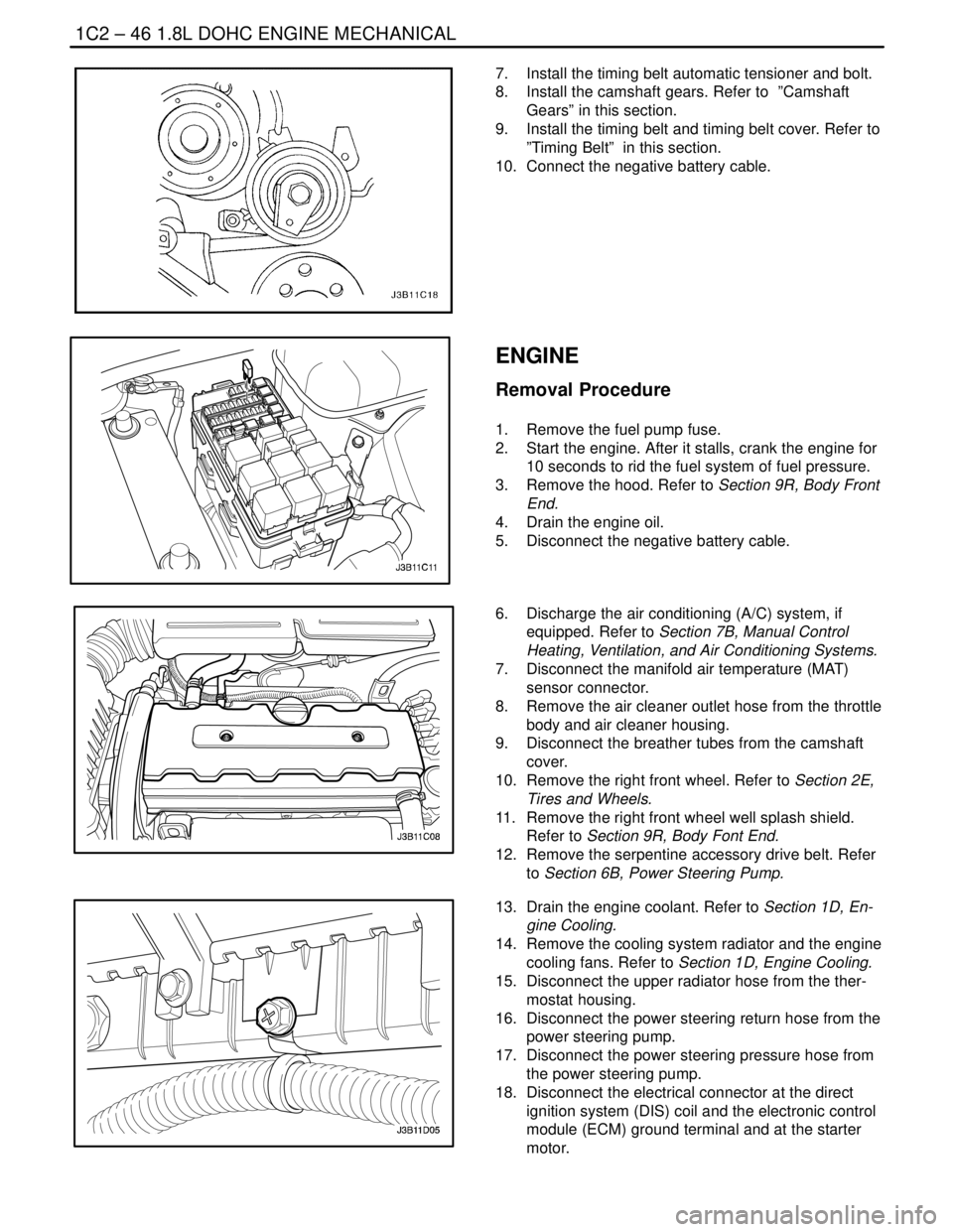
7. Install the timing belt automatic tensioner and bolt.
8. Install the camshaft gears. Refer to ”Camshaft
Gears” in this section.
9. Install the timing belt and timing belt cover. Refer to
”Timing Belt” in this section.
10. Connect the negative battery cable.
ENGINE
Removal Procedure
1. Remove the fuel pump fuse.
2. Start the engine. After it stalls, crank the engine for
10 seconds to rid the fuel system of fuel pressure.
3. Remove the hood. Refer to Section 9R, Body Front
End.
4. Drain the engine oil.
5. Disconnect the negative battery cable.
6. Discharge the air conditioning (A/C) system, if
equipped. Refer to Section 7B, Manual Control
Heating, Ventilation, and Air Conditioning Systems.
7. Disconnect the manifold air temperature (MAT)
sensor connector.
8. Remove the air cleaner outlet hose from the throttle
body and air cleaner housing.
9. Disconnect the breather tubes from the camshaft
cover.
10. Remove the right front wheel. Refer to Section 2E,
Tires and Wheels.
11. Remove the right front wheel well splash shield.
Refer to Section 9R, Body Font End.
12. Remove the serpentine accessory drive belt. Refer
to Section 6B, Power Steering Pump.
13. Drain the engine coolant. Refer to Section 1D, En-
gine Cooling.
14. Remove the cooling system radiator and the engine
cooling fans. Refer to Section 1D, Engine Cooling.
15. Disconnect the upper radiator hose from the ther-
mostat housing.
16. Disconnect the power steering return hose from the
power steering pump.
17. Disconnect the power steering pressure hose from
the power steering pump.
18. Disconnect the electrical connector at the direct
ignition system (DIS) coil and the electronic control
module (ECM) ground terminal and at the starter
motor.
Page 171 of 2643
1.8L DOHC ENGINE MECHANICAL 1C2 – 51
DAEWOO V–121 BL4
43. Connect the lower radiator hose to the coolant pipe.
44. Connect the upper radiator hose to the thermostat
housing.
45. Connect the heater inlet hose to the cylinder head.
46. Connect the heater outlet hose to the coolant pipe.
47. Connect the coolant surge tank hose to the coolant
pipe.
48. Connect the coolant hose to the throttle body.
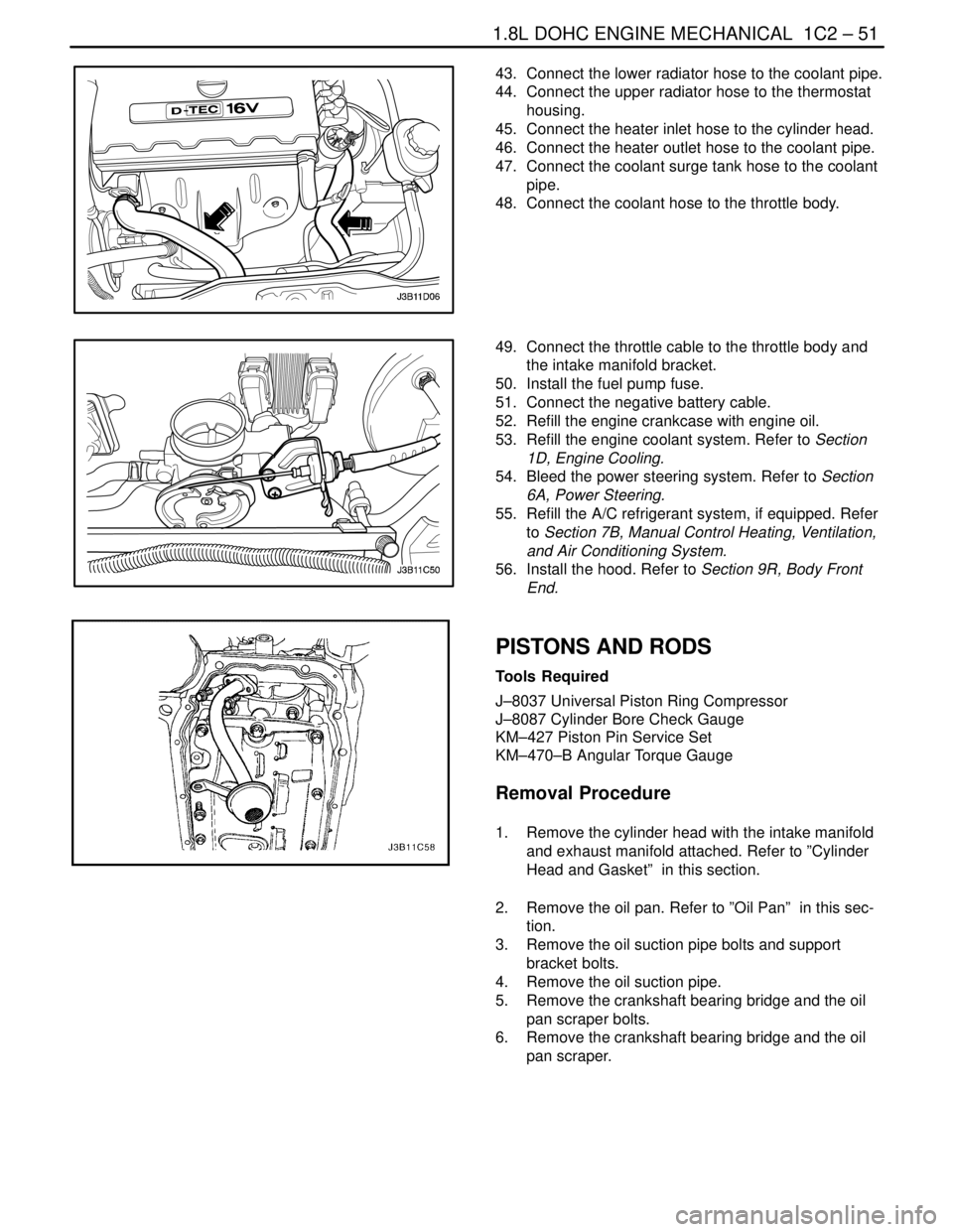
49. Connect the throttle cable to the throttle body and
the intake manifold bracket.
50. Install the fuel pump fuse.
51. Connect the negative battery cable.
52. Refill the engine crankcase with engine oil.
53. Refill the engine coolant system. Refer to Section
1D, Engine Cooling.
54. Bleed the power steering system. Refer to Section
6A, Power Steering.
55. Refill the A/C refrigerant system, if equipped. Refer
to Section 7B, Manual Control Heating, Ventilation,
and Air Conditioning System.
56. Install the hood. Refer to Section 9R, Body Front
End.
PISTONS AND RODS
Tools Required
J–8037 Universal Piston Ring Compressor
J–8087 Cylinder Bore Check Gauge
KM–427 Piston Pin Service Set
KM–470–B Angular Torque Gauge
Removal Procedure
1. Remove the cylinder head with the intake manifold
and exhaust manifold attached. Refer to ”Cylinder
Head and Gasket” in this section.
2. Remove the oil pan. Refer to ”Oil Pan” in this sec-
tion.
3. Remove the oil suction pipe bolts and support
bracket bolts.
4. Remove the oil suction pipe.
5. Remove the crankshaft bearing bridge and the oil
pan scraper bolts.
6. Remove the crankshaft bearing bridge and the oil
pan scraper.
Page 1014 of 2643

4–2WUSAGE AND CAPACITY OF FUSES IN FUSE BLOCK
1. ENGINE ROOM RELAY AND FUSE BLOCK
1) POSITION OF RELAY AND FUSE
2) USAGE OF FUSE IN ENGINE FUSE BLOCK
Power
Supply
ClassificationFuse
NoCapacityUsage
Ef130ABattery Main(F13~F16, F21~F24)
Ef260AEBCM, Oil Feeding Conenctor
Ef330ABlower Relay
30SBEf430AIgnition Switch–2
BAT (+)(Slow–BlownEf530AIgnition Switch–1
Fuse)Ef620ACooling Fan Low Relay
Ef730ADefog Relay
Ef830ACooling Fan HI Relay
IGN2 (15A)Ef920APower Window Switch
IGN1 (15)Ef1015AFuel Connector, ECM (MR–140), LEGR, EI
System
30Ef1110AECM, Main Relay (Sirius D4)
BAT(+)Ef1225AHead lamp Relay, ILLUM. Relay
Ef1315ABrake Switch
IGN2 (15A)Ef1420APower Window Switch
56 LIGHTEf1515AHead Lamp HI
30Ef1615AHorn Relay, siren, Hood Contact Switch
BAT(+)Ef1710AA/C Comp. Relay
IGN1 (15)Ef1815AFuel Pump
30 BAT(+)Ef1915ACluster, Key Remind S/W, Folding Mirror Unit, MAP
Lamp, Room Lamp, Trunk Open lamp, Trunk
Open S/W
56 LIGHTBlade TypeEf2010AHead Lamp Low
IGN1 (15)/FuseEf2115AEVAP Canister Purge Solenoid, HO2S, Cooling
Fan Relay
30 BAT(+)Ef2215Ainjector, EGR, EEGR
ILLUM. (58)Ef2310ALicense Plate Lamp, Chime Bell, Tail Lamp, Head
Lamp
30 BAT (+)Ef2415AFog Lamp Relay
IGN2 (15A)Ef2510AElectric OSRV Mirror
30 BAT (+)Ef2615ACentral Door Lock Unit
56 LIGHTEf2710AHead Lamp Low
ILLUM. (58)Ef2810AILLUM. Circuit, Head Lamp, Tail Lamp
SPAREEf2910ANot Used
Ef3015ANot Used
Ef3125ANot Used
Page 1154 of 2643
4G – 2IPARKING BRAKE
DAEWOO V–121 BL4
MAINTENANCE AND REPAIR
ON–VEHICLE SERVICE
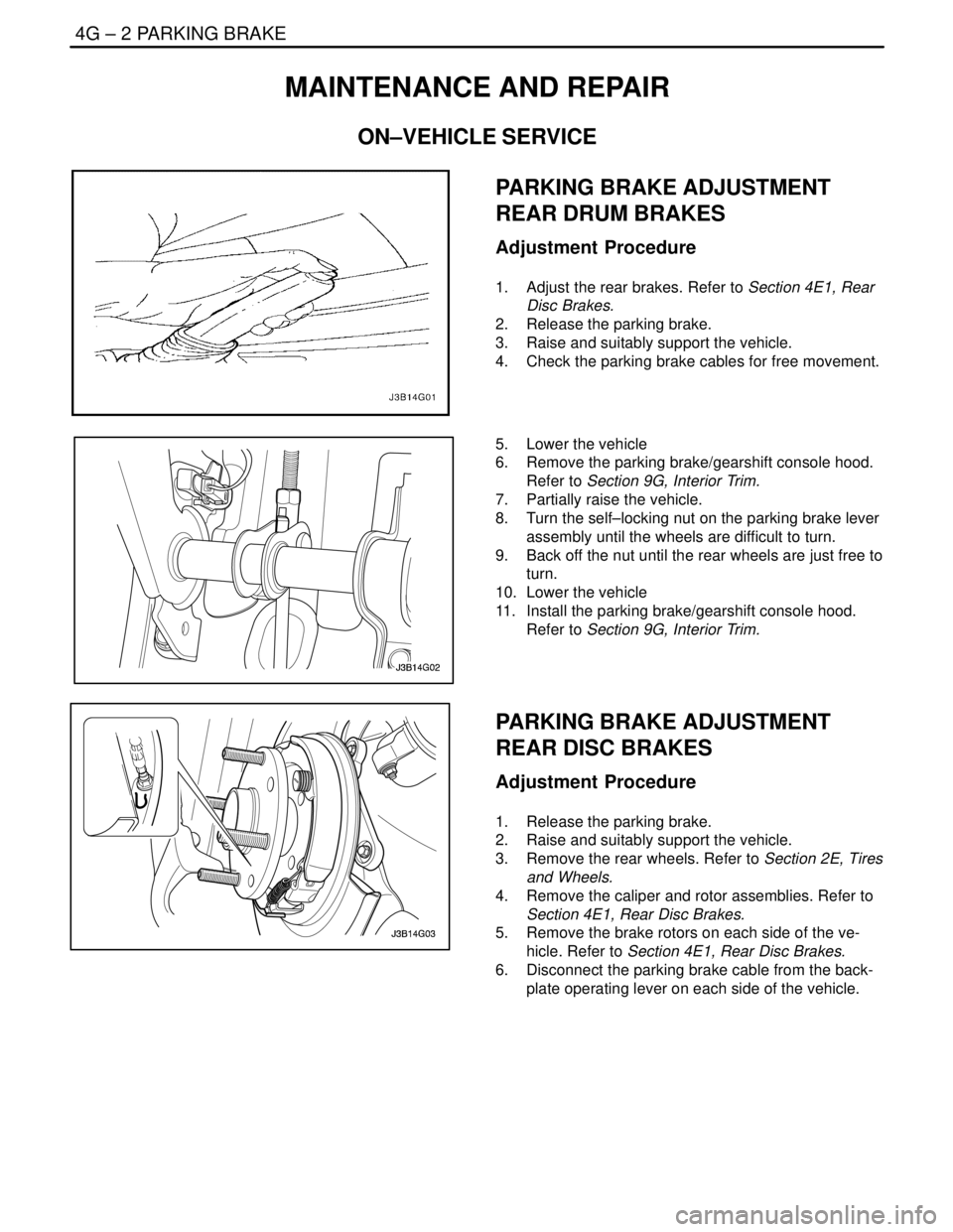
PARKING BRAKE ADJUSTMENT
REAR DRUM BRAKES
Adjustment Procedure
1. Adjust the rear brakes. Refer to Section 4E1, Rear
Disc Brakes.
2. Release the parking brake.
3. Raise and suitably support the vehicle.
4. Check the parking brake cables for free movement.
5. Lower the vehicle
6. Remove the parking brake/gearshift console hood.
Refer to Section 9G, Interior Trim.
7. Partially raise the vehicle.
8. Turn the self–locking nut on the parking brake lever
assembly until the wheels are difficult to turn.
9. Back off the nut until the rear wheels are just free to
turn.
10. Lower the vehicle
11. Install the parking brake/gearshift console hood.
Refer to Section 9G, Interior Trim.
PARKING BRAKE ADJUSTMENT
REAR DISC BRAKES
Adjustment Procedure
1. Release the parking brake.
2. Raise and suitably support the vehicle.
3. Remove the rear wheels. Refer to Section 2E, Tires
and Wheels.
4. Remove the caliper and rotor assemblies. Refer to
Section 4E1, Rear Disc Brakes.
5. Remove the brake rotors on each side of the ve-
hicle. Refer to Section 4E1, Rear Disc Brakes.
6. Disconnect the parking brake cable from the back-
plate operating lever on each side of the vehicle.
Page 1155 of 2643
PARKING BRAKE 4G – 3
DAEWOO V–121 BL4
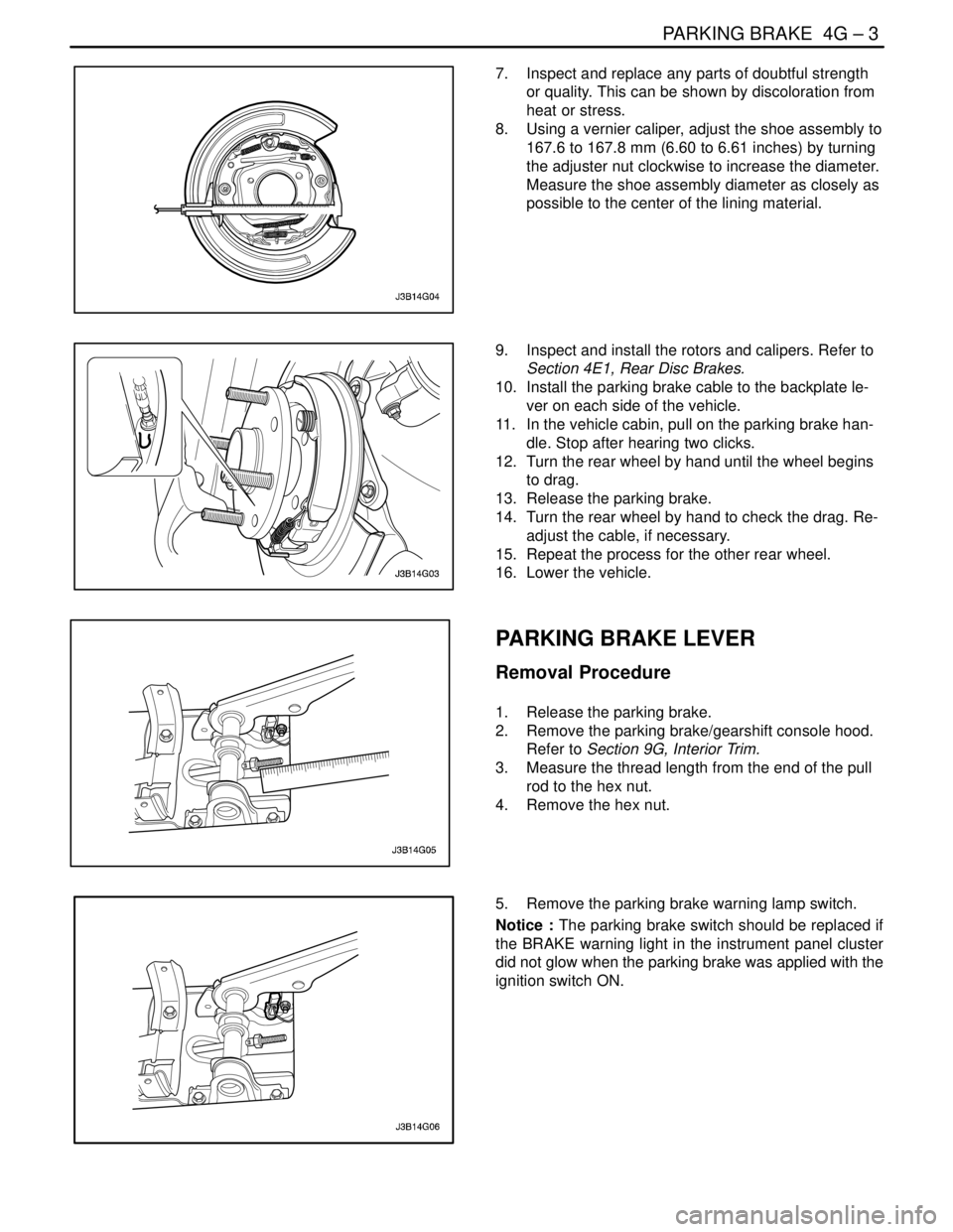
7. Inspect and replace any parts of doubtful strength
or quality. This can be shown by discoloration from
heat or stress.
8. Using a vernier caliper, adjust the shoe assembly to
167.6 to 167.8 mm (6.60 to 6.61 inches) by turning
the adjuster nut clockwise to increase the diameter.
Measure the shoe assembly diameter as closely as
possible to the center of the lining material.
9. Inspect and install the rotors and calipers. Refer to
Section 4E1, Rear Disc Brakes.
10. Install the parking brake cable to the backplate le-
ver on each side of the vehicle.
11. In the vehicle cabin, pull on the parking brake han-
dle. Stop after hearing two clicks.
12. Turn the rear wheel by hand until the wheel begins
to drag.
13. Release the parking brake.
14. Turn the rear wheel by hand to check the drag. Re-
adjust the cable, if necessary.
15. Repeat the process for the other rear wheel.
16. Lower the vehicle.
PARKING BRAKE LEVER
Removal Procedure
1. Release the parking brake.
2. Remove the parking brake/gearshift console hood.
Refer to Section 9G, Interior Trim.
3. Measure the thread length from the end of the pull
rod to the hex nut.
4. Remove the hex nut.
5. Remove the parking brake warning lamp switch.
Notice : The parking brake switch should be replaced if
the BRAKE warning light in the instrument panel cluster
did not glow when the parking brake was applied with the
ignition switch ON.