Engine Electrical DAEWOO NUBIRA 2004 Service Repair Manual
[x] Cancel search | Manufacturer: DAEWOO, Model Year: 2004, Model line: NUBIRA, Model: DAEWOO NUBIRA 2004Pages: 2643, PDF Size: 80.54 MB
Page 859 of 2643
ENGINE CONTROLS 1F – 613
DAEWOO V–121 BL4
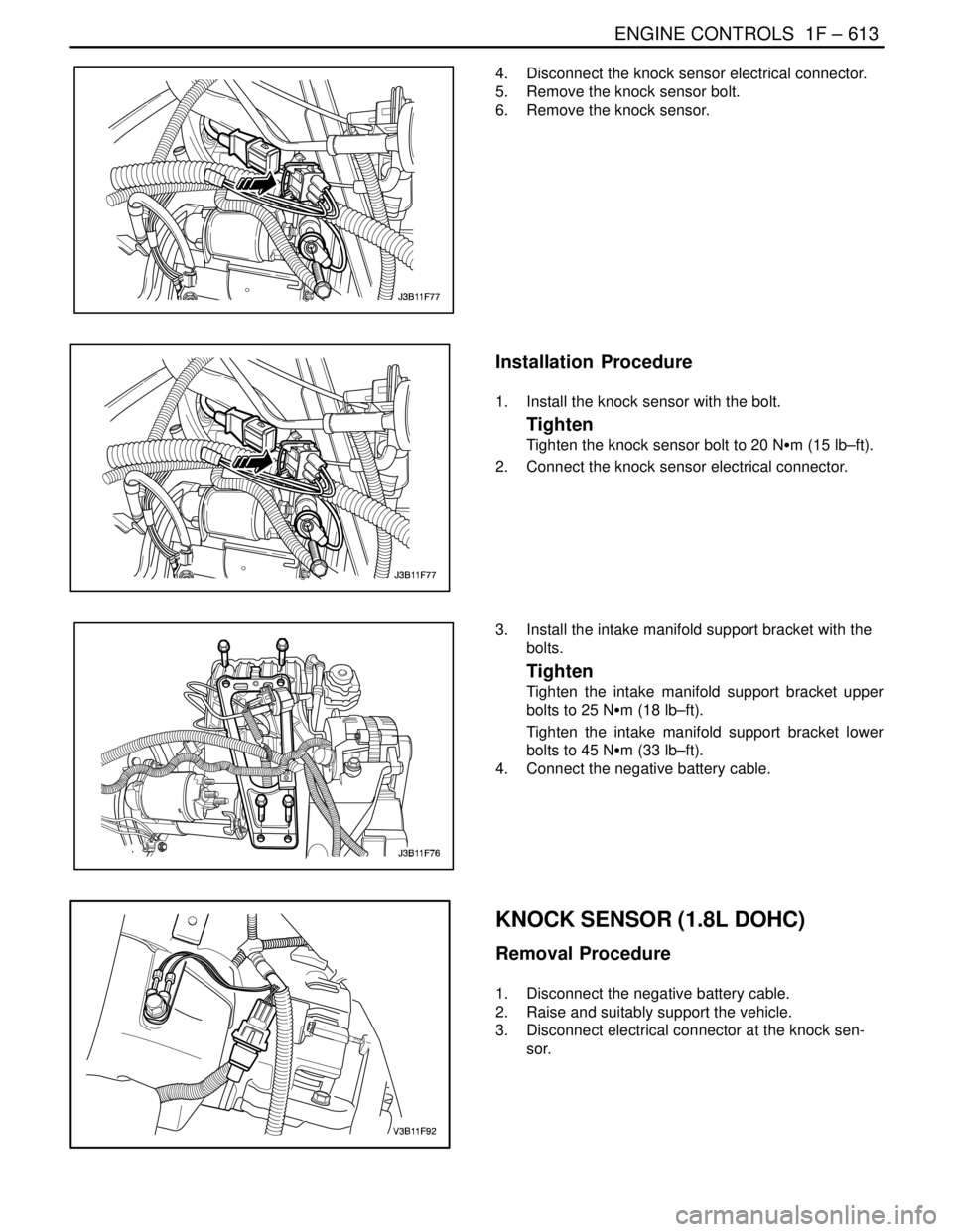
4. Disconnect the knock sensor electrical connector.
5. Remove the knock sensor bolt.
6. Remove the knock sensor.
Installation Procedure
1. Install the knock sensor with the bolt.
Tighten
Tighten the knock sensor bolt to 20 NSm (15 lb–ft).
2. Connect the knock sensor electrical connector.
3. Install the intake manifold support bracket with the
bolts.
Tighten
Tighten the intake manifold support bracket upper
bolts to 25 NSm (18 lb–ft).
Tighten the intake manifold support bracket lower
bolts to 45 NSm (33 lb–ft).
4. Connect the negative battery cable.
KNOCK SENSOR (1.8L DOHC)
Removal Procedure
1. Disconnect the negative battery cable.
2. Raise and suitably support the vehicle.
3. Disconnect electrical connector at the knock sen-
sor.
Page 860 of 2643
1F – 614IENGINE CONTROLS
DAEWOO V–121 BL4
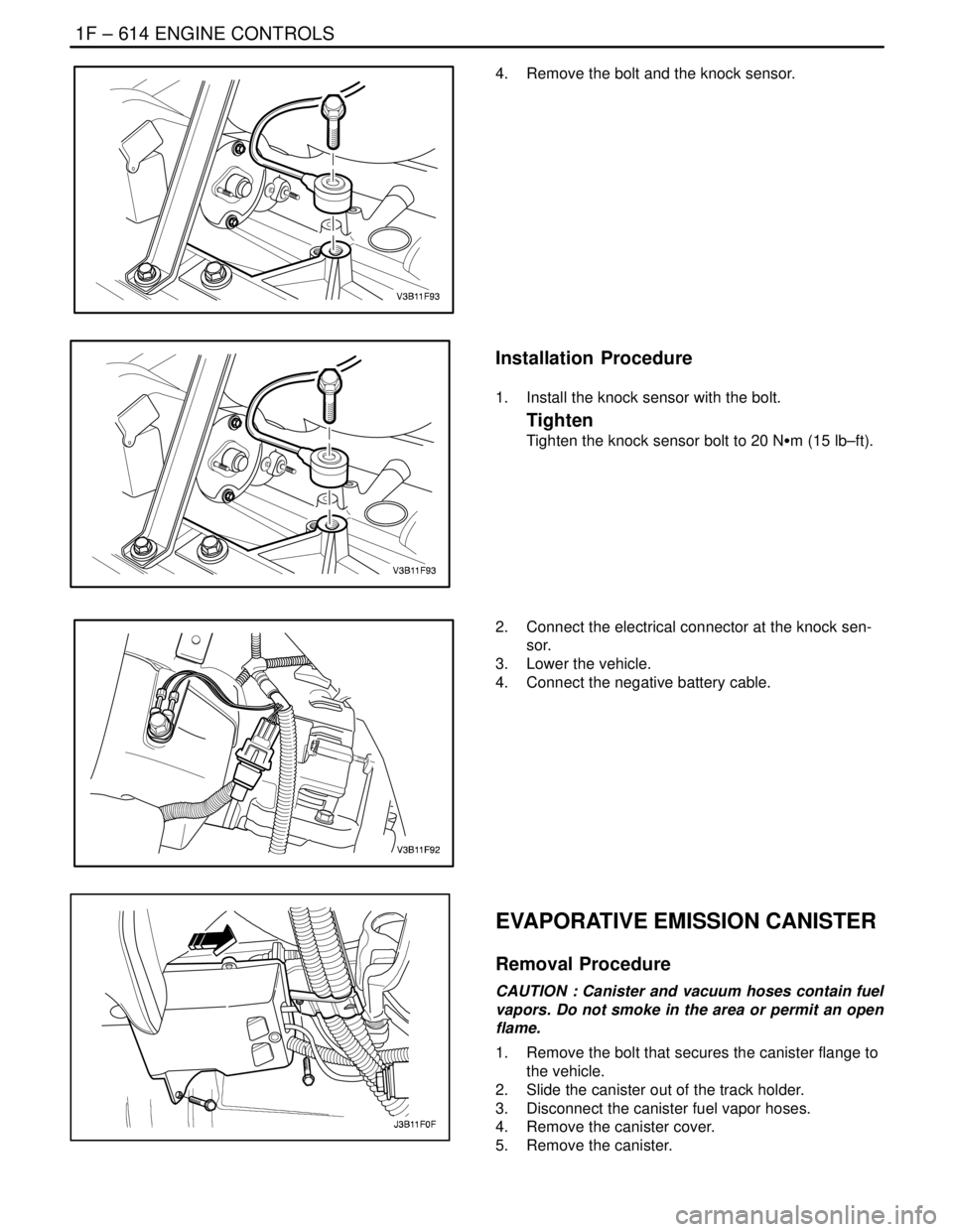
4. Remove the bolt and the knock sensor.
Installation Procedure
1. Install the knock sensor with the bolt.
Tighten
Tighten the knock sensor bolt to 20 NSm (15 lb–ft).
2. Connect the electrical connector at the knock sen-
sor.
3. Lower the vehicle.
4. Connect the negative battery cable.
EVAPORATIVE EMISSION CANISTER
Removal Procedure
CAUTION : Canister and vacuum hoses contain fuel
vapors. Do not smoke in the area or permit an open
flame.
1. Remove the bolt that secures the canister flange to
the vehicle.
2. Slide the canister out of the track holder.
3. Disconnect the canister fuel vapor hoses.
4. Remove the canister cover.
5. Remove the canister.
Page 861 of 2643
ENGINE CONTROLS 1F – 615
DAEWOO V–121 BL4
Installation Procedure
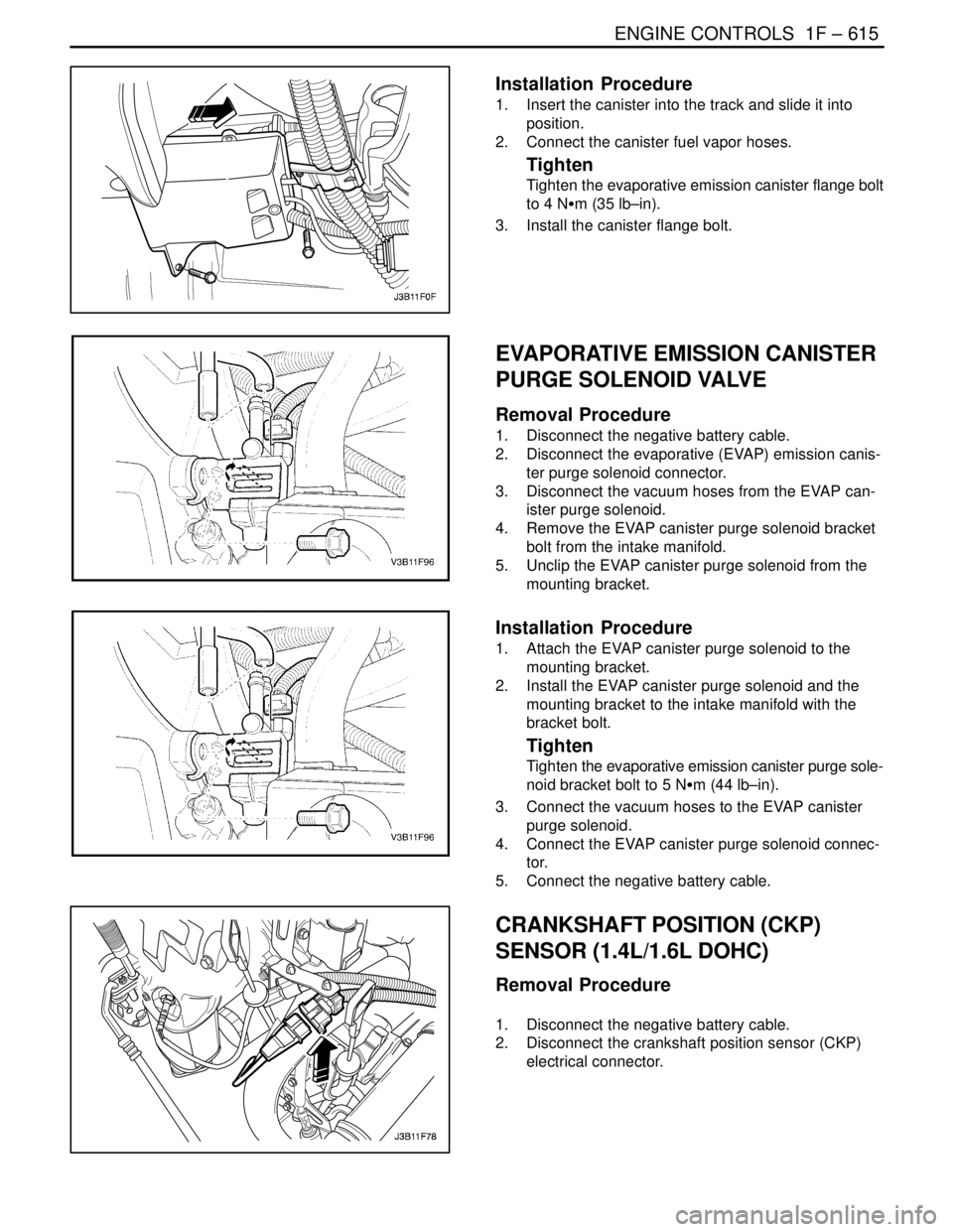
1. Insert the canister into the track and slide it into
position.
2. Connect the canister fuel vapor hoses.
Tighten
Tighten the evaporative emission canister flange bolt
to 4 NSm (35 lb–in).
3. Install the canister flange bolt.
EVAPORATIVE EMISSION CANISTER
PURGE SOLENOID VALVE
Removal Procedure
1. Disconnect the negative battery cable.
2. Disconnect the evaporative (EVAP) emission canis-
ter purge solenoid connector.
3. Disconnect the vacuum hoses from the EVAP can-
ister purge solenoid.
4. Remove the EVAP canister purge solenoid bracket
bolt from the intake manifold.
5. Unclip the EVAP canister purge solenoid from the
mounting bracket.
Installation Procedure
1. Attach the EVAP canister purge solenoid to the
mounting bracket.
2. Install the EVAP canister purge solenoid and the
mounting bracket to the intake manifold with the
bracket bolt.
Tighten
Tighten the evaporative emission canister purge sole-
noid bracket bolt to 5 NSm (44 lb–in).
3. Connect the vacuum hoses to the EVAP canister
purge solenoid.
4. Connect the EVAP canister purge solenoid connec-
tor.
5. Connect the negative battery cable.
CRANKSHAFT POSITION (CKP)
SENSOR (1.4L/1.6L DOHC)
Removal Procedure
1. Disconnect the negative battery cable.
2. Disconnect the crankshaft position sensor (CKP)
electrical connector.
Page 862 of 2643
1F – 616IENGINE CONTROLS
DAEWOO V–121 BL4
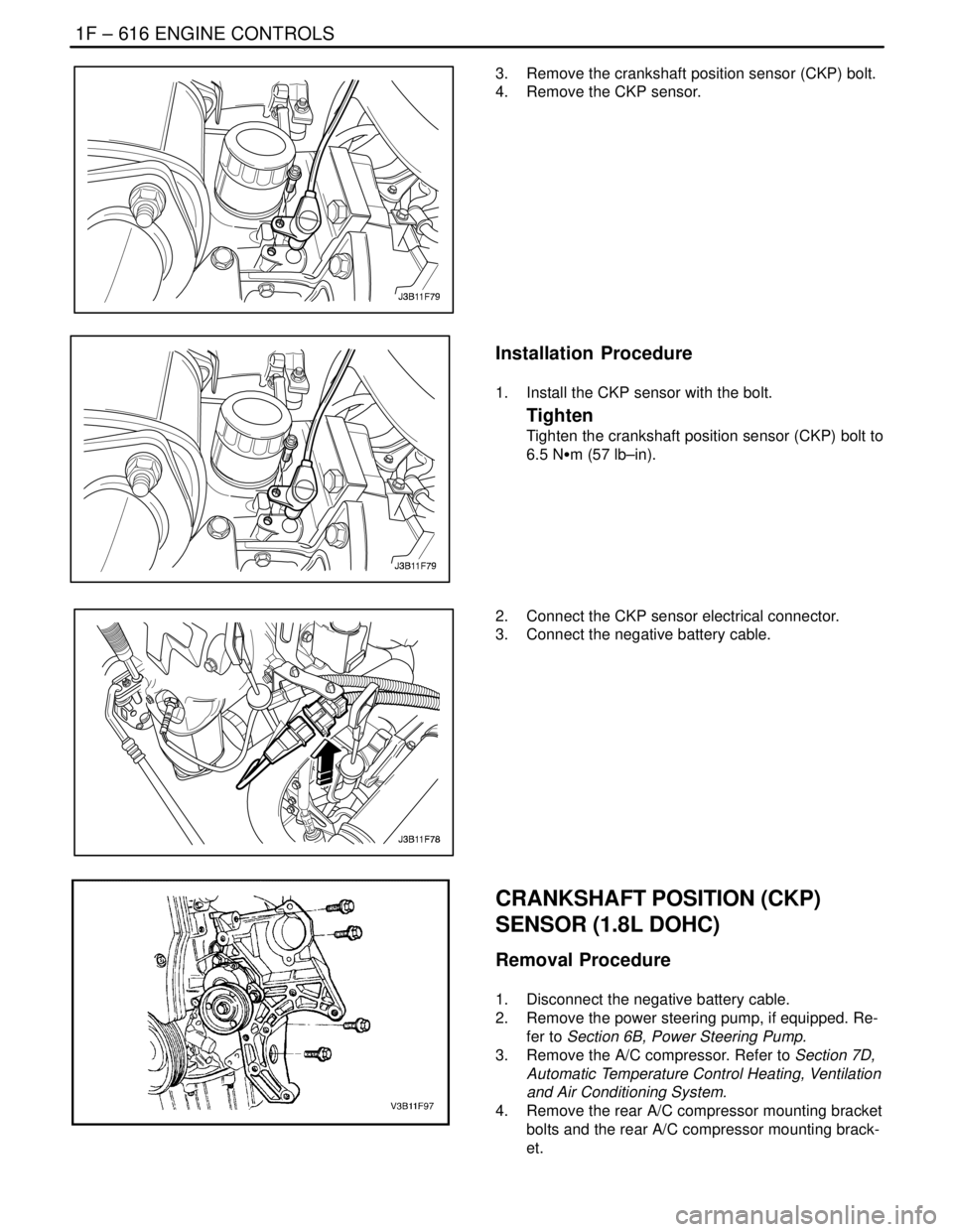
3. Remove the crankshaft position sensor (CKP) bolt.
4. Remove the CKP sensor.
Installation Procedure
1. Install the CKP sensor with the bolt.
Tighten
Tighten the crankshaft position sensor (CKP) bolt to
6.5 NSm (57 lb–in).
2. Connect the CKP sensor electrical connector.
3. Connect the negative battery cable.
CRANKSHAFT POSITION (CKP)
SENSOR (1.8L DOHC)
Removal Procedure
1. Disconnect the negative battery cable.
2. Remove the power steering pump, if equipped. Re-
fer to Section 6B, Power Steering Pump.
3. Remove the A/C compressor. Refer to Section 7D,
Automatic Temperature Control Heating, Ventilation
and Air Conditioning System.
4. Remove the rear A/C compressor mounting bracket
bolts and the rear A/C compressor mounting brack-
et.
Page 864 of 2643
1F – 618IENGINE CONTROLS
DAEWOO V–121 BL4
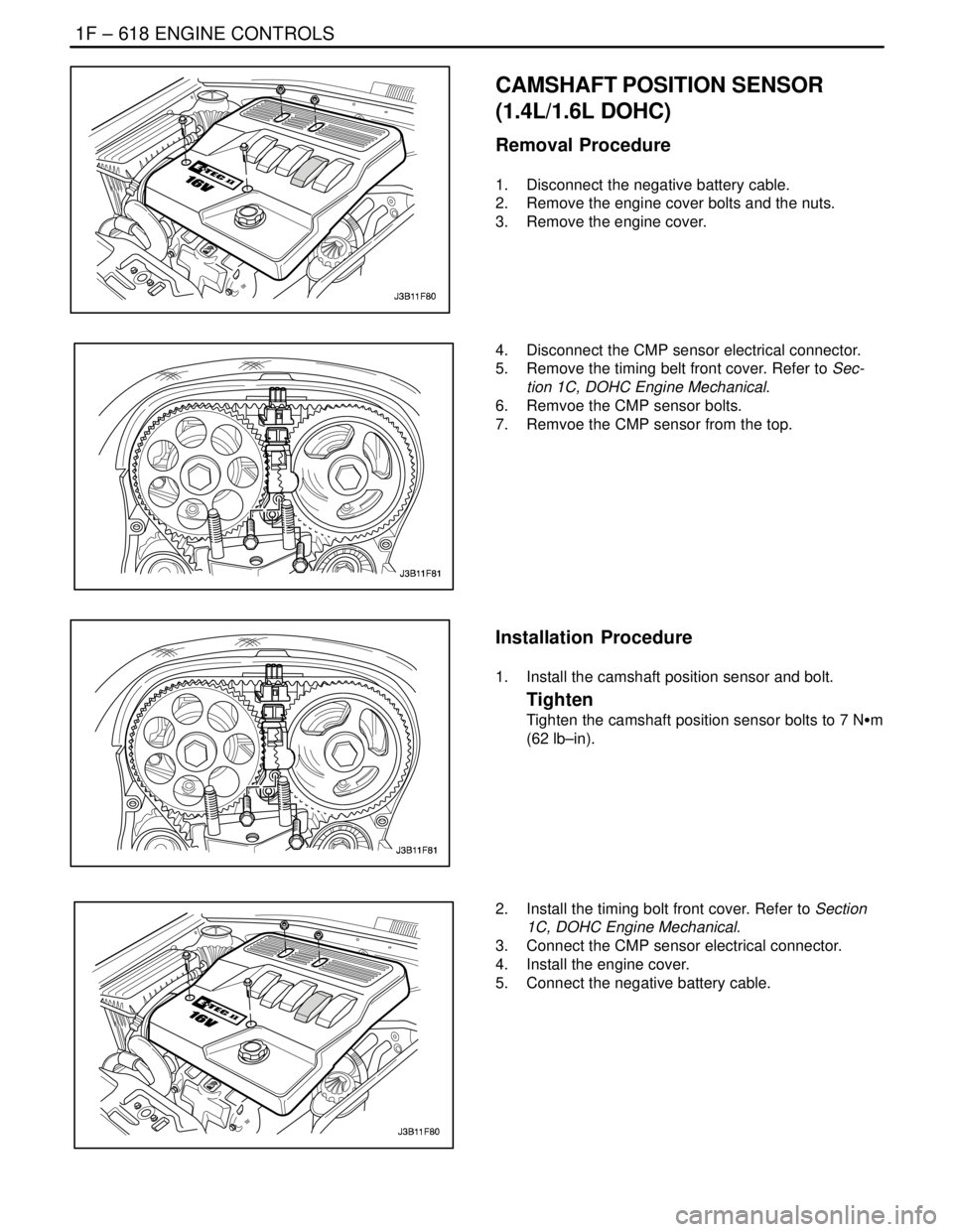
CAMSHAFT POSITION SENSOR
(1.4L/1.6L DOHC)
Removal Procedure
1. Disconnect the negative battery cable.
2. Remove the engine cover bolts and the nuts.
3. Remove the engine cover.
4. Disconnect the CMP sensor electrical connector.
5. Remove the timing belt front cover. Refer to Sec-
tion 1C, DOHC Engine Mechanical.
6. Remvoe the CMP sensor bolts.
7. Remvoe the CMP sensor from the top.
Installation Procedure
1. Install the camshaft position sensor and bolt.
Tighten
Tighten the camshaft position sensor bolts to 7 NSm
(62 lb–in).
2. Install the timing bolt front cover. Refer to Section
1C, DOHC Engine Mechanical.
3. Connect the CMP sensor electrical connector.
4. Install the engine cover.
5. Connect the negative battery cable.
Page 865 of 2643
ENGINE CONTROLS 1F – 619
DAEWOO V–121 BL4
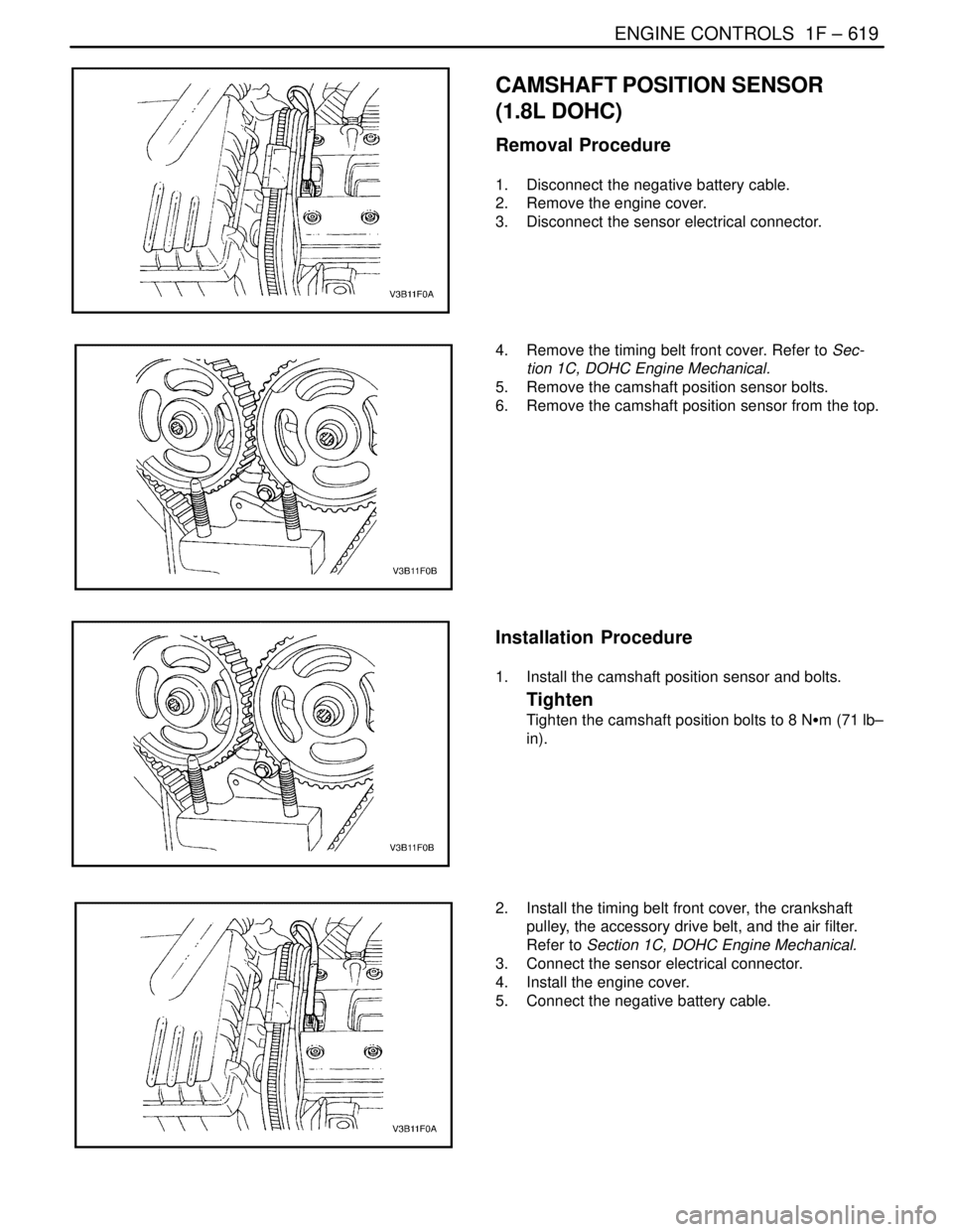
CAMSHAFT POSITION SENSOR
(1.8L DOHC)
Removal Procedure
1. Disconnect the negative battery cable.
2. Remove the engine cover.
3. Disconnect the sensor electrical connector.
4. Remove the timing belt front cover. Refer to Sec-
tion 1C, DOHC Engine Mechanical.
5. Remove the camshaft position sensor bolts.
6. Remove the camshaft position sensor from the top.
Installation Procedure
1. Install the camshaft position sensor and bolts.
Tighten
Tighten the camshaft position bolts to 8 NSm (71 lb–
in).
2. Install the timing belt front cover, the crankshaft
pulley, the accessory drive belt, and the air filter.
Refer to Section 1C, DOHC Engine Mechanical.
3. Connect the sensor electrical connector.
4. Install the engine cover.
5. Connect the negative battery cable.
Page 871 of 2643

ENGINE CONTROLS 1F – 625
DAEWOO V–121 BL4
EVAPORATIVE EMISSION CANISTER
The Evaporative (EVAP) Emission canister is an emission
control device containing activated charcoal granules.
The EVAP emission canister is used to store fuel vapors
from the fuel tank. Once certain conditions are met, the en-
gine control module (ECM) activates the EVAP canister
purge solenoid, allowing the fuel vapors to be drawn into
the engine cylinders and burned.
POSITIVE CRANKCASE
VENTILATION SYSTEM OPERATION
A Positive Crankcase Ventilation (PCV) system is used to
provide complete use of the crankcase vapors. Fresh air
from the air cleaner is supplied to the crankcase. The fresh
air is mixed with blowby gases which are then passed
through a vacuum hose into the intake manifold.
Periodically inspect the hoses and the clamps. Replace
any crankcase ventilation components as required.
A restricted or plugged PCV hose may cause the following
conditions:
S Rough idle
S Stalling or low idle speed
S Oil leaks
S Oil in the air cleaner
S Sludge in the engine
A leaking PCV hose may cause the following conditions:
S Rough idle
S Stalling
S High idle speed
ENGINE COOLANT TEMPERATURE
SENSOR
The Engine Coolant Temperature (ECT) sensor is a
thermistor (a resistor which changes value based on tem-
perature) mounted in the engine coolant stream. Low cool-
ant temperature produces a high resistance (100,000
ohms at –40 °F [–40 °C]) while high temperature causes
low resistance (70 ohms at 266 °F [130 °C]).
The engine control module (ECM) supplies 5 volts to the
ECT sensor through a resistor in the ECM and measures
the change in voltage. The voltage will be high when the
engine is cold, and low when the engine is hot. By measur-
ing the change in voltage, the ECM can determine the
coolant temperature. The engine coolant temperature af-
fects most of the systems that the ECM controls. A failure
in the ECT sensor circuit should set a diagnostic trouble
code P0117 or P0118. Remember, these diagnostic
trouble codes indicate a failure in the ECT sensor circuit,
so proper use of the chart will lead either to repairing a wir-
ing problem or to replacing the sensor to repair a problem
properly.
THROTTLE POSITION SENSOR
The Throttle Position (TP) sensor is a potentiometer con-
nected to the throttle shaft of the throttle body. The TP sen-
sor electrical circuit consists of a 5 volt supply line and a
ground line, both provided by the engine control module
(ECM). The ECM calculates the throttle position by moni-
toring the voltage on this signal line. The TP sensor output
changes as the accelerator pedal is moved, changing the
throttle valve angle. At a closed throttle position, the output
of the TP sensor is low, about 0.5 volt. As the throttle valve
opens, the output increases so that, at Wide Open Throttle
(WOT), the output voltage will be about 5 volts.
The ECM can determine fuel delivery based on throttle
valve angle (driver demand). A broken or loose TP sensor
can cause intermittent bursts of fuel from the injector and
an unstable idle, because the ECM thinks the throttle is
moving. A problem in any of the TP sensor circuits should
set a diagnostic trouble code (DTC) P0121 or P0122.
Once the DTC is set, the ECM will substitute a default val-
ue for the TP sensor and some vehicle performance will
return. A DTC P0121 will cause a high idle speed.
CATALYST MONITOR OXYGEN
SENSORS
Three–way catalytic converters are used to control emis-
sions of hydrocarbons (HC), carbon monoxide (CO), and
oxides of nitrogen (NOx). The catalyst within the convert-
ers promotes a chemical reaction. This reaction oxidizes
the HC and CO present in the exhaust gas and converts
them into harmless water vapor and carbon dioxide. The
catalyst also reduces NOx by converting it to nitrogen. The
engine control module (ECM) can monitor this process us-
ing the HO2S1 and HO2S2 sensor. These sensors pro-
duce an output signal which indicates the amount of oxy-
gen present in the exhaust gas entering and leaving the
three–way converter. This indicates the catalyst’s ability to
efficiently convert exhaust gasses. If the catalyst is operat-
ing efficiently, the HO2S1 sensor signals will be more ac-
tive than the signals produced by the HO2S2 sensor. The
catalyst monitor sensors operate the same way as the fuel
control sensors. The sensor’s main function is catalyst
monitoring, but they also have a limited role in fuel control.
If a sensor output indicates a voltage either above or below
the 450 mv bias voltage for an extended period of time, the
ECM will make a slight adjustment to fuel trim to ensure
that fuel delivery is correct for catalyst monitoring.
A problem with the HO2S1 sensor circuit will set DTC
P0131, P0132, P0133 or P0134 depending, on the special
condition. A problem with the HO2S2 sensor signal will set
DTC P0137, P0138, P0140 or P0141, depending on the
special condition.
A fault in the Rear Heated Oxygen Sensor (HO2S2) heat-
er element or its ignition feed or ground will result in lower
oxygen sensor response. This may cause incorrect cata-
lyst monitor diagnostic results.
Page 874 of 2643

1F – 628IENGINE CONTROLS
DAEWOO V–121 BL4
STRATEGY – BASED DIAGNOSTICS
Strategy–Based Diagnostics
The strategy–based diagnostic is a uniform approach to
repair all Electrical/Electronic (E/E) systems. The diag-
nostic flow can always be used to resolve an E/E system
problem and is a starting point when repairs are neces-
sary. The following steps will instruct the technician on
how to proceed with a diagnosis:
S Verify the customer complaint. To verify the cus-
tomer complaint, the technician should know the
normal operation of the system.
S Perform preliminary checks as follows:
S Conduct a thorough visual inspection.
S Review the service history.
S Detect unusual sounds or odors.
S Gather Diagnostic Trouble Code (DTC) informa-
tion to achieve an effective repair.
S Check bulletins and other service information. This
includes videos, newsletters, etc.
S Refer to service information (manual) system
check(s).
S Refer to service diagnostics.
No Trouble Found
This condition exists when the vehicle is found to operate
normally. The condition described by the customer may be
normal. Verify the customer complaint against another ve-
hicle that is operating normally. The condition may be in-
termittent. Verify the complaint under the conditions de-
scribed by the customer before releasing the vehicle.
Re–examine the complaint.
When the complaint cannot be successfully found or iso-
lated, a re–evaluation is necessary. The complaint should
be re–verified and could be intermittent as defined in ”In-
termittents,” or could be normal.
After isolating the cause, the repairs should be made. Vali-
date for proper operation and verify that the symptom has
been corrected. This may involve road testing or other
methods to verify that the complaint has been resolved un-
der the following conditions:
S Conditions noted by the customer.
S If a DTC was diagnosed, verify a repair by duplicat-
ing conditions present when the DTC was set as
noted in the Failure Records or Freeze Frame data.
Verifying Vehicle Repair
Verification of the vehicle repair will be more comprehen-
sive for vehicles with On–Board Diagnostic (EOBD) sys-
tem diagnostics. Following a repair, the technician should
perform these steps:
Important : Follow the steps below when you verify re-
pairs on EOBD systems. Failure to follow these steps
could result in unnecessary repairs.S Review and record the Failure Records and the
Freeze Frame data for the DTC which has been
diagnosed (Freeze Fame data will only be stored
for an A or B type diagnostic and only if the MIL
has been requested).
S Clear the DTC(s).
S Operate the vehicle within conditions noted in the
Failure Records and Freeze Frame data.
S Monitor the DTC status information for the specific
DTC which has been diagnosed until the diagnostic
test associated with that DTC runs.
EOBD SERVICEABILITY ISSUES
Based on the knowledge gained from On–Board Diagnos-
tic (EOBD) experience in the 1994 and 1995 model years,
this list of non–vehicle faults that could affect the perfor-
mance of the EOBD system has been compiled. These
non–vehicle faults vary from environmental conditions to
the quality of fuel used. With the introduction of EOBD
diagnostics across the entire passenger car and light–duty
truck market in 1996, illumination of the MIL due to a non–
vehicle fault could lead to misdiagnosis of the vehicle, in-
creased warranty expense and customer dissatisfaction.
The following list of non–vehicle faults does not include ev-
ery possible fault and may not apply equally to all product
lines.
Fuel Quality
Fuel quality is not a new issue for the automotive industry,
but its potential for turning on the Malfunction Indicator
Lamp (MIL) with EOBD systems is new.
Fuel additives such as ”dry gas” and ”octane enhancers”
may affect the performance of the fuel. If this results in an
incomplete combustion or a partial burn, it will set DTC
P0300. The Reed Vapor Pressure of the fuel can also
create problems in the fuel system, especially during the
spring and fall months when severe ambient temperature
swings occur. A high Reed Vapor Pressure could show up
as a Fuel Trim DTC due to excessive canister loading.
High vapor pressures generated in the fuel tank can also
affect the Evaporative Emission diagnostic as well.
Using fuel with the wrong octane rating for your vehicle
may cause driveability problems. Many of the major fuel
companies advertise that using ”premium” gasoline will
improve the performance of your vehicle. Most premium
fuels use alcohol to increase the octane rating of the fuel.
Although alcohol–enhanced fuels may raise the octane
rating, the fuel’s ability to turn into vapor in cold tempera-
tures deteriorates. This may affect the starting ability and
cold driveability of the engine.
Low fuel levels can lead to fuel starvation, lean engine op-
eration, and eventually engine misfire.
Non–OEM Parts
All of the EOBD diagnostics have been calibrated to run
with Original Equipment Manufacturer (OEM) parts.
Something as simple as a high–performance exhaust sys-
tem that affects exhaust system back pressure could po-
Page 883 of 2643
ENGINE EXHAUST 1G – 3
DAEWOO V–121 BL4
MAINTENANCE AND REPAIR
ON–VEHICLE SERVICE
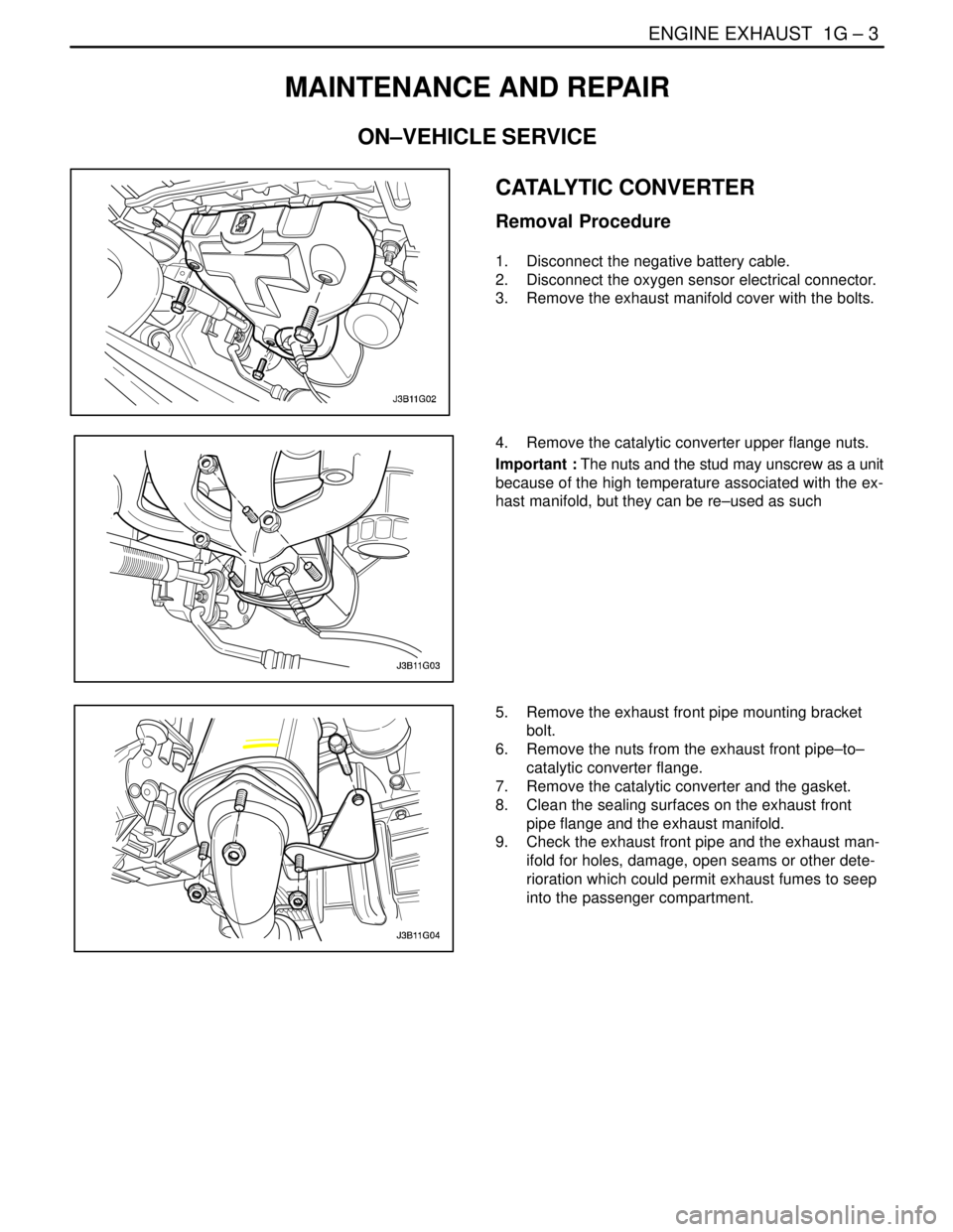
CATALYTIC CONVERTER
Removal Procedure
1. Disconnect the negative battery cable.
2. Disconnect the oxygen sensor electrical connector.
3. Remove the exhaust manifold cover with the bolts.
4. Remove the catalytic converter upper flange nuts.
Important : The nuts and the stud may unscrew as a unit
because of the high temperature associated with the ex-
hast manifold, but they can be re–used as such
5. Remove the exhaust front pipe mounting bracket
bolt.
6. Remove the nuts from the exhaust front pipe–to–
catalytic converter flange.
7. Remove the catalytic converter and the gasket.
8. Clean the sealing surfaces on the exhaust front
pipe flange and the exhaust manifold.
9. Check the exhaust front pipe and the exhaust man-
ifold for holes, damage, open seams or other dete-
rioration which could permit exhaust fumes to seep
into the passenger compartment.
Page 884 of 2643
1G – 4IENGINE EXHAUST
DAEWOO V–121 BL4
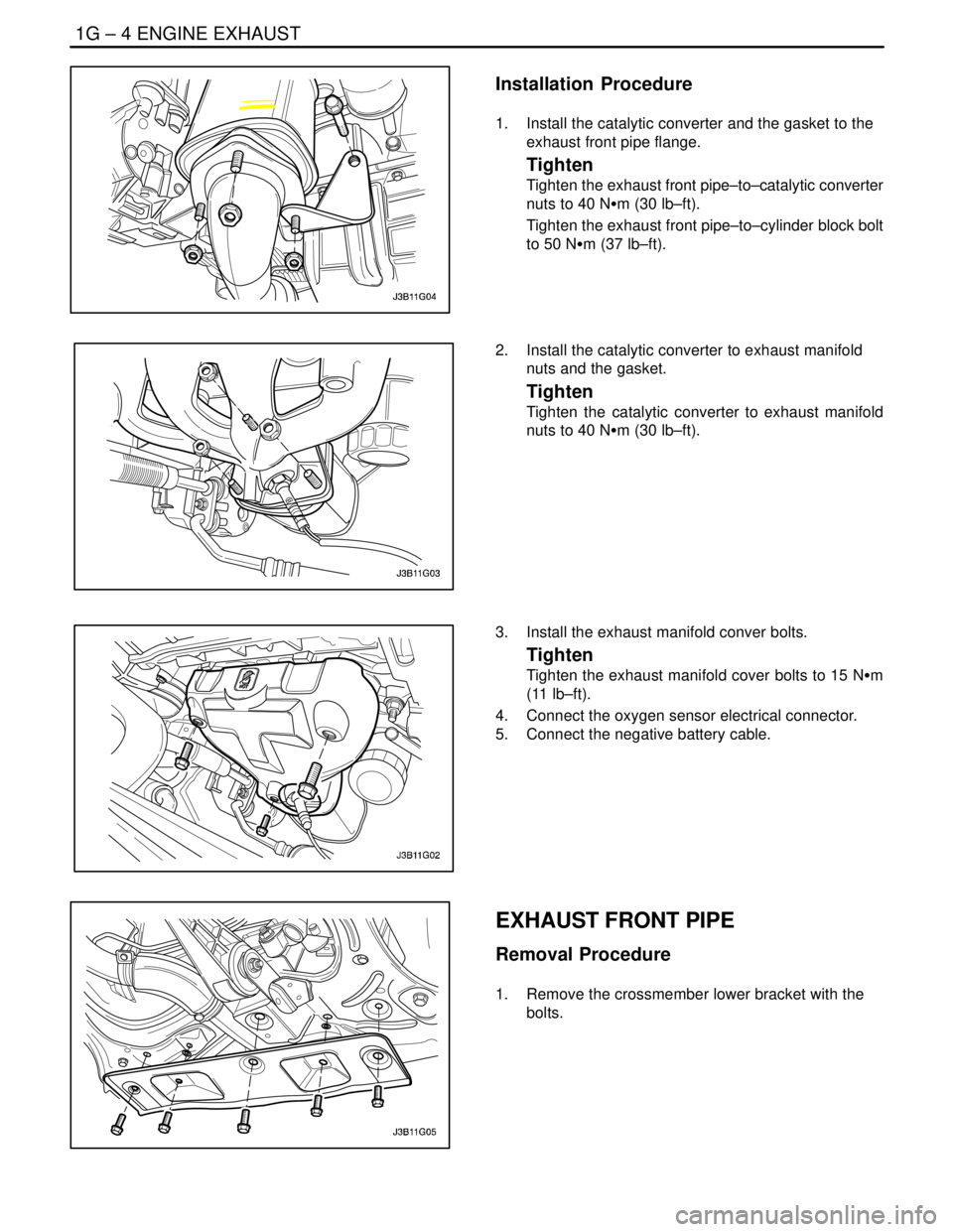
Installation Procedure
1. Install the catalytic converter and the gasket to the
exhaust front pipe flange.
Tighten
Tighten the exhaust front pipe–to–catalytic converter
nuts to 40 NSm (30 lb–ft).
Tighten the exhaust front pipe–to–cylinder block bolt
to 50 NSm (37 lb–ft).
2. Install the catalytic converter to exhaust manifold
nuts and the gasket.
Tighten
Tighten the catalytic converter to exhaust manifold
nuts to 40 NSm (30 lb–ft).
3. Install the exhaust manifold conver bolts.
Tighten
Tighten the exhaust manifold cover bolts to 15 NSm
(11 lb–ft).
4. Connect the oxygen sensor electrical connector.
5. Connect the negative battery cable.
EXHAUST FRONT PIPE
Removal Procedure
1. Remove the crossmember lower bracket with the
bolts.