oil temperature DAEWOO NUBIRA 2004 Service User Guide
[x] Cancel search | Manufacturer: DAEWOO, Model Year: 2004, Model line: NUBIRA, Model: DAEWOO NUBIRA 2004Pages: 2643, PDF Size: 80.54 MB
Page 83 of 2643
1C1 – 40I1.4L/1.6L DOHC ENGINE MECHANICAL
DAEWOO V–121 BL4
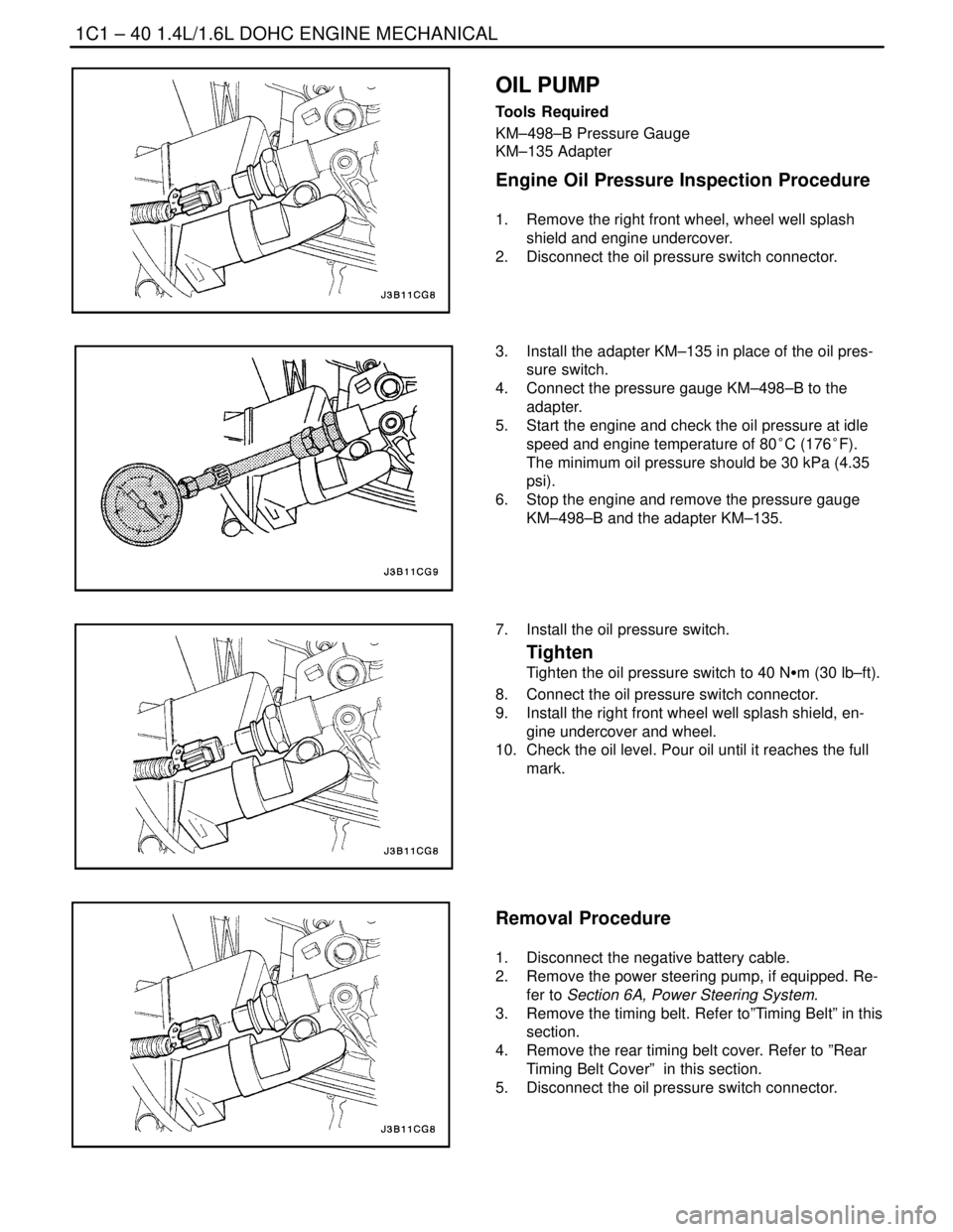
OIL PUMP
Tools Required
KM–498–B Pressure Gauge
KM–135 Adapter
Engine Oil Pressure Inspection Procedure
1. Remove the right front wheel, wheel well splash
shield and engine undercover.
2. Disconnect the oil pressure switch connector.
3. Install the adapter KM–135 in place of the oil pres-
sure switch.
4. Connect the pressure gauge KM–498–B to the
adapter.
5. Start the engine and check the oil pressure at idle
speed and engine temperature of 80°C (176°F).
The minimum oil pressure should be 30 kPa (4.35
psi).
6. Stop the engine and remove the pressure gauge
KM–498–B and the adapter KM–135.
7. Install the oil pressure switch.
Tighten
Tighten the oil pressure switch to 40 NSm (30 lb–ft).
8. Connect the oil pressure switch connector.
9. Install the right front wheel well splash shield, en-
gine undercover and wheel.
10. Check the oil level. Pour oil until it reaches the full
mark.
Removal Procedure
1. Disconnect the negative battery cable.
2. Remove the power steering pump, if equipped. Re-
fer to Section 6A, Power Steering System.
3. Remove the timing belt. Refer to”Timing Belt” in this
section.
4. Remove the rear timing belt cover. Refer to ”Rear
Timing Belt Cover” in this section.
5. Disconnect the oil pressure switch connector.
Page 85 of 2643
1C1 – 42I1.4L/1.6L DOHC ENGINE MECHANICAL
DAEWOO V–121 BL4
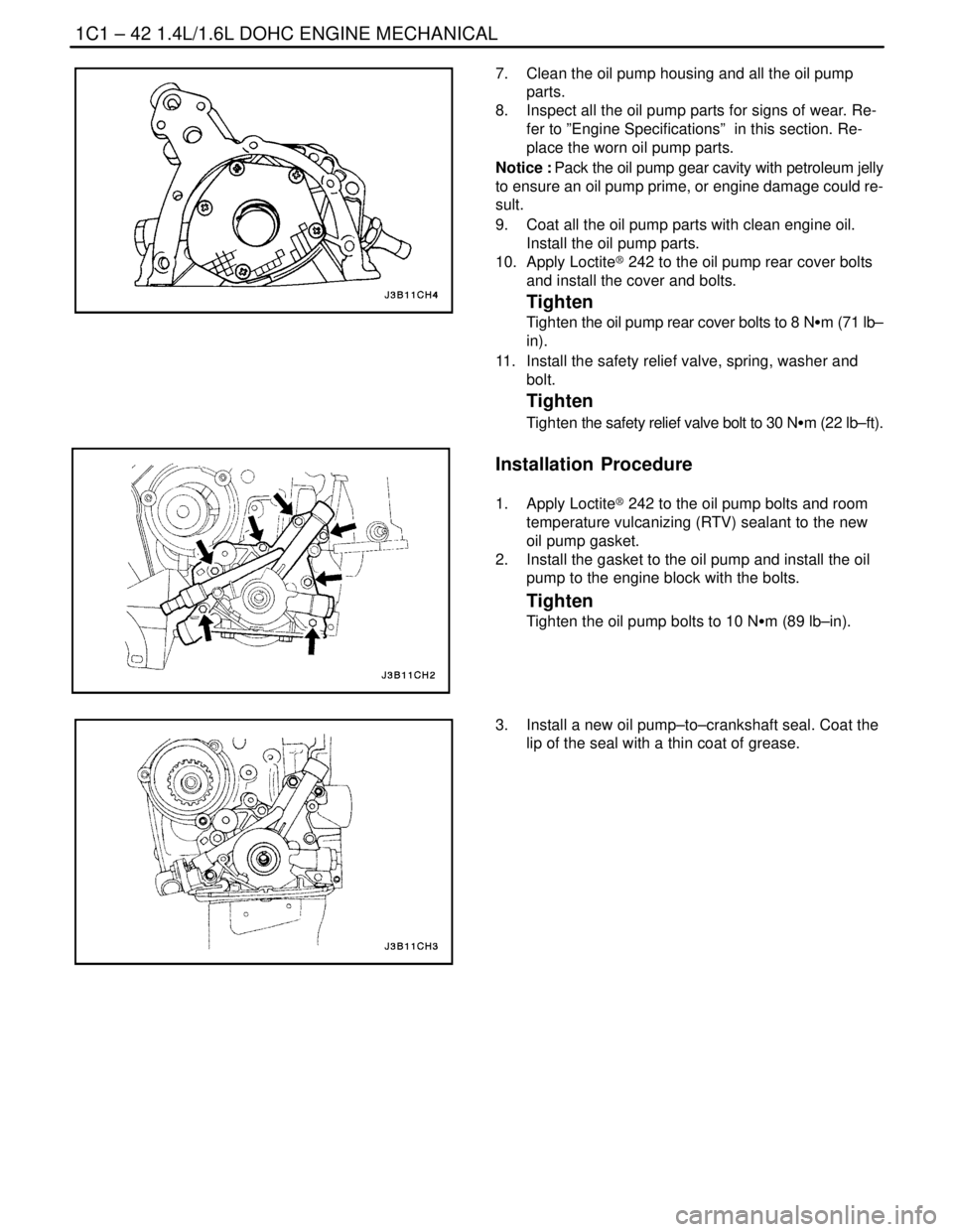
7. Clean the oil pump housing and all the oil pump
parts.
8. Inspect all the oil pump parts for signs of wear. Re-
fer to ”Engine Specifications” in this section. Re-
place the worn oil pump parts.
Notice : Pack the oil pump gear cavity with petroleum jelly
to ensure an oil pump prime, or engine damage could re-
sult.
9. Coat all the oil pump parts with clean engine oil.
Install the oil pump parts.
10. Apply Loctite® 242 to the oil pump rear cover bolts
and install the cover and bolts.
Tighten
Tighten the oil pump rear cover bolts to 8 NSm (71 lb–
in).
11. Install the safety relief valve, spring, washer and
bolt.
Tighten
Tighten the safety relief valve bolt to 30 NSm (22 lb–ft).
Installation Procedure
1. Apply Loctite® 242 to the oil pump bolts and room
temperature vulcanizing (RTV) sealant to the new
oil pump gasket.
2. Install the gasket to the oil pump and install the oil
pump to the engine block with the bolts.
Tighten
Tighten the oil pump bolts to 10 NSm (89 lb–in).
3. Install a new oil pump–to–crankshaft seal. Coat the
lip of the seal with a thin coat of grease.
Page 108 of 2643
1.4L/1.6L DOHC ENGINE MECHANICAL 1C1 – 65
DAEWOO V–121 BL4
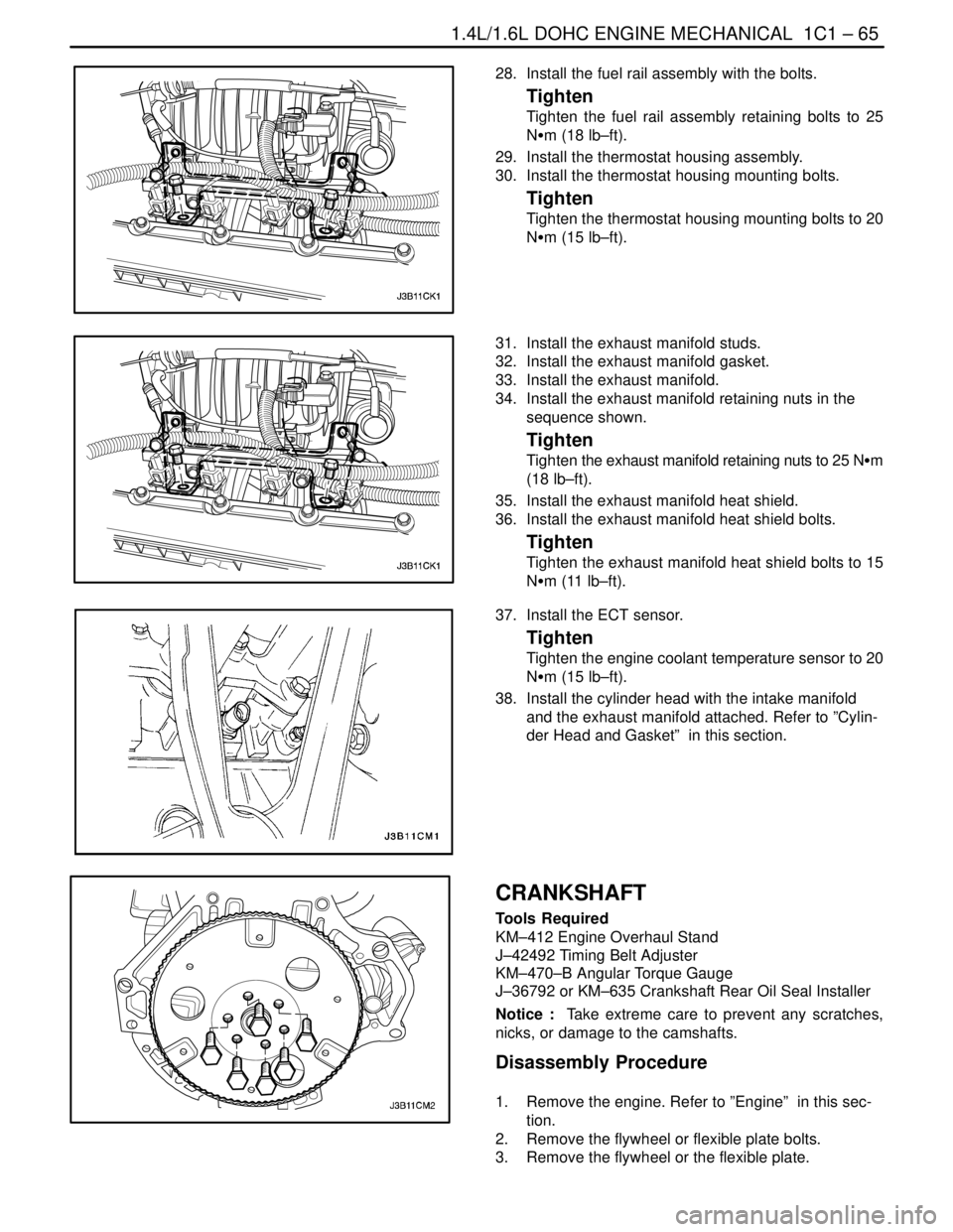
28. Install the fuel rail assembly with the bolts.
Tighten
Tighten the fuel rail assembly retaining bolts to 25
NSm (18 lb–ft).
29. Install the thermostat housing assembly.
30. Install the thermostat housing mounting bolts.
Tighten
Tighten the thermostat housing mounting bolts to 20
NSm (15 lb–ft).
31. Install the exhaust manifold studs.
32. Install the exhaust manifold gasket.
33. Install the exhaust manifold.
34. Install the exhaust manifold retaining nuts in the
sequence shown.
Tighten
Tighten the exhaust manifold retaining nuts to 25 NSm
(18 lb–ft).
35. Install the exhaust manifold heat shield.
36. Install the exhaust manifold heat shield bolts.
Tighten
Tighten the exhaust manifold heat shield bolts to 15
NSm (11 lb–ft).
37. Install the ECT sensor.
Tighten
Tighten the engine coolant temperature sensor to 20
NSm (15 lb–ft).
38. Install the cylinder head with the intake manifold
and the exhaust manifold attached. Refer to ”Cylin-
der Head and Gasket” in this section.
CRANKSHAFT
Tools Required
KM–412 Engine Overhaul Stand
J–42492 Timing Belt Adjuster
KM–470–B Angular Torque Gauge
J–36792 or KM–635 Crankshaft Rear Oil Seal Installer
Notice : Take extreme care to prevent any scratches,
nicks, or damage to the camshafts.
Disassembly Procedure
1. Remove the engine. Refer to ”Engine” in this sec-
tion.
2. Remove the flywheel or flexible plate bolts.
3. Remove the flywheel or the flexible plate.
Page 134 of 2643
1C2 – 14I1.8L DOHC ENGINE MECHANICAL
DAEWOO V–121 BL4
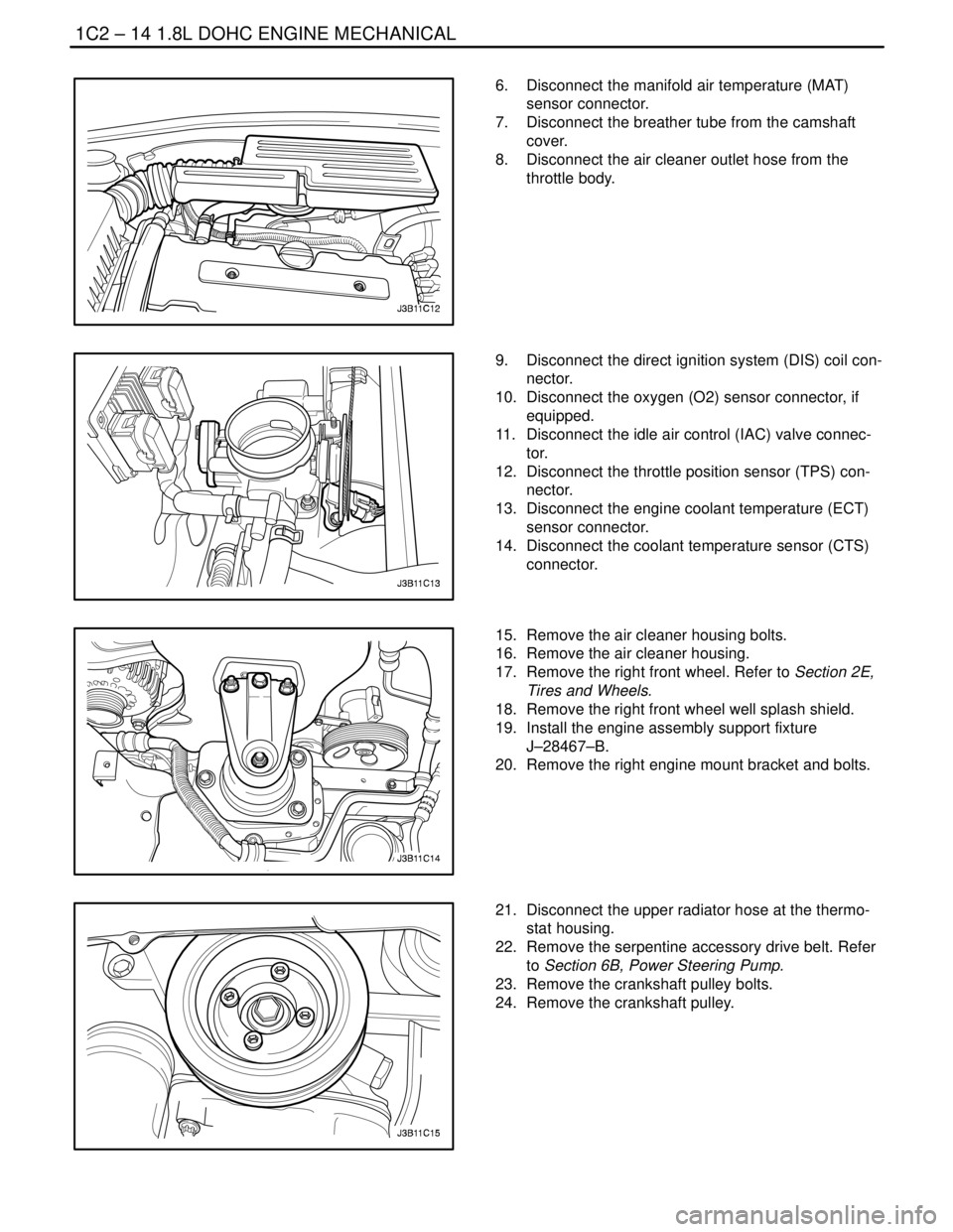
6. Disconnect the manifold air temperature (MAT)
sensor connector.
7. Disconnect the breather tube from the camshaft
cover.
8. Disconnect the air cleaner outlet hose from the
throttle body.
9. Disconnect the direct ignition system (DIS) coil con-
nector.
10. Disconnect the oxygen (O2) sensor connector, if
equipped.
11. Disconnect the idle air control (IAC) valve connec-
tor.
12. Disconnect the throttle position sensor (TPS) con-
nector.
13. Disconnect the engine coolant temperature (ECT)
sensor connector.
14. Disconnect the coolant temperature sensor (CTS)
connector.
15. Remove the air cleaner housing bolts.
16. Remove the air cleaner housing.
17. Remove the right front wheel. Refer to Section 2E,
Tires and Wheels.
18. Remove the right front wheel well splash shield.
19. Install the engine assembly support fixture
J–28467–B.
20. Remove the right engine mount bracket and bolts.
21. Disconnect the upper radiator hose at the thermo-
stat housing.
22. Remove the serpentine accessory drive belt. Refer
to Section 6B, Power Steering Pump.
23. Remove the crankshaft pulley bolts.
24. Remove the crankshaft pulley.
Page 154 of 2643
1C2 – 34I1.8L DOHC ENGINE MECHANICAL
DAEWOO V–121 BL4
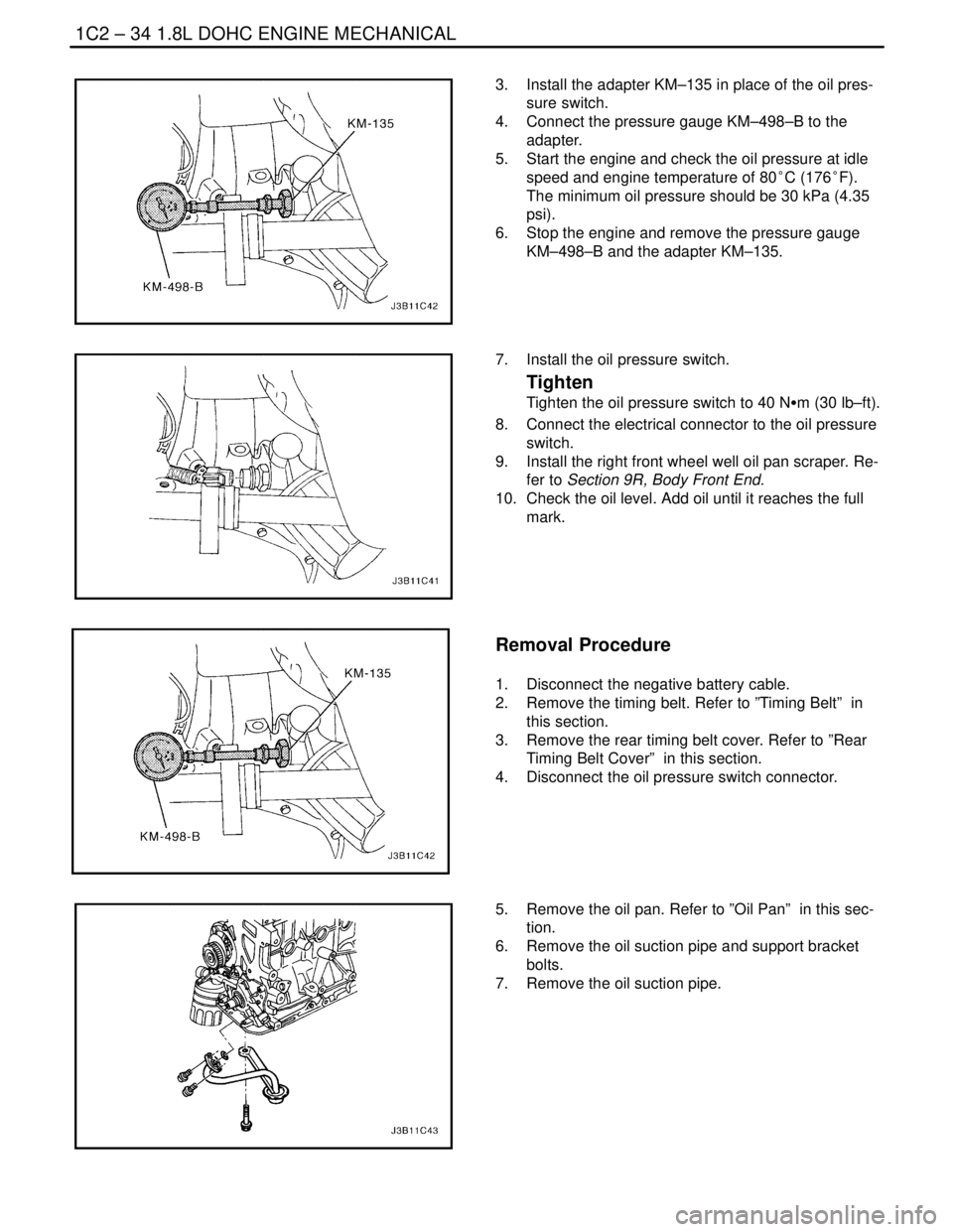
3. Install the adapter KM–135 in place of the oil pres-
sure switch.
4. Connect the pressure gauge KM–498–B to the
adapter.
5. Start the engine and check the oil pressure at idle
speed and engine temperature of 80°C (176°F).
The minimum oil pressure should be 30 kPa (4.35
psi).
6. Stop the engine and remove the pressure gauge
KM–498–B and the adapter KM–135.
7. Install the oil pressure switch.
Tighten
Tighten the oil pressure switch to 40 NSm (30 lb–ft).
8. Connect the electrical connector to the oil pressure
switch.
9. Install the right front wheel well oil pan scraper. Re-
fer to Section 9R, Body Front End.
10. Check the oil level. Add oil until it reaches the full
mark.
Removal Procedure
1. Disconnect the negative battery cable.
2. Remove the timing belt. Refer to ”Timing Belt” in
this section.
3. Remove the rear timing belt cover. Refer to ”Rear
Timing Belt Cover” in this section.
4. Disconnect the oil pressure switch connector.
5. Remove the oil pan. Refer to ”Oil Pan” in this sec-
tion.
6. Remove the oil suction pipe and support bracket
bolts.
7. Remove the oil suction pipe.
Page 156 of 2643
1C2 – 36I1.8L DOHC ENGINE MECHANICAL
DAEWOO V–121 BL4
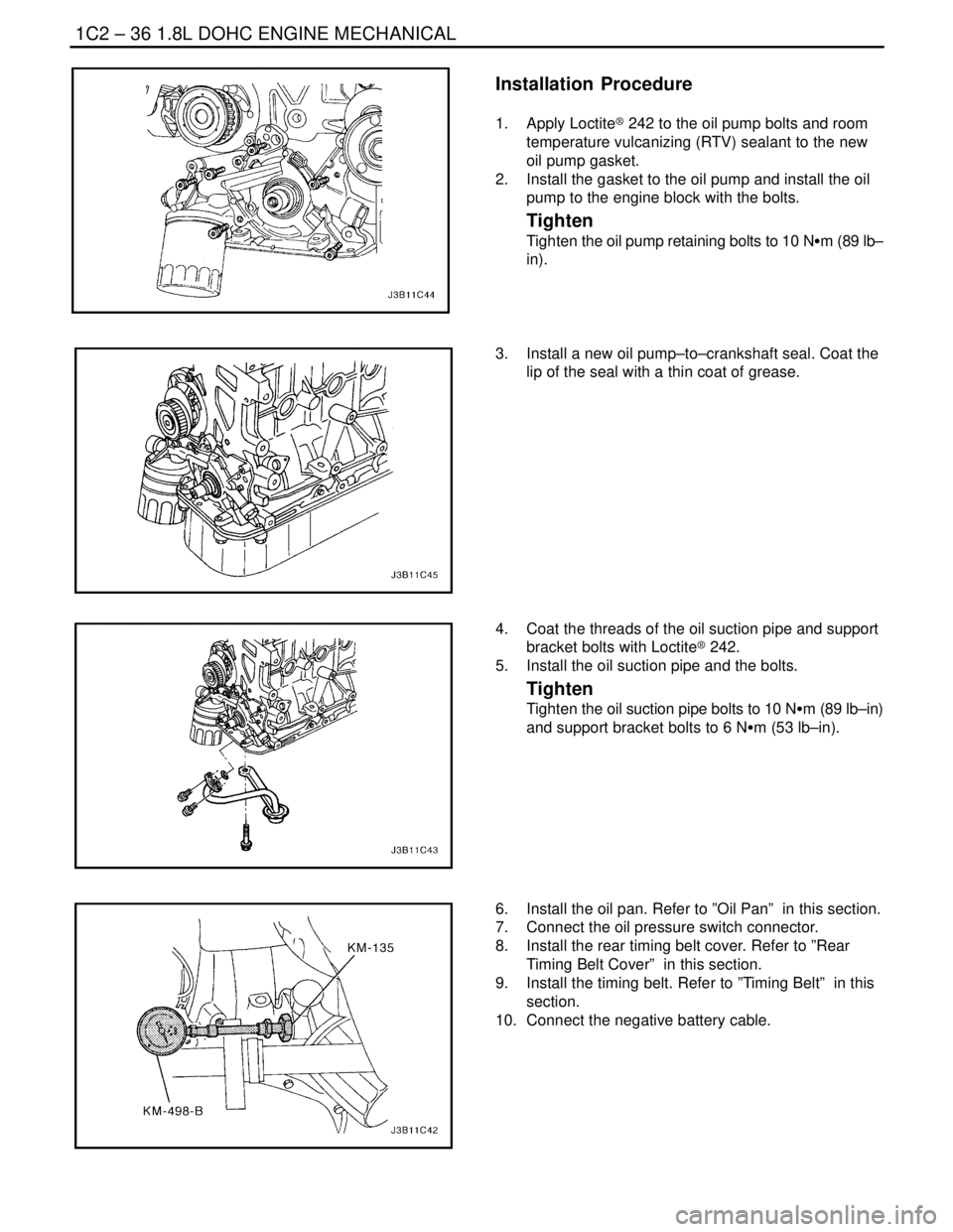
Installation Procedure
1. Apply Loctite® 242 to the oil pump bolts and room
temperature vulcanizing (RTV) sealant to the new
oil pump gasket.
2. Install the gasket to the oil pump and install the oil
pump to the engine block with the bolts.
Tighten
Tighten the oil pump retaining bolts to 10 NSm (89 lb–
in).
3. Install a new oil pump–to–crankshaft seal. Coat the
lip of the seal with a thin coat of grease.
4. Coat the threads of the oil suction pipe and support
bracket bolts with Loctite® 242.
5. Install the oil suction pipe and the bolts.
Tighten
Tighten the oil suction pipe bolts to 10 NSm (89 lb–in)
and support bracket bolts to 6 NSm (53 lb–in).
6. Install the oil pan. Refer to ”Oil Pan” in this section.
7. Connect the oil pressure switch connector.
8. Install the rear timing belt cover. Refer to ”Rear
Timing Belt Cover” in this section.
9. Install the timing belt. Refer to ”Timing Belt” in this
section.
10. Connect the negative battery cable.
Page 166 of 2643
1C2 – 46I1.8L DOHC ENGINE MECHANICAL
DAEWOO V–121 BL4
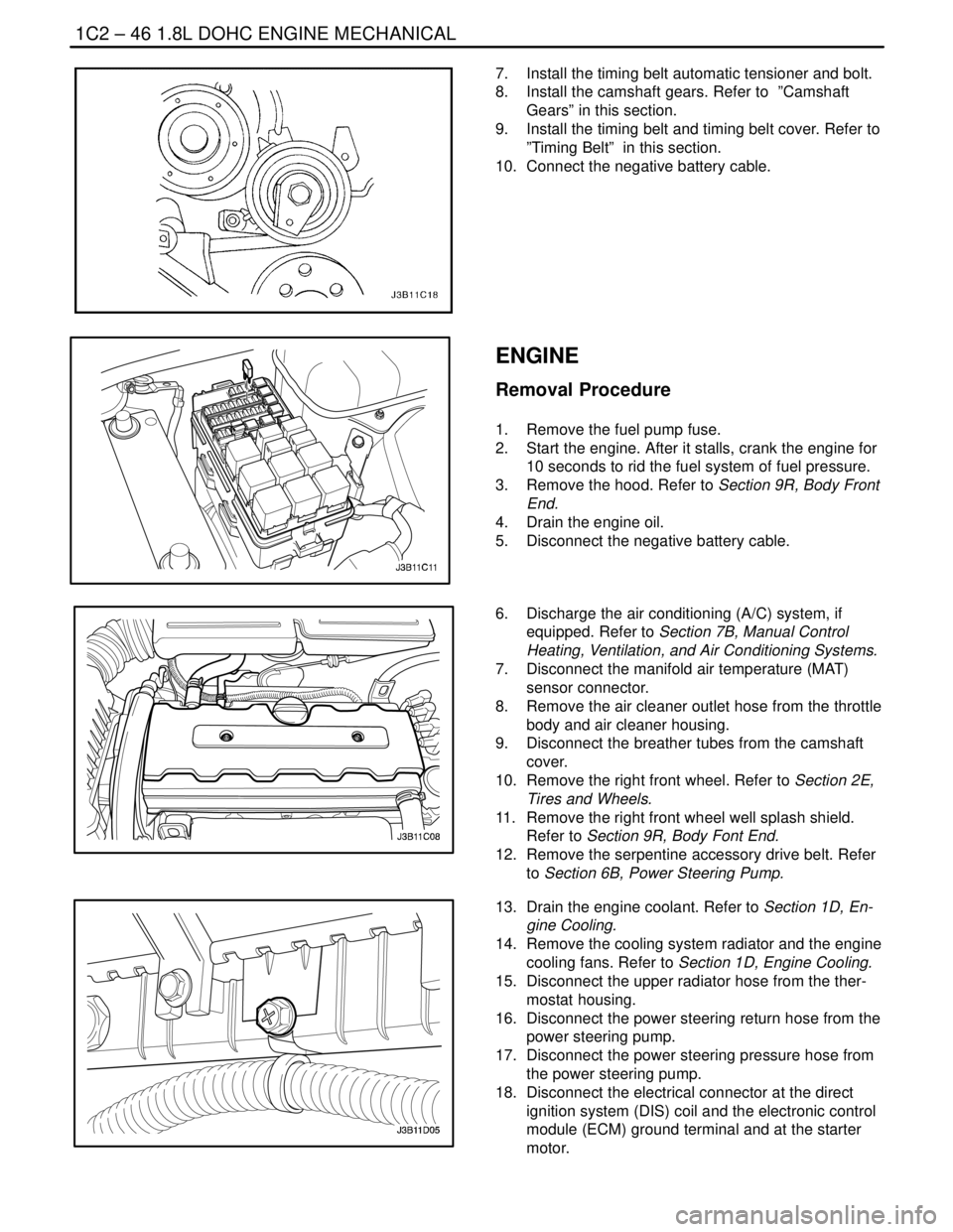
7. Install the timing belt automatic tensioner and bolt.
8. Install the camshaft gears. Refer to ”Camshaft
Gears” in this section.
9. Install the timing belt and timing belt cover. Refer to
”Timing Belt” in this section.
10. Connect the negative battery cable.
ENGINE
Removal Procedure
1. Remove the fuel pump fuse.
2. Start the engine. After it stalls, crank the engine for
10 seconds to rid the fuel system of fuel pressure.
3. Remove the hood. Refer to Section 9R, Body Front
End.
4. Drain the engine oil.
5. Disconnect the negative battery cable.
6. Discharge the air conditioning (A/C) system, if
equipped. Refer to Section 7B, Manual Control
Heating, Ventilation, and Air Conditioning Systems.
7. Disconnect the manifold air temperature (MAT)
sensor connector.
8. Remove the air cleaner outlet hose from the throttle
body and air cleaner housing.
9. Disconnect the breather tubes from the camshaft
cover.
10. Remove the right front wheel. Refer to Section 2E,
Tires and Wheels.
11. Remove the right front wheel well splash shield.
Refer to Section 9R, Body Font End.
12. Remove the serpentine accessory drive belt. Refer
to Section 6B, Power Steering Pump.
13. Drain the engine coolant. Refer to Section 1D, En-
gine Cooling.
14. Remove the cooling system radiator and the engine
cooling fans. Refer to Section 1D, Engine Cooling.
15. Disconnect the upper radiator hose from the ther-
mostat housing.
16. Disconnect the power steering return hose from the
power steering pump.
17. Disconnect the power steering pressure hose from
the power steering pump.
18. Disconnect the electrical connector at the direct
ignition system (DIS) coil and the electronic control
module (ECM) ground terminal and at the starter
motor.
Page 173 of 2643
1.8L DOHC ENGINE MECHANICAL 1C2 – 53
DAEWOO V–121 BL4
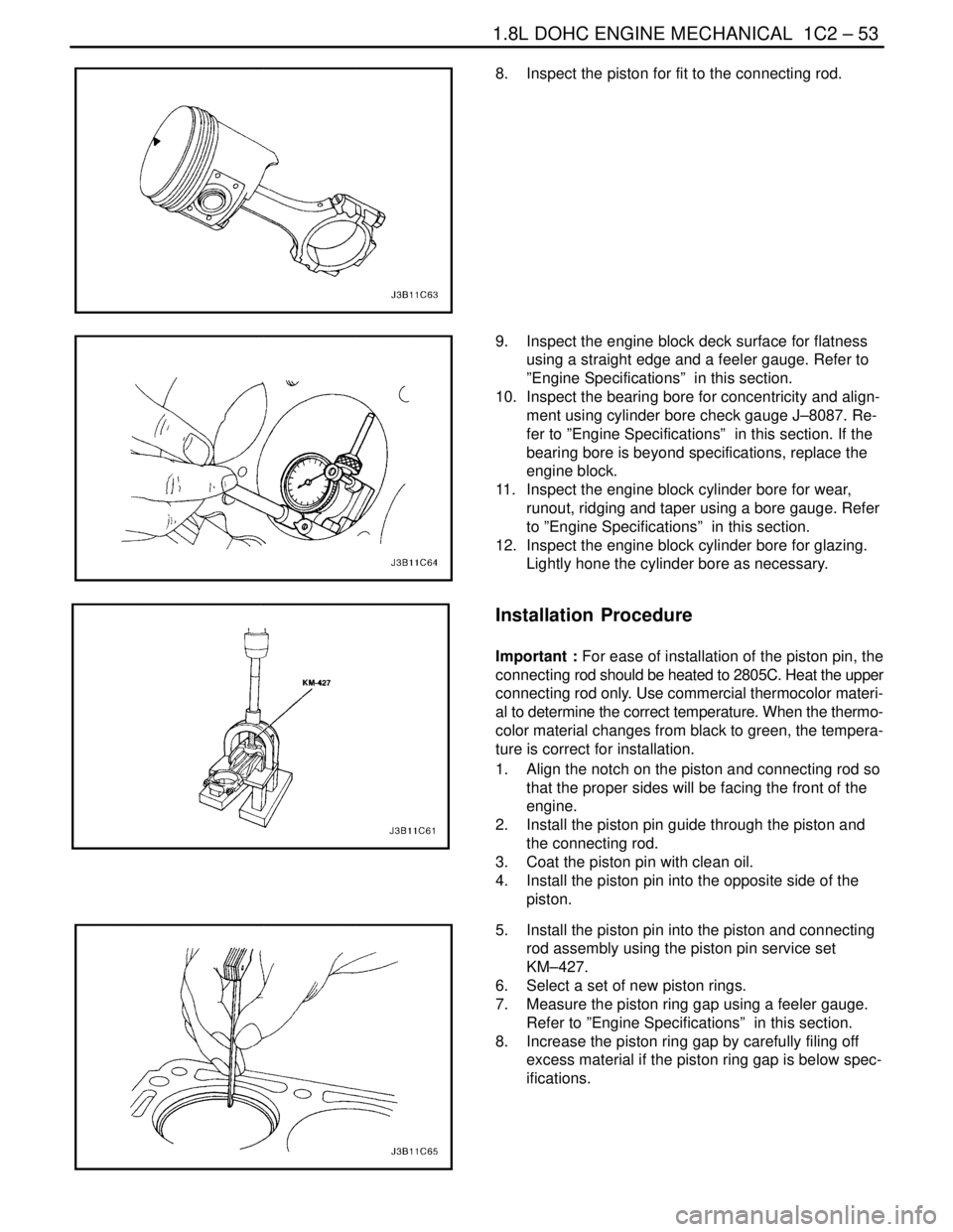
8. Inspect the piston for fit to the connecting rod.
9. Inspect the engine block deck surface for flatness
using a straight edge and a feeler gauge. Refer to
”Engine Specifications” in this section.
10. Inspect the bearing bore for concentricity and align-
ment using cylinder bore check gauge J–8087. Re-
fer to ”Engine Specifications” in this section. If the
bearing bore is beyond specifications, replace the
engine block.
11. Inspect the engine block cylinder bore for wear,
runout, ridging and taper using a bore gauge. Refer
to ”Engine Specifications” in this section.
12. Inspect the engine block cylinder bore for glazing.
Lightly hone the cylinder bore as necessary.
Installation Procedure
Important : For ease of installation of the piston pin, the
connecting rod should be heated to 2805C. Heat the upper
connecting rod only. Use commercial thermocolor materi-
al to determine the correct temperature. When the thermo-
color material changes from black to green, the tempera-
ture is correct for installation.
1. Align the notch on the piston and connecting rod so
that the proper sides will be facing the front of the
engine.
2. Install the piston pin guide through the piston and
the connecting rod.
3. Coat the piston pin with clean oil.
4. Install the piston pin into the opposite side of the
piston.
5. Install the piston pin into the piston and connecting
rod assembly using the piston pin service set
KM–427.
6. Select a set of new piston rings.
7. Measure the piston ring gap using a feeler gauge.
Refer to ”Engine Specifications” in this section.
8. Increase the piston ring gap by carefully filing off
excess material if the piston ring gap is below spec-
ifications.
Page 246 of 2643

1E – 32IENGINE ELECTRICAL
DAEWOO V–121 BL4
the same cable to the positive terminal on the other
battery. Never connect the other end to the nega-
tive terminal of the discharged battery.
CAUTION : To avoid injury do not attach the cable di-
rectly to the negative terminal of the discharged bat-
tery. Doing so could cause sparks and a possible bat-
tery explosion.
6. Clamp one end of the second cable to the negative
terminal of the booster battery. Make the final con-
nection to a solid engine ground (such as the en-
gine lift bracket) at least 450 millimeters (18 inches)
from the discharged battery.
7. Start the engine of the vehicle with the good bat-
tery. Run the engine at a moderate speed for sever-
al minutes. Then start the engine of the vehicle
which has the discharged battery.
8. Remove the jumper cables by reversing the above
sequence exactly. Remove the negative cable from
the vehicle with the discharged battery first. While
removing each clamp, take care that it does not
touch any other metal while the other end remains
attached.
GENERATOR
The Delco–Remy CS charging system has several mod-
els available, including the CS. The number denotes the
outer diameter in millimeters of the stator lamination.
CS generators are equipped with internal regulators. A
Delta stator, a rectifier bridge, and a rotor with slip rings
and brushes are electrically similar to earlier generators.
A conventional pulley and fan are used. There is no test
hole.
Unlike three–wire generators, the CS may be used with
only two connections: battery positive and an ”L’’ terminal
to the charge indicator lamp.
As with other charging systems, the charge indicator lamp
lights when the ignition switch is turned to RUN, and goes
out when the engine is running. If the charge indicator is
on with the engine running, a charging system defect is in-
dicated. This indicator light will glow at full brilliance for
several kinds of defects as well as when the system volt-
age is too high or too low.The regulator voltage setting varies with temperature and
limits the system voltage by controlling rotor field current.
At high speeds, the on–time may be 10 percent and the
off–time 90 percent. At low speeds, with high electrical
loads, on–time may be 90 percent and the off–time 10 per-
cent.
CHARGING SYSTEM
CS generators use a new type of regulator that incorpo-
rates a diode trio. A Delta stator, a rectifier bridge, and a
rotor with slip rings and brushes are electrically similar to
earlier generators. A conventional pulley and fan are used.
There is no test hole.
STARTER
Wound field starter motors have pole pieces, arranged
around the armature, which are energized by wound field
coils.
Enclosed shift lever cranking motors have the shift lever
mechanism and the solenoid plunger enclosed in the drive
housing, protecting them from exposure to dirt, icy condi-
tions, and splashes.
In the basic circuit, solenoid windings are energized when
the switch is closed. The resulting plunger and shift lever
movement causes the pinion to engage the engine fly-
wheel ring gear. The solenoid main contacts close. Crank-
ing then takes place.
When the engine starts, pinion overrun protects the arma-
ture from excessive speed until the switch is opened, at
which time the return spring causes the pinion to disen-
gage. To prevent excessive overrun, the switch should be
released immediately after the engine starts.
STARTING SYSTEM
The engine electrical system includes the battery, the igni-
tion, the starter, the generator, and all the related wiring.
Diagnostic tables will aid in troubleshooting system faults.
When a fault is traced to a particular component, refer to
that component section of the service manual.
The starting system circuit consists of the battery, the
starter motor, the ignition switch, and all the related electri-
cal wiring. All of these components are connected electri-
cally.
Page 248 of 2643

1F – 2IENGINE CONTROLS
DAEWOO V–121 BL4
TROUBLE CODE DIAGNOSIS
(1.4L/1.6L DOHC) 1F–111. . . . . . . . . . . . . . . . . . . . . . . .
Clearing Trouble Codes 1F–111. . . . . . . . . . . . . . . . . . . .
Diagnostic Trouble Codes (1.4L/1.6L DOHC) 1F–111.
DTC P0107 Manifold Absolute Pressure Sensor
Low Voltage 1F–114. . . . . . . . . . . . . . . . . . . . . . . . . . .
DTC P0108 Manifold Absolute Pressure Sensor
High Voltage 1F–117. . . . . . . . . . . . . . . . . . . . . . . . . .
DTC P0112 Intake Air Temperature Sensor Low
Voltage 1F–120. . . . . . . . . . . . . . . . . . . . . . . . . . . . . . .
DTC P0113 Intake Air Temperature Sensor High
Voltage 1F–122. . . . . . . . . . . . . . . . . . . . . . . . . . . . . . .
DTC P0117 Engine Coolant Temperature
Sensor Low Voltage 1F–125. . . . . . . . . . . . . . . . . . . .
DTC P0118 Engine Coolant Temperature
Sensor High Voltage 1F–128. . . . . . . . . . . . . . . . . . . .
DTC P0122 Throttle Position Sensor Low
Voltage 1F–131. . . . . . . . . . . . . . . . . . . . . . . . . . . . . . .
DTC P0123 Throttle Position Sensor High
Voltage 1F–134. . . . . . . . . . . . . . . . . . . . . . . . . . . . . . .
DTC P0131 Front Heated Oxygen Sensor Low
Voltage 1F–137. . . . . . . . . . . . . . . . . . . . . . . . . . . . . . .
DTC P0132 Front Heated Oxygen Sensor High
Voltage 1F–140. . . . . . . . . . . . . . . . . . . . . . . . . . . . . . .
DTC P0133 Front Heated Oxygen Sensor No
Activity 1F–142. . . . . . . . . . . . . . . . . . . . . . . . . . . . . . .
DTC P0135 Front Heated Oxygen Sensor Heater
Circuit Not Functioning 1F–145. . . . . . . . . . . . . . . . . .
DTC P0137 Rear Heated Oxygen Sensor Low
Voltage 1F–148. . . . . . . . . . . . . . . . . . . . . . . . . . . . . . .
DTC P0138 Rear Heated Oxygen Sensor High
Voltage 1F–151. . . . . . . . . . . . . . . . . . . . . . . . . . . . . . .
DTC P0140 Rear Heated Oxygen Sensor No
Activity 1F–153. . . . . . . . . . . . . . . . . . . . . . . . . . . . . . .
DTC P0141 Rear Heated Oxygen Sensor Heater
Malfunction 1F–156. . . . . . . . . . . . . . . . . . . . . . . . . . .
DTC P0171 Fuel Trim System Too Lean 1F–158. . . .
DTC P0172 Fuel Trim System Too Rich 1F–162. . . . .
DTC P0222 Main Throttle Idle Actuator (MTIA)
Low Voltage 1F–165. . . . . . . . . . . . . . . . . . . . . . . . . . .
DTC P0223 Main Throttle Idle Actuator (MTIA)
High Voltage 1F–168. . . . . . . . . . . . . . . . . . . . . . . . . .
DTC P0261 Injector 1 Low Voltage 1F–171. . . . . . . . .
DTC P0262 Injector 1 High Voltage 1F–173. . . . . . . .
DTC P0264 Injector 2 Low Voltage 1F–175. . . . . . . . .
DTC P0265 Injector 2 High Voltage 1F–177. . . . . . . .
DTC P0267 Injector 3 Low Voltage 1F–179. . . . . . . . .
DTC P0268 Injector 3 High Voltage 1F–181. . . . . . . .
DTC P0270 Injector 4 Low Voltage 1F–183. . . . . . . . .
DTC P0271 Injector 4 High Voltage 1F–185. . . . . . . . DTC P0300 Multiple Cylinder Misfire(Catalyst
Damage) 1F–188. . . . . . . . . . . . . . . . . . . . . . . . . . . . .
DTC P0300 Multiple Cylinder Misfire(Increase
Emission) 1F–192. . . . . . . . . . . . . . . . . . . . . . . . . . . . .
DTC P0327 Knock Sensor Circuit Fault
(1.4L DOHC) 1F–195. . . . . . . . . . . . . . . . . . . . . . . . . .
DTC P0327 Knock Sensor Circuit Fault
(1.6L DOHC) 1F–198. . . . . . . . . . . . . . . . . . . . . . . . . .
DTC P0335 Magnetic Crankshaft Position
Sensor Electrical Error 1F–201. . . . . . . . . . . . . . . . . .
DTC P0336 58X Crankshaft Position Sensor
No Plausible Signal 1F–204. . . . . . . . . . . . . . . . . . . .
DTC P0337 58X Crankshaft Position Sensor
No Signal 1F–207. . . . . . . . . . . . . . . . . . . . . . . . . . . . .
DTC P0341 Camshaft Position Sensor
Rationality 1F–210. . . . . . . . . . . . . . . . . . . . . . . . . . . .
DTC P0342 Camshaft Position Sensor Signal 1F–212
DTC P0351 Ignition Signal Coil A Fault 1F–214. . . . .
DTC P0352 Ignition Signal Coil B Fault 1F–216. . . . .
DTC P0400 Exhaust Gas Recirculation Out
Of Limit 1F–218. . . . . . . . . . . . . . . . . . . . . . . . . . . . . . .
DTC P0404 Exhaust Gas Recirculation
Opened 1F–221. . . . . . . . . . . . . . . . . . . . . . . . . . . . . . .
DTC P0405 EGR Pintle Position Sensor Low
Voltage 1F–224. . . . . . . . . . . . . . . . . . . . . . . . . . . . . . .
DTC P0406 EGR Pintle Position Sensor High
Voltage 1F–227. . . . . . . . . . . . . . . . . . . . . . . . . . . . . . .
DTC P0420 Catalyst Low Efficiency 1F–230. . . . . . . .
DTC P0444 EVAP Purge Control Circuit No
Signal 1F–232. . . . . . . . . . . . . . . . . . . . . . . . . . . . . . . .
DTC P0445 EVAP Purge Control Circuit Fault 1F–235
DTC P0462 Fuel Level Sensor Low Voltage
(1.6L DOHC Only) 1F–238. . . . . . . . . . . . . . . . . . . . .
DTC P0463 Fuel Level Sensor High Voltage
(1.6L DOHC Only) 1F–241. . . . . . . . . . . . . . . . . . . . .
DTC P0480 Low Speed Cooling Fan Relay
Circuit Fault (1.4L DOHC) 1F–245. . . . . . . . . . . . . . .
DTC P0480 Low Speed Cooling Fan Relay
Circuit Fault (1.6L DOHC) 1F–248. . . . . . . . . . . . . . .
DTC P0481 High Speed Cooling Fan Relay
Circuit Fault (1.4L DOHC) 1F–251. . . . . . . . . . . . . . .
DTC P0481 High Speed Cooling Fan Relay
Circuit Fault (1.6L DOHC) 1F–254. . . . . . . . . . . . . . .
DTC P0501 Vehicle Speed No Signal
(M/T Only) 1F–257. . . . . . . . . . . . . . . . . . . . . . . . . . . .
DTC P0510 Throttle Position Switch Circuit Fault
(1.4L DOHC) 1F–260. . . . . . . . . . . . . . . . . . . . . . . . . .
DTC P0510 Throttle Position Switch Circuit
Fault (1.6L DOHC) 1F–262. . . . . . . . . . . . . . . . . . . . .
DTC P0532 A/C Pressure Sensor Low Voltage 1F–264
DTC P0533 A/C Pressure Sensor High
Voltage 1F–267. . . . . . . . . . . . . . . . . . . . . . . . . . . . . . .