service DAEWOO NUBIRA 2004 Service User Guide
[x] Cancel search | Manufacturer: DAEWOO, Model Year: 2004, Model line: NUBIRA, Model: DAEWOO NUBIRA 2004Pages: 2643, PDF Size: 80.54 MB
Page 28 of 2643
GENERAL INFORMATION 0B – 21
DAEWOO V–121 BL4
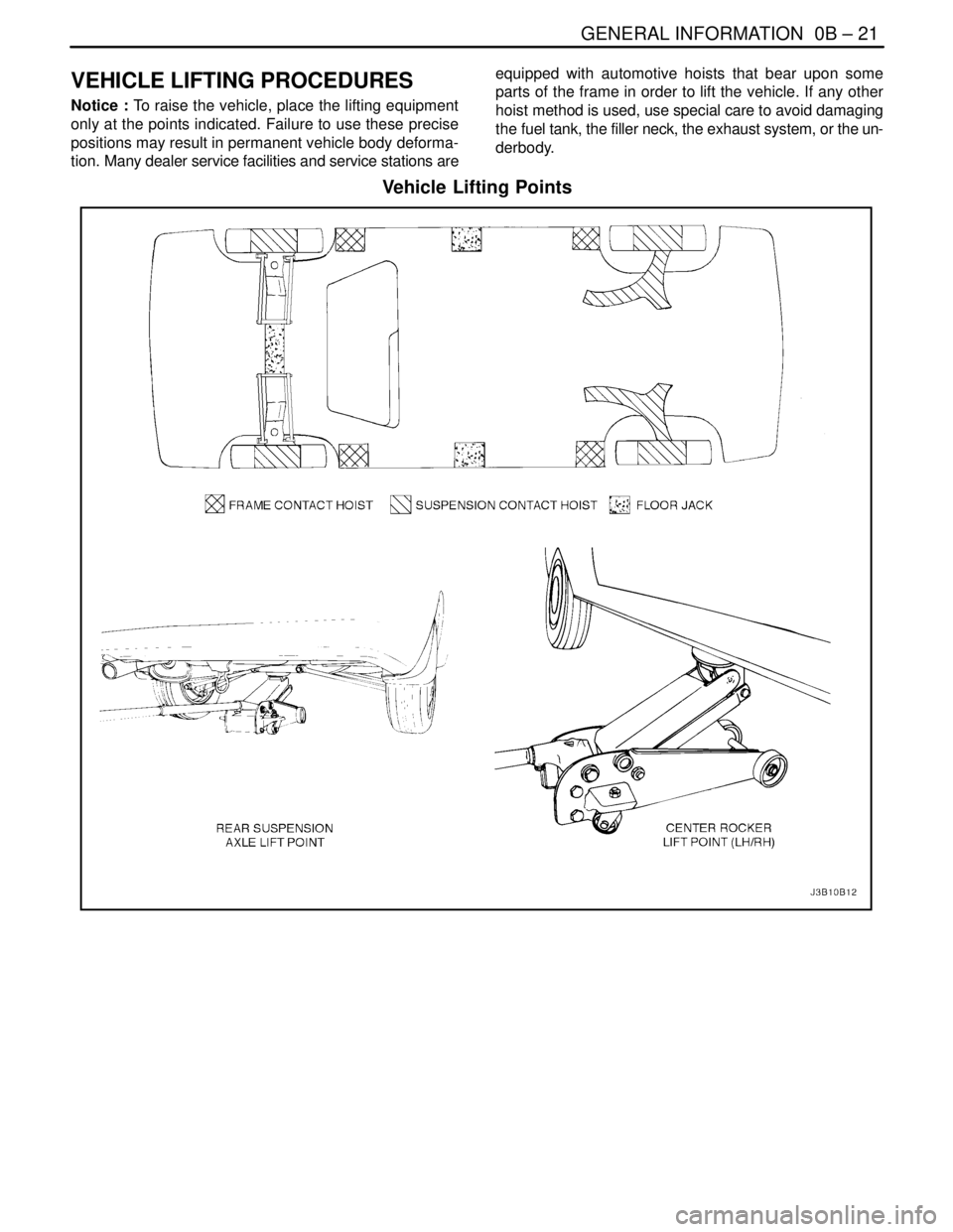
VEHICLE LIFTING PROCEDURES
Notice : To raise the vehicle, place the lifting equipment
only at the points indicated. Failure to use these precise
positions may result in permanent vehicle body deforma-
tion. Many dealer service facilities and service stations areequipped with automotive hoists that bear upon some
parts of the frame in order to lift the vehicle. If any other
hoist method is used, use special care to avoid damaging
the fuel tank, the filler neck, the exhaust system, or the un-
derbody.
Vehicle Lifting Points
Page 33 of 2643

SECTION : 1A
GENERAL ENGINE INFORMATION
TABLE OF CONTENTS
DIAGNOSIS1A–1 . . . . . . . . . . . . . . . . . . . . . . . . . . . . . . . .
Compression Test 1A–1. . . . . . . . . . . . . . . . . . . . . . . . .
Oil Pressure Test 1A–2. . . . . . . . . . . . . . . . . . . . . . . . . .
Oil Leak Diagnosis 1A–3. . . . . . . . . . . . . . . . . . . . . . . .
Knock Diagnosis 1A–4. . . . . . . . . . . . . . . . . . . . . . . . . . Noise Diagnosis 1A–8. . . . . . . . . . . . . . . . . . . . . . . . . .
GENERAL INFORMATION1A–11 . . . . . . . . . . . . . . . . . .
Cleanliness and Care 1A–11. . . . . . . . . . . . . . . . . . . . .
On–Engine Service 1A–11. . . . . . . . . . . . . . . . . . . . . . .
DIAGNOSIS
COMPRESSION TEST
Important : Disconnect the Crankshaft Position (CKP)
Sensor connector to disable the fuel and the ignition sys-
tems.
Test the compression pressure for each cylinder. Low
compression pressure may be the fault of the valves or the
pistons. The following conditions should be considered
when you check the cylinder compression:
S The engine should be at normal operating tempera-
ture.
S The throttle must be wide open.
S All the spark plugs should be removed.
S The battery must be at or near full charge.
1. Place approximately three squirts of oil from a
plunger– type oiler into each spark plug port.
2. Insert the engine compression gauge into each
spark plug port.
3. Crank test each cylinder with four to five compres-
sion strokes using the starter motor.4. The lowest reading should not be less than 70% of
the highest reading. The compression gauge read-
ing should not be less than 689 kPa (100 psi) for
any of the cylinders.
5. Examine the gauge readings obtained after the four
”puffs” per cylinder are obtained from cranking the
starter motor. The readings are explained in the
following descriptions:
S Normal Condition – Compression builds up quickly
and evenly to the specified compression on each
cylinder.
S Piston Rings Faulty – Compression is low on the
first stroke and tends to build up on following
strokes, but the compression pressure does not
reach normal. The compression pressure improves
considerably with the addition of oil into the cylin-
der.
S Valves Faulty – Low compression pressure on the
first stroke. The compression pressure does not
tend to build up on the following strokes. The com-
pression pressure does not improve much with the
addition of oil into the cylinder.
Page 43 of 2643

GENERAL ENGINE INFORMATION 1A – 11
DAEWOO V–121 BL4
GENERAL INFORMATION
CLEANLINESS AND CARE
An automobile engine is a combination of many machined,
honed, polished and lapped surfaces with tolerances that
are measured in the ten–thousandths of an inch. When
any internal engine parts are serviced, care and cleanli-
ness are important. A liberal coating of engine oil should
be applied to friction areas during assembly, to protect and
lubricate the surfaces on initial operation. Proper cleaning
and protection of machined surfaces and friction areas is
part of the repair procedure. This is considered standard
shop practice even if not specifically stated.
Whenever valve train components are removed for ser-
vice, they should be kept in order. They should be installed
in the same locations, and with the same mating surfaces,
as when they were removed.Battery cables should be disconnected before any major
work is performed on the engine. Failure to disconnect
cables may result in damage to wire harness or other elec-
trical parts.ON–ENGINE SERVICE
CAUTION : Disconnect the negative battery cable be-
fore removing or installing any electrical unit, or
when a tool or equipment could easily come in con-
tact with exposed electrical terminals. Disconnecting
this cable will help prevent personal injury and dam-
age to the vehicle. The ignition must also be in LOCK
unless otherwise noted.
Notice : Any time the air cleaner is removed, the intake
opening should be covered. This will protect against acci-
dental entrance of foreign material, which could follow the
intake passage into the cylinder and cause extensive
damage when the engine is started.
Page 44 of 2643

SECTION : 1C1
1.4L/1.6L DOHC ENGINE MECHANICAL
CAUTION : Disconnect the negative battery cable before removing or installing any electrical unit or when a tool
or equipment could easily come in contact with exposed electrical terminals. Disconnecting this cable will help
prevent personal injury and damage to the vehicle. The ignition must also be in LOCK unless otherwise noted.
TABLE OF CONTENTS
SPECIFICATIONS1C1–2 . . . . . . . . . . . . . . . . . . . . . . . . .
Engine Specifications 1C1–2. . . . . . . . . . . . . . . . . . . . .
Fastener Tightening Specifcations 1C1–5. . . . . . . . . .
SPECIAL TOOLS1C1–7 . . . . . . . . . . . . . . . . . . . . . . . . . .
Special Tools Table 1C1–7. . . . . . . . . . . . . . . . . . . . . . .
COMPONENT LOCATOR1C1–9 . . . . . . . . . . . . . . . . . . .
Cylinder Head 1C1–9. . . . . . . . . . . . . . . . . . . . . . . . . . . .
Cylinder Block 1C1–10. . . . . . . . . . . . . . . . . . . . . . . . . . .
Intake & Exhaust Manifold 1C1–12. . . . . . . . . . . . . . . .
Timing Belt 1C1–13. . . . . . . . . . . . . . . . . . . . . . . . . . . . .
Engine Mounting 1C1–14. . . . . . . . . . . . . . . . . . . . . . . .
MAINTENANCE AND REPAIR1C1–15 . . . . . . . . . . . . .
ON–VEHICLE SERVICE 1C1–15. . . . . . . . . . . . . . . . . . .
Engine Cover 1C1–15. . . . . . . . . . . . . . . . . . . . . . . . . . .
Camshaft Cover 1C1–15. . . . . . . . . . . . . . . . . . . . . . . . .
Intake Manifold 1C1–16. . . . . . . . . . . . . . . . . . . . . . . . . .
Exhaust Manifold 1C1–20. . . . . . . . . . . . . . . . . . . . . . . .
Cylinder Head and Gasket 1C1–21. . . . . . . . . . . . . . . .
Camshaft 1C1–29. . . . . . . . . . . . . . . . . . . . . . . . . . . . . . .
Timing Belt Check and Adjust 1C1–30. . . . . . . . . . . . .
Timing Belt 1C1–34. . . . . . . . . . . . . . . . . . . . . . . . . . . . . Oil Pan 1C1–38. . . . . . . . . . . . . . . . . . . . . . . . . . . . . . . . .
Oil Pump 1C1–40. . . . . . . . . . . . . . . . . . . . . . . . . . . . . . .
Engine Mount 1C1–43. . . . . . . . . . . . . . . . . . . . . . . . . . .
Camshaft Gears 1C1–45. . . . . . . . . . . . . . . . . . . . . . . . .
Rear Timing Belt Cover 1C1–46. . . . . . . . . . . . . . . . . . .
Engine 1C1–48. . . . . . . . . . . . . . . . . . . . . . . . . . . . . . . . .
Pistons and Rods 1C1–53. . . . . . . . . . . . . . . . . . . . . . . .
UNIT REPAIR 1C1–58. . . . . . . . . . . . . . . . . . . . . . . . . . . .
Cylinder Head and Valve Train Components 1C1–58.
Crankshaft 1C1–65. . . . . . . . . . . . . . . . . . . . . . . . . . . . . .
Crankshaft Bearing and Connecting Rod
Beadings – Gauging Plastics 1C1–74. . . . . . . . . . . .
GENERAL DESCRIPTION AND SYSTEM
OPERATION1C1–77 . . . . . . . . . . . . . . . . . . . . . . . . . . . .
Cylinder Head and Gasket 1C1–77. . . . . . . . . . . . . . . .
Crankshaft 1C1–77. . . . . . . . . . . . . . . . . . . . . . . . . . . . . .
Timing Belt 1C1–77. . . . . . . . . . . . . . . . . . . . . . . . . . . . .
Oil Pump 1C1–77. . . . . . . . . . . . . . . . . . . . . . . . . . . . . . .
Oil Pan 1C1–77. . . . . . . . . . . . . . . . . . . . . . . . . . . . . . . . .
Exhaust Manifold 1C1–77. . . . . . . . . . . . . . . . . . . . . . . .
Intake Manifold 1C1–77. . . . . . . . . . . . . . . . . . . . . . . . . .
Camshaft 1C1–77. . . . . . . . . . . . . . . . . . . . . . . . . . . . . . .
Page 50 of 2643
1.4L/1.6L DOHC ENGINE MECHANICAL 1C1 – 7
DAEWOO V–121 BL4
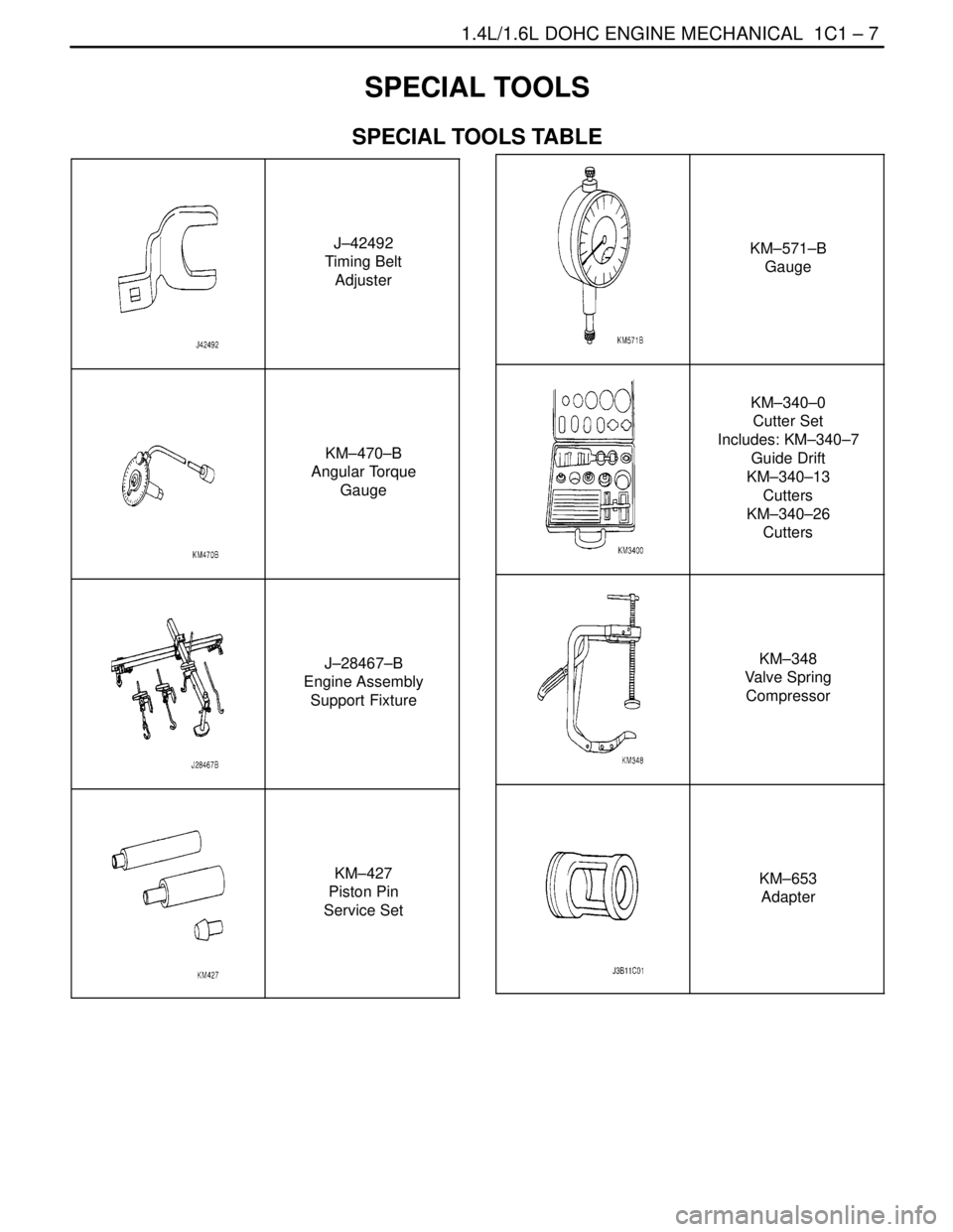
SPECIAL TOOLS
SPECIAL TOOLS TABLE
J–42492
Timing Belt
Adjuster
KM–470–B
Angular Torque
Gauge
J–28467–B
Engine Assembly
Support Fixture
KM–427
Piston Pin
Service Set
KM–571–B
Gauge
KM–340–0
Cutter Set
Includes: KM–340–7
Guide Drift
KM–340–13
Cutters
KM–340–26
Cutters
KM–348
Valve Spring
Compressor
KM–653
Adapter
Page 58 of 2643
1.4L/1.6L DOHC ENGINE MECHANICAL 1C1 – 15
DAEWOO V–121 BL4
MAINTENANCE AND REPAIR
ON–VEHICLE SERVICE
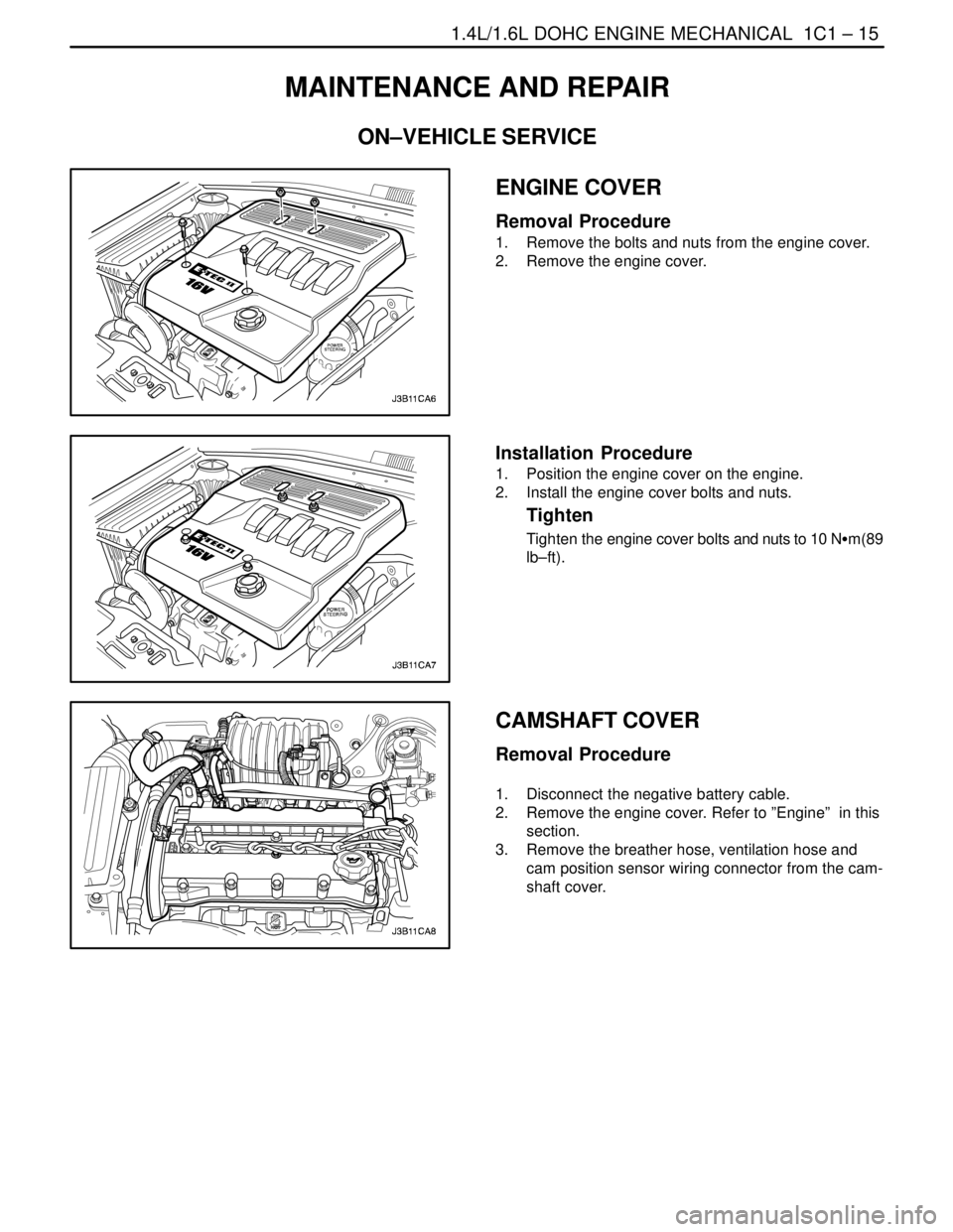
ENGINE COVER
Removal Procedure
1. Remove the bolts and nuts from the engine cover.
2. Remove the engine cover.
Installation Procedure
1. Position the engine cover on the engine.
2. Install the engine cover bolts and nuts.
Tighten
Tighten the engine cover bolts and nuts to 10 NSm(89
lb–ft).
CAMSHAFT COVER
Removal Procedure
1. Disconnect the negative battery cable.
2. Remove the engine cover. Refer to ”Engine” in this
section.
3. Remove the breather hose, ventilation hose and
cam position sensor wiring connector from the cam-
shaft cover.
Page 96 of 2643
1.4L/1.6L DOHC ENGINE MECHANICAL 1C1 – 53
DAEWOO V–121 BL4
39. Connect the lower radiator hose to the coolant pipe.
40. Connect the upper radiator hose to the thermostat
housing.
41. Connect the surge tank coolant hose to the radia-
tor.
42. Connect the heater inlet hose to the cylinder head.
43. Connect the heater outlet hose to the coolant pipe.
44. Connect the coolant surge tank hose to the coolant
pipe.
45. Connect the surge tank coolant hose to the throttle
body.
46. Connect the throttle cable to the throttle body and
the intake manifold bracket.
47. Install the fuel pump fuse.
48. Connect the negative battery cable.
49. Refill the engine crankcase with engine oil.
50. Refill the engine coolant system. Refer to Section
1D, Engine Cooling.
51. Bleed the power steering system. Refer to Section
6A, Power Steering System.
52. Refill the A/C refrigerant system, if equipped. Refer
to Section 7B, Manual Control Heating, Ventilation,
and Air Conditioning System.
53. Install the hood. Refer to Section 9R, Body Front
End.
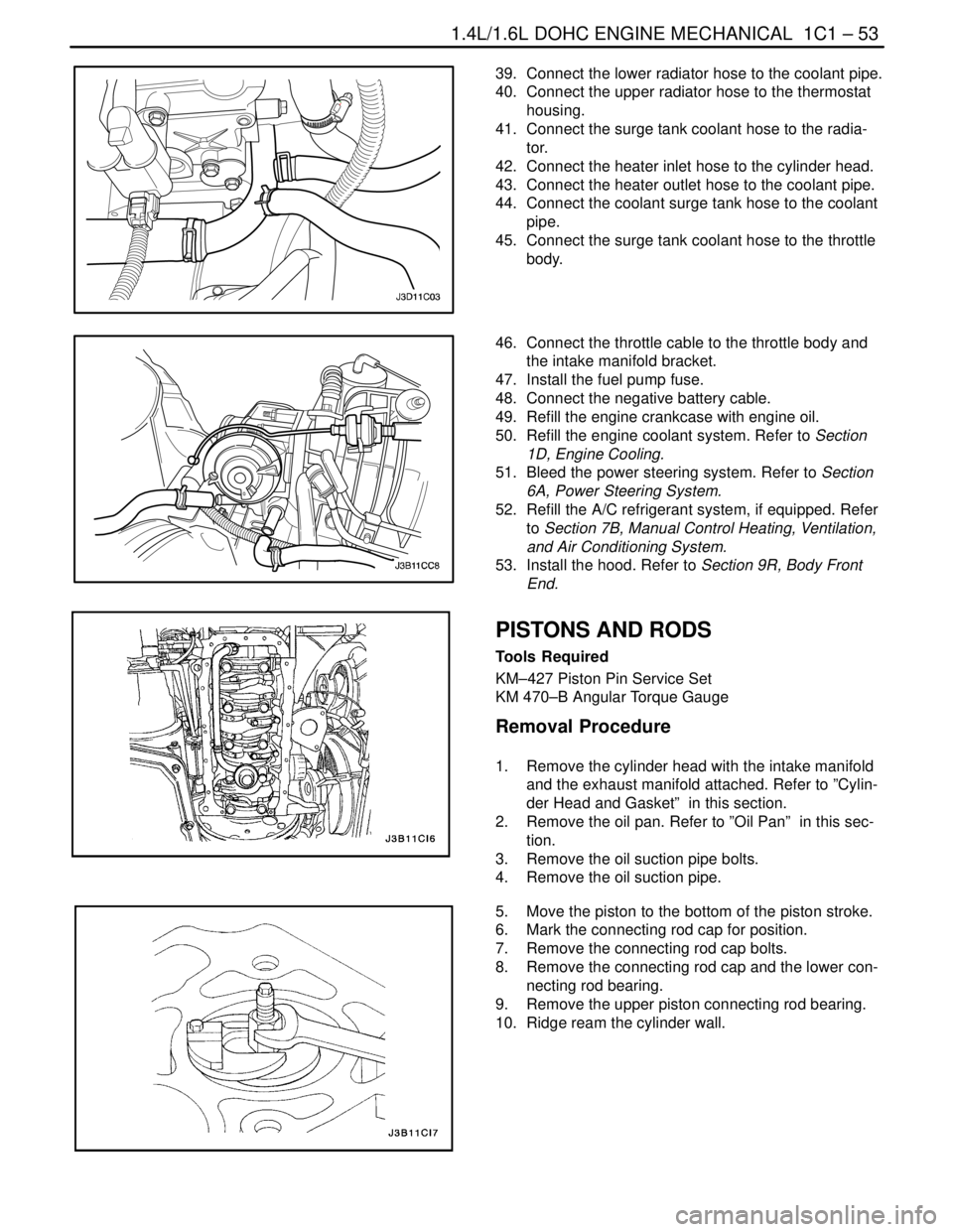
PISTONS AND RODS
Tools Required
KM–427 Piston Pin Service Set
KM 470–B Angular Torque Gauge
Removal Procedure
1. Remove the cylinder head with the intake manifold
and the exhaust manifold attached. Refer to ”Cylin-
der Head and Gasket” in this section.
2. Remove the oil pan. Refer to ”Oil Pan” in this sec-
tion.
3. Remove the oil suction pipe bolts.
4. Remove the oil suction pipe.
5. Move the piston to the bottom of the piston stroke.
6. Mark the connecting rod cap for position.
7. Remove the connecting rod cap bolts.
8. Remove the connecting rod cap and the lower con-
necting rod bearing.
9. Remove the upper piston connecting rod bearing.
10. Ridge ream the cylinder wall.
Page 97 of 2643
1C1 – 54I1.4L/1.6L DOHC ENGINE MECHANICAL
DAEWOO V–121 BL4
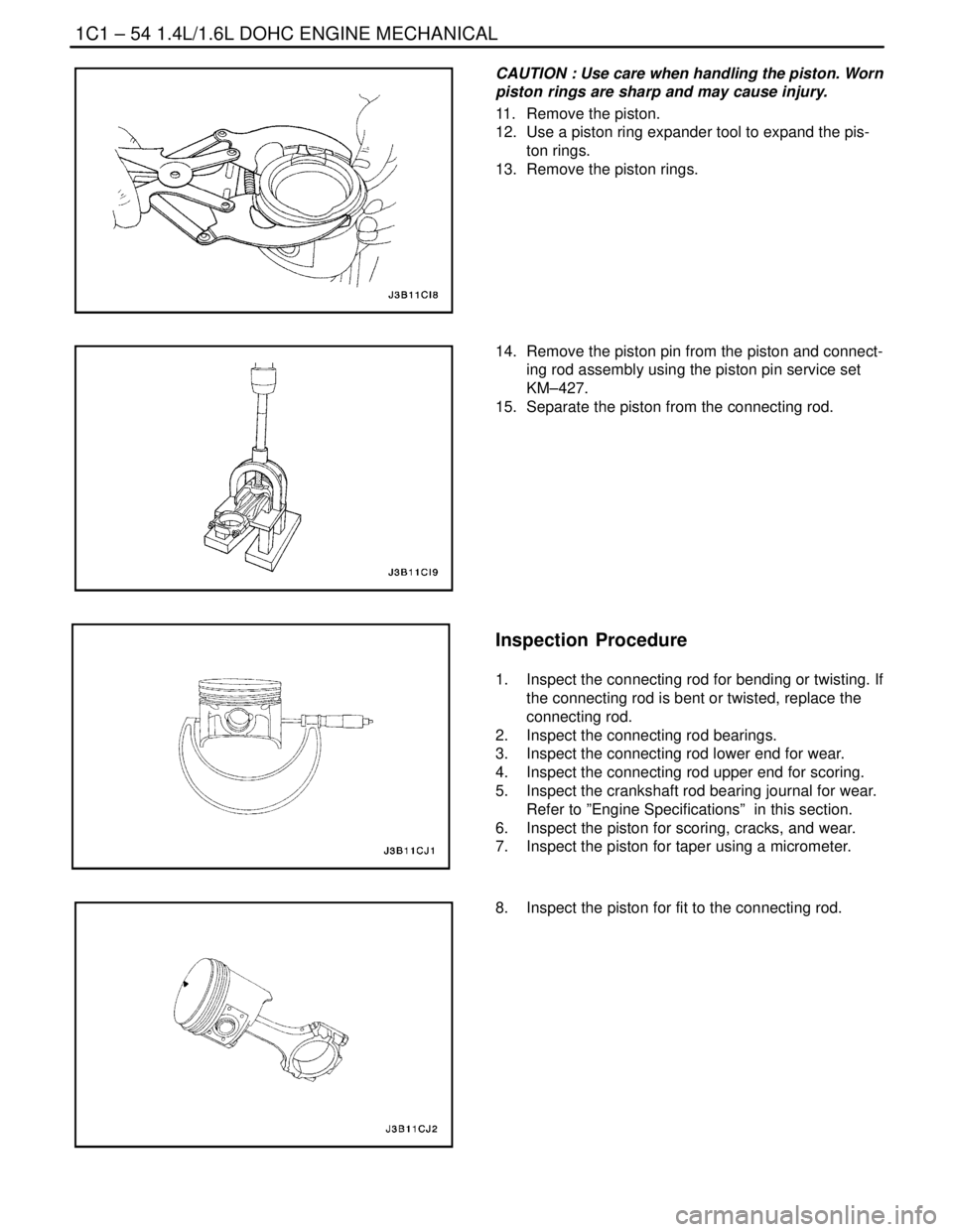
CAUTION : Use care when handling the piston. Worn
piston rings are sharp and may cause injury.
11. Remove the piston.
12. Use a piston ring expander tool to expand the pis-
ton rings.
13. Remove the piston rings.
14. Remove the piston pin from the piston and connect-
ing rod assembly using the piston pin service set
KM–427.
15. Separate the piston from the connecting rod.
Inspection Procedure
1. Inspect the connecting rod for bending or twisting. If
the connecting rod is bent or twisted, replace the
connecting rod.
2. Inspect the connecting rod bearings.
3. Inspect the connecting rod lower end for wear.
4. Inspect the connecting rod upper end for scoring.
5. Inspect the crankshaft rod bearing journal for wear.
Refer to ”Engine Specifications” in this section.
6. Inspect the piston for scoring, cracks, and wear.
7. Inspect the piston for taper using a micrometer.
8. Inspect the piston for fit to the connecting rod.
Page 98 of 2643
1.4L/1.6L DOHC ENGINE MECHANICAL 1C1 – 55
DAEWOO V–121 BL4
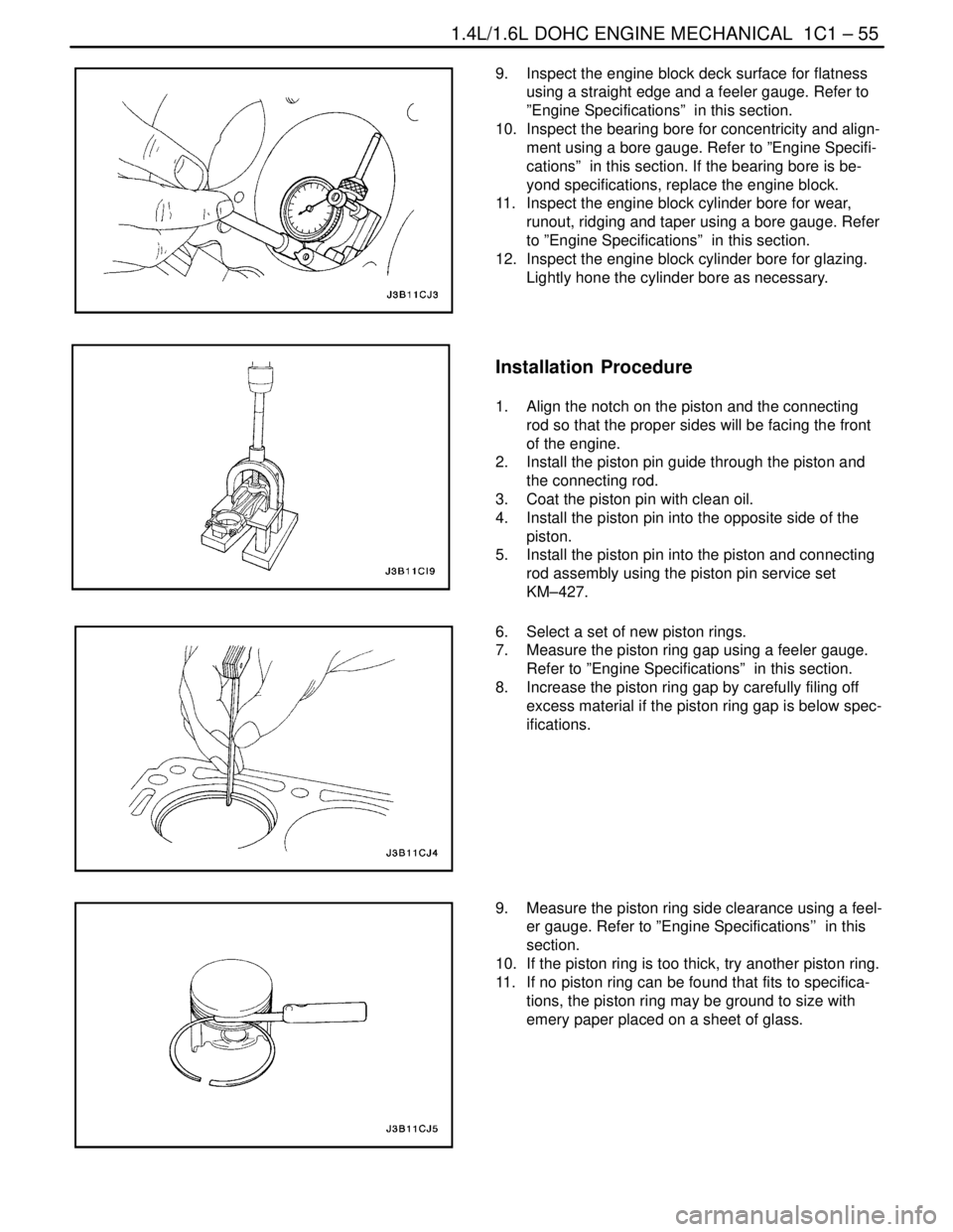
9. Inspect the engine block deck surface for flatness
using a straight edge and a feeler gauge. Refer to
”Engine Specifications” in this section.
10. Inspect the bearing bore for concentricity and align-
ment using a bore gauge. Refer to ”Engine Specifi-
cations” in this section. If the bearing bore is be-
yond specifications, replace the engine block.
11. Inspect the engine block cylinder bore for wear,
runout, ridging and taper using a bore gauge. Refer
to ”Engine Specifications” in this section.
12. Inspect the engine block cylinder bore for glazing.
Lightly hone the cylinder bore as necessary.
Installation Procedure
1. Align the notch on the piston and the connecting
rod so that the proper sides will be facing the front
of the engine.
2. Install the piston pin guide through the piston and
the connecting rod.
3. Coat the piston pin with clean oil.
4. Install the piston pin into the opposite side of the
piston.
5. Install the piston pin into the piston and connecting
rod assembly using the piston pin service set
KM–427.
6. Select a set of new piston rings.
7. Measure the piston ring gap using a feeler gauge.
Refer to ”Engine Specifications” in this section.
8. Increase the piston ring gap by carefully filing off
excess material if the piston ring gap is below spec-
ifications.
9. Measure the piston ring side clearance using a feel-
er gauge. Refer to ”Engine Specifications’’ in this
section.
10. If the piston ring is too thick, try another piston ring.
11. If no piston ring can be found that fits to specifica-
tions, the piston ring may be ground to size with
emery paper placed on a sheet of glass.
Page 105 of 2643
1C1 – 62I1.4L/1.6L DOHC ENGINE MECHANICAL
DAEWOO V–121 BL4
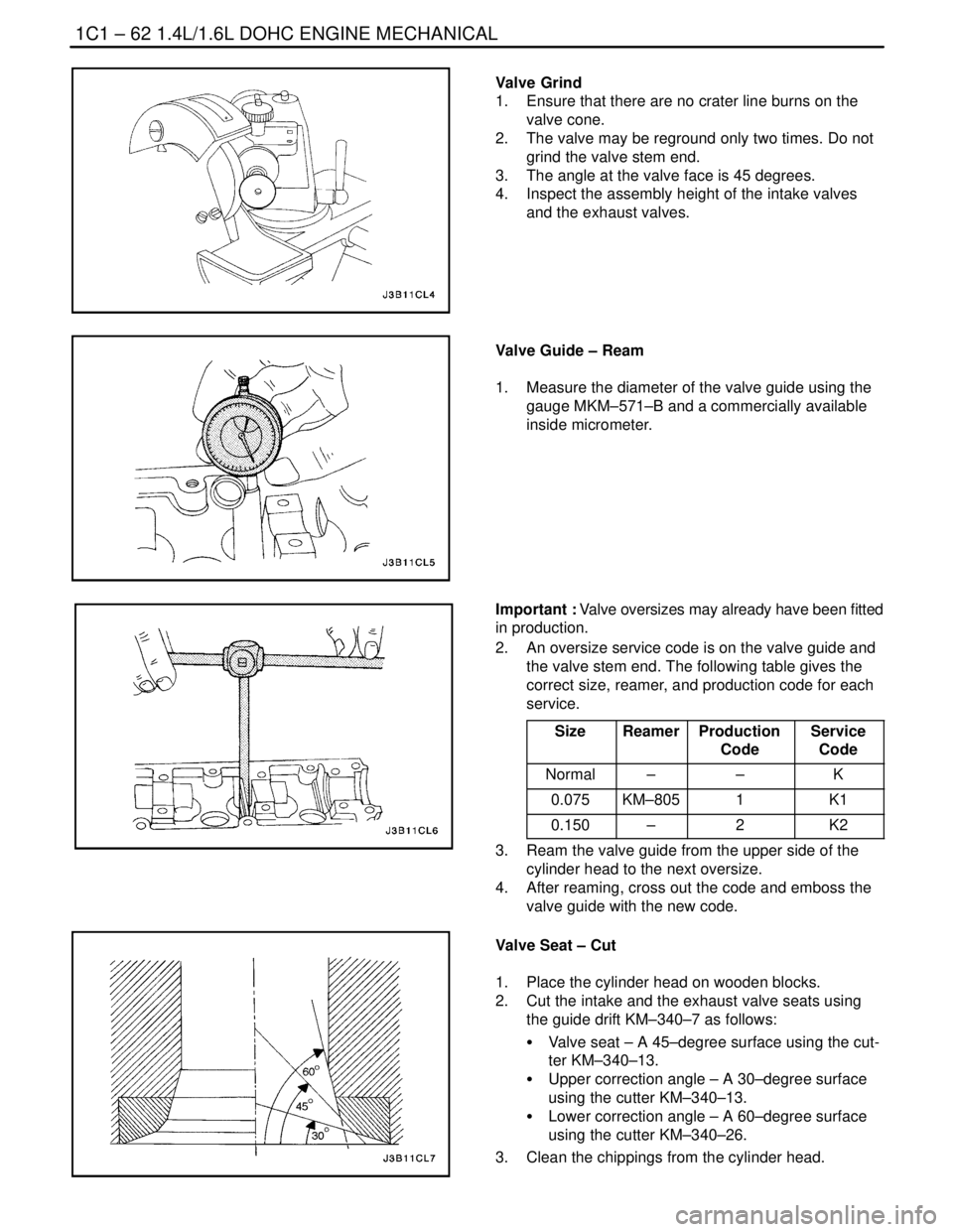
Valve Grind
1. Ensure that there are no crater line burns on the
valve cone.
2. The valve may be reground only two times. Do not
grind the valve stem end.
3. The angle at the valve face is 45 degrees.
4. Inspect the assembly height of the intake valves
and the exhaust valves.
Valve Guide – Ream
1. Measure the diameter of the valve guide using the
gauge MKM–571–B and a commercially available
inside micrometer.
Important : Valve oversizes may already have been fitted
in production.
2. An oversize service code is on the valve guide and
the valve stem end. The following table gives the
correct size, reamer, and production code for each
service.
Size
ReamerProduction
CodeService
Code
Normal––K
0.075KM–8051K1
0.150–2K2
3. Ream the valve guide from the upper side of the
cylinder head to the next oversize.
4. After reaming, cross out the code and emboss the
valve guide with the new code.
Valve Seat – Cut
1. Place the cylinder head on wooden blocks.
2. Cut the intake and the exhaust valve seats using
the guide drift KM–340–7 as follows:
S Valve seat – A 45–degree surface using the cut-
ter KM–340–13.
S Upper correction angle – A 30–degree surface
using the cutter KM–340–13.
S Lower correction angle – A 60–degree surface
using the cutter KM–340–26.
3. Clean the chippings from the cylinder head.