spring strut DAEWOO NUBIRA 2004 Service User Guide
[x] Cancel search | Manufacturer: DAEWOO, Model Year: 2004, Model line: NUBIRA, Model: DAEWOO NUBIRA 2004Pages: 2643, PDF Size: 80.54 MB
Page 947 of 2643

REAR SUSPENSION 2D – 5
DAEWOO V–121 BL4
1. Strut Mount Lock Nut
2. Strut Assembly–to–Body Nut
3. Strut Mount
4. Upper Spring Seat
5. Rear Spring
6. Strut Dampener Dust Cover
7. Hollow Bumper
8. Lower Spring Insulation Ring
9. Rear Strut Dampener
10. Strut Assembly–to–Knuckle Bolt
11. Strut Assembly–to–Knuckle Nut
12. Spindle Assembly
13. Brake Disc
14. Stabilizer Shaft Clamp Bolt
15. Stabilizer Shaft Clamp16. Stabilizer Shaft Insulator
17. Stabilizer Shaft
18. Stabilizer Shaft–to–Stabilizer Link Nut
19. Stabilizer Link
20. Rear Parallel Link–to–Knuckle Bolt
21. Rear Parallel Link
22. Trailing Link
23. Front Parallel Link
24. Trailing Link Bracket
25. Rear Crossmember–to–body Bolts
26. Rear Crossmember
27. Rear Crossmember Cover
28. Toe–in Adjustment Bolt
29. ABS Wiring Cover
30. Rear Drum
Page 959 of 2643
REAR SUSPENSION 2D – 17
DAEWOO V–121 BL4
UNIT REPAIR
SPRINGS AND INSULATORS
Tools Required
KM–329–A Spring Compressor
Disassembly Procedure
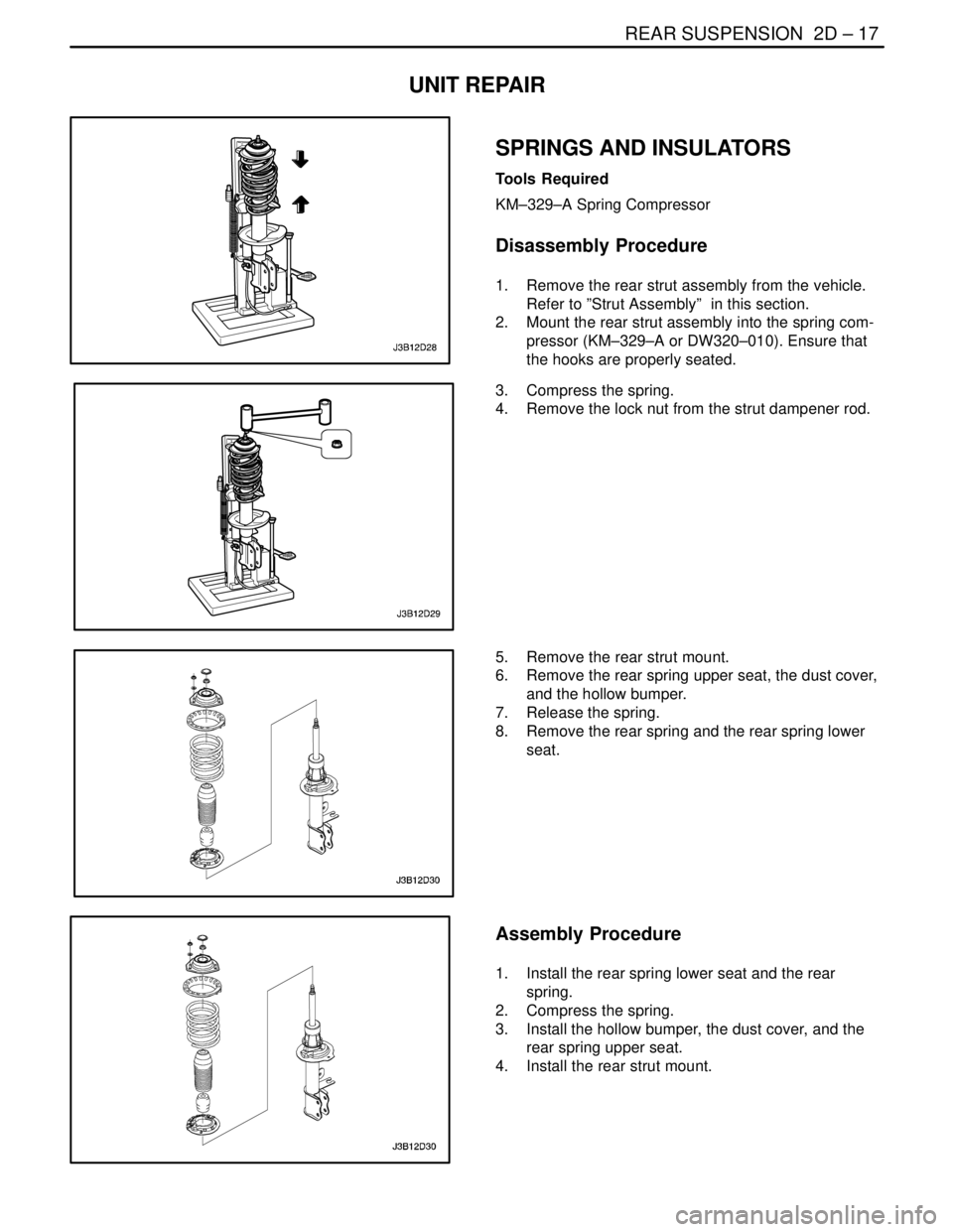
1. Remove the rear strut assembly from the vehicle.
Refer to ”Strut Assembly” in this section.
2. Mount the rear strut assembly into the spring com-
pressor (KM–329–A or DW320–010). Ensure that
the hooks are properly seated.
3. Compress the spring.
4. Remove the lock nut from the strut dampener rod.
5. Remove the rear strut mount.
6. Remove the rear spring upper seat, the dust cover,
and the hollow bumper.
7. Release the spring.
8. Remove the rear spring and the rear spring lower
seat.
Assembly Procedure
1. Install the rear spring lower seat and the rear
spring.
2. Compress the spring.
3. Install the hollow bumper, the dust cover, and the
rear spring upper seat.
4. Install the rear strut mount.
Page 960 of 2643
2D – 18IREAR SUSPENSION
DAEWOO V–121 BL4
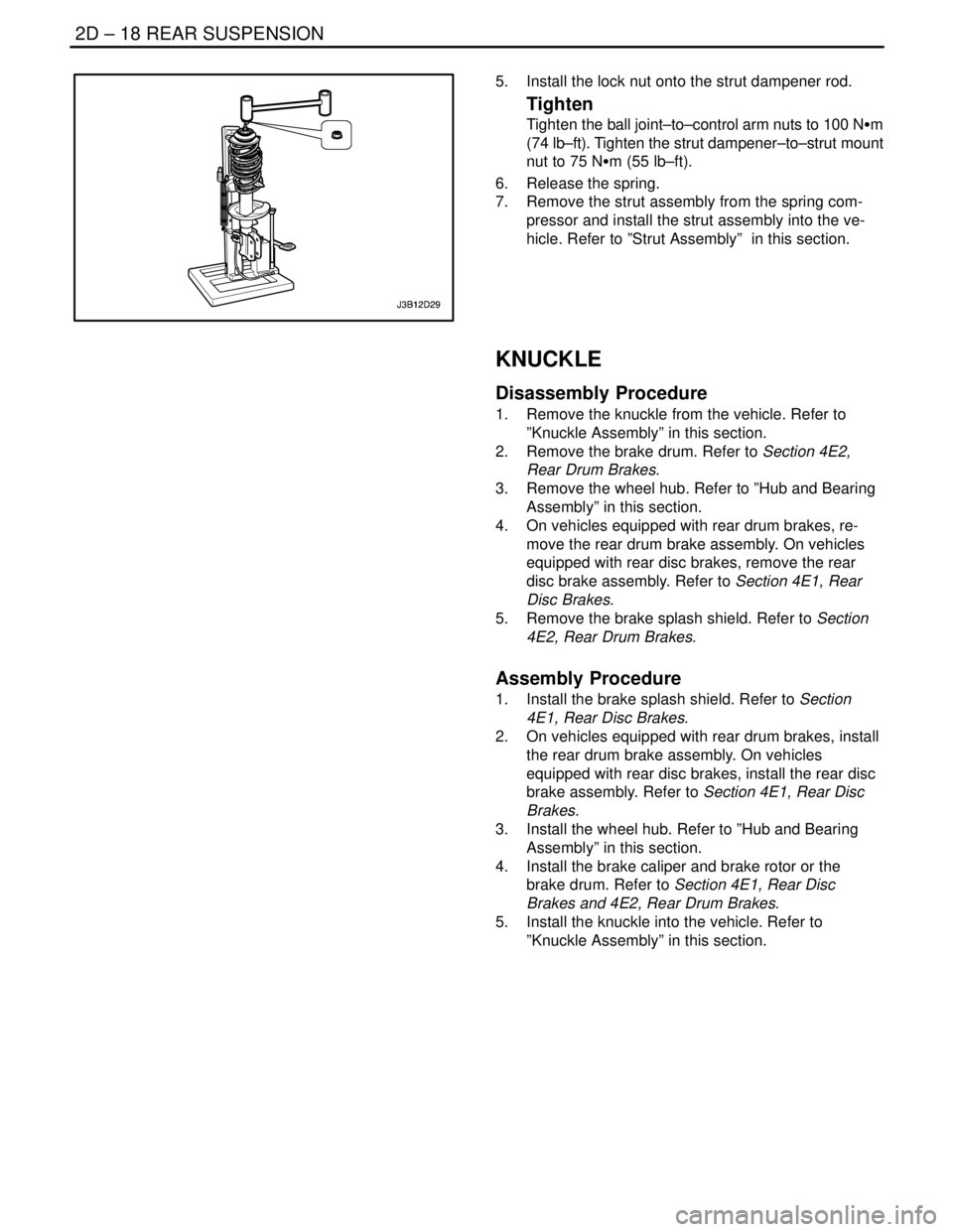
5. Install the lock nut onto the strut dampener rod.
Tighten
Tighten the ball joint–to–control arm nuts to 100 NSm
(74 lb–ft). Tighten the strut dampener–to–strut mount
nut to 75 NSm (55 lb–ft).
6. Release the spring.
7. Remove the strut assembly from the spring com-
pressor and install the strut assembly into the ve-
hicle. Refer to ”Strut Assembly” in this section.
KNUCKLE
Disassembly Procedure
1. Remove the knuckle from the vehicle. Refer to
”Knuckle Assembly” in this section.
2. Remove the brake drum. Refer to Section 4E2,
Rear Drum Brakes.
3. Remove the wheel hub. Refer to ”Hub and Bearing
Assembly” in this section.
4. On vehicles equipped with rear drum brakes, re-
move the rear drum brake assembly. On vehicles
equipped with rear disc brakes, remove the rear
disc brake assembly. Refer to Section 4E1, Rear
Disc Brakes.
5. Remove the brake splash shield. Refer to Section
4E2, Rear Drum Brakes.
Assembly Procedure
1. Install the brake splash shield. Refer to Section
4E1, Rear Disc Brakes.
2. On vehicles equipped with rear drum brakes, install
the rear drum brake assembly. On vehicles
equipped with rear disc brakes, install the rear disc
brake assembly. Refer to Section 4E1, Rear Disc
Brakes.
3. Install the wheel hub. Refer to ”Hub and Bearing
Assembly” in this section.
4. Install the brake caliper and brake rotor or the
brake drum. Refer to Section 4E1, Rear Disc
Brakes and 4E2, Rear Drum Brakes.
5. Install the knuckle into the vehicle. Refer to
”Knuckle Assembly” in this section.
Page 962 of 2643

2D – 20IREAR SUSPENSION
DAEWOO V–121 BL4
GENERAL DESCRIPTION
AND SYSTEM OPERATION
REAR SUSPENSION
The rear suspension is fully independent and consists of
a crossmember with four parallel links, two trailing links,
two strut assemblies with coil springs and insulators, and
two knuckles containing the hub and bearing assemblies.
The strut assemblies support the weight of the vehicle us-
ing coil springs positioned around the strut dampeners.The coil springs are seated on insulators attached to the
upper mount and the lower spring seat of the strut assem-
bly. The parallel links and the trailing link bracket have rub-
ber isolator bushings at each end and are attached to the
crossmember and the knuckle. The rear parallel link is at-
tached to the crossmember through adjustment cams that
are used to adjust rear toe. The trailing links are attached
to the body, through the trailing link bracket, and the bot-
tom of the knuckle. A forged knuckle bolts to each strut as-
sembly. Lateral movement of the knuckle is controlled by
the parallel links. Fore and aft movement of the knuckle is
controlled by the trailing link.