width DAEWOO NUBIRA 2004 Service User Guide
[x] Cancel search | Manufacturer: DAEWOO, Model Year: 2004, Model line: NUBIRA, Model: DAEWOO NUBIRA 2004Pages: 2643, PDF Size: 80.54 MB
Page 181 of 2643
1.8L DOHC ENGINE MECHANICAL 1C2 – 61
DAEWOO V–121 BL4
4. Inspect the dimension for the valve seat width.
S Intake: 1.2 to 1.4 mm (0.047 to 0.055 inch).
S Exhaust: 1.4 to 1.8 mm (0.055 to 0.070 inch).
5. Inspect the assembly height of the intake valves
and the exhaust valves. If the dimension is exceed-
ed, install new valves. Inspect the assembly height
of the intake valves and the exhaust valves again. If
the valve assembly height is still too large despite
replacing the valves, replace the cylinder head.
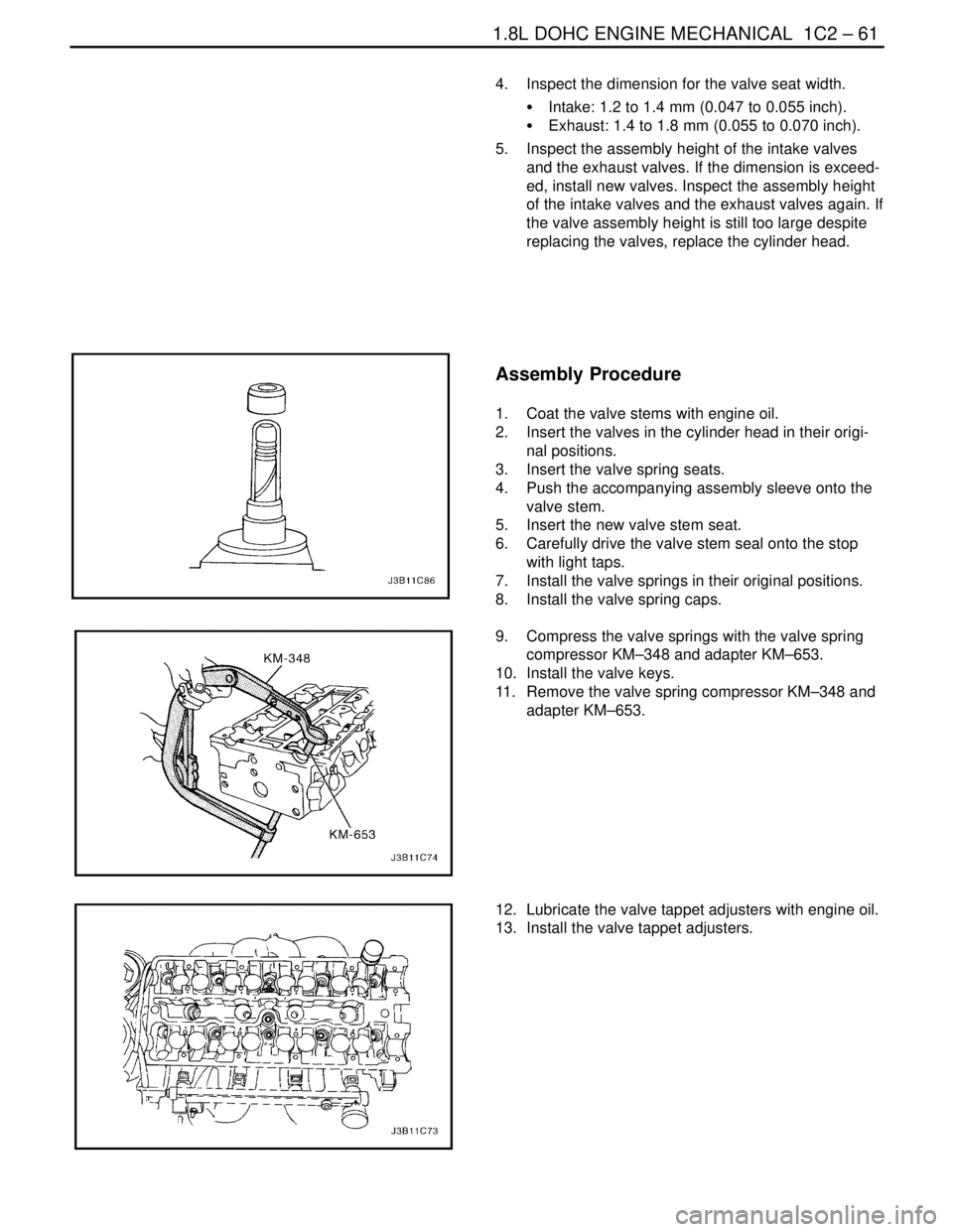
Assembly Procedure
1. Coat the valve stems with engine oil.
2. Insert the valves in the cylinder head in their origi-
nal positions.
3. Insert the valve spring seats.
4. Push the accompanying assembly sleeve onto the
valve stem.
5. Insert the new valve stem seat.
6. Carefully drive the valve stem seal onto the stop
with light taps.
7. Install the valve springs in their original positions.
8. Install the valve spring caps.
9. Compress the valve springs with the valve spring
compressor KM–348 and adapter KM–653.
10. Install the valve keys.
11. Remove the valve spring compressor KM–348 and
adapter KM–653.
12. Lubricate the valve tappet adjusters with engine oil.
13. Install the valve tappet adjusters.
Page 187 of 2643
1.8L DOHC ENGINE MECHANICAL 1C2 – 67
DAEWOO V–121 BL4
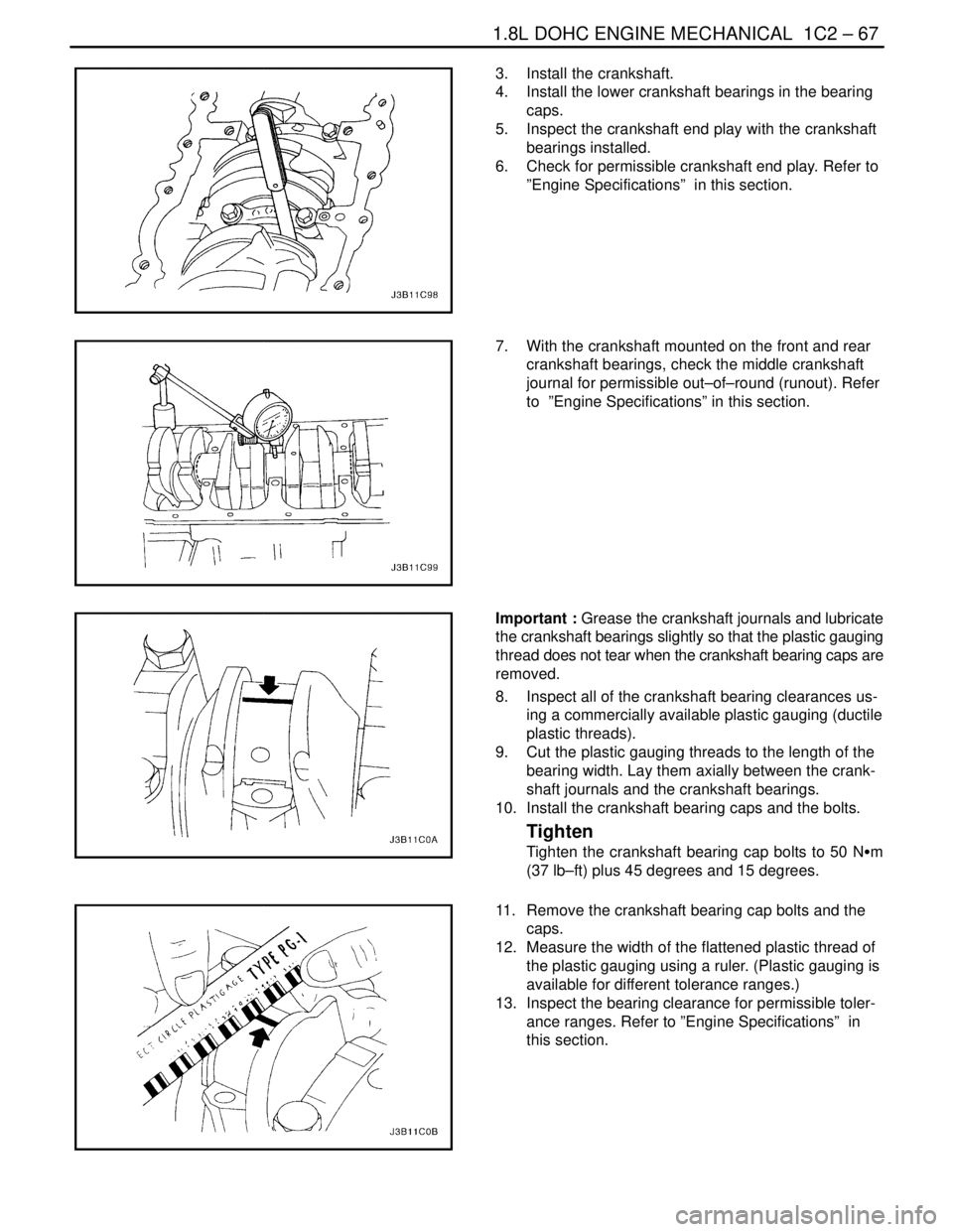
3. Install the crankshaft.
4. Install the lower crankshaft bearings in the bearing
caps.
5. Inspect the crankshaft end play with the crankshaft
bearings installed.
6. Check for permissible crankshaft end play. Refer to
”Engine Specifications” in this section.
7. With the crankshaft mounted on the front and rear
crankshaft bearings, check the middle crankshaft
journal for permissible out–of–round (runout). Refer
to ”Engine Specifications” in this section.
Important : Grease the crankshaft journals and lubricate
the crankshaft bearings slightly so that the plastic gauging
thread does not tear when the crankshaft bearing caps are
removed.
8. Inspect all of the crankshaft bearing clearances us-
ing a commercially available plastic gauging (ductile
plastic threads).
9. Cut the plastic gauging threads to the length of the
bearing width. Lay them axially between the crank-
shaft journals and the crankshaft bearings.
10. Install the crankshaft bearing caps and the bolts.
Tighten
Tighten the crankshaft bearing cap bolts to 50 NSm
(37 lb–ft) plus 45 degrees and 15 degrees.
11. Remove the crankshaft bearing cap bolts and the
caps.
12. Measure the width of the flattened plastic thread of
the plastic gauging using a ruler. (Plastic gauging is
available for different tolerance ranges.)
13. Inspect the bearing clearance for permissible toler-
ance ranges. Refer to ”Engine Specifications” in
this section.
Page 188 of 2643
1C2 – 68I1.8L DOHC ENGINE MECHANICAL
DAEWOO V–121 BL4
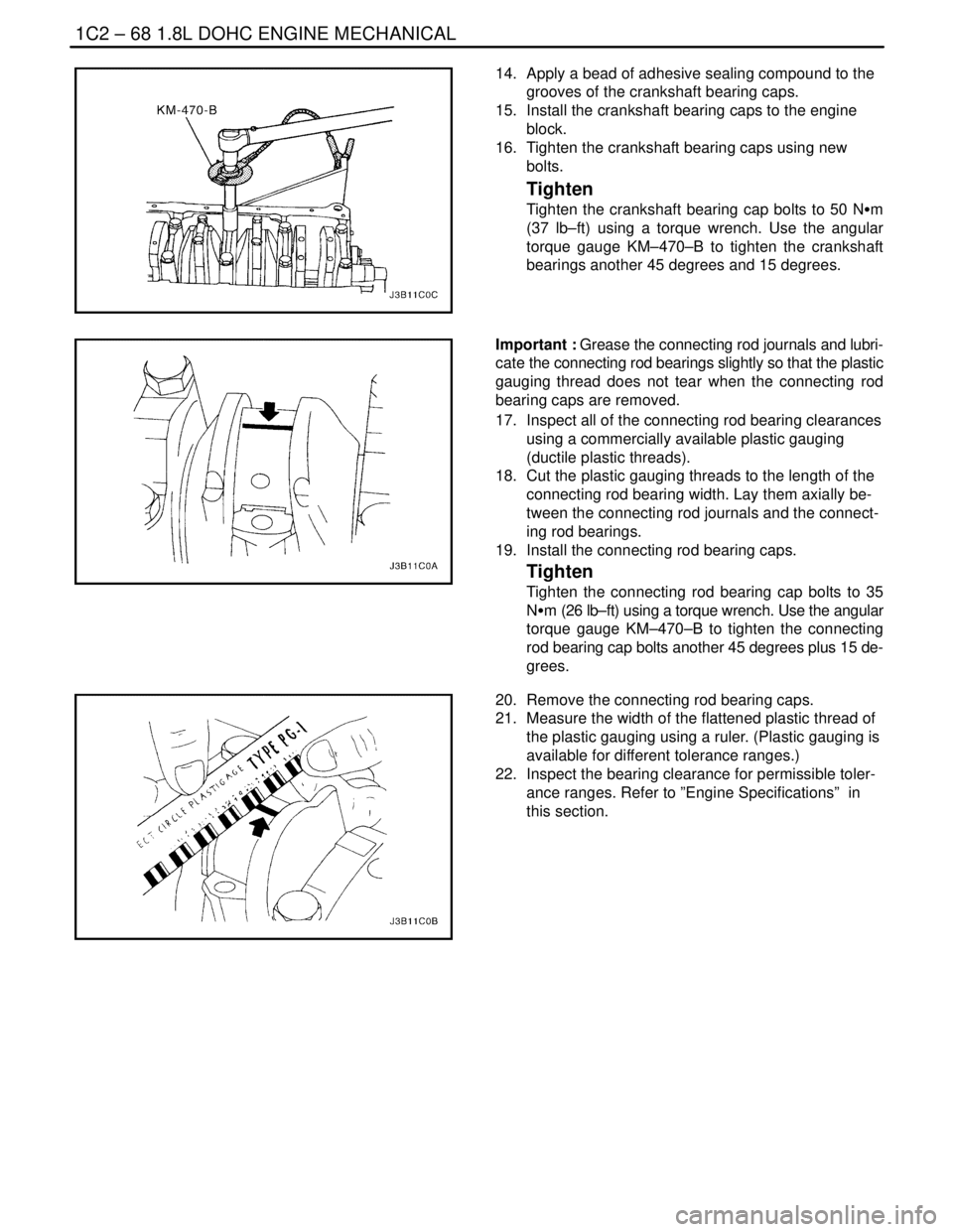
14. Apply a bead of adhesive sealing compound to the
grooves of the crankshaft bearing caps.
15. Install the crankshaft bearing caps to the engine
block.
16. Tighten the crankshaft bearing caps using new
bolts.
Tighten
Tighten the crankshaft bearing cap bolts to 50 NSm
(37 lb–ft) using a torque wrench. Use the angular
torque gauge KM–470–B to tighten the crankshaft
bearings another 45 degrees and 15 degrees.
Important : Grease the connecting rod journals and lubri-
cate the connecting rod bearings slightly so that the plastic
gauging thread does not tear when the connecting rod
bearing caps are removed.
17. Inspect all of the connecting rod bearing clearances
using a commercially available plastic gauging
(ductile plastic threads).
18. Cut the plastic gauging threads to the length of the
connecting rod bearing width. Lay them axially be-
tween the connecting rod journals and the connect-
ing rod bearings.
19. Install the connecting rod bearing caps.
Tighten
Tighten the connecting rod bearing cap bolts to 35
NSm (26 lb–ft) using a torque wrench. Use the angular
torque gauge KM–470–B to tighten the connecting
rod bearing cap bolts another 45 degrees plus 15 de-
grees.
20. Remove the connecting rod bearing caps.
21. Measure the width of the flattened plastic thread of
the plastic gauging using a ruler. (Plastic gauging is
available for different tolerance ranges.)
22. Inspect the bearing clearance for permissible toler-
ance ranges. Refer to ”Engine Specifications” in
this section.
Page 193 of 2643
1.8L DOHC ENGINE MECHANICAL 1C2 – 73
DAEWOO V–121 BL4
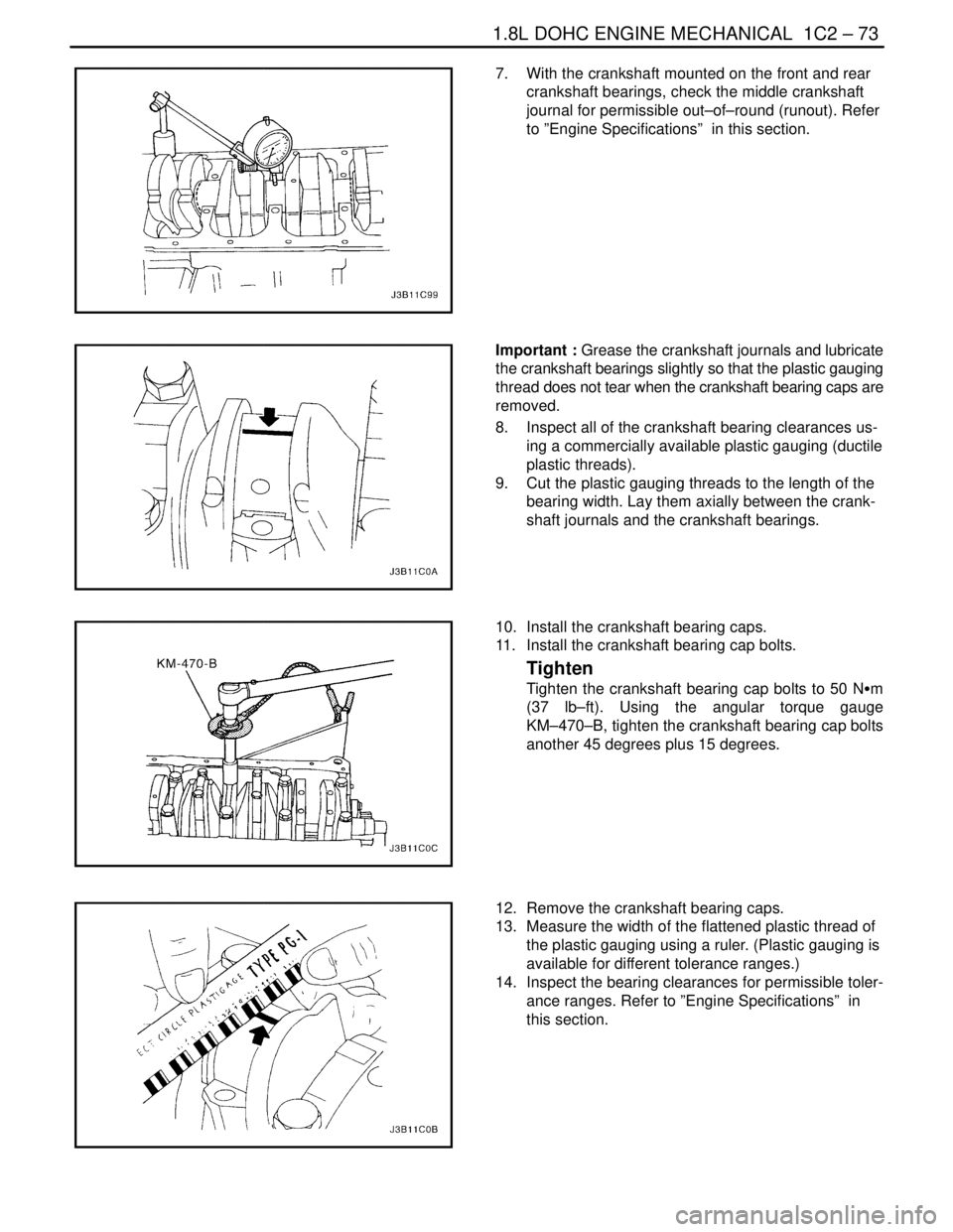
7. With the crankshaft mounted on the front and rear
crankshaft bearings, check the middle crankshaft
journal for permissible out–of–round (runout). Refer
to ”Engine Specifications” in this section.
Important : Grease the crankshaft journals and lubricate
the crankshaft bearings slightly so that the plastic gauging
thread does not tear when the crankshaft bearing caps are
removed.
8. Inspect all of the crankshaft bearing clearances us-
ing a commercially available plastic gauging (ductile
plastic threads).
9. Cut the plastic gauging threads to the length of the
bearing width. Lay them axially between the crank-
shaft journals and the crankshaft bearings.
10. Install the crankshaft bearing caps.
11. Install the crankshaft bearing cap bolts.
Tighten
Tighten the crankshaft bearing cap bolts to 50 NSm
(37 lb–ft). Using the angular torque gauge
KM–470–B, tighten the crankshaft bearing cap bolts
another 45 degrees plus 15 degrees.
12. Remove the crankshaft bearing caps.
13. Measure the width of the flattened plastic thread of
the plastic gauging using a ruler. (Plastic gauging is
available for different tolerance ranges.)
14. Inspect the bearing clearances for permissible toler-
ance ranges. Refer to ”Engine Specifications” in
this section.
Page 194 of 2643
1C2 – 74I1.8L DOHC ENGINE MECHANICAL
DAEWOO V–121 BL4
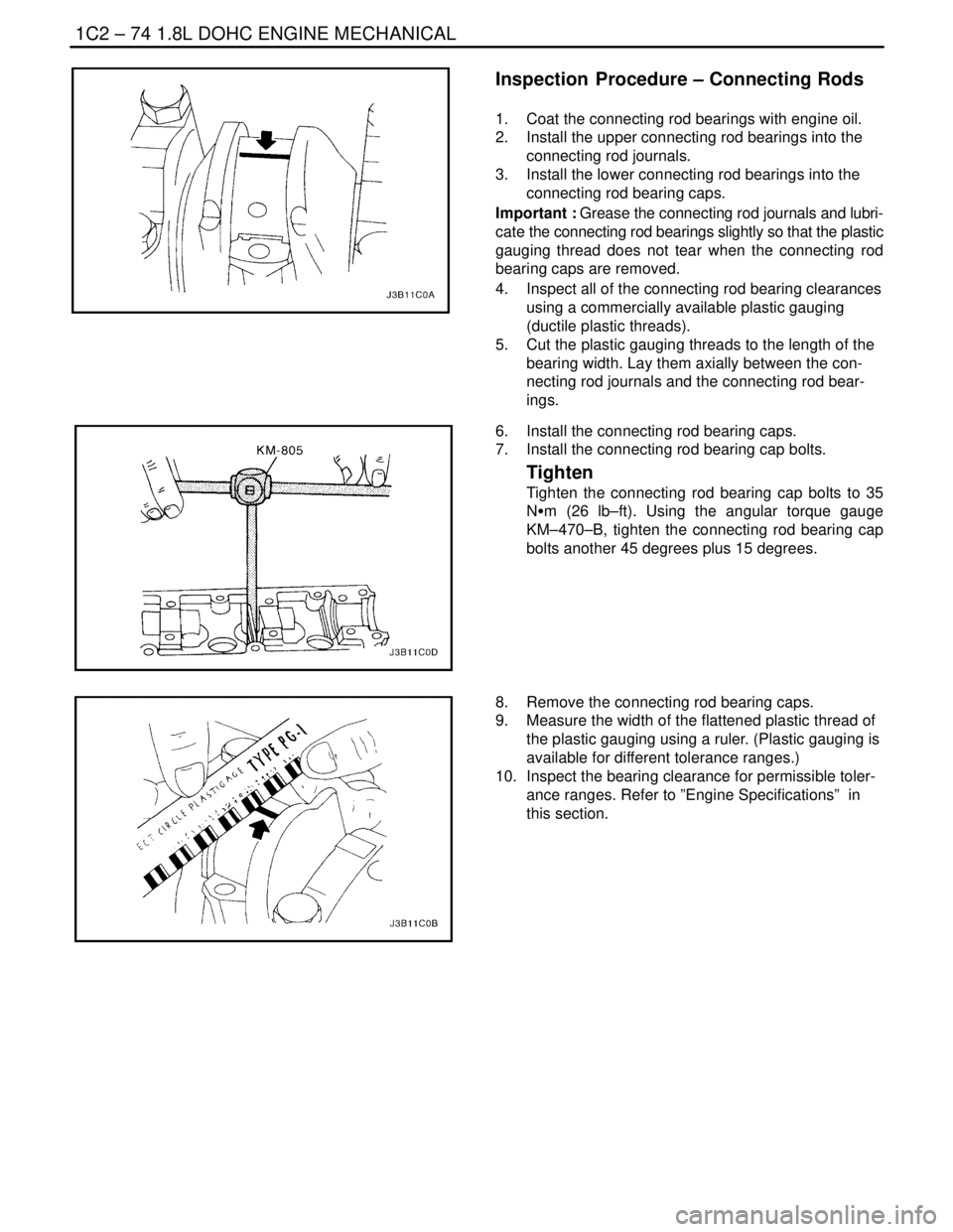
Inspection Procedure – Connecting Rods
1. Coat the connecting rod bearings with engine oil.
2. Install the upper connecting rod bearings into the
connecting rod journals.
3. Install the lower connecting rod bearings into the
connecting rod bearing caps.
Important : Grease the connecting rod journals and lubri-
cate the connecting rod bearings slightly so that the plastic
gauging thread does not tear when the connecting rod
bearing caps are removed.
4. Inspect all of the connecting rod bearing clearances
using a commercially available plastic gauging
(ductile plastic threads).
5. Cut the plastic gauging threads to the length of the
bearing width. Lay them axially between the con-
necting rod journals and the connecting rod bear-
ings.
6. Install the connecting rod bearing caps.
7. Install the connecting rod bearing cap bolts.
Tighten
Tighten the connecting rod bearing cap bolts to 35
NSm (26 lb–ft). Using the angular torque gauge
KM–470–B, tighten the connecting rod bearing cap
bolts another 45 degrees plus 15 degrees.
8. Remove the connecting rod bearing caps.
9. Measure the width of the flattened plastic thread of
the plastic gauging using a ruler. (Plastic gauging is
available for different tolerance ranges.)
10. Inspect the bearing clearance for permissible toler-
ance ranges. Refer to ”Engine Specifications” in
this section.
Page 253 of 2643

ENGINE CONTROLS 1F – 7
DAEWOO V–121 BL4
Parameter ValueScaling
A/C RequestYes/NoNo
A/C ClutchOn/OffOff
Fuel Pump CommandOn/OffOn
Closed LoopYes/NoYe s
Throttle At IdleYes/NoNo
O2 Ready (B1–S1)Yes/NoYe s
Knock PresentYes/NoNo
Fan LowOn/OffOn/Off
Fan HighOn/OffOn/Off
TCC Engaged (Only AT)Yes/NoYe s
Park/Neutral (Only AT)P/N and R/N/DP/N
Fuel Level InputVvaries
Fuel Level Output%varies
Fuel Trim Cell–18
G–SensorV1.1 – 3.7 V (Non–ABS Only)
Engine RuntimeHH:MM:SSHours:Minutes:Seconds
* Condition: Warmed up, idle, park or neutral, A/C off
ENGINE DATA DISPLAY TABLE
DEFINITIONS
ECM Data Description
The following information will assist in diagnosing emis-
sion or driveability problems. A first technician can view
the displays while the vehicle is being driven by second
technician. Refer to Powertrain On–Board Diagnostic
(EOBD) System Check for addition information.
A/C Clutch
The A/C Relay represents the commanded state of the
A/C clutch control relay. The A/C clutch should be en-
gaged when the scan tool displays ON.
A/C Pressure
The A/C High Side displays the pressure value of the A/C
refrigerant pressure sensor. The A/C High Side helps to
diagnose the diagnostic trouble code (DTC) P0533.
A/C Request
The A/C Request represents whether the air conditioning
is being requested from the HVAC selector. The input is re-
ceived by the instrument panel cluster and then sent serial
data to the ECM and finally to the scan tool over KWP 2000
serial data.
Air Fuel Ratio
The Air Fuel Ration indicates the air to fuel ratio based on
the Front Heated Oxygen Sensor (HO2S1) inputs. The
ECM uses the fuel trims to adjust fueling in order to at-
tempt to maintain an air fuel ratio of 14.7:1.BARO
The Barometric Pressure (BARO) sensor measures the
change in the intake manifold pressure which results from
altitude changes. This value is updated at ignition ON and
also at Wide Open Throttle (WOT).
Base Injection PWM
Indicates the base Pulse Width Modulation (PWM) or ON
time of the indicated cylinder injector in milliseconds.
When the engine load is increased, the injector pulse width
will increase.
Calculated Air Flow
The calculated air flow is a calculation based on manifold
absolute pressure. The calculation is used in several diag-
nostics to determine when to run the diagnostics.
Desired Idle Speed
The ECM commands the idle speed. The ECM compen-
sates for various engine loads in order to maintain the de-
sired idle speed. The actual engine speed should remain
close to the desired idle under the various engine loads
with the engine idling.
Engine Coolant Temperature
The Engine Coolant Temperature (ECT) sensor sends en-
gine temperature information to the ECM. The ECM sup-
plies 5 volts to the engine coolant temperature sensor cir-
cuit. The sensor is a thermistor which changes internal
resistance as temperature changes. When the sensor is
cold (internal resistance high), the ECM monitors a high
voltage which it interprets as a cold engine. As the sensor
warms (internal resistance decreases), the voltage signal
will decrease and the ECM will interpret the lower voltage
as a warm engine.
Page 254 of 2643

1F – 8IENGINE CONTROLS
DAEWOO V–121 BL4
EGR Desired Position
The desired exhaust gas recirculation (EGR) position is
the commanded EGR position. The ECM calculates the
desired EGR position. The higher the percentage, the lon-
ger the ECM is commanding the EGR valve ON.
Engine Load
Indicates engine load based on manifold absolute pres-
sure. The higher the percentage, the more load the engine
is under.
Engine Run Time
The engine run time is a measure of how long the engine
has been running. When the engine stops running, the tim-
er resets to zero.
Engine Speed
Engine Speed is computed by the ECM from the fuel con-
trol reference input. It should remain close to desired idle
under the various engine loads with the engine idling.
Fan
The Fan Control (FC) Relay is commanded by the ECM.
The FC Relay displays the command as ON or OFF.
Fuel Level Sensor
The Fuel Level Sensor monitors the fuel level in the tank.
The Fuel Level Sensor monitors the rate of change of the
air pressure in the EVAP system. Several of the Enhanced
EVAP System diagnostics are dependent upon the correct
fuel level.
Fuel System Status
The Closed Loop is displayed indicating that the ECM is
controlling the fuel delivery according to the Front Heated
Oxygen Sensor (HO2S1) voltage as close to an air/fuel ra-
tio of 14.7 to 1 as possible.
IAC Position
The scan tool displays the ECM command for the Idle Air
Control (IAC) pintle position in counts. The higher the
number of counts, the greater the commanded idle speed
reads. The Idle Air Control responds to changes in the en-
gine load in order to maintain the desired idle rpm.
Ignition 1 (Voltage)
The ignition volts represent the system voltage measured
by the ECM at the ignition feed circuit.
Intake Air Temperature
The ECM converts the resistance of the Intake Air Tem-
perature (IAT) sensor to degrees in the same manner as
the engine coolant temperature (ECT) sensor. In take air
temperature is used by the ECM to adjust fuel delivery and
spark timing according to incoming air density.Knock Present
The KS Noise Channel indicates when the ECM detects
the KS signal. The ECM should display NO at idle.
Long Term FT
The Long Term Fuel Trim (FT) is derived from the short
term fuel trim value. The Long Term FT is used for the long
term correction of the fuel delivery. A value of 128 counts
(0%) indicates that the fuel delivery requires no com-
pensation in order to maintain a 14.7:1 air to fuel ratio. A
value below 128 counts means that the fuel system is too
rich and the fuel delivery is being reduced. The ECM is de-
creasing the injector pulse width. A value above 128
counts indicates that a lean condition exists for which the
ECM is compensating.
MAP
The Manifold Absolute Pressure (MAP) sensor measures
the change in the intake manifold pressure which results
from engine load and speed changes. As the intake man-
ifold pressure increases, the air density in the intake also
increases and the additional fuel is required.
Misfire History #1–4
Indicates the number of misfires that have occurred after
195 current misfires have been counted. The current mis-
fire counter will add its misfires to the history misfire count-
er after 195 total misfires have taken place. If 1 cylinder is
misfiring, the misfiring current counter will have 195 mis-
fires counted before adding to its history counter. If 2 cylin-
ders are misfiring, the misfiring current counter will add to
their history counters after 97 misfires. The counter incre-
ments only after a misfire diagnostic trouble code (DTC)
has been set.
Front Heated Oxygen Sensor
The pre–converter Front Heated Oxygen Sensor
(HO2S1) reading represents the exhaust oxygen sensor
output voltage. This voltage will fluctuate constantly be-
tween 100 mv (lean exhaust) and 900 mv (rich exhaust)
when the system is operating in a Closed Loop.
Rear Heated Oxygen Sensor
The post–converter Rear Heated Oxygen Sensor
(HO2S2) represents the exhaust oxygen output voltage
past the catalytic converter. This voltage remains inactive,
or the voltage will appear lazy within a range of 100 mv
(lean exhaust) and 900 mv (rich exhaust) when operating
in a Closed Loop.
Short Term FT
The Short Term FT represents a short term correction to
fuel delivery by the ECM in response to the amount of time
the oxygen sensor voltage spends above or below the 450
mv threshold. If the oxygen sensor has mainly been below
450 mv, indicating a lean air/fuel mixture, short term fuel
trim will increase to tell the ECM to add fuel. If the oxygen
sensor voltage stays mainly above the threshold, the ECM
will reduce fuel delivery to compensate for the indicated
rich condition.
Page 821 of 2643

ENGINE CONTROLS 1F – 575
DAEWOO V–121 BL4
StepNo Yes Value(s) Action
5Replace the sensor in the affected circuit, if a Diag-
nostic Trouble Code (DTC) was stored for this circuit
(except for the DTCs P0171 and P0172.
Is the repair complete?–System OK–
6Does an intermittent Malfunction Indicator Lamp
(MIL) or DTC occur?–Go toStep 7Go toStep 8
71. Check for a faulty relay, electronic control mod-
ule (ECM) driven solenoid, or switch.
2. Check for improper installation of electrical de-
vices, such as lights, two–way radios, electric
motors, etc.
3. Inspect the ignition control wires for proper
routing (away from ignition wires, ignition sys-
tem components, and the generator).
4. Check for a short–to–ground in the MIL circuit
or the DLC ”test” terminal.
5. Inspect the ECM ground connections.
6. Correct or repair the affected circuits as need-
ed.
Is the repair complete?–System OK–
81. Check for a loss of DTC memory.
2. 2. Disconnect the Throttle Position Sensor.
3. Run the engine at idle until the MIL comes on.
4. Turn the ignition OFF.
Is DTC P0122 stored in memory?–Go toStep 10Go toStep 9
9Replace the ECM.
Is the repair complete?–System OK–
10Does the vehicle stall while driving?–Go toStep 11Go toStep 12
11Monitor the Front Heated Oxygen Sensor (HO2S1)
and the injector base pulse width with the scan tool.
Does the scan tool display a steady low voltage
(about 0 mv) for the HO2S1 sensor with the control
module commanding an injector base pulse width of
the value specified?8 msGo toStep 9Go toStep 12
121. Check for an open diode across the A/C clutch
and for other open diodes.
2. Repair or replace any components as needed.
Is the repair complete?–System OK–
Page 870 of 2643

1F – 624IENGINE CONTROLS
DAEWOO V–121 BL4
Because of the constant measuring and adjusting of the
air/fuel ratio, the fuel injection system is called a ”closed
loop” system.
The ECM uses voltage inputs from several sensors to de-
termine how much fuel to provide to the engine. The fuel
is delivered under one of several conditions, called
”modes.”
Starting Mode
When the ignition is turned ON, the ECM turns the fuel
pump relay on for two seconds. The fuel pump then builds
fuel pressure. The ECM also checks the Engine Coolant
Temperature (ECT) sensor and the Throttle Position (TP)
sensor and determines the proper air/fuel ratio for starting
the engine. This ranges from 1.5 to 1 at –97 °F (–36 °C)
coolant temperature to 14.7 to 1 at 201 °F (94 °C) coolant
temperature. The ECM controls the amount of fuel deliv-
ered in the starting mode by changing how long the fuel in-
jector is turned on and off. This is done by ”pulsing” the fuel
injectors for very short times.
Clear Flood Mode
If the engine floods with excessive fuel, it may be cleared
by pushing the accelerator pedal down all the way. The
ECM will then completely turn off the fuel by eliminating
any fuel injector signal. The ECM holds this injector rate
as long as the throttle stays wide open and the engine is
below approximately 400. If the throttle position becomes
less than approximately 80 percent, the ECM returns to
the starting mode.
Run Mode
The run mode has two conditions called ”open loop” and
”closed loop.”
Open Loop
When the engine is first started and it is above 400 rpm,
the system goes into ”open loop” operation. In ”open loop,”
the ECM ignores the signal from the HO2S and calculates
the air/fuel ratio based on inputs from the ECT sensor and
the MAP sensor. The sensor stays in ”open loop” until the
following conditions are met:
S The HO2S sensor has a varying voltage output,
showing that it is hot enough to operate properly.
S The ECT sensor is above a specified temperature.
S A specific amount of time has elapsed after starting
the engine.
Closed Loop
The specific values for the above conditions vary with dif-
ferent engines and are stored in the Electronically Eras-
able Programmable Read–Only Memory (EEPROM).
When these conditions are met, the system goes into
”closed loop” operation. In ”closed loop,” the ECM calcu-
lates the air/fuel ratio (fuel injector on–time) based on the
signal from the oxygen sensor. This allows the air/fuel ratio
to stay very close to 14.7 to 1.Acceleration Mode
The ECM responds to rapid changes in throttle position
and airflow and provides extra fuel.
Deceleration Mode
The ECM responds to changes in throttle position and air-
flow and reduces the amount of fuel. When deceleration
is very fast, the ECM can cut off fuel completely for short
periods of time.
Battery Voltage Correction Mode
When battery voltage is low, the ECM can compensate for
a weak spark delivered by the ignition module by using the
following methods:
S Increasing the fuel injector pulse width.
S Increasing the idle speed rpm.
S Increasing the ignition dwell time.
Fuel Cut–Off Mode
No fuel is delivered by the fuel injectors when the ignition
is OFF. This prevents dieseling or engine run–on. Also, the
fuel is not delivered if there are no reference pulses re-
ceived from the central power supply. This prevents flood-
ing.
EVAPORATIVE EMISSION CONTROL
SYSTEM OPERATION
The basic Evaporative (EVAP) Emission control system
used is the charcoal canister storage method. This meth-
od transfers fuel vapor from the fuel tank to an activated
carbon (charcoal) storage device (canister) to hold the va-
pors when the vehicle is not operating. When the engine
is running, the fuel vapor is purged from the carbon ele-
ment by intake airflow and consumed in the normal com-
bustion process.
Gasoline vapors from the fuel tank flow into the tube la-
beled TANK. These vapors are absorbed into the carbon.
The canister is purged by the engine control module
(ECM) when the engine has been running for a specified
amount of time. Air is drawn into the canister and mixed
with the vapor. This mixture is then drawn into the intake
manifold.
The ECM supplies a ground to energize the EVAP emis-
sion canister purge solenoid valve. This valve is Pulse
Width Modulated (PWM) or turned on and off several
times a second. The EVAP emission canister purge PWM
duty cycle varies according to operating conditions deter-
mined by mass airflow, fuel trim, and intake air tempera-
ture.
Poor idle, stalling, and poor driveability can be caused by
the following conditions:
S An inoperative EVAP emission canister purge sole-
noid valve.
S A damaged canister.
S Hoses that are split, cracked, or not connected to
the proper tubes.
Page 973 of 2643

TIRES AND WHEELS 2E – 11
DAEWOO V–121 BL4
pacity, diameter, rim width, offset, and mounting configu-
ration. A wheel of improper size or type may affect wheel
and bearing life, brake cooling, speedometer/odometer
calibration, vehicle ground clearance, and tire clearance
to the body and the chassis. The wheel offset is 49 ± 1 mm
(1.93 ± 0.04 inches). Steel wheels may be identified by a
two– or three–letter code stamped into the rim near the
valve stem. Alloy wheels should have the code, the part
number, and the manufacturer ID cast into the back side.
INFLATION O TIRES
The pressure recommended for any vehicle line is careful-
ly calculated to give a satisfactory ride, handling, tread life,
and load–carrying capacity.
Tire pressure should be checked monthly or before any
extended trip. Check the tires when they are cold, after the
vehicle has sat for 3 hours or more, or has been driven less
than 1 mile. Set the tire pressure to the specifications on
the tire label located on the rear face of the driver’s door.
Tire inflation pressure is also given under ”Tire Size and
Pressure Specifications” in this section.
Valve caps or extensions should be on the valves to keep
dust and water out.
For sustained driving at speeds up to 140 km/h (85 mph),
inflate the tires to the pressure recommended on the tire.
Sustained driving at speeds faster than 140 km/h (85mph), even if permitted by law, is not advised unless the
vehicle has special high–speed tires available from many
tire dealers. Tire pressures may increase as much as 41
kPa (6 psi) when the tires are hot.
Higher than recommended tire pressure can cause
S Hard ride.
S Tire bruising or damage.
S Rapid tread wear at the center of the tire.
Lower than recommended pressure can cause
S Tire squeal on turns.
S Hard steering.
S Rapid and uneven wear on the edges of the tread.
S Tire rim bruises and rupture.
S Tire cord breakage.
S High tire temperatures.
Unequal tire pressures on same axle can cause
S Uneven braking.
S Steering lead.
S Reduced handling.
S Swerve on acceleration.
S Torque steer.