brake DATSUN 610 1969 Owner's Manual
[x] Cancel search | Manufacturer: DATSUN, Model Year: 1969, Model line: 610, Model: DATSUN 610 1969Pages: 171, PDF Size: 10.63 MB
Page 106 of 171
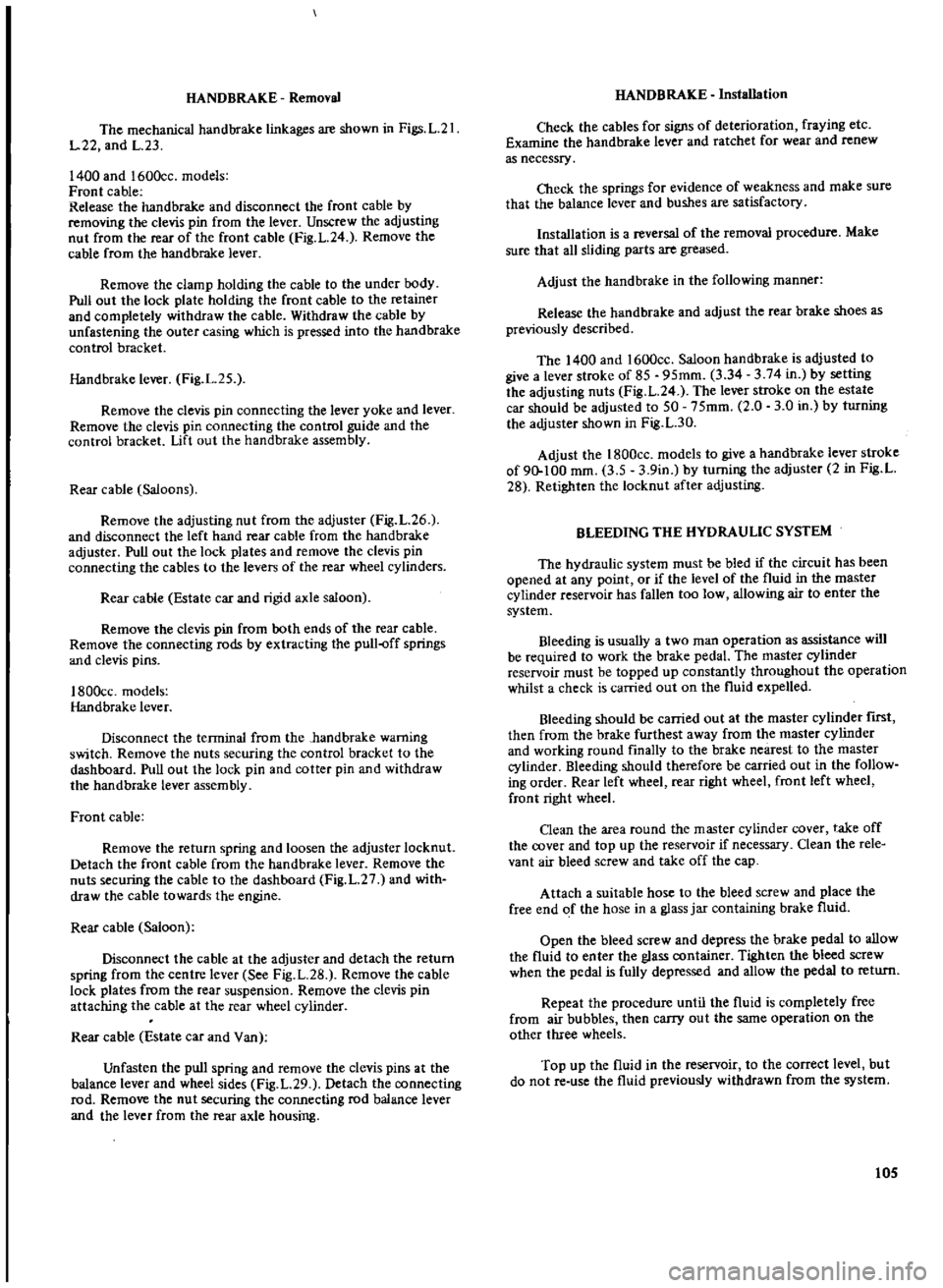
HAND
BRAKE
Removal
The
mechanical
handbrake
linkages
are
shown
in
Figs
L
21
1
22
and
1
23
1400
and
1600cc
models
Front
cable
Release
the
hand
brake
and
disconnect
the
front
cable
by
removing
the
clevis
pin
from
the
lever
Unscrew
the
adjusting
nut
from
the
rear
of
the
front
cable
Fig
L
24
Remove
the
cable
from
the
hand
brake
lever
Remove
the
clamp
holding
the
cable
to
the
under
body
Pull
out
the
lock
plate
holding
the
front
cable
to
the
retainer
and
completely
withdraw
the
cable
Withdraw
the
cable
by
unfastening
the
outer
casing
which
is
pressed
into
the
handbrake
control
bracket
Handbrake
lever
Fig
1
25
Remove
the
clevis
pin
connecting
the
lever
yoke
and
lever
Remove
the
clevis
pin
connecting
the
control
guide
and
the
control
bracket
Lift
out
the
handbrake
assembly
Rear
cable
Saloons
Remove
the
adjusting
nut
from
the
adjuster
Fig
L
26
and
disconnect
the
left
hand
rear
cable
from
the
handbrake
adjuster
Pull
out
the
lock
plates
and
remove
the
clevis
pin
connecting
the
cables
to
the
levers
of
the
rear
wheel
cylinders
Rear
cable
Estate
car
and
rigid
axle
saloon
Remove
the
clevis
pin
from
both
ends
of
the
rear
cable
Remove
the
connecting
rods
by
extracting
the
puU
off
springs
and
clevis
pins
1800cc
models
Handbrake
lever
Disconnect
the
terminal
from
the
hand
brake
warning
switch
Remove
the
nuts
securing
the
control
bracket
to
the
dashboard
Pull
out
the
lock
pin
and
cotter
pin
and
withdraw
the
handbrake
lever
assembly
Front
cable
Remove
the
return
spring
and
loosen
the
adjuster
10cknuL
Detach
the
front
cable
from
the
handbrake
lever
Remove
the
nuts
securing
the
cable
to
the
dashboard
Fig
L
27
and
with
draw
the
cable
towards
the
engine
Rear
cable
Saloon
Disconnect
the
cable
at
the
adjuster
and
detach
the
return
spring
from
the
centre
lever
See
Fig
L
28
Remove
the
cable
lock
plates
from
the
rear
suspension
Remove
the
clevis
pin
attaching
the
cable
at
the
rear
wheel
cylinder
Rear
cable
Estate
car
and
Van
Unfasten
the
pull
spring
and
remove
the
clevis
pins
at
the
balance
lever
and
wheel
sides
Fig
L
29
Detach
the
connecting
rod
Remove
the
nut
securing
the
connecting
rod
balance
lever
and
the
lever
from
the
rear
axle
housing
HANDBRAKE
Installation
Check
the
cables
for
signs
of
deterioration
fraying
etc
Examine
the
handbrake
lever
and
ratchet
for
wear
and
renew
as
necessry
Check
the
springs
for
evidence
of
weakness
and
make
sure
that
the
balance
lever
and
bushes
are
satisfactory
Installation
is
a
reversal
of
the
removal
procedure
Make
sure
that
all
sliding
parts
are
greased
Adjust
the
hand
brake
in
the
following
manner
Release
the
hand
brake
and
adjust
the
rear
brake
shoes
as
previously
described
The
1400
and
1600cc
Saloon
handbrake
is
adjusted
to
give
a
lever
stroke
of
85
95mm
3
34
3
74
in
by
setting
the
adjusting
nuts
Fig
L
24
The
lever
stroke
on
the
estate
car
should
be
adjusted
to
50
75mm
2
0
3
0
in
by
turning
the
adjuster
shown
in
Fig
L
30
Adjust
the
1800cc
models
to
give
a
handbrake
lever
stroke
of
90
100
mm
3
5
3
9in
by
turning
the
adjuster
2
in
Fig
L
28
Retighten
the
locknut
after
adjusting
BLEEDING
THE
HYDRAULIC
SYSTEM
The
hydraulic
system
must
be
bled
if
the
circuit
has
been
opened
at
any
point
or
if
the
level
of
the
fluid
in
the
master
cylinder
reservoir
has
fallen
too
low
allowing
air
to
enter
the
system
Bleeding
is
usually
a
two
man
operation
as
assistance
will
be
required
to
work
the
brake
pedal
The
master
cylinder
reservoir
must
be
topped
up
constantly
throughout
the
operation
whilst
a
check
is
carried
out
on
the
fluid
expelled
Bleeding
should
be
carried
out
at
the
master
cylinder
nrst
then
from
the
brake
furthest
away
from
the
master
cylinder
and
working
round
finally
to
the
brake
nearest
to
the
master
cylinder
Bleeding
should
therefore
be
carried
out
in
the
follow
ing
order
Rear
left
wheel
rear
right
wheel
front
left
wheel
front
right
wheel
Oean
the
area
round
the
master
cylinder
cover
take
off
the
cover
and
top
up
the
reservoir
if
necessary
Clean
the
rele
vant
air
bleed
screw
and
take
off
the
cap
Attach
a
suitable
hose
to
the
bleed
screw
and
place
the
free
end
of
the
hose
in
a
glass
jar
containing
brake
fluid
Open
the
bleed
screw
and
depress
the
brake
pedal
to
allow
the
fluid
to
enter
the
glass
container
Tighten
the
bleed
screw
when
the
pedal
is
fully
depressed
and
allow
the
pedal
to
return
Repeat
the
procedure
until
the
fluid
is
completely
free
from
air
bubbles
then
carry
out
the
same
operation
on
the
other
three
wheels
Top
up
the
fluid
in
the
reservoir
to
the
correct
level
but
do
not
re
use
the
fluid
previously
withdrawn
from
the
system
105
Page 107 of 171
inter
jjiC@
V
6iIiIIlli
I
Ii
r
f
r
7
r
Y
t
I
10
1
L
u
N
c
I
F
ll
L
2S
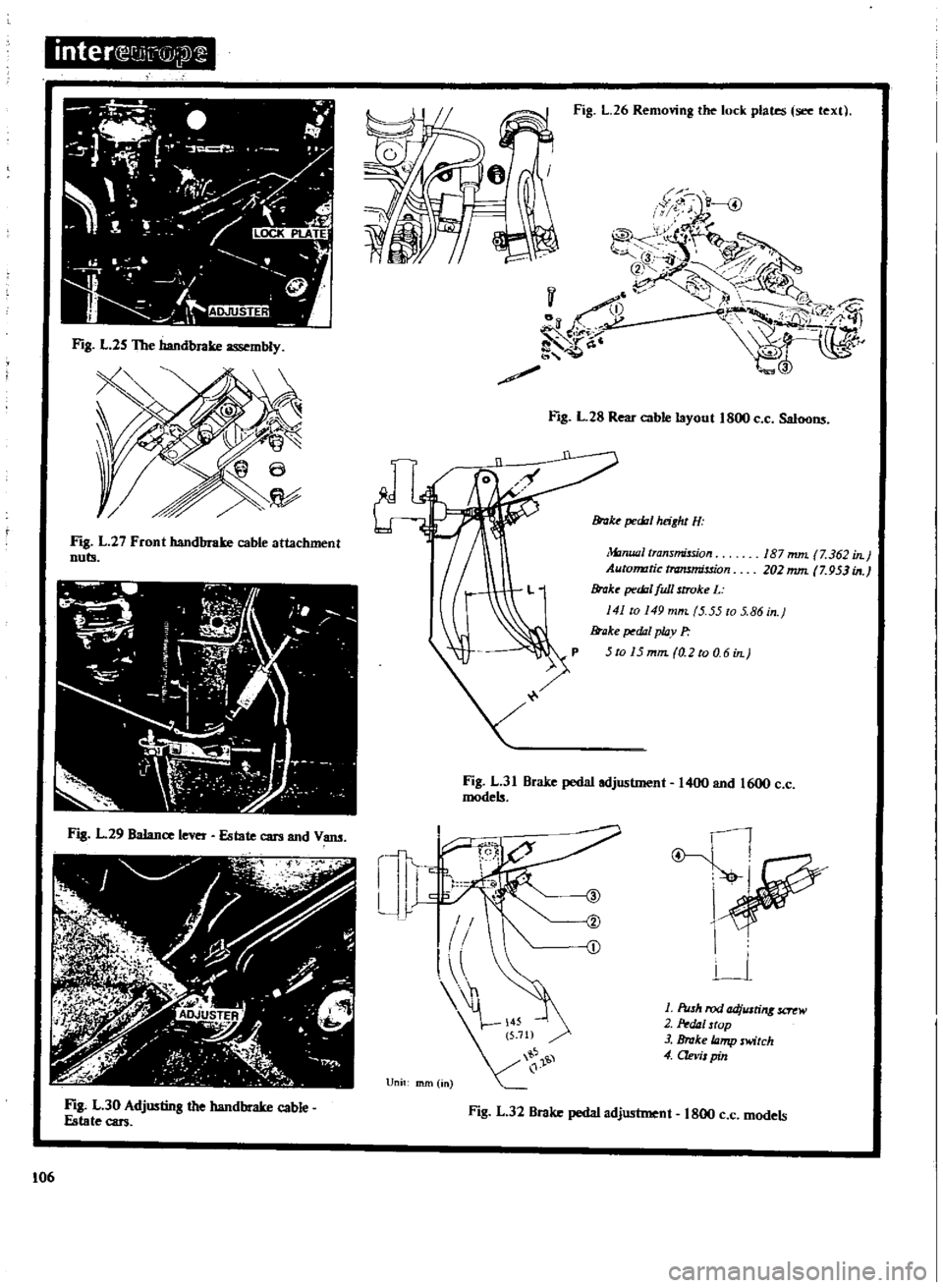
The
handbrake
mbly
Fig
L
27
Front
handbrake
cable
attachment
nuts
e7
rl
A
I
r
I
r
J
i
I
f
I
I
I
of
II
J
F
F
ll
L29
Balance
lever
Estate
ClU1l
and
Vans
F
ll
L
30
AdjWltins
the
handbrake
cable
Estate
ClU1l
106
J
ei
Fig
L
26
Removing
the
lock
plates
see
text
I
7
I
i
1
@
i
1
0
1
e
V
O
V
I
r
r
if1
1i
cl
t
Ji
Y
a
t
3
F
ll
L
28
Rear
cable
layout
1800
C
c
SatOOWl
ok
pedat
height
H
87
mm
7
362
in
202
mm
7
953
ill
Jltznual
transmission
AutomItic
transmission
y
Brake
pedal
full
stroke
L
141
0149
mm
5
55
to
5
86
in
Brake
pedal
p
tJv
P
5
to
15
mm
0
2
to
0
6
ilL
Fig
L
31
Brake
pedal
adjWltment
1400
and
1600
c
c
models
l
car
Ll
1
f
1
J
111
I
l
j
u
n
l
71
t
i1
Unit
mfll
in
1
Push
rod
adjusting
scrt
W
2
Ptdlz
stop
3
Brake
Iilmp
switch
4
Clevis
pin
Fig
L
32
Brake
pedaladjWltment
800
c
c
models
Page 108 of 171
BRAKE
PEDAL
ADJUSTMENT
The
brake
pedal
height
and
free
play
can
be
adjusted
in
the
following
manner
1400
and
1600
CC
models
Adjust
the
length
of
the
master
cylinder
push
rod
until
the
height
of
the
pedal
pad
is
187
mm
7
36
in
for
manual
gear
boxes
and
202
mm
7
95in
for
automatic
transmission
vehicles
without
brake
light
switch
Fig
L
31
Retighten
the
locknut
Screw
in
the
brake
light
switch
until
the
screwed
part
of
the
switch
is
against
the
front
of
the
stopper
bracket
then
tighten
the
locknut
Screw
in
the
stopper
bolt
until
the
moveable
part
of
the
switch
is
completely
pushed
in
by
the
pedal
and
tighten
the
locknut
in
this
position
Make
sure
that
the
lamp
is
00
when
the
pedal
is
pushed
down
by
1
5mm
0
06
in
1800cc
models
Adjust
the
bolt
of
the
brake
lamp
switch
until
its
end
face
is
flush
with
the
locknut
then
tighten
the
locknut
securely
See
Fig
L
32
Adjust
the
pedal
stopper
until
the
pedal
pad
is
positioned
at
a
height
of
185
mrn
7
28
in
from
the
floor
then
tighten
the
stopper
with
the
locknut
Adjust
the
length
of
the
master
cylinder
push
rod
until
a
pedal
free
play
of
I
5mm
0
04
D
2in
is
obtained
then
retighten
the
locknut
Depress
the
brake
pedal
several
times
to
make
sure
that
a
full
travel
of
145mm
5
7
in
is
available
and
that
the
pedal
moves
freely
and
without
noise
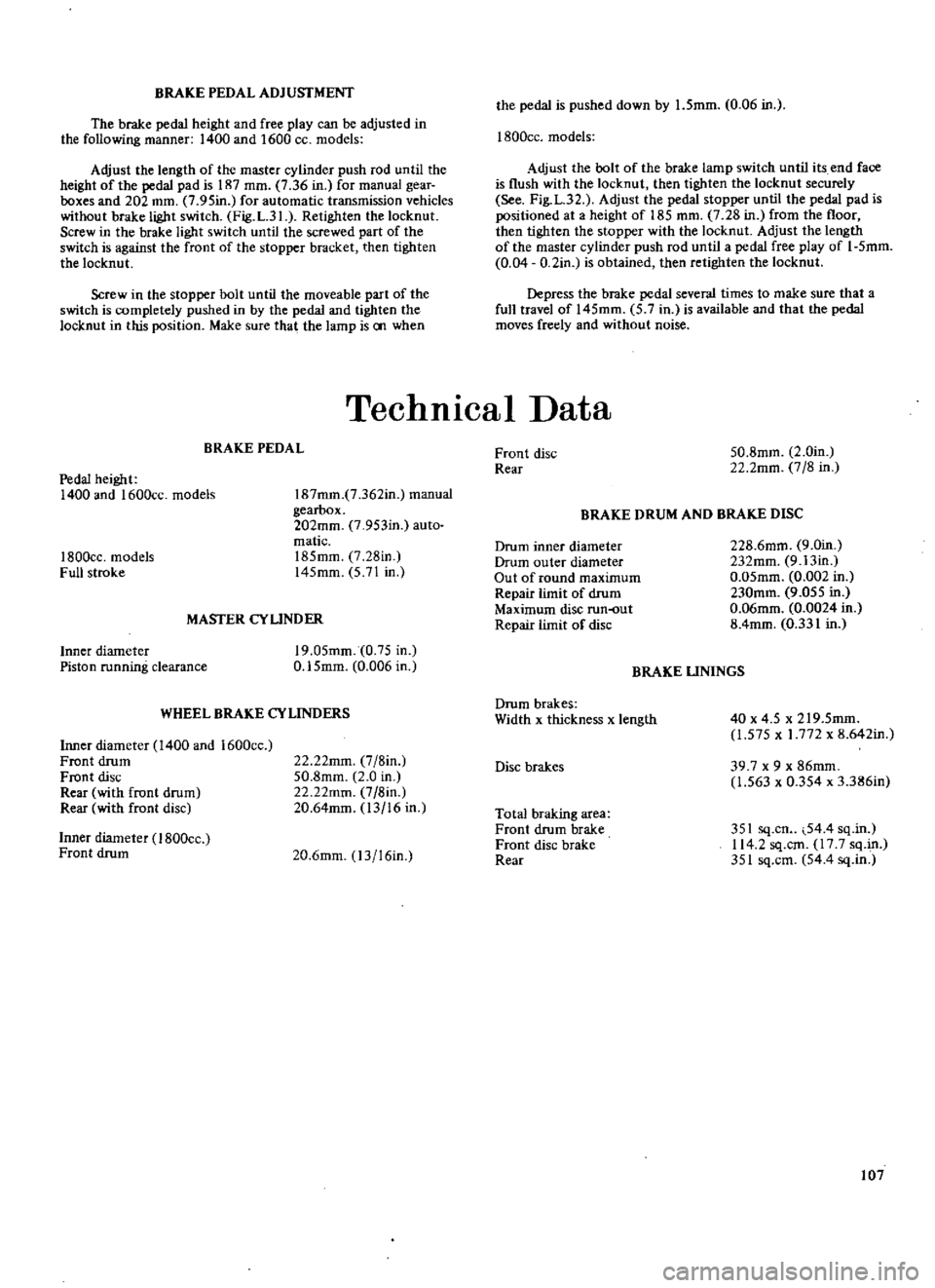
Technical
Data
BRAKE
PEDAL
Pedal
height
1400
and
1600cc
models
I
87mm
7
362in
manual
gearbox
202mm
7
953in
auto
matic
185mm
7
28in
145mm
5
71
in
1800cc
models
Full
stroke
MASTER
CYUNDER
Inner
diameter
Piston
running
clearance
19
05mm
0
75
in
0
15mm
0
006
in
WHEEL
BRAKE
CYLINDERS
Inner
diameter
1400
and
1600cc
Front
drum
Front
disc
Rear
with
front
drum
Rear
with
front
disc
22
22mm
7
8in
50
8mm
2
0
in
22
22mm
7
8in
20
64mm
13
16
in
Inner
diameter
I
BOOcc
Front
drum
20
6mm
13
16in
Front
disc
Rear
50
8mm
2
0in
22
2mm
7
8
in
BRAKE
DRUM
AND
BRAKE
DISC
Drum
inner
diameter
Drum
outer
diameter
Out
of
round
maximum
Repair
limit
of
drum
Maximum
disc
run
out
Repair
limit
of
disc
228
6mm
9
0in
232mm
9
13in
0
05mm
0
002
in
230mm
9
055
in
0
06mm
0
0024
in
8
4mm
0
331
in
BRAKE
UNINGS
Drum
brakes
Width
x
thickness
x
length
40
x
4
5
x
219
5mm
1
575
x
1
772
x
8
642in
Disc
brakes
39
7
x
9
x
86mm
1
563
x
0
354
x
3
386in
Total
braking
area
Front
drum
brake
Front
disc
brake
Rear
351
sq
cn
54
4
sq
in
114
2
sq
cm
17
7
sq
in
351
sq
cm
54
4
sq
in
107
Page 126 of 171
N
Engme
SYMPTOMS
I
Trouble
Shooting
Lubrication
System
SYMPTOMS
bed
t
f
I
h
i
1m
0
p
q
r
I
I
II
bed
t
f
I
h
Ii
I
m
n
ENGINE
WILL
NOT
CRANK
ENGINE
CRANKS
SLOWLY
ENGINE
CRANkS
BUT
OOES
NOT
START
ENGINE
STARTS
BUT
RUNS
FOR
SHORT
PERIODS
aNL
Y
ENGINE
I
tISFIRES
AT
LOW
SPEED
ENGINE
MISFIRES
AT
HIGH
SPEED
ENGINE
MISFIRES
AT
ALL
SPEEDS
ENGINE
MISFIRES
ON
ACCELERATION
AND
FAILS
TO
REV
ROUGH
IDLE
RUNS
ROUGH
AT
HIGH
SPEED
lACK
OF
POWER
POOR
CCElERA
nON
LACK
OF
TOP
SPEED
EXCESSIVE
FUEL
CONSUMmON
EXCESSIVE
OIL
CONSUMmON
PINKING
COMPRESSION
LEAK
PROIABLE
CAUSE
Faull
In
th
e
ltartinll
IYltem
Refer
to
the
ELECTRICAL
EQUIPMENT
leetion
fOI
dilllflOlIll
b
Eft
ineoiltoothick
Stiffenpne
d
Mechanieal
scimre
Flult
In
lhe
IpUlion
I
ltem
Refer
to
the
IGNITION
SYSTEM
IeCtion
for
di
I
f
Flult
the
fuellYlltm
Refer
to
the
FUEL
SYSTEM
Clion
or
di
l
OIII
Incomcl
tllvetlmln
h
ComprellllllIU
IClk
Air
leak
IRlel
JIlIIni
old
j
Reltriction
nhlu5t5ylltm
Ie
Poor
alYe
WIIIIIJ
I
Stick
tnlvall
n
m
Lclklnl
cylinder
held
Illke
Womcamlhlft
lobel
IncolTe
ttappetclurance
p
Worn
dlm
ed
cylinder
born
pUlon5
Ind
or
pll
f1np
q
Wom
nl
fC
paides
Damaced
a1wlttmseal
LeWnloilwaI
pu
e
Incorrectly
installed
apark
plu
CrICked
cylinder
Broken
weakv
w
sprinp
EXCES9lVE
OIL
CONSUMPTION
WW
OIL
ilRESSURE
PROIABLE
CAUSE
REMEDIES
I
Worn
dlmalJl
dcyhnderbon
P
v
lnd
orpulu
nnr
s
b
WorJl
valve
r
uides
C
D
m
led
valve
lIemluls
d
Lnlunr
oil
ul
pillet
e
Flulty
nil
P
uu
IluP
Iwnch
wmn
f
Relief
valve
defecuve
011
pick
up
pipellfline
blocked
h
011
filler
nver
flow
yaJYe
dcffe
WO
n
oil
pump
J
Dlmllfd
om
maUl
Ind
or
bl
nd
b
lnnll
l
lncorreCllndeofentpneoil
l
Oil
level
10
m
Oillevel
tnnhllh
Oillelk
the
preuunled
Ilde
of
the
lubn
IYSfem
p
Tldc
Rel1
f1nd
yllOde1
ne
OVCntZl
nd
nnJ
b
Rcpltte
v
lve
and
Iltd
c
Repl
cc
5c
l
d
Sullu
rt
pl
cp
aI
kCl
e
Trice
Ind
rtClify
f
heel
lod
replace
if
nccess
T
RemoYcblQChJC
h
Chcck
Ind
repllcclfncct
i
ry
i
Repll
e
rump
J
Renew
nnp
k
Rerl
ec
OIl
with
l
Top
up
oil
m
DTllnofllurpIUloil
Tn
ndremedy
Coolmg
System
b
r
h
j
I
m
p
q
d
REMEDIES
SYMI
IOMS
b
Drlm
oiJ
nd
rcpl
ce
with
ot
Add
smlll
quanllty
n
oil
to
the
fuel
Ind
rune
lmeFnd
d
SlfIpenJine
Ind
renew
p
ru
asn
celllry
I
bed
t
f
I
h
I
i
k
I
mn
0
OVERHEATING
ENGINE
FAILS
TO
REAOI
NORMAL
OPERATING
TEMPERAt
lRE
PROIAILE
CAUSE
REMEDIES
I
RetUne
enJine
h
Trace
ndseal
Tr
Ind
seal
j
RemO
f
t
rellnction
k
Relnnd
sel
I
Freelnd
trice
C
UIe
m
Renewguke
Fit
new
clmlhlrt
AdJult
t
appeti
p
bch
ngeenfin
q
Replacevalnluldes
Rtplace
seall
Repllccgukel
Repllcc
plulwlth
correct
Cl
Ie
Renew
cyhndcrblock
Repllce
5prLnp
I
IlIIIIfficien
coolant
b
DriYebellllippinIOfbrobn
c
RldiatOf
fUll
cloq
ed
d
Coo
inlflndefeclln
e
Wit
pl1mpdtfectlve
f
ThelTllOllatj
mmed
Ihul
Thermost
j
mmed
open
r
t
eti
I
kt
r
re
a
q
brake
j
lntel1laJp
se
lheenpne
ndforradi
torbloeked
11
HOItI
blocked
I
Carburetterm
djullmem
m
Excellive
arbon
depolit
in
thecylinden
In
ffici
enpneoil
uae
of
inferior
p1Ide
of
oil
Exce
inrldi
lorlrea
I
Topupradil
v
b
Ti
htenbdtorftnc
I
t
rmify
e
Repl
cwaterpump
f
Rcpll
e
thermoltll
I
Replleclhermolt
t
h
RetimeiaTUlion
i
Unload
ear
check
brl
ktt
j
Trace
ndclu
k
TfI
cdUrblockaae
L
AdjUllcorrc
cth
m
Decarbonise
fO
tne
top
overh
uJ
Top
up
wlth
correct
rade
Dr
inifneceUlry
PUIl
lly
blink
off
in
winter
only
Page 131 of 171
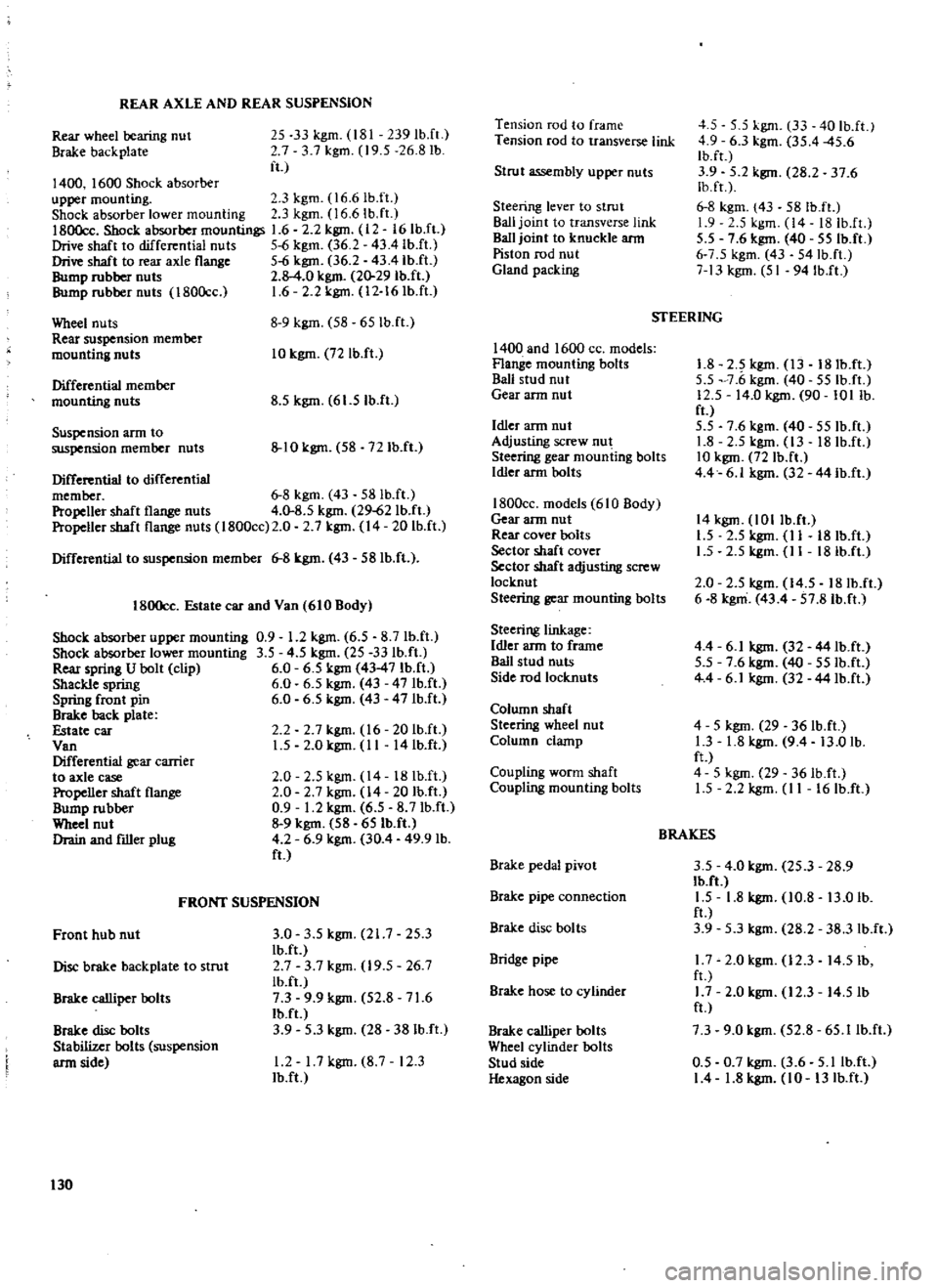
REAR
AXLE
AND
REAR
SUSPENSION
Rear
wheel
bearing
nut
Brake
backplate
25
33
kgm
181
239
IbJt
7
3
7
kgm
19
5
26
8
lb
ft
1400
1600
Shock
absorber
upper
mounting
3
kgm
l6
61b
ft
Shock
absorber
lower
mounting
3
kgm
16
6
Ih
ft
1800cc
Shock
absorber
mountings
1
6
2
2
kgm
12
161b
ft
Drive
shaft
to
differential
nuts
5
6
kgm
36
2
4341b
ft
Drive
shaft
to
rear
axle
flange
5
6
kgm
36
2
43
4lb
ft
Bump
rubber
nuts
2
8
4
0
kgm
20
29
Ib
ft
Bump
rubber
nuts
180Occ
1
6
2
2
kgm
12
16
Ib
ft
Wheel
nuts
Rear
suspension
member
mounting
nuts
8
9
kgm
58
651b
ft
10
kgm
72
Ib
ft
Differential
member
mounting
nuts
8
5
kgm
61
5Ib
ft
Suspension
arm
to
suspension
member
nuts
10
kgm
58
72
Ib
ft
Differential
to
differential
member
6
8
kgm
43
581b
fl
Propeller
shaft
flange
nuts
4
0
8
5
kgm
29
62
Ib
ft
Propeller
shaft
flange
nuts
I
800cc
2
0
2
7
kgm
14
201b
fl
Differential
to
suspension
member
6
8
kgm
43
58Ib
ft
1800cc
Estate
car
and
Van
610
Body
Shock
absorber
upper
mounting
0
9
1
2
kgm
6
5
8
7Ih
fl
Shock
absorber
lower
mounting
3
5
4
5
kgm
25
33Ib
ft
Rear
spring
U
bolt
clip
6
0
6
5
kgm
43
47
Ib
ft
Shackle
spring
6
0
6
5
kgm
43
47Ib
ft
Spring
front
pin
6
0
6
5
kgm
43
47Ib
ft
Brake
back
plate
Estate
car
Van
Differential
gear
carrier
to
axle
case
Propeller
shaft
flange
Bump
rubber
Wheel
nut
Drain
and
filler
plug
2
2
2
7
kgm
16
20IbJt
L5
2
0
kgm
II
14
Ib
ft
2
0
2
5
kgm
14
18Ib
ft
2
0
2
7kgm
14
20Ib
ft
0
9
1
2
kgm
6
5
8
7Ib
ft
9
kgm
58
65Ib
ft
4
2
6
9
kgm
30
4
49
9
lb
ft
FRONT
SUSPENSION
Front
hub
nut
3
0
3
5
kgm
21
7
25
3
Ib
ft
Disc
brake
backplate
to
strut
2
7
3
7
kgm
19
5
26
7
Ib
ft
Brake
ca1liper
bolts
7
3
9
9
kgm
52
8
71
6
Ib
ft
Brake
disc
bolts
3
9
5
3
kgm
28
381b
ft
Stabilizer
bolts
suspension
arm
side
1
2
I
7kgm
8
7
12
3
Ib
ft
130
Tension
rod
to
frame
Tension
rod
to
transverse
link
Strut
assembly
upper
nuts
Steering
lever
to
strut
Ball
joint
to
transverse
link
Ball
joint
to
knuckle
ann
Piston
rod
nut
Gland
packing
1400
and
1600
CC
models
Flange
mounting
bolts
Bali
stud
nut
Gear
ann
nut
Idler
ann
nut
Adjusting
screw
nut
Steering
gear
mounting
bolts
Idler
arm
bolts
1800cc
models
610
Body
Gear
ann
nut
Rear
cover
bolts
Sector
shaft
cover
Sector
shaft
adjusting
screw
locknut
Steering
gear
mounting
bolts
Steering
linkage
Idler
arm
to
frame
Ball
stud
nuts
Side
rod
locknuts
Column
shaft
Steering
wheel
nut
Column
clamp
COll
piing
worm
shaft
Coupling
mounting
bolts
Brake
pedal
pivot
Brake
pipe
connection
Brake
disc
bolts
Bridge
pipe
Brake
hose
to
cylinder
Brake
calliper
bolts
Wheel
cylinder
bolts
Stud
side
Hexagon
side
4
5
5
5
kgm
33
40Ib
ft
4
9
6
3
kgm
35
4
45
6
Ib
ft
3
9
5
2
kgm
28
2
37
6
Ib
fr
6
8
kgm
43
581b
ft
1
9
5
kgm
14
18Ib
fL
5
5
7
6
kgm
40
55Ib
ft
6
7
5
kgm
43
54Ib
ft
7
13
kgm
51
94Ib
ft
STEERING
1
8
2
5
kgm
13
18Ib
ft
5
5
7
6
kgm
40
55Ib
ft
12
5
14
0
kgm
90
101
lb
ft
5
5
7
6
kgm
40
55Ib
ft
1
8
2
5
kgm
13
18Ib
ft
10
kgm
72
Ib
ft
4
4
6
1
kgm
32
44Ib
ft
14
kgm
lOllb
ft
L5
2
5
kgm
II
18Ib
ft
1
5
2
5
kgm
II
18Ib
ft
2
0
2
5
kgm
14
5
18Ib
ft
6
8
kgm
43
4
57
8Ib
ft
4
4
6
1
kgm
32
44Ib
ft
5
5
7
6
kgm
40
55Ib
ft
4
4
6
1
kgm
32
44lb
ft
4
5
kgm
29
36
Ib
ft
1
3
1
8
kgm
9
4
13
0
lb
ft
4
5
kgm
29
36Ib
ft
L5
2
2
kgm
II
16Ib
ft
BRAKES
3
5
4
0
kgm
25
3
28
9
Ib
ft
1
5
1
8
kgm
10
8
13
0
lb
ft
3
9
5
3
kgm
28
2
38
3
IbJt
1
7
2
0
kgm
12
3
14
51b
fl
1
7
2
0
kgm
12
3
14
5lb
ft
7
3
9
0
kgm
52
8
65
llb
ft
0
5
0
7
kgm
3
6
5
llb
ft
1
4
1
8
kgm
10
13
Ib
ft
Page 153 of 171
inter
M
j
@W
J
1
i
I
r
p
@
2
1
Strut
mounting
inzulDtor
Thruu
b
aring
J
Coil
prins
4
rubber
j
Sl1ut
mbly
6
Compression
rod
Z
Bal
joint
8
T
1ink
9
Stabi
iur
10
ODS
rnt
r
i
L
St
Ting
wheel
2
Steering
column
maft
J
Rubb
rCOfl
linK
4
Sturing
lower
joint
5
St
rinuotlr
IwusUr8
6
Sid
rod
XlI
Fig
C
1
Front
suspension
assembly
Fig
C
2
The
steering
gear
iQ
r
y
y
v
I
Ii
1
1
Fig
C
3
Collapsible
steering
Fig
C
4
Disconnecting
the
brake
hose
I
f41
I
I
t
h
I
t
t
Il
t
k
I
Fig
C
5
Removing
the
front
hub
and
brake
disc
Fig
C
6
Detaching
the
brake
disc
522
Page 156 of 171
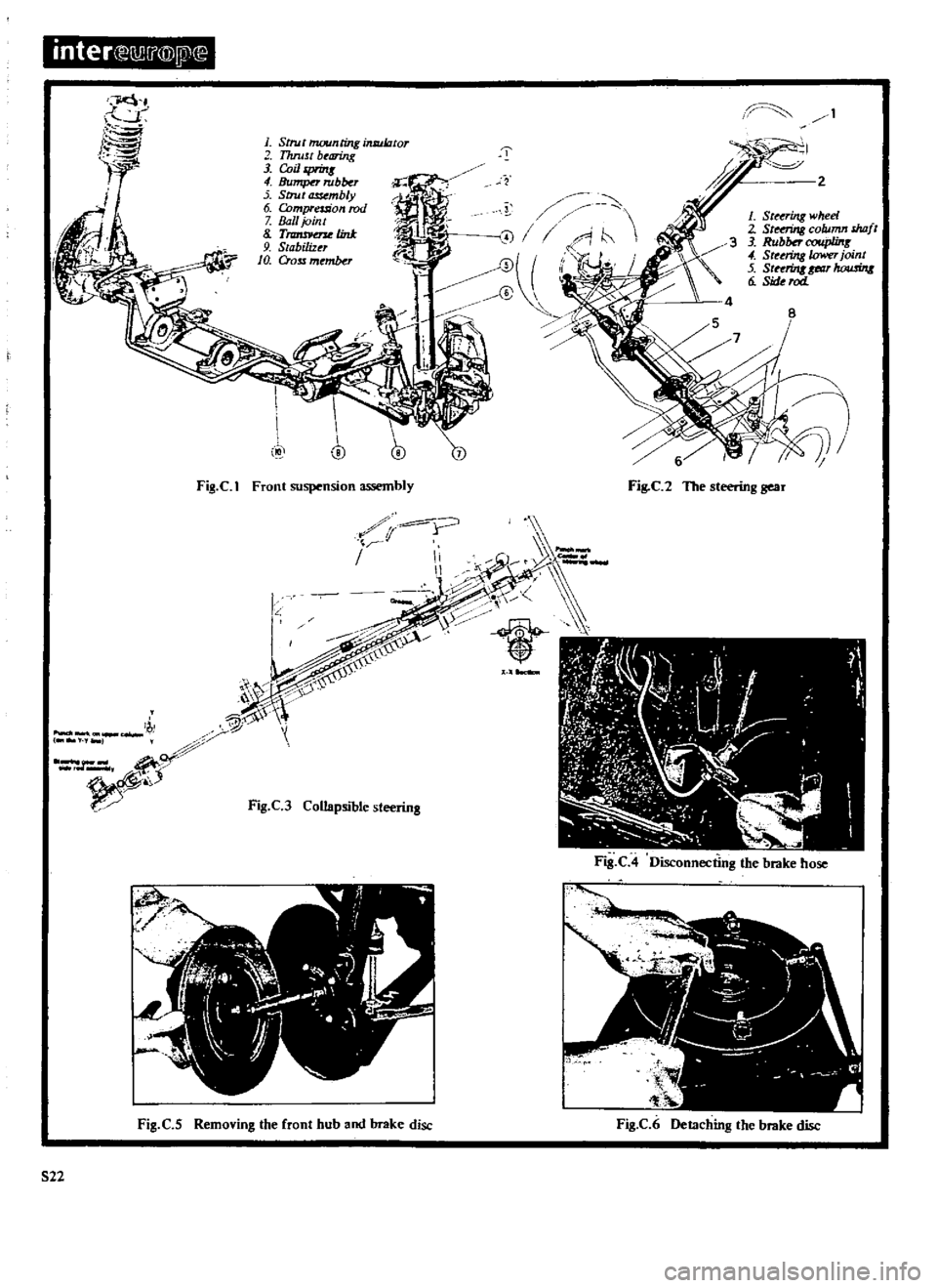
Remove
the
road
wheel
and
disconnect
the
brake
hose
at
the
connector
as
shown
in
Fig
C
4
of
this
section
Remove
the
brake
calliper
assembly
and
hub
cap
Withdraw
the
cotter
pin
and
remove
the
wheel
bearing
locknut
Remove
the
wheel
bearing
washer
and
take
off
the
hub
and
brake
disc
Fig
C
5
Remove
the
bearing
collar
take
out
the
outer
bearing
cage
and
prise
out
the
hub
grease
seal
Remove
the
inner
bearing
cage
and
drive
out
the
outer
races
of
the
inner
and
outer
bearings
using
the
special
drift
ST49120000
if
avail
able
Separate
the
brake
disc
from
the
hub
by
taking
out
the
retaining
bolts
as
shown
in
Fig
C
6
Installation
is
a
reversal
of
the
removal
procedure
Adjust
the
wheel
bearings
as
previously
described
taking
care
to
tighten
the
wheel
bearing
locknut
to
the
specified
torque
read
ing
of
3
0
to
3
5
kgm
21
7
to
25
3lb
ft
Turn
the
hub
several
times
to
settle
the
bearing
then
retighten
the
nut
to
the
same
figure
Slacken
the
locknut
by
a
quarter
turn
900
and
insert
the
cotter
pin
when
the
hole
in
the
spindle
is
aligned
with
the
hole
in
the
nut
Check
that
the
force
required
to
turn
the
hub
is
less
than
7
0
kg
cm
97
2
in
oz
STABILIZER
Removal
and
Installation
Remove
the
splash
board
and
take
off
the
bolts
I
in
Fig
C
7
which
attach
the
stabilizer
at
the
transverse
link
sides
Remove
the
bolts
attaching
the
stabilizer
bracket
2
to
the
frame
then
withdraw
the
stabilizer
Check
the
bar
and
rubber
components
for
signs
of
deforma
tion
or
damage
and
renew
as
necessary
Installation
is
a
reversal
of
the
removal
procedures
Tighten
the
fixing
bolts
to
a
torque
reading
of
1
2
to
I
7
kgm
8
7
to
12
3
lb
ft
at
the
transverse
link
side
and
1
9
to
2
5
kgm
13
7
to
18
llb
ft
at
the
frame
bracket
SPRING
AND
STRUT
ASSEMBLY
The
spring
and
strut
assembly
can
be
serviced
by
following
the
instructions
previously
given
for
the
assemblies
on
vehicles
fitted
with
the
L14
L16
and
Ll8engines
When
reassembling
make
sure
that
the
parts
shown
in
Fig
C
8
are
thomughly
greased
Installation
of
the
assembly
will
be
accomplished
more
easily
if
the
dust
cover
on
the
bonnet
ledge
is
removed
Tighten
the
nuts
and
bolts
to
a
torque
figures
given
in
TIGHTENING
TORQUES
TRANSVERSE
LINK
AND
LOWER
BALL
JOINT
The
transverse
link
and
lower
ball
joint
can
be
removed
in
a
similar
manner
to
the
parts
on
vehicles
fitted
with
L
14
L
16
and
L
18
engines
Renew
the
link
if
cracked
or
damaged
in
any
way
Check
the
measurement
A
in
Fig
C
9
The
measurement
between
front
and
rear
transverse
link
bushes
should
be
less
than
1
0
mm
0
039
in
Replace
the
bushes
if
necessary
The
lower
ball
joint
should
be
replaced
if
the
axial
play
of
the
joint
exceeds
0
03
to
0
6
mm
0
0012
to
0
0136
in
A
grease
nipple
must
be
installed
in
place
of
the
ball
joint
plug
so
that
the
joint
can
be
lubricated
with
multi
purpose
grease
as
previously
described
SUSPENSION
MEMBER
Removing
and
Installing
Jack
up
the
vehicle
and
support
it
on
stands
2
Remove
the
splash
board
Refer
to
Fig
C
I
0
and
detach
the
compression
rod
I
the
stabilizer
2
from
the
trans
verse
link
3
Detach
the
steering
linkage
from
the
suspen
sion
crossmember
4
3
Take
out
the
nuts
attaching
the
transverse
links
and
remove
the
links
at
both
sides
of
the
vehicle
4
Support
the
engine
with
a
hoist
as
shown
in
Fig
C
II
taking
care
not
to
damage
the
throttle
and
remote
control
linkages
and
then
remove
the
engine
mounting
bolts
at
both
sides
5
Remove
the
bolts
shown
arrowed
in
Fig
C
12
and
lift
the
suspension
member
away
Renew
the
suspension
member
if
it
is
cracked
or
deformed
in
any
way
Installation
is
a
reversal
of
the
removal
procedure
FRONT
WHEEL
ALIGNMENT
As
previously
stated
the
castor
and
camber
angles
are
preset
and
cannot
be
adjusted
A
thorough
check
should
be
made
of
the
steering
and
suspension
system
and
all
defective
parts
renewed
if
the
angles
are
incorrect
See
Technical
Data
The
front
wheels
should
toe
in
12
to
15
mm
0
4
7
to
0
59
in
Adjustment
can
be
carried
out
by
slackening
the
locknuts
1
in
Fig
C
13
and
then
turning
the
tie
rods
by
an
equal
amount
until
the
correct
toe
in
is
achieved
A
toe
in
gauge
will
of
course
be
required
for
this
operation
STEERING
WHEEL
AND
COLUMN
Removal
Disconnect
the
horn
wire
and
remove
the
horn
bar
Remove
the
steering
wheel
nut
and
pull
off
the
steering
wheel
2
Remove
the
turn
signal
and
lighting
switch
assembly
followed
by
the
steering
column
shell
covers
3
Remove
the
bolts
from
the
rubber
coupling
to
disconnect
the
lower
joint
See
Figs
C
14
and
C
I
5
if
the
car
is
fitted
with
right
hand
drive
The
lower
joint
upper
bolt
should
be
removed
to
disconnect
the
joint
if
the
car
is
fitted
with
left
hand
drive
4
Remove
the
cotter
pin
from
the
trunnion
and
disconnect
the
gearchange
rod
and
selector
rod
5
Remove
the
steering
column
upper
clamp
and
take
out
the
bolts
securing
the
lower
plate
STEERING
COLUMN
Dismantling
and
Assembling
Remove
the
C
washer
socket
screw
and
upper
bracket
bolt
Remove
the
lower
bracket
bolts
and
detach
the
remote
control
linkage
from
the
column
assembly
Remove
the
snap
ring
at
the
top
of
the
column
and
extract
the
column
shaft
from
the
jacket
Disconnect
the
rubber
coupling
from
the
lower
joint
then
remove
the
snap
ring
and
dismantle
the
lower
joint
S25
Page 161 of 171
12
11
3
1
i
20
20
y
l
17
4
5
17
1
18
le
8
15
0
20
lQ
l
ah
rod
a
S
y
Dus
ewer
Stopper
rint
condiuy
putcm
cup
MaJler
cylinder
puto
Primmy
plJlan
cup
Inlet
l
tIhe
cwy
Pi
Jton
retunl
SPrin8
cylinder
body
RtJeTfoir
btJnd
au
y
Rel6l
Ou
Reservoir
cap
ass
Bl
der
screw
cap
Binder
screw
C1teck
l1a
1ve
spring
Chechob
y
Packin8
Piston
stopper
scrrw
Vain
cap
fllsJcet
Vah
e
cap
Components
of
the
single
master
cylinder
Jx
1
As
y
bm
ke
mtUtn
cylinder
2
Oil
rnenoir
ClIp
3
Brake
oil
1
turJ1
U
4
Oil
rnervou
hlznd
5
Dlertler
JCTeW
6
Blettkr
ta
W
azp
7
Va
lle
cap
8
Gtuket
9
b
y
nzJpa
10
Vah
e
tpriIog
11
Valve
Uflt
12
Stopper
1CTe
W
Components
of
the
tandem
master
cylinder
13
Itukin8
U
b
y
pbto
A
15
PUlon
cup
16
Cylbukr
17
Au
y
puto
B
18
A
y
voba
tpriIog
19
1nktvahatprilog
20
PUlan
cup
21
40
y
pw
r
rod
22
Stopper
rinr
23
Dwt
coper
Fig
D
Fig
D
2
4
1
A
S
y
catft7a
2
Equalizu
hmuJ
broke
J
R
B
Tt
lJ1
cab
4
AdiU3tt
T
cailk
rmr
5
S
1TiIw
retum
6
L
H
ntu
Ofbk
7
Pir
fulcrum
hand
braJcalev
r
8
aJ
Vb1l
front
hand
bmka
9
TrutUon
pin
hand
bt
rzU
ctlbk
10
P
atMock
rand
IRvke
azb1l
10
1
L
1
4
6
l
Nota
@
Apply
11lI
gteall
@ApplychlSSis
1
7
Fig
D
3
Handbtaka
linkage
system
1
Tandem
nmt
cylintkr
2
Two
MY
COnMC
or
3
Brake
line
prtSlf
e
difftrentiJzl
umil16
ootch
Fig
D
S
Layout
of
brake
piping
with
tandem
master
cylinder
I
530
Page 162 of 171
BrakIng
System
Description
Front
disc
brake
Friction
pads
Front
disc
brake
Removal
and
Installation
Rear
drum
brake
Removal
and
Installation
Master
Vac
Servo
Unit
Handbrake
cables
Removing
Handbrake
Adjusting
Brake
pedal
Adjusting
Rear
drum
brake
Adjusting
Bleeding
the
hydraulic
system
DESCRIPTION
The
vehicle
is
fitted
with
disc
brakes
for
the
front
wheels
and
leading
trailing
shoe
type
drum
brakes
for
the
rear
wheels
A
conventional
single
master
cylinder
is
fitted
to
the
Standard
and
DeLuxe
models
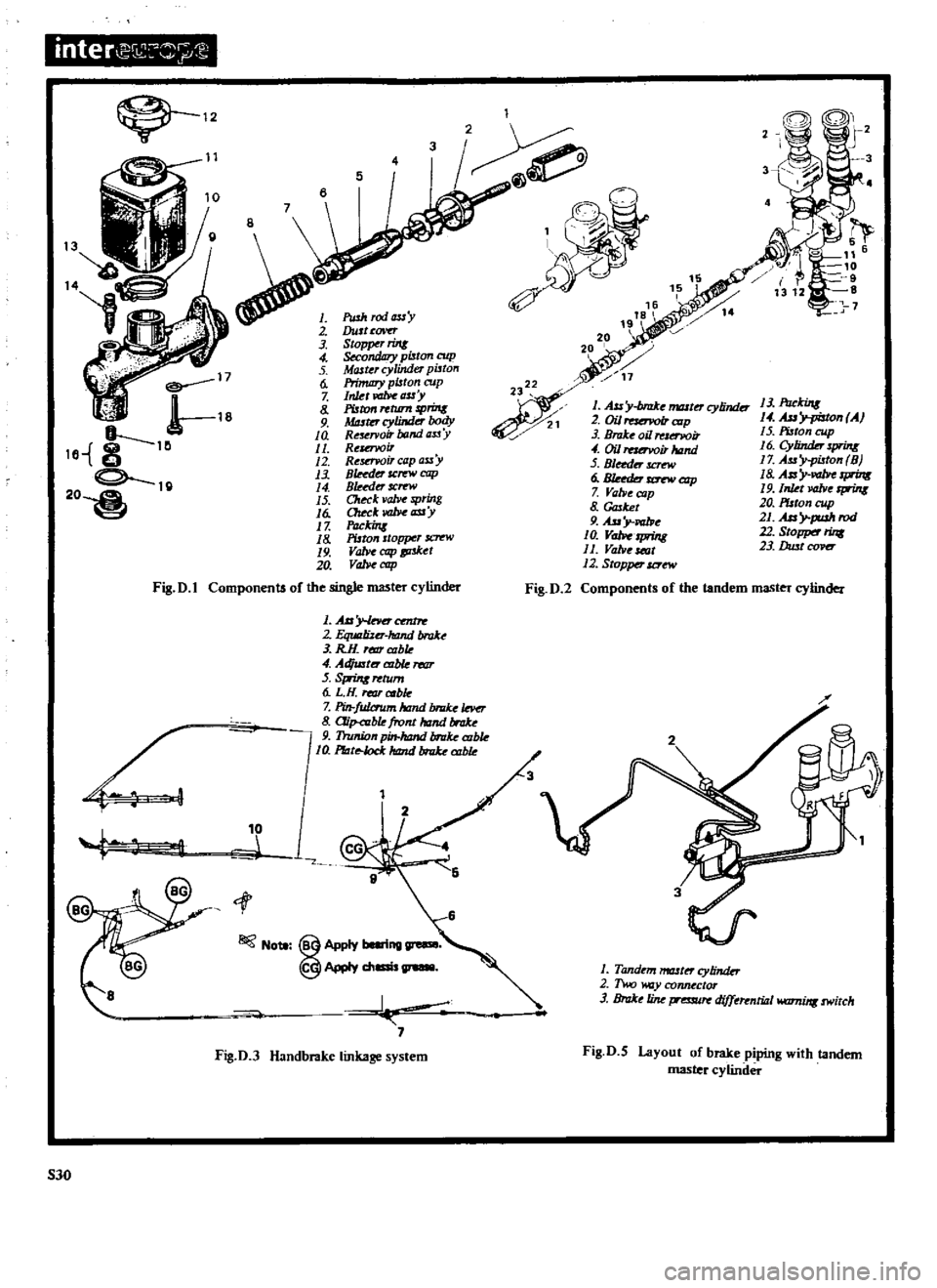
See
Fig
D
I
for
details
The
DeLuxe
models
are
however
additio
ally
equipped
with
a
Master
Vae
servo
unit
which
provides
a
much
higher
braking
performance
with
minimum
force
required
on
the
brake
pedal
A
tandem
master
cylinder
and
Master
Vac
servo
unit
are
fitted
as
standard
equipment
to
the
Datsun
CL30UA
and
CL3
OUT
models
Fig
D
2
gives
an
exploded
view
of
this
type
of
master
cylinder
The
handbrake
is
of
the
mechanical
type
with
the
handle
linked
to
the
rear
shoe
operating
lever
through
a
system
of
rods
and
wires
See
Fig
D
3
As
on
previous
models
a
brake
pressure
differential
warn
ing
light
switch
is
incorporated
with
dual
brake
circuits
The
front
and
rear
brake
systems
are
connected
to
the
switch
which
provides
a
warning
via
a
warning
light
on
the
instnllnent
panel
when
a
pressure
difference
of
13
to
17
kg
sq
cm
IB5
to
242
lb
sq
in
occurs
between
the
front
and
rear
systems
Brake
piping
layouts
of
the
single
and
tandem
master
cylinder
systems
are
shown
in
Figs
D
4
and
0
5
FRONT
DISC
BRAKE
Friction
pads
The
disc
brakes
are
self
adjusting
but
the
friction
pads
should
be
checked
for
wear
after
the
fIrst
6
000
un
4
000
miles
and
then
every
5
000
km
3
000
miles
The
pads
must
be
replaced
if
the
friction
lining
on
any
pad
has
worn
to
less
than
1
0
mm
0
04
in
The
thickness
of
the
pads
can
easily
be
checked
after
remov
ing
the
anti
rattle
clip
from
the
calliper
plate
Full
servicing
procedures
are
given
in
the
section
BRAKING
SYSTEM
for
vehicles
fitted
with
Ll4
Ll6
and
Ll8
engines
FRONT
DISC
BRAKE
Removal
and
Installation
Refer
to
the
section
BRAKING
SYSTEM
for
the
Ll4
L16
and
LIB
engines
for
full
details
of
the
removal
and
installation
procedures
Check
the
thickness
of
the
friction
pads
as
previously
described
and
replace
them
if
necessary
Check
the
brake
disc
for
scoring
and
out
of
round
The
standard
diSc
thickness
is
10
0
mm
0
394
in
and
must
not
be
reground
below
8
40
mm
0
331
in
The
run
out
of
the
disc
should
be
less
than
0
06
mm
0
0024
in
and
can
be
checked
with
a
dial
gauge
positioned
near
the
outer
diameter
of
the
disc
as
previously
described
REAR
DRUM
BRAKE
Removal
and
Installation
The
rear
drum
brakes
See
Fig
D
6
can
be
removed
and
inspected
as
described
in
the
section
BRAKING
SYSTEM
for
vehicles
fItted
with
L14
L16
LIB
engines
Examine
the
brake
drums
for
scoring
and
out
of
round
The
maximum
inner
diameter
of
the
drum
must
not
exceed
229
6
mm
9
040
in
after
reconditioning
Out
of
round
should
be
below
0
05
mm
0
002
in
Renew
the
brake
shoe
linings
if
they
are
contaminated
or
incorrectly
seated
or
if
the
thickness
of
the
lining
has
been
reduced
to
1
5
mm
0
06
in
or
less
Oil
or
grease
can
be
re
moved
from
the
linings
by
cleaning
thoroughly
with
carbon
tetrachloride
or
petrol
Check
the
shoe
return
springs
and
replace
them
if
they
have
become
weakened
Check
the
bores
of
the
wheel
cylinders
for
signs
of
wear
damage
or
corrosion
Renew
the
cylinders
and
pistons
if
the
clearance
between
the
two
parts
exceeds
to
0
15
mm
0
006
in
Renew
the
c
ps
when
overhauling
the
wheel
cylinders
MASTER
V
AC
SERVO
UNIT
Removing
and
Dismantling
The
servo
unit
should
be
removed
and
overhauled
at
yearly
intervals
A
Master
Vac
repair
kit
is
available
and
all
parts
marked
in
Fig
D
7
should
be
renewed
after
dismantling
the
unit
These
items
are
all
supplied
as
part
of
the
repair
kit
The
unit
can
be
removed
as
follows
Remove
the
clevis
pin
from
the
push
rod
and
detach
the
Master
V
ac
unit
from
the
brake
pedal
2
Disconnect
the
brake
tube
from
the
master
cylinder
and
the
vacuum
hooe
from
the
Master
Vac
3
Take
off
the
retaining
nuts
and
remove
the
Master
Vac
and
spacer
then
separate
the
master
cylinder
from
the
Master
Vac
Mark
the
front
cylinder
shell
and
the
rear
shell
and
stud
assembly
before
dismantling
the
unit
then
proceed
as
follows
S31
Page 163 of 171

inter
j
IJ
ITJJ
4
532
6
7
Fig
D
4
Layout
of
brake
piping
with
single
master
cylinder
3
15
7
6
e
2
1
rQt
coper
2
Adiwtint
Urim
3
dUe
4
Adiuster
5
Retum
springs
6
Anti
ttk
qJrinp
V
7
Adiwt
t
Fig
D
6
Rear
drom
brake
components
8
JIJmd
bnzke
Iner
9
Wh
1
cylinder
10
Lilli
11
A
nti
rattle
pim
3
4
1
PIIz
ed
st
tl1
2
Push
rod
3
Dittp
urtun
4
Rmr
Vrdl
J
Jbwer
phton
6
VQcwunl
OJlt
7
01
8
VQcuum
wzhe
9
fuppet
aucmb1y
10
Vah
body
pzrd
JEiID
12
II
Air
li
mur
Fzlter
12
V4lveopt
l
t1tintrod
13
Vobe
rdunuJNin8
14
lbppet
mum
Pri
If
15
AiTvah
e
16
RDut
17
Valve
plunger
18
Reaction
dUe
19
lJttp
rrqm
mum
Pri
If
20
Front
s
relJ
IS
Fig
D
Section
through
the
Master
Vac
unit
J
Bralee
rube
A
2
Front
COfIMctor
3
Bralee
tube
B
4
PreS
lJ
hO
e
front
R
H
5
Brake
tube
C
6
tubeD
7
Pressure
hose
front
L
H
8
2
way
connector
9
Brake
tube
E
10
Rear
connector
11
Pressure
hose
rear
R
12
Brake
tube
F
13
Brake
tube
G
14
PntruFe
h
e
raIT
L
H
IJ
Brake
hlbe
H
16
Hose
lock
plate
17
Hose
Jock
spring
Fig
US
Removing
the
air
silencer
retainer
Fig
D
9
Removing
the
valve
plunger
stop
key
G
lj
t
I
e
6
I
r
6
Fig
D
1O
Removing
the
bandbrake
front
cable