weight DATSUN B110 1973 Service User Guide
[x] Cancel search | Manufacturer: DATSUN, Model Year: 1973, Model line: B110, Model: DATSUN B110 1973Pages: 513, PDF Size: 28.74 MB
Page 362 of 513
ENGINE
Pig
EM
62
Bearing
clearance
check
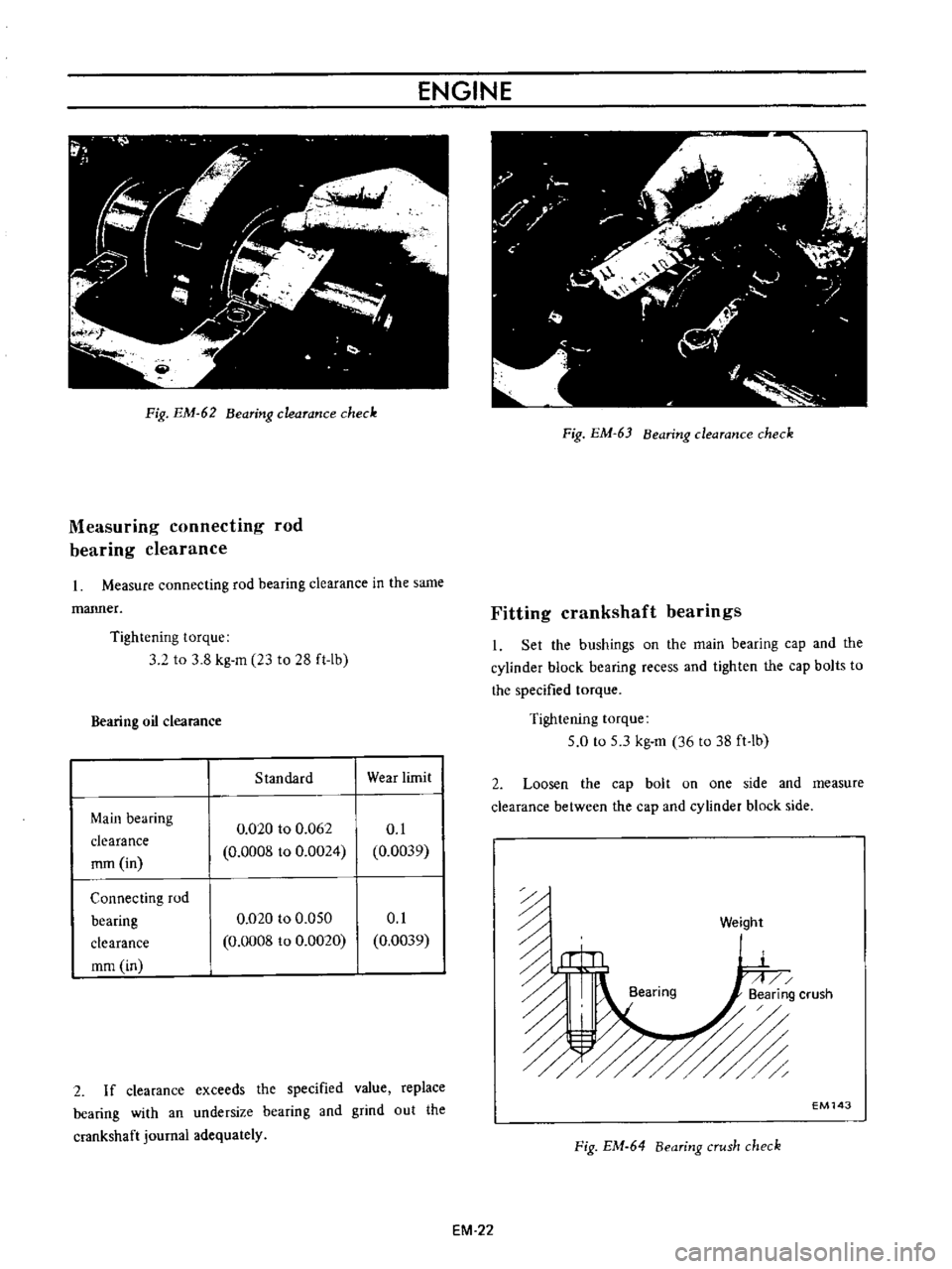
Measuring
connecting
rod
bearing
clearance
Measure
connecting
rod
bearing
clearance
in
the
same
manner
Tightening
torque
3
2
to
3
8
kg
m
23
to
28
ft
Ib
Bearing
oil
clearance
Standard
Wear
limit
Main
bearing
clearance
rom
in
0
020
to
0
062
0
0008
to
0
0024
0
1
0
0039
Connecting
rod
bearing
clearance
mm
in
0
020
to
0
050
0
0008
to
0
0020
0
1
0
0039
2
If
clearance
exceeds
the
specified
value
replace
bearing
with
an
undersize
bearing
and
grind
out
the
crankshaft
journal
adequately
Fig
EM
63
Bearing
clearance
check
Fitting
crankshaft
bearings
I
Set
the
bushings
on
the
main
bearing
cap
and
the
cylinder
block
bearing
recess
and
tighten
the
cap
bolts
to
the
specified
torque
Tightening
torque
5
0
to
5
3
kg
m
36
to
38
ft
lb
2
Loosen
the
cap
bolt
on
one
side
and
measure
clearance
between
the
cap
and
cylinder
block
side
n
n
u
ii
Bearing
6
Weight
EM143
Fig
EM
64
Bearing
crush
check
EM
22
Page 402 of 513
FUEl
SYSTEM
Idling
and
slow
system
Passing
through
the
main
jet
the
fuel
passage
is
separated
from
main
line
fuel
flows
through
the
slow
jet
primary
slow
air
bleed
is
ejected
from
the
by
pass
hole
and
idle
nozzle
Accelerating
mechanism
Cj
f
li
Ip
j
1
2
3
4
5
Inlet
valve
6
Outlet
valve
7
Primary
throttle
valve
8
Pump
connecting
rod
Pump
lever
Pump
nozzle
Piston
Piston
return
spring
Fig
EF
17
Accelerating
mechanism
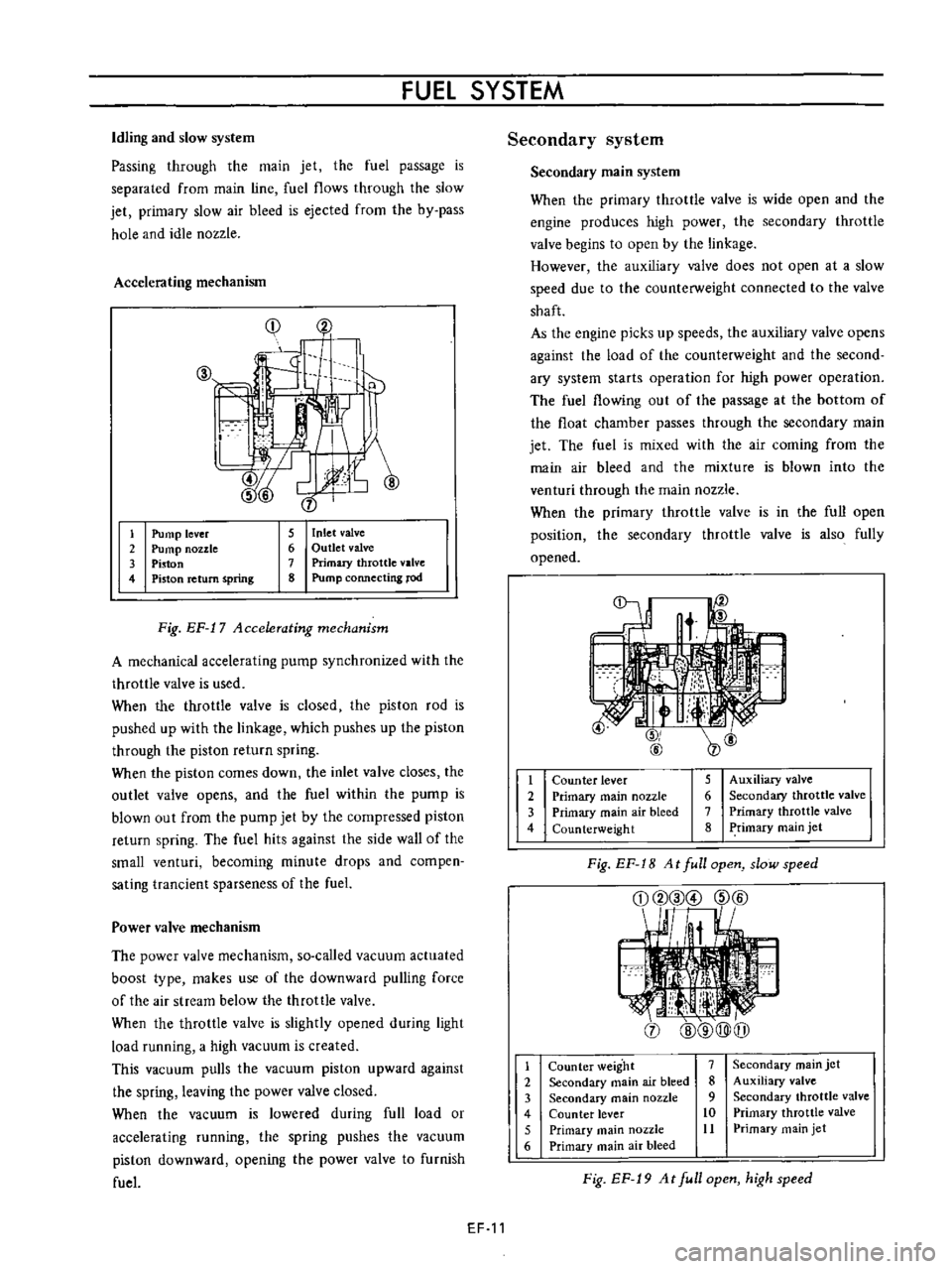
A
mechanical
accelerating
pump
synchronized
with
the
throttle
valve
is
used
When
the
throttle
valve
is
closed
the
piston
rod
is
pushed
up
with
the
linkage
which
pushes
up
the
piston
through
the
piston
return
spring
When
the
piston
comes
down
the
inlet
valve
closes
the
outlet
valve
opens
and
the
fuel
within
the
pump
is
blown
out
from
the
pump
jet
by
the
compressed
piston
return
spring
The
fuel
hits
against
the
side
wall
of
the
small
venturi
becoming
minute
drops
and
compen
sating
trancient
sparseness
of
the
fuel
Power
valve
mechanism
The
power
valve
mechanism
so
called
vacuum
actuated
boost
type
makes
use
of
the
downward
pulling
force
of
the
air
stream
below
the
throttle
valve
When
the
throttle
valve
is
slightly
opened
during
light
load
running
a
high
vacuum
is
created
This
vacuum
pulls
the
vacuum
piston
upward
against
the
spring
leaving
the
power
valve
closed
When
the
vacuum
is
lowered
during
full
load
or
accelerating
running
the
spring
pushes
the
vacuum
piston
downward
opening
the
power
valve
to
furnish
fuel
EF
11
Secondary
system
Secondary
main
system
When
the
primary
throttle
valve
is
wide
open
and
the
engine
produces
high
power
the
secondary
throttle
valve
begins
to
open
by
the
linkage
However
the
auxiliary
Y
J
lve
does
not
open
at
a
slow
speed
due
to
the
counterweight
connected
to
the
valve
shaft
As
the
engine
picks
up
speeds
the
auxiliary
valve
opens
against
the
load
of
the
counterweight
and
the
second
ary
system
starts
operation
for
high
power
operation
The
fuel
flowing
out
of
the
passage
at
the
bottom
of
the
float
chamber
passes
through
the
secondary
main
jet
The
fuel
is
mixed
with
the
air
coming
from
the
main
air
bleed
and
the
mixture
is
blown
into
the
venturi
through
the
main
nozzle
When
the
primary
throttle
valve
is
in
the
full
open
position
the
secondary
throttle
valve
is
also
fully
opened
t
2
3
4
5
Auxiliary
valve
6
Secondary
throttle
valve
7
Primary
throttle
valve
8
Primary
main
jet
Counter
lever
Primary
main
nozzle
Primary
main
air
bleed
Counterweight
Fig
EF
1B
At
full
open
slow
speed
j
1
2
3
4
5
6
Counter
weight
7
Secondary
main
air
bleed
8
Secondary
main
nozzle
9
Counter
lever
10
Primary
main
nozzle
11
Primary
main
air
bleed
Secondary
main
jet
Auxiliary
valve
Secondary
throttle
valve
Primary
throttle
valve
Primary
main
jet
Fig
EF
19
At
full
open
high
speed
Page 410 of 513
FUEl
SYSTEM
MA
JOR
SERVICE
OPERATIONS
A
completely
adjusted
and
serviced
carburetor
will
provide
the
engine
with
proper
mixture
at
all
speeds
Periodical
overhauling
which
cleans
all
components
and
passages
will
recover
the
originally
designed
performance
producing
the
engine
with
proper
gasoline
and
air
ratio
at
all
speeds
Passages
and
holes
of
the
carburetor
must
be
cleaned
carefully
Use
only
carburetor
solvent
and
com
pressed
air
to
clean
aU
passages
and
discharge
holes
Never
use
wire
or
other
pointed
tool
otherwise
accurately
calibrated
carburetor
will
be
affected
Removal
Remove
the
air
cleaner
2
Disconnect
the
fuel
line
vacuum
line
automatic
choke
harness
and
anti
dieseling
solenoid
harness
from
carburetor
3
Remove
the
throttle
lever
4
Remove
four
nuts
and
washers
retaining
the
carbuTe
tor
to
the
manifold
if
necessary
5
Lift
the
carburetor
and
remove
from
the
manifold
6
Remove
and
discard
the
gasket
used
between
the
carburetor
and
manifold
Disassembly
The
main
jets
and
needle
valves
on
both
primary
and
secondary
sides
are
accessible
from
outside
of
the
carbure
tor
for
disassembly
2
Remove
throttle
return
spring
3
Remove
pump
lever
shaft
take
out
pump
lever
and
pump
connecting
rod
4
Remove
rubber
pipe
from
choke
piston
5
Loosen
off
bolts
securing
servo
diaphragm
in
posi
tion
take
out
diaphragm
6
Back
off
total
of
five
bolts
which
hold
choke
in
position
and
remove
rods
of
starter
system
take
out
choke
chamber
In
removing
chamber
exercise
care
to
avoid
damaging
float
EF
19
ilia
Fig
EF
32
Removing
choke
dwmherand
seroo
diaphragm
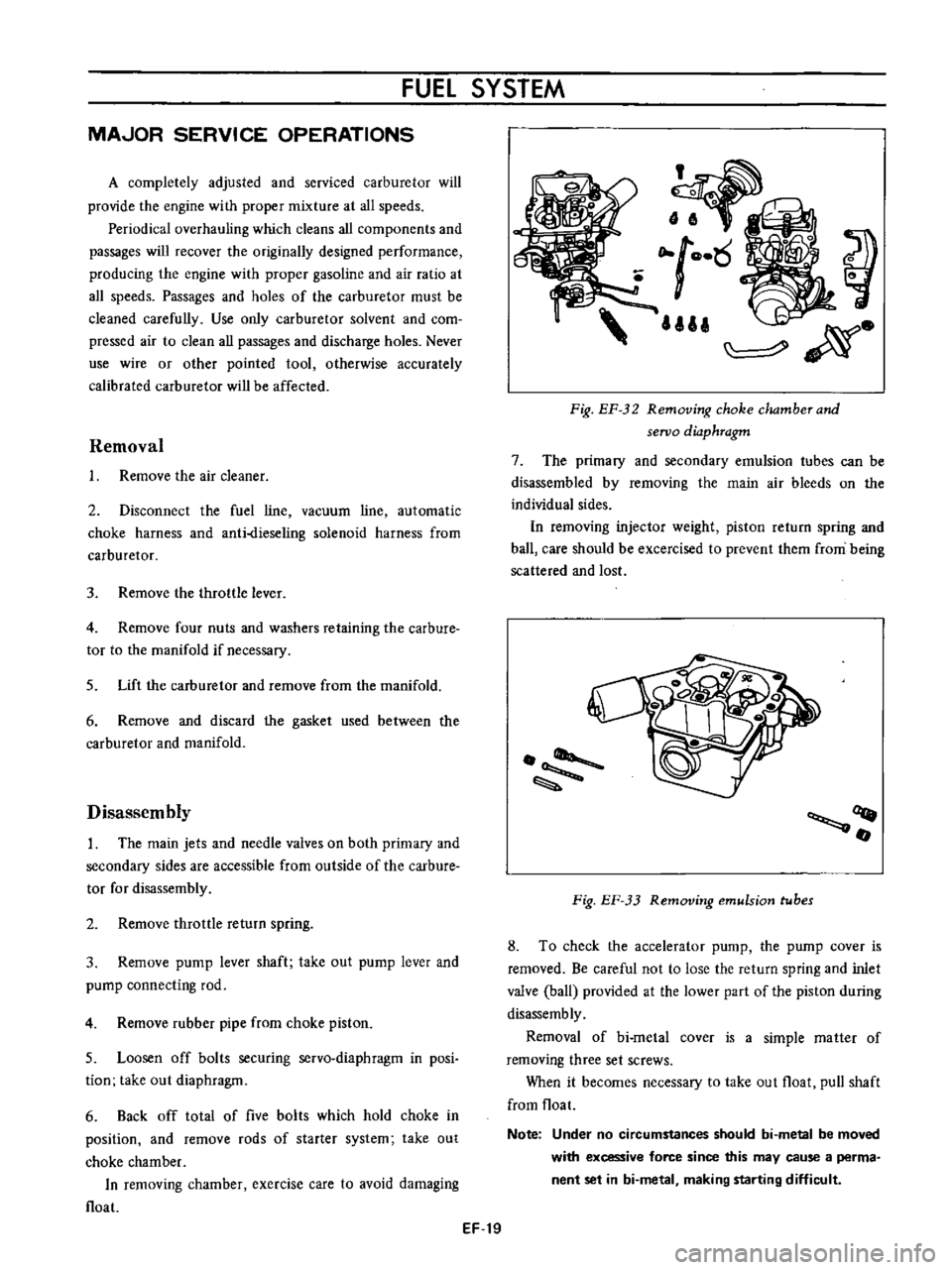
7
The
primary
and
secondary
emulsion
tubes
can
be
disassembled
by
removing
the
main
air
bleeds
on
the
individual
sides
In
removing
injector
weight
piston
return
spring
and
ball
care
should
be
excercised
to
prevent
them
from
being
scattered
and
lost
OQ
fI
Fig
EF
33
Removing
emulsion
tubes
8
To
check
the
accelerator
pump
the
pump
cover
is
removed
Be
careful
not
to
lose
the
return
spring
and
inlet
valve
ball
provided
at
the
lower
part
of
the
piston
during
disassemb
ly
Removal
of
bi
metal
cover
is
a
simple
matter
of
removing
three
set
screws
When
it
becomes
necessary
to
take
out
float
pull
shaft
from
float
Note
Under
no
circumstances
should
bi
metal
be
moved
with
excessive
force
since
this
may
cause
a
perma
nent
set
in
bi
metal
making
starting
difficult
Page 413 of 513
ENGINE
Choke
unloader
clearance
carburetor
body
C
between
choke
valve
and
mm
in
Bi
metal
resistance
ohms
2
01
0
07911
8
6t09
0
Accelerator
pump
Injector
hole
Return
spring
Fuel
pressure
mm
in
g
mm
Ib
in
kg
cm
2
psi
kg
lb
0
5
0
0197
78
I
I
0
18
2
6
Manual
transmission
Automatic
transmission
Weight
2
8
6
2
2
9
6
39
Example
1
215
represents
215
100
2
15
mm
0
0846
in
diameter
TROUBLE
DIAGNOSES
AND
CORRECTIONS
There
are
various
causes
of
engine
tarubles
It
some
times
happens
that
the
completely
effective
carburetor
seems
apparently
to
have
some
troubles
when
electric
system
is
defective
Therefore
whenever
the
enigne
has
troubles
electric
system
must
be
checked
first
before
adjusting
the
carburetor
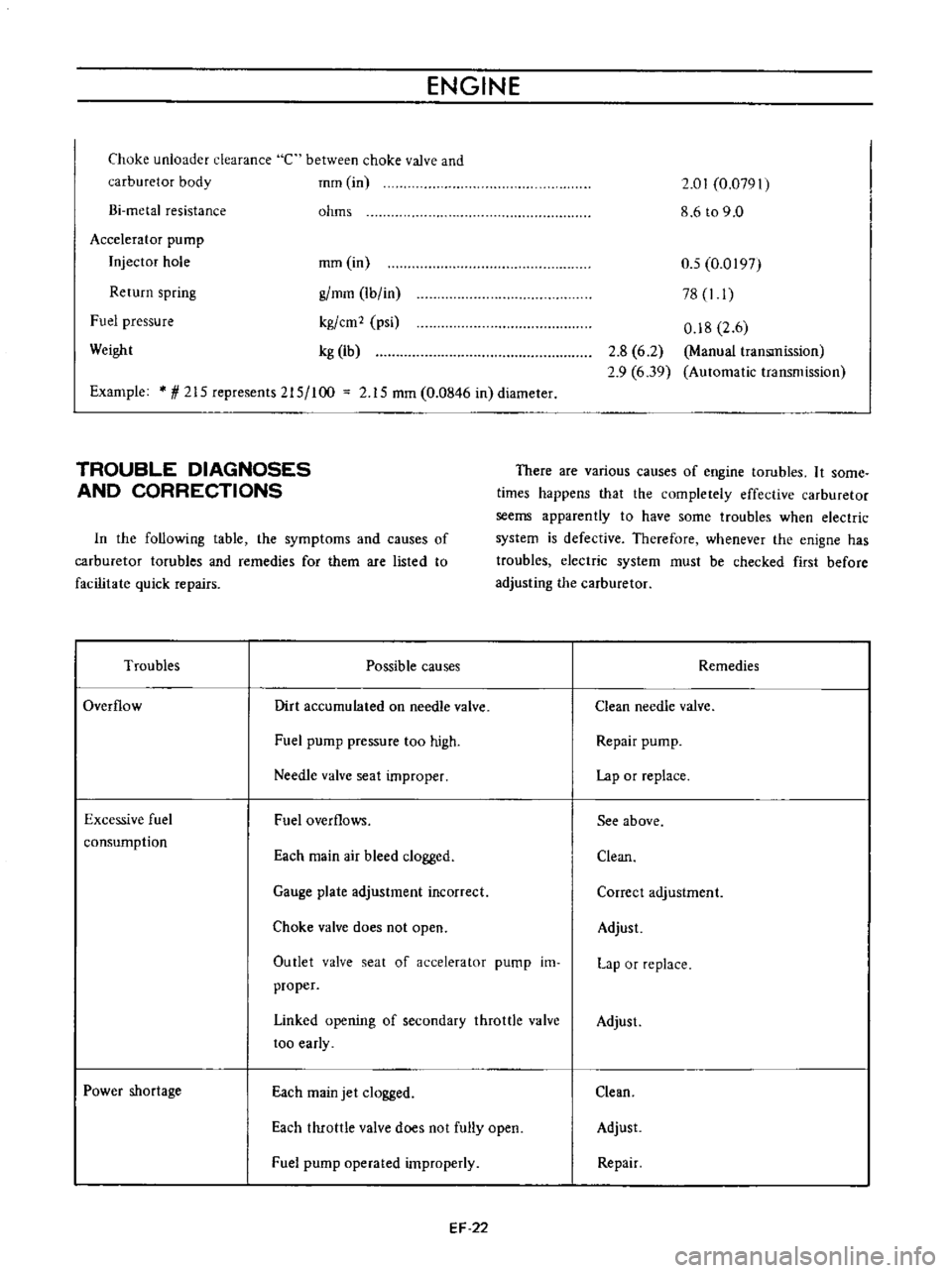
In
the
following
table
the
symptoms
and
causes
of
carburetor
tarubles
and
remedies
for
them
are
listed
to
facilitate
quick
repairs
Troubles
Possible
causes
Remedies
Overflow
Dirt
accumulated
on
needle
valve
Clean
needle
valve
Fuel
pump
pressure
too
high
Repair
pump
Needle
valve
seat
improper
Lap
or
replace
Excessive
fuel
consumption
Fuel
overflows
See
above
Each
main
air
bleed
clogged
Clean
Gauge
plate
adjustment
incorrect
Correct
adjustment
Choke
valve
does
not
open
Adjust
Outlet
valve
seat
of
accelerator
pump
im
proper
Lap
or
replace
Linked
opening
of
secondary
throttle
valve
too
early
Adjust
Power
shortage
Each
main
jet
clogged
Clean
Each
throttle
valve
does
not
fully
open
Adjust
Fuel
pump
operated
improperly
Repair
EF
22
Page 431 of 513
ENGINE
ElECTRICAL
SYSTEM
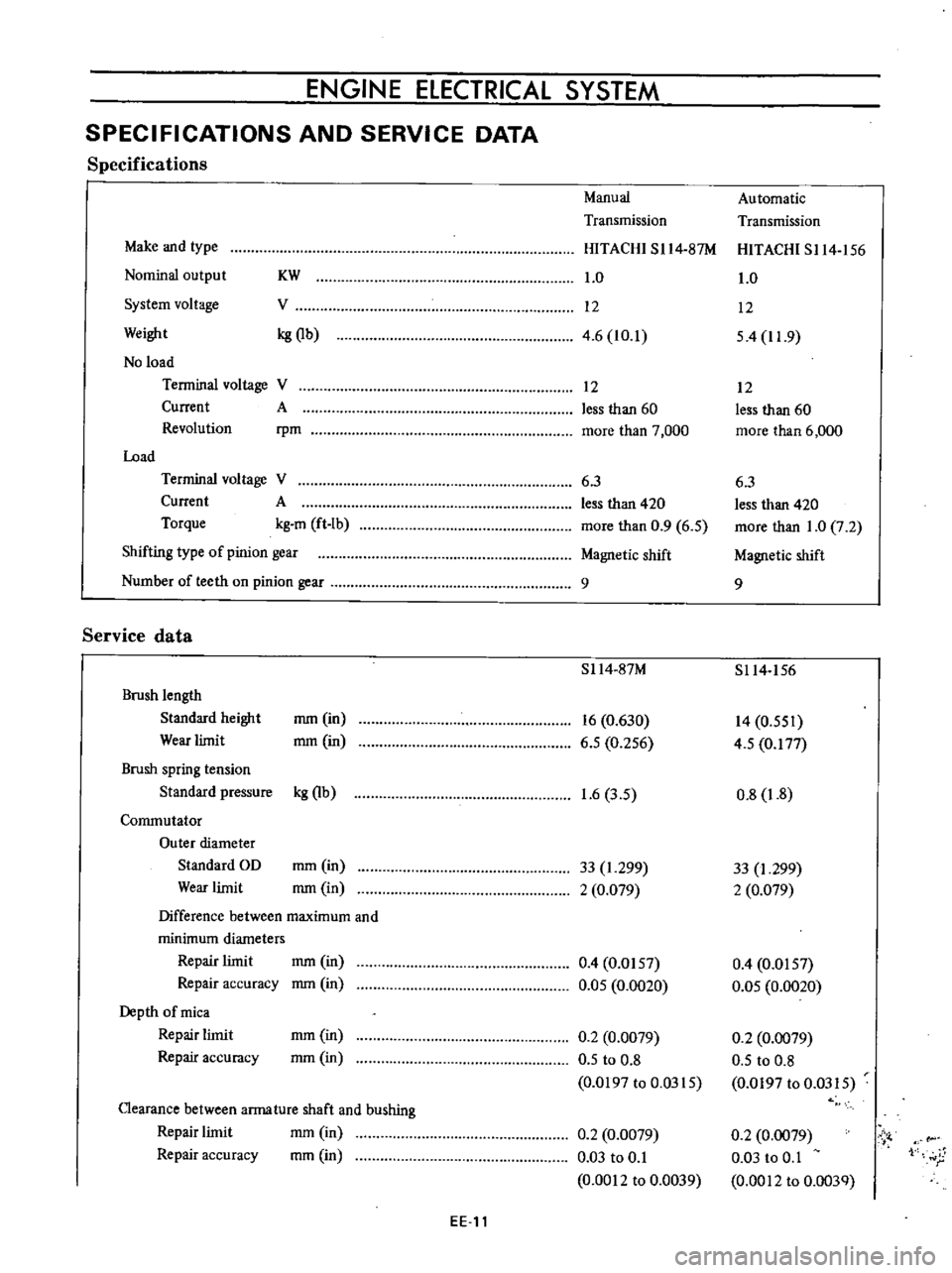
SPECIFICATIONS
AND
SERVICE
DATA
Specifications
Manual
Automatic
Transmission
Transmission
Make
and
type
HITACHI
SI14
87M
HITACHI
S114
156
Nominal
output
KW
1
0
1
0
System
voltage
V
12
12
Weight
kg
Qb
4
6
10
1
54
11
9
No
load
Terminal
voltage
V
12
12
Current
A
less
than
60
less
than
60
Revolution
rpm
more
than
7
000
more
than
6
000
Load
Terminal
voltage
V
6
3
6
3
Current
A
less
than
420
less
than
420
Torque
kg
m
ft
Ib
more
than
0
9
6
5
more
than
1
0
7
2
Shifting
type
of
pinion
gear
Magnetic
shift
Magnetic
shift
Number
of
teeth
on
pinion
gear
9
9
Service
data
S114
87M
S114
156
Brush
length
Standard
height
mm
in
16
0
630
14
0
551
Wear
limit
mm
in
6
5
0
256
4
5
0
177
Brush
spring
tension
Standard
pressure
kg
Qb
1
6
3
5
0
8
1
8
Commutator
Outer
diameter
Standard
OD
mm
in
33
1
299
33
I
299
Wear
limit
mm
in
2
0
079
2
0
079
Difference
between
maximum
and
minimum
diameters
Repair
limit
mm
in
0
4
0
0157
0
4
0
0157
Repair
accuracy
mm
in
0
05
0
0020
0
05
0
0020
Depth
of
mica
Repair
limit
mm
in
0
2
0
0079
0
2
0
0079
Repair
accuracy
mm
in
0
5
to
0
8
0
5
to
0
8
0
0197
to
0
0315
0
0197
to
0
0315
Clearance
between
arma
ture
shaft
and
bushing
mm
in
Repair
limit
0
2
0
0079
0
2
0
0079
Vi
Repair
accuracy
mm
in
0
03
to
0
1
0
03
to
0
1
1
r
0
0012
to
0
0039
0
0012
to
0
003Q
EE
11
Page 436 of 513
ENGINE
r
Ignition
switJ
c
o
iArm
ture
j
i
i
VC2
P
tP2
d
I
I
I
PI
I
ll
Rl
L
I
I
lRJ
t
R
I
Field
e
I
I
I
I
Ps
I
1
I
I
n
I
coil
M
4
i
f
I
L
1
J
Alternator
Voltage
regulator
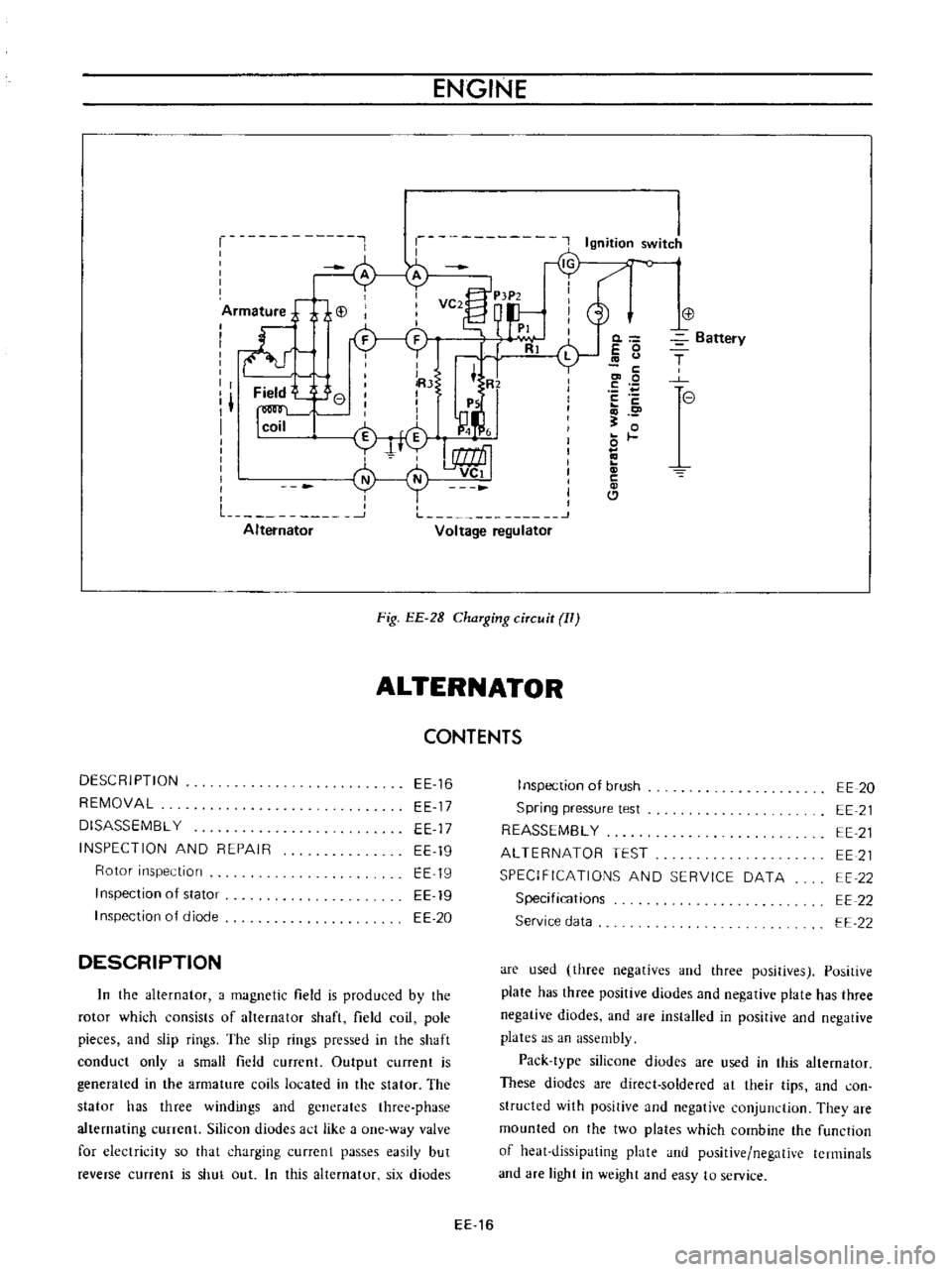
Fig
EE
2B
ChaTging
ciTcuit
II
ALTERNATOR
CONTENTS
DESCRIPTION
REMOVAL
DISASSEMBL
Y
INSPECTION
AND
REPAIR
Rotor
inspection
Inspection
of
stator
I
nspection
of
diode
EE
16
EE
17
EE
17
EE
19
EE
19
EE
19
EE
20
DESCRIPTION
In
the
alternator
a
magnetic
field
is
produced
by
the
rotor
which
consists
of
alternator
shaft
field
coil
pole
pieces
and
slip
rings
The
slip
rings
pressed
in
the
shaft
conduct
only
a
small
field
current
Output
current
is
generated
in
the
armature
coils
located
in
the
stator
The
stator
has
three
windings
and
generates
three
phase
alternating
currenl
Silicon
diudes
act
like
a
one
way
valve
for
electricity
so
that
charging
currcnt
passes
easily
but
reverse
current
is
shut
out
In
this
alternator
six
diodes
0
E
0
c
co
0
E
c
o
0
c
Cl
Battery
T
e
I
nspection
of
brush
Spring
pressure
test
REASSEMBL
Y
ALTERNATOR
TEST
SPECIFICATIONS
AND
SERVICE
DATA
Specifications
Service
data
EE
20
EE
21
EE
21
EE
21
EE
22
EE
22
EE
22
are
used
three
negatives
and
three
positives
Positive
plate
has
three
positive
diodes
and
negative
plate
has
three
negative
diodes
and
are
installed
in
positive
and
negative
plates
as
an
assembly
Pack
type
silicone
diodes
are
used
in
this
alternator
These
diodes
are
direct
soldered
at
their
tips
and
con
structed
with
positive
and
negative
conjunction
They
are
mounted
on
the
two
plates
which
combine
the
function
of
heat
dissipating
plate
and
positive
negative
terminals
and
are
light
in
weight
and
easy
to
service
EE
16
Page 450 of 513
ENGINE
I
Grease
I
I
I
n
r
Y
J
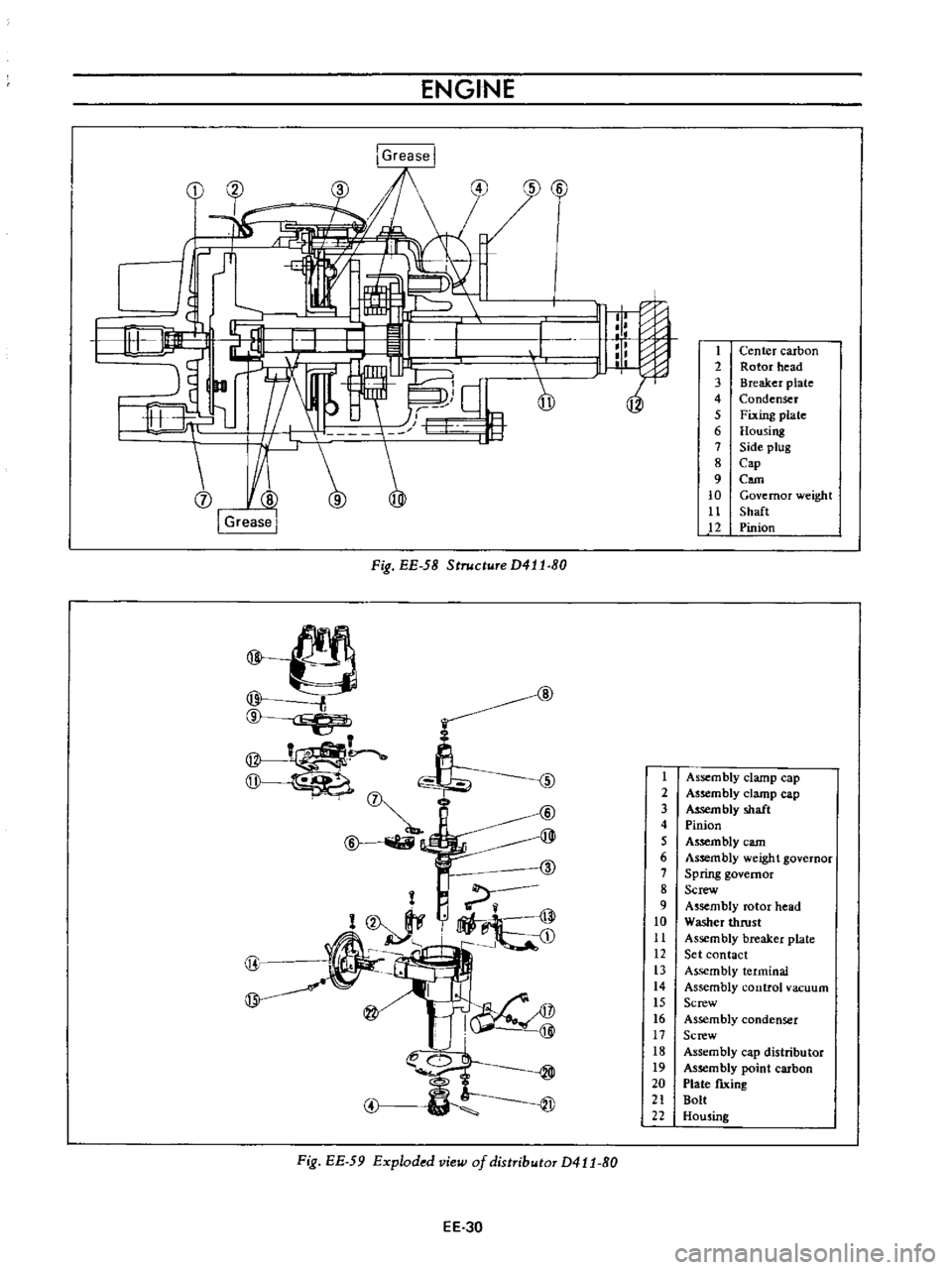
Fig
EE
5B
StructuTe
D4l
l
BO
jj
l1
@
f
1
j
0
i
@r
liiU
ID
r
@l
IlIlJ
e
D
r
J
@
i
i
nL
ft
L
6
Fig
BE
59
Exploded
view
of
distTibutoT
D4Il
BO
EE
30
1
Center
carbon
2
Rotor
bead
3
Breaker
plate
4
Condenser
5
Fixing
plate
6
Housing
7
Side
plug
8
Cap
9
Carn
10
Governor
weight
tl
Shaft
12
Pinion
t
2
3
4
5
6
1
8
9
to
tl
12
13
14
t5
t6
11
18
t9
20
21
22
Assem
bly
clamp
cap
Assembly
clamp
cap
Assembly
shaft
Pinion
Assembly
earn
Assembly
weight
governor
Spring
gO
1emor
Screw
A
sembty
rotor
head
Washer
thrust
Assembly
breaker
plate
Set
contact
Assembly
terminal
Assembly
control
vacuum
Screw
Assembly
condenser
Screw
Assembly
cap
distributor
Assembly
point
carbon
Plate
ftxing
Bolt
HOllSing
Page 452 of 513
ENGINE
When
nothing
is
wrong
with
its
characteristics
con
ceivable
causes
are
defectiveness
or
abnormal
wearing
of
driving
part
or
others
Do
not
disassemble
it
When
characteristics
are
improper
check
earn
as
sembly
governor
weight
shaft
and
governor
spring
and
other
relative
parts
carefully
When
reassembling
the
centrifugal
advance
mechanical
part
be
sure
to
check
advance
characteristics
by
the
use
of
a
distributor
tester
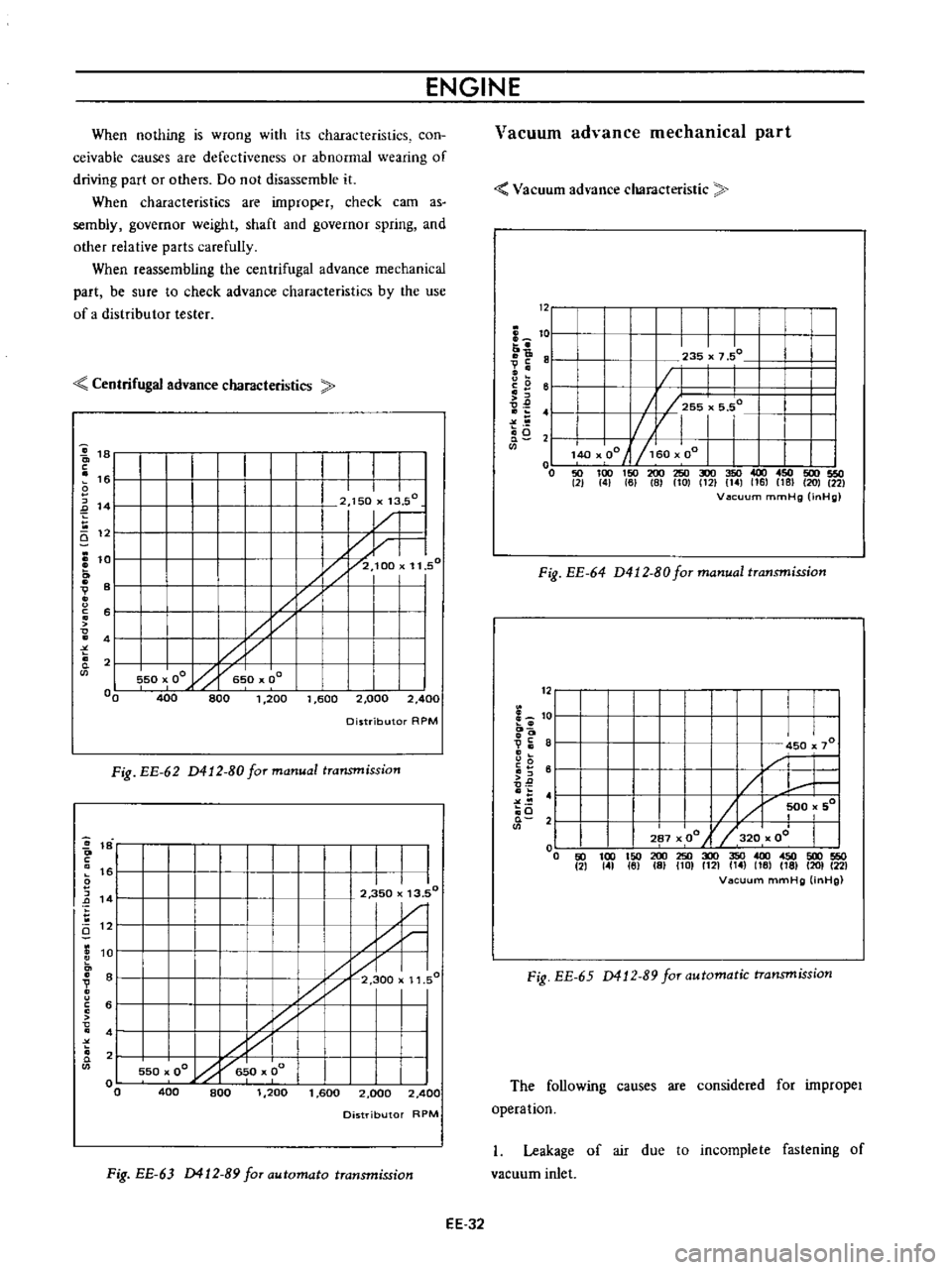
Centrifugal
advance
characteristics
1
c
1
Ei
12
L
o
V
o
u
c
o
o
t
D
c
s
151
14
e
101
0
81
V
0
u
c
51
0
41
t
0
Q
2
01
0
I
I
I
1
rj
11
50
I
J
2
100
50
oQ
5
00
400
800
1
200
1
600
2
00
Distributor
RPM
Fig
EE
62
D412
80formanual
transmission
I
I
I
2
350
13
50
1
1
1
300
1
1
550
00
h
6
0
0
I
400
800
1
200
1
600
2
000
Distributor
RPM
Fig
EE
63
D412
B9
faT
automata
transmission
2
400
I
11
50
2
400
EE
32
Vacuum
advance
mechanical
part
Vacuum
ad
ance
characteristic
12
I
I
I
I
I
II1
5515
5Q
i
01
40
00
i1j
50
00
1
I
o
50
100
150
200
250
300
350
400
450
500
550
21
41
6
8
101
C121
141
161
181
201
22
V2Icuum
mmHg
inHg
I
I
I
I
7
50
1
1Q
Ii
V
I
o
0
u
i
e
6
tI
2
o
i5
0
235
Fig
EE
64
D412
80
for
manual
transmission
c
1
0
I
o
9i
8
o
u
0
i
61
0
0
0
4
o
Q
2
I
I
I
450
x
70
L
H
1
500
501
287
00
l
320
oJ
I
I
200250300350400450500550
IS
101
1121
t4
16
16
1201
22
Vacuum
mmHg
OnHg
o
50
100
150
2
141
161
Fig
EE
65
0412
89
for
automatic
transmission
The
following
causes
are
considered
for
impropeI
opera
tion
I
Leakage
of
air
due
to
incomplete
fastening
of
vacuum
inlet
Page 454 of 513
ENGINE
6
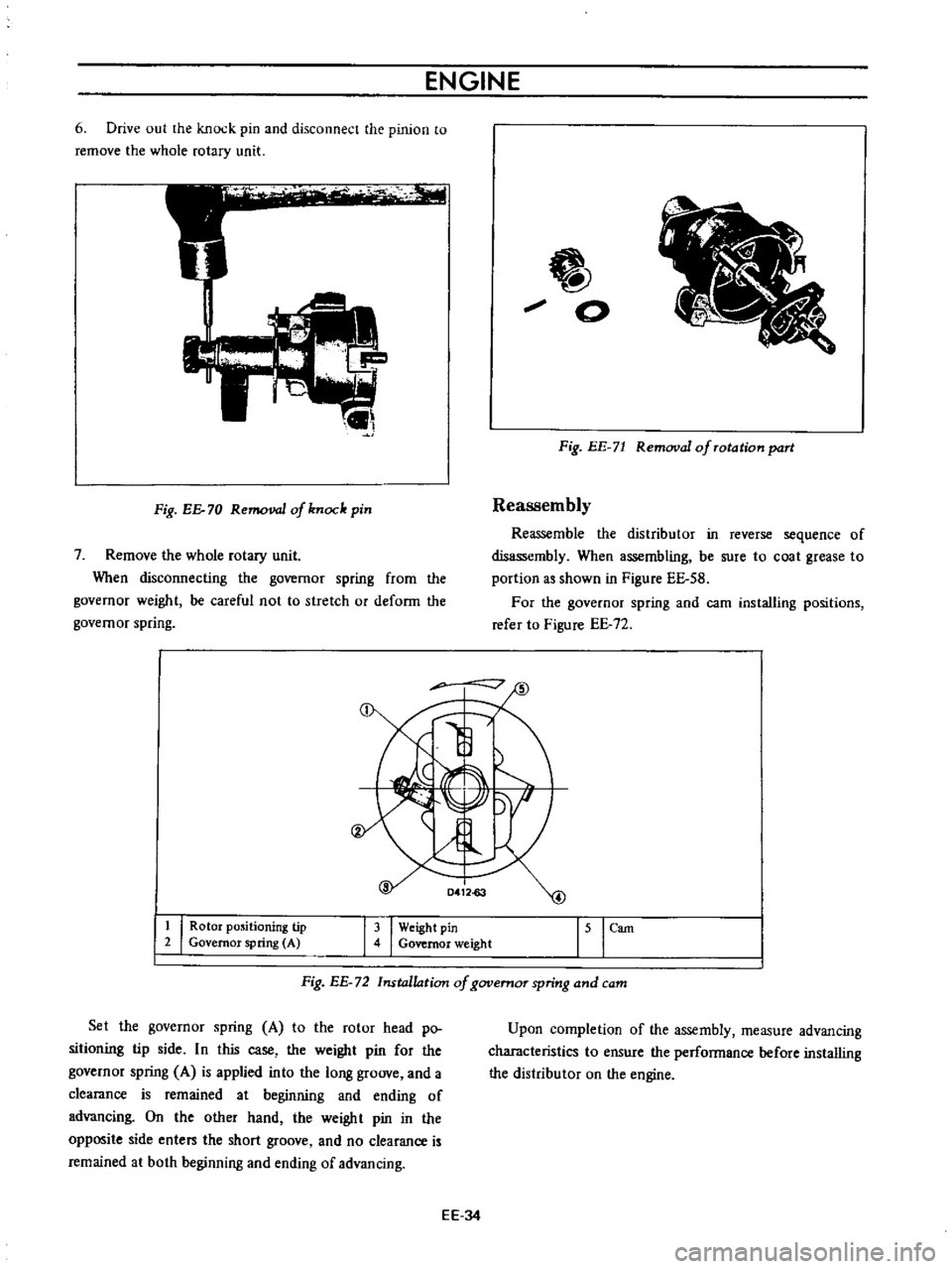
Drive
out
the
knock
pin
and
disconnect
the
pinion
to
remove
the
whole
rotary
unit
Fig
EE
70
Removal
of
knock
pin
7
Remove
the
whole
rotary
unit
When
disconnecting
the
governor
spring
from
the
governor
weight
be
careful
not
to
stretch
or
deform
the
governor
spring
tJ
0
Fig
EE
71
Removal
of
Totation
pari
Reassembly
Reassemble
the
distributor
in
reverse
sequence
of
disassembly
When
assembling
be
sure
to
coat
grease
to
portion
as
shown
in
Figure
EE
58
For
the
governor
spring
and
earn
installing
positions
refer
to
Figure
EE
72
1
I
Rotor
positioning
tip
2
Governor
spring
A
13
I
Weight
pin
4
Governor
weight
15
I
earn
Fig
EE
72
Installation
of
governor
spring
and
cam
Set
the
governor
spring
A
to
the
rotor
head
po
sitioning
tip
side
In
this
case
the
weight
pin
for
the
governor
spring
A
is
applied
into
the
long
groove
and
a
clearance
is
remained
at
beginning
and
ending
of
advancing
On
the
other
hand
the
weight
pin
in
the
opposite
side
enters
the
short
groove
and
no
clearance
is
remained
at
both
beginning
and
ending
of
advancing
Upon
completion
of
the
assembly
measure
advancing
characteristics
to
ensure
the
performance
before
installing
the
distributor
on
the
engine
EE
34
Page 456 of 513
ENGINE
Weight
pivot
diameter
mm
in
Weight
hole
diameter
mm
in
Clearance
between
pivot
and
hole
mmOn
5
0
028
0
9
9
1
0011
1
005
1
6
1
0002
5
1
018
0
1969
0
0007
o
0
0
005
to
0
046
0
0002
to
0
0018
IGNITION
COIL
CONTENTS
DESCRIPTION
EE
36
DESCRIPTION
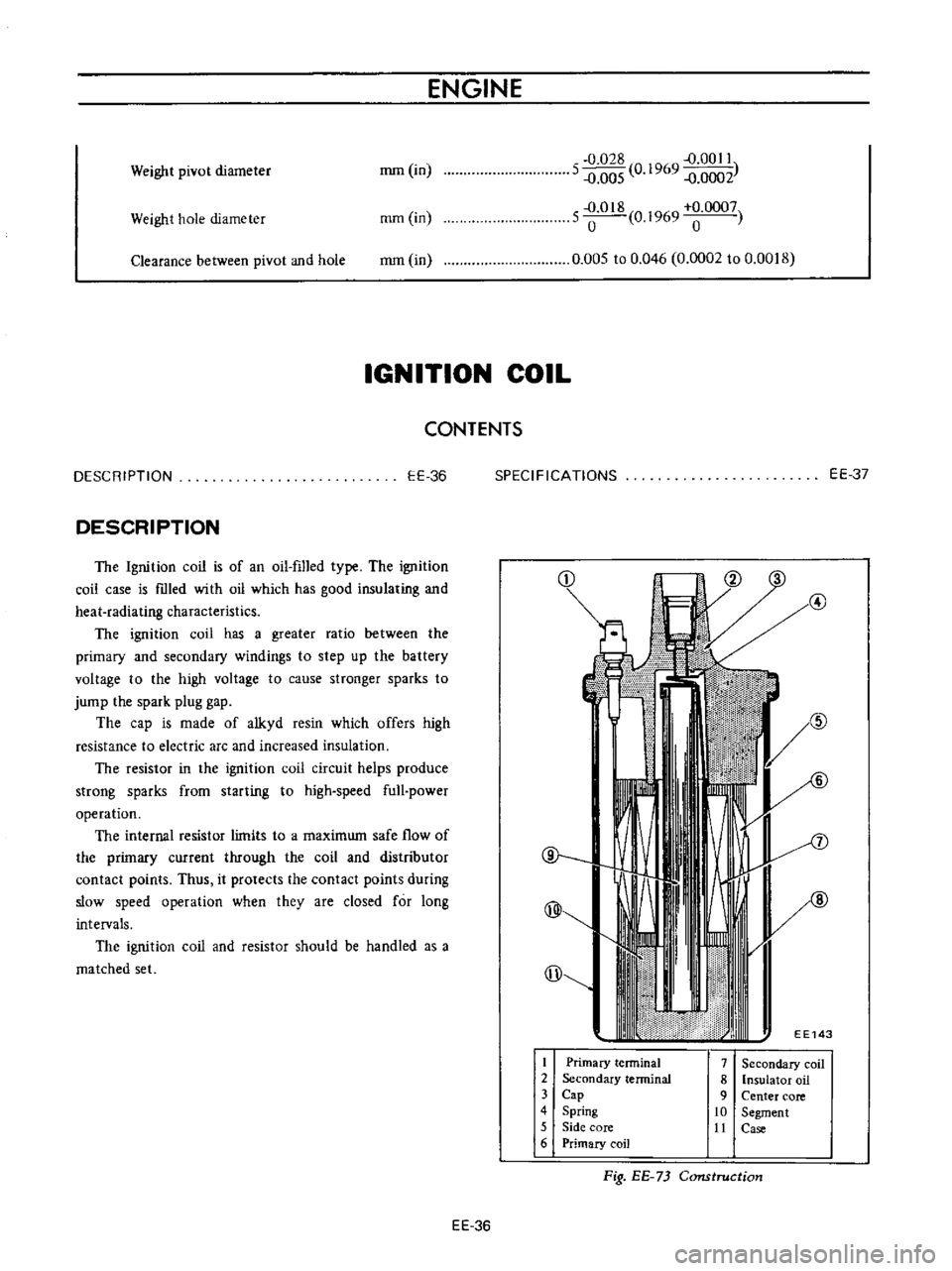
The
Ignition
coil
is
of
an
oil
filled
type
The
ignition
coil
case
is
mted
with
oil
which
has
good
insulating
and
heat
radiating
characteristics
The
ignition
coil
has
a
greater
ratio
between
the
primary
and
secondary
windings
to
step
up
the
battery
voltage
to
the
high
voltage
to
cause
stronger
sparks
to
jump
the
spark
plug
gap
The
cap
is
made
of
alkyd
resin
which
offers
high
resistance
to
electric
arc
and
increased
insulation
The
resistor
in
the
ignition
coil
circuit
helps
produce
strong
sparks
from
starting
to
high
speed
full
power
operation
The
internal
resistor
limits
to
a
maximum
safe
flow
of
the
primary
current
through
the
coil
and
distributor
contact
points
Thus
it
protects
the
contact
points
during
slow
speed
operation
when
they
are
closed
for
long
intervals
The
ignition
coil
and
resistor
should
be
handled
as
a
matched
set
EE
36
SPECIFICATIONS
EE
37
@
@
@l
@
EE143
I
Primary
terminal
2
Secondary
terminal
3
Cap
4
Spring
5
Side
core
6
Primary
coil
7
Secondary
coil
8
insulator
oil
9
Center
core
10
Segment
tt
Case
Fig
EE
73
Construction