brake light DODGE AVENGER 2008 User Guide
[x] Cancel search | Manufacturer: DODGE, Model Year: 2008, Model line: AVENGER, Model: DODGE AVENGER 2008Pages: 467, PDF Size: 7.16 MB
Page 282 of 467
The ABS light monitors the Anti-Lock Brake
System. The light will come on when the
ignition switch is turned to the ON position
and may stay on for as long as four seconds.
If the ABS light remains on or comes on while driving, it
indicates that the Anti-Lock portion of the brake system
is not functioning and that service is required. However,
the conventional brake system will continue to operate
normally if the BRAKE warning light is not on.
If the ABS light is on, the brake system should be serviced
as soon as possible to restore the benefits of Anti-Lock
brakes. If the ABS light does not come on when the
ignition switch is turned to the ON position, have the
bulb repaired as soon as possible.
If both the Brake Warning Light and the ABS Light
remain on, the Anti-Lock brakes (ABS) and Electronic Brake Force Distribution (EBD) systems are not function-
ing. Immediate repair to the ABS system is required. See
your authorized Dealer Service Center.
When the vehicle is driven over 7 mph (11 km/h), you
may also hear a slight clicking sound as well as some
related motor noises. These noises are the system per-
forming its self-check cycle to ensure that the ABS system
is working properly. This self check occurs each time the
vehicle is started and accelerated past 7 mph (11 km/h).
ABS is activated during braking under certain road or
stopping conditions. ABS-inducing conditions can in-
clude ice, snow, gravel, bumps, railroad tracks, loose
debris, or panic stops.
You also may experience the following when the brake
system goes into Anti-lock:
² The ABS motor running (it may continue to run for a
short time after the stop),280 STARTING AND OPERATING
Page 283 of 467
² the clicking sound of solenoid valves,
² brake pedal pulsations,
² and a slight drop or fall away of the brake pedal at the
end of the stop.
These are all normal characteristics of ABS.
WARNING!The Anti-Lock Brake System contains sophisticated
electronic equipment that may be susceptible to
interference caused by improperly installed or high
output radio transmitting equipment. This interfer-
ence can cause possible loss of anti-lock braking
capability. Installation of such equipment should be
performed by qualified professionals. All vehicle wheels and tires must be the same size and
type and tires must be properly inflated to produce
accurate signals for the computer.
ELECTRONIC BRAKE CONTROL SYSTEMS ±
ABS/TCS/BAS/ESP
Your vehicle may be equipped with an optional ad-
vanced electronic brake control system that includes
Anti-Lock Brake System (ABS), Traction Control System
(TCS), Brake Assist System (BAS), and Electronic Stability
Program (ESP). All systems work together to enhance
vehicle stability and control in various driving conditions
and are commonly referred to as ESP.
ANTI-LOCK BRAKE SYSTEM (ABS)
This system aids the driver in maintaining vehicle control
under adverse braking conditions. The system controls
hydraulic brake pressure to prevent wheel lock-up and STARTING AND OPERATING 281
5
Page 292 of 467
CAUTION!² Driving through standing water may cause dam-
age to your vehicle's drivetrain components. Al-
ways inspect your vehicle's fluids (i.e., engine oil,
transmission, axle, etc.) for signs of contamination
(i.e., fluid that is milky or foamy in appearance)
after driving through standing water. Do not con-
tinue to operate the vehicle if any fluid appears
contaminated, as this may result in further dam-
age. Such damage is not covered by the New
Vehicle Limited Warranty.
² Getting water inside your vehicle's engine can
cause it to lock up and stall out, and cause serious
internal damage to the engine. Such damage is not
covered by the New Vehicle Limited Warranty. WARNING!² Driving through standing water limits your vehi-
cle's traction capabilities. Do not exceed 5 mph (8
km/h) when driving through standing water.
² Driving through standing water limits your vehi-
cle's braking capabilities, which increases stop-
ping distances. Therefore, after driving through
standing water, drive slowly and lightly press on
the brake pedal several times to dry the brakes.
² Getting water inside your vehicle's engine can
cause it to lock up and stall out, and leave you
stranded.
² Failure to follow these warnings may result in
injuries that are serious or fatal to you, your
passengers, and others around you.290 STARTING AND OPERATING
Page 344 of 467
² Trailer brakes are recommended for trailers over 1,000
lbs (450 kg) and required for trailers in excess of 2,000
lbs (907 kg).
CAUTION!If the trailer weighs more than 1,000 lbs (450 kg)
loaded, it should have its own brakes with adequate
braking capacity. Failure to do this could lead to
accelerated brake lining wear, higher brake pedal
effort, and longer stopping distances. WARNING!Do not connect trailer brakes to your vehicle's hy-
draulic brake lines. It can overload your brake sys-
tem and cause it to fail. You might not have brakes
when you need them and could have an accident.
Towing any trailer will increase your stopping dis-
tance. When towing, you should allow for additional
space between your vehicle and the vehicle in front
of you. Failure to do so could result in an accident.
Towing Requirements Ð Trailer Lights and Wiring
Whenever you pull a trailer, regardless of the trailer size,
stoplights and turn signals on the trailer are required for
motoring safety.
Use a factory approved trailer harness and connector.342 STARTING AND OPERATING
Page 368 of 467
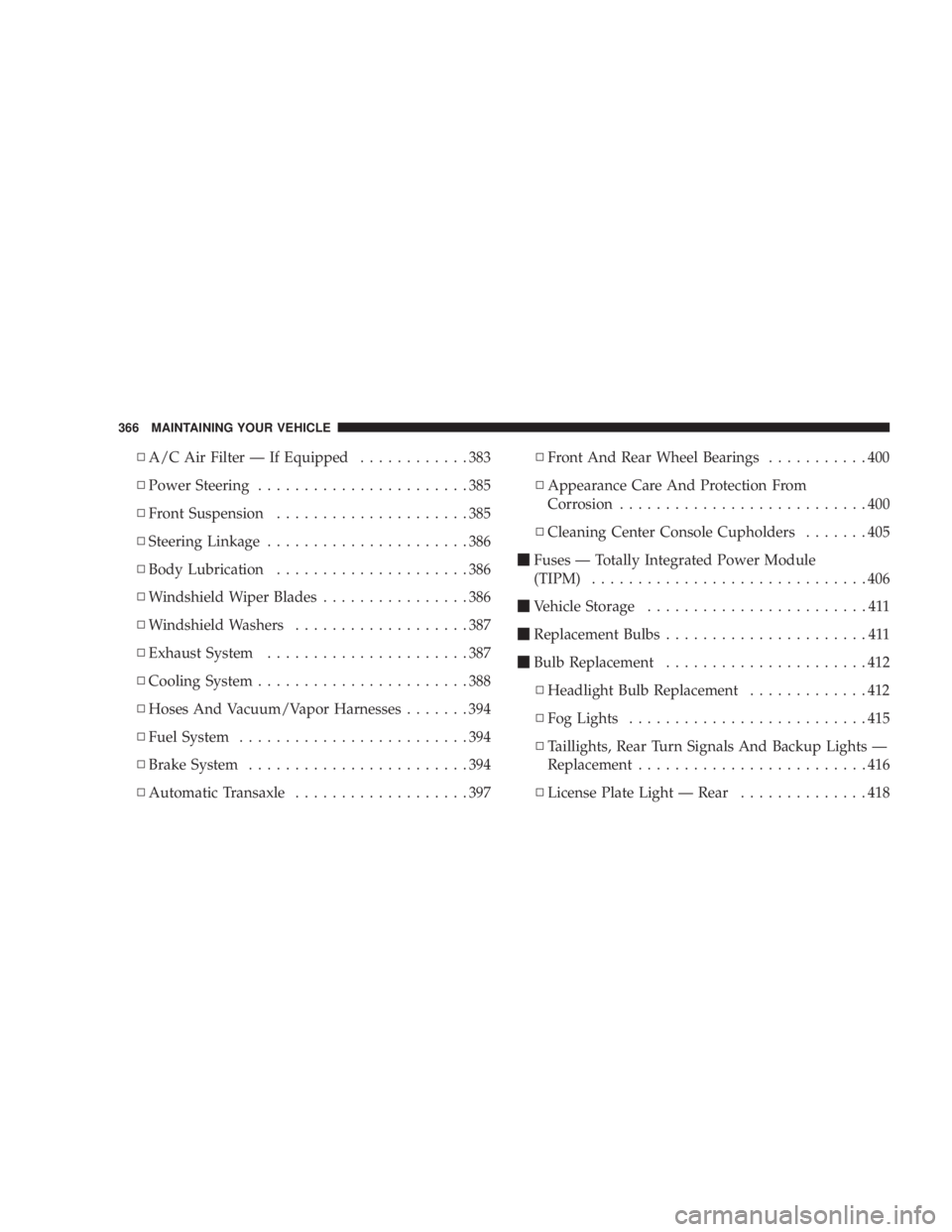
N A/C Air Filter Ð If Equipped ............383
N Power Steering .......................385
N Front Suspension .....................385
N Steering Linkage ......................386
N Body Lubrication .....................386
N Windshield Wiper Blades ................386
N Windshield Washers ...................387
N Exhaust System ......................387
N Cooling System .......................388
N Hoses And Vacuum/Vapor Harnesses .......394
N Fuel System .........................394
N Brake System ........................394
N Automatic Transaxle ...................397 N Front And Rear Wheel Bearings ...........400
N Appearance Care And Protection From
Corrosion ...........................400
N Cleaning Center Console Cupholders .......405
m Fuses Ð Totally Integrated Power Module
(TIPM) ..............................406
m Vehicle Storage ........................411
m Replacement Bulbs ......................411
m Bulb Replacement ......................412
N Headlight Bulb Replacement .............412
N Fog Lights ..........................415
N Taillights, Rear Turn Signals And Backup Lights Ð
Replacement .........................416
N License Plate Light Ð Rear ..............418366 MAINTAINING YOUR VEHICLE
Page 398 of 467
immediately! Eventual deterioration of the hose can
take place resulting in a possibility of a burst failure.
WARNING!Worn brake hoses can burst and cause brake failure.
You could have an accident. If you see any signs of
cracking, scuffing, or worn spots, have the brake
hoses replaced immediately.
Master Cylinder - Brake Fluid Level Check
Check the fluid level in the master cylinder immediately
if the brake system warning light indicates system fail-
ure.
Check the fluid level in the master cylinder when per-
forming underhood services. Clean the top of the master cylinder area before removing
the cap. If necessary, add fluid to bring the fluid level up
to the requirements described on the brake fluid reser-
voir.
Overfilling of fluid is not recommended because it may
cause leaking in the system.
Fluid level can be expected to fall as the brake pads wear.
Brake fluid level should be checked when pads are
replaced. However, low fluid level may be caused by a
leak and a checkup may be needed.
Use only manufacturers recommended brake fluid. Refer
to ªFluids, Lubricants, and Genuine Partsº for the correct
fluid type.396 MAINTAINING YOUR VEHICLE
Page 404 of 467
² If your vehicle is damaged due to an accident or
similar cause which destroys the paint and protective
coating, have your vehicle repaired as soon as pos-
sible. The cost of such repairs is considered the respon-
sibility of the owner.
² If you carry special cargo such as chemicals, fertilizers,
de-icer salt, etc., be sure that such materials are well
packaged and sealed.
² If a lot of driving is done on gravel roads, consider
mud or stone shields behind each wheel.
² Use Mopar t touch up paint on scratches as soon as
possible. Your authorized dealer has touch up paint to
match the color of your vehicle.
Wheel and Wheel Trim Care
All wheels and wheel trim, especially aluminum and
chrome plated wheels, should be cleaned regularly with
a mild soap and water to prevent corrosion. To remove heavy soil and/or excessive brake dust, use Mopar t
Wheel Cleaner (05066247AB) or equivalent or select a
nonabrasive, non-acidic cleaner. Do not use scouring
pads, steel wool, a bristle brush, or metal polishes. Only
Mopar t or equivalent is recommended. Do not use oven
cleaner. Avoid automatic car washes that use acidic
solutions or harsh brushes that may damage the wheels'
protective finish.
Cleaning Headlights
Your vehicle has plastic headlights that are lighter and
less susceptible to stone breakage than glass headlights.
Plastic is not as scratch resistant as glass and therefore
different lens cleaning procedures must be followed.
To minimize the possibility of scratching the lenses and
reducing light output, avoid wiping with a dry cloth. To
remove road dirt, wash with a mild soap solution fol-
lowed by rinsing.402 MAINTAINING YOUR VEHICLE
Page 409 of 467
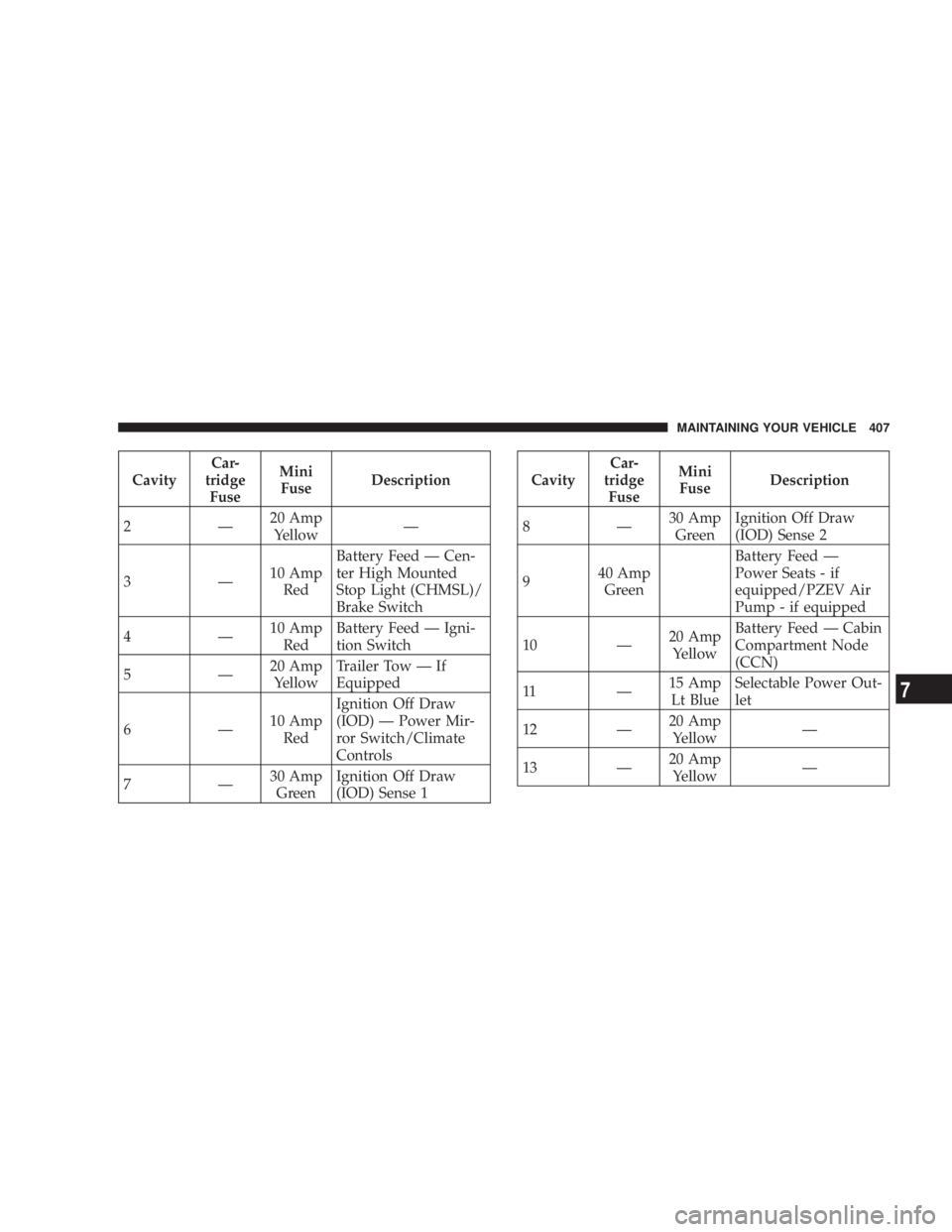
Cavity Car-
tridge
Fuse Mini
Fuse Description
2Ð 20 Amp
Yellow Ð
3Ð 10 Amp
Red Battery Feed Ð Cen-
ter High Mounted
Stop Light (CHMSL)/
Brake Switch
4Ð 10 Amp
Red Battery Feed Ð Igni-
tion Switch
5Ð 20 Amp
Yellow Trailer Tow Ð If
Equipped
6Ð 10 Amp
Red Ignition Off Draw
(IOD) Ð Power Mir-
ror Switch/Climate
Controls
7Ð 30 Amp
Green Ignition Off Draw
(IOD) Sense 1 Cavity Car-
tridge
Fuse Mini
Fuse Description
8Ð 30 Amp
Green Ignition Off Draw
(IOD) Sense 2
9 40 Amp
Green Battery Feed Ð
Power Seats - if
equipped/PZEV Air
Pump - if equipped
10 Ð 20 Amp
Yellow Battery Feed Ð Cabin
Compartment Node
(CCN)
11 Ð 15 Amp
Lt Blue Selectable Power Out-
let
12 Ð 20 Amp
Yellow Ð
13 Ð 20 Amp
Yellow Ð MAINTAINING YOUR VEHICLE 407
7
Page 418 of 467
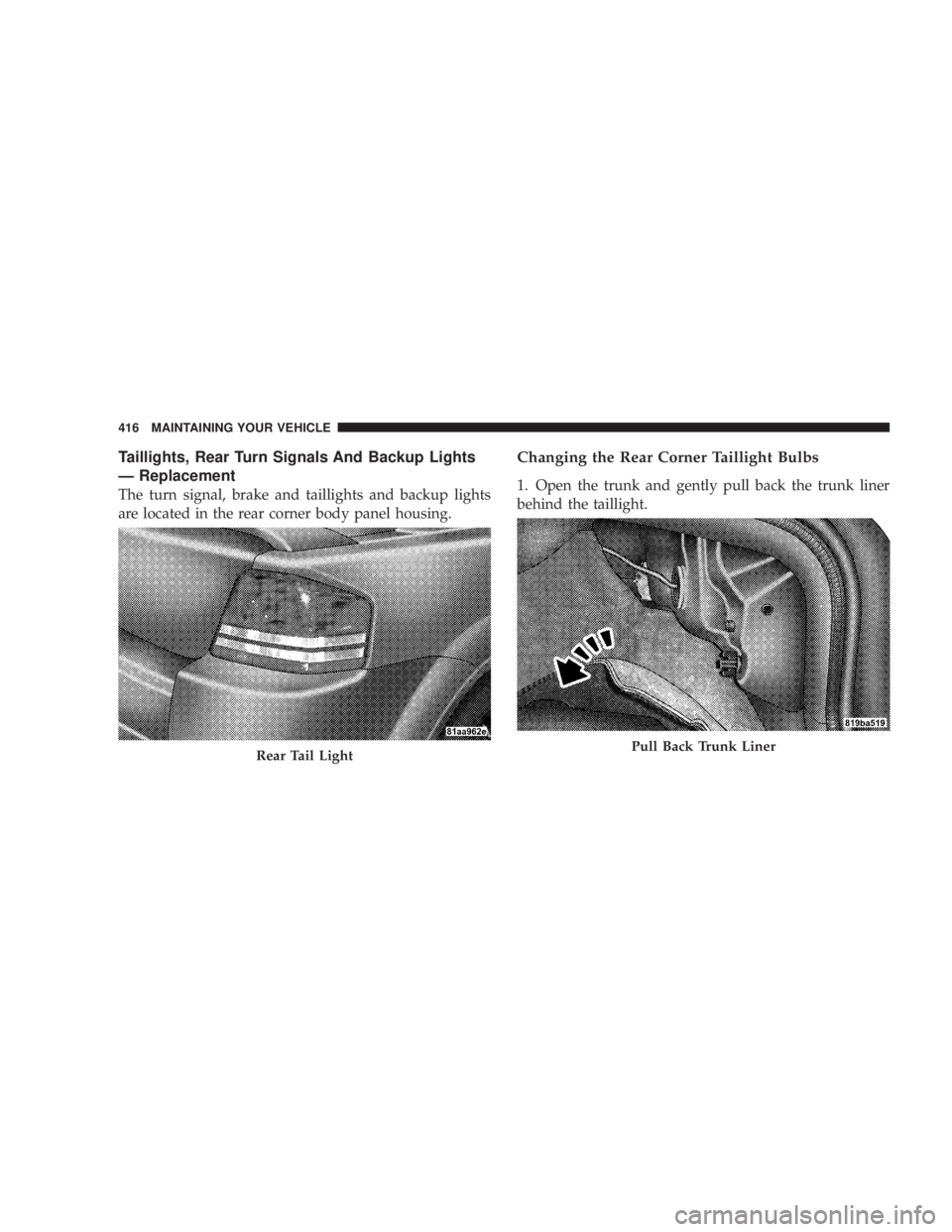
Taillights, Rear Turn Signals And Backup Lights
Ð Replacement
The turn signal, brake and taillights and backup lights
are located in the rear corner body panel housing. Changing the Rear Corner Taillight Bulbs
1. Open the trunk and gently pull back the trunk liner
behind the taillight.
Rear Tail Light Pull Back Trunk Liner416 MAINTAINING YOUR VEHICLE
Page 430 of 467
NOTE: Six-speed AutoStick t Transaxle, if equipped, is
sealed therefore, checking the fluid level can only be
done by a certified dealership service center.
² Check all lights and other electrical items for correct
operation. At Each Oil Change
² Change the engine oil filter.
² Inspect the brake hoses and lines.
CAUTION!Failure to perform the required maintenance items
may result in damage to the vehicle.428 MAINTENANCE SCHEDULES
8 M
A
I
N
T
E
N
A
N
C
E
S
C
H
E
D
U
L
E
S