spare tire DODGE AVENGER 2008 User Guide
[x] Cancel search | Manufacturer: DODGE, Model Year: 2008, Model line: AVENGER, Model: DODGE AVENGER 2008Pages: 467, PDF Size: 7.16 MB
Page 316 of 467
repeat, providing the system fault still exists. The Tire
Pressure Monitoring Telltale Light will turn off when the
fault condition no longer exists. A system fault can occur
due to any of the following:
1. Jamming due to electronic devices or driving next to
facilities emitting the same Radio Frequencies as the TPM
sensors.
2. Installing some form of aftermarket window tinting
that affects radio wave signals.
3. Lots of snow or ice around the wheels or wheel
housings.
4. Using tire chains on the vehicle.
5. Using wheels/tires not equipped with TPM sensors.
NOTE:
1. The compact spare tire (if so equipped) does not have
a tire pressure monitoring sensor. Therefore, the TPMS
will not monitor the pressure in the compact spare tire. 2. If you install the compact spare tire in place of a road
tire that has a pressure below the low-pressure warning
limit, upon the next ignition key cycle, a chime will
sound and the TPM Telltale Light will turn ON.
3. After driving the vehicle for up to 10 minutes above 15
mph (25 km/h), the TPM Telltale Light will flash on and
off for 75 seconds and then remain on solid.
4. For each subsequent ignition key cycle, a chime will
sound and the TPM Telltale Light will flash on and off for
75 seconds and then remain on solid.
5. Once you repair or replace the original road tire, and
reinstall it on the vehicle in place of the compact spare,
the TPMS will update automatically and the TPM Telltale
Light will turn OFF, as long no tire pressure is below the
low-pressure warning limit in any of the four active road
tires. The vehicle may need to be driven for up to 10
minutes above 15 mph (25 km/h) in order for the TPMS
to receive this information.314 STARTING AND OPERATING
Page 320 of 467
1. Jamming due to electronic devices or driving next to
facilities emitting the same Radio Frequencies as the TPM
sensors.
2. Installing some form of aftermarket window tinting
that affects radio wave signals.
3. Lots of snow or ice around the wheels or wheel
housings.
4. Using tire chains on the vehicle.
5. Using wheels/tires not equipped with TPM sensors.
NOTE:
1. The compact spare tire (if so equipped) does not have
a tire pressure monitoring sensor. Therefore, the TPMS
will not monitor the pressure in the compact spare tire.
2. If you install the compact spare tire in place of a road
tire that has a pressure below the low-pressure warning
limit, upon the next ignition key cycle, the TPM Telltale Light will remain ON, a chime will sound, and the EVIC
will still display a flashing pressure value in the graphic
display.
3. After driving the vehicle for up to 10 minutes above 15
mph (25 km/h), the TPM Telltale Light will flash on and
off for 75 seconds and then remain on solid. In addition,
the EVIC will display a 9 CHECK TPM SYSTEM 9 message
for three seconds and then display dashes (- -) in place of
the pressure value.
4. For each subsequent ignition key cycle, a chime will
sound, the TPM Telltale Light will flash on and off for 75
seconds and then remain on solid, and the EVIC will
display a 9 CHECK TPM SYSTEM 9 message for three
seconds and then display dashes (- -) in place of the
pressure value.318 STARTING AND OPERATING
Page 321 of 467
5. Once you repair or replace the original road tire, and
reinstall it on the vehicle in place of the compact spare,
the TPMS will update automatically. In addition, the
TPM Telltale Light will turn OFF and the graphic in the
EVIC will display a new pressure value instead of dashes
(- -), as long no tire pressure is below the low-pressure
warning limit in any of the four active road tires. The
vehicle may need to be driven for up to 10 minutes above
15 mph (25 km/h) in order for the TPMS to receive this
information.
GENERAL INFORMATION
This device complies with part 15 of the FCC rules and
RSS 210 of Industry Canada. Operation is subject to the
following conditions:
² This device may not cause harmful interference.
² This device must accept any interference received,
including interference that may cause undesired op-
eration. The tire pressure sensors are covered under one of the
following licenses:
United States ..................... KR5S120123
Canada ........................ 2671-S120123
FUEL REQUIREMENTS
2.4L AND 2.7L ENGINES
2.4L and 2.7L engines are designed to meet
all emission regulations and provide excel-
lent fuel economy and performance when
using high quality unleaded ªregularº
gasolines having an octane rating of 87.
The use of premium gasoline is not recom-
mended. Under normal conditions, the use of premium
gasoline will not provide a benefit over high quality
unleaded ªregularº gasolines, and in some circumstances
may result in poorer performance. STARTING AND OPERATING 319
5
Page 343 of 467
4. Trailer tongue weight rating for the trailer hitch
utilized (This requirement may limit the ability to
always achieve 10% of trailer tongue weight as a
percentage of total trailer weight).
Towing Requirements Ð Tires
² Do not attempt to tow a trailer while using a compact
spare tire.
² Proper tire inflation pressures are essential to the safe
and satisfactory operation of your vehicle. Refer to the
ªTires Ð General Informationº in this section for
information on tire pressures and for proper tire
inflation procedures.
² Also, check the trailer tires for proper tire inflation
pressures before trailer usage.
² Check for signs of tire wear or visible tire damage
before towing a trailer. Refer to ªTires Ð General Informationº in this section for information on tread
wear indicators and for proper inspection procedure.
² When replacing tires, refer to ªTires Ð General Infor-
mationº in this section for information on replacement
tires and for proper tire replacement procedures. Re-
placing tires with a higher load carrying capacity will
not increase the vehicle's GVWR and GAWR limits.
Towing Requirements Ð Trailer Brakes
² Do not interconnect the hydraulic brake system or
vacuum system of your vehicle with that of the trailer.
This could cause inadequate braking and possible
personal injury.
² An electronically actuated trailer brake controller is
required when towing a trailer with electronically
actuated brakes. When towing a trailer equipped with
a hydraulic surge actuated brake system, an electronic
brake controller is not required. STARTING AND OPERATING 341
5
Page 349 of 467
WHAT TO DO IN EMERGENCIESCONTENTS m Hazard Warning Flasher ..................348
m If Your Engine Overheats .................348
N Engine Oil Overheating (2.4L Engine Only) Ð
If Equipped .........................350
m Jacking And Tire Changing ................350
N Jack Location ........................351
N Spare Tire Stowage ....................351
N Preparations For Jacking ................352
N Jacking Instructions ....................352 m Jump-Starting Procedures Due To A Low Battery . . 358
m Freeing A Stuck Vehicle ..................361
m Towing A Disabled Vehicle ................362
N Towing With The Ignition Key ............362
N Towing Without The Ignition Key ..........363
N Towing This Vehicle Behind Another Vehicle . . 363
N Towing This Vehicle Behind Another Vehicle
With A Tow Dolly .....................363
N Towing Without Power Ð Override Transaxle
Interlock System ......................364
6
Page 353 of 467
Jack Location
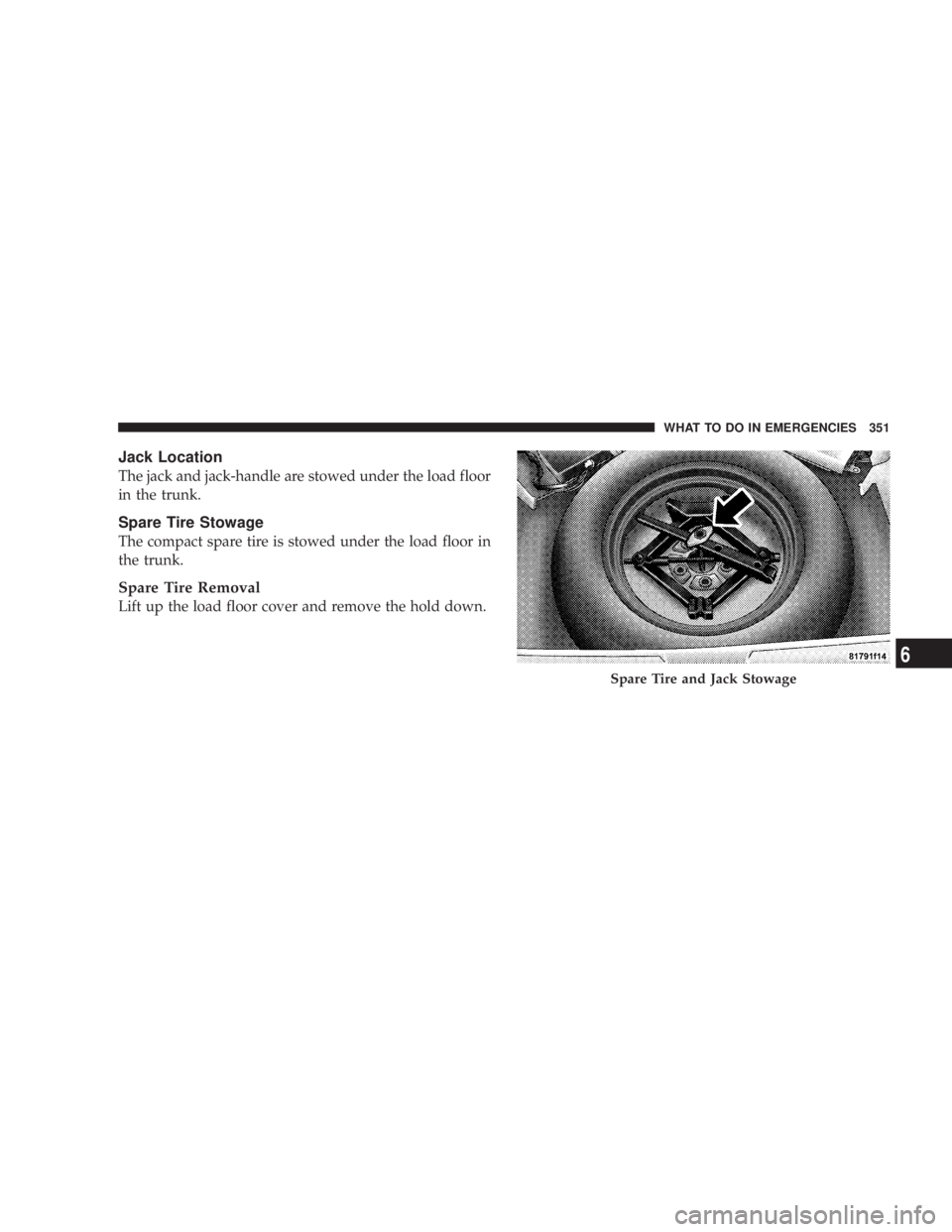
The jack and jack-handle are stowed under the load floor
in the trunk.
Spare Tire Stowage
The compact spare tire is stowed under the load floor in
the trunk.
Spare Tire Removal
Lift up the load floor cover and remove the hold down.
Spare Tire and Jack Stowage WHAT TO DO IN EMERGENCIES 351
6
Page 355 of 467
WARNING!Carefully follow these tire changing warnings to
help prevent personal injury or damage to your
vehicle:
² Always park on a firm, level surface as far from
the edge of the roadway as possible before raising
the vehicle.
² Block the wheel diagonally opposite the wheel to
be raised.
² Set the parking brake firmly and set an automatic
transmission in park; a manual transmission in
reverse.
² Do not let anyone sit in the vehicle when it is on a
jack. 1. Remove the scissors jack and lug wrench from the
spare wheel as an assembly. Turn the jack screw to the left
to loosen the lug wrench, and remove the wrench from
the jack assembly. WHAT TO DO IN EMERGENCIES 353
6
Page 358 of 467
3. There are two front jacking locations and two rear
jacking locations on each side of the body as shown.
CAUTION!Do not attempt to raise the vehicle by jacking on
locations other than those indicated in step 3.
4. Turn the jack screw to the left until the jack can be
placed under the jacking location. Once the jack is
positioned, turn the jack screw to the right until the jack
head is properly engaged with the lift area closest to the
wheel to be changed. Do not raise the vehicle until you
are sure the jack is securely engaged. WARNING!Raising the vehicle higher than necessary can make
the vehicle less stable. It could slip off the jack and
hurt someone near it. Raise the vehicle only enough
to remove the tire.
5. Raise the vehicle by turning the jack screw to the right,
using the swivel wrench. Raise the vehicle only until the
tire just clears the surface and enough clearance is
obtained to install the spare tire. Minimum tire lift
provides maximum stability.
6. Remove the wheel nuts, and pull the wheel and wheel
covers (where applicable) off the hub. Install the spare
wheel and wheel nuts with the cone shaped end of the
nuts toward the wheel. Lightly tighten the nuts. To avoid
the risk of forcing the vehicle off the jack, do not tighten
the nuts fully until the vehicle has been lowered.356 WHAT TO DO IN EMERGENCIES
Page 359 of 467
WARNING!To avoid possible personal injury, handle the wheel
covers with care to avoid contact with any sharp
edges.
7. Lower the vehicle by turning the jack screw to the left.
8. Finish tightening the nuts. Push down on the wrench
while tightening the wheel nuts. Alternate nuts, until
each nut has been tightened twice. Correct wheel nut
torque is 100 ft. lbs (135 N´m). If you doubt that you have
tightened the nuts correctly, have them checked with a
torque wrench by your dealer or at a service station.
9. Remove the wheel blocks and lower the jack until it is
free. Reassemble the lug wrench to the jack assembly and
stow it in the spare tire area. Secure the assembly using
the means provided. WARNING!A loose tire or jack thrown forward in a collision or
hard stop could endanger the occupants of the ve-
hicle. Always stow the jack parts and the spare tire in
the places provided.
10. Place the deflated (flat) tire in the cargo area and have
the tire repaired or replaced as soon as possible.
WARNING!A loose tire thrown forward in a collision or hard
stop could injure the occupants in the vehicle. Have
the deflated (flat) tire repaired or replaced
immediately. WHAT TO DO IN EMERGENCIES 357
6
Page 449 of 467
Compact Spare Tire ...................... 303
Compass .............................. 186
Compass Calibration ..................... 186
Compass Variance ....................... 187
Computer, Trip/Travel .................. 20,184
Connector
UCI ................................ 227
Universal Consumer Interface (UCI) ......... 227
Console ............................ 127,156
Console, Floor ....................... 127,156
Contract, Service ........................ 437
Converter, Catalytic ...................... 379
Coolant Pressure Cap (Radiator Cap) .......... 391
Cooler, Beverage ........................ 161
Cooling System ......................... 388
Adding Coolant (Antifreeze) .............. 390
Coolant Capacity ...................... 420
Coolant Level ...................... 389,392
Disposal of Used Coolant ................ 392 Drain, Flush, and Refill .................. 389
Inspection ........................... 392
Points to Remember .................... 392
Pressure Cap ......................... 391
Radiator Cap ......................... 391
Selection of Coolant (Antifreeze) ...... 389,420,422
Corrosion Protection ..................... 400
Crankcase Ventilation Module ............... 20
Cruise Light ........................... 174
Cup Holder ...................... 127,158,405
Customer Assistance ..................... 435
Customer Programmable Features ............ 188
Data Recorder, Event ...................... 65
Dealer Service .......................... 374
Defroster, Rear Window ................... 256
Defroster, Windshield ............. 80,244,250,251
Delay (Intermittent) Wipers ................. 136
Diagnostic System, Onboard ................ 371 INDEX 447
10