trailer DODGE AVENGER 2008 User Guide
[x] Cancel search | Manufacturer: DODGE, Model Year: 2008, Model line: AVENGER, Model: DODGE AVENGER 2008Pages: 467, PDF Size: 7.16 MB
Page 339 of 467
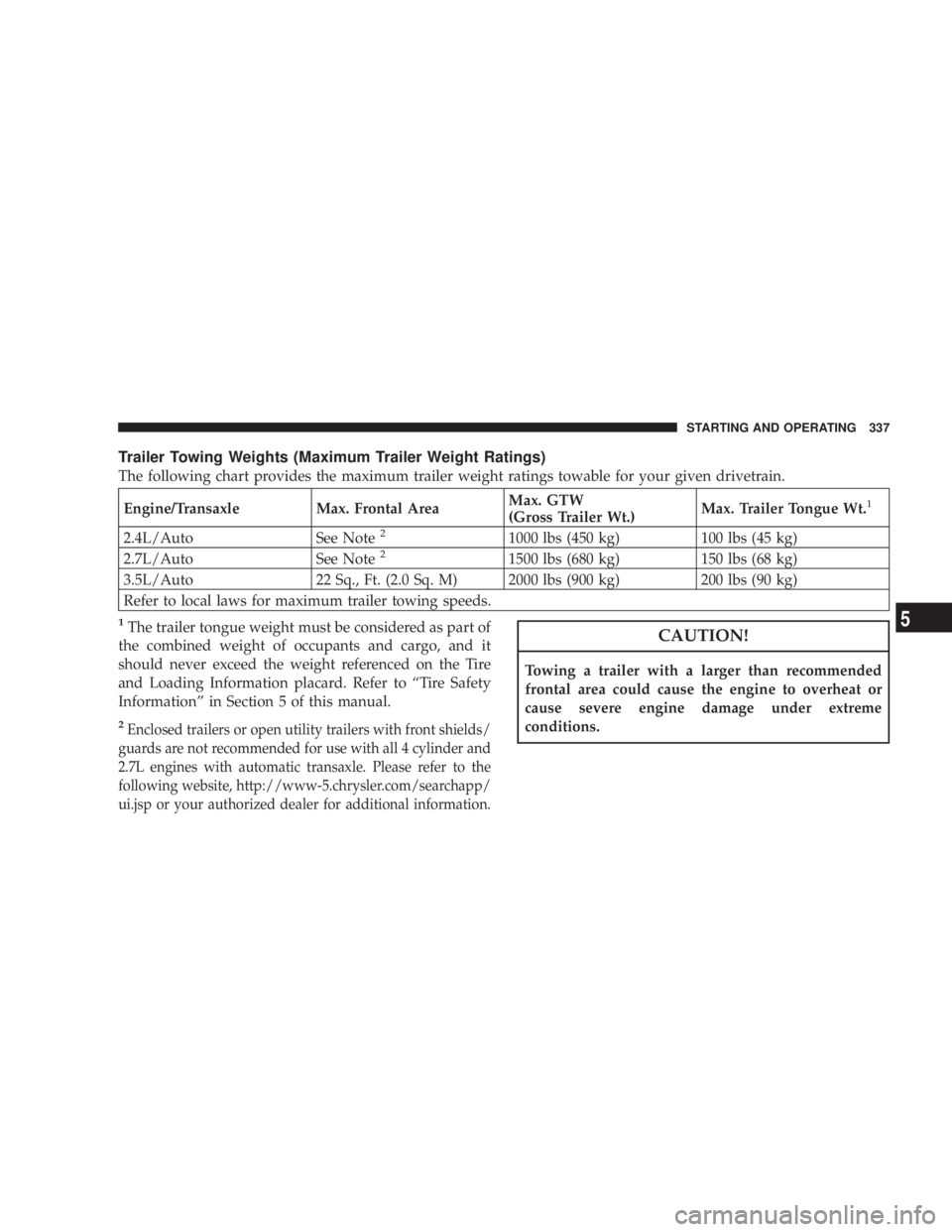
Trailer Towing Weights (Maximum Trailer Weight Ratings)
The following chart provides the maximum trailer weight ratings towable for your given drivetrain.
Engine/Transaxle Max. Frontal Area Max. GTW
(Gross Trailer Wt.) Max. Trailer Tongue Wt. 1
2.4L/Auto See Note 2
1000 lbs (450 kg) 100 lbs (45 kg)
2.7L/Auto See Note 2
1500 lbs (680 kg) 150 lbs (68 kg)
3.5L/Auto 22 Sq., Ft. (2.0 Sq. M) 2000 lbs (900 kg) 200 lbs (90 kg)
Refer to local laws for maximum trailer towing speeds. 1
The trailer tongue weight must be considered as part of
the combined weight of occupants and cargo, and it
should never exceed the weight referenced on the Tire
and Loading Information placard. Refer to ªTire Safety
Informationº in Section 5 of this manual. 2
Enclosed trailers or open utility trailers with front shields/
guards are not recommended for use with all 4 cylinder and
2.7L engines with automatic transaxle. Please refer to the
following website, http://www-5.chrysler.com/searchapp/
ui.jsp or your authorized dealer for additional information. CAUTION!Towing a trailer with a larger than recommended
frontal area could cause the engine to overheat or
cause severe engine damage under extreme
conditions. STARTING AND OPERATING 337
5
Page 340 of 467
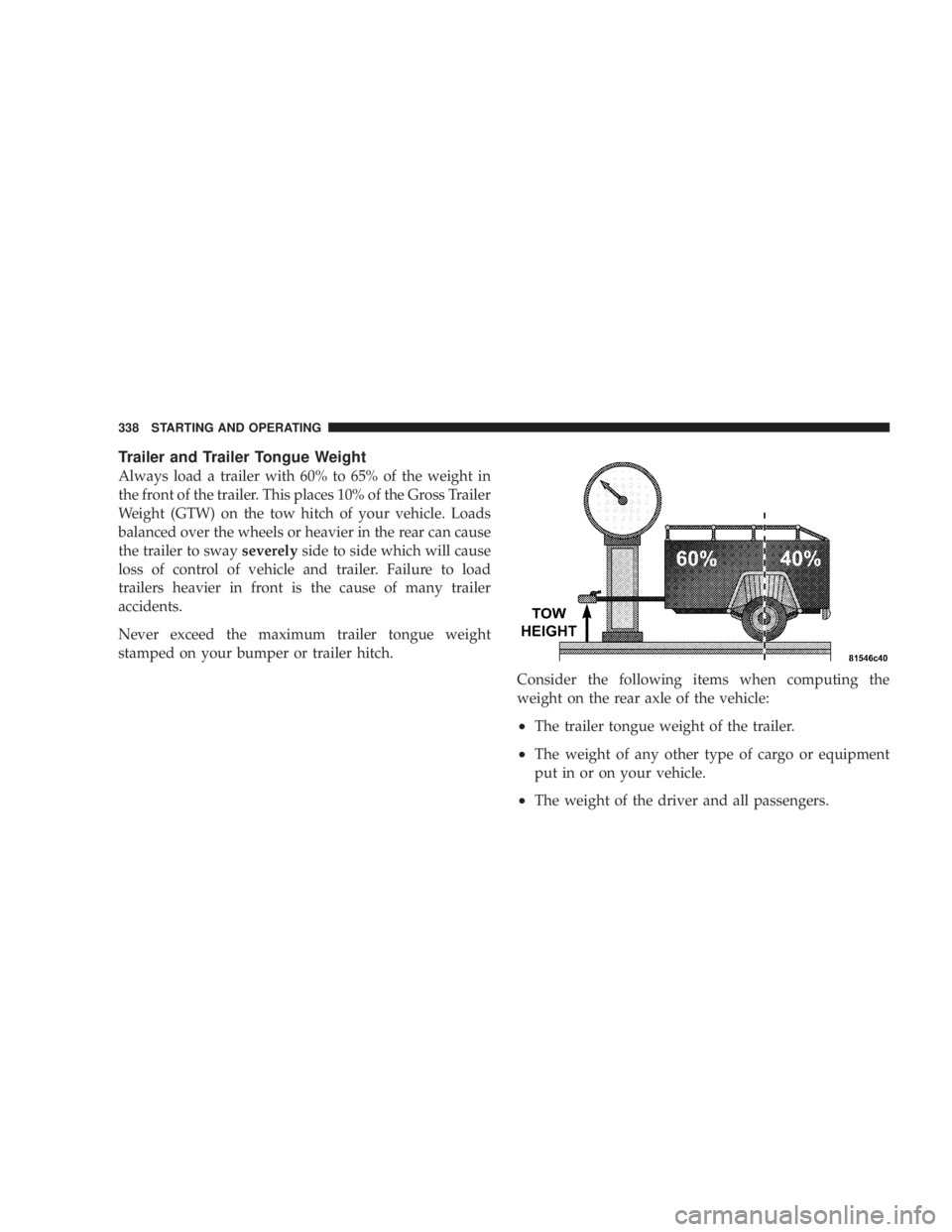
Trailer and Trailer Tongue Weight
Always load a trailer with 60% to 65% of the weight in
the front of the trailer. This places 10% of the Gross Trailer
Weight (GTW) on the tow hitch of your vehicle. Loads
balanced over the wheels or heavier in the rear can cause
the trailer to sway severely side to side which will cause
loss of control of vehicle and trailer. Failure to load
trailers heavier in front is the cause of many trailer
accidents.
Never exceed the maximum trailer tongue weight
stamped on your bumper or trailer hitch.
Consider the following items when computing the
weight on the rear axle of the vehicle:
² The trailer tongue weight of the trailer.
² The weight of any other type of cargo or equipment
put in or on your vehicle.
² The weight of the driver and all passengers.338 STARTING AND OPERATING
Page 341 of 467
NOTE: Remember that everything put into or on the
trailer adds to the load on your vehicle. Also, additional
factory-installed options, or authorized dealer-installed
options, must be considered as part of the total load on
your vehicle. Refer to the Tire and Loading Information
placard in the Tire Safety Information Section of this
manual for the maximum combined weight of occupants
and cargo for your vehicle.
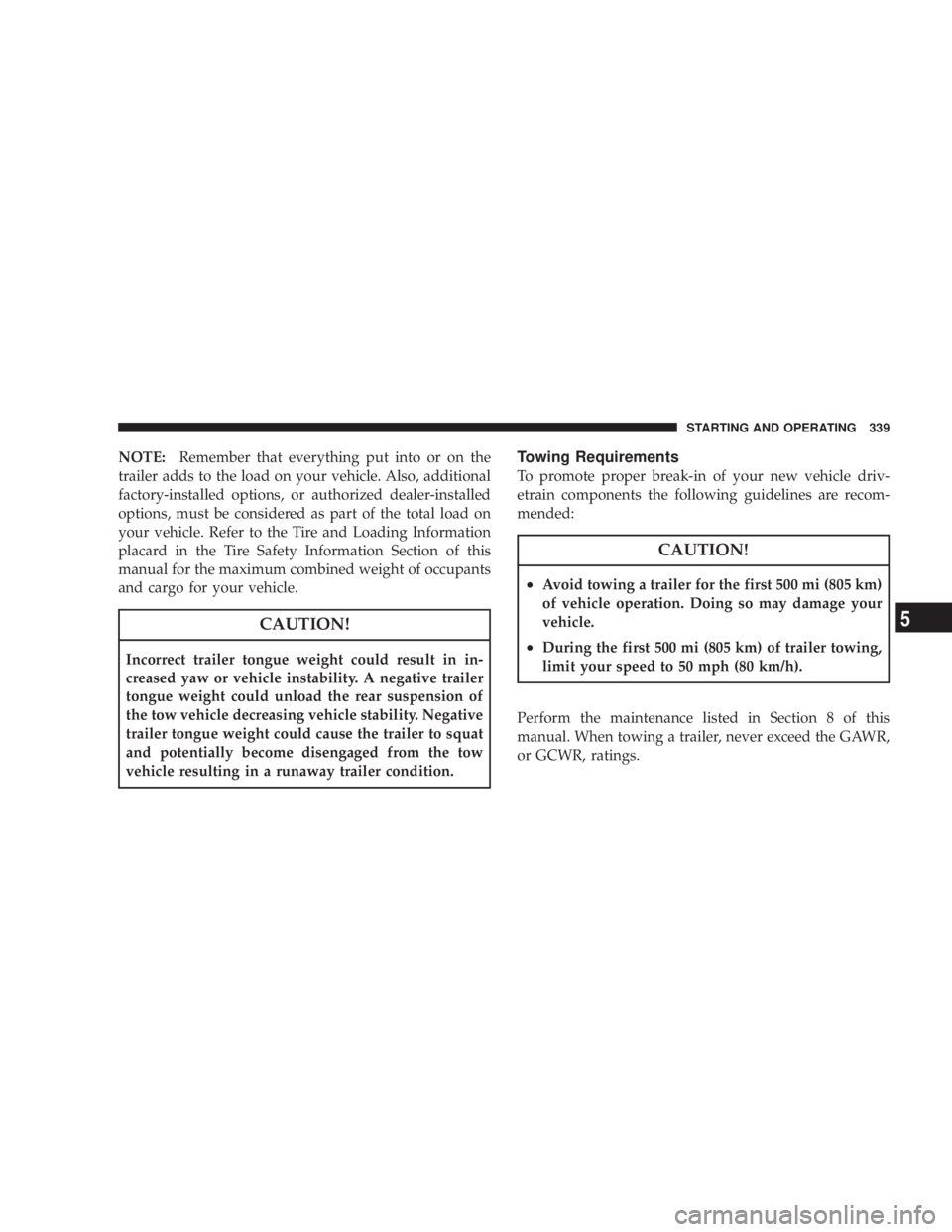
CAUTION!Incorrect trailer tongue weight could result in in-
creased yaw or vehicle instability. A negative trailer
tongue weight could unload the rear suspension of
the tow vehicle decreasing vehicle stability. Negative
trailer tongue weight could cause the trailer to squat
and potentially become disengaged from the tow
vehicle resulting in a runaway trailer condition. Towing Requirements
To promote proper break-in of your new vehicle driv-
etrain components the following guidelines are recom-
mended:
CAUTION!² Avoid towing a trailer for the first 500 mi (805 km)
of vehicle operation. Doing so may damage your
vehicle.
² During the first 500 mi (805 km) of trailer towing,
limit your speed to 50 mph (80 km/h).
Perform the maintenance listed in Section 8 of this
manual. When towing a trailer, never exceed the GAWR,
or GCWR, ratings. STARTING AND OPERATING 339
5
Page 342 of 467
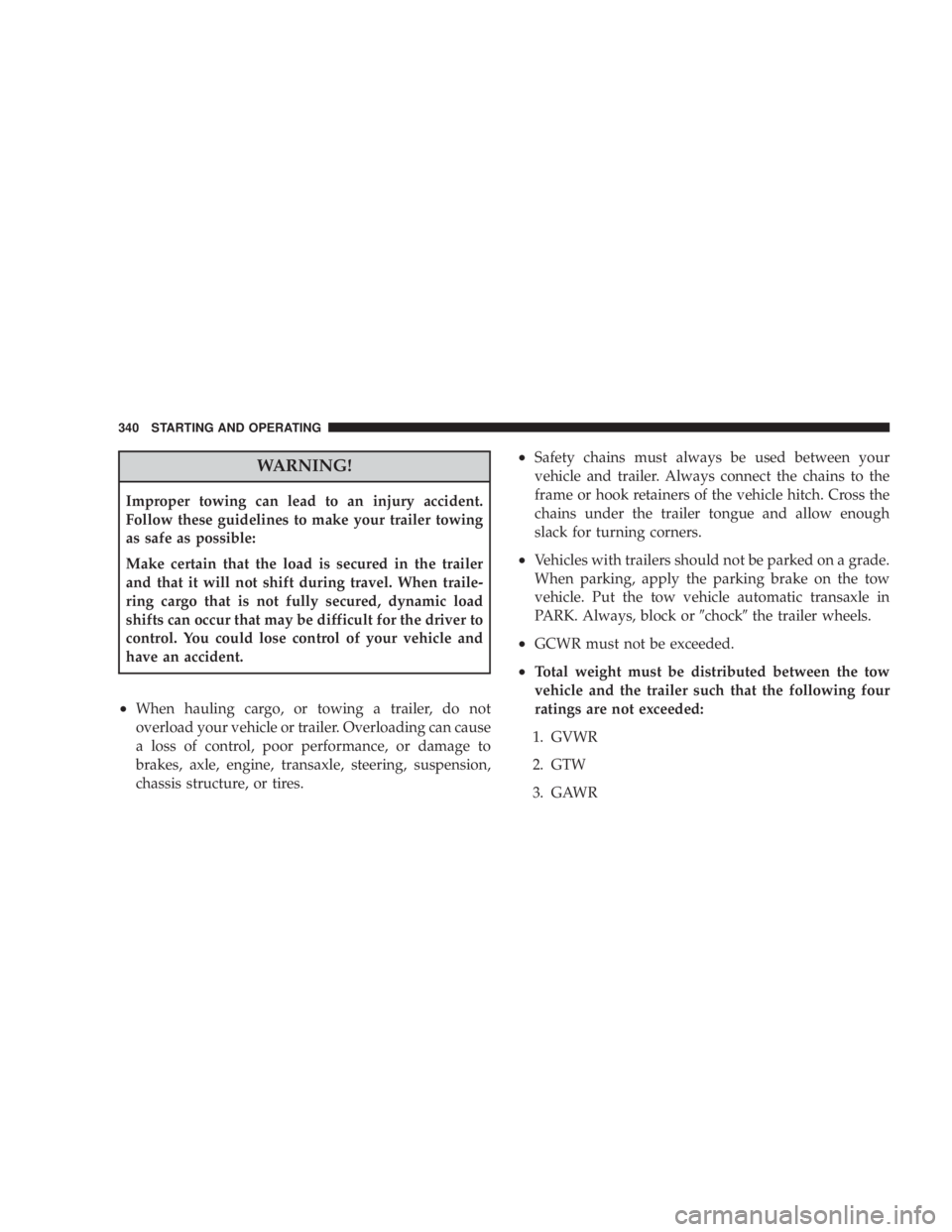
WARNING!Improper towing can lead to an injury accident.
Follow these guidelines to make your trailer towing
as safe as possible:
Make certain that the load is secured in the trailer
and that it will not shift during travel. When traile-
ring cargo that is not fully secured, dynamic load
shifts can occur that may be difficult for the driver to
control. You could lose control of your vehicle and
have an accident.
² When hauling cargo, or towing a trailer, do not
overload your vehicle or trailer. Overloading can cause
a loss of control, poor performance, or damage to
brakes, axle, engine, transaxle, steering, suspension,
chassis structure, or tires. ² Safety chains must always be used between your
vehicle and trailer. Always connect the chains to the
frame or hook retainers of the vehicle hitch. Cross the
chains under the trailer tongue and allow enough
slack for turning corners.
² Vehicles with trailers should not be parked on a grade.
When parking, apply the parking brake on the tow
vehicle. Put the tow vehicle automatic transaxle in
PARK. Always, block or 9 chock 9 the trailer wheels.
² GCWR must not be exceeded.
² Total weight must be distributed between the tow
vehicle and the trailer such that the following four
ratings are not exceeded:
1. GVWR
2. GTW
3. GAWR340 STARTING AND OPERATING
Page 343 of 467
4. Trailer tongue weight rating for the trailer hitch
utilized (This requirement may limit the ability to
always achieve 10% of trailer tongue weight as a
percentage of total trailer weight).
Towing Requirements Ð Tires
² Do not attempt to tow a trailer while using a compact
spare tire.
² Proper tire inflation pressures are essential to the safe
and satisfactory operation of your vehicle. Refer to the
ªTires Ð General Informationº in this section for
information on tire pressures and for proper tire
inflation procedures.
² Also, check the trailer tires for proper tire inflation
pressures before trailer usage.
² Check for signs of tire wear or visible tire damage
before towing a trailer. Refer to ªTires Ð General Informationº in this section for information on tread
wear indicators and for proper inspection procedure.
² When replacing tires, refer to ªTires Ð General Infor-
mationº in this section for information on replacement
tires and for proper tire replacement procedures. Re-
placing tires with a higher load carrying capacity will
not increase the vehicle's GVWR and GAWR limits.
Towing Requirements Ð Trailer Brakes
² Do not interconnect the hydraulic brake system or
vacuum system of your vehicle with that of the trailer.
This could cause inadequate braking and possible
personal injury.
² An electronically actuated trailer brake controller is
required when towing a trailer with electronically
actuated brakes. When towing a trailer equipped with
a hydraulic surge actuated brake system, an electronic
brake controller is not required. STARTING AND OPERATING 341
5
Page 344 of 467
² Trailer brakes are recommended for trailers over 1,000
lbs (450 kg) and required for trailers in excess of 2,000
lbs (907 kg).
CAUTION!If the trailer weighs more than 1,000 lbs (450 kg)
loaded, it should have its own brakes with adequate
braking capacity. Failure to do this could lead to
accelerated brake lining wear, higher brake pedal
effort, and longer stopping distances. WARNING!Do not connect trailer brakes to your vehicle's hy-
draulic brake lines. It can overload your brake sys-
tem and cause it to fail. You might not have brakes
when you need them and could have an accident.
Towing any trailer will increase your stopping dis-
tance. When towing, you should allow for additional
space between your vehicle and the vehicle in front
of you. Failure to do so could result in an accident.
Towing Requirements Ð Trailer Lights and Wiring
Whenever you pull a trailer, regardless of the trailer size,
stoplights and turn signals on the trailer are required for
motoring safety.
Use a factory approved trailer harness and connector.342 STARTING AND OPERATING
Page 345 of 467
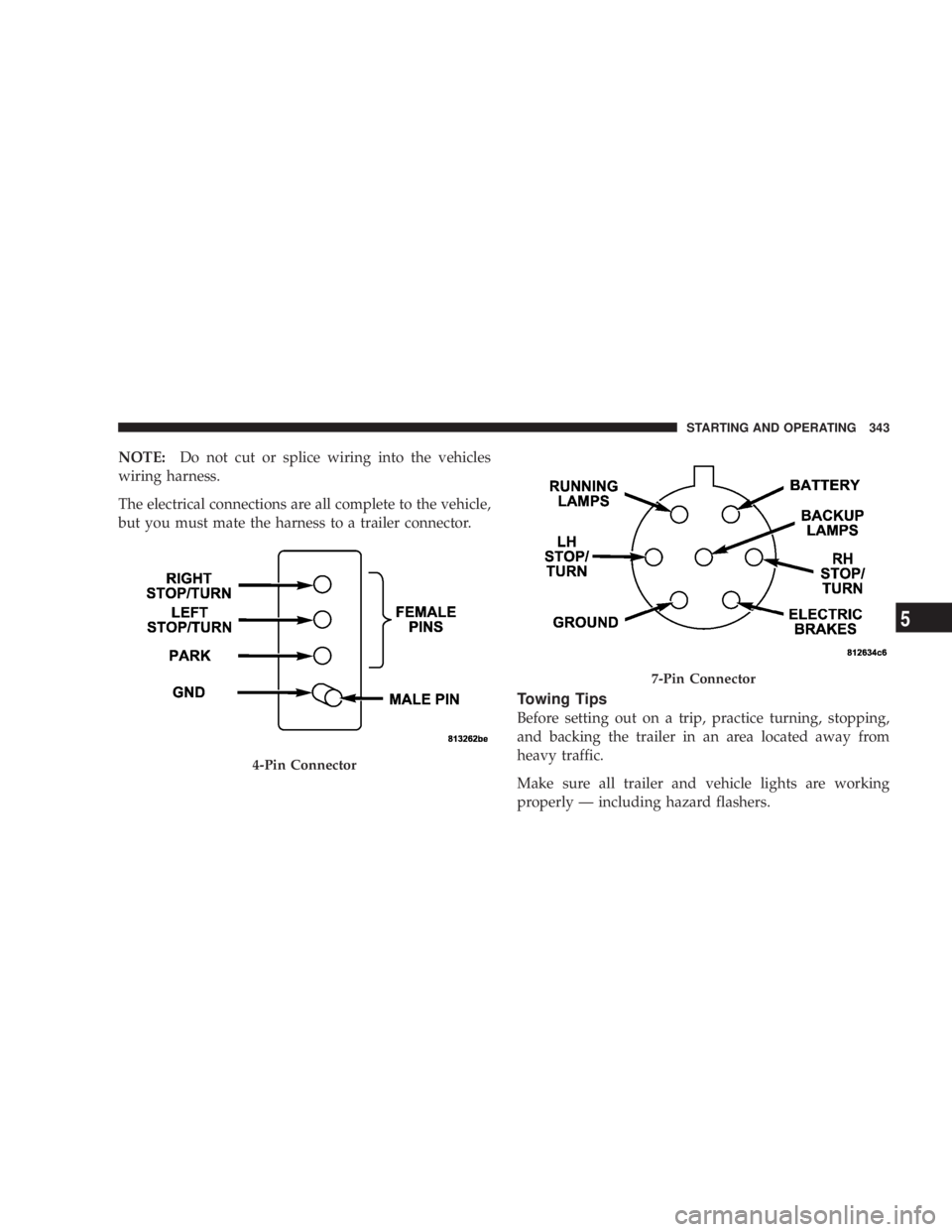
NOTE: Do not cut or splice wiring into the vehicles
wiring harness.
The electrical connections are all complete to the vehicle,
but you must mate the harness to a trailer connector.
Towing Tips
Before setting out on a trip, practice turning, stopping,
and backing the trailer in an area located away from
heavy traffic.
Make sure all trailer and vehicle lights are working
properly Ð including hazard flashers.4-Pin Connector 7-Pin Connector STARTING AND OPERATING 343
5
Page 346 of 467
Automatic Transaxle
The DRIVE range can be selected when towing. How-
ever, if frequent shifting occurs while in this range, third
gear for a four-speed automatic and the fifth gear for a
six-speed AutoStick t should be selected.
NOTE: Using third or fifth instead of DRIVE while
operating the vehicle under heavy operating conditions,
will improve performance and extend transaxle life by
reducing excessive shifting and heat build-up. This ac-
tion will also provide better engine braking.
If you REGULARLY TOW a trailer for more than 45
minutes of continuous operation, then change the auto-
matic transaxle fluid and filter according to the interval
specified for ªpolice, taxi, fleet, or frequent trailer tow-
ingº in the ªMaintenance Scheduleº in this manual.
NOTE: Check the four-speed automatic transaxle fluid
level before towing. AutoStick t sixÐspeed transmission is sealed and the fluid level cannot be checked. See your
authorized dealership service center for assistance.
Electronic Speed Control Ð (If Equipped)
² Don't use in hilly terrain or with heavy loads.
² When using the speed control, if you experience speed
drops greater than 10 mph (16 km/h), disengage until
you can get back to cruising speed.
² Use speed control in flat terrain and with light loads to
maximize fuel efficiency.
Cooling System
To reduce potential for engine and transaxle overheating,
take the following actions:
² City Driving
When stopped for short periods of time, put transaxle in
neutral and increase engine idle speed.344 STARTING AND OPERATING
Page 352 of 467
WARNING!A hot engine cooling system is dangerous. You or
others could be badly burned by steam or boiling
coolant. You may want to call a service center if your
vehicle overheats. If you decide to look under the
hood yourself, refer to Section 7, Maintenance, of this
manual. Follow the warnings under the Cooling
System Pressure Cap paragraph.
ENGINE OIL OVERHEATING (2.4L ENGINE ONLY)
Ð IF EQUIPPED
During sustained high-speed driving or trailer tow up
long grades on a hot day, the engine oil temperature may
become too hot. If this happens, the ªHOTOILº message
flashes in the odometer and the vehicle speed will be
reduced to 53 mph (85 km/h) until the engine oil
temperature is reduced. NOTE: The vehicle speed is reduced to a maximum of
53 mph (85 km/h). You may of course, reduce your
vehicle speed further if needed.
JACKING AND TIRE CHANGING
WARNING!² Getting under a jacked-up vehicle is dangerous.
The vehicle could slip off the jack and fall on you.
You could be crushed. Never get any part of your
body under a vehicle that is on a jack. If you need
to get under a raised vehicle, take it to a service
center where it can be raised on a lift.
² The jack is designed to use as a tool for changing
tires only. The jack should not be used to lift the
vehicle for service purposes. The vehicle should
be jacked on a firm level surface only. Avoid ice or
slippery areas.350 WHAT TO DO IN EMERGENCIES
Page 409 of 467
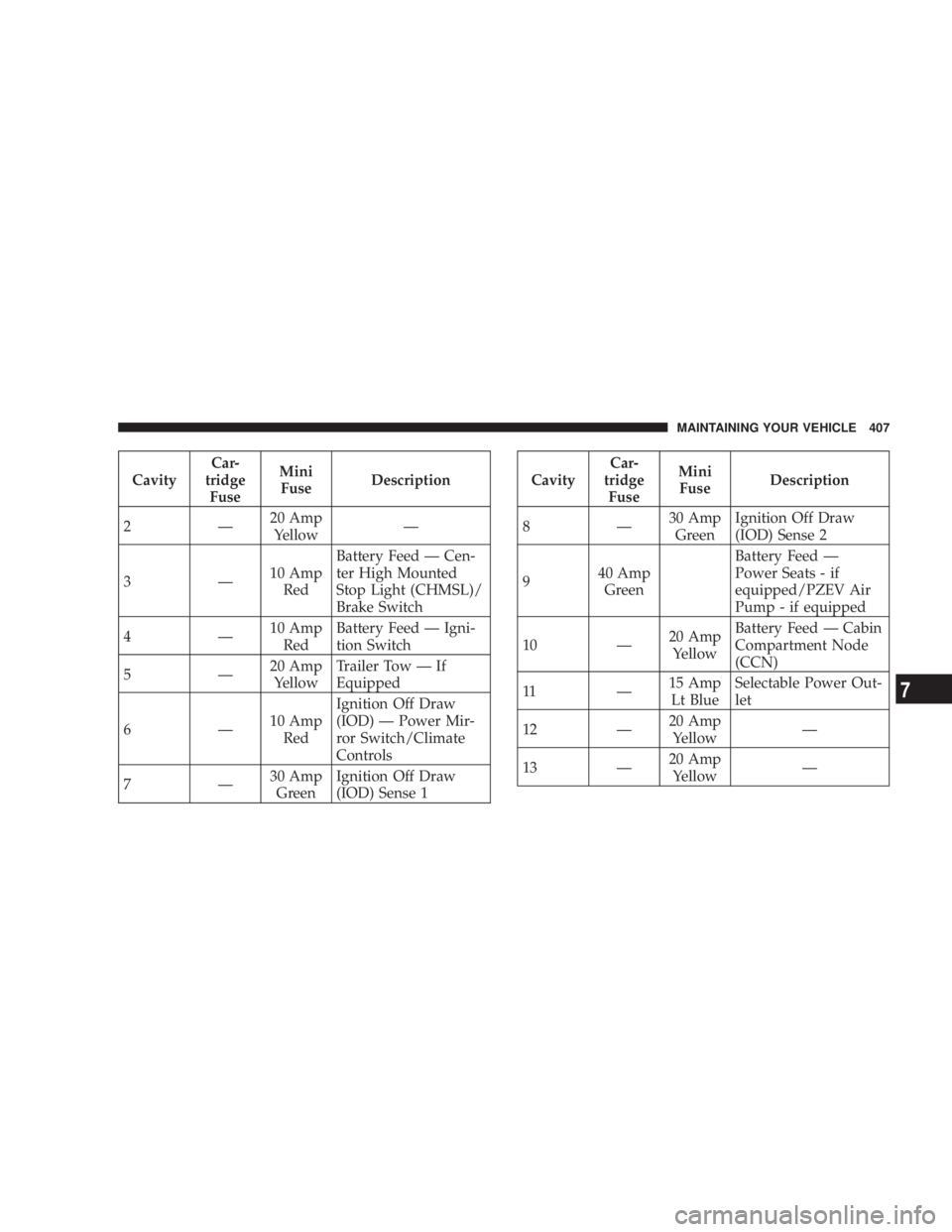
Cavity Car-
tridge
Fuse Mini
Fuse Description
2Ð 20 Amp
Yellow Ð
3Ð 10 Amp
Red Battery Feed Ð Cen-
ter High Mounted
Stop Light (CHMSL)/
Brake Switch
4Ð 10 Amp
Red Battery Feed Ð Igni-
tion Switch
5Ð 20 Amp
Yellow Trailer Tow Ð If
Equipped
6Ð 10 Amp
Red Ignition Off Draw
(IOD) Ð Power Mir-
ror Switch/Climate
Controls
7Ð 30 Amp
Green Ignition Off Draw
(IOD) Sense 1 Cavity Car-
tridge
Fuse Mini
Fuse Description
8Ð 30 Amp
Green Ignition Off Draw
(IOD) Sense 2
9 40 Amp
Green Battery Feed Ð
Power Seats - if
equipped/PZEV Air
Pump - if equipped
10 Ð 20 Amp
Yellow Battery Feed Ð Cabin
Compartment Node
(CCN)
11 Ð 15 Amp
Lt Blue Selectable Power Out-
let
12 Ð 20 Amp
Yellow Ð
13 Ð 20 Amp
Yellow Ð MAINTAINING YOUR VEHICLE 407
7